



Abstract
This paper investigates a principal-agent problem between the operator of an information service online platform and the content provider in which the content provider’s effort to develop new content is unobservable to the operator and the market demand is unknown to both parties and characterized by an uncertain variable. The purpose of the operator is to maximize the total profit earned on the information service’s online platform by designing a contract, whereas the content provider determines the price and the effort level. Next, we apply the critical value criteria to establish two different principal-agent models from the perspective of symmetric and asymmetric effort information. Subsequently, the optimal contracts, the optimal price and the information value of the effort information are derived, respectively. Finally, the impacts of the model parameters on the operator’s profit and the effort’s information value are presented.
Introduction
In recent years, the Internet has played an important role in transactions involving products and services. The online market changes the nature of the relationships among supply-chain members. In an online market, a service platform is usually an intermediary that maximizes its profit by bringing together content providers and consumers [4]. In general, on the one hand, the platform obtains revenues from content providers’ transactions involving products and services, and on the other hand, revenues come from advertising, such as advertisements placed on users’ websites [19, 26]. For instance, the Dedao App from Logic Show. The operator invites some experts to offer audio lessons about a certain area, then these audio lessons can be sold to paying users through Dedao App platform. However, the content provider’s effort to develop new content is generally unobservable to the operator of an online service platform. Therefore, to maximize profit, it is important for the operator to design an incentive mechanism for motivating the provider to develop new content.
There are four distinct streams of research related to this work: the online platforms problem, information asymmetry in the principal-agent problem, principal-agent problem in uncertain environment and risk attitude.
The online platforms problem
With the rapid development of the Internet, studies of online platforms have attracted interest from many scholars and practitioners. For example, Ghose et al. [4] considered the impact of Internet referral services on a supply chain consisting of a manufacturer, an infomediary, and two competing retailers focusing on the pricing method of the infomediary. Kannan et al. [28] examined the optimal pricing policies of the National Academies Press for various forms of products on the publisher’s website. Dimoka et al. [2] focused on seller uncertainty and product uncertainty in online markets. Albuquerque et al. [26] showed that the MagCloud platform created by Hewlett-Packard allowed users (who were content creators) to buy and sell online content using print-on-demand services. Wu et al. [18] developed online manufacturer referrals to heterogeneous retailers through the manufacturer’s website. Jia [19] studied the fee policies for online sales platforms. Dukes and Liu [3] considered an intermediary’s strategic incentives to design its search environment for evaluations of breadth and depth. Rao [5] analyzed the interaction of purchase and rental markets in the context of content pricing strategies for forms of digitization both with and without commitment. de Matta et al. [30] studied how price competition and cost sharing in two online channel settings influence the seller’s revenue share and price respectively, in which one was a common retailer setting, while the other was an exclusive retailer setting. Different from previous studies, this paper considers a principal-agent system in which an operator (he) as a principal opens a new online service platform to promote the platform, he excites a content provider (she) as an agent to develop new contents for his platform. Furthermore, we incorporate the operator’s risk attitude and the effort level of the content provider into the principal-agent problem.
Information asymmetry in the principal-agent problem
Various types of information asymmetry have been widely considered in the context of the principal-agent problem. For example, Corbett et al. [12] studied how suppliers could use quantity discounts contract to influence buyers’ ordering behavior. Iyer et al. [6] focused on a principal-agent model for product specification and production at an automobile manufacturer, where both the supplier’s resource allocation and capability were information kept private from the buyer. Chen [14] explored a firm’s provision of incentives to its sales force to learn more about market information. Mukhopadhyay et al. [32] developed a distribution channel in which a manufacturer authorized a sales agent to sell his product; the cost of the effort was the agent’s private information. Ciliberti et al. [15] examined how a code of conduct could help formulate a problem in which chain directors were principals and partners were agents. Çakanyildirim et al. [24] considered a supply chain consisting of a supplier and a retailer in which the supplier’s unit production cost was asymmetric. Li et al. [48] extended the investigation of supplier encroachment to an environment in which the reseller might be better informed than the supplier. Chen et al. [13] described two types of information asymmetry, including information-acquisition and sales effort. Wang and Shin [20] studied the impact of supply chain contracts with endogenous upstream innovation under three different contract scenarios. Syam et al. [25] had three major findings. Chen et al. [27] investigated the advantages and disadvantages of manufacturer encroachment in a dual-channel supply chain, where the manufacturer’s production cost was private. These papers characterized the assessments of asymmetric information as random variables based on probability theory. Sometimes they lack data, and random variables cannot depict the subjective assessment. Different from these papers, in our paper, assessments of asymmetric information are characterized as uncertain variables based on Liu [10]’s uncertainty theory, which can both depict subjective assessment and model human uncertainty.
Principal-agent problem in uncertain environment
Indeed, many scholars have applied uncertainty theory to study the principal-agent theory in various fields. For example, Lan et al. [42] presented a bilevel principal-agent model for optimal nonlinear taxation problems with asymmetric information in which the government and monopolist’s assessment of the consumer’s taste was characterized as an uncertain variable. Wang et al. [16] investigated an uncertain price discrimination problem in the labor market in which the employee’s capability was private information characterized as an uncertain variable. Lan et al. [43] studied a contract model with pricing and a warranty in which the supplier’s product quality constituted asymmetric information. Wu et al. [39] considered a principal-agent problem with multi-dimensional incomplete information in which the agent had private information about his efforts. Wu et al. [38] applied a credibility measure to characterize incomplete information for managing certain principal-agent problems. In new product development, Yang et al. [23] designed incentive mechanisms with a risk-averse project manager. Yang et al. [22] discussed the impact of risk attitudes under dual information asymmetry. Yang et al. [21] conducted the impacts of uncertain project duration and asymmetric risk sensitivity information in project management. These studies all adopted uncertain variables to depict subjective assessments such as consumer taste and employees’ capabilities, efforts and ideas. Different from these studies, our study contributes to this stream of literature by introducing both parties’ risk attitudes and the agent’s moral hazard in order to study the optimal incentive contracts under symmetric and asymmetric effort information.
Risk attitude
The fourth stream of literature relevant to our research involves risk attitude. For example, Xu et al. [17] investigated the impact of establishing a dual-channel supply chain coordinating contract when the supply chain agents were risk aversion under a mean-variance model. Li et al. [7] investigated a dual-channel supply chain with one risk-neutral manufacturer and one risk-averse retailer where there was only one perishable product with price-dependent stochastic demand. Li et al. [8] considered a manufacturer’s encroachment problem, where the supplier was risk-neutral, the retailer was risk-averse, and the market demand was uncertain. Li et al. [29] introduced the retailer’s risk-averse behavior into dual channel supply chain under asymmetric information, studying how the risk-averse behavior of the retailer and the per-unit selling cost of the manufacturer influence the optimal decisions. Avinadav et al. [34] evaluated mergers and acquisitions in a supply chain involving risk-averse parties. Jiang et al. [41] investigated the consumer returns policy of dual-channel supply chain, in which the manufacturer was risk-neutral, and the retailer was risk-averse. Zheng et al. [36] considered the pricing strategies of two competing ocean carriers facing uncertain demand. The first carrier was risk-neutral, whereas the second carrier was risk-averse. Wang et al. [37] investigated a wage mechanism design problem, where the worker was risk averse. Yu et al. [40] studied a cooperation royalty contract design problem. Li et al. [47] researched the contract design problem between the virtual product supplier and the digital platform retailer. Chen et al. [46] investigated the compensation contract under different information structures. Our paper contributes to the aforementioned references through researching a principal-agent relationship between a new online platform and a content provider with moral hazard, and studies how the moral hazard behavior affects the parties’ profits.
In this paper, we discuss a principal-agent problem consisting of an operator of the new online platform and a content provider. The operator incentivizes the content provider to develop new service contents and the content provider then exerts an effort on her new contents. However, the content provider’s effort level might be unknown to the operator and the market demand influenced by the content provider’s effort is characterized by uncertain variables. According to whether the operator can contract based on the content provider’s effort, two types of uncertain principal-agent models with optimal contracts for providing information service are presented and analyzed in detail. Finally, we study the impacts of model parameters on the operator’s profits and the information value of the content provider’s effort. By the obtained results, we establish the following main findings. The operator’s optimal mechanism depends on both parties’ risk attitudes. Under symmetric effort information, if one party is more conservative, the operator should set a higher incentive term to ameliorate the risk; if one party is more aggressive, the operator should set a lower incentive term to ameliorate the risk. Under asymmetric effort information, if the content provider is more conservative, the operator should set a lower incentive term to ameliorate the risk. Otherwise, he should do the opposite. If the operator is more conservative, the operator should set a higher incentive term to ameliorate the risk. The information value of the effort relies on the different value between the operator’s risk attitudes and the content provider’s risk attitude. Specially, the greater the difference value between the operator’s risk attitude and the content provider’s risk attitude, the greater the value of effort information.
The rest of this paper is organized as follows. Section 2 recalls some basic concepts of uncertainty theory. Section 3 describes the principal-agent model. Section 4 presents the optimal incentive contracts under information symmetric and asymmetric cases, and the effects of some important parameters are examined in Section 5. Section 6 draws conclusions.
Preliminaries
Moreover, if Φ (x) is continuous, then
Model formulation
In this section, we consider that an operator of a new online service platform (the principal) provides online services from a content provider (the agent), whose effort level is unobservable to the operator. As a leader, the operator (he) offers an incentive contract (ω0, ω1), where ω0 represents the fixed payment from the operator to the agent, ω1 denotes the agency payment from each transaction of the users on the new online service platform through the content service of the agent. Subsequently, as a follower the content provider (she) decides whether to accept (work for the operator to develop new contents). If so, the content provider determines the price w of her product, and exerts how much effort level e is made to develop the new service content. Here the contract is restricted to be linear as in Chao et al. [31] and Xiao and Xu [35]. Thus, the operator pays the content provider ω0 + ω1D based on the transaction volume D (e, w), which depends on both the agent’s effort level e and the service price w on the new online service platform. We assume that the operator cannot directly observe the content provider’s effort level and thus must specify it through the contract. In addition, for the operator, p represents his revenue of each transaction. For the content provider, c is her cost of each transaction and C (e) is her effort cost of developing new service content. According to Tsay and Agrawal [1], Sigue and Chintagunta [33], Xiao and Xu [35] and Chao et al. [31], let C (e) = e2/ 2.
Indeed, Chen et al. [13] highlighted that the linear contract menu was the classical best choice compared to other forms of contracts. Thus, given the agent’s effort level e and the service price w, the total demand from developing the new service through the new online platform is given as follows:
where D (e, w) is the transaction demand function. Parameters α1 and α2 are the sensitivity coefficients of the effort level and the service price, respectively. The parameter a characterizes the degree of market uncertainty and a > 0. To ensure meaningful results, we require
The total profit of the operator, which equals his revenue minus the payment to the content provider, can be written as
The β1-profit of the operator is
Similarly, the content provider’s total profit, which equals her revenue minus the cost of effort level, can be written as
Assume that β2 ∈ (0, 1] is the confidence level of the content provider, which reflects the content provider’s risk attitude (Yang et al. [21]; Wu et al. [38]; Wu et al. [39]). The β2-profit of the content provider is
Here, on one hand, when β1 = 1/ 2, the operator is risk-neutral; when β1 < 1/ 2, he is aggressive; and when β1 > 1/ 2, he is conservative, so does the content provider’s risk attitude β2. On the other hand, to guarantee the content provider’s participation, the individual rationality constraint can be expressed as
Thus, if the operator can contract based on the content provider’s effort Yang et al. [22], the incentive-compatibility constraint is denoted as
Here, the operator decides on ω0, ω1 and e, and the content provider decides on the service price w.
However, if the operator cannot observe the content provider’s effort, the content provider will choose the optimal service price for the product and the effort level. To encourage the content provider to make more effort, the incentive-compatibility constraint is defined as follows:
Under these circumstances, the operator decides on ω0 and ω1, whereas the content provider decides on e and w.
For convenience, we introduce two labels S and A, in which S represents the symmetric effort information scenario in which the operator can contract on the content provider’s effort, and A represents the asymmetric effort information scenario in which the operator cannot contract based on the content provider’s effort.
Design of the optimal incentive contracts
In this section, we investigate a two-stage optimization problem. In the first stage, the operator designs an incentive contract to maximize the operator’s total profit and in the second stage, the content provider determines her price policy. Below, we will discuss the problem from the perspective of symmetric and asymmetric information about the content provider’s efforts.
Optimal incentive contract under symmetric effort information
When the operator can directly contract on the content provider’s effort level e, we establish a principal-agent model as follows:
Using the computational method for critical value, the operator’s β1-profit can be rewritten as
Using the above results, we can rewrite Model (1) as follows:
By solving Model (2), we can obtain the optimal incentive contract under symmetric information.
The content provider’s corresponding effort level is given by
Furthermore, the content provider’s profit is
From Proposition 1, we can derive that the incentive payment
When the operator’s risk attitude β1 is given, the incentive payment
When the content provider’s risk attitude β2 is given, the incentive payment
In addition, if β1 + β2 > 1 (<1), then the incentive payment
Similar to Yang et al. [23], the content provider’s effort level e S is related to the demand risk and the content provider’s risk attitude. From Proposition 1, the content provider’s optimal effort level e S depends on her risk attitude β2 but is unrelated to the operator’s risk attitude β1. That means that the content provider’s effort level e S is only influenced by her own risk behavior and decreases in β2. In addition to demand risk, however, the literature [23] discussed risk behavior. Here, three types of risk behavior by a content provider are analyzed; the different risk behaviors have different impacts on the content provider’s effort level e S . That is, the more conservative (aggressive) the content provider, the lower (higher) the effort level e S . In other words, the more conservative content provider makes less of an effort. Meanwhile, if the content provider is aggressive (0 < β2 < 1/ - 2), the content provider’s effort level e S is increasing in the degree of market uncertainty of demand a, i.e., when confronted by an aggressive content provider, higher market uncertainty leads to a higher effort level; if the content provider is conservative (1/ - 2 < β2 < 1), the content provider’s effort level e S is decreasing in the degree of market uncertainty of demand a, which means that when confronted by a conservative content provider, higher market uncertainty leads to a lower effort level. Furthermore, when the principal can directly contract on the agent’s effort, Yang et al. [22]’s result related to the agent’s effort level depends only on the sensitivity coefficient of the effort level. However, this paper’s result also relies on the sensitivity coefficients (α1, α2), the content provider’s risk attitude (β2), the degree of market uncertainty (a), and the cost (c). This means that the determinants of the agent’s effort level are more complex.
In this section, we consider the scenario in which the operator cannot contract on the content provider’s effort. In that situation, we can formulate the following principal-agent model:
Applying the same method used in Section 4.1, we can rewrite problem (3) as follows:
Solving Model (4), we can obtain the optimal incentive contract under asymmetric effort information.
The content provider’s corresponding effort level is given by
Furthermore, the content provider’s profit is
Similarly, from Proposition 2, we can obtain some results as follows:
When the operator’s risk attitude β1 is given, the incentive payment
When the content provider’s risk attitude β2 is given, the incentive payment
In addition, if β1 - β2 > 0 (<0), then the incentive payment
Unlike Proposition 1, Proposition 2 states that the content provider’s optimal effort level e
A
not only depends on the content provider’s risk attitude β2 but also relies on the operator’s risk attitude β1. Given the operator’s risk attitude β1, the content provider’s effort level e
A
decreases in the content provider’s risk attitude β2, i.e., the more conservative (aggressive) the content provider, the lower (higher) effort level e
A
. In other words, the more aggressive content provider makes a greater effort. Given the content provider’s risk attitude β2, the content provider’s effort level e
A
increases in the operator’s risk attitude β1, i.e., the more conservative (aggressive) the operator, the higher (lower) effort level e
A
. In addition, we find that the content provider is willing to make more of an effort if the operator enhances the incentive payment
We are interested in examining the information value of the effort level of the operator of the online service platform in this section, which is defined as the difference between his profits with and without contracting on the content provider’s effort level. First, the difference between the two effort levels is given in Proposition 3.
Proposition 3 demonstrates that the sign of difference between the two effort levels is only determined by the sign of β2 - β1 . Δe, which is decreasing in the operator’s risk attitude β1 but increasing in the content provider’s risk attitude β2. We know that if β1 < β2, then Δe > 0; if β1 = β2, then Δe = 0; whereas if β1 > β2, then Δe < 0. In other words, when the content provider is more conservative than the operator, she is motivated to make less of an effort under asymmetric information than under symmetric information. Interestingly, when the content provider is more aggressive than the operator, she trends to make more effort under asymmetric information than under symmetric information, which means that a more aggressive attitude induces the content provider to make more effort than the first-best attitude, in other words, the aggressive attitude dominates asymmetric information in the efforts on the content provider’s optimal effort.
From Proposition 4, we know that the information value of the effort VI is nonnegative and increasing in the sensitivity coefficient of effort level α1 and the uncertainty degree a but decreasing in the sensitivity coefficient of service price α2. More specifically, the higher the content provider’s productivity of effort, the higher the information value of the effort and the faster the growth rate. In other words, the increase in the information value of the effort implies that the effort of acquiring information becomes important for the operator. Likewise, the degree of uncertainty has the same impact on the information value of the effort. In addition, the impact of varying the sensitivity coefficient of service price α2 on the information value of the effort shows that the higher the content provider’s productivity of the service price, the lower the information value of the effort, and the slower the rate of reduction. In other words, the decrease in the information value of the service price implies that acquiring information about the service price becomes less important for the operator.
Given the content provider’s risk attitude β2, the information value of the effort VI decreases with the operator’s risk attitude β1 in the interval (0, β2] but increases in the interval (β2, 1]; given the operator’s risk attitude β1, the information value of the effort VI decreases with the content provider’s risk attitude β2 in the interval (0, β1] but increases in the interval (β1, 1]. In other words, the operator of the online service platform can always benefit when he can contract on the content provider’s effort, which is independent of the information structure. When β1 = β2, i.e., both parties have the same risk attitudes, it is unnecessary for the operator to contract on the content provider’s effort. However, when β1 ≠ β2, the operator can benefit from contracting on the content provider’s effort. In particular, the greater |β1 - β2|, the greater the value of effort information.
In addition, under symmetric and asymmetric effort information, the two prices are different, and we can obtain the following proposition.
1) If β1, β2 ∈ (0, 1/ - 2) , then Δw> 0 ;
2) If β1, β2 ∈ (1/ - 2, 1) , then Δw< 0 ;
3) If β1 or β2 belongs to (0, 1/2), and the other one belongs to (1/2, 1) , we can obtain these results as follows.
If
Proposition 5 demonstrates that the sign of difference between the two prices is determined by the sign of Δw . Note that Δw is decreasing in the operator’s risk attitude β1 and the content provider’s risk attitude β2. In addition, Proposition 5 demonstrates that when the risk attitudes of both the operator and the content provider are consistent, it is easy to judge the sign of Δw, i.e., when both the operator and the content provider are aggressive (conservative), the price under symmetric information is higher (lower) than under asymmetric information. When the risk attitudes of the operator and the content provider are different, it is difficult to judge the sign of Δw, i.e., when one party is aggressive and the other party is conservative, the comparative results of the two prices are uncertain.
Effects of parameters
The purpose of this section is to study the impacts of model parameters on the operator’s profit. This study complements our analytical results and provides additional managerial insights and interpretations.
Based on the references [22, 23], we select the data to perform the experiments and demonstrate the effects of varying the sensitivity coefficient of effort α1, the sensitivity coefficient of service price α2 and the degree of market uncertainty of demand a on the operator’s profit under the information symmetry and asymmetry scenarios (see Figs. 1–3). In different figures, the parameters of the operator’s risk attitude β1 and the content provider’s risk attitude β2 are described in four types of situations as follows: β1 = 0.4, β2 = 0.4 ; β1 = 0.4, β2 = 0.8 ; β1 = 0.8, β2 = 0.4 ; β1 = 0.8, β2 = 0.8 . For clarity, we also set the parameters of our models in the following p = 100, c = 60, π0 = 30. Given two of three parameters—the sensitivity coefficient of effort α1, the sensitivity coefficient of service price α2 and the degree of market uncertainty of demand a—we can obtain how these three parameters affect the operator’s profit.

The effect of varying α1 on the operator’s profits.
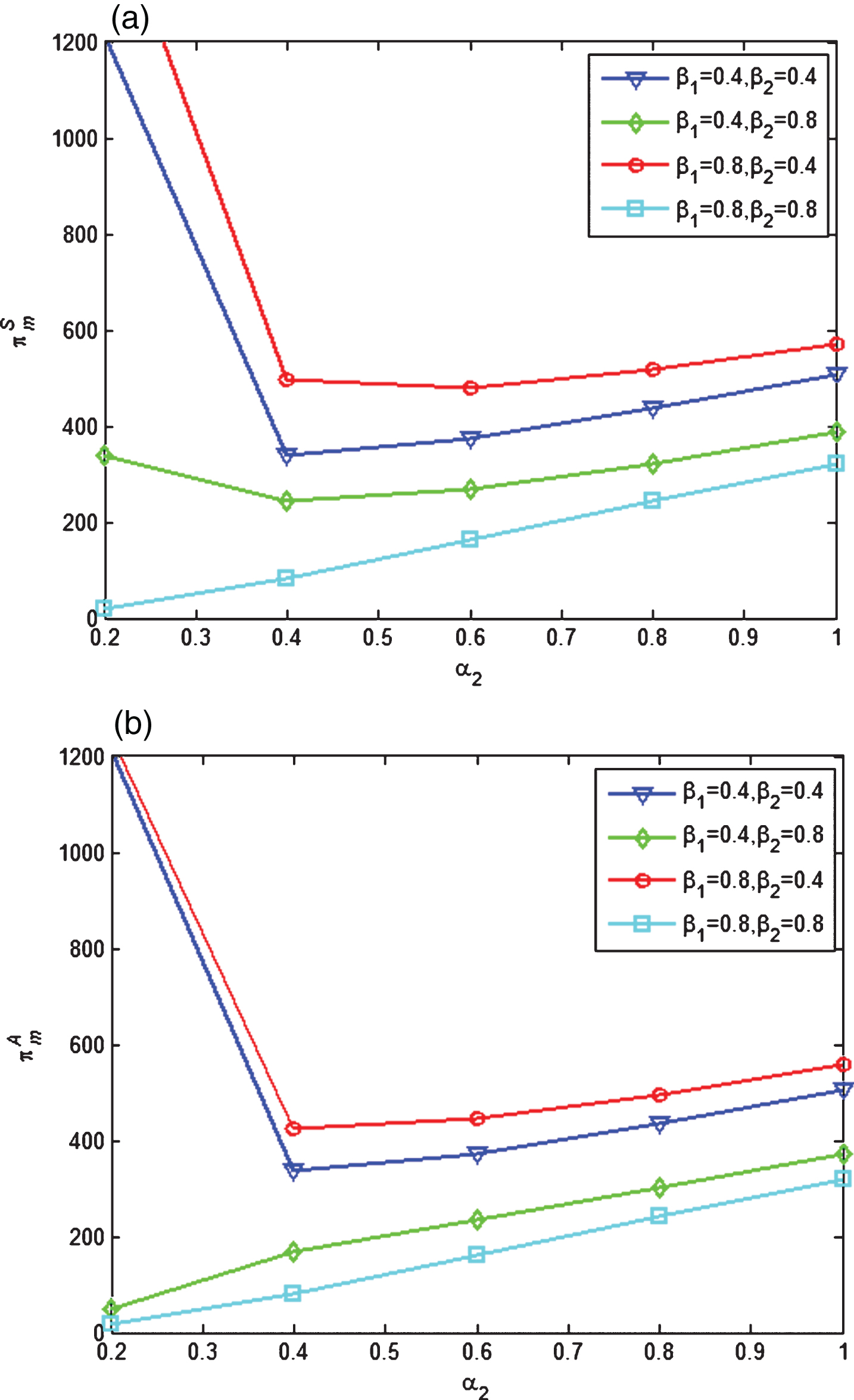
The effect of varying α2 on the operator’s profits.
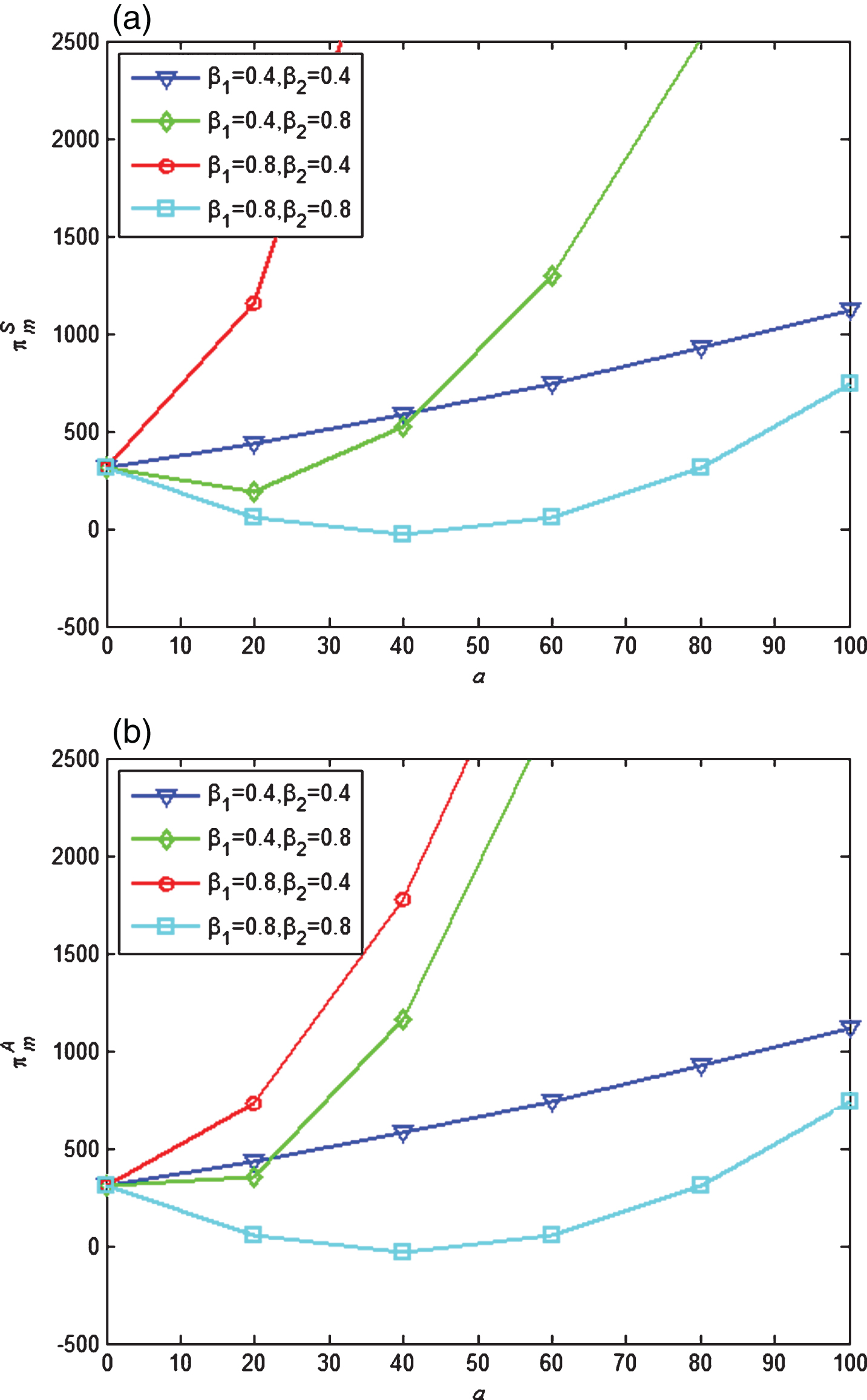
The effect of varying a on the operator’s profits.
First, we consider the effect of the sensitivity coefficient of effort α1 on the operator’s profit. Assume that α2 = 0.6 and a = 10, then we can obtain Fig. 1(a-b), which depict the results under symmetric and asymmetric effort levels, respectively. We can see that as the sensitivity coefficient of the effort level increases, the operator’s profits increase in all scenarios. This is an expected result because increased effort benefits the operator. Meanwhile, we can obtain two parts in the following.
On the one hand, when the operator’s risk attitude β1 is given, the operator’s profits under two cases decrease in the content provider’s risk attitude β2 . Specifically, the lower (higher) the content provider’s risk attitude β2, the higher (lower) the operator’s profit. In other words, the more conservative (aggressive) the content provider, the lower (higher) the operator’s profit. The content provider’s aggressive attitude is beneficial to the operator.
On the other hand, when the content provider’s risk attitude 0 < β2 < 1/2 is given, the higher the operator’s risk attitude β1, the higher the operator’s profit; when the content provider’s risk attitude 1/ - 2 < β2 < 1 is given, the lower the operator’s risk attitude β1, the higher the operator’s profit. In other words, when the content provider is aggressive, the more conservative the operator, the higher the operator’s profit, whereas the more aggressive the operator, the lower the operator’s profit. The operator’s conservative attitude is beneficial to the operator. When the content provider is conservative, the more conservative the operator, the lower the operator’s profit, whereas the more aggressive the operator, the higher the operator’s profit. The operator’s aggressive attitude is beneficial to the operator.
Second, we consider the effect of varying the sensitivity coefficient of service price α2 on the operator’s profit. Assume that α1 = 0.6 and a = 10, we can obtain Fig. 2(a-b). From Fig. 2(a-b), it is found that when the content provider is aggressive, as the sensitivity coefficient of the service price increases, the operator’s profits in two scenarios first decrease and then increase; when both the operator and the content provider are conservative, the operator’s profits in two scenarios are increasing; when β1 = 0.4, β2 = 0.8, the monotonicities of the operator’s profits in the sensitivity coefficient of service price α2 ∈ [0.2, 0.4] are different under symmetric and asymmetric scenarios. In addition, when β1 = β2 = 0 . 4(or β1 = β2 = 0 . 8), i.e., both parties’ risk attitudes are aggressive (or conservative), the operator’s profits are the same under symmetric and asymmetric scenarios. At this point, it is unnecessary for the operator to contract on the content provider’s effort. However, when β1 = 0.4, β2 = 0.8 and β1 = 0.8, β2 = 0.4, the operator’s profit under symmetric scenario is more than that under asymmetric scenario. That’s to say that the operator can benefit from contracting on the content provider’s effort.
Third, we consider the effect of varying the degree of market uncertainty of demand a on the operator’s profits. Assume that α1 = 0.6 and α2 = 0.6, we can obtain Fig. 3(a-b). From Fig. 3(a-b), we derive that if the content provider is aggressive, as the uncertainty degree increases, the operator’s profits increase; if both the operator and the content provider are conservative, then the operator’s profits in two scenarios first decrease and then increase. However, when β1 = 0.4, β2 = 0.8, the monotonicities of the operator’s profits in the degree of market uncertainty of demand a ∈ [0, 20] are different under symmetric and asymmetric scenarios. That’s possibly because the conservative content provider will bring lower market demand under symmetric scenario.
This paper studies the uncertain principal-agent models between the operator of the information service online platform and the content provider. Unlike the relevant references, the market demand is characterized by an uncertain variable, and critical value criteria are proposed to measure the two parties’ objectives. The content provider’s effort to develop new contents is generally unobservable to the operator of an online service platform. Therefore, to maximize profit, it is important for the operator to design an incentive mechanism to motivate the provider in an effort to develop new content. Based on the view of symmetric information and asymmetric information about the content provider’s effort, two types of uncertain principal-agent models are established in detail.
Several findings are as follows: First, under symmetric effort information, when the operator’s risk attitude is given, the more conservative (aggressive) the content provider, the higher (lower) the incentive payment; when the content provider’s risk attitude is given, the more conservative (aggressive) the operator, the higher (lower) the incentive payment. Second, under asymmetric effort information, when the operator’s risk attitude is given, the more conservative (aggressive) the content provider, the lower (higher) the incentive payment; when the content provider’s risk attitude is given, the more conservative (aggressive) the operator, the higher (lower) the incentive payment. Third, when both the operator and the content provider have the same risk attitude, it is unnecessary for the operator to contract on the content provider’s effort. However, when the operator and the content provider have different risk attitudes, the operator can benefit from contracting on the content provider’s effort. In particular, the greater the difference value between the operator’s risk attitude and the content provider’s risk attitude, the greater the value of effort information.
In our future research, we will address the following issues. First, we will develop the effects of varying the sensitivity coefficient of effort, the sensitivity coefficient of service price and the degree of market uncertainty of demand on the operator’s profit under the competitive environment. Second, we will construct a random weight network based on fuzzy nonlinear regression model to handle the fuzzy principal-agent models between the operator of the information service online platform and the content provider [44, 45].
Footnotes
Acknowledgments
We thank the editors and the reviewers for their insightful comments and suggestions. Their suggestions have helped us to greatly improve the quality of this paper. This work was supported by the National Nature Science Foundation of China under Grant No. 71472133 and No. 71771166.