In this paper, by using the concept of maximal filter of equality algebra, we introduce radical of equality algebra. Then some equivalence definitions of it and some related properties are investigated. Then by using this notion, we introduce the concept of semi-maximal filter and prime-like filter on equality algebras and the relation between them and other filters of equality algebra are investigated. Finally, by using the notion of prime-like filters, we introduce a topology on equality algebra.
A new structure, called equality algebras, was introduced by Jenei in [12] and ithe study continued in [2, 22]. The equality algebra has two connectives, a meet operation and an equivalence, and a constant. Given that equality algebra can be considered as corresponding algebras with fuzzy type theory, it is important to study in this field. In [7], the author studied the relation among equality algebra and BCK-meet semilattice and he proved that every BCK(D)-meet semilattice and equality algebra equivalent. In logical algebra, a kind of subset of them which are called filters play very important role in this filed such as normal subgroup and ideal in group and ring theory, respectively.
Zebardast et al. [23] investigated the relation between equality algebras and other logical algebras and studied that under which conditions they are equivalent to others. Also, Zebardast et al. [23] studied commutative equality algebras. They considered characterizations of commutative equality algebras.
In [3, 19], the authors defined the concept of the radical of a filter in MTL-algebras and some equivalent definitions and properties are studied. Moreover, they introduced the notion of dense element and proved some properties of it and the relation between dense element and radical filters. In [18], Paad and Borzooei defined the new filters on BL-algebra and called it semi-maximal filters. Then they studied the radical of them and showed that any semi-maximal filter is a primary filter. Moreover, they investigated the relationship among semi-maximal filters and other types of filters. Specially, they showed that any fantastic filter is a semi-maximal filter and any semi-maximal filter is an (n-fold) positive implicative filter in a Gödel algebra. In [15], Motamed presented new properties for the primary filters and defined the notions of prime-like filters and BL-algebras. Then by using this notion, he/she introduced Top-like BL-algebras and by using the concept of prime-like filters, he/she studied a new topology on BL-algebras. In [21], the radical of an implicative filter in Hilbert algebras is studied and some theorems are given on its properties and the authors showed that radical form a closure operator. Also, the radical of the set of all regular elements is characterized. Also, the notion of semi-maximal filter is introduced as a closed set of that closure operator and studied it in detail. In addition, in [16], the notion of the radical of a filter in BL-algebras is defined and several characterizations of the radical of a filter are given. Also, the authors proved that is an MV-algebra if and only if Ds(A) ⊆ F. After that the authors defined the notion of semi-maximal filter in BL-algebras and they stated and proved some theorems which determine the relationship between this notion and the other types of filters of a BL-algebra. Moreover, they proved that is a semi-simple BL-algebra if and only if F is a semi-maximal filter of A. Prime filters of hyperlattices were studied in [1].
Considering the importance of the concept of filters in logical algebras and its application in creating the quotient space and creating logical algebras, one of the aims of this article is to introduce new filters on equality algebras and examine the relationship between them and the filters that are previously defined. It is shown that the introduced concepts are the expansion of previous filters, such as the prime and maximal(ultra) filters. On the other hand, we used the introduced concepts and define new open sets on equality algebra that could be used to construct a Zarisky topology. These concepts can also be used to define concepts related to algebra such as modules and minimal prime filters and results in this field. On the other hand, we used the introduced concepts and define new open sets on equality algebra that could be used to construct a Zarisky topology. These concepts can also be used to define concepts related to algebra such as modules and minimal prime filters and results in this field.
Preliminaries
Here, we refer to the basic concepts and features required in the field of equality algebra that use in the next sections [8, 20].
Definition 2.1. [12] An algebraic structure (L, ∧ , ∼ , 1) is said to be an equality algebra if for each e, h, u ∈ L, it satisfies in the following conditions:
(E1) (L, ∧ , 1) is a commutative idempotent integral monoid,
(E2) The operation “∼” is commutative,
(E3) e ∼ e = 1,
(E4) e ∼ 1 = e,
(E5) If e ≼ h ≼ u, then e ∼ u ≼ h ∼ u and e ∼ u ≼ e ∼ h,
(E6) e ∼ h ≼(e ∧ u) ∼(h ∧ u),
(E7) e ∼ h ≼(e ∼ u) ∼(h ∼ u),
where e ≼ h iff e ∧ h = e. The equality algebra (L, ∧ , ∼ , 1) is simply denoted by L for short.
We define an operation “ ↠ ” on L by e ↠ h : = e ∼(e ∧ h).
The equality algebra L is said to be prelinear if the unique upper bound of the set {e ↠ h, h ↠ e} is 1, and L is called commutative if (e ↠ h) ↠ h =(h ↠ e) ↠ e, for each e, h ∈ L. We notice that every prelinear equality algebra is a distributive lattice.
Proposition 2.2. [12] For any e, h, u ∈ L, the next assertions are valid:
(i) e ↠ h = 1 iff e ≼ h,
(ii) e ↠ (h ↠ u) = h ↠ (e ↠ u) ,
(iii) 1 ↠ e = e, e ↠ 1 = 1, e ↠ e = 1,
(iv) e ≼ h ↠ u iff h ≼ e ↠ u,
(v) e ≼ h ↠ e,
(vi) e ≼(e ↠ h) ↠ h,
(vii) e ↠ h ≼(h ↠ u) ↠ (e ↠ u) ,
(viii) If h ≼ e, then e ↠ h = e ∼ h,
(ix) e ∼ h ≼ e ↠ h,
(x) If e ≼ h, then h ↠ u ≼ e ↠ u and u ↠ e ≼ u ↠ h,
(xi) ((e ↠ h) ↠ h) ↠ h = e ↠ h,
(xii) e ↠ (h ∧ e) = e ↠ h.
(xiii) If L is a prelinear equality algebra, then (e ∨ h) ↠ u =(e ↠ u) ∧(h ↠ u).}
A bounded equality algebra has the bottom element such as 0 such that 0 ≼ e, for any e ∈ L. The negation operation “¬”, in any bounded equality algebra L is defined by ¬e = e ↠ 0 = e ∼ 0, for any e ∈ L. If for each e ∈ L, ¬¬ e = e, then L is called involutive.
Let (L ; ∧ L, ∼ L, 1L) and (D ; ∧ D, ∼ D, 1D) be equality algebras. Then a mapping f : L → D is said to be an equality homomorphism if for each e, h ∈ L, the following conditions hold:
Moreover, suppose L and D are two bounded equality algebras, then an equality homomorphism f is called bounded if f(0L) =0D.
An equality homomorphism f is said to be an equality (epimorphism) monomorphism if f is a (onto)one-to-one mapping and an equality homomorphism f is called an equality isomorphism if f is a one-to-one and onto mapping.
A subset Q of L is said to be a filter of L (see [13]) if for any e, h ∈ L:
(F1) If e ∈ Q such that e ≼ h, then h ∈ Q.
(F2) If e ∈ Q and e ∼ h ∈ Q, then h ∈ Q.
Denote by the set of all filters of L.
Lemma 2.3. [11] Suppose ∅ ≠ Q ⊆ L. Then iff 1 ∈ Q and for any e, h ∈ L, if e ∈ Q and e ↠ h ∈ Q, then h ∈ Q.
Clearly, 1 ∈ Q, for every . Also, is said to be a proper filter if Q ≠ L. Clearly, if L is bounded, then a filter of L is proper iff it is not containing 0. An equality algebra L is called simple if .
Let . Define the relation θQ on L as (e, h) ∈ θQ iff {e ↠ h, h ↠ e} ⊆ Q. Let where [e] = {h ∈ L ∣ (e, h) ∈ θQ}. Then the binary relation ≼Q on defined as follows:
which is a POSET. For any e, h ∈ L, define
Then is an equality algebra called quotient equality algebra and denoted by .
Definition 2.4. [6] Let ∅neqQ ⊆ L such that 1 ∈ Q and e, h, u ∈ L.
(i) A prime filter is a proper filter Q of L such that e ↠ h ∈ Q or h ↠ e ∈ Q, for any e, h ∈ L. We use for prime filters of L.
(ii) An ultra filter(maximal) is a proper filter of L that is the greatest filter of L. We use for ultra filters of L.
(iii) Q is said to be a positive implicative filter of L if e ↠ (h ↠ u) ∈ Q and e ↠ h ∈ Q imply e ↠ u ∈ Q, for each e, h, u ∈ L.
(iv) Q is called an implicative filter of L if u ↠ ((e ↠ h) ↠ e) ∈ Q and u ∈ Q imply e ∈ Q.
(v) Q is called a fantastic filter of L if u ↠ (e ↠ h) ∈ Q and u ∈ Q imply ((h ↠ e) ↠ e) ↠ h ∈ Q.
(vi) Suppose L is a bounded lattice equality algebra. Then is said to be a Boolean filter of L if e ∨ ¬e ∈ Q, for any e ∈ L.
Proposition 2.5. [6] (i) Every implicative filter of L is a positive implicative filter of L.
(ii) If L is bounded, then a filter Q of L is implicative iff for e ∈ L, ¬e ↠ e ∈ Q implies that e ∈ Q.
(iii) Suppose L is a bounded lattice equality algebra and . Then Q is a Boolean filter of L iff Q is an implicative filter of L.
Definition 2.6. [10] Consider X as a non-empty set. A mapping is called a closure map on X, if for every , we get:
(C1) Y ⊆ φ(Y),
(C2) φ2(Y) = φ(Y),
(C3) Y ⊆ Z implies φ(Y) ⊆ φ(Z).
Note. From now on, we let L be a bounded equality algebra, unless otherwise specified.
Radical filter of equality algebras
In the following, we introduce the concept of radical in equality algebras and study some properties of it.
Definition 3.1. Consider Q is a proper filter of L. The intersection of all ultra filters of L which contain Q is called the radical of Q and is denoted by Rad(Q).
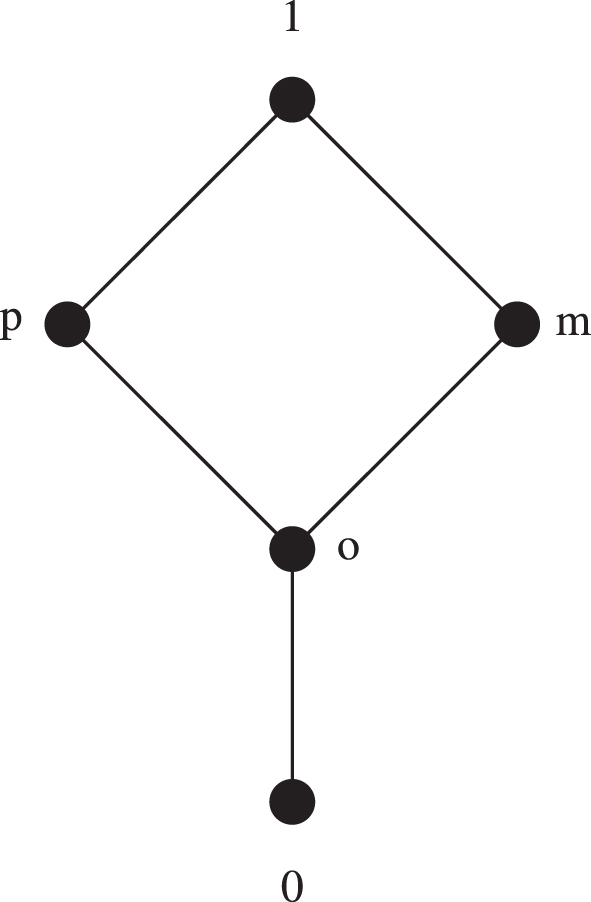
Example 3.2. Assume L = {0, p, m, o, 1} is a POSET with the next Hasse diagram. Define the operation "∼" on L as follows:
~
0
o
p
m
1
0
1
0
0
0
1
o
0
1
m
p
o
p
0
m
1
o
p
m
0
p
o
1
m
1
0
o
p
m
1
↠
0
o
p
m
1
0
1
1
1
1
1
o
0
1
1
1
1
p
0
m
1
m
1
m
0
p
p
1
1
1
0
o
p
m
1
Then (L, ∼ , ∧ , 1) is an equality algebra. Suppose Q = {p, 1} and U = {o, p, m, 1}. Thus . Clearly Q ≠ {1} and so Rad(Q) ≠ {1}.
Remark 3.3. (i) According to Example 3.2, by our definition,
(ii) Clearly .
(iii) If , then Q ⊆ Rad(Q).
(iv) Q is a proper filter of L iff Rad(Q) is a proper filter of L.
(v) If , then Rad(Q) = Q.
Proposition 3.4.If Q is an implicative (positive implicative, fantastic, Boolean) filter of L, then Rad(Q) is, too.
Definition 3.5. Consider A ⊆ L. Then the smallest filter of L containing A is called the generated filter by A in L which is denoted by 〈A〉. Indeed, .
Proposition 3.6.Consider ∅ ≠ A ⊆ L. Then
In particular, for any element p ∈ L, we have where e↠ 0h = h and e↠ nh = e ↠ (e↠ n - 1h).
If and p ∈ L \ Q, then
If , then
Corollary 3.7.If L is a lattice equality algebra, then for any e, h ∈ L, we have 〈e〉∩〈h〉 = 〈e ∨ h〉.
Proposition 3.8.(i) For each proper filter Q of L there is an ultra filter of L that contains Q.
(ii) If , then a unique ultra filter of L exists such that contains T.
(iii) Assume Q is a proper filter of L. Then iff 〈Q ∪ {e} 〉 = L, for any e ∈ L \ Q.
(iv) If L is bounded and , then e ∈ L \ U iff there is such that e↠ n0 ∈ U.
(v) iff is a TOSET.
(vi) Every ultra filter of L is a prime filter of L.
Theorem 3.9.Consider . Then
Proof. Suppose .
Assume Q is a proper filter of L. Let e ∈ Rad(Q) such that e ∉ B. Then there exists such that (e↠ n0) ↠ e ∉ Q. Since Q is a proper filter of L, by Proposition 3.8 (i) and (iv), there exists such that Q ⊆ T and (e↠ n0) ↠ e ∉ T. Since , by Proposition 3.8 (i), there exists an ultra filter U of L such that T ⊆ U. Moreover, since and (e↠ n0) ↠ e ∉ T, we have e ↠ (e↠ n0) ∈ T, and so e ↠ (e↠ n0) ∈ U. If e ∈ U, then e↠ n0 ∈ U. By repeating this method, we get 0 ∈ U, a contradiction. If e ∉ U, then there exists an ultra filter of L such that Q ⊆ T ⊆ U and e ∉ U. Thus, e ∉ Rad(Q), a contradiction. Hence, for any , (e↠ n0) ↠ e ∈ Q, and so e ∈ B.
Conversely, suppose e ∈ B and e ∉ Rad(Q). Since e ∈ B, for any we have (e↠ n0) ↠ e ∈ Q. Moreover, e ∉ Rad(Q), then there exists an ultra filter U of L such that Q ⊆ U and e ∉ U. Then by Proposition 3.8. (iv), there exists such that e↠ n0inU. Since (e↠ n0) ↠ e ∈ Q and Q ⊆ U, we get e ∈ U, is a contradiction. Hence, e ∈ Rad(Q). Therefore,
Now, let e ∈ Rad(Q). Then for any , (e↠ n0) ↠ e ∈ Q. By Proposition 2.2 (v), e ↠ 0 ≼ e ↠ (e ↠ 0). By repeating this method n - 1 times we have e ↠ 0 ≼ e↠ n0. By Proposition 2.2(x), (e↠ n0) ↠ e ≼(e ↠ 0) ↠ e = ¬ e ↠ e. Since and (e↠ n0) ↠ e ∈ Q, we get ¬e ↠ e ∈ Q. □
Next example shows Rad(Q) is not equal with {e ∈ L ∣ ¬e ↠ e ∈ Q}, in general.
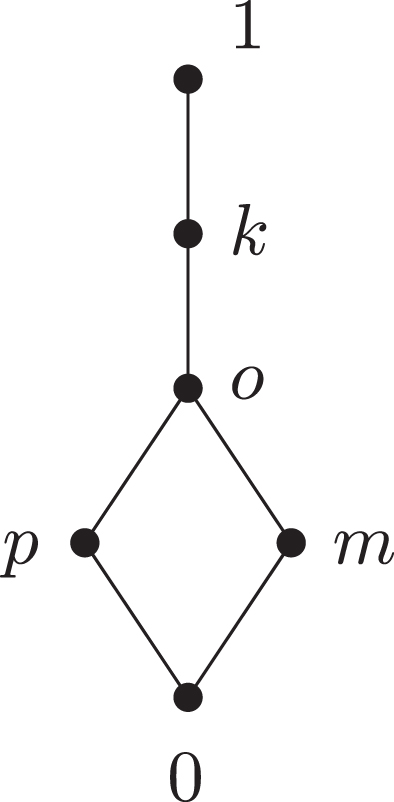
Example 3.10. Consider L = {0, p, m, o, k, 1} is a POSET with the next Hasse diagram.Define the operation ∼ on L as follows:
~
0
p
m
o
k
1
0
1
k
k
k
o
0
p
k
1
o
k
o
p
m
k
o
1
k
o
m
o
k
k
k
1
k
o
k
o
o
o
k
1
k
1
0
p
m
o
k
1
↠
0
p
m
o
k
1
0
1
1
1
1
1
1
p
k
1
k
1
1
1
m
k
k
1
1
1
1
o
k
k
k
1
1
1
k
o
o
o
k
1
1
1
0
p
m
o
k
1
Then (L, ∧ , ∼ , 1) is an equality algebra. Suppose Q = {1}. Clearly, Rad(Q) = {1} and ¬k ↠ k = o ↠ k = 1 ∈ Q but k ∉ Rad(Q).
Corollary 3.11.If Q is a positive implicative filter of L, then
Proposition 3.12.Assume . If for any e ∈ L, e ∧ ¬ e = 0, then Rad(Q) ⊆ {e ∈ L ∣ ¬ ¬e ∈ Q}.
Proof. Suppose e ∈ Rad(Q). Then by Theorem 3.9, ¬e ↠ e ∈ Q. Since for any e ∈ L, e ∧ ¬ e = 0, by Proposition 2.2(xii) we have, ¬e ↠ 0 = ¬e ↠ (e ∧ ¬e) = ¬e ↠ e ∈ Q, and so ¬¬e ∈ Q. Hence, Rad(Q) ⊆ {e ∈ L ∣ ¬ ¬e ∈ Q}. □
Proposition 3.13.Consider Q is a positive implicative filter of L. Then Rad(Q) = {e ∈ L ∣ ¬ ¬e ∈ Q}.
Proof. Let Q be a positive implicative filter of L and e ∈ Rad(Q). Then by Corollary 3.11, ¬e ↠ e ∈ Q. Since Q is positive implicative, we have
Since , (¬e ↠ e) ↠ ¬ ¬e ∈ Q and ¬e ↠ e ∈ Q, we get ¬¬e ∈ Q. Hence, Rad(Q) ⊆ {e ∈ L ∣ ¬ ¬e ∈ Q}. Conversely, suppose ¬¬ e ∈ Q. Since ¬¬e ≼ ¬e ↠ e and , we have ¬e ↠ e ∈ Q and by Corollary 3.11, e ∈ Rad(Q). Therefore, Rad(Q) = {e ∈ L ∣ ¬ ¬e ∈ Q}. □
Proposition 3.14.Assume Q and K are two proper filters of L. Then:
(i) For any e ∈ L \ {0}, ¬e = 0 iff Rad(Q) = L \ {0}.
(ii) If Q ⊆ K, then Rad(Q) ⊆ Rad(K).
(iii) Rad(Rad(Q)) = Rad(Q).
(iv) The map such that for any , ψ(Q) = Rad(Q) is a closure operator.
(v) Rad(Q) ∩Rad(K) ⊆ Rad(〈Q ∪K〉).
(vi) Rad(Q ↠ K) ⊆ Rad(Q ↠ Rad(K)), where Q ↠ K = {e ∈ L ∣ Q ∩〈e〉 ⊆ K}.
(vii) Rad(Q) ↠ Rad(K) ⊆ Q ↠ Rad(K).
(viii) If f : L ↠ L is a bounded equality homomorphism, then Rad(kerf) = f-1(Rad({1})), where kerf = {e ∈ L ∣ f(e) =1}.
(ix) If {Qi} i∈I is a family of filters of L, then .
Proof. (i) Suppose for any e ∈ L \ {0}, ¬e = 0. Clearly Rad(Q) ⊆ L \ {0}. If e ∈ L \ {0}, then by assumption, ¬e = 0 and for any ,
Hence, by Theorem 3.9, e ∈ Rad(Q) and so L \ {0} ⊆ Rad(Q). Therefore, Rad(Q) = L \ {0}.
Conversely, suppose Rad(Q) = L \ {0}. Assume e ∈ L \ {0} such that ¬e ≠ 0. Then by assumption, e ∈ Rad(Q) and e ↠ 0 = ¬e ∈ Rad(Q). Since , we have 0 ∈ Rad(Q), a contrsdiction. Hence, ¬e = 0. Therefore, for any e ∈ L \ {0}, we have ¬e = 0.
(ii) Consider e ∈ Rad(Q). Then by Theorem 3.9, for any , (e↠ n0) ↠ e ∈ Q. Since Q ⊆ K, we get that for any , (e↠ n0) ↠ e ∈ K, and so e ∈ Rad(K). Hence, Rad(Q) ⊆ Rad(K).
(iii) Since Rad(Q) is a proper filter of L, we get Rad(Q) ⊆ Rad(Rad(Q)). Suppose e ∈ Rad(Rad(Q)). Then for any ultra filter U of L such that Rad(Q) ⊆ U, we have e ∈ U. Suppose such that Q ⊆ U0. By (ii), Rad(Q) ⊆ Rad(U0) = U0. Then e ∈ U0. Thus we show that for any ultra filter U of L that Q ⊆ U, we have e ∈ U. Hence, e ∈ Rad(Q), and so Rad(Rad(Q)) ⊆ Rad(Q). Therefore, Rad(Rad(Q)) = Rad(Q).
(iv) By Remark 3.3(iii), (ii) and (iii), the proof is clear.
(v) Since Q, K ⊆ 〈Q ∪ K〉, by (ii), we have Rad(Q) , Rad(K) ⊆ Rad(〈Q ∪ K〉). Hence,
(vi) Assume e ∈ Rad(Q ↠ K). Then for any , we have (e↠ n0) ↠ e ∈ Q ↠ K. Thus Q ∩〈(e↠ n0) ↠ e〉 ⊆ K ⊆ Rad(K), and so 〈(e↠ n0) ↠ e〉 ∈ Q ↠ Rad(K). Hence, e ∈ Rad(Q ↠ Rad(K)). Therefore, Rad(Q ↠ K) ⊆ Rad(Q ↠ Rad(K)).
(vii) Let e ∈ Rad(Q) ↠ Rad(K). Then 〈e〉∩Rad(Q) ⊆ Rad(K). By Remark 3.3(iii), Q ∩〈e〉 ⊆ 〈e〉∩Rad(Q) ⊆ Rad(K), and so e ∈ Q ↠ Rad(K). Hence, Rad(Q) ↠ Rad(K) ⊆ Q ↠ Rad(K).
(viii) For any e ∈ L, e ∈ Rad(kerf) iff for any , (e↠ n0) ↠ e ∈ kerf iff f((e↠ n0) ↠ e) =1 iff (f(e) ↠ nf(0)) ↠ f(e) =1 iff for any , f(e) ∈ Rad({1}) iff e ∈ f-1(Rad({1})).
(ix) Clearly, for any i ∈ I, . Then by (ii), we have . Conversely, suppose . Then for any i ∈ I, e ∈ Rad(Qi). Thus for any i ∈ I and , (e↠ n0) ↠ e ∈ Qi, and so for any , . Hence, . Therefore, .
(x) For any e ∈ L, [e] ∈ Rad([1]) iff for any , ([e] ↠ n [0]) ↠ [e] ∈ [1] iff for any , (e↠ n0) ↠ e ∈ Q iff e ∈ Rad(Q) iff .
(xi) By Remark 3.3(iii), we have Q ⊆ Rad(Q) and K ⊆ Rad(K). Then Q ∪ K ⊆ Rad(Q) ∪ Rad(K), and so 〈Q ∪ K〉 ⊆ langleRad(Q) ∪ Rad(K) 〉. Thus by (ii),
(xii) Since Q∩K ⊆ Q, K, by (ii) we have Rad(Q∩K) ⊆ Rad(Q) , Rad(K). Suppose h ∈ [e] Rad(Q∩K). Then e ↠ h, h ↠ e ∈ Rad(Q∩K). Since Rad(Q∩K) ⊆ Rad(Q), we get e ↠ h, h ↠ e ∈ Rad(Q) and so h ∈ [e] Rad(Q). By the similar way, we have h ∈ [e] Rad(K). Hence, h ∈ [e] Rad(Q)∩ [e] Rad(K). Therefore, [e] Rad(Q∩K) ⊆ [e] Rad(Q)∩ [e] Rad(K). Now, suppose h ∈ [e] Rad(Q)∩ [e] Rad(K). Then e ↠ h, h ↠ e ∈ Rad(Q) and e ↠ h, h ↠ e ∈ Rad(K). Thus e ↠ h, h ↠ e ∈ Rad(Q) ∩Rad(K). By (ix), we have e ↠ h, h ↠ e ∈ Rad(Q∩K), and so h ∈ [e] Rad(Q∩K). Hence, [e] Rad(Q)∩ [e] Rad(K) ⊆ [e] Rad(Q∩K). Therefore, [e] Rad(Q)∩ [e] Rad(K) = [e] Rad(Q∩K).
(xiii) Consider such that K ⊆ Q. Then
□
Next example shows that the converse of relation in Proposition 3.14 (v), (vi) and (ii) does not hold, in general.
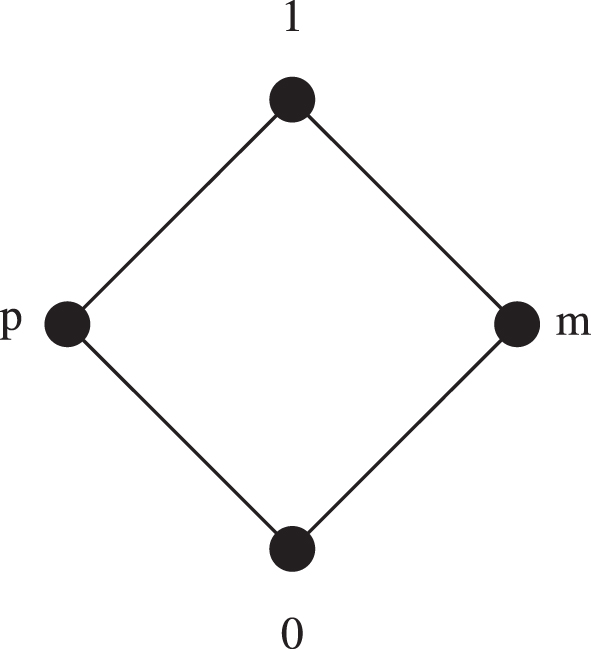
Example 3.15. (i) Let L = {0, p, m, 1} be a POSET with the next Hasse diagram. Define the operation ∼ on L as follows:
~
0
p
m
1
0
1
m
p
0
p
m
1
0
p
m
p
0
1
m
1
0
p
m
1
↠
0
p
m
1
0
1
1
1
1
p
m
1
m
1
m
p
p
1
1
1
0
p
m
1
Then (L, ∧ , ∼ , 1) is an equality algebra. Suppose Q = {p, 1} and K = {m, 1}. Clearly, Rad(Q) = Q, Rad(K) = K and 〈Q ∪ K〉 = 〈 {p, m, 1} 〉 = L. Hence, L = 〈Q ∪ K〉 ⊈ Rad(Q) ∩Rad(K) = {1}.
(ii) Assume L is the equality algebra as in Example 3.2. Suppose Q = {p, 1} and K = {m, 1}. By routine calculations, Q ↠ K = {m, 1} and so Rad(Q ↠ K) = {p, m, o, 1}. On the other side, Q ↠ Rad(K) = Q ↠ {p, m, o, 1} = L, and so
(iii) Let L be the equality algebra as in Example 3.2. Obviously, K = {p, 1} and Q = {m, 1} are two proper filters of L such that
but {p, 1} ⊈ {m, 1}.
Proposition 3.16.Let . Then there exists a uniqe ultra filter U of L such that Rad(T) = U.
Proof. By Proposition 3.8(ii), the proof is clear. □
The set of dense elements of L is denoted by D(L) = {e ∈ L ∣ ¬ e = 0}.
Example 3.17. Suppose L is the equality algebra as in Example 3.2. Clearly D(L) = {p, m, o, 1}.
Remark 3.18. (i) If , then D(Q) = D(L) ∩Q.
(ii) If , then D(Q) ⊆ Rad(Q). Since for any e ∈ D(Q), we have ¬e = 0 and for any , (e↠ n0) ↠ e = 0 ↠ e = 1 ∈ Q, and so e ∈ Rad(Q).
Proposition 3.19..
Proof. Since ¬1 =0, it is clear that 1 ∈ D(L). Suppose e, e ↠ h ∈ D(L). Then ¬e = ¬(e ↠ h) =0. By Proposition 2.2(vii), e ↠ h ≼(h ↠ 0) ↠ (e ↠ 0). Since ¬e = 0 we get e ↠ h ≼(h ↠ 0) ↠ 0. Moreover, by Proposition 2.2(xi), we have h ↠ 0 =((h ↠ 0) ↠ 0) ↠ 0 ≼(e ↠ h) ↠ 0. From ¬(e ↠ h) =0, we obtain h ↠ 0 = 0 and so h ∈ D(L). Therefore, . □
Proposition 3.20.Assume . Then:
(i) If is an involutive equality algebra, then D(L) ⊆ Q.
(ii) If L is an involutive equality algebra, then D(L) = {1}.
Proof. (i) If is an involutive equality algebra, then for any e ∈ L, [¬ ¬e] = [e]. Thus ¬¬e ↠ e ∈ Q and e ↠ ¬ ¬e ∈ Q. Suppose e ∈ D(L). Then ¬e = 0 and so ¬¬e = 1. Since for any e ∈ L, e = 1 ↠ e = ¬ ¬e ↠ e ∈ Q, we get e ∈ Q. Hence D(L) ⊆ Q.
(ii) Let L be an involutive equality algebra. Since , kfracL {1} is well-defined and kfracL {1} oongL. Thus kfracL {1} is an involutive equality algebra and so by (i), D(L) ⊆ {1}. On the other side, clearly ¬1 =0 and so {1} ⊆ D(L) ⊆ {1}. Hence D(L) = {1}. □
In the following example we show that the converse of Proposition 3.20(ii) does not hold:
Example 3.21. Let L be the equality algebra as in Example 3.10. Clearly D(L) = {1}, but L is not involutive, since ¬¬ m = ¬ k = o ≠ m.
Proposition 3.22.Suppose . We have,
(i) D(L) ⊆ Rad(Q).
(ii) .
Proof. (i) Consider e ∈ D(L). Then ¬e = 0. Thus similar to Remark 3.18(ii), we can see that e ∈ Rad(Q). Hence, D(L) ⊆ Rad(Q).
(ii) For e ∈ L, iff for any , iff iff (en ↠ 0) ↠ e ∈ Q iff e ∈ Rad(Q) iff . □
Example 3.23. Let L be the equality algebra as in Example 3.15(i). Suppose K = {p, 1} and Rad(K) = K. Clearly, p ∈ Rad(K) and ¬p = m ≠ 0, and so p ∉ D(L).
Proposition 3.24.Let f : L ↠ D be an equality epimorphism such that , , respectively, and kerf ⊆ Q. Then Rad(f(Q)) = f(Rad(Q)) and Rad(f-1(K)) = f-1(Rad(K)).
Proof. Since and kerf ⊆ Q, we get . Suppose h ∈ Rad(f(Q)). Then
Now, we prove Rad(f-1(K)) = f-1(Rad(K)). For this, e ∈ f-1(Rad(K)) iff f(e) ∈ Rad(K) iff for any , (f(e) ↠ nf(0)) ↠ f(e) ∈ K iff for any , (e↠ n0) ↠ e ∈ f-1(K) iff e ∈ Rad(f-1(K)). □
Definition 3.25. If and , respectively, then , where for any (p, m) , (o, k) ∈ L×D we have
Proposition 3.26.If and , respectively, then Rad(Q) × Rad(K) = Rad(Q × K).
Proof. According to Definition 3.25, we have
Therefore, Rad(Q) × Rad(K) = Rad(Q × K). □
Corollary 3.27.If {Qi} i∈I is a non-empty family of filters of L, then .
Theorem 3.28.Assume and , respectively. Then .
Proof. Consider the natural homomorphisms and such that for any e ∈ L and h ∈ D we have πL(e) = [e] and πD(h) = [h]. We define such that for any (e, h) ∈ L × D, Θ(e, h) =([e] , [h]). Then it is clear that Θ is a well-defined onto homomorphism. Now, we prove kerΘ = Rad(Q × K). For this, by Proposition 3.26 we have,
Therefore, . □
Proposition 3.29.Rad({1}) = {1} iff .
Proof. Suppose Rad({1}) = {1} and . Since for any , e ≼(e↠ n0) ↠ e, we get e is a lower bound of B. Now, we prove e is the greatest lower bound of B. Suppose there exists h ∈ L such that for any , h ≼(e↠ n0) ↠ e. We prove h ≼ e. For this, since h ≼(e↠ n0) ↠ e, we have h ↠ ((e↠ n0) ↠ e) =1. Moreover, by Proposition 2.2(v) and (x), e ≼ h ↠ e, and so (h ↠ e) ↠ 0 ≼ e ↠ 0. By Proposition 2.2(x), (h ↠ e) ↠ ((h ↠ e) ↠ 0) ≼(h ↠ e) ↠ (e ↠ 0). Also, since (h ↠ e) ↠ 0 ≼ e ↠ 0, we have e ↠ ((h ↠ e) ↠ 0) ≼ e ↠ (e ↠ 0). Then
By continuing this method, we get (h ↠ e) ↠ n0 ≼ e↠ n0, for any . Thus (e↠ n0) ↠ e ≼((h ↠ e) ↠ n0) ↠ e, and so h ↠ ((e↠ n0) ↠ e) ≼ h ↠ (((h ↠ e) ↠ n0) ↠ e). From h ↠ ((e↠ n0) ↠ e) =1, we obtain h ↠ (((h ↠ e) ↠ n0) ↠ e) =1, and so ((h ↠ e) ↠ n0) ↠ (h ↠ e) =1. Thus h ↠ e ∈ Rad({1}) = {1}. Hence, h ≼ e. Therefore, .
Conversely, it is clear that {1} ⊆ Rad({1}). Suppose e ∈ Rad({1}). Then for any , (e↠ n0) ↠ e ∈ {1}. Thus . Hence, e = 1. Therefore, Rad({1}) = {1}.□
Semi-maximal filter of equality algebras
Next, we define the concept of semi-maximal filter of equality algebra and show some properties of it.
Definition 4.1. Consider . If Rad(Q) = Q, then Q is called a semi-maximal filter of L.
All semi-maximal filters of L is denoted by .
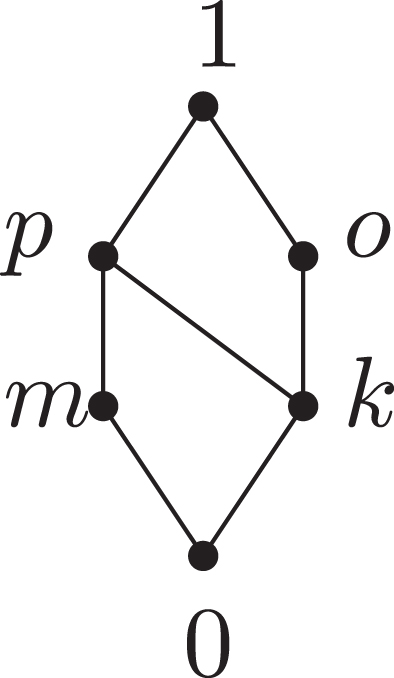
Example 4.2. (i) Consider L = {0, p, m, o, k, 1} is a lattice with the next Hasse diagram. Define the operation "∼" on E as follows:
~
0
p
m
o
k
1
0
1
k
o
m
p
0
p
k
1
p
k
o
p
m
o
p
1
0
k
m
o
m
k
0
1
p
o
k
p
o
k
p
1
k
1
0
p
m
o
k
1
↠
0
p
m
o
k
1
0
1
1
1
1
1
1
p
k
1
p
o
o
1
m
o
1
1
o
o
1
o
m
p
m
1
p
1
k
p
1
p
1
1
1
1
0
p
m
o
k
1
Then (L, ∼ , ∧ , 1) is an equality algebra. Suppose Q = {p, m, 1}. Easily Rad(Q) = Q, and so .
(ii) Let L be the equality algebra as in Example 3.2. If Q = {p, 1}, then easily we can see that Rad(Q) = {p, m, o, 1} ≠ Q, and so .
In the next example, the relation between different kinds of filter of equality algebra and semi-maximal filter of it is studied.
Example 4.3. (i) Consider L is the equality algebra of Example 4.2(i). Suppose Q = {1, o}. Since Rad(Q) = Q, we get which is not a positive implicative filter of L. Because p ↠ (p ↠ 0) = o ∈ Q and p ↠ p = 1 ∈ Q, but p ↠ 0 = k ∉ Q.
(ii) Assume L is the equality algebra of Example 3.10. Suppose Q = {1}. Obviously, which is not a fantastic filter of L. Because 0 ↠ p ∈ Q but ((p ↠ 0) ↠ 0) ↠ p = k ∉ Q.
(iii) Consider L is the equality algebra of Example 3.10. Suppose Q = {1}. Clearly, because m ↠ p = k ∉ Q and p ↠ m = k ∉ Q.
(iv) According to Example 3.15, suppose Q = {1}. Obviously, but it is not an ultra filter of L because U1 = {p, 1} and U2 = {m, 1} are two ultra filters of L.
(v) Suppose L = {0, p, m, 1} is a TOSET such that 0 ≼ p ≼ m ≼ 0. Define the operation ∼ on L as follows:
~
0
p
m
1
0
1
p
0
0
p
p
1
p
p
m
0
p
1
m
1
0
p
m
1
↠
0
p
m
1
0
1
1
1
1
p
p
1
1
1
m
0
p
1
1
1
0
p
m
1
Then (L, ∼ , ∧ , 0, 1) is an equality algebra. Suppose Q = {m, 1}. Clearly, but it is not an implicative filter of L because ¬p ↠ p = 1 ∈ Q but p ∉ Q. Also, Q = {m, 1} is not a Boolean filter of L, since p ∨ ¬p = p ∉ Q.
Proposition 4.4.Assume . Then the next statements hold:
(i) If Q is an implicative filter of L, then .
(ii) If L is a bounded lattice equality algebra and Q is a Boolean filter of L, then .
(iii) If , then .
(iv) If and a positive implicative filter of L, then Q is an implicative filter of L.
(v) If such that e↠ 2h = e ↠ h, for any e, h ∈ L, then Q is an implicative filter of L.
Proof. (i) Consider Q is an implicative filter of L. By Remark 3.3(iii), Q ⊆ Rad(Q). Suppose e ∈ Rad(Q). Then for any , (e↠ n0) ↠ e ∈ Q. By Proposition 2.5(i), Q is a positive implicative filter of L, then e↠ n0 = e ↠ 0, thus (e ↠ 0) ↠ e =(e↠ n0) ↠ e ∈ Q, and so ¬e ↠ e ∈ Q. Since Q is an implicative filter of L, by Proposition 2.5(ii), e ∈ Q. Hence, Rad(Q) ⊆ Q. Therefore, Rad(Q) = Q and so .
(ii) Let Q be a Boolean filter of L. By Proposition 2.5(iii), Q is an implicative filter of L and by (i), .
(iii) If , clearly Rad(Q) = Q, and so .
(iv) Suppose , a positive implicative filter of L and ¬e ↠ e ∈ Q, for any e ∈ L. Since Q is a positive implicative filter of L, by Corollary 3.11, e ∈ Rad(Q) = Q. Hence, by Proposition 2.5(ii), Q is an implicative filter of L.
(v) Let e ↠ (h ↠ u) ∈ Q and e ↠ h ∈ Q. Then by Proposition 2.2(vii), we have
Since , we get e ↠ (e ↠ u) ∈ Q. Then by assumption
Thus Q is a positive implicative filter of L and by (iv), Q is an implicative filter of L. □
Proposition 4.5.Considerf : L ↠ D is an equality homomorphism. Then:
(i) If , then .
(ii) If f is onto such that kerf ⊆ Q and , then .
Proof. (i) Since K is a proper filter of D, it is easy to see that f-1(K) is a proper filter of L. Moreover, K is semi-maximal, then Rad(K) = K. Thus
Hence, .
(ii) Since , we have Rad(Q) = Q. Clearly, and by Proposition 3.24, f(Q) = f(Rad(Q)) = Rad(f(Q)), and so . □
Proposition 4.6.If , then:
(i) Rad(Q) is the smallest semi-maximal filter of L such that Q ⊆ Rad(Q).
(ii) .
Proof. (i) By Proposition 3.14(iii), Rad(Rad(Q)) = Rad(Q). Then such that by Remark 3.3(iii), Q ⊆ Rad(Q). Suppose such that Q ⊆ K. Then by Proposition 3.14(ii), Rad(Q) ⊆ Rad(K). Since , we have Rad(Q) ⊆ K, and so Rad(Q) is the smallest semi-maximal filter of L such that Q ⊆ Rad(Q).
(ii) Clearly, by Remark 3.3(iii), . Assume for any e ∈ L, . Then for any , . Thus there exists h ∈ Rad(Q) such that ([e] ↠ n [0]) ↠ [e] = [h], and so ((e↠ n0) ↠ e) ↠ h ∈ Q and h ↠ ((e↠ n0) ↠ e) ∈ Q ⊆ Rad(Q). Since h ∈ Rad(Q) and , we get (e↠ n0) ↠ e ∈ Rad(Q), and so by Proposition 3.14(iii), e ∈ Rad(Rad(Q)) = Rad(Q). Thus, . Hence, . Therefore, . □
Corollary 4.7.(i) Let . Then .
(ii) Consider . Then iff .
Prime-like filters of equality algebras
In this section, we introduce the notion of prime-like filter and investigate some properties of it.
Note. In this section we let L be a lattice equality algebra unless otherwise state.
Definition 5.1. Assume Q is a proper filter of L. Then Q is called a ∨-prime filter of L, if e ∨ h ∈ Q implies e ∈ Q or h ∈ Q, for any e, h ∈ L.
Example 5.2. Suppose L is the equality algebra as in Example 3.15 such that Q = {p, 1} and K = {1}. Then Q is a ∨-prime filter of L. Since p ∨ m = 1 ∈ K but p, m ∉ K, then K is not a ∨-prime filter of L.
Example 5.3. Consider L is the equality algebra as in Example 3.10 such that Q = {1}. Then Q is a ∨-prime but , because p ↠ m = m ↠ p = k ∉ Q.
Theorem 5.4.Every prime filter of L is a ∨-prime filter of L.
Proof. Suppose and Q = Q1∩Q2. If Q ≠ Q1 and Q ≠ Q2, then there exist e ∈ Q1 \ Q and h ∈ Q2 \ Q. Since , we have e ↠ h ∈ Q or h ↠ e ∈ Q. If e ↠ h ∈ Q ⊆ Q1, then since e ∈ Q1 and Q1 is a filter of L, we get h ∈ Q1. Thus h ∈ Q1∩Q2 = Q, a contradiction. By the similar way, from h ↠ e ∈ Q, we get e ∈ Q1∩Q2 = Q, a contradiction. Hence, Q = Q1 or Q = Q2. Now, suppose e ∨ h ∈ Q such that e ∉ Q and h ∉ Q. Then by Corollary 3.7, clearly, 〈Q ∪ {e} 〉∩〈Q ∪ {h} 〉 = 〈Q ∪ {eveeh} 〉 = Q. Thus 〈Q ∪ {e} 〉 ⊆ Q and 〈Q ∪ {h} 〉 ⊆ Q, and so e ∈ Q or h ∈ Q, which is a contradiction. Hence, Q is a ∨-prime of L. □
Theorem 5.5.If L is prelinear, then any prime filter of L and any ∨-prime filter of L are conside.
Proof. (⇒) Since L is a prelinear equality algebra, we get L is a lattice. Let e, h ∈ L such that e ∨ h ∈ Q. Since , we have e ↠ h ∈ Q or h ↠ e ∈ Q. If e ↠ hinQ, since e ∨ h ∈ Q, by Proposition 2.2(xiii), (e ∨ h) ↠ h = e ↠ h ∈ Q. Since , we get h ∈ Q. By the similar way, e ∈ Q.
(⇐) Assume Q is a ∨-prime filter of L. Since L is prelinear, for any e, h ∈ L, (e ↠ h) ∨(h ↠ e) =1, and so (e ↠ h) ∨(h ↠ e) ∈ Q. Moreover, from Q is a ∨-prime filter of L, we get e ↠ h ∈ Q or h ↠ e ∈ Q. Hence, . □
Next example shows that the condition prelinear in Theorem 5.5 is necessary.
Example 5.6. Suppose L is the equality algebra as in Example 3.10. Since (p ↠ m) ∨(m ↠ p) = k ≠ 1, it is obvious that L is not prelinear. Suppose Q = {1}. Then Q is a ∨-prime but , because p ↠ m = m ↠ p = k ∉ Q.
Definition 5.7. A proper filter Q of L is called a prime-like filter of L if for any e, h ∈ L, e ∨ h ∈ Q implies e ∈ Q or h ∈ Rad(Q).
Example 5.8. (i) Assume L is the equality algebra as in Example 4.3(v). Then Q = {m, 1} is a prime-like filter of L.
(ii) Let L be the equality algebra as in Example 3.15. Then Q = {1} and Rad(Q) = {p, 1} ∩ {m, 1} = {1}. Thus p ∨ m = 1 ∈ Q and clearly p ∉ Q and m ∉ Rad(Q). Hence, Q is not a prime-like filter of L.
In the next example we show the relation between different kind of filters of L with prime-like filters of L.
Example 5.9. (i) Assume L is the equality algebra as in 4.2(i). Suppose Q = {1, o}. Then Q is a prime-like filter of L but it is not a positive implicative filter of L. Because p ↠ (p ↠ 0) = o ∈ Q and p ↠ p = 1 ∈ Q, but p ↠ 0 = k ∉ Q.
(ii) Consider L is the equality algebra as in Example 3.2. Suppose Q = {p, 1}. It is clear that Q is a prime-like filter but it is not a fantastic filter of L. Because 0 ↠ m ∈ Q but ((m ↠ 0) ↠ 0) ↠ m = m ∉ Q.
(iii) Let L be the equality algebra as in Example 4.3(v). Suppose Q = {m, 1}. Clearly, Q is a prime-like filter of L but it is not an implicative filter of L because ¬p ↠ p ∈ Q but p ∉ Q.
Proposition 5.10.Every ∨-prime filter of L is a prime-like filter of L.
Proof. Suppose Q is a ∨-prime filter of L and for any e, h ∈ L, e ∨ h ∈ Q. Since Q is a ∨-prime filter of L, we get e ∈ Q or h ∈ Q. If e ∈ Q, then the proof is complete. If e ∉ Q, then h ∈ Q. By Remark 3.3(iii), QsubseteqRad(Q), and so h ∈ Rad(Q). Therefore, Q is a prime-like filter of L.
In the next example, we show that the converse of above proposition may not be true, inmreak general.
Example 5.11. Let L be the equality algebra as in Example 3.3. Suppose Q = {1}. Clearly, Rad(Q) = {o, p, m, 1}, thus Q is a prime-like filter of L but it is not a ∨-prime filter of L, because p ∨ m = 1 ∈ Q but p ∉ Q and m ∉ Q.
Proposition 5.12.AssumeQ is a proper filter of L such that it satisfies in at least one of the following conditions:
(i) .
(ii) .
(iii) Q is implicative filter.
Then Q is a prime-like filter of L iff Q is a ∨-prime filter of L.
Proof. By Propositions 4.4 and 5.8, the proof is clear. □
Corollary 5.13.Any proper filter ofL can be extended to a prime-like filter of L.
Corollary 5.14.Every prime filter of L is a prime-like filter of L.
Proof. By Theorem 5.4 and Proposition 5.10, the proof is clear. □
Next example shows that the converse of Corollary 5.14 does not hold, in general.
Example 5.15. Consider L is the equality algebra as in Example 3.10. Suppose Q = {1}. Clearly, Q is a prime-like filter of L but , because m ↠ p = k ∉ Q and p ↠ m = k ∉ Q.
Corollary 5.16.Every ultra filter of L is a prime-like filter of L.
Proof. By Proposition 3.8(vi), Theorem 5.4 and Proposition 5.10, the proof is clear. □
Following example shows that the converse of Corollary 5.16 is not true, in general.
Example 5.17. Let L be the equality algebra as in Example 3.2. Suppose Q = {p, 1}. Clearly, Q is a prime-like filter of L but because .
Proposition 5.18.Suppose L is prelinear and Q is a proper filter of L. Then Q is a prime-like filter of L iff for any e, h ∈ L, e ↠ h ∈ Q or h ↠ e ∈ Rad(Q).
Proof. Suppose Q is a prime-like filter of L and e, h ∈ L. Since L is prelinear, we have (e ↠ h) ∨(h ↠ e) =1 ∈ Q. Then e ↠ h ∈ Q or h ↠ e ∈ Rad(Q). Conversely, suppose Q is a proper filter of L and e, h ∈ L such that e ∨ h ∈ Q. Then by Proposition 2.2(xiii), (eveeh) ↠ h = e ↠ h ∈ Q. Since (eveeh) ↠ h ∈ Q, e ∨ h ∈ Q and , we get h ∈ Q. If e ↠ h ∉ Q, then h ↠ e ∈ Rad(Q). By Remark 3.3(iii), Q ⊆ Rad(Q), then eveeh ∈ Rad(Q). Again, by Proposition 2.2(xiii), (eveeh) ↠ e = h ↠ e ∈ Rad(Q). Since (eveeh) ↠ e ∈ Rad(Q), e ∨ h ∈ Rad(Q) and , we get e ∈ Rad(Q). Therefore, Q is a prime-like filter of L. □
Theorem 5.19.Consider L is prelinear, Q is a prime-like filter of L and K is a proper filter of L such that Q ⊆ K. Then K is a prime-like filter of L.
Proof. Assume K is a proper filter of L such that for e, h ∈ L, e ∨ h ∈ K. Since Q is a prime-like filter of L, by Proposition 5.18, for any e, h ∈ L, e ↠ h ∈ Q or h ↠ e ∈ Rad(Q). If e ↠ h ∈ Q, since Q ⊆ K, then e ↠ h ∈ K. Thus by Proposition 2.2(xiii), (eveeh) ↠ h = e ↠ h ∈ K. Since (eveeh) ↠ h ∈ K, e ∨ h ∈ K and , we get h ∈ K. If h ↠ e ∈ Rad(Q), then by Proposition 3.14(ii), since Q ⊆ K, we have Rad(Q) ⊆ Rad(K), and so h ↠ e ∈ Rad(K). Thus (eveeh) ↠ e = h ↠ e ∈ Rad(K). Since (eveeh) ↠ e ∈ Rad(K), e ∨ h ∈ Rad(K) and , we get e ∈ Rad(K). Therefore, K is a prime-like filter of L. □
Corollary 5.20.Let L be prelinear. Then radical of every prime-like filter of L is a ∨-prime filter of L.
Proof. Suppose Q is a prime-like filter of L. Since Q ⊆ Rad(Q), by Proposition 5.19, Rad(Q) is a prime-like filter of L. Moreover, by Proposition 3.14(iii), Rad(Rad(Q)) = Rad(Q), and so . Then by Proposition 5.12, Rad(Q) is a ∨-prime filter of L. □
Proposition 5.21.Consider such that Q ⊆ K. If K is a prime-like filter of L, then is a prime-like filter of .
Proof. Let be a filter of such that . Then eveeh ∈ K. Since K is a prime-like filter of L, we have e ∈ K or h ∈ Rad(K), and so or . By Proposition 3.14(xiii), we have . Therefore, is a prime-like filter of . □
Lemma 5.22. Assume L is prelinear. If Q is a prime-like filter of L, then .
Proof. Suppose Q is a prime-like filter of L. Then by Proposition 5.18, for any e, h ∈ L, e ↠ h ∈ Q or h ↠ e ∈ Rad(Q). By Remark 3.3(iii), Q ⊆ Rad(Q), thus for any e, h ∈ L, e ↠ h ∈ Rad(Q) or h ↠ e ∈ Rad(Q). Hence, . □
Theorem 5.23.Suppose {Qi} i∈I is a non-empty chain family of prime-like filters of L. We have:
(i) is a prime-like filter of L.
(ii) If L is prelinear, then are prime-like filters of L.
Proof. (i) Assume e, h ∈ L such that . Then for any i ∈ I, e ∨ h ∈ Qi. Since for any i ∈ I, Qi is a prime-like filter of L, we get x ∈ Qi or h ∈ Rad(Qi). If for any i ∈ I, e ∈ Qi, then , and so is a prime-like filter of L. If there exists i ∈ I such that e ∉ Qi, then since Qi is a prime-like filter of L, we obtain h ∈ Rad(Qi). From {Qi} i∈I is a chain, there is t ∈ I such that Qi ⊆ Qt or Qt ⊆ Qi. If e ∉ Qi, then h ∈ Rad(Qi). If Qi ⊆ Qt, by Proposition 3.14(ii), Rad(Qi) ⊆ Rad(Qt), and so h ∈ Rad(Qt). If Qt ⊆ Qi, then e ∉ Qt, and so h ∈ Rad(Qt). By the similar way, we can see that h ∈ Rad(Qi). Thus, for any i ∈ I, h ∈ Rad(Qi). Moreover, by Proposition 3.14(ix), . Hence, .
(ii) By Proposition 5.19, the proof is clear. □
Theorem 5.24.Consider L is a prelinear equality algebra and {Qi} i∈I be a non-empty chain family of prime-like filters of L. Then 〈 {Qi} i∈I, ∩, ∪, L〉 is a lattice.
Proof. The proof is straightforward. □
Lemma 5.25. Assume and e, h, u ∈ L. If e↠ nu, h↠ mu ∈ Q, for some , then there exists such that (e ∨ h) ↠ ku ∈ Q.
Proof. The proof is straightforward. □
Theorem 5.26.Let Q be a prime-like filter of L. Then for any p ∈ LsetminusQ there exists a prime-like filter such as K such that Q ⊆ K and p ∉ K.
Proof. Define . Since Q ∈ ∑, we get ∑≠ ∅. Then by Zorn’ Lemma, ∑ has a maximal element such as K. Now, we prove that K is a prime-like filter of L. For this, suppose e ∨ h ∈ K such that e ∉ K and h ∉ Rad(K). It is clear that K ⊆ 〈K∪ {e} 〉 and K ⊆ 〈K∪ {h} 〉. Since K is a maximal element of ∑ we get 〈K∪ {e} 〉, 〈K∪ {h} 〉 ∉ ∑. Thus p ∈ 〈K∪ {e} 〉∩〈K∪ {h} 〉. Then there exist such that e↠ np ∈ K and h↠ mp ∈ K. Thus by Lemma 5.25, there exists such that (eveeh) ↠ kp ∈ K. Since e ∨ h ∈ K and , we have p ∈ K, a contradiction. Hence, K is a prime-like filter of L. □ □
Proposition 5.27.Consider T is a prime-like filter of L and such that Q∩K ⊆ T. Then Q ⊆ T or K ⊆ Rad(T).
Proof. Suppose Q∩K ⊆ T such that Q ⊈ T. Then there exists e ∈ Q \ T. Thus for any h ∈ K, we have e ≼ e ∨ h and h ≼ e ∨ h. Since , we get e ∨ h ∈ Q∩K ⊆ T. Moreover, T is a prime-like filter of L, then h ∈ Rad(T). Hence, K ⊆ Rad(T). □
Corollary 5.28.(i) Let T be a prime-like filter of L and such that Q∩K = T. Then Q = T or Rad(K) = Rad(T).
(ii) Assume T is a prime-like filter of L and {Qi} i∈I is a non-empty family of filters of L such that . Then there exists i ∈ I such that Qi ⊆ T or Rad(Qi) subseteqRad(T).
Proposition 5.29.Considerf : LrightarrowD is a lattice equality homomorphism. Then:
(i) If K is a prime-like filter of D, then f-1(K) is a prime-like filter of L.
(ii) If f is an epimorphism and Q is a prime-like filter of L such that kerf ⊆ Q, then f(Q) is a prime-like filter of D.
Proof. (i) By Proposition 3.24, the proof is clear.
(ii) Suppose p, m ∈ D such that p ∨ m ∈ f(Q). Since f is an epimorphism, there exists e, h ∈ L such that f(e) = p and f(h) = m and so f(e) ∨ f(h) ∈ f(Q). Thus there is u ∈ Q such that f(e) ∨ f(h) = f(u), and so f(u ↠ (eveeh)) =1. Thus u ↠ (e ∨ h) ∈ kerf ⊆ Q. Since u ∈ Q and , we have e ∨ h ∈ Q. Since Q is a prime-like filter of L, we get e ∈ Q or h ∈ Rad(Q) and so p = f(e) ∈ f(Q) or m = f(h) ∈ f(Rad(Q)). Thus by Proposition 3.24, p = f(e) ∈ f(Q) or m = f(h) ∈ Rad(f(Q)). Therefore, f(Q) is a prime-like filtermreak of D. □
Proposition 5.30.LetL be a prelinear and Q be a prime-like filter of L. Then
is a chain.
Proof. Suppose . Then K1 and K2 are two proper filters of L such that Rad(Q) ⊆ K1 and Rad(Q) ⊆ K2. Suppose K2 ⊈ K1 and K1 ⊈ K2. Then there exist e ∈ K1 \ K2 and h ∈ K2 \ K1. Since Q is a prime-like filter of L, for any e, h ∈ L, by Proposition 5, e ↠ h ∈ Q or h ↠ e ∈ Rad(Q). If e ↠ h ∈ Q, since QsubseteqRad(Q) ⊆ K1, then e ↠ h ∈ K1. Since e ∈ K1 and , we have h ∈ K1, is a contradiction. If h ↠ e ∈ Rad(Q), since Rad(Q) ⊆ K2, then h ↠ e ∈ K2. Since h ∈ K2 and , we have e ∈ K1, a contradiction. Hence, K2 ⊆ K1 or K1 ⊆ K2. Therefore, is a chain. □
Consider Q is a filter of L. Define
Proposition 5.31.Assume. We have:
(i) and .
(ii) If Q ⊆ K, then .
(iii) , where .
(iv) .
Proof. The proof is starightforward. □
Following example shows .
Example 5.32. Let L be the equality algebra as in Example 3. Clearly, all filters are prime-like filter. Suppose Q = {p, 1} and K = {m, 1}. Then and . Therefore, .
Proposition 5.33.Suppose every filter of L is a semi-maximal filter of L and . Then .
Proof. Suppose . By Proposition 5(iii), clearly . Suppose T is a prime-like filter of L such that . Then Q∩K ⊆ T. Since T is a prime-like filter of L, by Proposition 5, Q ⊆ T or K ⊆ Rad(T). If Q ⊆ T, then , and the proof complete. If K ⊆ Rad(T), then by assumption and so K ⊆ Rad(T) = T. Thus . Hence, . □
Define
Theorem 5.34.If is closed under finite union, then is a topological space.
Corollary 5.35.If every filter of , then is a topological space.
Conclusion
Considering the importance of the concept of filters in logical algebras and its application in creating the quotient space and creating logical algebras, one of the aims of this article is to introduce new filters on equality algebras and examine the relationship between them and the filters that are previously defined. It is shown that the introduced concepts are the expansion of previous filters, such as the prime and maximum filters. On the other hand, we used the introduced concepts and define new open sets on equality algebra that could be used to construct a Zarisky topology. In future, we want to define the notion of primary filter on equality algebra and we investigate the relation between all kind of filters are introduced on equality algebra. Also, we try to investigate the notion of flat topology on equality algebra.
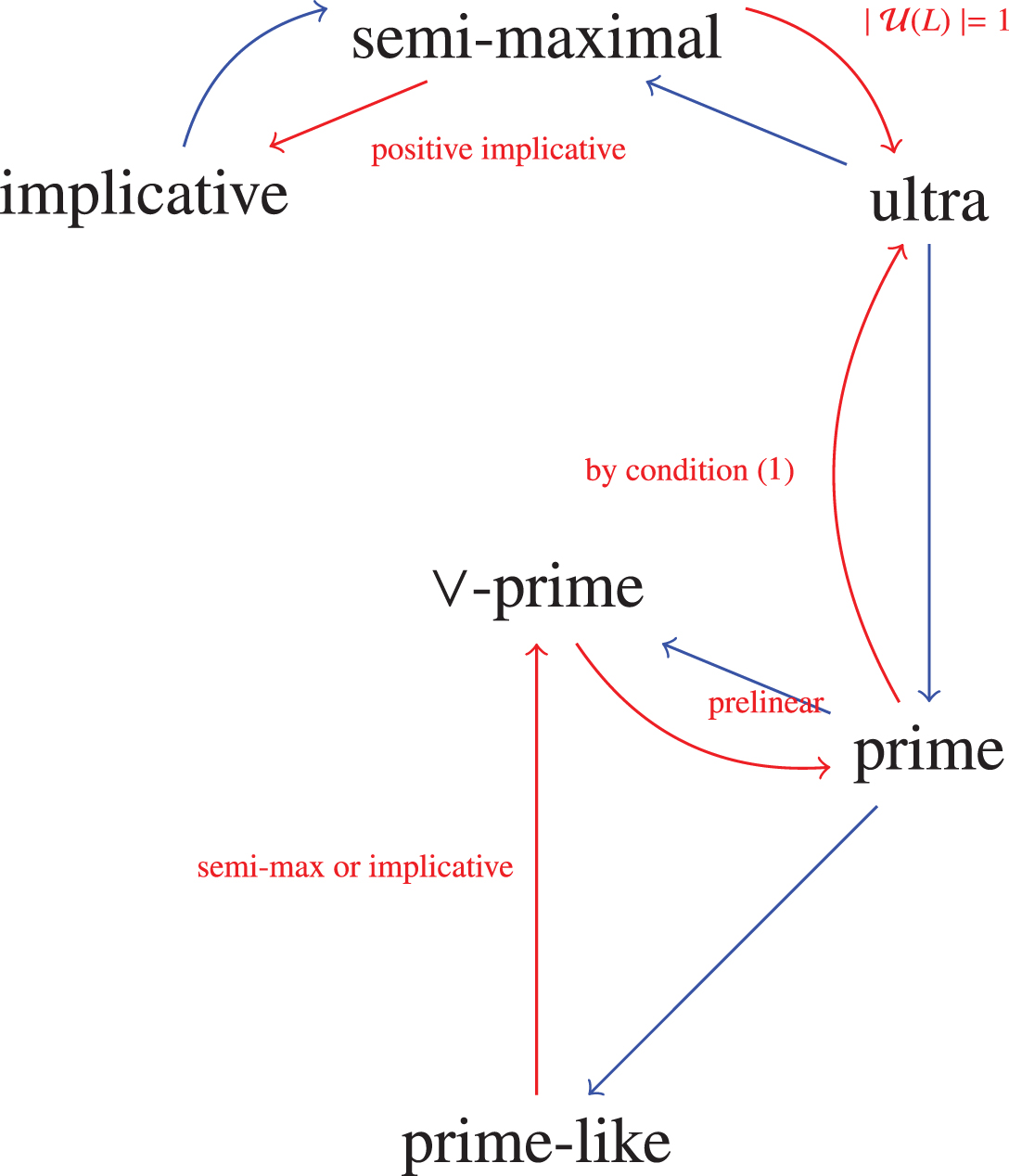
In the following diagram we show the relation between different filters:
Footnotes
Acknowledgements
The authors would like to thank the anonymous referees for their valuable comments, which greatly improved the quality and clarity of the paper.
This research was supported by the grant VAROPS (DZRO FVT 3) granted by the Ministry of Defence of the Czech Republic.
References
1.
AmeriR., Amiri-BideshkiM., Borumand SaeidA. and
Hoskova-MayerovaS., Prime filters of hyperlattices, An Stiint Univ “Ovidius” Constanta Ser Mat24(2) (2016), 15–26. doi: 10.1515/auom-2016-0025
2.
Aaly KologaniM.,
BorzooeiR.A.,
RezaeiG.R. and
JunY.B., Commutative equality algebras and &-equality algebras, Annal Univ Cra Math Comp Sci Ser47(2) (2020), 331–345.
BorzooeiR.A., ZebardastF. and Aaly KologaniM., Some types of filters in equality algebras, Cat Gen Alg Str Appl7 (2017), 33–55.
7.
CiunguL.C., Internal states on equality algebras, Soft Comp19(4) (2015), 939–953.
8.
Flaut, C., Hošková-Mayerová, Š., Saeid, A.B. et al., Wajsberg algebras of order n(n ≤ 9). Neural Comput & Applic. 32, 13301–13312, (2020), doi: 10.1007/s00521-019-04676-x
9.
Flaut, C., Hošková-Mayerová, Š., Vasile, R., Some remarks regarding finite bounded commutative BCK-algebras, In: Hošková-Mayerová, Š., et al. (eds.), Algorithms as a Basis of Modern Alied Mathematics. Studies in Fuzziness and Soft Computing 404, Cham: Springer, 2021, 131–140, doi: 10.1007/978-3-030-61334-1_6
10.
JamesI.M., Introduction to uniform spaces, Cam Univ Pre, New York, 144 (1990).
11.
JeneiS., Equality algebras, Proc. CINTI 2010 Con.-11th IEEE Inter. Sym. Comp. Intel. Info., Budapest, Hungary, 2010.
JeneiS. and KóródiL., On the variety of equality algebras, Fuzzy Log Tech (2011), 153–155.
14.
MeikolaA.T., Graphs of BCI/BCK-algebras, Turk J Math42 (2018), 1272–1293.
15.
MotamedS., Primary filters in BL-algebras, New Math Nat Comp15(3) (2019), 447–461.
16.
MotamedS., TorkzadehL., Borumand SaeidA. and
MohtashamniaN., Radicals of filters in BL-algebras, Math Log Quart57(2) (2011), 166–179.
17.
PaadA., Ideals in bounded equality algebras, Filomat33(7) (2019), 2113–2123.
18.
PaadA. and BorzooeiR.A., On semi-maximal filters on BL-algebras, J Alg Syst6(2) (2019), 101–116.
19.
Saeid. A. B., Zahiri. S., Radicals in MTL-algebras, Fuzzy Set. Sys. (2013), doi: 10.1016/j.fss.2013.06.001..
20.
Saeid, A. B., Flaut, C., Hošková-Mayerová, Š., et al. Some connections between BCK-algebras and n-ary block codes. Soft Comput. 22, 4–46 (2018). doi: 10.1007/s00500-017-2788-z.
21.
Soleimani NasabA. and
Borumand SaeidA., Semi-maximal filters in Hilbert algebras, J Intel Fuzzy Sys30 (2016), 7–15.
22.
ZareanM., BorzooeiR.A. and ZahiriO., On state equality algebras, Quasi Rel Sys25 (2017), 307–326.
23.
ZebardastF., BorzooeiR.A. and Aaly KologaniM., Results on equality algebras, Info Sci381 (2017), 270–282.