In practice, picture hesitant fuzzy sets (PHFSs) combining the picture fuzzy sets (PFSs) and hesitant fuzzy sets (HFSs) are suitable to represent more complex multi-criteria decision-making (MCDM) information. The power heronian (PH) operators, which have the merits of power average (PA) and heronian mean (HM) operators, are extended to the environment of PHFSs in this article. First, some algebraic operations of picture hesitant fuzzy numbers (PHFNs), comparative functions and distance measure are introduced. Second, two novel operators, called as picture hesitant fuzzy weighted power heronian (PHFWPH) operator and picture hesitant fuzzy weighted geometric power heronian (PHFWGPH) operator, are defined. Meanwhile, some desirable characteristics and special instances of two operators are investigated as well. Third, a novel MCDM approach applying the proposed PH operators to handle PHFNs is explored. Lastly, to indicate the effectiveness of this novel method, an example regarding MCDM problem is conducted, as well as sensitivity and comparison analysis.
In recent years, picture fuzzy sets (PFSs) initially conceived by Cuong [1], as an expansion of Atanassov’s intuitionistic fuzzy sets (IFSs) [2], have become an important research hotspot on multi-criteria decision-making (MCDM). PFSs can simultaneously depict different preferences of decision makers (DMs), including the membership degrees of positive, neutral, negative and refusal. Therefore, many achievements on PFSs [3–10] have been conducted, such as the aggregation operators (AOs), distance measures, similarity coefficient, and so on.
In some cases, people may be hesitant when describing their evaluation results. Thus, Torra introduced hesitant fuzzy sets (HFSs) [11], which apply multiple values to convey the membership degree. As the increasing complex decision-making process, under PFSs environment, DMs may select several numbers to represent their possible opinions regarding a criterion. For instance, DMs may prefer to use 0.5 or 0.6 to express the positive degree, the negative degree is 0.2 or 0.3 and the neural degree is 0.1. This circumstance is beyond the expression of PFSs. Therefore, Wang and Li [12] initially defined the notion of picture hesitant fuzzy sets (PHFSs), and extended prioritized weighted AOs to PHFSs. Subsequently, Yang et al. [13] built up a group MCDM method to solve end-of-life vehicle problem under picture hesitant fuzzy environment. Ullah et al. [14] constructed a MCDM model using picture hesitant fuzzy information where the criteria weights are unknown. Mathew et al. [15] conceived of multi-granulation picture hesitant fuzzy rough sets by combing the multi-granulation rough sets and PHFSs, and also explored the correlations of them. Yang and Li [16] firstly proposed the definition of multiple-valued picture fuzzy linguistic set by considering the advantages of PHFSs and linguistic term set, and utilized generalized heronian mean operators to cope with MCDM problem.
In MCDM process, AOs, which can merge a series of assessment values into a global value, have become an important tool for information fusion. For example, Liu and Shi [17] explored heronian mean operators to handle MCDM under neutrosophic uncertain linguistic information. Ye [18] extended weighted arithmetic average and weighted geometric average operators to interval neutrosophic uncertain linguistic set. Li et al. [19] proposed normalized weighted Bonferroni mean (NWBM) operator according to Hamacher operation and applied to MCDM with multivalued neutrosophic linguistic information. Yang and Li [20] developed NWBM operator according to Dombi operations to multiple-valued neutrosophic uncertain linguistic sets. Besides AOs mentioned above, there are diverse operators to manage different fuzzy information [21–29]. For PFSs, some AOs have also been applied to aggregate picture fuzzy numbers, including Dombi Heronian mean [30], Hamacher [31], Muirhead mean [32], Dombi [33], Bonferroni mean [34], Interaction Partitioned Heronian [35], and so on.
Power average (PA) operator, firstly conceived by Yager [36], is able to eliminate the impact of irrational asessment results given by DMs. Heronian mean (HM) operator introduced by Beliakov et al. [37] can reflect the correlations of assessment data and avoid the redundant computation compared with Bonferroni mean [38] operator. Inspired by the advantages of these two operators, Liu introduced the Power Heronian (PH) AOs by combining PA operator with HM operator to manage interval-valued intuitionistic fuzzy information [39], linguistic neutrosophic information [40] and [41]. Liu et al. [42] established PH AOs based on Dombi operations to cope with 2-tuple linguistic neutrosophic set. Shi et al. [43] explored power geometric heronian AOs to IFSs. Zhao et al. [44] investigated PH AOs to single-valued neutrosophic environment. Ju and Wang [45] extended power generalized Heronian AOs to hesitant fuzzy linguistic environment. Wang et al. [46] expanded PH operators to q-rung orthopair hesitant fuzzy information. Jiang et al. [47] utilized PH AOs to dispose of MCDM problem with interval-valued dual hesitant fuzzy numbers. Furthermore, Dordevic et al. [48] combined the full consistency approach with the rough PH AOs to select criteria of service quality in rail transport. Zhong et al. [49] applied PH AOs based on Dombi operations to q-rung orthopair fuzzy numbers. Bai et al. [50] extended power partitioned Heronian AOs to q-rung orthopair uncertain linguistic numbers.
It can be seen from the above discussion that PH AOs simultaneously considering the correlations among attributes and reducing the impact of irrational data have gained more attentions day by day. Nevertheless, to date, there is no achievement about expanding PH AOs to MCDM problem with picture hesitant fuzzy numbers (PHFNs) information, which is more appropriate for describing the hesitancy attitude of DMs than PFSs. Consequently, it is significant to explore PH AOs to manage MCDM problem with PHFNs information. Thus, the key goal of this paper is to provide a novel MCDM approach under PHFNs environment and expand PH AOs to PHFSs.
Thus, the remainder section of this article is arranged as below. In Section 2, the concept of PHFSs is recalled, and the comparison functions and distance measure of PHFNs are proposed. In Section 3, two novel PH AOs are established to fuse PHFNs, and their special properties and particular cases are investigated as well. In Section 4, a novel MCDM approach is developed, which is based on the PH AOs defined above. In Section 5, an instance is performed, along with the sensitivity analysis and comparison analysis with other studies. Eventually, some remarks are sum up In Section 6.
Picture hesitant fuzzy sets
Here, PHFSs and their algebraic operations are introduced, and the comparative method and distance measure are investigated as well.
PHFSs and operations
Definition 1. [12] A PHFSs B in Y is shown as
where , and respectively represent three sets of possible positive, neutral and negative membership degrees, and each of them may contain multiple values in [0, 1], satisfying the condition below, 0 ⩽ μ+ + η+ + ν+ ⩽ 1. Where , and .
If there is only one point in Y, then B is expressed as , called as a picture hesitant fuzzy number (PHFN).
Definition 2. [12] Let and be two PHFNs, and γ > 0, and the algebraic operations of PHFNs are given by:
.
Comparative method
Definition 3. Let be a PHFN, then the score and accuracy functions, represented by s (B) and a (B), are listed below.
Where , and are the numbers of object in , and .
Theorem 1.Letandb e two PHFNs, then
(1) ifs (B) > s (C), thenB > C;
(2) ifs (B) = s (C) anda (B) = a (C), thenB = C;
(3) ifs (B) > s (C) anda (B) = a (C) thenB > C.
Distance measure
Definition 4. Let and be any two PHFNs, then the Hamming distance between B and C is provided.
It can be easily proved that the Hamming distance mentioned above for PHFNs A, B and C meets characteristics below.
(1) d (B, B) =0;
(2) d (B, C) = d (C, B) , d (B, C)∈ [0, 1] ;
(3) d (A, B) + d (B, C) ⩾ d (A, C).
Novel power heronian operators
In the following, corresponding power heronian AOs for PNs are elored, and some interesting properties and particular instances are also presented.
Power and heronian operators
Definition 5. [36] Let βg (g = 1, 2, …, h) be many real numbers, the form of PA operator is shown below:
Where , and sup(βg, βf) is the support for βg from βf. Satisfying the conditions below:
Definition 6. Let s, t ⩾ 0, and βg (g = 1, 2, ⋯ , h) be many real numbers, HM operator [51] and geometric HM (GHM) operator [51] are shown below respectively:
Picture hesitant fuzzy weighted power heronian operator
Definition 7. Let s, t ⩾ 0, and be a group of PHFNs, and the importance of Bg (g = 1, 2, ⋯ , h) is denoted by ωg. Satisfying ωg ⩾ 0 (g = 1, 2, ⋯ , h) and the sum of ωg is equal to 1, namely, . The picture hesitant fuzzy weighted power heronian (PHFWPH) operator is expressed as follows:
where and sup(Bg, Bf) =1 - d (Bg, Bf).
Theorem 2.Lets, t ⩾ 0, andbe a group of PHFNs, and the importance ofBg (g = 1, 2, ⋯ , h) is denoted by ωg. Satisfying ωg ⩾ 0 (g = 1, 2, ⋯ , h) and. The result utilizing PHFWPH operator is still a PHFN, which is shown as below.
Proof. Let , then the formula (1) is transformed into the following form.
According to algebraic orational rules of PHFNs provided in Definition 2, we get
Then,
Thus,
Then,
So,
Consequently, Theorem 2 is provided.
Theorem 3.(Idempotency) Letbe a group of PHFNs, and ω = (ω2, …, ωh) T, satisfyingand. IfB1 = B2 = ⋯ = Bg = B, then PHFWPH operator is degenerated to PHFPH operator, which has the property of idempotency. Thus,
Proof.
Theorem 4.(Boundedness) Letbe a group of PHFNs, and ω = (ω1, ω2, …, ωh) T, satisfying ωg = and . B- = minand. Then,
Proof. Since , then .
Since , then, , hςB- = hςB+ = 1,
Thus,
Then, B- ⩽ PHFWPHs,t (B1, B2, ⋯ , Bh) ⩽ B+.
Thus, the proof of Theorem 4 is obtained.
Next, some particular instances of PHFWPH operator are explored.
(1) If s = 0, then the PHFWPH operator in Theorem 2 is degenerated to the following forms.
(2) If t = 0, then the PHFWPH operator in Theorem 2 is degenerated to the following forms.
(3) If , then the PHFWPH operator in Theorem 2 is degenerated to the following forms.
(4) If s = t = 1, then the PHFWPH operator in Theorem 2 is degenerated to the following forms.
Picture hesitant fuzzy weighted geometric power heronian operator
Definition 8. Let s, t ⩾ 0, and be a group of PHFNs, and the importance of Bg (g = 1, 2, ⋯ , h) is denoted by ωg. Satisfying ωg ⩾ 0 (g = 1, 2, ⋯ , h) and the sum of ωg is equal to 1, namely, . The picture hesitant fuzzy weighted geometric power heronian (PHFWGPH) operator is expressed as follows:
where , and sup(Bg, Bf) = 1 - d (Bg, Bf).
Theorem 5.Lets, t ⩾ 0, and be a group of PHFNs, and the importance ofBg (g = 1, 2, ⋯ , h) is denoted by ωg. Satisfying ωg ⩾ 0 (g = 1, 2, ⋯ , h) and. The global result aggregated by PHFWGPH operator is still a PHFN, wch is shown as below.
Proof. Let , then the formula (2) is transformed into the following form.
According to algebraic operational rules of PHFNs provided in Definition 2, we get.
And,
Then,
Thus,
Then,
So,
Consequently, Theorem 5 is provided.
Analogously, PHFGPH operator h the characteristics of idempotency and boundedness when all weights of criteria are equal.
Theorem 6.(Idempotency) Letbe a group of PHFNs, and ω = (ω1, ω2, …, ωh) T, satisfying ωg =and. IfB1 =B2 = ⋯ = Bg = B, then PHFWGPH operator is degenerated to PHFGPH operator, which has the property of idempotency. Thus,
Proof.
Theorem 7.(Boundedness) Letbe a group of PHFNs, and ω = (ω1, ω2, …, ωh) T, satisfyingand. andthen,
Next, some particular instances of PHFWGPH operator are explored.
(1) If s = 0, then the PHFWGPH operator in Theorem 5 is degenerated to the following form of formula (3).
(2) If t = 0, then the PHFWGPH operator in Theorem 5 is degenerated to the following form of formula (4).
(3) If , then the PHFWGPH operator in Theorem 5 is degenerated to the following form of formula (5).
(4) If s = t = 1, then the PHFWGPH operator in Theorem 5 is degenerated to the following form of formula (6).
Novel MCDM method based on PH operators
In this part, the proposed PH operators will be applied to solve MCDM problem with picture hesitant fuzzy information. Suppose X ={ X1, X2, ⋯ , Xp } be p alternatives and Y ={ Y1, Y2, ⋯ , Yh } be h criteria. The importance of each criterion is represented by ωg (g = 1, 2, ⋯ , h), satisfying and ωg ⩾ 0. DMs provide the assessment values (m = 1, 2, ⋯ , p ; g = 1, 2, ⋯ , h) of alternative Xm regarding criterion Yg, which take the form of PHFN. The initial matrix is denoted as D = [βmg] p×h (m = 1, 2, ⋯ , p ; g = 1, 2, ⋯ , h).
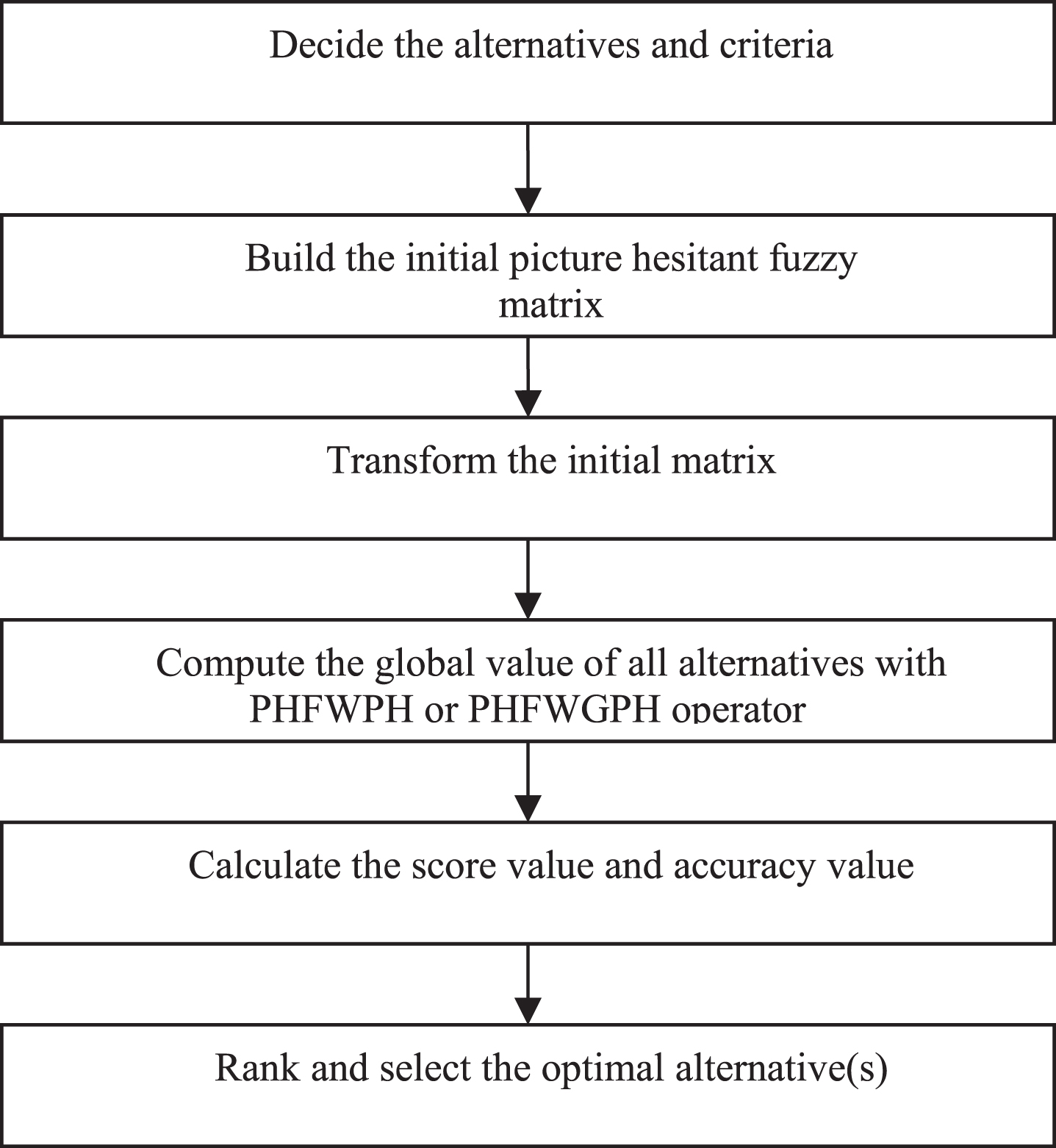
The novel MCDM procedure using the PH operators is illustrated in Fig. 1.
Step 1. Transform the initial matrix.
In MCDM problem, the set of attributes commonly contain the benefit and cost criteria, and the cost criteria need to be converted into the benefit criteria. Thus, the initial matrix D = [βmg] p×h is transformed into the normalized picture hesitant fuzzy matrix based on the formula below.
Here m = 1, 2, ⋯ , p ; g = 1, 2, ⋯ , h.
Step 2. Compute the supports .
Where m = 1, 2, ⋯ , p ; g, f = 1, 2, ⋯ , h, and is the distance between and as given in Definition 4.
The procedure of proposed algorithm.
Step 3. Compute the weigths ςmg relating to the PHFN .
Where ςmg ⩾ 0, , and , m = 1, 2, ⋯ , p ; g, f = 1, 2, ⋯ , h.
Step 4. Obtain the overall value of each alternative.
Aggregate each assessment value of alternative Xm (m = 1, 2, ⋯ , p) associated with criterion Yg (g = 1, 2, ⋯ , h) using PHFWPH or PHFWGPH operator, and the overall value is gained. The values are calculated based on formular (10) and formular (11) in the following.
Step 5. Compute the score value and accuracy value .
According to the formulas in Definition 3, the comparative function values of alternative Xm (m = 1, 2, ⋯ , p) are derived.
Step 6. Rank and choose alternative(s).
We can rank all alternative in terms of their function values. The alternative providing the maximize score value is the best one.
or
Instance and analysis
In this part, an instance is explored to verify the practicability of the MCDM approach mentioned above. Meanwhile, we provide sensitivity and comparison analysis to show the effectiveness of the novel method.
Example
A company wants to choose the most suitable investment project from four alternatives, which are expressed as Xi (i = 1, 2, 3, 4). There are three criteria, namely, risk (Y1), growth (Y2) and environmental impact (Y3), and the corresponding weight of each criterion is ω = (0.35, 0.25, 0.4). The assessment values decided by DMs take the form of PHFN, which is represented as . The initial decision matrix D = [βmg] 4×3 is provided as follows.
Then, we will utilize the novel MCDM approach proposed above to solve this actual example. For simplicity, let s = t = 1.
Step 1. Transform the initial matrix.
Because the criterion Y3 is the cost type, the normalized evaluation PHFN matrix is gained based on the formula (3).
Step 2. Compute the supports .
Based on the formula (4), the support for PHFN from is computed.
Step 3. Compute the weigths ςmg.
Based on the formula , we can get
Thus, based on the formula (5), the weigths ςmg are obtained.
Step 4. Compute the global values of all alternatives.
According to the PHFWPH operator defined in Theorem 2, the global value of Xm (m = 1, 2, 3, 4) can be obtained.
Similarly, the global value of Xm (m = 1, 2, 3, 4) using PHFWGPH operator defined in Theorem 5 can be obtained as well.
Step 5. Compute the score value and accuracy value .
Based on the formulas in Definition 3, the following results using PHFWPH and PHFWGPH operator can be obtained, respectively.
For PHFWPH operator,
For PHFWGPH operator,
Step 6. Rank and choose alternative(s).
The final ranking using PHFWPH operator is X4 ≻ X2 ≻ X1 ≻ X3, the most suitable solution is X4, while X3 is the worst one. Meanwhile, the final ranking using PHFWGPH operator is X2 ≻ X4 ≻ X1 ≻ X3, then the most suitable solution is X2, while X3 is the worst one.
Sensitivity analysis
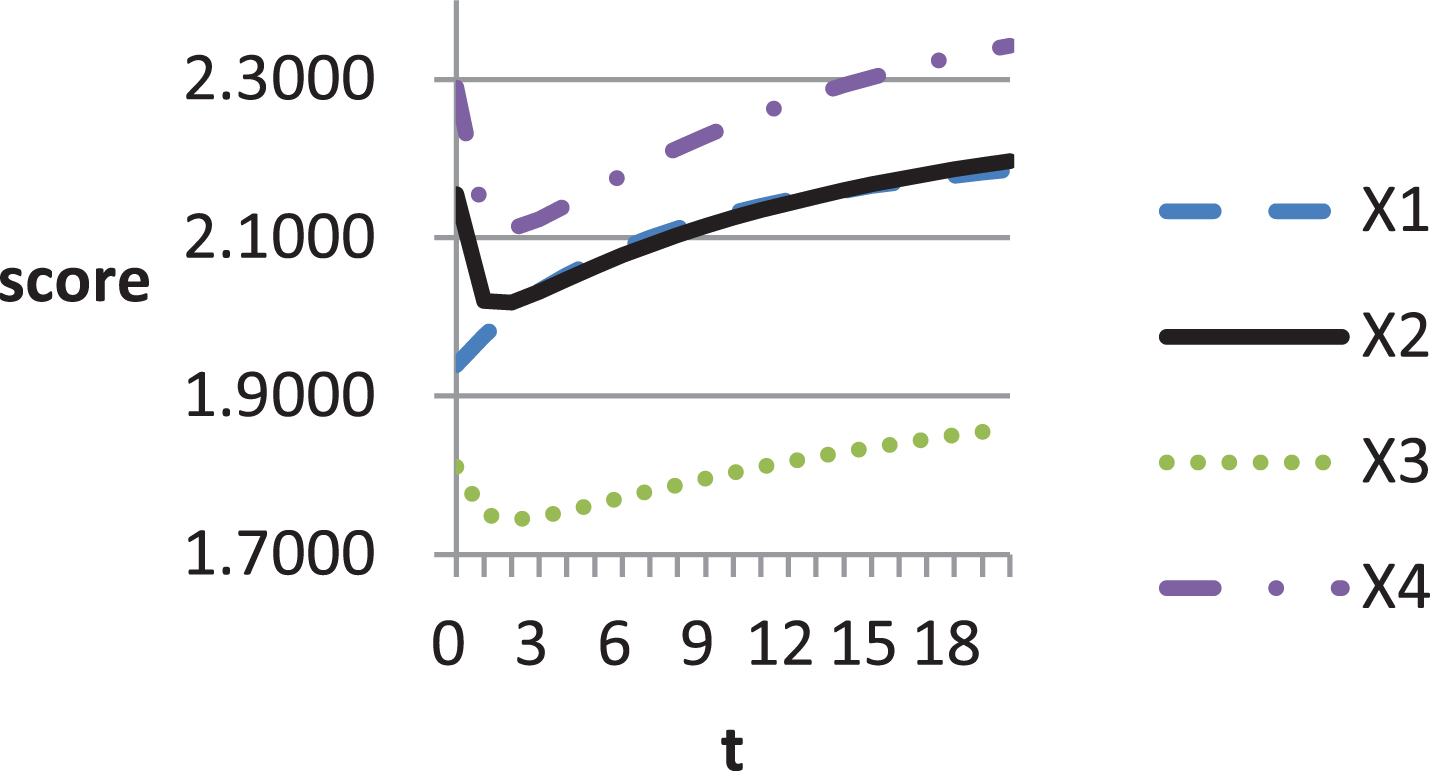
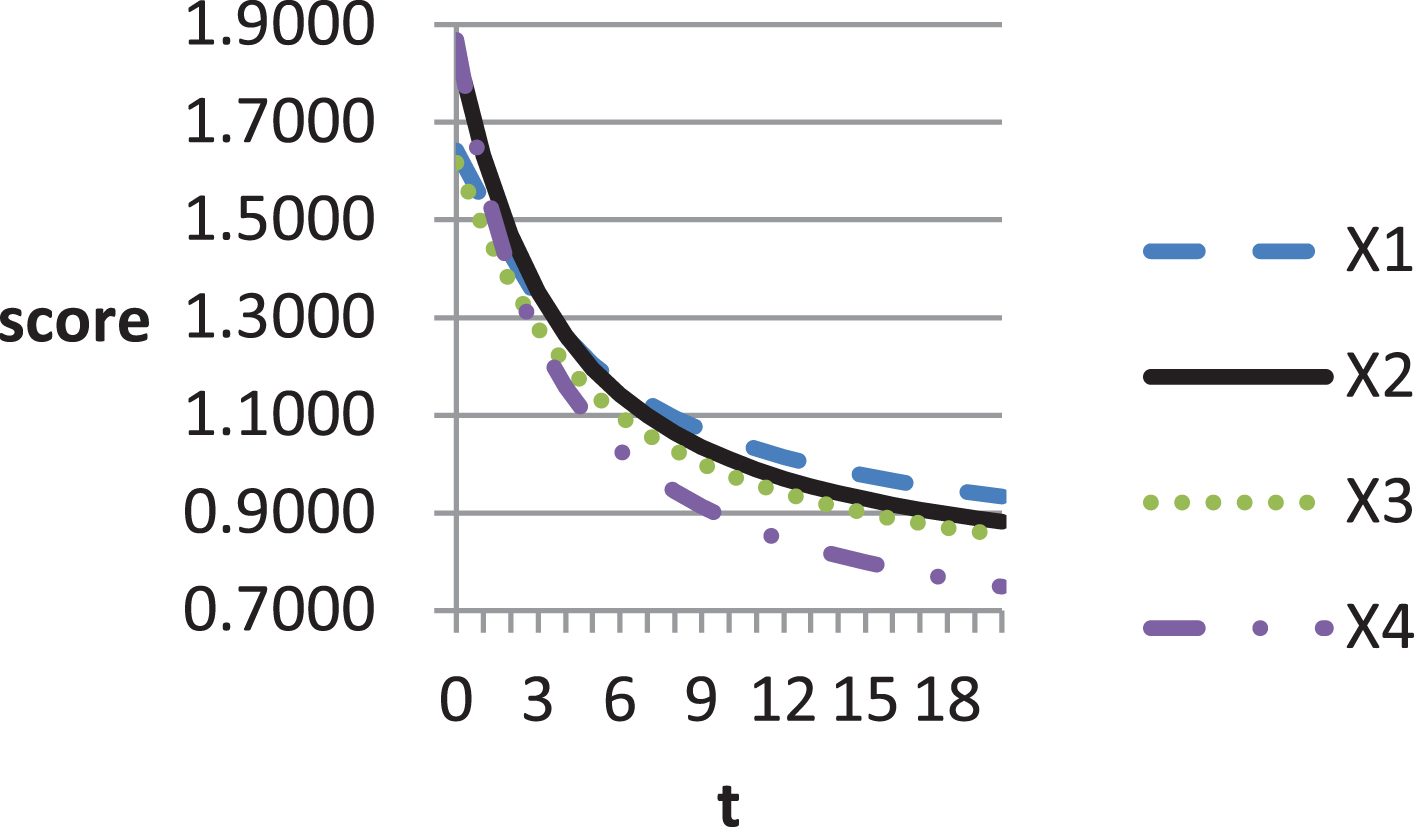
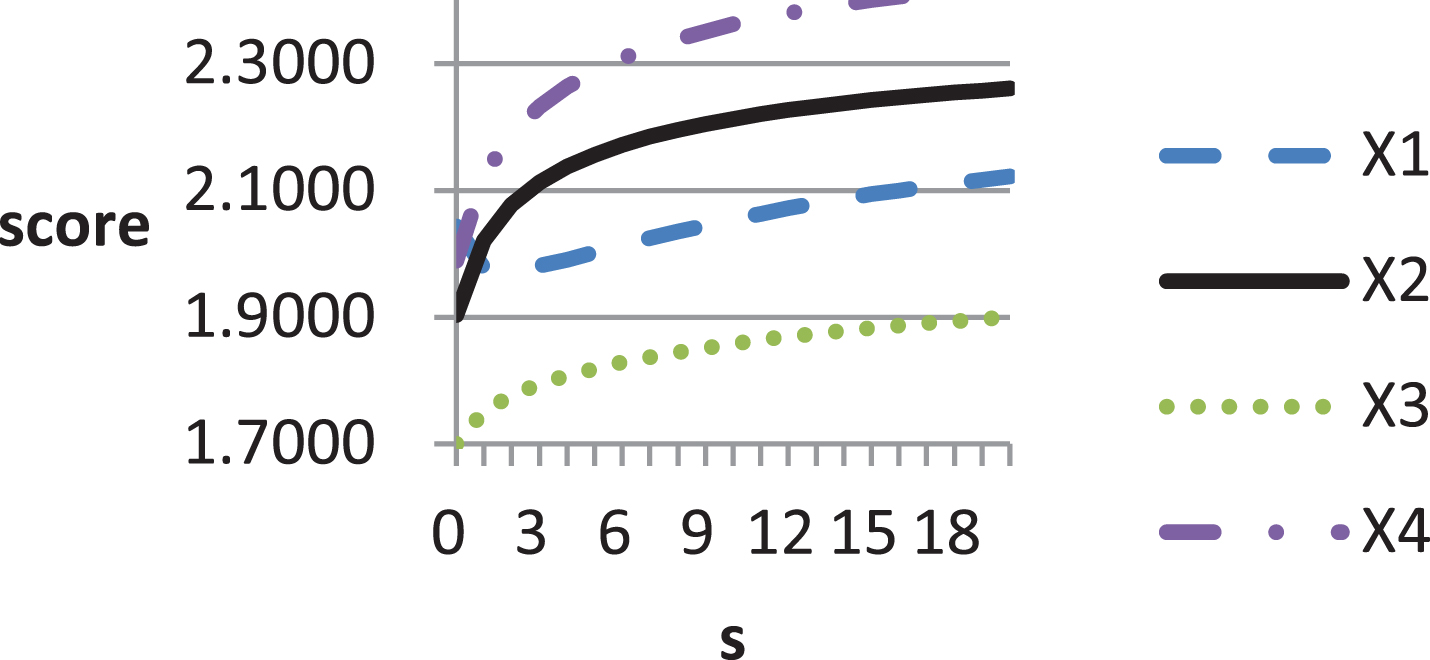
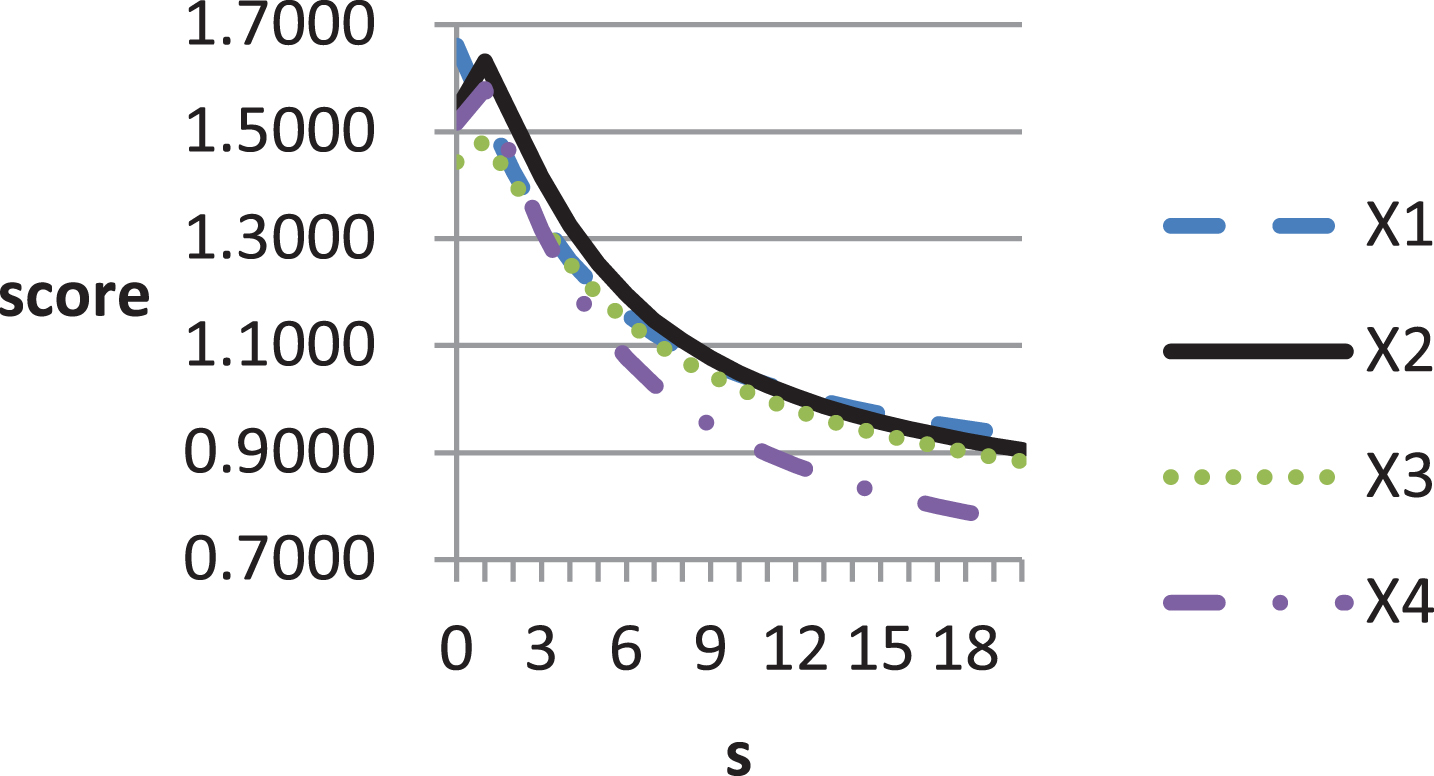
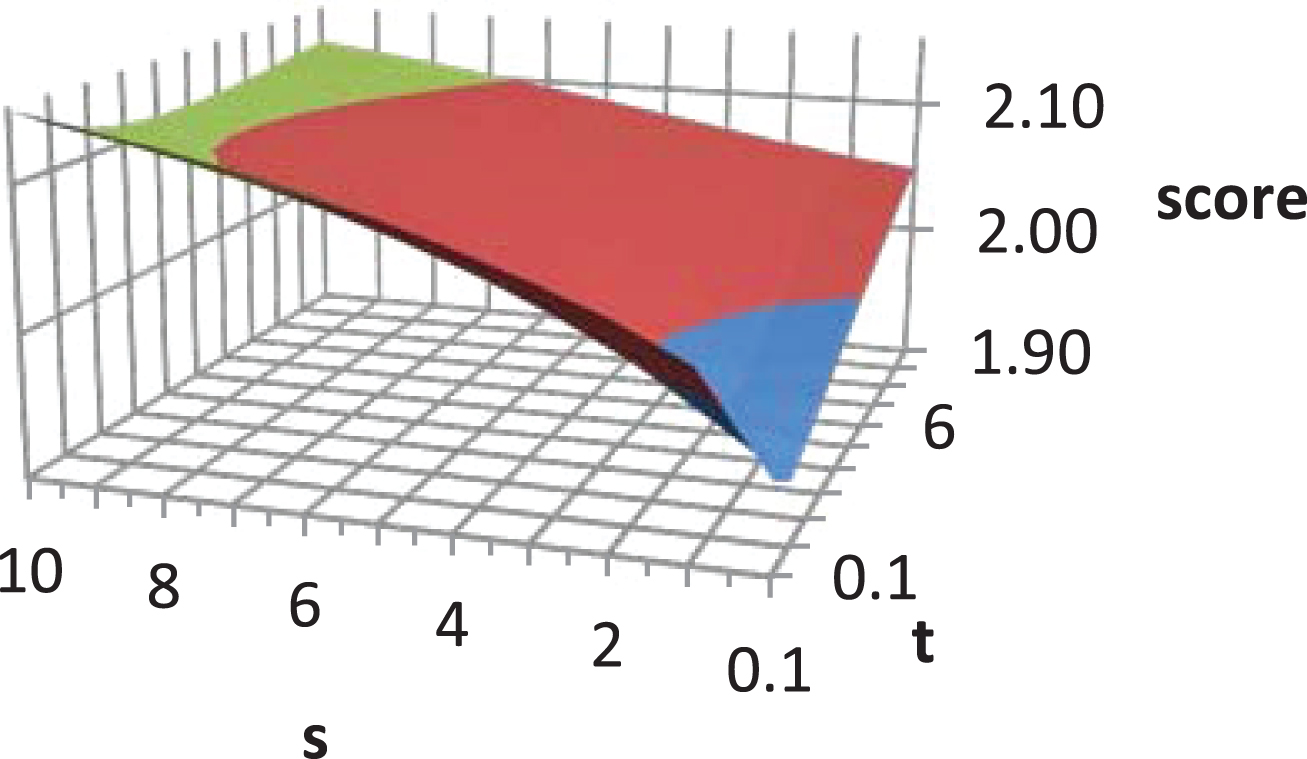
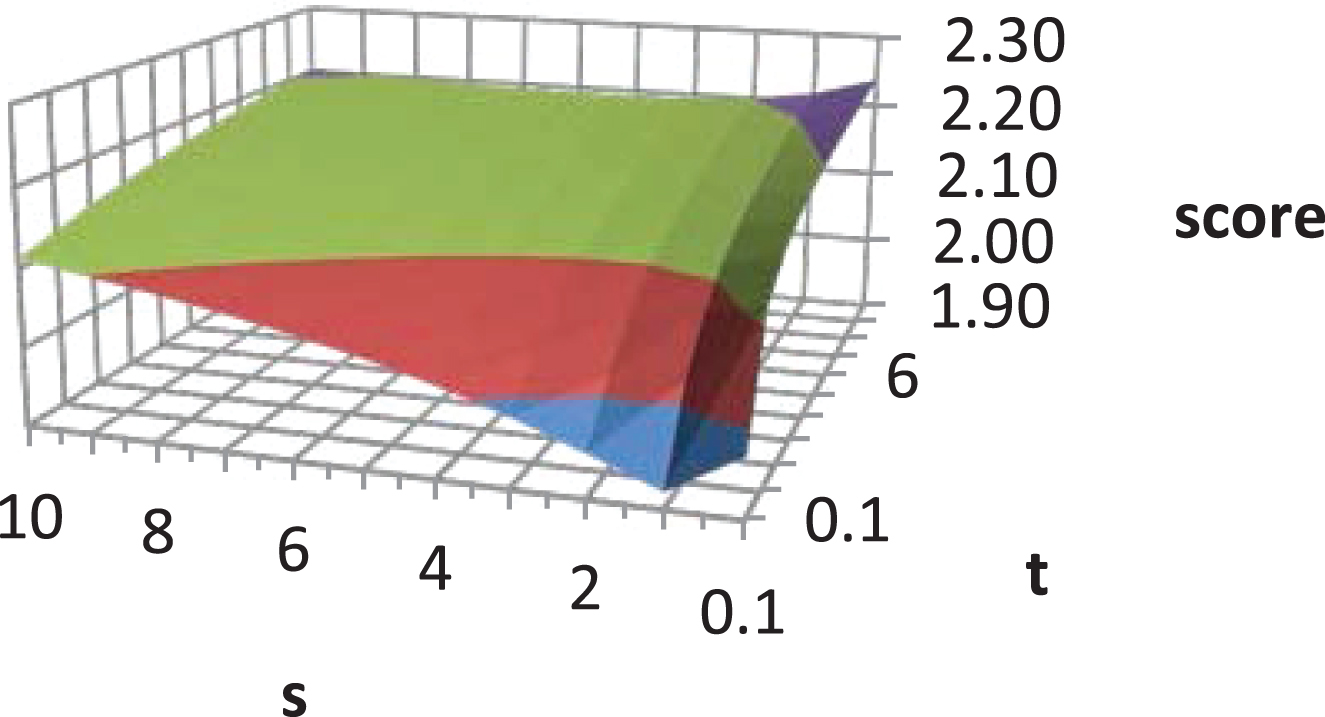
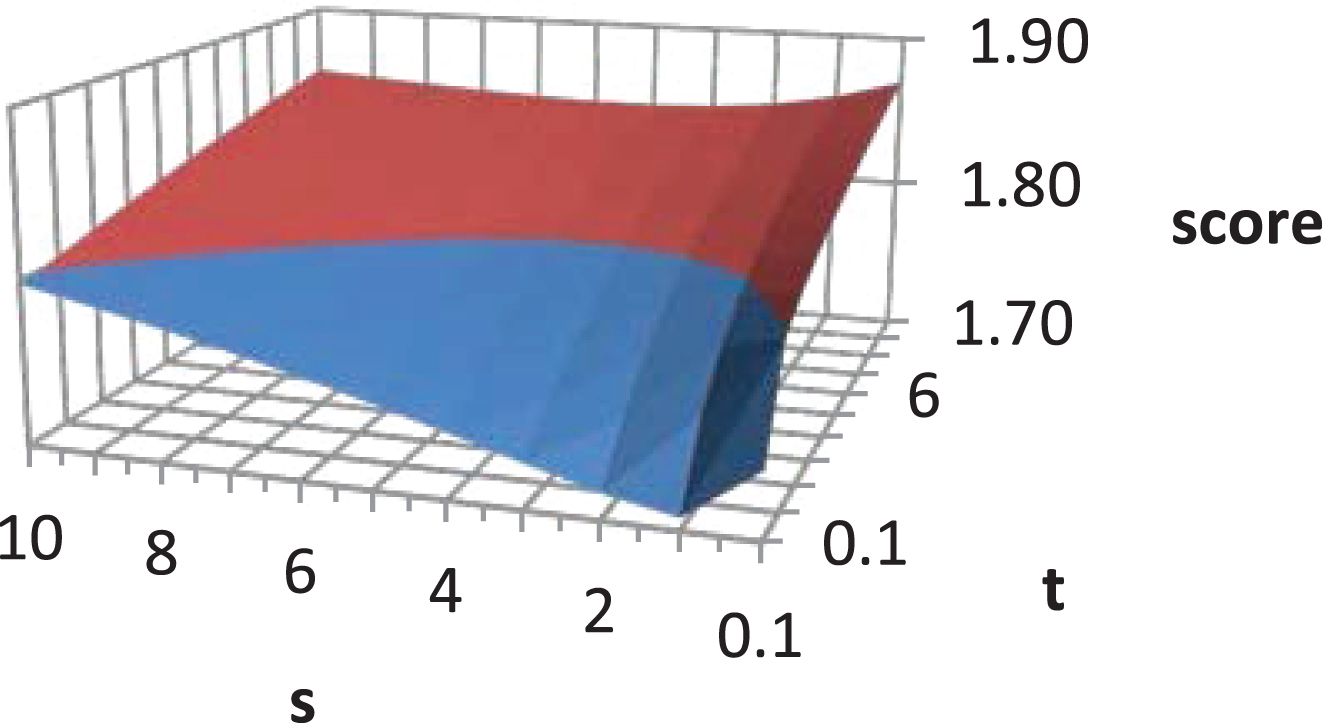
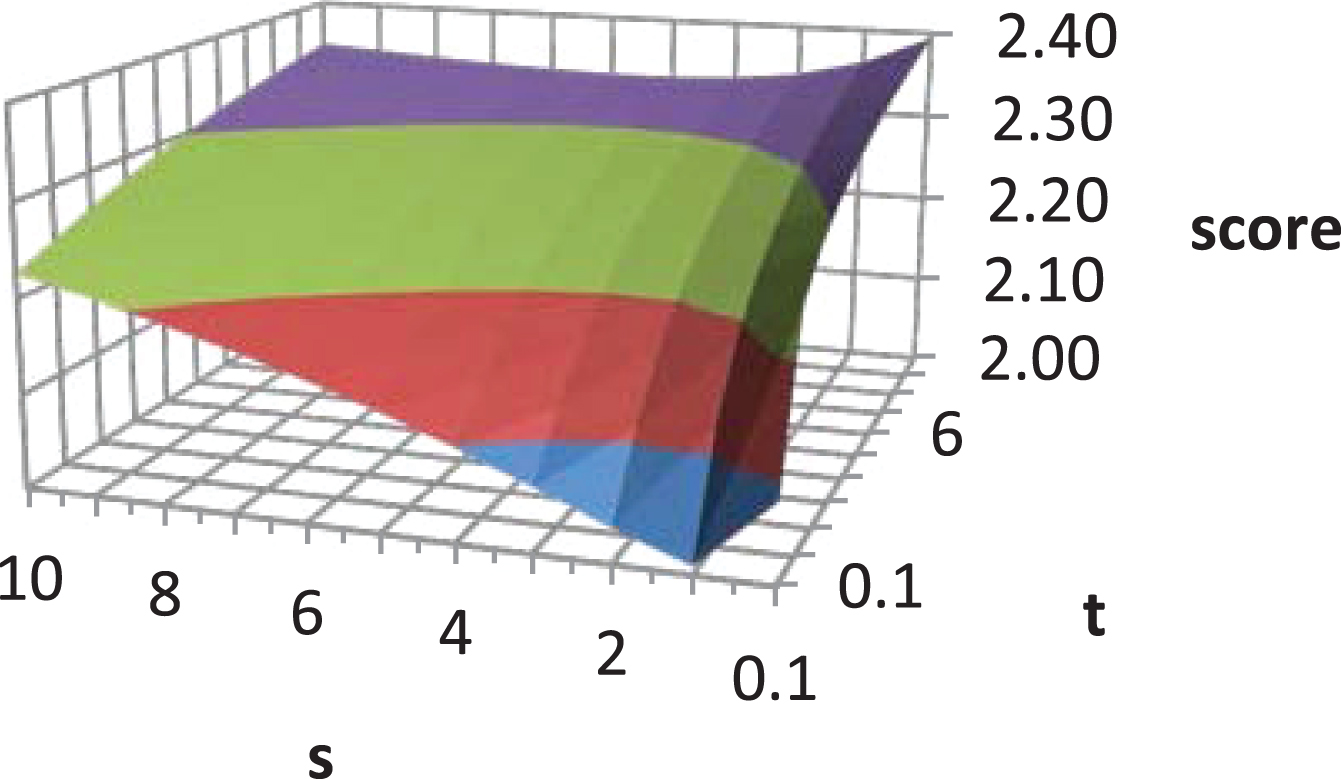
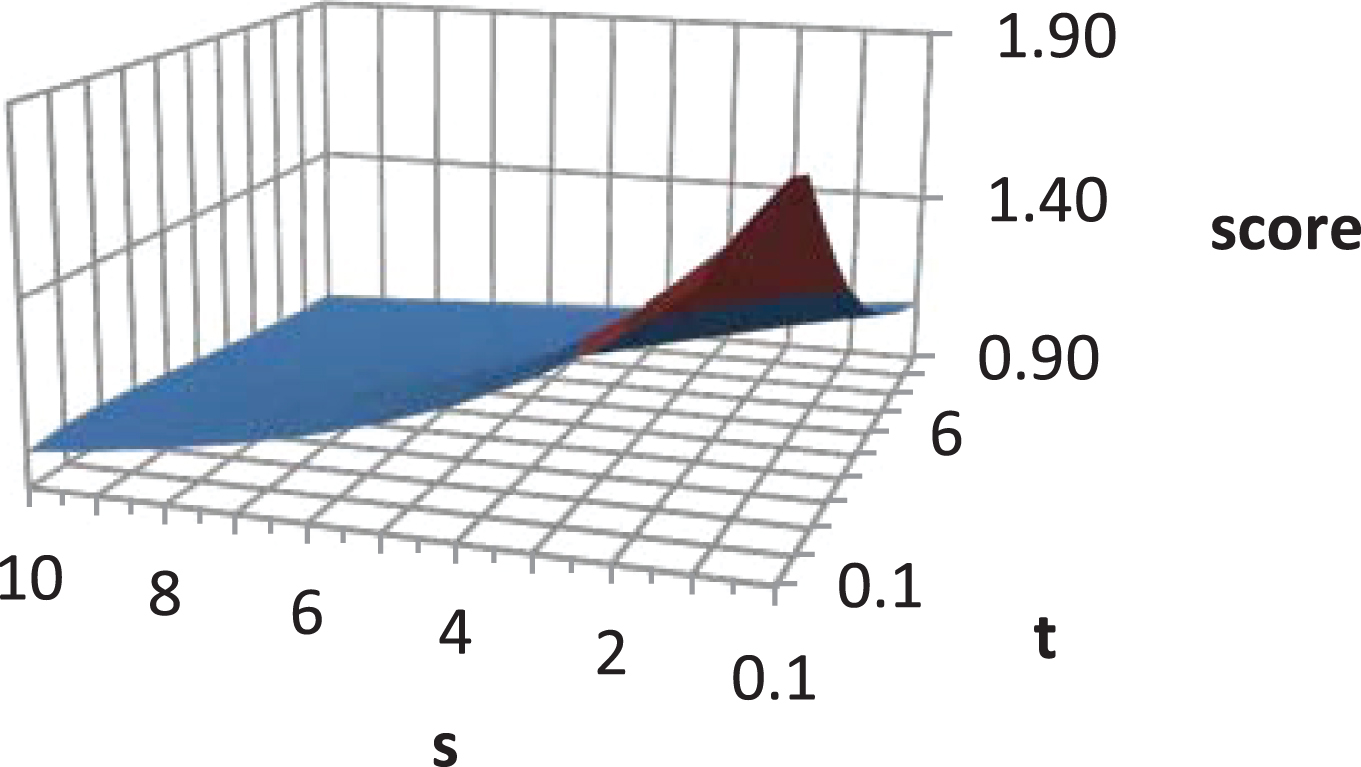
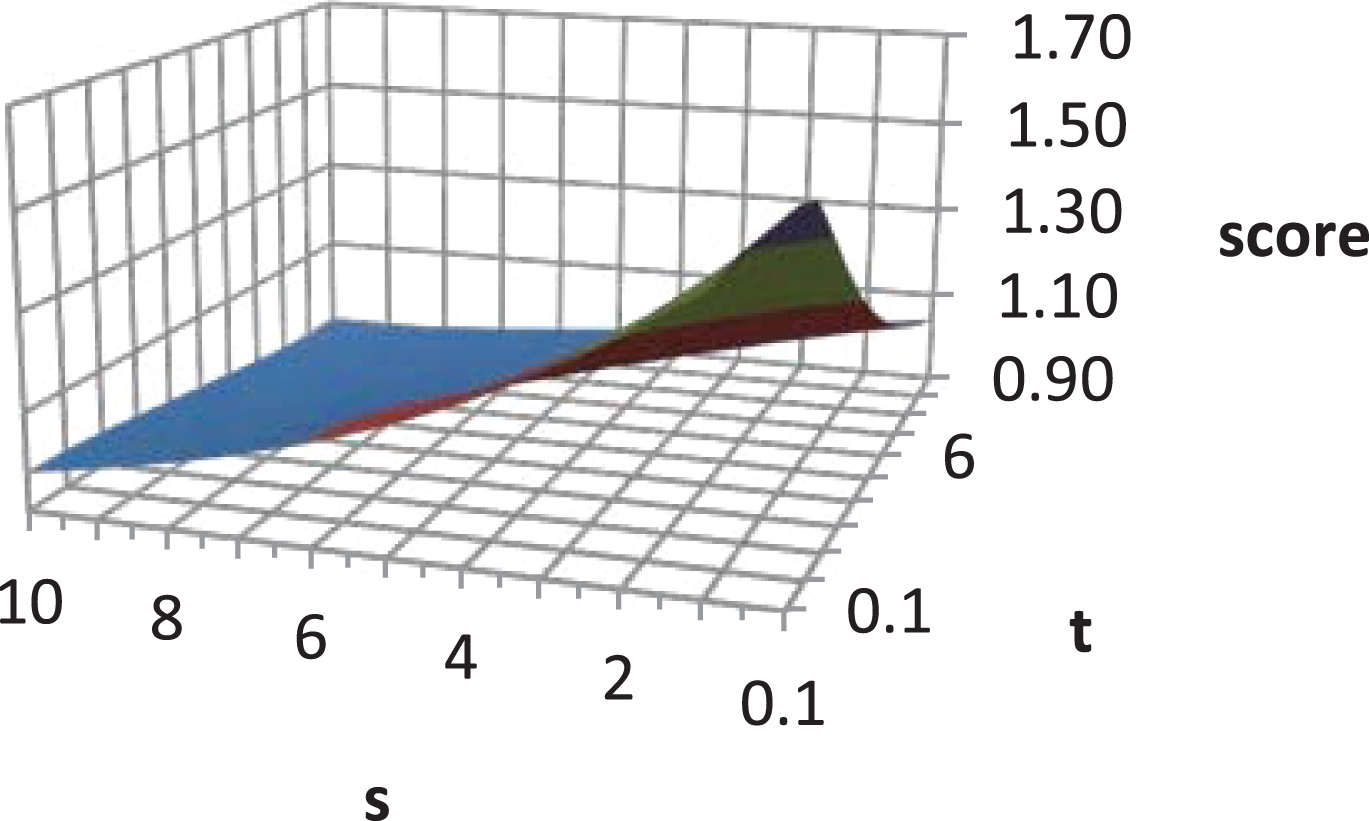
In this part, the influences of different parameters s and t regarding the scores and ranking results of four alternatives are shown in the following Figs. 2–13. When parameter s is equal to 1 and parameter t is varying from 0 to 20, the changing trend of scores regarding four alternatives utilizing PHFWPH operator and PHFWGPH operator are illustrated in Figs. 23, respectively. Similarly, when parameter t is equal to 1 and parameter s is varying from 0 to 20, the changing trend of scores regarding four alternatives utilizing PHFWPH operator and PHFWGPH operator are obtained in Figs. 45, respectively. The scores of alternative Xi (i = 1, 2, 3, 4) utilizing PHFWPH operator are presented in Figs. 6–9 when parameters s and t are varying from 0.1 to 20. Similarly, the scores of alternative Xi (i = 1, 2, 3, 4) utilizing PHFWGPH operator are presented in Figs. 10–13 when parameters s and t are varying from 0.1 to 20.
The score values using PHFWPH operator when s = 1, t ∈ [0, 20].
The score values using PHFWGPH operator when s = 1, t ∈ [0, 20].
The score values using PHFWPH operator when t = 1, s ∈ [0, 20].
The score values using PHFWGPH operator when t = 1, s ∈ [0, 20].
The score values of X1 using PHFWPH operator when s, t ∈ [0 . 1, 20].
The score values of X2 using PHFWPH operator when s, t ∈ [0 . 1, 20].
The score values of X3 using PHFWPH operator when s, t ∈ [0 . 1, 20].
The score values of X4 using PHFWPH operator when s, t ∈ [0 . 1, 20].
The score values of X1 using PHFWGPH operator when s, t ∈ [0 . 1, 20].
The score values of X2 using PHFWGPH operator when s, t ∈ [0 . 1, 20].
The score values of X3 using PHFWGPH operator when s, t ∈ [0 . 1, 20].
The score values of X4 using PWGPH operator when s, t ∈ [0 . 1, 20].
In Fig. 2, let s = 1, it is clearly that the optimal alternative is always X4 and the worst alternative is always X3, no matter what the value of parameter t is. This illustrates the robustness of the PHFWPH operator.
From Fig. 3, we can obatin that the scores of four alternatives utilzing PHFWGPH operator become smaller as the parameter t becomes bigger, and the optimal alternative changes from X2 to X1 as the parameter t becomes bigger.
In Fig. 4, it is clearly that the scores of four alternatives utilzing PHFWPH operator become bigger as the parameter s becomes bigger and s is greater than 1, and the optimal alternative changes from X1 to X4 with the increasing of parameter s, while the worst alternative ialways X3.
In Fig. 5, the optimal alternative is X1 or X2 as parameter s changes, and the worst alternative is X3 or X4. Since the deloping trend of Fig. 5 differs from Fig. 3, then the parameters s and t are asymmetric.
From Figs. 6–9, we can observe that the score values of alternative Xi (i = 1, 2, 3, 4) utilizing PHFWPH operator become smaller as parameters sand t become smaller. As a contrast, the scores of alternative Xi (i = 1, 2, 3, 4) utilizing PHFWGPH operator become bigger as parameters sand t become smaller in Figs. 10–13.
To sum up, different parameters sand t may derive different scores and affect the final selection. DMs can decide the values of parameters sand t in terms of their preference. Therefore, the proposed MCDM method is flexible and practical.
Comparison analysis
In this subsection, the novel approach proposed in this paper with existing picture fuzzy MCDM approach [12, 52] is compared.
Some characteristics comparison of our method with these methods mentioned above are presented in Table 1.
Wei [52] applied weighted average (WA), weighted geometric (WG), ordered weighted average (OWA), and ordered weighted geometric (OWG) operators to solve MCDM problem with picture fuzzy information. One hand, the PH AOs proposed in this paper are more powerful than those proposed by Wei [52], which ignores the influence of irrational data and correlations between criteria. On the other hand, picture hesitant fuzzy information is more practical than picture fuzzy information [52], which is unsuitable to situations where DMs feel hesitant to be difficult to decide a fixed membership degree value.
Wang [12] proposed the definition of PHFS and explored prioritized weighted AOs to MCDM problem. The picture hesitant fuzzy prioritized weighted (PHFPW) AOs investigated by Wang [12] consider different priorities of criteria but cannot capture the interrelationships of criteria and handle the impact of unreasonable data. Thus, the PH AOs proposed in this paper have more advantages than that of Wang [12].
In sum, fuzzy set is only a special case of PHFS. In contrast, our method not only consider the correlations of criteria, but also reduce the impact of irrational data. Moreover, it has two parameters s and t. These characteristics make the proposed method more general and flexible.
Conclusion and future directions
PHFSs can better express the hesitancy of DMs in actual situation with the increasing complicated decision-making environment. Nevertheless, the study on AOs applying to PHFN environment is inadequate. Therefore, we propose two novel AOs, namely, PHFWPH operator and PHFWGPH operator. A novel MCDM approach based on the proposed PH AOs is also investigated under PHFN environment.
In summary, the main characteristics of our work are listed as below: (1) PHFSs are more appropriate to convey uncertain and hesitant information in MCDM problems. (2) The novel MCDM approach is more practical for utilizing PH AOs, which can not only decrease the impact of irrational data but also capture the correlations among criteria. (3) The PH AOs including PHFWPH operator and PHFWGPH operator proposed in this paper are more powerful for fusing multiple values, which provide flexible parameters s and t by DMs according to their actual requirements.
In future, we will explore to apply the proposed PH AOs to other fuzzy sets, such as pythagorean fuzzy set [53], multiple-valued picture fuzzy linguistic set [16], multiple-valued neutrosophic uncertain linguistic set [20], and so on. Meanwhile, we will consider the interaction between membership and non-membership, and further explore the MCDM problems under PHFSs environment where the criteria weights are unknown.
Conflicts of interest
The authors declare no conflict of interest.
Acknowledgments
The authors are very grateful to the anonymous reviewers for their valuable comments and suggestions to help improve the overall quality of this paper.
This work was supported by the Social Science Foundation of Hubei Province (No. 20ZD065) and the industry-university cooperation collaborative education project provided by the Ministry of Education (No. 201802234027).
References
1.
CuongB.C., “Picture fuzzy sets—A new concept for computational intelligence problems,” in Proc. 3rdWorld Congr. Inf. Commun. Technol., pp. 1–3, Dec. 2013.
GargH., Some picture fuzzy aggregation operators and their applications to multicriteria decision-making, Arab. J. Sci. Eng.42 (2017), 5275–5290.
4.
KhanS., AbdullahS. and AshrafS., Picture fuzzy aggregation information based on Einstein operations and their application in decision making, Math. Sci.13 (2019), 213–219.
5.
WeiG.W., Picture fuzzy Hamacher aggregation operators and their application to multiple attribute decision making, Fund. Inform.157 (2018), 271–320.
6.
SonL.H., Generalized picture distance measure and applications to picture fuzzy clustering, Appl. Soft Comput.46 (2016), 284–295.
7.
ZengS., AshrafS., ArifM. and AbdullahS., Application of exponential jensen picture fuzzy divergence measure in multi-criteria group decision making, Mathematics7 (2019), 191.
8.
WeiG., Some cosine similarity measures for picture fuzzy sets and their applications to strategic decision making, Informatica28 (2017), 547–564.
9.
RafiqM., AshrafS., AbdullahS., MahmoodT. and MuhammadS., The cosine similarity measures of spherical fuzzy sets and their applications in decision making, J. Intell. Fuzzy Syst.36 (2019), 6059–6073.
10.
LuoM. and ZhangY., A new similarity measure between picture fuzzy sets and its application, Eng. Appl. Artif. Intel.96 (2020), 103956.
11.
TorraV., Hesitant fuzzy sets, Int. J. Intell. Syst.25 (2010), 529–539.
12.
WangR. and LiY., Picture hesitant fuzzy set and its application to multiple criteria decision-making, Symmetry-Basel10(7) (2018), 295.
13.
YangY., HuJ., LiuY. and ChenX., Alternative selection of end-of-life vehicle management in China: A group decision-making approach based on picture hesitant fuzzy measurements, J. Clean. Prod.206 (2018), 631–645
14.
UllahW., LbrarM., KhanA., KhanM., Multiple attribute decision making problem using GRA method with incomplete weight information based on picture hesitant fuzzy setting, Int. J. Intell. Syst. DOI: 10.1002/int.22324, Nov.2020.
YangL. and LiB., Multiple-valued picture fuzzy linguistic set based on generalized heronian mean operators and their applications in multiple attribute decision making, IEEE Access8 (2020), 86272–86295.
17.
LiuP.D. and ShiL.L., Some neutrosophic uncertain linguistic number Heronian mean operators and their application to multi-attribute group decision making, Neural Comput. Appl.28 (2017), 1079–1093.
18.
YeJ., Multiple attribute group decision making based on interval neutrosophic uncertain linguistic variables, Int. J. Mach. Learn. Cybern.8 (2017), 837–848.
19.
LiB., WangJ., YangL. and LiX., Multiple criteria decision making approach with multivalued neutrosophic linguistic normalized weighted Bonferroni mean Hamacher operator, Math. Problems Eng.2018(2432167) (2018), 1–23.
20.
YangL. and LiB., Multiple-valued neutrosophic uncertain linguistic sets with Dombi normalized weighted Bonferroni mean operator and their applications in multiple attribute decision making problem, IEEE Access8 (2020), 5906–5927.
21.
BonferroniC., Sulle medie multiple di potenze,” Bollettino dell, Unione Matematica Italiana5(3–4) (1950), 267–270.
XuZ. and YagerR.R., Some geometric aggregation operators based on intuitionistic fuzzy sets, Int. J. Gen. Syst.35(4) (2006), 417–433.
24.
YangL. and LiB., Multi-valued neurosophic linguistic power operators and their applications, Eng. Lett.26 (2018), 518–525.
25.
GulistanM., MohammadM., KaraaslanF., KadryS., KhanS. and WahabH., Neutrosophic cubic Heronian mean operators with applications in multiple attribute group decision-making using cosine similarity functions, Int. J. Distrib. Sens. Netw.15 (2019), 21.
26.
YangL. and LiB., An extended single-valued neutrosophic normalized weighted Bonferroni mean Einstein aggregation operator, Int. J. Appl. Math.48 (2018), 373–380.
27.
LiangW., ZhaoG. and LuoS., Linguistic neutrosophic Hamacher aggregation operators and the application in evaluating land reclamation schemes for mines, PLOS One13 (2018), 29.
28.
LiB., WangJ., YangL. and LiX., A novel generalized simplified neutrosophic number Einstein aggregation operator, Int. J. Appl. Math.48 (2018), 67–72.
29.
WuL., WeiG., WuJ. and WeiC., Some interval-valued intuitionistic fuzzy Dombi Heronian mean operators and their application for evaluating the ecological value of forest ecological tourism demonstration areas, Int. J. Environ. Res. Public Health17 (2020), 31.
30.
ZhangH., ZhangR., HuangH. and WangJ., Some picture fuzzy Dombi Heronian mean operators with their application to multi-attribute decision-making, Symmetry-Basel10 (2018), 27.
31.
WeiG., Picture fuzzy Hamacher aggregation operators and their application to multiple attribute decision making, Fundam. Inform.157 (2018), 271–320.
32.
WangR., WangJ., GaoH. and WeiG., Methods for MADM with picture fuzzy Muirhead mean operators and their application for evaluating the financial investment risk, Symmetry-Basel11 (2019), 20.
33.
JanaC., SenapatiT., PalM. and YagerR., Picture fuzzy Dombi aggregation operators: Application to MADM process, Appl. Soft. Comput.74 (2019), 99–109.
34.
AtesF. and AkayD., Some picture fuzzy Bonferroni mean operators with their application to multicriteria decision making, Int. J. Intell. Syst.35 (2020), 625–649.
35.
LuoS. and XingL., Picture fuzzy interaction partitioned Heronian aggregation operators for hotel selection, Mathematics8 (2020), 23.
36.
YagerR.R., The power average operator, IEEE Trans. Syst., Man, Cybern. A, Syst. Humans31(6) (2001), 724–731.
37.
BeliakovG., PraderaA., CalvoT., “Aggregation functions:Aguide for practitioners,” in Studies in Fuzziness and Soft Computing. Berlin, Germany: Springer-Verlag, 2007.
38.
BonferroniC., Sulle medie multiple di potenze, Bollettino dell’Unione Matematica Italiana5 (1950), 267–270.
39.
LiuP., Multiple attribute group decision making method based oninterval-valued intuitionistic fuzzy power Heronian aggregationoperators, Comput.Ind.Eng.108 (2017), 199–212.
40.
LiuP., MahmoodT. and KhanQ., Group decision making based on power Heronian aggregation operators under linguistic neutrosophic environment, Int. J. Fuzzy. Syst.20 (2018), 970–985.
41.
LiuP., KhanQ. and MahmoodT., Group decision making based on power Heronian aggregation operators under neutrosophic cubic environment, –, Soft. Comput.24 (2020), 1971–1997.
42.
LiuP., KhanQ., MahmoodT., SmarandacheF. and LiY., Multiple attribute group decision making based on 2-tuple linguistic neutrosophic Dombi power heronian mean operators, IEEE Access7 (2020), 100205–100230.
43.
ShiM., YangF. and XiaoY., Intuitionistic fuzzy power geometric heronian mean operators and their application to multiple attribute decision making, J. Intell. Fuzzy. Syst.37 (2019), 2651–2669.
44.
ZhaoS., WangD., LiangC., LengY. and XuJ., Some single valued neutrosophic power heronian aggregation operators and their application to multiple-attribute group decision-making, Symmetry-Basel11 (2019), 653.
45.
JuD., JuY. and WangA., Multi-attribute group decision making based on power generalized heronian mean operator under hesitant fuzzy linguistic environment, Soft.Comput.23 (2019), 3823–3842.
46.
WangJ., WangP., WeiG., WeiC. and WuJ., Some power heronian mean operators in multiple attribute decision-making based on q-rung orthopair hesitant fuzzy environment, J. Exp. Theor. Artif. In32 (2019), 909–937.
47.
JiangS., HeW., QinF. and ChengQ., Multiple attribute group decision-making based on power heronian aggregation operators under interval-valued dual hesitant fuzzy environment, Math. Problems Eng.2080413 (2020), 1–19.
48.
DordevicD., StojicG., StevicZ., PamucarD., VulevicA. and MisicV., A new model for defining the criteria of service quality in rail Transport: The full consistency method based on a rough power Heronian aggregator, Symmetry-Basel11 (2019), 992.
49.
ZhongY., GaoH., WeiG., GuoX., QinY., HuangM. and LuoX., Dombi power partitioned Heronian mean operators of q-rung orthopair fuzzy numbers for multiple attribute group decision making, PloS One14 (2019), e0222007.
50.
BaiK., ZhuX., WangJ. and ZhangR., Power partitioned Heronian mean operators for q-rung orthopair uncertain linguistic sets with their application to multiattribute group decision making, Int. J. Intell. Syst.35 (2019), 3–37.
51.
SykoraS., Mathematical means and averages: Generalized Heronian means, Stan’s Libr., Castano Primo, Italy3 (2009).
52.
WeiG., Picture fuzzy aggregation operators and their application to multiple attribute decision making, J. Intell. Fuzzy. Syst.33 (2017), 1–12.
53.
WangL., GargH. and LiN., Pythagorean fuzzy interactive Hamacher power aggregation operators for assessment of express service quality with entropy weight, Soft. Comput.25(5) (2021).