



Abstract
This research is about the development of a dynamic programming model for solving fuzzy linear programming problems. Initially, fuzzy dynamic linear programming model FDLP is developed. This research revises the established dynamic programming model for solving linear programming problems in a crisp environment. The mentioned approach is upgraded to address the problem in an uncertain environment. Dynamic programming model can either be passing forward or backward. In the proposed approach backward dynamic programming approach is adopted to address the problem. It is then followed by implementing the proposed method on the education system of Pakistan. The education system of Pakistan comprises of the Primary, Middle, Secondary, and Tertiary education stages. The problem is to maximize the efficiency of the education system while achieving the targets with minimum usage of the constrained resources. Likewise the model tries to maximize the enrollment in the Primary, Middle, Secondary and Tertiary educational categories, subject to the total available resources in a fuzzy uncertain environment. The solution proposes that the enrollment can be increased by an amount 9997130, by increasing the enrollment in the Middle and Tertiary educational categories. Thus the proposed method contributes to increase the objective function value by 30%. Moreover, the proposed solutions violate none of the constraints. In other words, the problem of resources allocation in education system is efficiently managed to increase efficiency while remaining in the available constrained resources. The motivation behind using the dynamic programming methodology is that it always possesses a numerical solution, unlike the other approaches having no solution at certain times. The proposed fuzzy model takes into account uncertainty in the linear programming modeling process and is more robust, flexible and practicable.
Keywords
Introduction
The idea of fuzzy sets was proposed by L. A. Zadeh. Bellman and Zadeh proposed the process of decision making as an intersection of the fuzzy objective function and fuzzy resource constraints. This idea was adapted to introduce fuzzy linear programming problems.
After that, different approaches were proposed to address fuzzy linear programming problems. Some authors addressed problems when the models were partially fuzzy. Moreover, the problems were fully fuzzy in some studies. The methodology was either to convert the problem to its crisp equivalent or solve the problem directly using the simplex method.
To elaborate more, there are two approaches to solve the fuzzy linear programming problems.
1. To solve the problem using the fuzzy arithmetic operations (For example interval operations, fuzzy triangular arithmetic operations, fuzzy trapezoidal arithmetic operations etc). In such cases first of all the operations are well defined in the research and then the fuzzy linear programming is solved with the help of them.
2. To convert the problem to its equivalent crisp model and then use the world wide accepted crisp arithmetic operations. In this case there is no need to introduce new arithmetic operations for the fuzzy linear programming model.
The authors of [1–3] used ranking function to solve linear programming problems directly without converting it to their crisp equivalent. Li and Wang [4] used a fuzzy relational approach to address linear programming problems. In some studies fully fuzzy linear programming problems were solved by converting the problems to its crisp equivalent. Computational algorithms were developed in to solve fully fuzzy linear programming problems. Lexicographic methods were developed in [5, 6] for solving fully fuzzy linear programming problems. Ezzati et al. [7] proposed a new method by comparing triangular fuzzy numbers. Ebrahimnejad and Verdegay [8] proposed a method for bounded variable linear programming problem.
Ezzati et al., [9] proposed some new operations and solved intuitionistic fuzzy linear programming problems with lexicographic method. The operations defined in [9] were adopted in Daneshra and Jafari, [10] to solve fully fuzzy linear programming problems. A full literature review on the development and evolution of fuzzy linear programming can be found in Verdegy [11]. The authors of [12] adopted simplex approaches with ranking function for solving fuzzy linear programming problems. Generalized fuzzy LR numbers were used in Gong el al., [13] to solve fully fuzzy linear programming problems. The author of [14] applied the idea of weak and strong dominance to solve the problem. problems with fuzzy constraints and objective functions were considered in Zack [15]. Ghanbari et al., [16] utilized a revised kerre’s method for solving fuzzy linear programming problem. In [17–19] different techniques for solving fuzzy linear programming problems were proposed. In [20] fully fuzzy linear programming problem was addressed using LR fuzzy numbers, whereas, an epsilon constraint method was used in [21]. In studies [22–24] lexicographic methods were used to address fuzzy linear programming problems. Recently efficient techniques were developed to address the fuzzy linear programming problems. The authors of [25] used ant colony computational algorithm for identifying the shortest path in a network having fuzzy weighted values on its arcs. To solve linear and fractional linear programming problem a multi-objective optimization schema was presented in [26]. Interval fuzzy linear programming problem were solved with the help of distance ranking approach in [27]. In study [28], a computational algorithm was utilized to solve the problem with multi-objective linear programming method.
The idea of dynamic programming was proposed by Bellman in 1957. Approximate dynamic programming problems were solved by using linear programming approach in [29, 30]. A constraint sampling approach to solve approximate dynamic programming problem was presented in de Farias and Roy [31]. Buyuktahtakin [32] solved dynamic programming problem with linear programming approach.
A thorough review of the literature reveals that although linear programming problems have been previously addressed by dynamic programming approach, however, fuzzy linear programming problems (FLPs) have not been addressed by the dynamic programming approach to date. Thus there is a possible and promising gap to address FLPs through the method of dynamic programming. The authors of [33] pointed that although many methods have been previously devised to solve fuzzy linear systems, however none of them is considered the best. Thus the need for applying dynamic programming approach to solve fuzzy linear programming problems increases. The present study proposes dynamic fuzzy linear programming DFLP model. The proposed model is then implemented on the education system of Pakistan. Furthermore, the importance of the technique for dynamic fuzzy linear programming increases to implement it on data envelopment analysis, transportation and shortest path problems [34–37].
The statement of the proposed research problem is “How fuzzy linear programming problems can be solved by a dynamic programming Approach?”. The research addresses the following questions. How fuzzy linear programming problems can be addressed by using a dynamic programming Approach? What will be the revised version of the dynamic linear programming model in a fuzzy environment? How fuzzy linear programming problems with fuzzy constraints (total resource availability / right hand side) can be addressed by using a dynamic programming Approach? How to implement the proposed model on the education system in Pakistan, make analysis, identify the possible areas of improvement, make suggestions for future planning.
This study is organized as follows. After the introduction, the approach of dynamic programming for solving linear programming is presented. This is followed by section (3), in which, the main novel technique for solving fuzzy linear programming problems with the dynamic programming approach is proposed. Section (3) has three subsections, namely 3.1.1, 3.1.2 and 3.1.3. In section (4), we implement the proposed method on the education system of Pakistan. Study is concluded in section (5).
Dynamic programming approach for solving linear programming problems
The classical maximization problem is given below:
The problem is solved as an “n” stage dynamic computational problem. At each stage, the technique of backward computational procedure is used for the determination of the variable x j , j = 1, 2, 3, . . . , n. Furthermore, b1, b2, . . . , b m denote the available resources of “m” sources. At each stage, the states variables u ij , i = 1, 2, 3, . . . , m, j = 1, 2, 3, . . . , n, are the available resources to be allocated. The “n” stage dynamic computational algorithm is presented as below.
Stage n:
Equation (2) suggests that the maximum value of [c
n
x
n
], occurs at x
n
= Min [u
in
] , i = 1, 2, 3, … , m . Thus (2), becomes (3).
It is worth noting that constraints of “⩽” are used that is why we take x n = Min [u in ] , i = 1, 2, 3, … , m, at a particular stage Ahmad et al., [38]. For constraints of “⩾” type, we may change it to x n = Max [u in ] , i = 1, 2, 3, . . . , m, formulate the dual, or multiply the constraint by – 1 to convert to “⩽”. Furthermore, for “=” type constraints, we are confronted with the curse of dimensionality. The problem then should be n × n dimensional only. In other words the number of unknowns must be equal to the number of constrains. In that case we have no specific one value to be selected over a range of constraints [u in ] , i = 1, 2, 3, . . . , m, at any specific stage.
The states variables u
in
, i = 1, 2, 3, . . . , m, can be determined.
From (4), the optimal value is given.
Stage n-1:
The states variables and the optimal state are given in (8) and (9).
Here,
Stage n-2:
The optimal functional value, states variables and optimal state are given in (11), (12) and (13), respectively.
Here,
Stage 3:
Continuing in the same manner as given in stages n, n-1, and n-2, we can formulate the optimal function for stage 3 as:
Stage 2:
Put value of (14) in (15).
The state variable ui2, i = 1, 2, 3, . . . , m, can be determined.
From (17), the optimal value is determined as given below.
Here,
Equation (19) gives optimal value at stage “2”.
Stage 1:
Put value of (19) in (20).
The states variables ui1, i = 1, 2, 3, . . . , m, can be given as:
From (22), the optimal value is determined as given below.
Here,
In this section the proposed technique for solving fuzzy linear programming problems is presented. It is assumed that in the fuzzy linear programming the total available resources B1, B2, . . . , B m are fuzzy, presented in section 3. This technique consists of three steps presented in sub-sub sections 3.1.1, 3.1.2, and 3.1.3.
Proposed dynamic fuzzy linear programming in which the total available resources B1, B2, . . . , B m are Fuzzy
The problem is given as (25).
Here, B1, B2, . . . , B m , are fuzzy total available resource given by Equation (26).
Next, we determine the lower value of the objective function z
l
from the linear programming model given below:
Here,
Furthermore, the upper value of the objective function z
u
is determined from the model below:
The value of the objective function is then obtained from the lower and upper solution as (29).
The optimal value of the objective function between z
l
and z
u
is then obtained from the linear programming problem.
Equations (27) and (28) are solved by using the dynamic programming approach, whereas, (30), is solved by using the classical linear programming approach.
The linear program (27) is solved by using dynamic programming approach. Equation (27) can be rewritten (31).
This problem is same as problem in Equation (1). The optimal values of the function at “stage n, stage n-1, ..., stage 3, stage 2, stage1”, are calculated same as in equation “(3), (10), (11), ..., (14), (19), (24)”, respectively.
In this step the linear program (28) is solved by using dynamic programming approach. Equation (28) rewritten (32).
The problem comprises of an “n” stage dynamic computational problem. At each stage, the backward computational technique determines the variable x j , j = 1, 2, 3, . . . , n. Moreover, b1 + p1, b2 + p2, . . . , b m + p m denote the available resources of “m” sources. The state variables u ij , i = 1, 2, 3, . . . , m, j = 1, 2, 3, . . . , n, are the available resources to be allocated. The “n” stage dynamic computational algorithm is presented below.
Stage n:
The maximum of (33) occurs at x n = Min [u in ] , i = 1, 2, 3, … , m .
The states variables u
in
, i = 1, 2, 3, . . . , m, can be given as:
From (35), the optimal value is given as (36).
Stage n-1:
The states variables and optimal state can be given.
Here,
Equation (40) gives optimal value at stage “n-1”.
Stage n-2:
The optimal functional value, states variables and optimal state are given in (41), (42) and (43), respectively.
Here,
Stage 3:
Continuing in the manner as given in stages n, n-1, and n-2, we formulate the optimal function for stage 3 as given below.
Stage 2:
The states variables and optimal state can be determined.
Here,
Equation (48) gives optimal value at stage “2”.
Stage 1:
Substitute
The optimal states variables can be determined as below (51).
Here,
Equation (52) gives optimal value at stage “1”.
The procedure from stage n to 1 is summarized in the Table 1.
Procedure from Stage n to Stage 1 for the Upper Bound LP problem
The lower and upper values of the objective function z l and z u , obtained in step 1 and step 2, respectively, are used to determine the function (53).
Now, the optimal value of the objective function is obtained from the linear program (54).
The approaches of linear programming and fuzzy linear programming have been extensively used for educational planning around the globe. The authors of [39], used linear programming for student allocation in education programs. Hassan [40] used mathematical programming approach for students allocation to educational programs. Amaya et al., [41] proposed an optimized model for resource allocation in Chilean public school system. El-Quliti and Mohamed [42] used a non linear integer goal programming approach for national planning and admission capacity in the higher education system of Saudi Arabia. Jayashree et al., [43] used goal programming for university management system. Thus a thorough review of literature shows that these studies used linear programming, goal programming and mathematical programming techniques for different purposes in the field of education planning and management in different countries. Thus the application of the proposed dynamic fuzzy linear programming approach to the resource allocation problem in education system of Pakistan is not far from its practicability and implementation. The primary superiority of the proposed method is the flexibility, robustness and uncertainty in modeling the educational system of Pakistan.
The education system of Pakistan consists of the educational categories of primary, middle, secondary and tertiary systems. The data in Table 2, obtained for the resources constraints are as follows [44–47]. It is worth noting that the tertiary educational category is composed of the higher secondary schools, degree colleges, universities, technical and vocational institutions, and teacher training institutions.
The per enrollment utilization of these constraints can be summarized in the Table 3. Let x1, x2, x3, and, x4 denote the enrollment in the primary, middle, secondary and tertiary programs.
Per Enrollment Utilization of the Constrained Resources
Then we formulate the fuzzy model as (55).
The fuzzy constraints are then formulated as (56).
Here, p1 = 500, p2 = 10000, p3 = 500000, p4 = -10000, p5 = 20000, p6 = -400000. It is worth noting that the incorporation of p i , i = 1, 2, 3, . . . , 6 make the problem fuzzy. Furthermore, the selection of p i , i = 1, 2, 3, . . . , 6 is intuitive. Yet again the values must be so wisely chosen such that it may not be too small to record any change, nor too large to change the problem drastically.
The lower linear programming model (Crisp/Non Fuzzy) can be formulated as (57).
Furthermore, the upper linear programming model can be formulated as (58).
The solutions of the lower and upper programming models (57), (58) are z l = 43302841, z u = 43414932 .
The initial lower and upper solutions (although not final solutions) can be written in the interval form. Note that the interval solutions are obtained from lower model (57) and upper model (58) as z l = 43302841 and z u = 43414932, respectively. The solutions can be written in the interval form. The lower and upper solutions of (57) and (58) are further used in (59) and another linear programming problem (60) is formulated. This is because we follow Khan and Rafique [48] and Klir and Yaun [49], where they did not rely on the lower and upper solutions, but further used it to formulate a model of the form (59) and finally another independent linear programming problem of the form (60). It is further worth noting that no interval arithmetic operations of addition, subtraction, multiplication and division are used to calculate the interval solutions. Thus the initial level solutions construct our models (59) and (60) and do not reflect our final solutions. The final solutions will be that obtained from model (60).
The solutions of the lower and upper programming models (57), (58), as shown in Fig. (1) gives z l = 43302841, z u = 43414932, that can be used to formulate the fuzzy function as given (59).
The information above can be used to model the fuzzy model (60).
The optimal solution of the model gives λ = 0.9, x1 = 1039376, x2 = 14929029, x3 = 1750958, x4 = 25584360 and z = 43303723 as shown in Table 4. This is an amount 9997130 greater than the present enrollment.
Lower solution, upper solution and solution for the proposed fuzzy model
Solution- Present Enrollment 9997130.
Note that the values of the present enrollment are from Pakistan Education Statistics 2014-2015, Pages 9– 27, 76. It is worth noting that enrollment in the tertiary educational category is composed of the enrollments in higher secondary schools, degree colleges, universities, technical and vocational institutions, and teacher training institutions [45] page 76.
Figure 2 shows a comparison of the lower, upper and the solution of the model (57), (58) and (60), respectively.
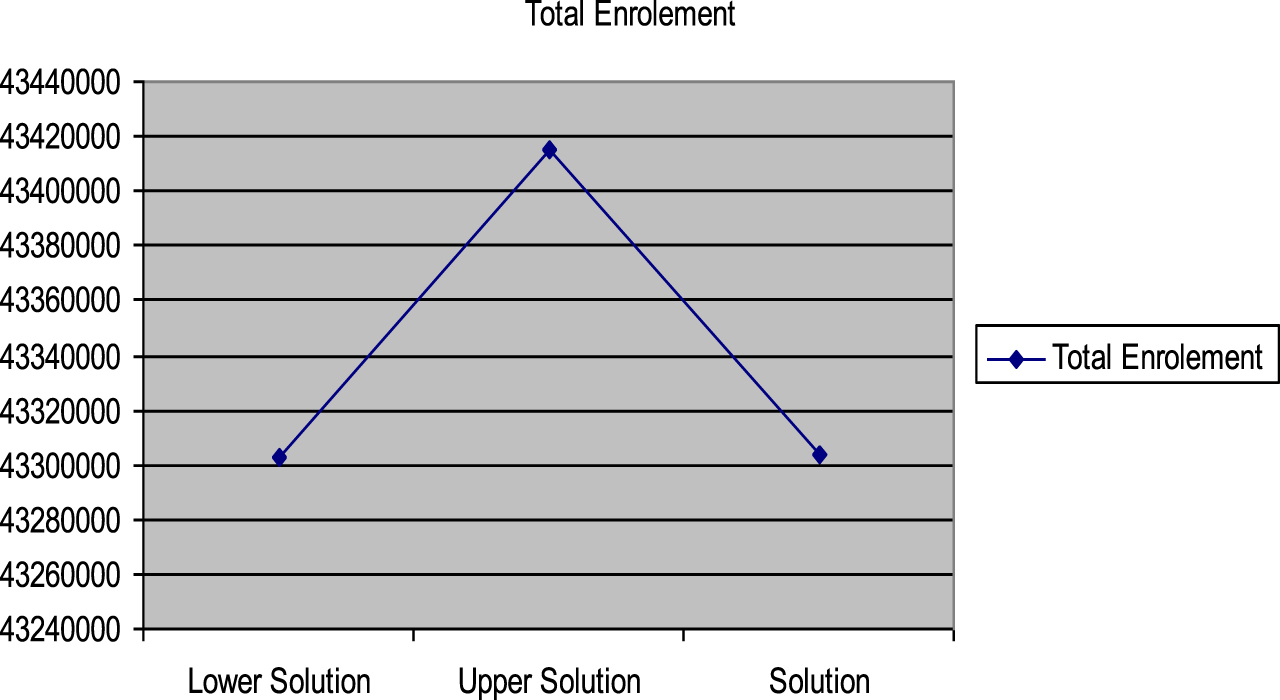
Lower Solution, Upper Solution and Solution of the Fuzzy Programming Model.
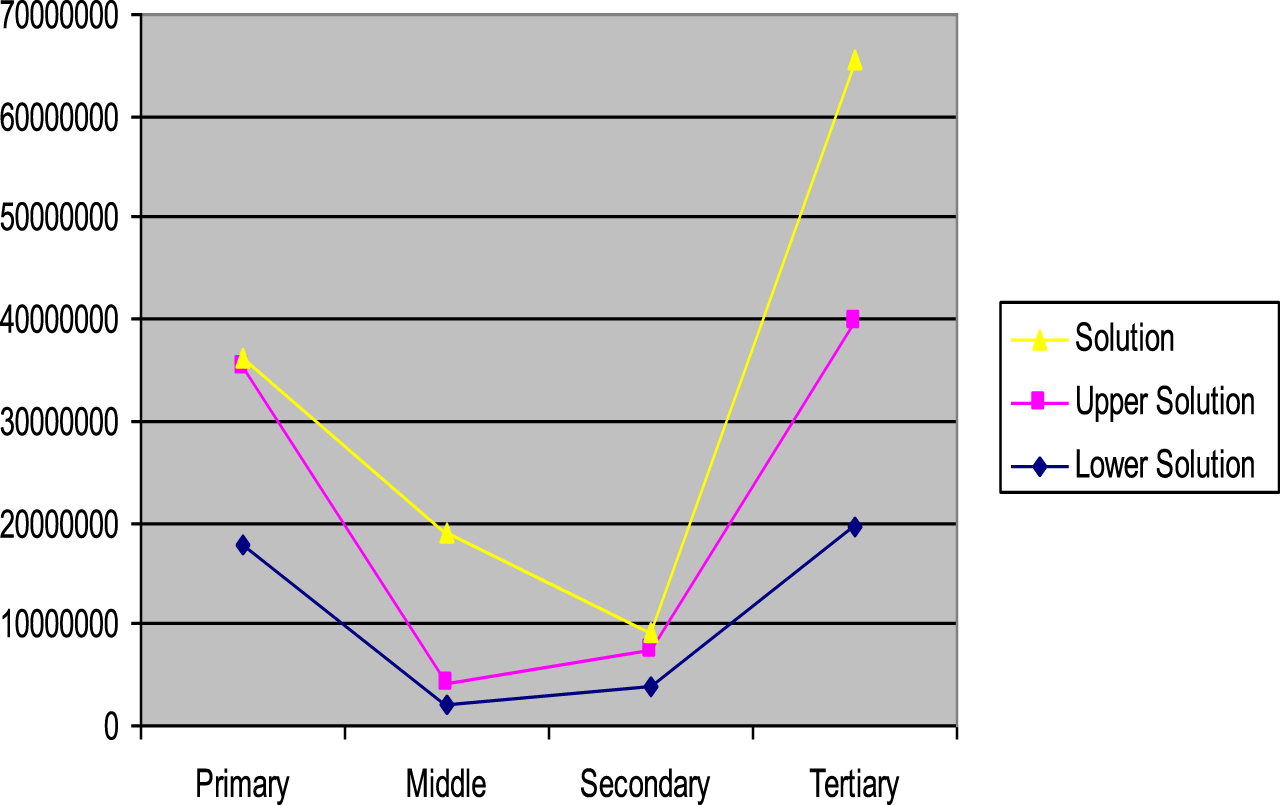
Proposed Enrollments at each Educational Category.
Moreover, Fig. 3, visualizes the comparison between the solution of the fuzzy model and the present enrollment in the Primary, Middle, Secondary and Tertiary educational categories. On analyzing Fig. 3, and, Table 4, we come to know that the method proposes comparatively higher enrollment for the middle and tertiary educational categories in case of the present resources constraints.
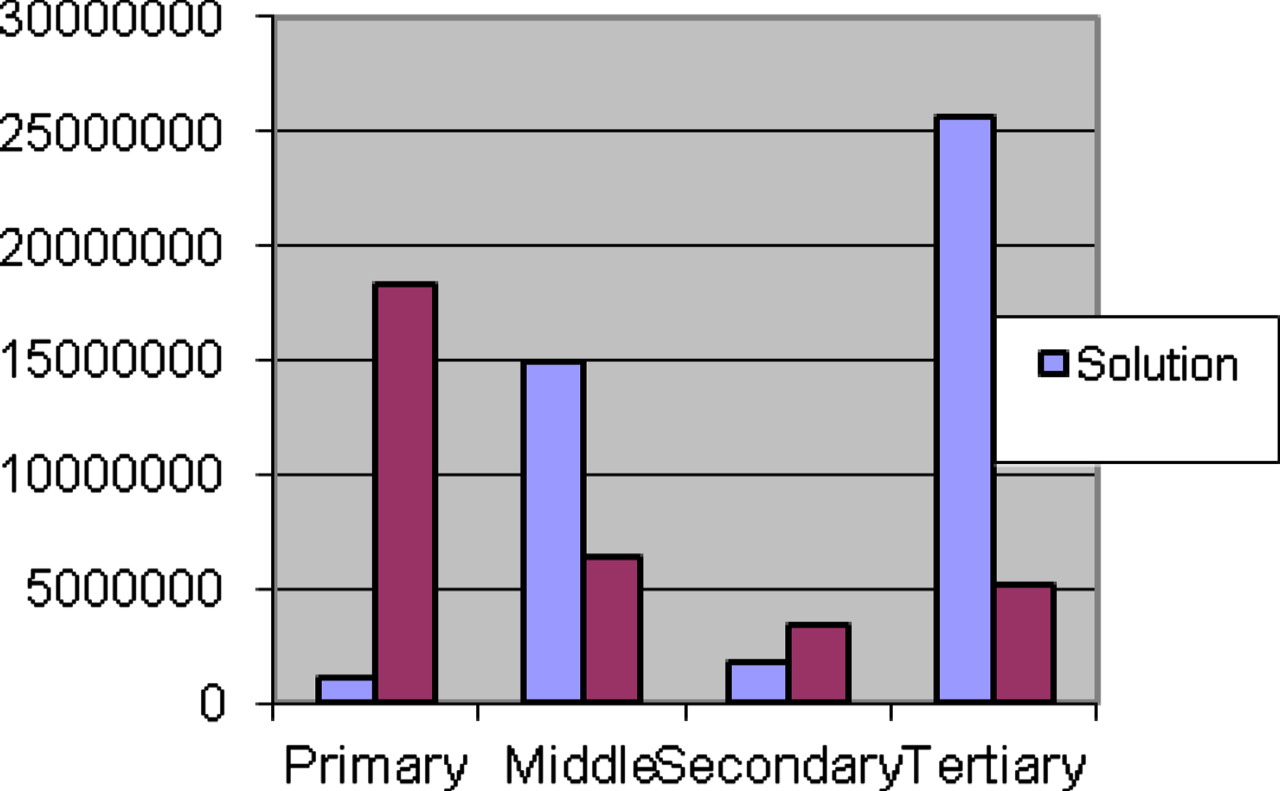
Comparison of the Present and Proposed Enrollments at Each Educational Category.
Now we compare the results of the proposed fuzzy dynamic programming approach with that of the crisp (non fuzzy) approach. The comparison of the fuzzy approach with the crisp approach is presented in Table 5. Comparing the solution of the proposed fuzzy approach presented in equations (57), (58) and (60) with the non fuzzy (crisp) approach presented in (57) shows that the fuzzy model emphasizes on the enrollment in the middle and tertiary educational categories. This situation is visualized in Fig. 4.
Comparison of the crisp model with the proposed dynamic fuzzy model
Validity of solution for the lower model (57)
Validity of solution for the UPPER model (58)
Validity of solution for the Final fuzzy model (60)
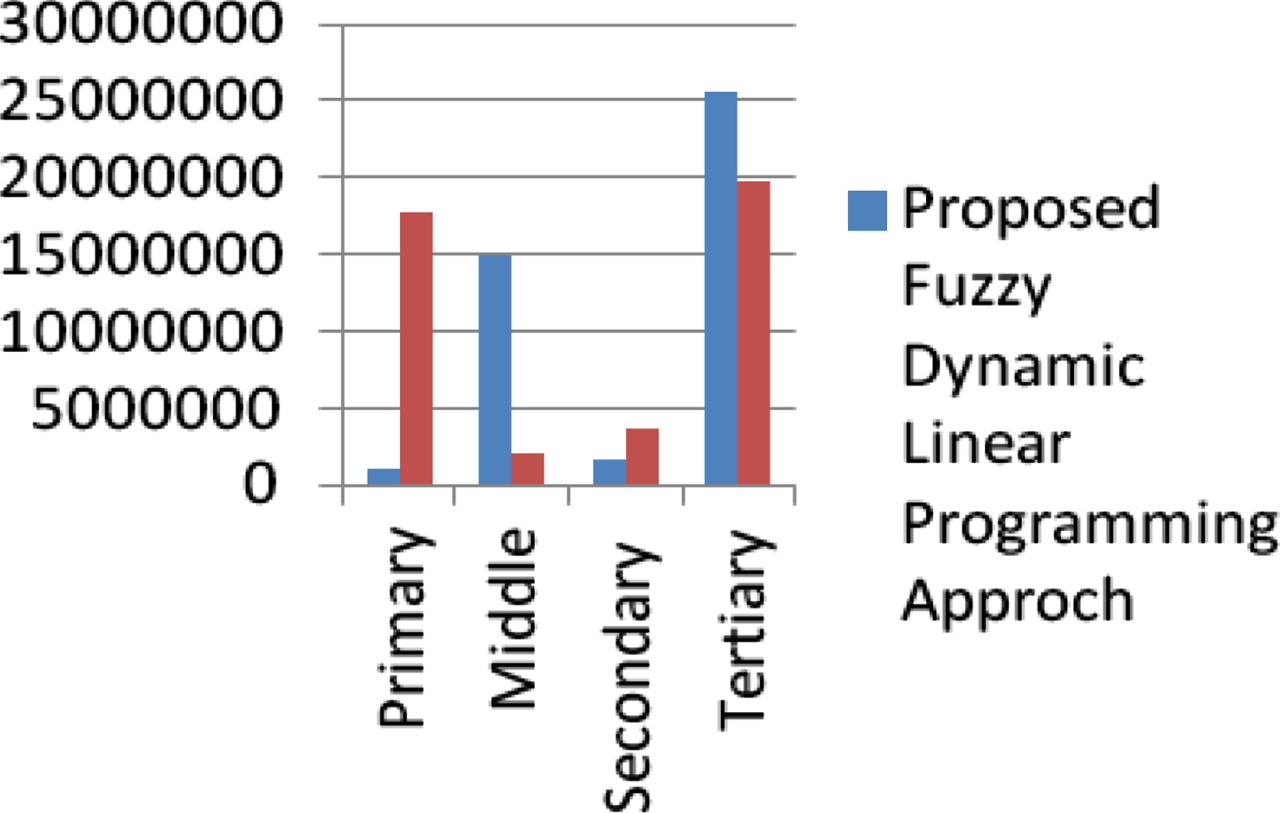
Comparison of the crisp model with the proposed dynamic fuzzy model.
To validate the solution efficiency, we check whether the obtained solution satisfy the constraints. First of all we validate the solution of the lower model (57), followed by the upper model (58) and then the model (60) presented in Tables (6), (7) and (8) respectively.
The validation for the model (58) given in Table (7).
Finally the validation for the model (60) is presented in Table (8)
From the Tables (6), (7) and (8), we conclude that the obtained solutions are satisfied and validated for the lower, upper and the final fuzzy models, respectively.
Finally, we compare the performance of the proposed fuzzy dynamic fuzzy linear programming approach with that of the Khan and Rafique [48]. The proposed dynamic fuzzy linear programming approach contribute to increase the objective function by 30%, whereas, the method of Khan and Rafique [48] contribute to increase the objective function by 12%. Thus the performance of the proposed dynamic fuzzy linear programming approach is better than [48]. In other words, whereas in [48], the objective function is increased by 12%, the proposed dynamic fuzzy linear programming method can increase the objective function by 30%. This situation is shown in Table (9) and Fig. (5). Thus the proposed method gives more promising results than [48].
Comparison of the proposed dynamic fuzzy model with the fuzzy linear programming model of khan and Rafique [48]
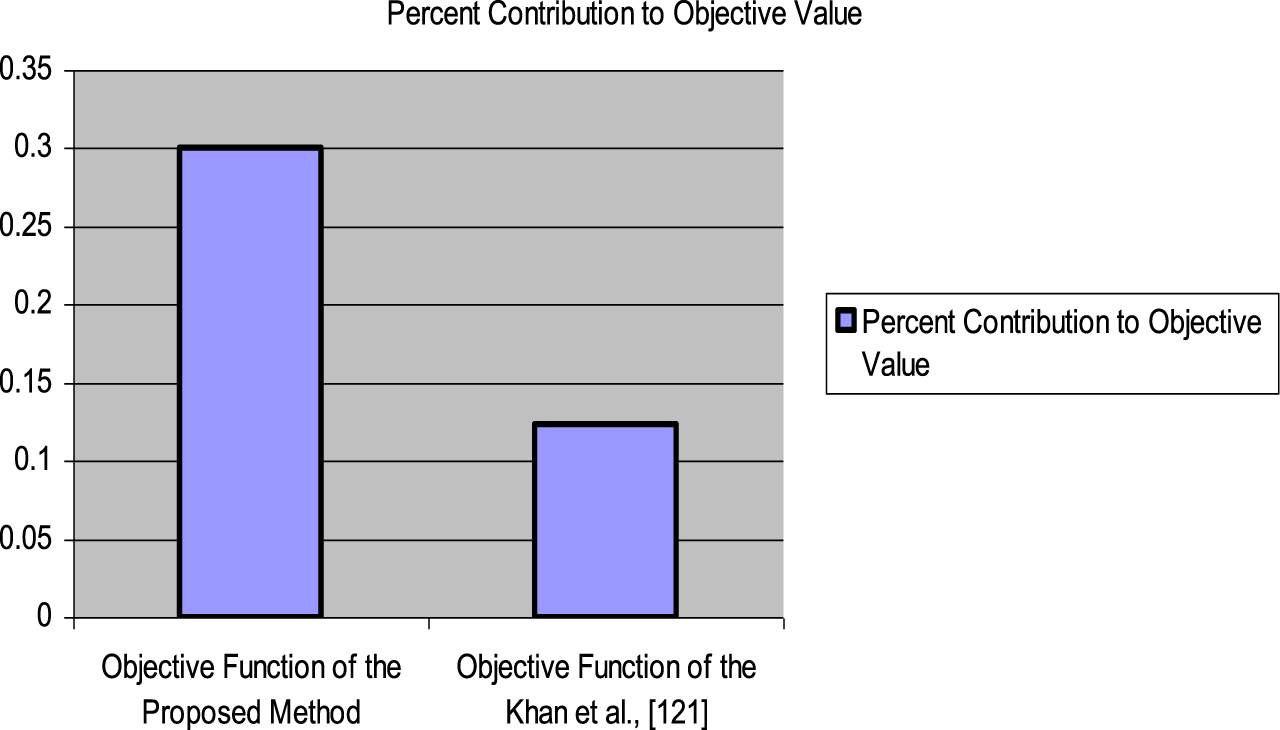
Percent Contribution to the Objective Function of the Proposed Dynamic Fuzzy Linear Programming Approach and the Khan and Rafique [48].
Linear programming and eventually fuzzy linear programming have promising applicability to other systems such as data envelopment analysis, transportation problem and shortest path problem. The proposed method can be easily adopted on fuzzy data envelopment analysis [34], transportation problem [35], and shortest path problem [36, 37]. These are the potential research avenues for future studies.
Moreover, the proposed study has some limitations. Most prominent limitations are discussed as under:
1. Determining the optimal solution through proposed fuzzy dynamic programming approach requires many rigorous backward pass computational experiments.
2. The results of the fuzzy dynamic programming approach are based data from the education system of Pakistan. Broader data are required to develop general planning and development theories for global organizations.
In this research fuzzy linear programming problems were addressed using the dynamic programming approach. In this regard, a novel dynamic fuzzy linear programming method was proposed. This was followed by implementing the proposed method to the education planning in Pakistan. The goal was to maximize the enrollment in the primary, middle, secondary and tertiary educational categories, subject to the available resources constraints. The constraints were total available institutions, government budget, teachers, ensuring minimum repeaters and out of school children, and, maximum enrollment. The results showed that the enrollment can be increased by 9997130, by increasing the enrollment in the middle and tertiary educational categories. Possible future research may be the application of the proposed method to multi-objective optimization problems and its implementation to other real world scenarios. The use of a dynamic programming approach to solve fuzzy linear programming problems ensures the existence of a numerical solution of the problem. Moreover, the proposed approach can increase the objective function by 30%. The proposed fuzzy model is more flexible and robust as the uncertainty in the system modeling process is taken into consideration.
Footnotes
Acknowledgments
We thank the respectable reviewers for their valuable comments and suggestions for the script were greatly improved due to their credible reviews and suggestions. Thanks to the editor, associate editor and reviewers for their kind reviews, suggestions, and views.
Conflict of interest
The authors declare that they have no conflict of interest regarding the publication of this manuscript.
Funding
This study was supported by no funding agency.