



Abstract
Since the implementation of the Private Education Promotion Law in China, reasonably evaluating the competence of private higher-learning institutions (PHLIs) has become an urgent issue. Based on an analysis of the advantages and disadvantages of the existing evaluation methods and index system, this paper proposes a comprehensive method for evaluating the competitiveness of private colleges and universities. The evaluation index system is constructed, and private colleges and universities are then evaluated by means of the best worst method (BWM) and vague set theory. Finally, S university in Zhejiang Province is evaluated as an example. The results show that the university has strong competitiveness in operating its schools, but the quality of the schools and its ability to operate them need to be strengthened. Compared with other experimental approaches, this method can be used for effective and reasonable evaluation of the competitiveness of private universities.
Keywords
Introduction
Private education in China formally resumed on December 4, 1982, when the Fifth National People’s Congress passed the Constitution of the People’s Republic of China. Today, private education has become an important part of education services in China. As one of the important components of the participation of social forces in education, private education is undergoing development at multiple levels, from preschool to higher education and from degree to nondegree education. On August 20, 2018, the Ministry of Justice of China issued a notice soliciting public opinions on the Regulations of the Implementation of the Private Education Promotion Law (PEPL) of the People’s Republic of China (Revised Draft) (Draft for Review) (DFR). On May 14, 2021, the premier of the State Council issued State Council Decree No. 741, namely, the Private Education Promotion Law of the People’s Republic of China, which came into force on September 1, 2021. The aim of this decree is to support private higher-learning institutions (PHLIs) by endowing them with status equal to that of public institutions, a status that PHLIs had not previously enjoyed. The decree further establishes protocols regulating these institutions and allows party transactions in the interests of ensuring their financial security. In addition, their contribution to the development fund for for-profit private schools was reduced from 25% to 10% of their profits. As a result, the capitalization obstacle to civilian-operated education was eliminated, ushering in an era of education capitalization. It is believed that with the implementation of the PEPL, China’s education industry will undergo marketization and privatization as well as a large-scale increase in the number of private and for-profit educational organizations/companies.
PHLIs are institutions of higher learning and other educational institutions established by enterprises and institutions, social organizations and individual citizens using nonstate educational funds to provide relevant education and teaching activities. These institutions can be divided into junior college and undergraduate education. Against the current background of national rejuvenation through science and education, the educational quality and scientific research competence of PHLIs have increasingly become a central topic that has attracted attention from the government, enterprise groups, and the public. With the gradual implementation of the PEPL, the private education system, which developed under conditions dominated by public education, has exerted a considerable impact on public education and the whole education system. Creating highly competitive PHLIs has become an effective means of improving the public education service level and meeting public demands for diversified education in China. PHLIs are gradually becoming a major driver of social development. Therefore, with the implementation of the PEPL, promoting breakthroughs and innovations in PHLIs to achieve core competence and reasonably evaluating the competence of PHLIs have become important issues.
The competence of higher-learning institutions (HLIs) has always been a research hotspot in academic circles. Researchers in China and elsewhere have extensively studied the competence of HLIs from multiple perspectives and have accumulated numerous research results. However, to date, relatively few studies have evaluated the competence of PHLIs since the implementation of the PEPL. The competence of PHLIs plays an important role in effectively improving competence in local or even national higher education. Analysing the competence of PHLIs can help the government and HLIs address problems encountered in the development of higher education, help develop PHLIs and improve their competence. Therefore, establishing a competence evaluation indicator system for PHLIs is of great value. In this study, given the implementation of the PEPL, the best worst method (BWM) and vague set theory are employed to evaluate the competence of PHLIs through a focused and targeted study. The results of this study provide an action basis for enterprises, the government, and HLIs to promote the development of PHLIs.
Literature review
As early as the 1980s, the World Economic Forum (WEF) proposed the concept of global competence [1]. Initially, global competence was linked primarily with enterprises. Several years later, the WEF and the International Institute for Management and Development (Lausanne, Switzerland) conducted a joint study to further promote the concept of global competence and the development of relevant methods. In 1990, Prahalad and Hamel first proposed the concept of core competence in their paper entitled “The Core Competence of the Corporation”, which was published in the Harvard Business Review, an authoritative magazine [2]. Competitiveness refers to an enterprise’s organic integration of its limited resources so that it can achieve long-term survival and sustainable development and, at the same time, earn profits and serve consumers. In recent years, an increasing number of researchers have studied competence from various perspectives. For example, Setyawan et al. evaluated the competence of medium-sized and small enterprises in Indonesia based on Porter’s diamond model [3]. Ulubeyli evaluated the competence of the cement industry using the fuzzy comprehensive evaluation method and conducted a case study on Turkey [4]. Li and Wang established a green competence evaluation indicator system for regional manufacturing industries based on a genetic algorithm-based projection pursuit model and used it to evaluate the green competence of manufacturing industries in eastern, central, and western China over a 15-year period [5]. Zou and Hao established an influential factor-based competence evaluation indicator system for cultural and creative industries based on the entropy weight method and determined the key factors affecting competence [6]. Gen et al. established an evaluation model for incentive tourism competitiveness based on the G1 method, standard deviation method and TOPSIS theory [7]. Thus, competence evaluation has become a focus of research in various fields, industries, and organizations.
How to evaluate the competence of HLIs, promote the optimal allocation of resources, and improve the comprehensive strength of HLIs have long been central topics in China and elsewhere in all sectors of society. In terms of the evaluation of the competence of HLIs, four prestigious rankings are the most influential worldwide. The US News Best Global Universities Rankings comprehensively rank universities based primarily on ten indicators, including academic level and global reputation, to provide students in various locations with a basis for choosing universities around the globe. The QS World University Rankings rank universities based primarily on three indicators, namely, academic reputation, employer reputation, and scientific research influence. The highly regarded Times Higher Education World University Rankings are updated annually and rank universities using a total of 13 indicators in five categories, namely, teaching, research, citations, international diversity, and industry income, to provide the most comprehensive rankings. The Academic Ranking of World Universities (ARWU), the first global comprehensive university ranking, is published by the Center for World-Class Universities at Shanghai Jiao Tong University in China and focuses mainly on evaluating the strength of HLIs in scientific research. The ARWU was originally produced to characterize the gap between Chinese and world-class universities in terms of scientific research strength.
In studies of the competence of HLIs, researchers have proposed a number of scientific and reasonable evaluation systems and achieved important results. Song and Liu established a fuzzy comprehensive evaluation model based on membership transformation using an entropy-based data mining method to evaluate the core competence of HLIs [8]. Wu et al. evaluated 12 private universities in Taiwan Province using a multicriteria decision-making model [9]. Gou et al. proposed a competence evaluation model for HLIs based on principal component analysis (PCA) that effectively avoids mutual influence between indicators [10]. Yu and Zhang evaluated the competence of HLIs using an entropy-weighted technique for order of preference by similarity to an ideal solution and found through a case study that this method is highly reliable [11]. Chen and Hu evaluated the competence of HLIs using the analytic hierarchy process (AHP) and data envelopment analysis (DEA), respectively [12, 13]. In addition, the kernel Hilbert space method and structural equation model can be used in practical evaluations [14, 15]. An increasing number of methods are being used to evaluate the competence of HLIs. As a result, evaluation mechanisms are becoming increasingly scientific and reasonable. In comparison, few studies have evaluated the competence of PHLIs, which are playing an increasingly important role that cannot be overlooked in the higher education system. The AHP, DEA, and PCA are the main methods used to evaluate the competence of PHLIs [16–18]. The China Private Higher Education Research Institute at Zhejiang Shuren University published Reports on the Evaluation of the Scientific Research Competence of Private Undergraduate HLIs and Independent Colleges for six consecutive years beginning in 2012. These reports evaluate the scientific research competence of PHLIs in China and are an important basis for evaluating these institutions [19].
When comprehensively evaluating the competence of PHLIs, it is necessary to determine the weight of each evaluation indicator. The calculation of the weight of each indicator will directly affect the quality and results of a competence evaluation. Dutch scholar Rezaei proposed the BWM, a subjective weight assignment method, to solve the problem of multistandard decision-making [20]. Like the AHP, the BWM is based on the concept of pairwise comparison. Compared with other multicriteria decision-making methods (MCDMs), it has unique advantages. First, it is not an arbitrary pairwise comparison; rather, a systematic comparison method is constructed to reduce the number of comparisons by screening the two special criteria of best and worst, thus ensuring the accuracy of the evaluation [21]. Second, it is based on vector calculation, while other methods are based on matrix calculation. Moreover, it uses only integers in the calculation process, while the AHP and other methods use fractions; therefore, the BWM is superior in terms of simplicity of calculation. Third, due to the simplification of the comparison process, it reduces the inconsistency of expert judgements and optimizes the index weight to ensure objective and credible results. Based on the above advantages, this method has been widely applied in different fields, such as site selection of urban hospitals, sustainability assessment of existing onshore wind plants, and selection of the best transportation mode during a pandemic [22, 23]. A literature analysis shows that the BWM can effectively improve the calculation process of the AHP, improve the accuracy of consistency testing, and provide a scientific theoretical basis for assessment and selection.
Evaluation of the competence of PHLIs involves a large number of factors, and uncertainties and incomplete data and information are involved in the evaluation process. The fuzzy comprehensive evaluation method is advantageous because it can address the nonlinear relationship between risk factors and comprehensive risk measurements. However, due to the lack of additivity, weight membership can easily cause errors during max or min operations. Hence, this study presents an improved evaluation method based on vague set theory. Gau and Buehrer proposed vague set theory, which added the concept of true and false membership functions on the basis of traditional fuzzy sets and compensated for the lack of fuzzy ability expression, in 1993 [24]. Vague sets can provide more realistic description of complex situations than fuzzy sets and can reflect richer information when representing and processing fuzzy and uncertain information [25]. The affiliation of evaluation objects with linguistic indicators in vague sets can be divided into 2 aspects, support and opposition, and can provide evidence of both aspects, thus expressing fuzzy information more comprehensively. And compare with intuitionistic fuzzy sets, although the notion of vague sets is the same as that of intuitionistic fuzzy sets defined by Atanassov practically ten years earlier [26]. But using a vague set is more natural than using an intuitionistic fuzzy set, especially for merging fuzzy objects [27]. With further research and development of artificial intelligence, the application of vague set theory is becoming increasingly extensive. At present, scholars in China and abroad have applied vague set theory to research on topics such as fuzzy control, decision-making, and fault diagnosis and have achieved satisfactory results [28–30].
This study evaluates the competence of PHLIs from various perspectives and presents a comprehensive evaluation model based on the BWM and vague set theory. As indicated by the above-described advantages of the model, the use of BWM in the competitiveness evaluation of this paper can simplify the comparison process and reduce inconsistency in expert judgements. In addition, competitiveness evaluations of PHLIs have potential and complex effects that are difficult to calculate precisely, making it appropriate to use uncertainty models to discover and understand such evaluations. Moreover, competitiveness evaluation itself is a fuzzy concept that needs to be described using tools that address uncertainties. Therefore, it is appropriate to introduce vague set into the research process of PHLI competitiveness evaluation. This evaluation system provides a reference for students and their parents as well as researchers and policy-makers to evaluate the competence of PHLIs.
Establishing a competence evaluation model for PHLIs
Evaluation indicator system design
Although private colleges and universities in China have strong vitality, compared with public schools, there is still a wide gap in educational resources, teachers, discipline construction and other aspects. In the face of competition between private colleges and public colleges and universities at the same level, PHLIs tend to focus on improving their strength. The PEPL has had a substantial impact on the competence of PHLIs among HLIs and will exert a considerable impact on the future development of higher education in China. Amid the vigorous development of PHLIs in China, evaluating competence is particularly crucial. However, there are certain limitations in general competence evaluation indicator systems for PHLIs. Therefore, designing a scientific and reasonable evaluation indicator system is of great value. Based on the development characteristics of PHLIs in China as well as the analysis of evaluation indicator systems for HLIs developed in China and elsewhere, a broadly applicable, simple, and effective competence evaluation indicator system for China’s PHLIs, which combines quantitative and qualitative evaluations, is presented in this study (Table 1).
Competence evaluation indicator system for PHLIs
Competence evaluation indicator system for PHLIs
The BWM is employed in this study to determine the weight of each competence evaluation indicator for PHLIs.
The steps involved in the BWM are as follows: Select a best criterion C
B
and a worst criterion C
W
from the indicator set {c1, c2, … c
n
}. Determine the preference for each indicator relative to the best indicator with a number between 1 and 9 (each number between 1 and 9 signifies the importance of the best indicator relative to the indicator in question). If experts believe that an indicator is almost as important as the best indicator, then that indicator receives a score of 1. If experts believe that an indicator is extremely unimportant compared to the best indicator, then that indicator receives a score of 9. Thus, the following best comparative vector is ultimately established: A
B
= (aB1, aB2, …, a
Bn
), where a
Bi
represents the preference for the best criterion compared to criterion i and a
BB
= 1. Determine the preference relative to the worst indicator. The importance of the worst indicator relative to that of the other indicators is still represented by a number between 1 and 9. If experts believe that an indicator is as important as the worst indicator, then that indicator receives a score of 1. If experts believe that an indicator is very important compared to the worst indicator, then that indicator receives a score of 9. Thus, the following worst comparison vector is established: A
W
= (a1W, a2W, …, a
nW
)
T
, where a
iW
represents the preference for the worst criterion relative to criterion i and a
WW
= 1. Theoretically, if the actual weight of an indicator is w
i
, then we have
However, there is a certain difference between the actual weight ratio and the corresponding element in the comparison vector. Therefore, optimal weights
In the above formula, ωB is the weight of CB; Ci is the criterion vector; ωi is the weight of Ci, that is, the actual weight of the indicators; ωW is the weight of CW; aBi represents the importance of CB to Ci; AiW represents the importance of Ci to CW; k is the absolute error; and the optimization goal is to minimize k.
The BWM is a subjective weighting method to determine index weight based on systematic pair-wise comparison. The parameters that affect the performance of the BWM include main two categories: one is the selection of the optimal and worst indexes, and the other is the construction of the optimal and worst vectors. Specifically, in the process of BWM weighting, the best index and worst index should be first, as they are the basis for the subsequent comparison of importance between two indexes. Experts consider the optimal index to be the most important among all indicators, while they consider the worst index to be the least important. After determining the optimal and worst indexes, experts should be invited to judge the relative importance between the optimal index and other indexes to form the optimal judgement vector. Similarly, experts are invited to separately judge the relative importance between the worst index and each of the other indicators to form the worst judgement vector. Based on the optimal and worst judgement vectors, the weight that is closest to the consistency of the expert judgement results can be obtained by solving the optimization problem represented by Formulas (1) and (2). It should be noted that there is a certain subjectivity in the process of determining the optimal and worst judgement vectors. To reduce this subjectivity, several experts can be invited to jointly judge in order to obtain a consensus judgement vector and reduce contingency.
A vague set is the expansion of a fuzzy set. A fuzzy set is a member of the interval [0, 1]. In the concept of vague sets, the membership of each element consists of support and opposition and can be represented by a true membership t and a false membership f. Let U be a universe of discourse and x be an arbitrary element in U. A vague set in U can be represented by a true-membership function t A and a false-membership function f A . t A (x) is the lower bound of the membership of x derived from the evidence supporting x. f A (x) is the lower bound of the membership of x derived from the evidence opposing x. The uncertain part is 1 - t A (x) - f A (x). t A (x) and f A (x) links the real numbers in the interval [0, 1] with each element in U; i.e., t A (x) : U → [0, 1] and f A (x) : U → [0, 1].
For convenience of discussion, t
A
(x) and f
A
(x) are denoted by t
x
and f
x
, respectively. Thus, t
x
+ f
x
≤ 1. If t
x
= 1 - f
x
, then the vague set degrades to a fuzzy set. If t
x
= 1 - f
x
= 0 or t
x
= 1 - f
x
= 1, the vague set degrades to an ordinary set. The following describes the steps for using vague set theory to evaluate the competence of a PHLI: Set an evaluative remark for each level of each evaluation indicator. In this study, the following set of evaluative remarks, which contains five levels, is used: V = (V1, V2, V3, V4, V5)=(very strong, relatively strong, average, relatively poor, and very poor). Then, ask relevant experts to choose appropriate linguistic variables to represent evaluative opinions. Determine the weights using the previously discussed BWM. Establish a vague set evaluation matrix, and invite experts to score each evaluation indicator based on the set of evaluative remarks. Let C
i
be an arbitrary indicator and V
j
(j = 1, 2, 3, 4, 5) be the set of evaluative remarks. A vague set evaluation matrix R between the evaluation indicator system C and the set of evaluative remarks V is then established:
Comprehensively evaluate the vague set through calculation based on the obtained indicator weights W and the vague set evaluation matrix R:
where F is the result of the vague set-based comprehensive evaluation, F
j
is the vague value evaluative remark of the evaluation object for evaluative remark level V
j
, ⊗ is the matrix multiplication operator for the vague sets, and ⊕ is the finite summation operator for the vague sets. Therefore, the above calculation requires two basic formulas for the vague sets, namely, scalar multiplication and finite summation. Let k be a real number in the interval [0, 1] and A and B be elements in the vague set (A = [t
A
, 1 - f
A
] and B = [t
B
, 1 - f
B
]). Thus, we have
In this study, the established model was used to evaluate the competence of a PHLI (S university) in Zhejiang. Due to the relatively significant uncertainty and incompleteness of the data acquired for some indicators involved in the competence evaluation process, experts on HLIs and in relevant fields were consulted through questionnaires to ensure a smooth competence evaluation process. On this basis, the previously established competence evaluation model for PHLIs was examined and analysed.
Calculated weight of each indicator
The BWM was used to determine the weights for the established competence evaluation indicator system for PHLIs. First, based on the experts’ opinions, the best and worst indicators were determined. To improve the accuracy of the experts’ opinions, the overall evaluation indicator system was decomposed based on the secondary indicators into three subevaluation indicator systems, namely, a C1 subevaluation indicator system, a C2 subevaluation indicator system, and a C3 subevaluation indicator system.
Based on the experts’ opinions, C122 and C113 were found to be the best and worst indicators in the C1 subevaluation indicator system, respectively; C213 and C232 were found to be the best and worst indicators in the C2 subevaluation indicator system, respectively; and C312 and C323 were found to be the best and worst indicators in the C3 subevaluation indicator system, respectively. On this basis, the preference for each indicator relative to the best and worst indicators in each subevaluation indicator system was determined by consulting the experts through questionnaires (Table 2).
Preference for each evaluation indicator in each subevaluation indicator system relative to the best and worst indicators
Preference for each evaluation indicator in each subevaluation indicator system relative to the best and worst indicators
Based on Table 3 and Equations (1) and (2), the weight coefficient of each indicator in each subevaluation indicator system was calculated using Lingo11. Table 1 summarizes the results.
Vague value evaluative remarks provided by experts for indicators in the C1 subevaluation indicator system
Vague set evaluation matrix
To evaluate the competence of S university, a total of 20 experts on HLIs and in relevant fields were invited to provide vague set evaluation values for the evaluation indicators through questionnaires. Each expert was asked to select an evaluative remark from the set of evaluative remarks for each indicator. The set of evaluative remarks contains five levels: very strong (V1), relatively strong (V2), average (V3), relatively poor (V4), and very poor (V5).
On this basis, combined with the evaluation results of all the experts, the vague value evaluation of each index is constructed. For example, in evaluation index system C1, as for evaluation index C111 in subevaluation index system C1, one of the 20 experts thought that the private university was very strong in terms of school size, five thought it was strong, four thought it was average, six thought it was poor, two thought it was very poor, and two abstained. According to the construction rules of the vague set, comments of the vague value corresponding tindicator C111 are shown in Table 4. Similarly, the vague values of all indexes in the subevaluation index system can be evaluated.
Vague set-based comprehensive evaluation results for the primary competence evaluation indicators for the PHLI
Vague set-based comprehensive evaluation results for the primary competence evaluation indicators for the PHLI
For any subevaluation indicator system, when the weight W of each of its indicators and its vague value evaluation matrix R are known, a weighted vague value evaluative remark for each of its indicators can be determined by performing a scalar multiplication operation on the vague sets based on Equation (6). Subsequently, a vague value evaluative remark for the evaluation object on each evaluative remark level can be determined by performing a finite summation operation on the vague sets based on Equation (7).
In the C1 subevaluation indicator system, the vague value evaluative remark for C111 on the V1 evaluative remark level is [0.05, 0.15], and the weight of C111 is 0.0660. Thus, the weighted vague value evaluative remark for C111 on the V1 level is as follows: wr111 = [0.0033, 0.0099]. Similarly, a vague value evaluative remark for each indicator in each subevaluation indicator system on each evaluative remark level can be obtained. On this basis, a vague value evaluative remark for each primary indicator and for each of the secondary indicators under it can be obtained. Table 4 summarizes the vague value evaluative remarks of the primary indicators. Table 4 shows the results of the vague set-based evaluation of the competence of the PHLI, i.e., the vague values for the educational capability, advantages, and quality of S university in Zhejiang on the five evaluative remark levels.
The following shows the vague set comprehensive evaluation values for the competence of the PHLI based on the above results as well as the weight of each primary indicator: F=([0.3312, 0.4156], [0.4124, 0.4948], [0.295, 0.3779], [0.1392, 0.2083], [0.0395, 0.109]).
A score for each evaluative remark level can be determined using the score function in Equation (8). Figure 2 shows that the scores for the educational capability, advantages, and quality of S university on the five evaluative remark levels (V1, V2, V3, V4, and V5) are 0.3617, 0.4494, 0.3217, 0.1495, and 0.0425, respectively. Thus, we have V2ΦV1ΦV3ΦV4ΦV5. Evidently, the evaluation indicates that the competence of S university is “relatively strong”. This finding reflects the actual situation of the school relatively well.
The following conclusions can be derived from Fig. 1. (1) The evaluation finds that the school has “very strong” educational advantages. This suggests that the school is highly competitive in terms of disciplinary field development, practical capability, and scientific research capability. (2) The educational quality of the school is slightly stronger than its educational capability. However, the evaluation finds that both of these areas are “relatively strong”. There is still room for improvement in these two areas.

Vague set-based comprehensive evaluation scores.
To verify the effectiveness of the evaluation results, the traditional AHP-fuzzy calculation case was used and compared with the proposed method. Figure 2 shows the evaluation results obtained by applying different methods. The scheme-ordering results obtained by the two methods are consistent, which verifies the effectiveness and accuracy of the proposed method. Compared with the AHP-FUZZY method, the membership degree (score function value) of the results from the BWM-VAGUE method is more evenly distributed among different grades, indicating that the BWM-VAGUE method better reflects the degree of variability among experts assigning different grades. Although the AHP-FUZZY method has a great degree of differentiation in all grades, the results may be biased because the hesitancy of experts is not considered; that is, the incorrect judgement information of experts reduces the reliability of the final evaluation results.
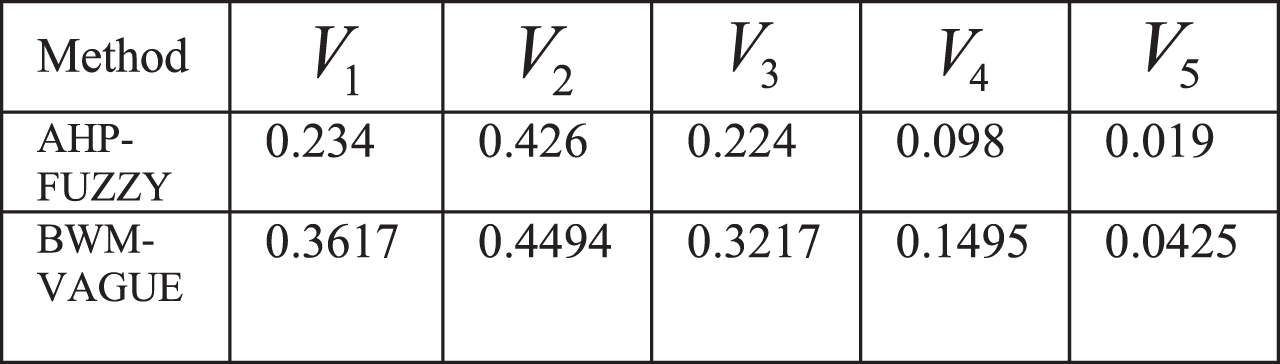
Comparison of methods.
Evaluating the competence of PHLIs is an important means to measure the development level of higher education and an important precondition for future educational reform. This study presents a competence evaluation model for PHLIs based on the BWM and vague set theory. The model has low requirements for the number of evaluation samples and the amount of data of the sample index value and can solve the comprehensive evaluation problems of the information uncertainty and incompleteness of fuzzy sets. Specifically, according to the analysis of the key characteristics of PHLIs, the environmental impact assessment index system considering the environmental characteristics of high-altitude areas was constructed based on three areas: educational capability, educational advantages and educational quality. Second, considering the accessibility of the index value and the evaluation sample size, an index weighting method based on the BWM was proposed to simplify the comparison process by establishing two special criteria, best and worst, and to ensure the reliability of the results through the optimization model. Then, considering the characteristics of the competitive evaluation of PHLIs and the disadvantages of traditional fuzzy comprehensive evaluation, this paper proposes an improved fuzzy comprehensive evaluation method based on vague set theory. Finally, taking S private university in Zhejiang Province as an example, the paper conducts an empirical analysis and verifies the validity and practicability of the model by comparing it with the traditional fuzzy comprehensive evaluation method.
In this paper, the sample quantity and sample index data requirements of the proposed evaluation method are low, and the method can effectively address uncertainty and incompleteness of information to perform a comprehensive evaluation. Therefore, the proposed method has good application value and contributes meaningfully to the field of competency evaluation. Although the proposed model achieved satisfactory results in an empirical application, it still has room for improvement. On the one hand, the BWM relies on expert judgements to establish an index of relative importance, and when there are multiple experts and specialists, inconsistent results may arise; thus, a range of experts in related fields should be consulted when applying the BWM proposed in this paper. On the other hand, the comprehensive evaluation method based on vague set theory involves an increased number of experts and allows experts to abstain, effectively reducing the subjectivity of evaluation. However, the method assumes that all experts judge the degree of importance in the same way, whereas, due to conditions such as individual knowledge, background, and experience, this is not the case. Different experts assign different weights to their judgements based on their knowledge, background, experience and other conditions, allowing the final evaluation results to be more scientific and effective.