



Abstract
This paper summarizes the relationship of subjective information with artificial intelligence (AI) technology and points out how the role of subjective information and its position in AI. Eventually, the characteristic of digital era is the “softening of the theories and hardening of the experiences”. Subjective information is widely used in digital revolution for transforming the qualitative estimations into quasi-quantitative solutions, such as the empirical methods in decision making for quantitative management, etc., it will be the transferor for realizing it. The theoretical formulation of how subjective information is digitized through “Fuzzy-AI Model” for digital revolution is presented in this paper; it has becoming a universal problem solver of utilizing AI technology for quantizing the degree uncertainties in decision-making and fuzzy estimation. Besides, the “Big Data” searching will heavily depend on the completeness of its source information, yet “subjective information” approach can directly predict human thinking or the internal law of complicated objective events into an explicit digital form, for the completeness of source information to make the correct and comprehensive “Big Data” prediction possible. Practical case studies are presented.
Introduction
Let us first investigate why the Big Data exploration or mining is not omnipotent, since a correct solution of Big Data prediction can be made only if the source data and source information satisfying “completeness” condition. There are two kinds of source information: “explicit” and “implicit” ones. For instance, when we are driving, we may know the traffic jamming distribution over neighborhood zones right on time, it is because the sensor network obtained those “explicit” information of current vehicle existence throughout the neighborhood areas in real time by means of sensors, detectors and information collectors. However, it is difficult to know the traffic jamming distribution in neighborhood zones at certain latter time, because it depends on all the destinations of the vehicle drivers in wider areas. Actually it is indeed the “subjective information” of these drivers or it is a series of “implicit” information, which cannot be easily collected by conventional means of sensor networks. Therefore, if the source information cannot be completely collected due to the absence of “implicit” information, the correctness of Big Data prediction will be questionable.
Using the “Fuzzy-AI model” based on “subjective information” will be possible to digging the implicit information for the objective events, which are complicated and implicit in its internal law of development and for maneuvering the event, it is necessary to explore this implicit information.
We know the management can be understood as “For achieving certain purpose(s), to make a series of decision under uncertainties”. However, the decision making reflects the highest intelligence of human being, the essence of which is that human being possesses immense capability of processing massive fuzzy information instantly for the decision making and problem identification. Therefore, for simulating human intelligence in digital form through computer, the AI technology was emerged, which is naturally coincident to “subjective information” and founded the theoretical argumentation of digging the “implicit” information for the completeness of source information necessary for Big Data exploration.
Digital revolution means to digitize everything in the objective world, it can be realized only if the “implicit information” can be effectively digging out from all the objective events. Then the AI technology based on “subjective information” becomes a most powerful tool for making digitization of everything in the objective world comes true. This is why the necessity of this paper is valid for investigation.
Subjective information is widely used in digital revolution, it will be the transferor for realizing the qualitative estimations into quasi-quantitative solutions through “Fuzzy-AI Model”, such as in the qualitative management, empirical methods in decision making, etc. All the above-mentioned qualitative information based on subjective information must be expressed quantitatively in digital form for accommodating to real accessibility in our daily life. The theoretical formulation of how subjective information is digitized for digital revolution here presented has becoming a universal problem solver of utilizing AI technology for quantizing the degree uncertainties in decision-making and fuzzy estimation. Moreover, for Big Data prediction, the completeness of source information is the pre-requisite. In order to explore the implicit part of source information in subjective mind of human being, the application of “Fuzzy-AI Model” for solving this problem is also a contribution in digital revolution.
The remainder of this paper is organized as follows: Section 2 describes the definition of subjective information and explains how “Softening of theories” and “Hardening of human experiences” are realized by means of subjective information and provides cases of intelligentization in different fields. Section 3 presents how to build Inv. K(*’) by “Fuzzy-AI Model” using “Subjective information” of human being and AI machine learning with a case study of overseas project risk prediction. The implication of subjective information for managerial science is further stated in Section 4, where it notes the “subjective information” combined with “Fuzzy-AI Model” could work together for exploring the internal law of development from social, economic and engineering events for solving a family of problems in an uncertain real world. Finally, conclusive remarks are made.
Literature review
Toward this end, the existing contributions in the past are reviewed firstly as following:
More than sixty years have been escaped since the founding of AI in 1956 [1], AI has experienced a tortuous and uneven way of its development, particularly in intelligent design studies [2]. Introducing the concept of AI by mathematical logicians, they created the ideas and framework of what AI likes [3–5]. However, they have overestimated the role of pure logic inference, which is far from enough with the intelligent software system in reasoning [6, 7]. Thus, it results in a misleading of the intelligent software system development. Next to the logicians there are enthusiastic expert system builders, who promoted AI application based on the heuristic knowledge of the domain experts [8–11]. And various machine learning (ML) [12–14], including supervised ML, unsupervised ML and semi-supervised ML, emerged in recent years that further enhanced it. From SIRI [15] to AlphaGo [16], AI has developed fast which is mainly focused on robots and pattern recognition (voice, images, video, etc.) [17–21]. Nevertheless, since the human being is by no means perfect in knowledge transfer, to develop a knowledge based expert system (KBES) could be constrained by the effectiveness of knowledge acquisition from the domain experts [22–23]. Hence, it seems difficult to develop an intelligent system for practical use directly from the KBES.
The rapid development of the digital computer is owe to the availability of its theoretical basis of numerical analysis [24–26], which is widely applicable and has been prepared about 200 years ahead than the emergence of digital computer in 1946 [27]. In comparison with this, for the intelligent computer in the digital era has not yet well prepared its theoretical bases, especially in its reasoning model, which form the kernel of an intelligent system [28–34]. Indeed, the AI system researchers, who have lost plenty of time in puzzling, are facing a new challenge of AI development. Therefore, it seems necessary to terminate the puzzling state in AI development and study the fundamental reasoning models which may speed up the development of AI, especially in intelligent systems for different applications [2, 22]. Taking into account of definition of AI is the arts of computer technology for simulating the intelligence of human being [35], on the other hand, fuzziness is the basic characteristic of the objective world [36, 37], it is closely related to thinking philosophy, or subjective information of the human being, these are also the preferential characteristics of human intelligence. One cannot simulate human intelligence without consideration of above-mentioned characteristics of fuzzy information processing of the mankind [38, 39]. Thus, the suggestion of “Fuzzy-AI model” [2, 23] is reasonable, by which the complicated non-structured problem in the real world might be solved.
As above-mentioned past contributions in this field, we conclude that it is worthwhile to study the role of subjective information to AI for promoting the process of digital revolution. Under VUCA (volatility, uncertainty, complexity and ambiguity) era, analytical expression is no longer exactness in evaluating the objective reality; in the contrast, the fuzzy set is accommodating to the uncertain and continuous changing environment. The approach proposed in this paper is significant in the digitization world due to the fact that it is naturally using fuzzy evaluation and fuzzy reasoning for quantitatively digitizing the objective world and operated through the computer, so as to access the objective world more efficiently than any existing approaches for accommodating to the digital world.
On subjective information in different cases of intelligentization
We are in the era of digital revolution, which is characterized by “softening of theories” and “hardening of human experiences” [40]. In other words, our era is characterized by “qualitative to quasi-quantitative transformation”, and therefore we need to study a variety of feasible approaches that bring us to digital revolution. Fig. 1 shows two types of transformation operator for universal events. Let us first examine the system behavior in Fig. 1 (a), which is a real world event defined by input I and correspondent output O through certain black box K(*). Herein, K(*) is referred to a structured operator since it can be expressed mathematically by an analytic formulation. Though its inverse operator Inv. K(*) can be referred to a structured transformation operator, for majority of real world events the operator K(*) is cumbersome to find. For obtaining approximate solution of the problem, one needs to replace the Inv. K(*) with an uncertain inverse transformation operator Inv. K(*’) for finding the approximate solutions as shown in Fig. 1 (b). In practice, one has to use the non-structured K(*’) to replace structured K(*) for finding the approximate quantitative solution O. In order to quantize the output (solved solution) O’ approximate to real solution O, we must build the inverse operator Inv. K(*’), which is determined by the combination of “subjective information” and the “Fuzzy-AI Model”. The essential of so-called “softening of theories” is based on the replacement of Inv. K(*) by Inv. K(*’).

Two types of transformation operator for universal events.
Figure 2 shows the schematic framework of knowledge capture and digitization from the best practices of project management processes, where the knowledge (experience) from different stages of project implementation will go through corresponding gate to digitization transformer (DT). Then the digitized knowledge will store to the knowledge base according to its rank. Fig. 3 shows the procedure of DT for building the knowledge base.

Framework of knowledge capture and digitization from best practices.
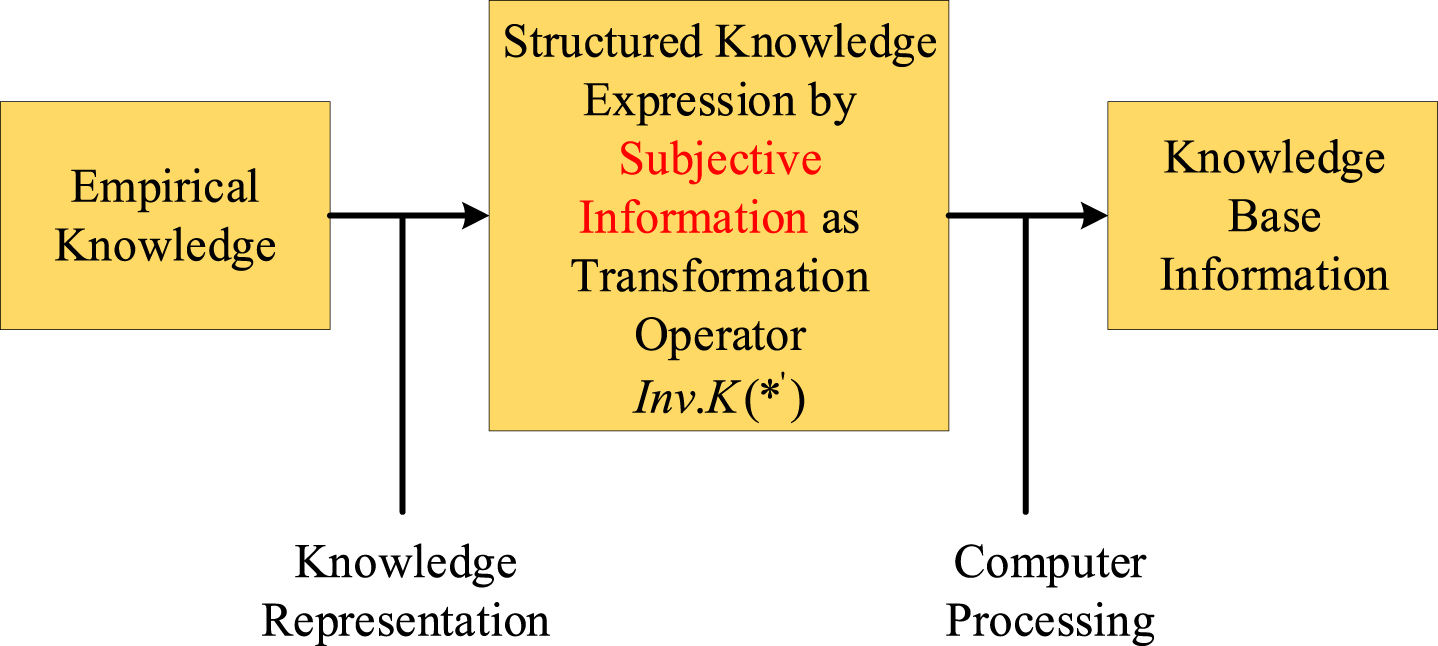
Procedure of DT for building the knowledge base.
It can be evident from Figs. 2 and 3 that DT is the fundamental procedure in building the knowledge base for AI application. Since knowledge involves in system behavior of any event, which also represented by Inv. K(*’) of the event. Through computer processing the empirical knowledge of human being is digitized by DT, which is the essential of Inv. K(*’) by “subjective information”. Since Inv. K(*’) has now been digitized, the output O’ in Fig. 1 (b) can be regarded as the quasi-quantitative solution of the problem. It shows that the Inv. K (*’) makes the event solution O approximately to O’ from qualitative to quasi-quantitative possible, thus explores the role of “subjective information” in “hardening of the human experience” in our digital era.
We take medicine remedy process as an example for Fig. 1(b), where uncertain input I’ can be regarded as the statement from the patient, and the uncertain output O’ can be understood as the doctor’s medical recipe. The “subjective information” for building Inv. K(*’) is based on doctor’s empirical knowledge, which can be found through searching the knowledge base information as shown in Fig. 3, which represents the uncertain transformation operator Inv. K (*’) from qualitative to quasi-quantitative.
We can further extend such a simulation to different cases of intelligentization. In the past centuries, we have a large amount of experiences in using analytic mathematical models to strengthen the theoretical system in different disciplines. For instance, the system optimization can be achieved by mathematical programming modeling for the output of analytical optimum solutions, which is now widely used and proved to be efficient in many engineering problems. Now we are in the transition stage from integration to digitization and then to intelligentization, as frequently encountered in practice, we integrate “AI and hardware” to form robot-like intelligent machines. On the other hand, we integrate “AI and software” for developing intelligent planning systems or intelligent management systems. For example, most of the computer aided design (CAD) system nowadays (which is no longer computer to aid design, but computer to aid drawing), has becoming Intelligent CAD (ICAD); computer aided manufacturing system CAM has becoming Intelligent CAM (ICAM); the management information system (MIS) is upgrading to Intelligent MIS (IMIS); decision supporting system (DSS) is upgrading to Intelligent DSS (IDSS), etc. The most practical intelligent systems can be formulated by adding AI as a “shells” upon conventional system through “subjective information” to build the Inv. K(*’) of the system itself as shown in Fig. 1 (b).
How to build Inv. K(*’) by Fuzzy-AI Model using subjective information of human being and AI machine learning? What are the basic considerations of building Inv. K (*’) and realizing the problem solving from qualitative to quasi-quantitative? Among them, subjective information plays an important role in “softening the theories” and “hardening the human experiences” for that is the basic principle of building Inv. K (*’) by the help of Fuzzy-AI Model.
Subjective information implies the experience of human being that possesses the nature of fuzzy information processing and follows the AI processes of simulating human intelligence. Fuzzy-AI Model integrates the features of both “Fuzzy” and “AI”, which is suggested to be applied for the implementation of building Inv. K (*’). Usually, Inv. K (*’) is formulated by Fuzzy-AI model using subjective information of human being, which can obtain an output O’ after an input I’ is being inputted. Both I’ and O’ are uncertain since the input I’ is changeable by uncertain environment, and Inv. K (*’) itself is a set of non-structured formulation processes, thus the output O’ should certainly maintains its uncertain feature.
Numerous examples of Inv. K (*’) built by Fuzzy-AI model have been published by the authors, which shows the applicability of this model to build Inv. K (*’) for effective solution of the real world problems. As regard to the challenges on the applicability of fuzzy membership function, it is proved that to build membership function through AI machine learning with practical samples, the convincible solution of fuzzy membership function can be achieved with solid arguments.
Now let us present a case study of implementation of building Inv. K (*’) for a practical project, which is a risk evaluation and prediction of overseas project in construction and investment taken by Chinese enterprises who need to make the argumentation for decision making. Certainly, this is an extremely complicated problem because there are different kinds of risks in the case event and its environment is full of uncertainties. Moreover, all the factors and attributes involved in the project risks are volatile, uncertain, complex and ambiguous. Let us return to Fig. 1(b), we have to use approximate approach from input I’ to output O’ as to build our target Inv. K (*’) and solve the problem through it.
The case project, named “Chinese Enterprises’ Overseas Construction and Investment Risk Predictions”, is aimed to study overseas project risk management for Chinese enterprises by integrating of past experiences (subjective information). The contents of the project consists of theoretical studies, investigation to best/worst practices, knowledge acquisition, and the development of knowledge-based fuzzy decision supporting system (KB-FDSS) for project risk evaluation, prediction and control. The whole processes of obtaining above-mentioned objectives belong to the scope of building Inv. K (*’) of the project, which is a set of non-structured formulation processes.
A series of work need to be carried out for building the Inv. K (*’), including follows:
(1) Contents of Work
Theoretical studies of project risk management including the system studies of risk points in different stages of the project for establishing the skeleton of the knowledge base. Retrieving from experts’ knowledge and from best/worst practices to build knowledge base, as well as verifying the completeness and quality of the knowledge base being used. Developing knowledge based fuzzy decision supporting system KB-FDSS (prototype). The essential of KB-FDSS is fuzzy reasoning, and which is based on subjective information. Using risk knowledge framework (RKF) and KB-FDSS for realizing the solution of from I’ to O’ in Fig. 1 (b) and perform the complete processes of building Inv. K (*’). Further improvement of the results by tests and practical applications.
(2) Technical Strategy of Project Research
The technical strategy for solving this project is based on the theory of quantitative management by using fuzzy logic. By systematic investigating numerous risks of overseas projects, the AI theory is employed to solve the problem by means of knowledge engineering for building a knowledge based fuzzy decision supporting system KB-FDSS. The system solution is to carry out a fuzzy inference for risk evaluation and knowledge restraining for risk mitigation under uncertain environment; starting from CRKF for construction and IRKF for investment, then extending to BRKF for BOT; ERKF for EPC and PRKF for PPP, which are hierarchical tree structure for the skeleton of building knowledge base of KB-FDSS. RKF is the basic relation between risk and corresponding knowledge for its restraining. Take construction risk as an example, Fig. 4 shows the relationship of construction risk knowledge framework (CRKF) with its construction subordinate risks CR1, CR2, CR3, ....; and the sub-risks (CR11, CR12, CR13, ....) of CR1 and its corresponding construction knowledge CK11, CK12, CK13, ....for restraining these risks. Certainly, these construction risks can be restrained by several construction knowledge; such as CR11 is restrained by CK11, CK12 and CK22, etc. as shown in Fig. 4. Similarly, RKF can be expressed by IRKF for investment, BRKF for BOT, ERKF for EPC and PRKF for PPP, etc. Quantizing the risk through fuzzy reasoning based on subjective information, starting from the definition of fuzzy membership function, each CKij and IKpq can be expressed by a fuzzy membership vector represented the effectiveness of exercising this particular knowledge to restrain the corresponding risk. CKij is the j-th knowledge to restrain the i-th construction risk, IKpq is the q-th knowledge to restrain the p-th investment risk. For the degree of construction and investment risks CRi and IRp, it depends on the effectiveness of the restrains of counter-measured knowledge CKjk (j = 1,2,3, ...; k = 1,2,3,...) and IKqp (q = 1,2,3, ...; p = 1,2,3, ...); which represent intensity of how the counter-measured knowledge has offered restrain effects to the risk undertaken. Establishing RKF the basic skeleton of knowledge base; RKF represents multiple relations between risk and its restrained knowledge and form the basic skeleton of knowledge base. It includes CRKF, IRKF, BRKF, PBKF and ERKF for construction, investment, BOT, PPP and EPC projects respectively. Expressing the procedures of Inv. K(*’) system through KB-FDSS; starting from forming knowledge base and data base for input information to KB-FDSS through pre-processor and obtain the output from the system for prediction the risk as decision support to those main stakeholders through post-processor as shown in Fig. 5. The system comprises three modules: (i) Module of Data and Knowledge; (ii) Objective decision software module; and (iii) Input & Output Module. The project outcomes aimed to provide expected outcomes through KB-FDSS for management and control of overseas project risks by assessing, prediction and optimizing restrain of risks for those main stakeholders.
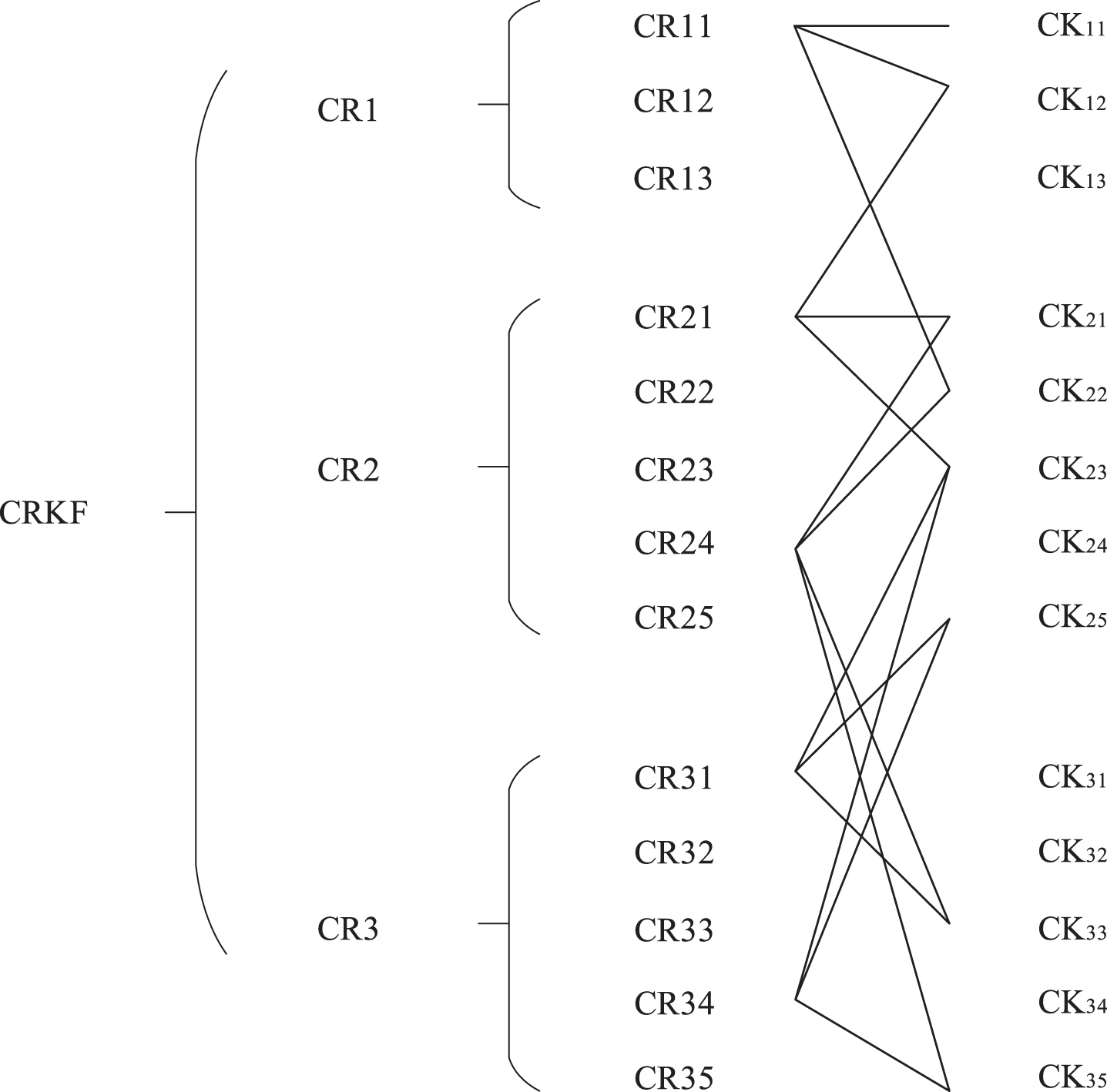
Example for relationship of construction risk knowledge framework (CRKF).

The data and knowledge flows of KB-FDSS.
(3) Fuzzy Quantitative Reasoning for Risks by Subjective Information
The subjective information is applied in fuzzy vectors for identifying the effectiveness of the restrained knowledge to the corresponding risk, so as to build the relation of RKF between the risks and the restrained knowledge. In order to make risk management decision, it is necessary to quantize the risk level while following fuzzy mathematical model is adopted:
Define: risk factor set U = {Political Risk, Economic Risk, Legal Risk, Social Environment Risk, Social Security Risk, Technical Risk, Management Risk}; V is the vector of effectiveness of knowledge in restraining risks, and V can be expressed by four categories: VE (Very Effective), RE (Rather Effective), SE (Slight Effective), and NG (Negligible), and V = {VE, RE, SE, NG}.
Introduce fuzzy sets to describe degrees of the problem, the fuzzy relation
Where rij is the membership of the i-th risk in U to the j-th domain of V. Fix i, then we have:
Eq. (2) represents the membership of the i-th risk in U to the four domains of V. Using “subjective information” to value the components in (2)
When i = 1 and 3, the risks can be effectively reduced, and the fuzzy risk matrix of the project
Now introduce the risk weight matrix of each functional system
Considering the political risk, economic risk and social security risk of the local region are most influential to the safety of the project, these risks should be considered in priority. Then
Then we have the weight row matrix (12) multiplies to first column of matrix (10):
Similarly, the weight row matrix (12) multiplies to second column of matrix (10): 0.0745; the weight row matrix (12) multiplies to third column of matrix (10): 0.2525; the weight row matrix (12) multiplies to fourth column of matrix (10): 0.3275.
After nominalization,
According to the principle of maximizing the membership function, the domain where maximum membership of E is located reflects the effectiveness of risk reduction. Its physical meaning can be summarized as following: If it is in domain VE, that means the risks are negligible and can be very effectively reduced. If it is in domain RE, that means the risks are slight and can be effectively reduced. If it is in domain SE, that means the risks are comparatively serious which can be just slightly reduced. If it is in domain NE, that means the risks are extremely serious which can barely be reduced.
It is concluded that Max (E)=0.419 of this project is in the fourth NG region of V, so the risks are barely reduced. It is evaluated those measures are negligible effective for both social environment risk and security risk, and so the project should be denied or reconsidered.
Management is actually a process of making a series of decisions for certain definite purposes. Subjective information will play a dominant role through AI technology in the processes of transformation qualitative decision making to quasi-quantitative by simulating human intelligence in decision processes. In other words, the decision-making processes will be replaced by quasi-quantitative in digital form based on subjective information of the decision maker. It is also the essentials of “Quantitative Management” with its fuzzy inference [40, 41], which represents the sign of digital revolution, have making a serious impact to managerial science. Above-mentioned procedures can be included in the processing of Fuzzy-AI Model, which will play important role in dealing with different managerial events and transform the management decision from qualitative to quasi-quantitative. Therefore, introducing the concept of subjective information can potentially expresses the heuristic decision process made by human beings to a digitized solution, which will directly create a new discipline in “Quantitative Management”.
Fuzzy-AI Model can be expressed in different forms according to different natures of problem being solved [42]. Usually, it can be an expression of evaluation fuzzy value of system parameters, or it may apply analytic formulation with uncertain variables. In some practical cases, it can be expressed by an optimization formulation such as mathematical programming with uncertain fuzzy system parameters and fuzzy uncertain constraint conditions as described in [43].
The subjective information combined with Fuzzy-AI Model to AI for Big Data exploration, which could work together for exploring the internal law of development from social, economic and engineering events for solving a family of uncertain real-world problems. The ever increasing of data expansion and variety in its ranking, the real meaning of big data in the big data era is no longer related to data, but negates to the law of more data identical to more points of view [44, 45]. In contrast, more data sometimes will cause more difficulties in data processing; it even exhausted more efforts but in vain attempt for solving encountered problems. It is understandable that the source data (information) can be divided into two categories: explicit and implicit, what we have nowadays for big data searching is just the explicit one retrieved from sensors, detectors and data (information) collectors from smart-cards; we have almost no way of collecting those implicit data (information) of what people is really thinking in their mind before they make their decisions. Furthermore, the sufficiency of the conclusion from big data searching depends upon the completeness of its source data (information), the situation of incompleteness of source data (information) due to without implicit information is the fundamental drawback of big data searching, sometimes it will result in completely wrong prediction.
To retrieve implicit source information from human’s brain is essentially needed for a comprehensive prediction from big data searching. Here the “subjective information” combined with “Fuzzy-AI Model” could work together, plays a role of digging out that implicit information from one’s mind and bridging the qualitative human thinking to the quasi-quantitative expression of human thought through the function of Inv. K (*’) in digital form. By which it can also retrieve that implicit information for the completeness of source information for big data searching to solve a family of uncertain real-world problems.
Since data itself is not the expected product of big data searching, what real meanings of data are those points, which promote social development, retrieved from big data exploration, such as: how to mining valuable information from big data searching for assessing the perspective economic feasibility of a social project? What are the implicit reasons of social faith and believing degradation which cause reputation degradation of government during the operation of certain policies, or how is the competitiveness of a candidate during the vote? etc.
Results and discussion
Under VUCA (volatility, uncertainty, complexity and ambiguity) era, analytical expression is no longer exactness in evaluating the objective reality. Evaluation in the past is based on analytic solution, which cannot accommodate to changeable environment. On the contrast, the fuzzy set is suitable to the uncertain and continuous changing environment. The approach proposed in this paper is significant in the digitization world due to the fact that it is naturally using fuzzy evaluation and fuzzy reasoning for quantitatively digitizing the objective world and operated through the computer, so as to access the objective world more efficiently than any existing approaches for accommodating to the digital world. The building of Knowledge-Based Fuzzy Decision Supported System (KB-FDSS) in this paper is totally along this path and has been successfully applied in a mega project [34], which has tested around twenty projects all over the world for its risk management by five years and obtained satisfactory results.
The project operated by the Author was organized by 5 institutions and companies from UK and 7 from China in 2010 and in 2011 the project was carried out the topic of “the risk characteristics and management of overseas projects”; in 2012 two visiting teams were sent for England, Qatar, UAE, Ethiopia and Tanzania respectively for using KB-FDSS to evaluate the risks and its management/control. Favorable results were achieved; in 2013 efforts were continued for improving the quality of theoretical work as well as extending the investigation of practical projects in USA for further searching the way of exploring high-end market in developed countries. And the trip of visit South-East Asia is mainly studies the EPC project (Engineering, Procurement and Construction) risks in this region. The software KB-FDSS based on subjective information and fuzzy reasoning not only can test the project risks and find out its direction of improvement, but also find out the decision traps of failure as well as the soft strength of enterprises against risks. Report [46] has shown the details of numerous practical examples with favorable results no matter for success or default.
Conclusive remarks
Subjective information will explore a wide range of applications in digital revolution as the basis of transformation uncertain operator from qualitative to quasi-quantitative. It is most suitable for simulating decision-making process of human beings, which forms the essential of management issues.
As the basis of non-structured problem-solving technology, subjective information can be applied to a wide range of real-world problems. It is a breakthrough of applied science for the solution of many practical problems characterized by non-structured nature. Fuzzy–AI Model can be used in many cases as a tool of transferring knowledge from qualitative to quasi-quantitative, while the computer digitization can be fully used. Most of the real-world problems could be solved by fuzzy approach and the suspicion of membership problem could be well verified by [25].
One should not underestimate the roles of subjective information and Fuzzy-AI Model for improving the completeness of source data and source information in Big Data searching. From logic point of view, the results from Big Data searching only based on explicit data and explicit information is questionable, since reliable results achieved by Big Data searching only if both explicit and implicit data/information is available. One would hardly deny that the introduction of subjective information and Fuzzy–AI Model is an important step forward in cognition science.
This work is just an attempt to raise interests for AI, engineering, sociality and cognition science researchers for paying their attention on this new sophisticated field. Though the theoretical formulation may have to be further improved, nevertheless, it is related to exploring second half of implicit information in human’s brain for the completeness of Big Data source information and solved a family of non-structured problems in our digital revolution era. We expect the common efforts of all related scientists and researchers to explore and to promote this interesting field.
Footnotes
Acknowledgments
The study was financially supported by the National Natural Science Foundation of China (71701152, 72071147), and the Research Program of Science and Technology Commission in Shanghai (18510745800).