



Abstract
IoT-Mobile Wireless Sensor Networks (IMWSNs) are being employed in a variety of simulators to visually demonstrate the exposure, energy usage situation, and expected life duration of Internet of Things (IoT) mobile sensors. The majority of academics have projected and expanded routing procedures in order to extend the network’s life cycle. In IMWSNs, clustering is the most important process for improving energy efficiency. In cluster approaches, each IoT sensor node provides the acquired data to the cluster-head of their own cluster. The cluster-head embraces the conscientiousness of gathering prepared information and directing it to the arranged network’s basestation. A fuzzy based energy proficient secure clustered routing (FEPSRC) is proposed in this research effort, which takes the residue energy, remoteness from the basestation, and compactness of IoT sensor nodes in its locality as input to the Fuzzy-Inference-System. For cluster-head selection, an eligibility ratio is calculated for each IoT sensor node. This protocol guarantees energy harmonizing by electing the preeminent IoT sensor node for the position of cluster-head, velocity of IoT sensor nodes are estimated and also provides best path for routing. The simulation consequence illustrates that projected fuzzy based energy proficient secure clustered routing condensed entire power expenditure, diminishes E-to-E delay, amplifies packet deliverance percentage and accomplishes maximal network life span.
Introduction
IoT-Mobile Wireless Sensor Networks (IMWSNs) are networks of Internet of Things (IoT) mobile sensor nodes that have limited sensing and broadcasting capabilities. These mobile IoT nodes are distributed across a vast area, with at least one basestation (BS) [1]. Every IoT sensor node restrains an identifying phase, a progression phase, a broadcasting phase, and energy management. It has wide-ranging appliance possibilities, includes environmental observing, patient observing, submarine habitat observing, military supervision, protection observation, etc. The route determination is a crucial problem for the effectual deliverance of the information to their goal point. Moreover, the functional routing design should substantiate minimize energy consumption and consequently expands the life span of the network [2]. Researchers have confirmed that clustering is an effectual technique in intensifying life span and condenses energy utilization of MWSNs. Each cluster has a large number of IoT sensor nodes; however, only one sensor node will operate as a cluster-head (CH), and the rest will act as cluster members. The information from the atmosphere is gathered by cluster members and transmitted to cluster CH. Furthermore, because the CH serves as a fusion point for information, the authentic information disseminated to the BS is condensed [3]. When the BS is far away from CH, the CHs exploit multi-hopping procedure to achieve the BS. Hence to construct network more energy proficient multi-hop broadcasting and clustering techniques are more effective tools [4]. By utilizing Fuzzy based Energy Proficient Secure Clustered Routing (FEPSCR) for the improvement of span in network. It uses a contingency strategy to choose Cluster Head CH. The network is splitted into four identical-size regions allowing for the severance remoteness from the BS. The IoT mobile sensor nodes which are closer to BS contain higher related possibility value in association to the IoT mobile sensor nodes farthest away from BS. Fuzzy-Logic (FL) that calculates the eligibility ratio of IoT mobile sensor node to be CH.
This research work is organized as follows. Section 2 appraisals the literature review. Problem statement is conversed in Section 3. FEPSRC is conversed in Section 4. Estimation of FEPSRC with fuzzy attribute-based joint integrated scheduling and tree formation (FAJIT) is done in Section 5. Finally research work is summarized and accomplished in Section 6.
Literature survey
A method operates spontaneously over no previous allocation of energy stages in mobile sensor nodes, as well as generating a hierarchy of CHs and identifying energy savings. The clustering process comprises two phases: setup and steady-state. The steady-state phase engages the information collecting and coverage process, while the set-up phase elects CHs based on remaining energy. Every CH acquires information from its cluster member. It mingle obtain information and it broadcast the information in a multi-hop transmission to the nearby super CH. The negative aspect of this approach is information collection encumber on CH amplify in WSN [3].
For two-level heterogeneity, a stochastic and plausible clustering-related energy-efficient strategy is proposed. The CH determination is based on a calculated active possibility based on constant power use [5]. Heterogeneous-Hybrid Energy-Efficient Distributed clustering (HEED) which integrates FL and consider sensor nodes compactness and residue energy for CH determination [6]. Cluster-formation using fuzzy logic (CFFL) focuses on cluster configuration for increased network life span and uses FL having two limitations to reduce energy consumption: energy and proximity to BS [7]. This study addresses the issue of proper CH assortment. Low-energy adaptive clustering hierarchy (LEACH) is extended by using FL. The Fuzzy-Inference-System (FIS) takes into account residue battery intensity, cluster centrality, and BS mobility FIS. Mamdani’s law is utilized to pick CH. The recital of this technique is to recovered life span and constancy [8]. HEED reveals energy-effectiveness with recovered throughput and packet delivery to BS [9] with various stage heterogeneity associated to replica variables. In Energy-efficient fuzzy logic (EEFL)-CH enhanced the LEACH procedure by diminishing the energy expenditure by combing Fuzzy technique. This approach exploits three factors predictable effectiveness, nearness to BS and residue energy for cluster development [10].
An innovative effectual-clustering approach for lengthen life span of WSN. This novel energy-efficient clustering procedure (NEECP) uses a malleable sensing zone to effectively desire CHs and a chaining technique to collect information. It also uses a redundancy verify task to avoid broadcasting of unnecessary data in order to extend the network’s life span. This method can be used both with and without information collection. The negative aspect of this approach is broadcasting transparency occurs due to chain related Data-Aggregation [11].
A clustering algorithm based on the K-means technique for data mining. The entire clusters in which information has to be detached are equivalent to the complete centroid, which is accepted as an input factor in the k-means clustering algorithm. Using innovative k-means, the first centroids are picked illogically from the provided set of centroids. Then, using differing arbitrarily chosen primary centroids, various clustering effects are achieved for the same dataset [12, 13].
Clusters are produced intermittently depending on lasting energy and remoteness in a modified-LEACH for energy maximisation in WSN. Reclustering divides the work burden among different sensor nodes by spinning the CH, increasing the network life cycle. Sensor nodes, on the other hand, are only in a dynamic state during the broadcasting phase, and they sleep the rest of the time, storing energy. In terms of network life span and throughput, the results show that this technique outperforms LEACH and the modified-LEACH approach [14, 15].
Every cluster in a scattered WSN by modified-k-means approach has three CHs. The CHs achieve a load scattering procedure to alternate as the dynamic CH that accumulates the sensor nodes enduring energy, thus lengthen network life span. Furthermore, it reduces clustering while significantly increasing the amount of information broadcast throughout the network process. Due to its limited manifold CH procedures, the Modified-k-means approach was evaluated as the accessible clustering approaches [16, 17].
In a resourceful routing protocol to recover cluster configuration convoying by Fuzzy-K-means technique, cluster element selection is based on atom swarm optimization, and super CH selection is based on Mamdani’s rule and nearby remoteness to BS. It extends the network’s life span. The weakness of this approach is selection of S-CHs that is close to BS. The number of CHs has been significantly condensed in huge range WSNs [18, 19].
Secured-energy-aware Routing method, called Trust-Destruct-Protocol (TDP) improved-k-means method is utilized to improve topology supervision. Each sensor node determines its energy by transmitting and receiving a set of trial packets. Each sensor node is assigned a rank based on its energy output. The basic issue in this technique is that before broadcasting to other sensor nodes, each sensor node must first calculate its trust and distrust costs, which raises the transmission cost [20–22].
Problem statement
Energy-effectiveness is major explore area in MWSN. The energy-effectiveness and life span of IoT sensor networks has correlation. Broadcasting necessitates a significant quantity of energy. Researchers are working to extend the network’s life lifetime, but cultivating it is the most important priority in the MWSN. LEACH, Threshold sensitive Energy Efficient sensor Network (TEEN), Adaptive-TEEN, Power Efficient Gathering in Sensor Information Systems PEGASIS, HEED, Intra-balanced (IB-LEACH), and Threshold-LEACH are just a few of the energy-efficient routing and clustering systems that have been proposed. Existing methods are unable to construct unbiased clusters while reducing energy expenditure to a minimum altitude. The projected FEPSCR tactic recovers the configuration of the cluster development, diminish energy expenditure for information broadcasting, recover the life span of the network and afford enhanced security.
Installing and using the Microsoft Word template
In this segment, Fuzzy based Energy Proficient Secure Clustered Routing tactic is converse. The structure of a fuzzy logic system is shown in Fig. 1. The protocol is completed in three states. Initially, the CH election occupies fuzzy-logic for superlative nominee election from the accessible IoT sensor nodes in the network by using cluster configuration using fuzzy-logic. Subsequent, the residue energy intensity of the IoT sensor node measured IoT sensor node energy supervise algorithm. Successive arbitrary velocity of entire IoT sensor nodes in the network is evaluated SNodevelocityModel. Finally, the route innovation stage is alienated into two components intra-zone-routing and inter-zone-routing this is done during route innovation.

Structure of fuzzy logic system.
The IoT sensor nodes are haphazardly spotted over target region. After commencement of every cycle, configuration of clusters takes position before accumulating the information from destination region. In every cycle, supreme s% CH is elected from the position energetic IoT sensor node. BS telecasts a packet (LOC-BS) into the destination region after the exploitation. This packet contains important messages such as the location of the BS, the synchronisation of the sector confidential, and the time space for the IoT sensor node to avoid destruction. The IoT sensor nodes now broadcast a packet (Hello-pkt) to the network in accordance with the time space set by BS to avoid destruction. The IoT sensor nodes detect the restricted variables, such as node compactness, residual energy, and distance from the BS, after all communications have been completed. The procedure for configuring a cluster for a proposed protocol is explained in the next section.
Begin
1. N = Total IoT sensor nodes in network
2. IDSN = Unique ID of IoT sensor node
3. SNode(i).E = Ed // Energy level throughout consumption
4. SNode(i).State = member
5. CH_list = 0
6. CH_co = 1
7. SNode(i).Pa = Allocate area based possibility
8. SNode(i).B = Total IoT Sensor nodes inside broadcast Range (Br)
9. SNode(i).RBS = Remoteness among SNode(i) to BS
10. While (CH count< = s%)
11. {
12. Compute eligibility ratio for every SNode (i).
13. Compute mean[ME]
14. Compute Threshold Level(TL) for SNode(i)
15. Generate arbitrary number (AN) for every Node (i).
16. If AN < SNode(i).TL and CH_count < s% then
17. SNode(i).State = CH
18. CH_co++
19. Add SNode(i) to CH_list
20. End If
21.}
22. Each CH transmits H_Msg(IDSN, Reng) to every IoT sensor node
23. SNode(i) connect nearby CH to form cluster
End
Creating a new document with the MS Word template
FL technique is integrated for superlative nominee election to the responsibility of CH in this proposed study task. FL is skilled at understanding and resolving human creature behaviour. The critical configuration of a fuzzy-system that will be used in future research.
Fuzzification
The fuzzifier crisp input variable is one of the most cost-effective ways to manipulate the eligibility ratio [23]. The Euclidean distance between every IoT sensor node and the BS is known as remoteness to BS. The total power available to the IoT sensor node at the time is referred to as residue energy. IoT sensor node compactness refers to the number of close IoT sensor nodes in the network that are considered for CH contention. These precise values are sent to the FIS. As illustrated in [24], the values of the association function (AF) and the junction point of the input variable are adjudicated among these variables.
General remarks on figures
The cost of fuzzy regulation is provided to the rule-base for the IF-THEN condition after fuzzification. A value is obtained by using the Fuzzy related & and | operators. The Gathering technique combines all of the production after applying the 27 rules mentioned in [24], and the most cost-effective choice is chosen from the merged fuzzy set. Because of its peculiarity, the Mamdani assumption system has been employed to attain the eligibility ratio through Fuzzy-Logic.
General remarks on figures
The fuzzy variables utilised for the crisp profitability cost are shown in [24]. In Equation 1, the core region (Z) approach is employed for defuzzification.
AF has a different architecture than trilateral, trapezoidal, elliptical, Gaussian, and so on. The only stipulation that an AF wants to make is that it should range from 0 to 1. In this study, Gaussian AF is chosen for the intermediary value because of its efficiency and non-zero value everywhere, while Trapezoidal AF is used for the margin variables because of its simplicity and speedier processing [25]. Other association functions exist, but Gaussian and Trapezoidal AFs must be used to produce better results. Equations (2) and (3) incorporate the Gaussian and trapezoidal AF.
The bottom and the carry of the trapezoid are positioned by x,y,z and w correspondingly.
The defuzzifier converts the input into a crisp set, resulting in a high eligibility ratio for each IoT sensor node. In equation 4, the eligibility ratio for each IoT sensor node is determined by the threshold level.
Throughout the calculation of TL, mean of eligibility ratio of every IoT sensor nodes and possibility allocated to every IoT sensor node as per their continuation in consequent area is measured. Every active IoT sensor node in the network generates an arbitrary number for CH assortment indiscrimination. If the value is less than the measured TL, the CH duty is allocated to the IoT sensor node. CH plays a crucial part in the network’s energy efficiency, and it is turned after each cycle to balance the load among the IoT sensor nodes that are strategically placed. Once the choice of nominee of CH in topology construction segment, the IoT sensor nodes in CH list transmit (CH_H) inside the broadcast range (Br). The IoT sensor node not elected for CH position join nearby cluster by broadcasting (N_Join) to the nearby CH. Topology construction segment gets consummate entire IoT sensor nodes get combine to clusters.
Input function for remoteness among IoT sensors and BS is close(C), medium(M) and far(F) is portrayed in Fig. 2, IoT sensor compactness is sparse(S), medium(M) and dense(D) is portrayed in Fig. 3, Input function for outstanding energy is low(L), medium(M) and high(H) is portrayed in Fig. 4 and output function for fuzzy is worst(WT), worse(WS), bad(B), Fair(F), good(G), better(BT), far-better(FB), best(BS), very best(VB) is portrayed in Fig. 5. Further more input and output functions are shown in Table 1.

Input function for Remoteness among BS.
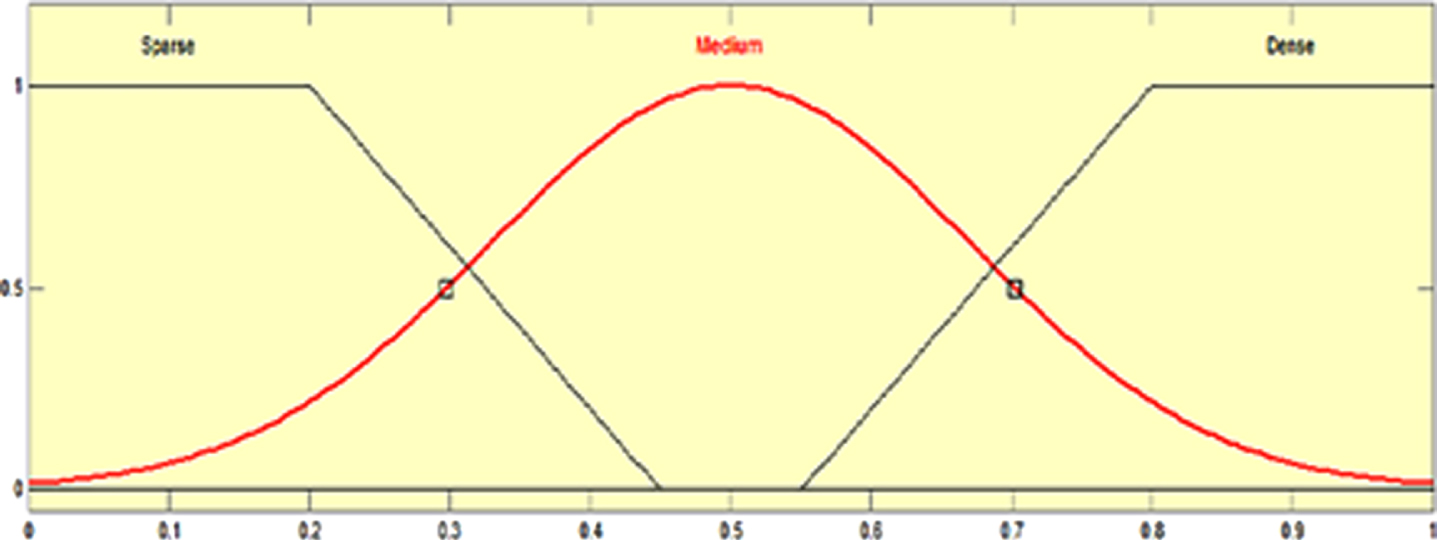
Input function for compactness.
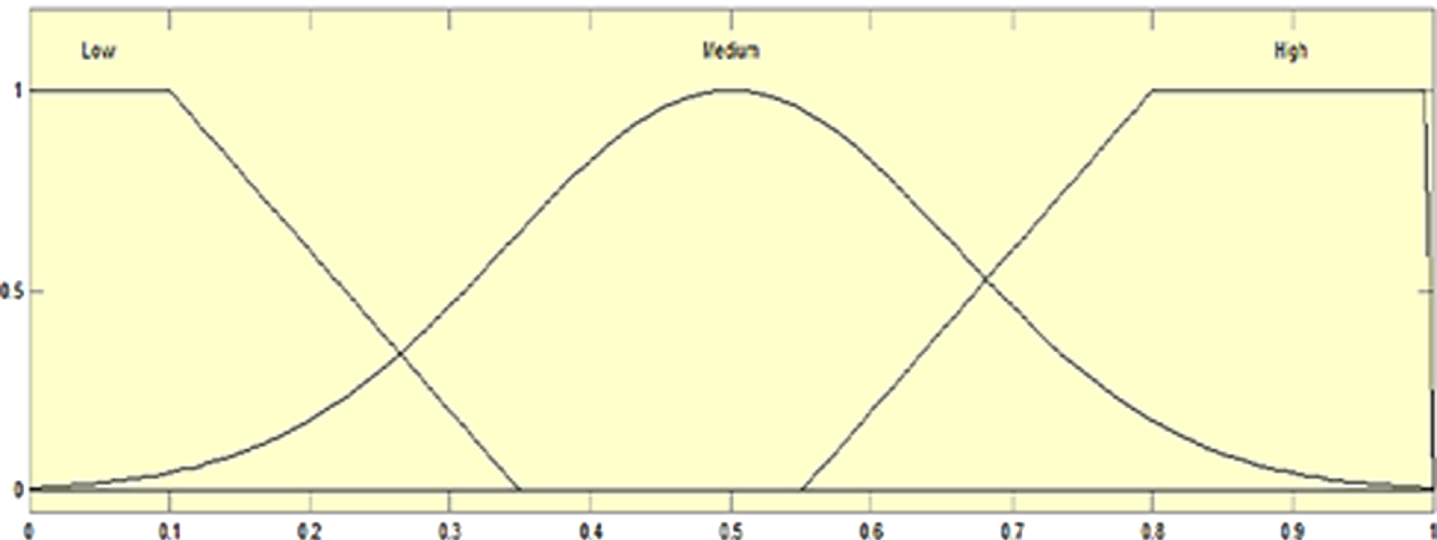
Input function for outstanding energy.
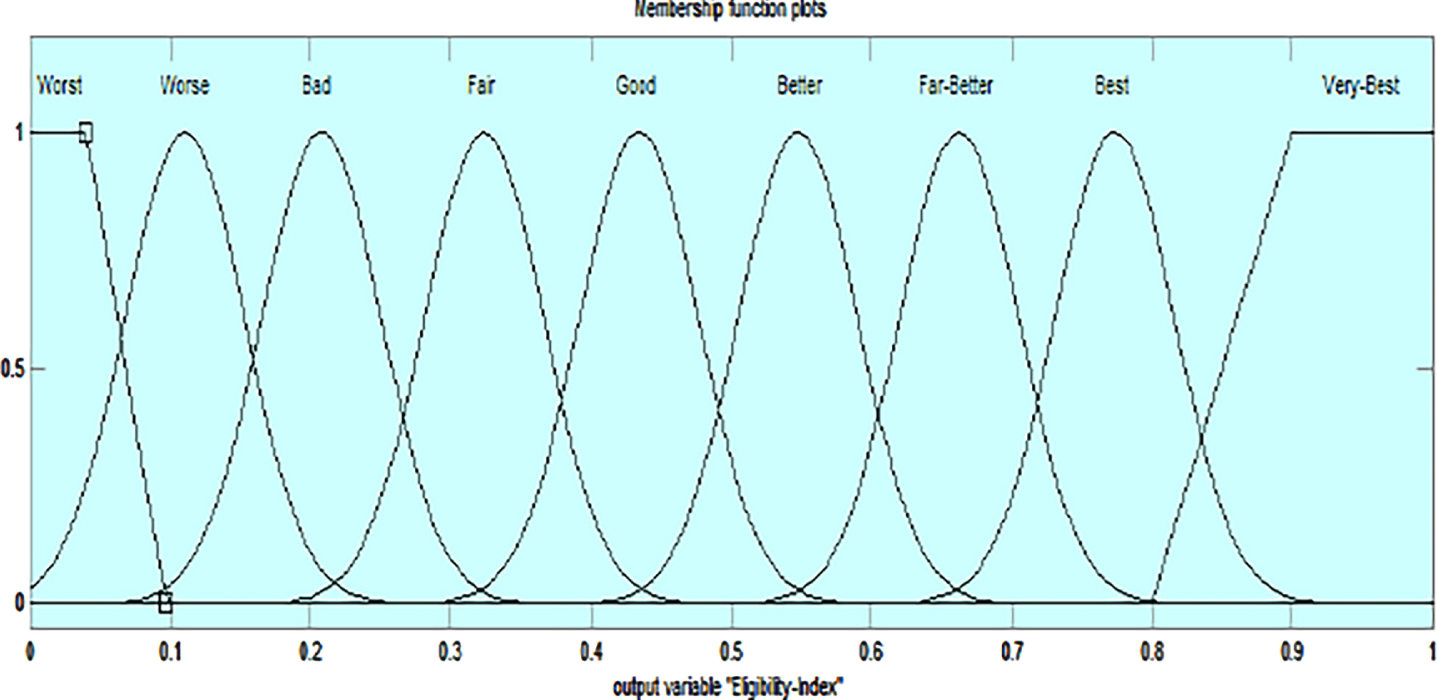
Output function.
Fuzzy Rules recognized for FEPSCR
In Fig. 5 the output functions are worst(WT), worse(WS), bad(B), Fair(F), good(G), better(BT), far-better(FB), best(BS), very best(VB) is portrayed in Fig. 5. Further more input and output functions are shown in
In CCF() task the maximal remaining energy IoT sensor node will be chosen as CH is shown in Equation (5).
where N IoT sensor nodes in network.
The remaining IoT sensor nodes are allocated with special responsibility depending on offered remaining energy of every IoT sensor node. That can be achieved by S-NESA() function. The energy mandatory to broadcast one bit of information is specified as Ebro in Equation 6. Total broadcasting energy mandatory to broadcast one bit along path p,
Entire broadcasting energy Eeb that is mandatory by IoT sensor node SN to broadcast information bits is given in Equation 7.
Where,
RSN(p) is residual number of information bits for continuing path through IoT sensor node SN along pth path.
BESN(p) is broadcasting energy that IoT sensor node SN is mandatory to broadcast one bit along path.
Imagine every IoT sensor nodes initiate with a restricted quantity of energy and energy indulgence per bit of information and controls packet broadcasting and response are recognized. Determine least effectual energy residual in every IoT sensor nodes along pth broadcasting path is evaluated in Equation 8.
Where,
Reng(min) is the minimal remaining energy of IoT sensor node.
Reng is the remaining energy of IoT sensor node.
TBeng is the total broadcast energy required by an IoT sensor node SN to broadcast a certain number of data bits along the path.
Ibro is overall information size to be broadcasted.
The pth path should not be the direct path among source and target; rather, it should be the one that provides the most effective energy, i.e. every IoT sensor node in this pth path has the most exceptional energy.
S-NESA which computes Reng(min) and verify it beside dissimilar threshold levels. S-NESA() task consigned diverse positions to the IoT sensor nodes depending upon accessible outstanding energy as, if outstanding energy above 80% will be CH, if outstanding energy above 60% and below 80% intermediate IoT sensor node (IN), if outstanding energy above 40% and below 60% broadcast and accept information (BA-N), if outstanding energy above 30% and below 40% critical information broadcast as a intermediate IoT sensor node (CIN), and if outstanding energy above 0% and below 30% periodic snooze manner(PSN).
begin
1. call CCF()
2. t = 10 sec
3. for k = 1 to n.
4. begin
5. if (OEk> = 80) // OEk is outstanding energy of kth IoT sensor node
6. {
7. then CH< -OEk
8. else if(OEk< = 60 and OEk > 80)
9. then IN< -OEk
10. else if(OEk> = 40 and OEk < 60)
11. then BA-N < -OEk
12. else if(OEk> = 30 and OEk < 40)
13. then CIN < -OEk
14. else
15. PSN < -OEk
16. }
17. end
18. Replicate until every IoT sensor node in cluster are observe.
19. Replicate when reclustering takes place.
end
In the proposed FEPSCR approach arbitrary velocity of entire IoT sensor nodes in the network. A IoT Sensor Node Velocity Supervising Algorithm (SNVSA) to observe the velocity of IoT sensor node. Here velocity threshold VTs at 30 m/s. If SNspeed is lower than VTs then IoT sensor node transmit packet. If the number of VTs is insufficient, employ precedence stages to relay the data packages, as described in Algorithm 3.
begin
1. step1: Imagine the arbitrary velocity of every IoT sensor nodes in the networks
2. step2: Examine velocity threshold VTs at 30 m/s.
3. Step3: if SNvelocity is lower than VTs
4. then
5. IoT sensor node transmit packet.
6. elseif velocity is among 10–30 m/s
7. then
8. IoT sensor node transmit packet with low precedence P3.
9. elseif velocity is among 30–50 m/s
10. then
11. IoT sensor node transmit packet with average precedence P2.
12. else
13. elseif velocity is among 50–70 m/s
14. then
15. IoT sensor node transmit packet with higest precedence P1.
16. IoT sensor node never contribute in packet transmission.
end
Route innovation stage
The route innovation stage is alienated into two components intra-zone-routing and inter-zone-routing.
The source IoT sensor node S advertises the RREQ packet in route innovation.<S-IDSN, D-IDSN, hop_count, Lspan, Emin, SNsnooze, SNvelocity > are all included in the RREQ packet’s header. Where Lspan is the nth route’s life span, SNsnooze is the number of IoT sensor nodes in the sleep state, and SNvelocity is the IoT sensor node’s velocity. Lspan = 0 and SNvelocity = 0 at first. If an IoT sensor node needs to send a packet, it must first check to see if the target IoT sensor node is listed in its associate table. Intra-zone routing is utilised when the target IoT sensor node is on the table because both sensor nodes are part of the same cluster and have the same corresponding velocity.
Both sensor nodes are in a separate cluster if the destination IoT sensor node is not located in the table, and CH must execute inter-zone routing. The cases that will be measured in the future are included in the inter-zone.
The RREQ packet is relayed through CH from the source IoT sensor node. The CH detects RREQ, checks D-IDSN and SNvelocity, and forwards the packet to the appropriate CH. The CH takes RREQ, verifies D-IDSN and Emin, and if the target is in a similar cluster, broadcasts the packet to the target IoT sensor node; or else, the package is abandoned.
Source IoT sensor node broadcast RREQ packet to CH which verifies D-IDSN and transmit packet to all zones. As IoT sensor nodes with high velocity are not incorporated in any cluster, the goal is not begun in any cluster, and packets are abandoned by whole CHs.
The RREQ packet is sent by the source IoT sensor node. The sensor nodes that receive this RREQ packet verify the IoT sensor node’s location-IDSN and velocity. If the velocity exceeds the threshold and is between 10 and 30 m/s, the IoT sensor node broadcasts packets with priority P3. If the velocity is between 30 and 50 m/s, the packet is broadcast with priority, and P2 receives a retransmission. If velocity is in 50–70 m/s range then packet is broadcasted with precedence P1
1. Cintra
2. Step 1: Route innovation (RI)
3. Step 2: initialize Lspan = 0 and SNsleep = 0
4. Step 3: RREQ(S-IDSN, D-IDSN, hop_count, Lspan, Emin, SNsnooze, SNvelocity) transmitted by source IoT sensor.
5. Step 4: If IoT sensor node—- broadcast –>packet then verify existence of target in associate table.
6. Step 5: If IoT sensor node is in table & both source IoT sensor node and target IoT sensor node are inside similar cluster then execute Intra-Cluster-routing by calling dynamic source routing (DSR) [26].
7. Else
8. call Inter-Cluster-Routing.
9. Cinter(If DSN not present in C)
10. Case1: S-SN and D-SN are in dissimilar cluster.
11. Step1: S-SN—(transmit)—->RREQ through CH.
12. Step2: CH verify D-IDSN and SNvelocity.
13. Step3:Broadcast to entire CH.
14. Step4: other CH< —(receives)–RREQ and verifies D-IDSN.
15. Step5:If D-SN is in similar cluster then transmit to target IoT sensor node.
16. else
17. abandon Packet.
18. Case2: S-SN in cluster and D-SN is not in any cluster.
19. Step1:S-SN——>RREQ to CH.
20. Step2:CH verifies id and broadcast to further CH
21. Step3:if D-SN is contains higher velocity then
22. not initiated in any cluster and abandon request.
23. Case3: S-SN is not in any cluster and D-SN is in cluster.
24. Step1: S-SN—-(transmit)—->RREQ.
25. Step2: every IoT Sensor Nodes SNi who accept RREQ verifies D-IDSN and SNvelocity
26. if(SNvelocity> = 10&& SNvelocity< = 30) then
27. SNi transmit packet with precedence P3
28. elseif(SNvelocity> = 30&& SNvelocity< = 50) then
29. SNi transmit packet with precedence P2
30. elseif (SNvelocity> = 50&& SNvelocity< = 70) then
31. SNi transmit packet with precedence P1
32. else
33. SNi abandon the packet
And if velocity is greater than 70 ms IoT sensor node abandons the packet.
As RREQ packet broadcast along path p, its significance is simplified as follows
if (
else if (
else if (
else if (
The target IoT sensor node remains for convinced time Trem till every RREQ destined for the target is arrived. The target IoT sensor nodes evaluates D-seq_no, hop_count and Lspan of the path in RREQ packet arrived with D-seq_no, hop_count and Lspan of the path in routing table and chooses the path with Lspan maximal energy and minimal number of snooze IoT sensor nodes as for every RREQ, decline RREQ’s with
The target IoT sensor node then determine following factor for every staying RREQ packet in Equation 9.
begin
step1: call network-initilizer()
step2: Cluster configuration and IoT Sensor Node Energy Supervise Algorithm.
for every time space Ts // imagine Time space Ts simulation duration
i) call CCF()
ii) verify IoT sensor node energy(SNeng),SNode velocity(SNvelocity) and then call S-NESA() and SNVMA() consequently.
iii) go step i and ii for every time space.
Step3: Route innovation and Packet broadcasting
If routing is inside cluster then
i) call C intra ()
ii) call SNVMA()
else if routing is in dissimilar clusters.
i) call C inter ()
ii) call SNVMA()
Step4: go step 2 and step 3 till simulation finish.
end
Where Pm cost specifies whether mth path is chosen or not.
The target IoT sensor node subsequently choose path with maximal Pm and modifications are done in routing table.
The IoT sensor nodes along the path will communicate path reply information after the route has been determined, in which the IoT sensor nodes answer to the chosen route by communicating their location information velocity along the reverse path.
Path_reply is sent out by the selected IoT sensor nodes in the path.
In path_reply, every chosen IoT sensor node includes its position (x,y) and velocity SNvelocity.
Every transmitting IoT sensor node uses these location parameters to determine the distance between it and the next hop IoT sensor node.
Based on the movement of the IoT sensor node, the SNvelocity cost is utilised to determine the priority of conveying a response.
For a sender node to broadcast among the present IoT sensor node and subsequent IoT sensor nodes, the minimum broadcasting power is required.
Simulation results
In this simulation is conceded in NS2 energy consumption and speed of IoT sensor nodes are contrasted with FAJIT procedure [24]. 100 mobile IoT sensor nodes are instinctively spotted in a region of 300 m. BS, CH and mobile sensor nodes have motion. The bandwidth of network is set to 1 Mbps, the size of broadcasting packets is 256 bytes and packet header is 12 bytes. An entire IoT mobile sensor node in the cluster has unrelated energy intensity and broadcast congregated information to the BS. While a IoT mobile sensor node exploits energy it goes downward to its energy threshold, it unable to broadcast information and is believed as an insensible IoT sensor node. Table 2 lists the simulation parameters, whereas Table 3 lists the results. Shows the cost of sending a certain amount of packets, how many packets were lost, how many packets were routed, and how much energy was consumed in the network at different speeds and numbers of IoT sensor nodes.
Simulation Parameters
Simulation Parameters
For various speeds and numbers of IoT sensor nodes, costs for number of packets transmitted, lost, number of packets routed, and energy enthusiastic in network
The number of information packets accepted divided by the number of information packets transmitted is known as packet delivery,
FEPSCR achieves relatively recovered as network will not broadcast RREQ message except it discover minimal path contains maximal outstanding energy IoT sensor nodes. Also velocity of every IoT sensor nodes, either it could be the transmitter, recipient or communicate IoT sensor node is measured while choosing paths. Tremendous velocity IoT sensor nodes and depressed energy IoT sensor nodes are not contributed in information broadcasting task. Consequently packet bead is fewer which raise the deliverance proportion of the network. In Fig. 6 displays that FEPSCR proficiently dispatched packets (85% to 95%) when capacity is limited but raise in traffic the achievement humiliated casually since packets are discarded due to bottleneck.

Packet Accepted versus Simulation Time of mobile IoT sensor nodes.
Where, PD ->Packet deliverance, I A ->number of information packets accepted and I T ->number of information packets transmitted.
Packet loss is number of packets discarded in the network. Figure 7 shows that the packet bead in FEPSCR is reduced because it condenses RREQ inundation and also because of connection faults and collision. If the network’s mobility of IoT sensor nodes grows, the packet bead grows as well. As the jam grows, the bottleneck is caused by IoT sensor node beads packets, which causes the packet bead to grow as the network traffic or demand grows.
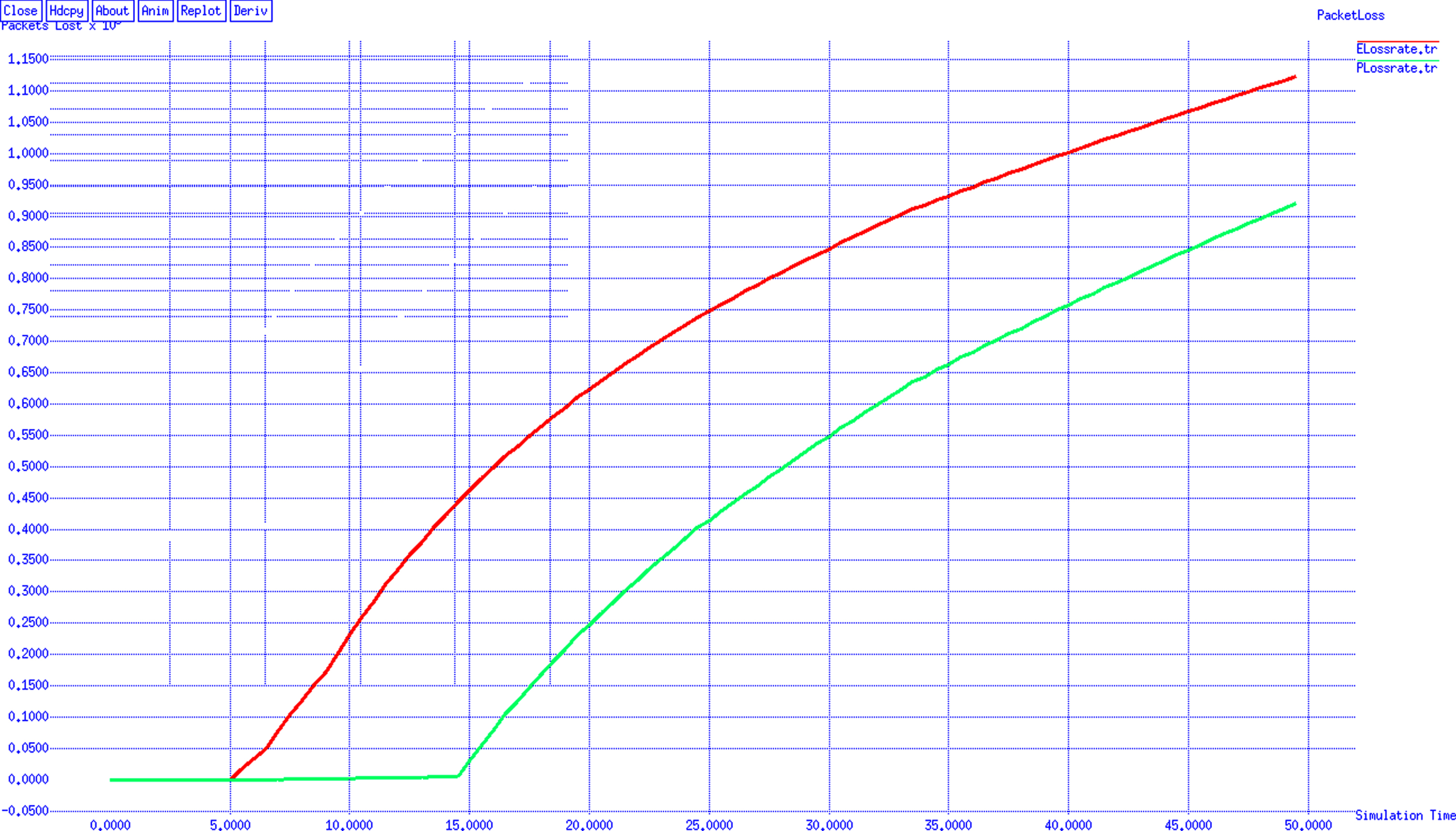
Packet Bead versus Simulation Time of mobile IoT sensor nodes.
In Fig. 8, the proposed algorithm’s latency is compared to the delay of the FAJIT algorithm. Routing and information packets are used to distribute bandwidth in the majority of cases, and routing packets are thus measured as network latency. Figure 8 displays an evaluation of routing delay of FEPSCR with FAJIT protocol. It displays that routing delay is lesser in FEPSCR because of lower inundation and rebroadcasting. The velocity of IoT sensor node amplifies the delay is too amplified to some amount. The number of IoT sensor nodes enlarges the delay is too enlarged since the traffic is more in network. Figure 9 shows the Remaining Energy of sensors in environment.

Average Delay.
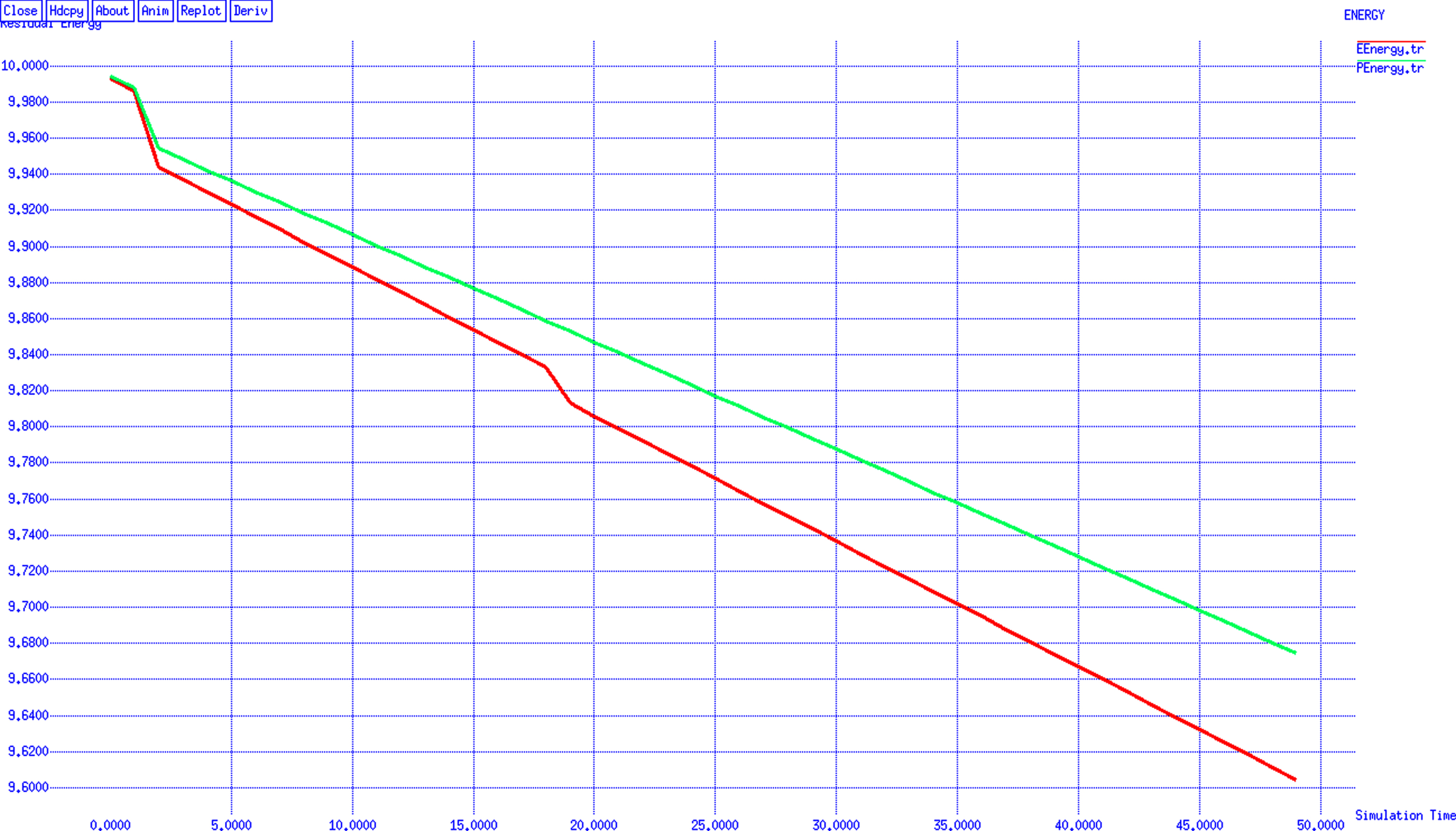
Remaining Energy to Increase the duration of Network.
After broadcasting and gathering data, a certain amount of battery power remains in the IoT sensor node. When the number of IoT sensor nodes varies, Table 2 shows the cost for number of packets transmitted, bead, amount of routing packets, and energy drained in the network.
The Fuzzy based Energy Proficient Secure Clustered Routing is planned and carried out in advance. FAJIT is used to test the efficacy of this proposed improved technique FEPSCR. The network is divided into associate networks in FEPSCR, and each IoT sensor node is given a capability based on the separation distance. In comparison to FAJIT, the proposed study effort has showed improved performance by combining FL in the clustering technique. The corollary shows that FEPSCR can recover in low-movement-velocity IoT sensor nodes (Packet deliverance percentage up to 98.2%), provide consistent performance in extremely mobile networks (Packet deliverance percentage up to 93.3%), and consumes less energy (regular residual battery energy is 25% higher than other approaches). In less dense or denser mobile sensor networks, the projected strategy performs better. According to the simulation, FEPSCR improves cluster architecture, network life span, and reduces energy consumption by a significant amount. In future it can be implemented for high speed IoT based mobile sensor networks.
Authors Declaration
The authors