In the multi-objective programming problem (MOPP), finding an efficient solution is challenging and partially encompasses some difficulties in practice. This paper presents an approach to address the multi-objective linear fractional programing problem with fuzzy coefficients (FMOLFPP). In the method, at first, the concept of α - cuts is used to change the fuzzy numbers into intervals. Therefore, the fuzzy problem is further changed into an interval-valued linear fractional programming problem (IVLFPP). Afterward, this problem is transformed into a linear programming problem (LPP) using a parametric approach and the weighted sum method. It is proven that the solution resulted from the LPP is at least a weakly ɛ - efficient solution. Two examples are given to illustrate the method.
Linear fractional programming problem (LFPP) has played a significant role in optimization. In [32], applications of the LFPP in economy, business, engineering, and management were demonstrated. Apart from that the LFPP was more recently utilized as an appropriate model in transportation, water consumption, medicine, and industry [1, 37]. Charnes and Cooper [12] proposed the best ever method dealing with the LFPP. In the method, the fractional problem is transformed into the LPP using variable transformation technique. [19] showed that the fractional programming problem (FPP) can be replaced by a series of non-fractional problems. Based on this principle, many approaches have been developed [8, 24]. Borza and Rambely [4] designed a non-iterative method to obtain the global optimal solution of the sum of linear fractional programming problem (S-LFPP) by the use of variable transformation. [22] constructed an iterative algorithm for the large-scale S-LFPP using a branch and bound technique.
In different disciplines of optimization such as engineering, business, and management, the notion of fuzzy sets has been used to design approaches [5, 40]. Specifically, one can use fuzzy numbers when there exists an ambiguity to specify coefficients. In the LFPP, we deal with the fuzzy linear fractional programming problem (FLFPP) if the coefficients are fuzzy numbers. One way of addressing the FLFPP is to use fuzzy ranking approaches. In this manner, a fuzzy number is changed into the fixed number(s). Therefore, multiple LFPPs may be considered instead of the main fuzzy problem [3]. Although these kinds of approaches are easy and straightforward, representing a fuzzy number with fixed numbers may not be as comprehensive as we expected generally. On the other hand, using the concept of α - cut has been considered by many researchers as an efficient and comprehensive approach dealing with fuzzy numbers [16, 38].
In general, when the concept of α – cut is used, minimizing of the FLFPP is changed into a bi-objective linear linear fractional programming problem (BOLFPP) of the form . Mehra et al. [23] developed a method treating this bi-objective problem in which only FL (X) is used. Ignoring FU (X) can be considered as a drawback of their approach. In order to overcome this shortcoming, convex combinations of the solutions of problems and were suggested by Stanojević and Stanojević [33]. However, their method increases the computational expenses since there is no rule to recognize which combination gives the best result. The methodology of [23] was developed by Chinnadurai and Muthukumar [14] to address the LFPP with positive fuzzy coefficients and positive fuzzy decision variables [7]. Presented an approach to deal with the LFPP with interval coefficients. In their method, the original problem is transformed into a LPP using suitable variable transformations. Recently, Borza and Rambely [6] introduced a method to address LFPP with fuzzy coefficients based on the concept of α- cut, membership functions of the objectives, suitable variable transformation, and max-min technique. In their method, the fuzzy problem is finally replaced by a LPP.
In the literature, there are several methods to deal with the multi objective linear fractional programming problem (MOLFPP). These approaches can be also employed to tackle , where FL (X) and FU (X) are linear fractional functions and S is a polyhedral set. Chakraborty and Gupta [10] developed a method to address MOLFPP. In their method, the multi objective problem is transformed into a multi objective linear programming problem (MOLPP). Subsequently, the membership functions are specified after identifying the fuzzy aspiration levels of the linear objectives. Finally, the MOLPP is changed into a LPP using the max-min technique. Their method was designed such that it has not been possible to prove that the outcome is efficient, which is a drawback. Motivated by Chakraborty and Gupta’s methodology, Veeramani and Sumathi [35], and De and Deb [18] introduced approaches to deal with LFPP with fuzzy coefficients and MOLFPP, respectively. Pal et al. [26] transformed the MOLFPP into a LPP using a fuzzy goal programming approach in addition to suitable variable transformations. Toksari [34] introduced an approach to tackle the MOLFPP where the membership functions of the objectives are defined and then linearized by using the first-order Taylor series about the individual optimal solutions. For some examples, Borza et al. [9] reported that the results of using the first-order Taylor series proposed by Toksari are to some extent more accurate than the results of the fuzzy goal programming used by Pal et al. Nayak and Ojha [25] introduced a method dealing with the MOLFPP with fuzzy coefficients where the fuzzy problem is altered into an interval valued LFPP using the concept of α - cut. In their method, the fuzzy problem is reduced into the MOLFPP. Afterward, they reach a MOLPP employing the first-order Taylor series. Finally, the weighted sum technique is utilized to achieve a LPP. In general, there exists a drawback to the methods which use first-order Taylor expansion since this expansion reduces the accuracy.
In the MOLFPP, if the coefficients are fuzzy numbers, then we deal with fuzzy multi-objective linear fractional programming problem (FMOLFPP). To the best of our knowledge, the most efficient method to deal with FMOLFPP was proposed by Nayak and Ojha [25]. In their method, the α - cuts of the fuzzy numbers are used. Accordingly, the problem is changed into:
Let be the optimal solution of , and be the first-order Taylor expansion of around . In their method, the following problem is finally solved.
In general, there are two drawbacks to the method: the first one is to utilize the first-order Taylor series, which decreases the accuracy automatically. The other one is to use only . In other word, does not play any role in finding the solution. This paper aims to provide a method to solve the MOLFPP with fuzzy coefficients in which the parametric approach of [19] is utilized instead of the first-order Taylor series. In addition, the weighted sum technique, the method of [12], and the approach of [23] are used to design our approach. In this method, the FMOLFPP is finally changed into the LPP. It is proven that the solution resulted from the LPP is at least a weakly ɛ - efficient solution for the main fuzzy problem.
The remainder of this paper is organized as follows. In Section 2, some basic notions and definitions are given. In section 3, the main results are given. In fact, in this section, we show how the FMOLFPP is changed into the LPP. In section 4, numerical examples are solved to illustrate the method, and comparisons are made to show the efficiency. Finally, section 5 concludes the paper.
Preliminaries
Fuzzy Numbers and intervals
Definition 1 (
α- cut). Suppose is a fuzzy set in X and α ∈ [0, 1]. The α- cut of the fuzzy set is the crisp set given by: .
Definition 2 (Triangular fuzzy numbers). Assume is a fuzzy set. A triangular fuzzy number is defined as:
For the triangular fuzzy number , .
In the literature, there exist several methods to rank fuzzy numbers. Chen and Hwang [13] reviewed 2o ranking methods. Refer to [30] for a more recent method to rank fuzzy numbers.
A fuzzy number can be represented uniquely by its α - cut. Therefore, in this paper, arithmetic operations and the ranking of fuzzy numbers are defined in terms of α - cut s of the fuzzy numbers.
According to Wu [39], the following proposition is true for given two arbitrary fuzzy numbers and .
Proposition 1. if only if and .
In the above, α ∈ [0, 0.5] means the α - cuts include the element with small membership degrees. To compensate for this shortcoming, referential fuzzy numbers are defined.
Definition 3 (Referential fuzzy number). Let be a triangular fuzzy number with the membership function , then its referential fuzzy number is a triangular fuzzy number denoted by and defined as follows:
In addition, .
It is not difficult to show . Therefore, ∃ intervals V1 and V2 such that:
where , ∀x ∈ V1 ∪ V2, .
Definition 4 (Ranking of fuzzy numbers). Let and be referential fuzzy numbers related to triangular fuzzy numbers and , respectively. Consider and . Fuzzy number is said to be smaller than and denoted by if only if and .
Definition 5 (Arithmetic of intervals). Assume A = [AL, AU], B = [BL, BU] are intervals, and k ⩾ 0 is a scalar. Therefore, addition, multiplication, and division on the intervals are defined as follows:
In this paper, symbols ′ ∼ ′ and ′ - ′ denote the fuzziness and interval, respectively. In fact, means that a is a fuzzy number, and indicates that A is an interval.
Linear fractional programming
Consider the general form of the linear fractional programming problem (LFPP) as follows:
where . In addition, DTX + β > 0, ∀ X = (X1, …, Xn) ∈ Ω. It is additionally assumed that feasible region Ω is a regular set i.e. a non-empty and compact set. Notify X ⩾ 0 means Xi ⩾ 0, for i = 1, …, n.
Using variable transformations transforms (1) into:
where φ is regular feasible set.
Lemma 1.In (2) , variable t cannot be zero.
Lemma 2.If , then .
Theorem 1.If (Y*, t*) is optimum for (2), then is optimum for (1) .
Charnes and Cooper [12] proved the above theorem and lemmas.
Multi-objective programming
Consider the general form of MOPP as follows:
where S is a regular feasible region.
Definition 6. In (3), X* ∈ S is an efficient solution if ∀X ∈ S, then ∃j∈ { 1, …, k } such that Fj (X*) < Fj (X).
Definition 7. In (3), X* ∈ S is a weakly efficient solution if ∀X∈ S, then ∃ j ∈ { 1, …, k } such that Fj (X*) ⩽ Fj (X).
Definition 8. In (3), X* ∈ S is an ɛ- efficient solution if ∀X∈ S, ∃ j ∈ { 1, …, k } such that Fj (X*) - ɛ < Fj (X), where ɛ = inf {δ > 0 : Fj (X*) - δ < Fj (X)}.
Definition 9. In (3), X* ∈ S is an ɛ- weakly efficient solution if ∀X ∈ S, then ∃j∈ { 1, …, k } such that Fj (X*) - ɛ ⩽ Fj (X), where ɛ = inf {δ > 0 : Fj (X*) - δ ⩽ Fj (X)}.
Weighted sum approach is a classical method, which is used to change the MOPP into a single objective programming problem as follows:
where .
Theorem 2.The optimal solution X* of (4) is an efficient solution for (3).
In (3), if k = 1, then the problem becomes a single objective programming problem.
Definition 10. Let X* ∈ S is an ɛ- optimal solution for the single objective program if F1 (X*) - ɛ ⩽ F1 (X) , ∀ X ∈ S, where ɛ = inf {δ > 0 : F1 (X*) - δ ⩽ F1 (X) , ∀ X ∈ S}.
Parametric approach for solving MOFPP
In this part, the aim was to show how a MOFPP can be changed into a non-fractional single objective programming problem. For this reason, consider the following two problems.
where f (X) and g (X) are continuous functions, and S is a non-empty compact feasible region, and θ is a parameter.
Theorem 3 ([19]). Let X* be optimum for (5), then (5) and (6) are equivalent iff .
Now, consider the MOFPP as follows:
Let us assume , for i = 1, …, k.
According to theorem 3, the equivalent of (7) is:
The weighted sum approach transforms (8) into:
where .
Theorem 4.The optimal solution X* of (9) is an efficient solution for (7).
Proof. Since the weighted sum approach is used to transform (8) into (9), then theorem 2 implies X* is an efficient solution for (8). Since (8) and (7) are equivalent, then X* is an efficient solution for (7). ■
A Method to solve LFPP with fuzzy coefficients
In this section, we briefly describe a method for solving LFPP with fuzzy parameters. Apart from that, the efficiency of the solution resulted is proved.
Consider the general form of LFPP with fuzzy parameters as follows:
where ,
After specifying an α level of satisfaction for the fuzzy coefficients, the fuzzy problem is changed into the following problem.
where .
Applying the interval arithmetic and ranking method of fuzzy numbers given by def. 4 changes (11) into:
where the following cases must be considered in order to define FL (X) and FU (X) such that:
Case 1.
If , then . Otherwise, .
Case 2.
If , then . Otherwise, .
Without loss of generality, we assume , and . Therefore, (12) turns into:
According to [11], the minimization of interval [FL (X) , FU (X)] leads to the minimization of both objectives FL (X) and FU (X). Therefore, the above problem is considered as a bi-objective programming problem as:
Since solving the above problem encompasses some difficulties in practice, to overcome such hardships [23], considered the following problem instead.
Let’s assume (15) is solved and the solution obtained is X*, then X* is called an α- acceptable solution for (10). In addition, [FL (X*) , FU (X*)] is an α- acceptable interval for the value of the objective function.
Remark 1. In the method of [23], the bi-objective problem is reduced into: .
Theorem 5.Suppose X* is optimum for (15), is optimum for , , then X* is an ɛ- optimal solution for (10).
Proof., ∀X ∈ φ. This implies X* is an ɛ - optimal solution for (10). ■
Proposed method to solve FMOLFPP
In this part, we introduce a method to address MOLFPP with fuzzy coefficients. In addition, the efficiency of the solution obtained is demonstrated.
Let us consider the general form of the FMOLFPP as follows:
where .
Taking into account the concept of α - cuts alters (16) into:
where .
Considering interval arithmetic along with def. 4 changes (17) into:
The (18) is transformed into:
where,
Case 1.
If , then . Otherwise, .
Case 2.
If , then . Otherwise, .
Keep in mind that the above cases must be followed in order to:
, ∀X ∈ S, for i = 1, …, k.
Without loss of generality, let us assume , .
Thus, (19) turns into:
According to [23], the following problem is solved to find an α- acceptable optimal solution and consequently an α- acceptle interval for , for i = 1, …, k.
Let’s consider the above problem is solved by the method of [12] and X*i be the optimum. Thus, is an α- acceptable interval for the value of .
Afterward, the parametric approach of [19] changes (18) into:
Using the weighted sum method in addition to interval arithmetic transforms (22) is into:
where, wi ∈ [0, 1] i = 1, …, k is specified by the decision maker as the weight for the objective function . Moreover,
Theorem 6. The optimal solution of (25) is a weakly ɛ - efficient solution for (16).
Proof.
Suppose is the optimal solution of (25). More-over, let’s suppose for i = 1, …, k, X**i is optimum for , , , and ɛ = min { ɛi, for i = 1, …, k } = ɛp. Therefore, . This proves is at least a weakly ɛ - efficient solution for (16). ■
Algorithm to the proposed method
This algorithm summarizes the procedure of finding efficient solutions for the multi-objective linear fractional programming problem with fuzzy coefficients or with interval coefficients.
Initial Step. Define the referential fuzzy numbers, and then specify their α - cuts .
Step 1. Specify , and wi ∈ [0, 1], for i = 1, …, k.
Step 2. Formulate (18). Subsequently, identify , , for i = 1, … k.
Step 3. Formulate (21). Next, compute as an α- acceptable interval of , for i = 1, …, k .
Step 4. Formulate (23). Afterward, formulate (25) and find as the optimal solution. Consider as a weakly ɛ- efficient solution for (16) and as an α- acceptable interval for the value of ith objective function of (16).
Step 5. Calculate as the criteria to evaluate the accuracy of the solution obtained.
Remark 2. For a maximization problem, the value of ɛ is calculated as follows:
Numerical example
Example 1
In this section, a numerical example is given to illustrate the method. The example was taken from Nayak and Ojha [24], but the parameters were changed into triangular fuzzy numbers.
where,
Referential fuzzy numbers related to the above fuzzy numbers are defined as follows:
The α–cuts of the corresponding referential fuzzy coefficients are given as below, .
Step 1. Set α = 0.4, w1 = w2 = 0.5.
Step 2. Formulate (18) for this example as follows:
According to (27),
Step 3. The (21) is formulated as follows:
The (28) is solved and the solution obtained is: X*1 = (1.6983, 0.1303).
Thus, .
The (29) is solved and the solution resulted is: X*2 = (0, 1.4545).
Thus, .
Step 4. The (23) is formulated for (27) as follows:
One can normalize ZL (X) and ZU (X) if necessary and then proceed to the next step.
Form (25) for the above problem as follows:
The above problem is solved and the solution obtained is: .
Furthermore, the acceptable intervals for the objective functions of the fuzzy multi-objective problem are , respectively.
Step 5. The solutions X**1 = (1.6983, 0.1303) and X**2 = (0, 1.4554) are optimum for and , respectively. Thus,
Numerical analysis
In Table 1, the extreme points of feasible region S and values of and at extreme points are listed. As we observe numerically, ∀ extreme point :
Extreme points and their objective function values for the fuzzy multi-objective problem for α = 0.4
Extreme point
(0, 1.4545)
[1.4160, 1.9483]
[0.7745, 1.0551]
(1.5144, 0.7318)
[0.5487, 0.8879]
[1.5448, 2.0328]
(1.7831, 0.1687)
[0.1266, 0.4042]
[1.9342, 2.5753]
(1.7541, 0.2295)
[0.1836, 0.4688]
[1.8841, 2.5040]
(1.6983, 0.1303)
[0.1265, 0.4087]
[1.9577, 2.6109]
[1.4805, 2.0585]
[0.9348, 1.2829]
ɛ = 0.2341
[1.2464, 1.8244]
[0.7007, 1.0488]
and . Therefore, the convexity of S in addition to pseudoconvexity of , results that:
and As a consequence, . This indicates is an ɛ- efficient solution for the fuzzy multi-objective problem.
Apart from the above analysis, according to the Figs. 1–4 and considering the average of the lower bounds and the average of the upper bounds of the intervals related to the objectives, it can be partially deduced that:
Objective , Objective .
Objective , Objective .
Objective , Objective .
Objective , Objective .
This demonstrates that the proposed solution is ɛ- efficient due to the fact that: .
Example 2
In this section, a production problem taken partially from [27] is considered, where the coefficients of the objective functions are set to be triangular fuzzy numbers.
Considering the concept of referential fuzzy numbers and their α - cuts along with transforms (32) into:
By using the interval arithmetic, the (33) is further changed into:
where
Following the technique proposed by [23], and are solved and respectively the solutions obtained are:
X*1 = (0, 0, 0, 0, 0, 370.3704) and X*2 = (50.5767, 0, 0, 0, 0, 364.2565). Furthermore, respectively the α- acceptable optimal intervals for and are:
and .
If we set w1 = 0, w2 = 1, then
Thus, the following problem is formulated:
The above problem is solved and the obtained solution is: . At the solution :
For the maximization problem, the accuracy of the proposed solution is calculated as follows:
where and .
Therefore, ɛ = min { max { 2.4435 - 2.4272, 2.3127 - 2.2895 } , max { 508.8314 - 508.8314, 484.6467 - 484.6467 }} = 0 ; this means is at least a weakly efficient solution.
Conclusion
In this paper, we proposed an approach to address the multi-objective linear fractional programming problem with fuzzy coefficients (FMOLFPP). In the method, the multi-objective problem is finally changed into the linear programming problem (LPP). It was proven that the solution resulted from the LPP is at least a weakly ɛ- efficient for the main problem. To design our method, the concept of α - cuts was used to transform the fuzzy numbers into the intervals in addition to rank the fuzzy numbers; a parametric approach was utilized to linearize the fractions; the weighted sum method was considered to end up with the LPP.
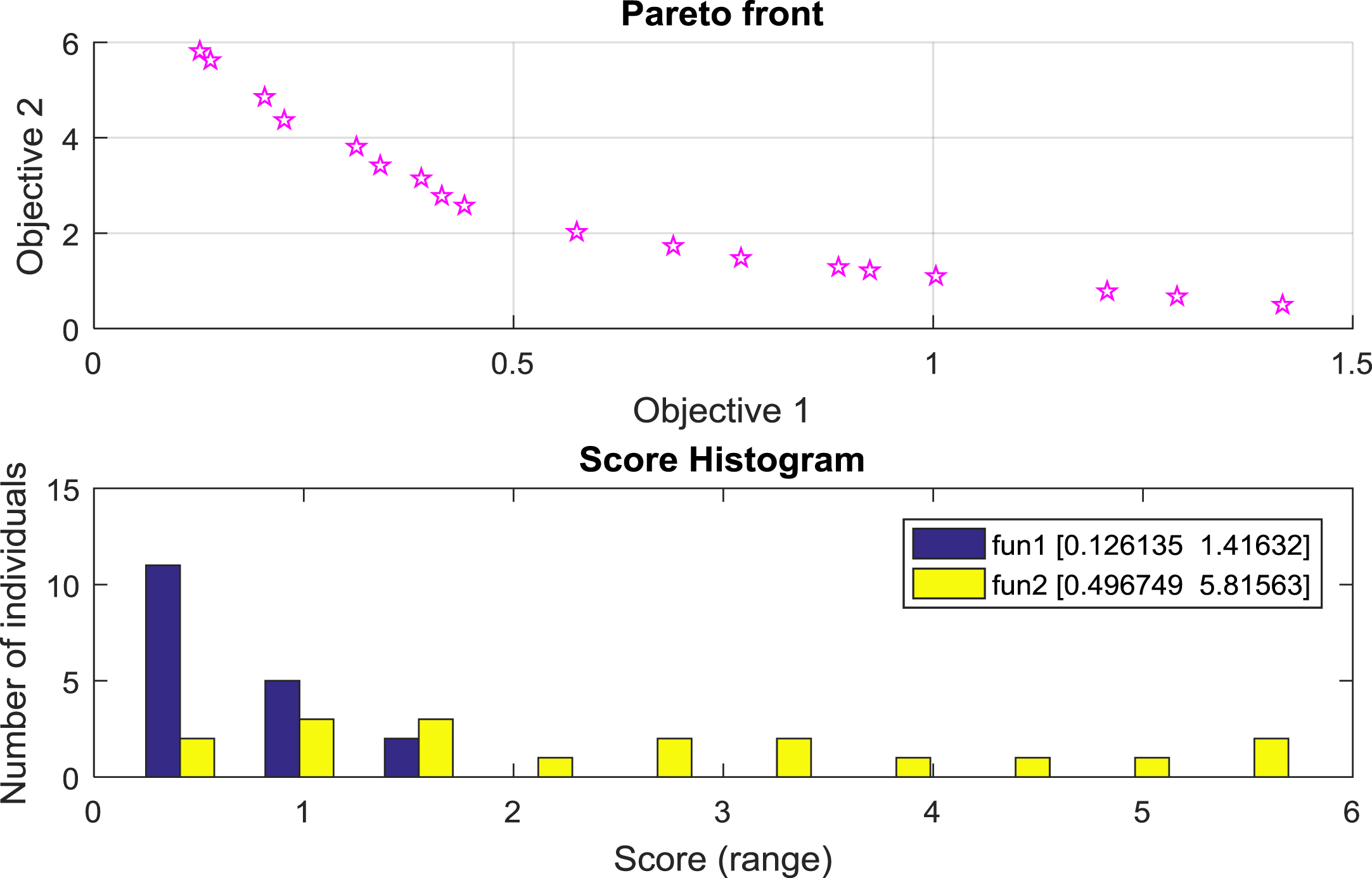
Two examples were solved and the results showed that this study proposed ɛ- efficient outcomes. Moreover, we applied the genetic algorithm (GA) of the Optimization Toolbox of MATLAB R2016b and found that: the GA results are efficient solutions for example 1. However, for example 2, the GA failed to reach an efficient solution. In fact, the GA tends to which is completely dominated by the solution proposed by this study. Therefore, we don’t suggest using the GA to address the partially large-scale FMOLFPPs.
Footnotes
Acknowledgment
The authors would like to thank UKM for the financial support through the research grant ST-2019-016.
References
1.
AhmadS., UllahA., AkgülA. and BaleanuD., Analysis of the fractional tumour-immune-vitamins model with Mittag–Leffler kernel, Results in Physics19 (2020), 103559.
2.
ArqubO.A., Al-SmadiM., MomaniS. and HayatT., Application of reproducing kernel algorithm for solving second-order, two-point fuzzy boundary value problems, Soft Computing21(23) (2017), 7191–7206.
3.
AryaR., SinghP., KumariS. and ObaidatM.S., An approach for solving fully fuzzy multi-objective linear fractional optimization problems, Soft Computing24(12) (2020), 9105–9119.
4.
BorzaM. and RambelyA.S., A linearization to the sum of linear ratios programming problem, Mathematics9(9) (2021), 1004.
5.
BorzaM. and RambelyA.S., A New Method to Solve Multi-Objective Linear Fractional Problems, Fuzzy Information and Engineering13(3) (2021), 323–334.
6.
BorzaM.,
RambelyA.S., An approach based on alpha-cuts and max-min technique to linear fractional programming with fuzzy coefficients. Iranian Journal of Fuzzy Systems, 19(1) (2022), 153–168.
7.
BorzaM., RambelyA.S. and SarajM., Solving linear fractional programming problems with interval coefficients in the objective function. A new approach, Applied Mathematical Sciences6(69) (2012), 3443–3452.
8.
BorzaM., RambelyA.S. and SarajM., Parametric approach for an absolute value linear fractional programming with interval coefficients in the objective function, In AIP Conference Proceedings1602(1) (2014), 415–421.
9.
BorzaM., RambelyA.S. and SarajM., Fuzzy approaches to the multi objectives linear fractional programming problems with interval coefficients, Asian Journal of Mathematics and Computers Research4 (2015), 83–94.
10.
ChakrabortyM. and GuptaS., Fuzzy mathematical programming for multi objective linear fractional programming problem, Fuzzy Sets and Systems125(3) (2002), 335–342.
11.
ChanasS. and KuchtaD., Linear programming problem with fuzzy coefficients in the objective function, Fuzzy Optimization, Physica-Verlag, Heidelberg (1994), 148–157.
12.
CharnesA. and CooperW.W., Programming with linear fractional functionals, Naval Research Logistics Quarterly9(3-4) (1962), 181–186.
13.
ChenS.J. and HwangC.L., Fuzzy multiple attribute decision making: Methods and applications. Verlag, NY: Springer, (1992).
14.
ChinnaduraiV. and MuthukumarS., Solving the linear fractional programming problem in a fuzzy environment: Numerical approach, Applied Mathematical Modelling40(11) (2016), 6148–6164.
15.
CruzC., SilvaR.C., VerdegayJ.L. and YamakamiA., A survey of fuzzy quadratic programming, Recent Patents on Computer Science1(3) (2008), 182–193.
16.
DarehmirakiM., A novel parametric ranking method for intuitionistic fuzzy numbers, Iranian Journal of Fuzzy Systems16(1) (2019), 129–143.
17.
DasS.K., EdalatpanahS.A. and MandalT., Application of Linear Fractional Programming problem with fuzzy nature in industry sector, Filomat34(15) (2020), 5073–5084.
18.
DeP.K. and DebM., Solution of multi objective linear fractional programming problem by Taylor series approach, In 2015 International Conference on Man and Machine Interfacing (MAMI), (2015), 1–5, IEEE.
19.
DinkelbachW., On nonlinear fractional programming, Management Science13(7) (1967), 492–498.
20.
GüzelN., Aproposal to the solution ofmulti-objective linear fractional programming problem, In Abstract and applied analysis, (2013).
21.
KheirfamB. and VerdegayJ.L., Strict sensitivity analysis in fuzzy quadratic programming, Fuzzy Sets and Systems198 (2012), 99–111.
22.
LiuX., GaoY.L., ZhangB. and TianF.P., A new global optimization algorithm for a class of linear fractional programming, Mathematics7(9) (2019).
23.
MehraA., ChandraS. and BectorC.R., Acceptable optimality in linear fractional programming with fuzzy coefficients, Fuzzy Optimization and Decision Making6 (2007), 5–16.
24.
NayakS. and OjhaA.K., Solution approach to multi-objective linear fractional programming problem using parametric functions, Opsearch56(1) (2019), 174–190.
25.
NayakS., OjhaA.K., Multi-objective linear fractional programming problem with fuzzy parameters, In Soft Computing for Problem Solving, Springer, Singapore, (2019), 79–90.
26.
PalB.B., MoitraB.N. and MaulikU., A goal programming procedure for fuzzy multi objective linear fractional programming problem, Fuzzy Sets and Systems139 (2003), 395–405.
27.
PramyF.A. and IslamM.A., Determining efficient solutions of multi-objective linear fractional programming problems and application, Open Journal of Optimization6 (2017), 164.
28.
PrecupR.E., DavidR.C., PetriuE.M., Szedlak-StineanA.I. and Bojan-DragosC.A., Grey wolf optimizer-based approach to the tuning of PI-fuzzy controllers with a reduced process parametric sensitivity, IFAC-Papers On Line49(5) (2016), 55–60.
29.
RadhakrishnanB. and AnukokilaP., Fractional goal programming for fuzzy solid transportation problem with interval cost, Fuzzy Information and Engineering6(3) (2014), 359–377.
30.
RaoP.P.B., Ranking fuzzy numbers using alpha cuts and centroids, Journal of Intelligent & Fuzzy Systems33(4) (2017), 2249–2258.
31.
RashmanlouH. and BorzooeiR.A., Vague graphs with application, Journal of Intelligent & Fuzzy Systems30(6) (2016), 3291–3299.
32.
Stancu-MinasianI. M., Fractional programming: theory, methods and applications, Springer Science & Business Media 409 (2012).
33.
StanojevicB. and StanojevicM., Solving method for linear fractional programming problem with fuzzy coefficients in the objective function, International Journal of Computers and Communications Control 8 (2013), 146–152.
34.
ToksariM.D., Taylor series approach to fuzzy multi objective linear fractional programming, Information Sciences178 (2008), 1189–1204.
35.
VeeramaniC. and SumathiM., Fuzzy mathematical programming approach for solving fuzzy linear fractional programming problem, RAIRO-Operations Research48(1) (2014), 109–122.
36.
WangC. and LiJ., Periodic Solution for aMax-Type Fuzzy Difference Equation, Journal of Mathematics (2020), 2020.
37.
WangY., LiuL., GuoS., YueQ. and GuoP., A bi-level multi-objective linear fractional programming for water consumption structure optimization based on water shortage risk, Journal of Cleaner Production237 (2019), 117829.
38.
WangC., LiJ. and JiaL., Dynamics of a high-order nonlinear fuzzy difference equation, Journal of Applied Analysis & Computation11(1) (2021), 404–421.
39.
WuH.C., Duality theorems in fuzzy mathematical programming problems based on the concept of necessity, Fuzzy Sets and Systems139(2) (2003), 363–377.
40.
ZapataH., PerozoN., AnguloW. and ContrerasJ., A hybrid swarm algorithm for collective construction of 3D structures, International journal of Artificial Intelligence18(1) (2020), 1–18.