Finding efficient solutions for the multi-objective linear fractional programming problem (MOLFPP) is a challenging issue in optimization because more than one target has to be taken into account. For the problem, we face the concept of efficient solutions which is an infinite set especially when the objectives are in conflict. Since a classical method generally comes out with only one efficient solution, thus introducing new efficient approaches is helpful and beneficial for the decision makers to make their decisions according to more possibilities. In this paper, we aim to consider the MOLFPP with fuzzy coefficients (FMOLFPP) where the concept of α - cuts is utilized so as to transform the fuzzy numbers into closed intervals and rank the fuzzy numbers as well. Consequently, the fuzzy problem is changed into an interval valued multi-objective linear fractional programming problem (IV-MOLFPP). Subsequently, the IV-MOLFPP is further changed into linear programming problems (LPPs) using a parametric approach, weighted sum and max-min methods. It is demonstrated that the solution obtained is at least a weakly ɛ - efficient solution, where the value of ɛ helps a decision maker (DM) to make his decision appropriately i.e. DMs chose more likely the solutions with the lowest value of ɛ. Numerical examples are solved to illustrate the method and comparison are made to show the accuracy, and the reliability of the proposed solutions.
Linear fractional programming problem (LFPP) represents a mathematical modeling for the problem of two conflict linear objective functions which are going to be optimized over a feasible region comprises of affine constraints. In [25], several real world problems were considered as the instances of LFPPs. Charnes and Cooper [7] proposed the best ever method dealing with the LFPP in which the fractional problem is transformed into a LPP by the use of variable transformation technique. Dinkelbach [11] showed that any FPP can be replaced by a series of non-fractional problems. Based on this principle, many approaches were developed [4, 19].
The concept of the fuzzy LFPP may arise when there exists an ambiguity to identify the coefficients. In this case, articulating the coefficients with the fuzzy numbers and then using an appropriate technique to tackle them is helpful. There exists several method to deal with fuzzy numbers [8, 23]. One of the most important and comprehensive technique is to use the concept of α - cut, which transforms a fuzzy number into a closed interval. Accordingly, the LFPP with fuzzy coefficients is changed into an IV-LFPP as follows:
In Mehra et al. [15], is solved instead since solving the above problem encompasses some difficulties in practice. Stanojević and Stanojević [26] introduced a solution proposal to (I) using convex combination of the solutions of and . Chinnadurai and Muthukumar [9] addressed LFPP, where the parameters and decision variables are positive fuzzy numbers. In their method, after finding the optimal solutions of and , a membership function is defined for the optimal solutions. Let us consider (a, b, c) represents triangular fuzzy number . Veeramani and Sumathi [31] introduced a method to LFP with triangular fuzzy coefficients. In the method, the fuzzy problem is finally changed into a LPP using the methodology of Chakraborty and Gupta [5]. To construct the method, only fixed numbers a, b, and c were used which can be considered as a drawback since facing fuzzy numbers in this way is not comprehensive enough. Recently, Borza and Rambely [3] proposed a new approach to tackle the FLFPP. In their method, the fuzzy problem is finally changed into a LPP using suitable variable transformations.
Multi-objective programming problem (MOPP) has received much attention in recent decades as an appropriate model for a number of real world problems in, for instance, transportation, finance, engineering, commercials, house planning, energy systems, medicine, etc. [13, 30]. In MOPP, more than one target is optimized over a same feasible region. Thus, for the problem, the concept of efficient solution is considered instead of exact optimal solution. A solution is efficient if moving to another solution doesn’t improve all the objectives. In MOPP, if the objectives and the constraints are linear fractional and affine functions, respectively, then the model represents the MOLFPP. There are several efficient and straightforward methods designed based on the concept of fuzzy aspiration levels to address MOLFPP. Chakrobarty and Gupta [5] introduced a method to MOLFPP, where the problem is changed into a MOLPP using variable transformations. Afterwards, the membership functions of the linear objectives are specified after identifying the fuzzy aspiration levels. Finally, the MOLPP is changed into a LPP using max-min technique. Motivated by the methodology of [5], De and Deb [10] proposed a method so that goal programming was utilized instead of max-min in the final step of their method. In Pal et al. [21], membership functions are defined after identifying fuzzy aspiration levels of the objective functions. Subsequently, the problem of finding efficient solutions to the MOLFPP is transformed into a LPP by the use of goal programming approach and suitable variable transformations. In the method suggested by Toksari [28], the membership functions are defined and then transformed into linear functions by applying the first-order Taylor expansion about the individual optimal solutions. Then, the summation of the linearized membership functions is maximized. Borza and Rambely [2] introduced a method to address the MOLFPP by the use of variable transformations.
In MOLFPP, if the coefficients are fuzzy numbers, then we deal with fuzzy multi-objective linear fractional programming problem (FMOLFPP). Nayak and Ojha [20] proposed an approach to cope with the FMOLFPP. In their method, the α - cuts of the fuzzy numbers are used. Accordingly, the problem is changed into an IV-MOLFPP. By using the first-order Taylor series of the upper bounds of the intervals, finally they reached a LPP. In general, there are two drawbacks to the method: first, using the first-order Taylor series, which decrease the accuracy automatically. Only using the upper bounds and not using the lower bounds in finding the solutions can be considered as the second drawback regarding their method. Arya et al. [1] developed a method to fully fuzzy MOLFPP i.e. the MOLFPP with triangular fuzzy coefficients and fuzzy decision variables. They used a ranking method of the fuzzy numbers to change the fuzzy numbers into some fixed numbers and weighted sum method to construct the methodology. However, transforming a fuzzy number into some fixed numbers reduces the comprehensiveness of the notion of fuzziness which can be a drawback.
The set of efficient solutions of a MOPP is infinite, therefore introducing new efficient methods is helpful and beneficial for a decision maker to make his decision according to more possibilities. Thus, in this study, by eliminating the drawbacks of [1] and [20] we aim to provide an efficient method to tackle the MOLFPP with fuzzy coefficients. To construct our methodology, the concept of α- cut, a parametric approach, max-min technique, and weighted sum and max-min methods are used. In the approach, finally the main fuzzy problem is reduced into LPPs. It is proven the solution proposed is at least a weakly ɛ- efficient solution. This should be mentioned that the structure of the method is easy and straightforward with less complexities compared to some existing methods. Moreover, the algorithm has this ability to produce more than one efficient solution, on the contrary of the methods proposed by Pal et al., Toksari, and Güzel.
The remainder of this paper is organized as follows. In Section 2, some basic notions and definitions are given. In section 3, the main results are given. In fact, in this section, we show how the FMOLFPP is changed into the LPPs. In section 4, numerical examples are solved to illustrate the method and comparisons are made to show the efficiency. Finally, section 5 concludes the paper.
Preliminaries
Fuzzy numbers and intervals
Definition 1 (boldialpha- cut). Suppose is a fuzzy set in X and α ∈ [0, 1]. The α-cut of the fuzzy set is the crisp set given by: .
Definition 2 (Triangular fuzzy numbers). Assume is a fuzzy set. A triangular fuzzy number is defined as:
For the triangular fuzzy number , .
In the literature, there exists several methods to rank fuzzy numbers. Chen and Hwang [8] reviewed 20 ranking methods. See Rao [23] for a more recent method to rank fuzzy numbers.
A fuzzy number can be represented uniquely by its α - cut. Therefore, in this paper, arithmetic operations in addition to ranking of fuzzy numbers are defined in terms of the α - cuts of the fuzzy numbers.
According to Wu [32], the following proposition is true for any two fuzzy numbers and .
Proposition 1. if and only if and .
In the above, α ∈ [0, 0.5] means the α - cuts include the elements with small membership degrees. To compensate for this shortcoming, referential fuzzy numbers are used.
Definition 3 (Referential fuzzy number). Let be a triangular fuzzy number with the membership function , then its referential fuzzy number is a triangular fuzzy number denoted by and defined as follow.
In addition, .
Proposition 2..
According to the above proposition, ∃ intervals V1 and V2 such that:
and , ∀x ∈ V1 ∪ V2 and this means the number of elements with low degree of membership functions are decreased in compared to .
Definition 4 (Ranking of fuzzy numbers). Let and be referential fuzzy numbers related to triangular fuzzy numbers and , respectively. Consider and . Fuzzy number is said to be smaller than and denoted by if only if and .
Definition 5 (Arithmetic of intervals). Assume A = [AL, AU], B = [BL, BU] are intervals, and k ⩾ 0 is a scalar. Therefore, addition, multiplication, and division on the intervals are defined as following.
Linear fractional programming
Consider the general form of the linear fractional programming problem (LFPP) as follows:
where . In addition, DTX + q > 0, ∀ X = (X1, …, Xn) ∈ Ω. It is additionally assumed that feasible region Ω is a regular set i.e. a non-empty and compact set. Notify X ⩾ 0 means Xi ⩾ 0, for i = 1, …, n.
Using variable transformations changes the (1) into:
Theorem 1 ([7]).If (Y*, t*) is optimum for problem (2), then is optimum for (1).
Multi-objective programming
Consider the general form of MOPP as follows:
where S is a non-empty and bounded feasible region.
Definition 6. In (3), X* ∈ S is an efficient solution if ∀X ∈ S, then ∃j∈ { 1, …, k } such that Fj (X*) < Fj (X).
Definition 7. In (3), X* ∈ S is an ɛ- weakly efficient solution if ∀X ∈ S, then ∃j∈ { 1, …, k } such that Fj (X*) - ɛ ⩽ Fj (X), where ɛ = inf {δ > 0 : Fj (X*) - δ ⩽ Fj (X)}.
Weighted sum approach is a classical method which transforms the (3) into:
where wi ⩾ 0, i = 1, …, k.
Theorem 2.The optimal solution X* of (4) is an efficient solution for (3).
Proof. Let us assume X* not be an efficient solution for (3). Therefore, such that:
, i = 1, …, k, ∃j∈ { 1, …, k } so that . Therefore, . This contradicts the optimality of X* for (4). ■
Max-min technique transforms the (3) into:
Theorem 3.Let (X*, β*) be the unique optimal solution of (5), then X* is an efficient solution for (3).
Proof. Let X* not be an efficient solution for (3). Therefore, such that:
Since (X*, β*) is feasible point of φ, then Fi (X*) ⩽ β*. Thus, from the (6):
Let us define:
Thus, it directly comes from (7) and (8) that:
Thus, and implies that (. Hence, feasibility of () and contradicts the unique optimality of (X*, β*). The proof is then complete. ■
Parametric Approach for FPP
Dinkelbach [11] showed that a factional programming can be changed into a non-fractional program. In other word, he proved the following two problems are equivalent.
where f (X) and g (X) are continuous functions, and S is a non-empty compact feasible region, and θ is a parameter.
Theorem 3. If X* is optimum for (10), then (10) and (11) are equivalent if .
Proof. To proof, we need to demonstrate that the optimal solution of (10) is also optimum for (11), and vice versa. Since X* is optimum for (10), then we have: (i) . In addition, (ii) f (X*) - θg (X*) = 0. Now, let us assume X* not be optimum for (11). Then, the (ii) results: such that: . Thus, positivity of results: . This contradicts the (i) ; this contradiction proves X* is also optimum for (11).
Now, let us assume is optimum for (11), but is not optimum for (10). Since is optimum for (11), then we have: (iii) . Since is not optimum for (10), then we conclude: (iv) . This contradicts the (iii); this means is also optimal for (10).
■
Proposed method to solve FMOLFPP
In this part, we develop a procedure to MOLFPP with fuzzy coefficients. In addition, the efficiency of the solution obtained is demonstrated.
Consider the general form of the FMOLFPP as follows:
where , , , .
Using the concept of α - cuts changes the (12) into:
where , , , , , and .
Using the arithmetic of intervals and also the ranking of fuzzy numbers transform (13) into:
where if , else , and if , else .
Let and , i = 1, …, k. Thus, Theorem 3 alters the (14) into:
Using the weighted sum approach and the arithmetic of the sum of intervals change the (15) into:
where wi is the weight determined by the decision maker based on the importance of the ith objective function, i = 1, …, k.
According to Chanas and Kuchta [6], it is concluded that minimization of interval [ZL (X) , ZU (X)] leads to minimization of both objectives ZL (X) and ZU (X). Therefore, (16) is considered as a bi-objective programming problem:
The above bi-objective LPP can be addressed using different approaches. In this paper, we use the weighted sum method and max-min technique in what follows.
Using the weighted sum method transforms the (17) into:
where v1, v2 ⩾ 0, v1 + v2 = 1.
Using the max-min technique transforms the (17) into:
Notify, in (19), the constraint β ⩾ 0 is derived from the fact that , wi ⩾ 0, i = 1, …, k.
Theorem 4. The optimal solution of (18) is a weakly ɛ - efficient solution for (12).
Proof. Suppose X* is the optimal solution of (18). Moreover, let’s suppose for i = 1, …, k,
, , and ɛ = min { ɛi, fori = 1, …, k } = ɛp. Therefore, . This proves X* is a weakly ɛ - efficient solution for (12). ■
Hint 1. The above theorem is also true for the solution of max-min technique i.e. the solution resulted from (19).
Algorithm to the proposed method
This algorithm summarizes the procedure of finding efficient solutions for the multi-objective linear fractional programming problem with fuzzy coefficients or with interval coefficients.
Initial Step. Define the referential fuzzy numbers, and then specify their α - cuts .
Step 1. Specify , wi ∈ [0, 1], i = 1, …, k, and v1, v2 ∈ [0, 1].
Step 2. Formulate (14).
Step 3. Determine and , i = 1, …, k.
Step 4. Formulate (15).
Step 5. Formulate (18) and find X* as the optimal solution.
Step 6. Calculate as the criteria to evaluate the accuracy of the solution obtained.
Step 7. Set X* as a weakly ɛ - efficient solution for (12). And, consider as an α - acceptable interval for the value of ith objective function of (12).
Hint 2. In Step 5 of the algorithm, if we formulate (19), then the solution resulted from the max-min technique is obtained.
Numerical example
Example 1 (An illustrative example)
where
Referential fuzzy numbers related to the above fuzzy numbers are defined as following:
The α–cuts of the corresponding referential fuzzy coefficients are given as below, .
Step 1. Set α = 0.4, w1 = w2 = 0.5.
Step 2. We formulate (14) for this example as follows:
Step 3.
,
, and
,
.
Step 4. The (15) is formed for this example as follows:
Step 5. For this example, (18) is formulated as follows:
We solve the (23) for different values of vi and wi, i = 1, 2 and the results are summarized in Tables 1, 2 and 3.
Solution of (23) and the values of the objective functions of (20) for (v1, v2) = (0.5, 0.5)
(w1, w2)
X*
ɛ
(0.5, 0.5)
(0, 0.6875)
[1.4805, 2.0585]
[0.9346, 1.2829]
0.2278
(1, 0)
(1.6983, 0.1303)
[0.1265, 0.4087]
[1.9577, 2.6109]
0
(0, 1)
(0, 1.4545)
[1.4160, 1.9483]
[0.7745, 1.0551]
0
Solution of (23) and the values of the objective functions of (20) for (v1, v2) = (1, 0)
(w1, w2)
X*
ɛ
(0.5, 0.5)
(0, 0.6875)
[1.4805, 2.0585]
[0.9346, 1.2829]
0.2278
(1, 0)
(1.6983, 0.1303)
[0.1265, 0.4087]
[1.9577, 2.6109]
0
(0, 1)
(0, 0.6875)
[1.4805, 2.0585]
[0.9346, 1.2829]
0.2278
Solution of (23) and the values of the objective functions of (20) for (v1, v2) = (0, 1)
(w1, w2)
X*
ɛ
(0.5, 0.5)
(0, 0.6875)
[1.4805, 2.0585]
[0.9346, 1.2829]
0.2278
(1, 0)
(1.6983, 0.1303)
[0.1265, 0.4087]
[1.9577, 2.6109]
0
(0, 1)
(0, 1.4545)
[1.4160, 1.9483]
[0.7745, 1.0551]
0
Max-min technique i.e. the (19) is formed for this example as follows:
For (w1, w2) = (0.5, 0.5) , (1, 0) , (0, 1), the above problem is solved and the solution resulted is:
Numerical analysis
In Table 4, the extreme points of feasible region S and values of and at extreme points are listed.
Extreme points and their objective function values for the fuzzy multi-objective problem for α = 0.4
Extreme point
(0, 1.4545)
[1.4160, 1.9483]
[0.7745, 1.0551]
(1.5144, 0.7318)
[0.5487, 0.8879]
[1.5448, 2.0328]
(1.7541, 0.2295)
[0.1836, 0.4688]
[1.8841, 2.5040]
(1.6983, 0.1303)
[0.1265, 0.4087]
[1.9577, 2.6109]
(0, 0.6875)
[1.4805, 2.0585]
[0.9348, 1.2829]
Let X* = (0, 0.6875), and ɛ = 0.2278. In this case, , and .
As we observe numerically, ∀ extreme point : and . Therefore, convexity of S and pseudoconvexity of , result that: and . As the consequence, . This indicates X* is a weakly ɛ - efficient solution for the fuzzy multi-objective problem.
Let X* = (1.6983, 0.1303), and ɛ = 0 . In this case, , and . As we observe numerically, ∀ extreme point : and . Therefore, convexity of S in addition to pseudoconvexity of , results that: and . As the consequence,
. This indicates X* is an efficient solution for the fuzzy multi-objective problem. In a same way, it is showed numerically X* = (0, 1.4545) is an efficient solution.
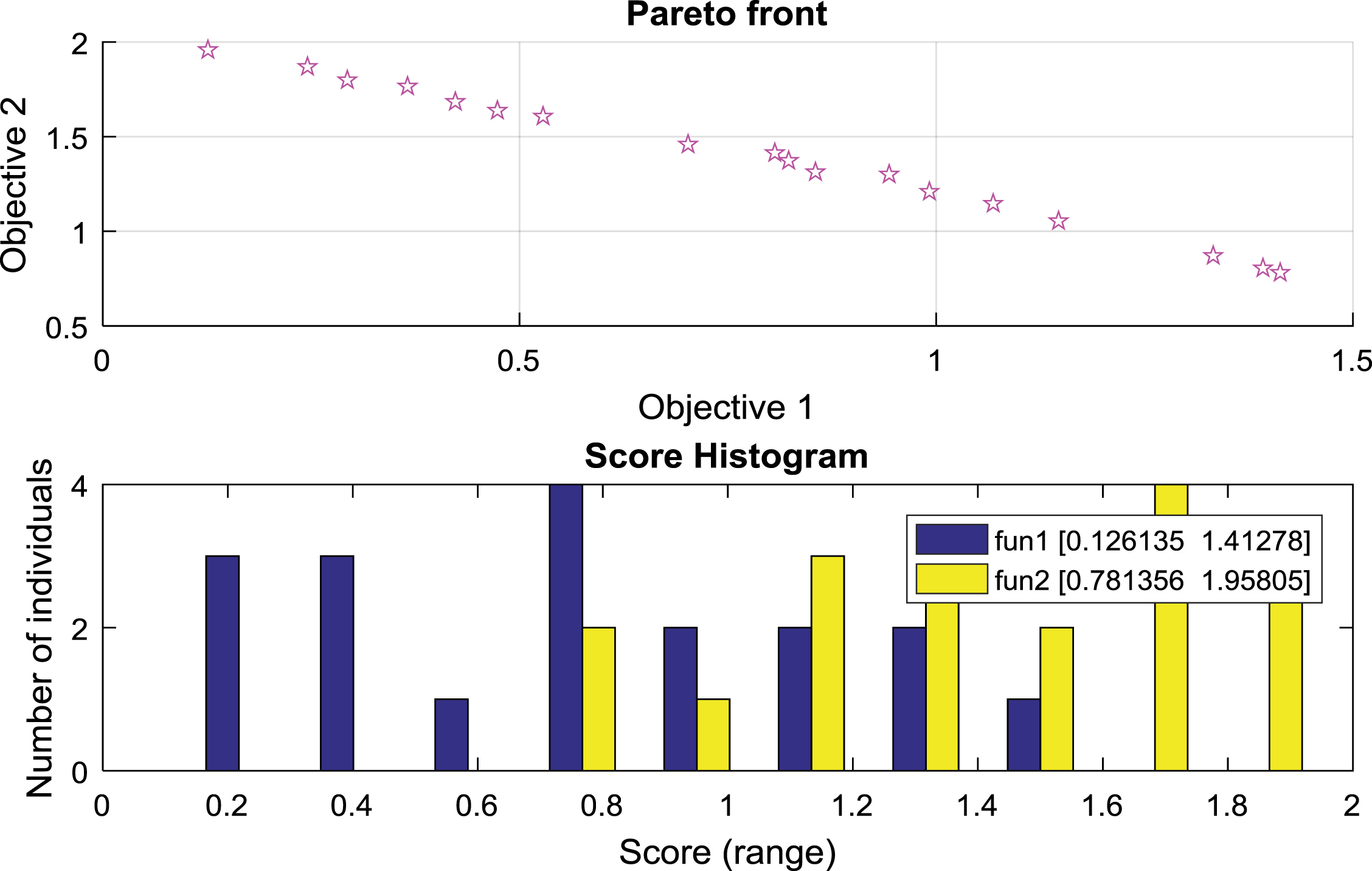
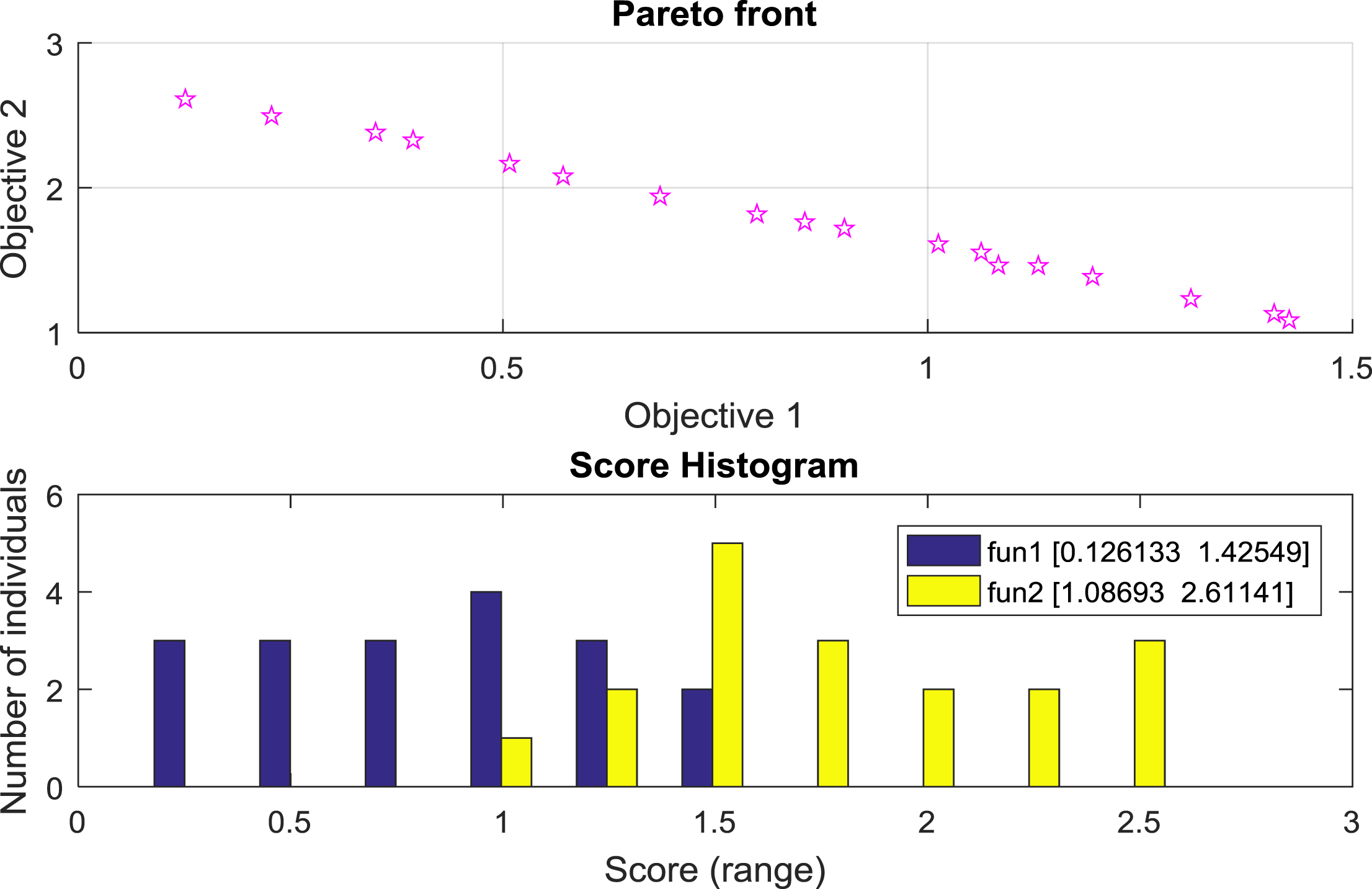
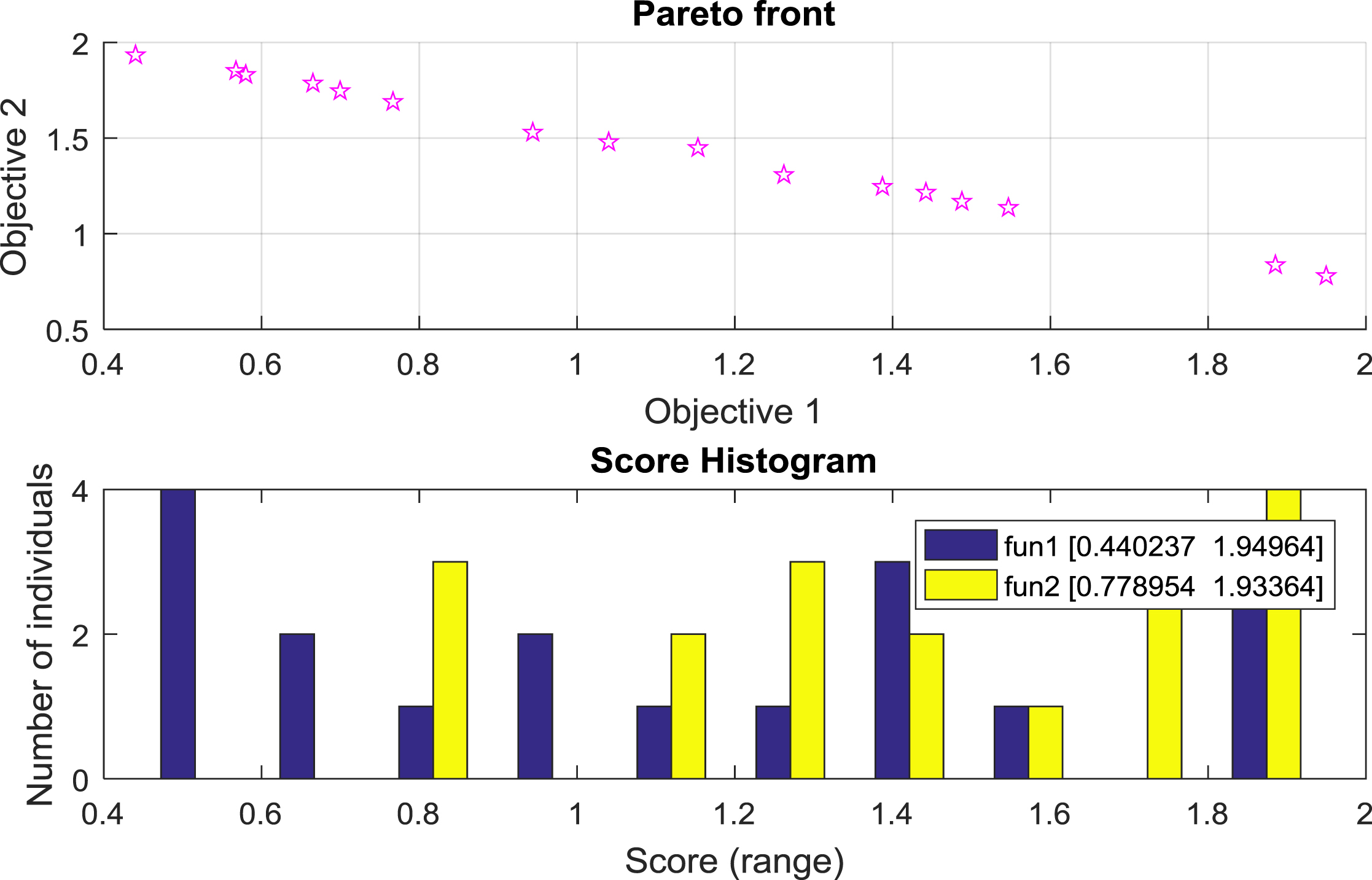
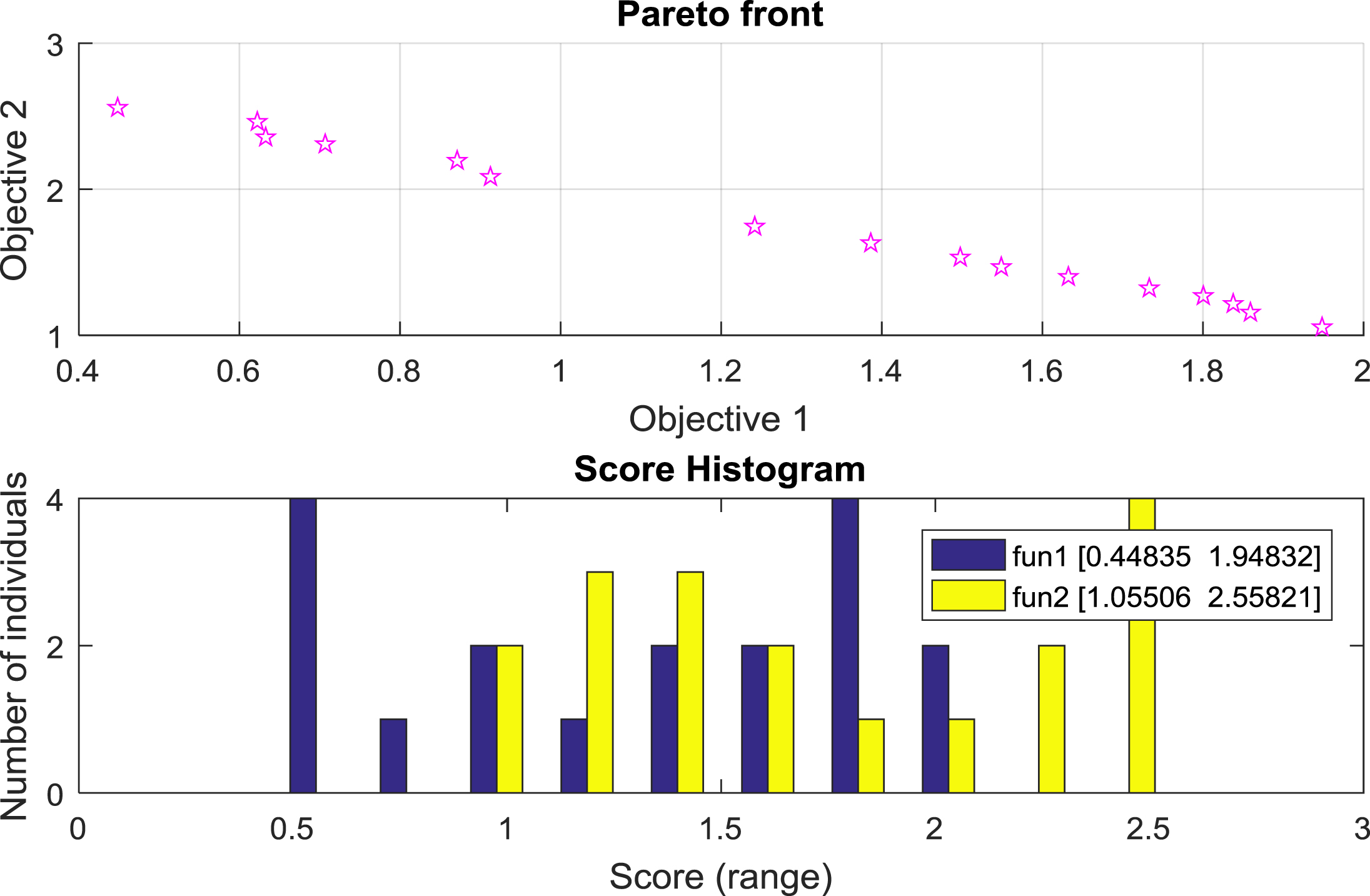
Apart from that we applied the multiobj documentation of MATLAB R2016b and the results are depicted in figures below Figs. 1–4. According to the average of the Pareto fronts, average of the values of the objective functions at the efficient solutions, it can be concluded that:
Pareto front resulted from multiobj where objective 1 , objective 2 .
Pareto front resulted from multiobj where objective 1 , objective 2 .
Pareto front resulted from multiobj where objective 1 , objective 2 .
Pareto front resulted from multiobj where objective 1 , objective 2 .
According to the Tables 1, 2 and 3, the proposed solutions of this study are X1 = (1.6983, 0.1303) and X2 = (0, 1.4545) i.e. the solution with the lowest ɛ. Obviously, these two solutions satisfy the (25) ; this means the solutions proposed are Pareto, efficient, for this example.
Comparison
In this section, the methods of Güzel, Toksari, Pal et al., Nayak and Ojha [20], and genetic algorithm (GA) with are applied to this example and the results are shown in Table 5.
Table5
Method
X*
ɛ
Güzel
(0, 0.6875)
[1.4805, 2.0585]
[0.9346, 1.2829]
0.2278
Pal et al.
(0, 0.6875)
[1.4805, 2.0585]
[0.9346, 1.2829]
0.2278
Toksari
(0, 1.4545)
[1.4160, 1.9483]
[0.7745, 1.0551]
0
Nayak and Ojha with
w1 = w2 = 0.5
(0, 1.4545)
[1.4160, 1.9483]
[0.7745, 1.0551]
0
w1 = 1, w2 = 0
(0, 1.4545)
[1.4160, 1.9483]
[0.7745, 1.0551]
0
w1 = 0, w2 = 1
(1.7451, 0.2295)
[0.1192, 0.4729]
[1.8831, 2.5027]
0.0642
GA with
w1 = w2 = 0.5
(1.5147, 0.7321)
[0.3765, 0.8879]
[1.5447, 2.0327]
0.4792
w1 = 1, w2 = 0
(1.6983, 0.1303)
[0.1265, 0.4087]
[1.9577, 2.6109]
0
w1 = 0, w2 = 1
(0, 1.4545)
[1.4160, 1.9483]
[0.7745, 1.0551]
0
According to Table 5, solutions (0, 1.4545) and (1.6983, 0.1303) are probably the most appropriate solutions for this example. It is noticeable that these two solutions are also found by this study. Thus, it is not far-fetched to claim that our approach is efficient and accurate.
Example 2
In this section, an example with triangular fuzzy numbers taken from Nayak and Ojha [20] is considered. In their approach, the AHP technique is utilized to specify the values of weights. In order to make a fair comparison, we use the same weights.
In the method of Nayak and Ojha, the problem above is changed into the following problem after using the α - cuts of the fuzzy number with degree of satisfaction α = 0.5.
Let , , and be the first order Taylor expansions of about their maximizers, respectively. In their approach, the following problem is then formulated.
The (28) is solved where w1 = 0.6333, w2 = 0.2605, w3 = 0.1062, and the solution obtained is: (2.5, 0, 0).
Our proposed method, with w1 = 0.6333, w2 = 0.2605, w3 = 0.1062, , and , i = 1, 2, 3, finally transforms (27) into:
According to the value of ɛ listed in Table 6, a decision maker should chose X* = (0, 1.6667, 0) as an efficient solution for (26).
Solution of (29) and the values of the objective functions of (27)
(v1, v2)
X*
ɛ
(0.5, 0.5)
(0, 1.6667, 0)
[0.9697, 2.3636]
[0.8182, 1.5970]
[0.6045, 1.5484]
0
(1, 0)
(0, 1.6667, 0)
[0.9697, 2.3636]
[0.8182, 1.5970]
[0.6045, 1.5484]
0
(0, 1)
(2.5, 0, 0)
[0.8519, 2.3265]
[0.7063, 1.4217]
[1.0588, 3.5357]
0.1178
Notify, we applied the methods of Toksari, Pal et al., Güzel, and GA with to the (27) and found that all these methods resulted in solution .
According to Table 6, . Thus, the solution X* is more likely in favor of a decision maker compared to . Keep in mind that our method was able to find the as well. Indeed, finding more than one solution is an advantage, which demonstrates the flexibility of our approach.
Conclusion
This paper proposed an approach to cope with the multi-objective linear fractional programming problem with fuzzy coefficients (FMOLFPP). In the method, the fuzzy problem is finally changed into the LPPs, and the solutions obtained are proved to be at least weakly ɛ- efficient solutions. To construct our methodology, a parametric approach, the weighted sum and the max-min methods were utilized. Producing more than one efficient solution, and being easy and straightforward are the advantages of the method. Notify that this approach is only applicable for the MOLFPP with triangular and trapezoidal fuzzy coefficients due to the fact that the concept of the referential fuzzy numbers was used. However, one can disregard the concept of referential fuzzy numbers and use this method to address the MOLFPP with any kind of fuzzy coefficients. Keep in mind that positivity of the denominator of the ratios is the only limitation regarding the method, which is a common assumption in the existing approaches introduced to address optimization problems with fractional objective function(s).
Multi-level programming problem is hard and can be used as an appropriate mathematical model for the decentralized organizations. Therefore, the multi-level multi-objective programming problem with fuzzy coefficients can be considered as a problem with complex structure. Therefore, working on this problem is beneficial and helpful. In this way, considering the method proposed by this study can help to construct an efficient algorithm.
Footnotes
Acknowledgments
This work was supported by funding from UKM, ST-2019-016.
Conflicts of interests
We declare no conflict of interest.
References
1.
AryaR., SinghP., KumariS. and ObaidatM.S., An approach for solving fully fuzzy multi-objective linear fractional optimization problems, Soft Computing24 (2020), 9105–9119.
2.
BorzaM. and RambelyA.S., A new method to solve multi-objective linear fractional problems, Fuzzy Information and Engineering13(3) (2021), 323–334.
3.
BorzaM. and RambelyA.S., An approach based on-cuts and max-min technique to linear fractional programming with fuzzy coefficients, Iranian Journal of Fuzzy Systems19(1) (2022), 153–168.
4.
BorzaM., RambelyA.S. and SarajM., Mixed 0-1 Linear Programming for an Absolute valued Linear Fractional Programming Problem with Interval Coefficients, Applied Mathematical Sciences7 (2013), 3641–3653.
5.
ChakrabortyM. and GuptaS., Fuzzy mathematical programming for multi objective linear fractional programming problem, Fuzzy Sets and Systems125 (2002), 335–342.
6.
ChanasS. and KuchtaD., Linear programming problem with fuzzy coefficients in the objective function, Fuzzy Optimization, Physica-Verlag, Heidelberg (1994), 148–157.
7.
CharnesA. and CooperW.W., Programming with linear fractional functionals, Naval Research Logistics Quarterly9 (1962), 181–186.
8.
ChenS.J. and HwangC.L., Fuzzy multiple attribute decision making: Methods and applications, Verlag, NY, Speringer (1992).
9.
ChinnaduraiV. and MuthukumarS., Solving the linear fractional programming problem in a fuzzy environment: Numerical approach, Applied Mathematical Modelling40 (2016), 6148–6164.
10.
DeP.K. and DebM., Using goal programming approach to solve fuzzy multi-objective linear fractional programming problems, In 2016 IEEE International Conference on Computational Intelligence and Computing Research (ICCIC) (2016 December) 1–5, IEEE.
11.
DinkelbachW., On nonlinear fractional programming, Management Science13 (1967), 492–498.
12.
GüzelN., A proposal to the solution of multiobjective linear fractional programming problem, Abstract and Applied Analysis 2013 September (2013).
13.
HuY.C., ChiuY.J., ChenC.M. and TzengG.H., Competence set expansion for obtaining scheduling plans in intelligent transportation security systems, In Multi-Objective Programming and Goal Programming, Springer, Berlin, Heidelberg (2003), 347–352.
14.
LiuY., ZhangH., WuY. and DongY., Ranking range based approach to MADM under incomplete context and its application in venture investment evaluation, Technological and Economic Development of Economy25(5) (2019), 877–899.
15.
MehraA., ChandraS. and BectorC.R., Acceptable optimality in linear fractional programm&ing with fuzzy coefficients, Fuzzy Optimization and Decision Making6 (2007), 5–16.
16.
MohamedM.A., AbdullahH.M., El-MeligyM.A., SharafM., SolimanA.T. and HajjiahA., A novel fuzzy cloud stochastic framework for energy management of renewable microgrids based on maximum deployment of electric vehicles, International Journal of Electrical Power & Energy Systems129 (2021), 106845.
17.
MohamedM.A., AlmalaqA., AbdullahH.M., AlnowibetK.A., AlrasheediA.F. and ZaindinM.S.A., A Distributed Stochastic Energy Management Framework Based-Fuzzy-PDMM for Smart Grids Considering Wind Park and Energy Storage Systems, IEEE Access9 (2021), 46674–46685.
18.
MohamedM.A., Al-SumaitiA.S., KridM., AwwadE.M. and Kavousi-FardA., A Reliability-Oriented Fuzzy Stochastic Framework in Automated Distribution Grids to Allocate μ-PMUs, IEEE Access7 (2019), 33393–33404.
19.
NayakS. and OjhaA.K., Solution approach to multi-objective linear fractional programming problem using parametric functions, Opsearch56 (2019), 174–190.
20.
NayakS. and OjhaA.K., Multi-objective linear fractional programming problem with fuzzy parameters, In Soft Computing for Problem Solving, Springer, Singapore (2019), 79–90.
21.
PalB.B., MoitraB.N. and MaulikU., A goal programming procedure for fuzzy multi objective linear fractional programming problem, Fuzzy Sets and Systems139 (2003), 395–405.
22.
RamuS.C. and TakedaE., Pseudo-Criterion Approaches to Evaluating Alternatives in Mangrove Forests Management, In Multi-Objective Programming and Goal Programming, Springer, Berlin, Heidelberg (2003), 389–394.
23.
RaoP.P., Ranking fuzzy numbers using alpha cuts and centroids, Journal of Intelligent & Fuzzy Systems33 (2017), 2249–2258.
24.
RezaeiM., AlharbiS.A., RazmjooA. and MohamedM.A., Accurate location planning for a wind-powered hydrogen refueling station: Fuzzy VIKOR method, International Journal of Hydrogen Energy46(67) (2021), 33360–33374.
StanojevicB. and StanojevicM., Solving method for linear fractional programming problem with fuzzy coefficients in the objective function, International Journal of Computers Communications & Control8 (2013), 146–152.
27.
TakedaK. and TakedaE., DEA Approach to the Allocation of Various TV Commercials to Dayparts, In Multi-Objective Programming and Goal Programming. Springer, Berlin, Heidelberg (2003), 403–408.
28.
ToksariM.D., Taylor series approach to fuzzy multi objective linear fractional programming, Information Sciences178 (2008), 1189–1204.
29.
VafamandA., VafamandN., ZareiJ., Razavi-FarR. and SaifM., Multi-objective NSBGA-II control of HIV therapy with monthly output measurement, Biomedical Signal Processing and Control68 (2021), 102561.
30.
VafamandA., VafamandN., ZareiJ., Razavi-FarR. and DragicevicT., Intelligent Multi-objective NSBGA-II Control of Power Converters in DC Microgrids, IEEE Transactions on Industrial Electronics (2020).
31.
VeeramaniC. and SumathiM., Fuzzy mathematical programming approach for solving fuzzy linear fractional programming problem, RAIRO-Operations Research48 (2014), 109–122.
32.
WuH.C., Duality theorems in fuzzy mathematical programming problems based on the concept of necessity, Fuzzy Sets and Systems139 (2003), 363–377.