



Abstract
The global challenges associated with urbanization and the escalating waste production have been magnified in recent times, particularly in the context of the COVID-19 pandemic. In response to these challenges, municipal authorities, especially in developing nations, are confronted with the imperative task of discerning the most suitable healthcare waste (HCW) disposal methods. These methods are crucial for the effective management of medical waste, both during and after the COVID-19 era. This study introduces a novel similarity measure designed for lattice ordered q-rung orthopair multi-fuzzy soft sets (L q * q-ROM n FSSs) and exploring some of their essential characteristics. Currently, no established methods are available for gauging the similarity of L q * q-ROM n FSSs sets. Therefore, this paper takes a pioneering step by presenting similarity measures tailored for L q * q-ROM n FSSs sets. Moreover, we propose an evaluation methodology that leverages the lattice ordered q-rung orthopair multi-fuzzy soft information to determine the optimal health care waste (HCW) disposal approach. This approach seeks to enhance decision-making within the realm of waste management, facilitating more informed and effective choices in handling healthcare waste.
Introduction
In the last five decades, global population growth, especially in developing nations, has raised significant concerns for both human and animal well-being. Managing healthcare waste (HCW) in these nations is challenging due to resource limitations, inadequate infrastructure, inappropriate disposal methods, insufficient training and awareness, restricted regulatory frameworks, and inadequate transportation systems. Addressing these challenges requires a comprehensive strategy involving infrastructure improvement, regulatory framework fortification, education, training, and sufficient financial resources. The World Health Organization (WHO) defines HCW to include materials like used syringes, blood-soaked items, bandages, scalpels, body parts, chemicals, cytotoxic substances, and radioactive components [17, 36]. WHO reports that around 85% of HCW is nonhazardous, while the remaining 15% poses risks such as contagion, toxicity, or radioactivity [35, 39]. Inadequate handling of this 15% can lead to various ecological and health risks. Establishing an environmentally friendly HCW management system is a primary concern for healthcare organizations [40]. Therefore, selecting the most suitable HCW disposal technique from a set of alternatives is a complex multi-criteria decision-making (MCDM) process due to multiple qualitative and quantitative criteria from sustainable perspectives [41].
The decision-making process faces numerous challenges when dealing with unclear, ambiguous, imprecise, and vague criteria in multi-criteria decision-making. In such situations, crisp sets are rendered ineffective in addressing uncertainty and imprecision in information, while fuzzy information can adeptly manage these issues. Zadeh [48] proposed the idea of fuzzy set (FS), debates on MAGDM with fuzzy information have never ended. However, the fuzzy set cannot adequately represent all decision-making difficulties. For example, during the site selection process, some assessors agree with a scheme, while others oppose or even reject it. As a result, how to successfully employ them to cope with the fuzzy decision-making problem is directly tied to people’s productivity, living, and societal advancement. Atanassov [2] introduced the intuitionistic fuzzy set (IFS), which is an extension of FS, for this purpose. The IFS depicts the fuzziness of objects from three perspectives: membership values(MVs), nonmembership values (NMVs), and hesitation degree; hence, it has greater fuzziness and uncertainty flexibility.
Yager [43, 44] showed that the existing frameworks of FS and IFS were inadequate for capturing human opinions in a more practical manner. He introduced Pythagorean Fuzzy Sets (PyFSs), which extended the scope of information by introducing a novel conditional constraint (i.e.,) an element is assigned a membership values(MVs) of 0.65 and a non-membership values(NMVs) degree of 0.85. When you square these values, (0.65) 2 + (0.85) 2 = 1.145, which is greater than 1. This means that PFSs (Pythagorean Fuzzy Sets) can’t handle this situation. To address such cases, Senapati and Yager [34] introduced Fermatean fuzzy sets (FFSs) with a condition: 0 ≤ (δ) 3 + (λ) 3 ≤ 1. This expanded range of uncertainties allows us to handle the problems discussed earlier because (0.65) 3 + (0.85) 3 = 0.888, which is less than or equal to 1. Later on, Yager [45] contributed by introducing q-rung orthopair fuzzy sets (q-ROFSs) or generalized orthopair fuzzy sets, where the sum of the qth power of belongingness and non-belongingness values of elements doesn’t exceed one. These q-ROFSs can be simplified to IFSs, PFSs, and FFSs for different values of q: q = 1, 2, and q = 3, respectively.
Molodtsov [23] introduced a completely novel theory known as the theory of soft sets (S t S), which provides a parameterized mathematical framework that overcomes the aforementioned limitations. Yager and Sebastian and Ramakrishnan [32, 33, 42] quantify the concept of multi-fuzzy sets for duplicate elements in a set with similar or distinct membership values. Yang et al. [46] introduced the concept of an MFSS by merging MFS and SS and applied it in the context of MCDM. Meanwhile, Das and Kar [8] and Asit and Dey [4] introduced the Intuitionistic Multi-Fuzzy Soft Set (IMFS t S) model and hesitant multi-fuzzy soft set model as a extension of MFS t S. Recently, Vimala et al. and Jeevitha et al. successfully extended the IMFS t S model by introducing the q-rung orthopair multi-fuzzy soft set (q-ROMFS t S) and linear diophantine multi-fuzzy soft set (LDMFS t S) models.
Lattice theory holds significant significance in various everyday life domains. Birkhoff [6] made crucial contributions to lattice theory, exploring its practical applications. However, the absence of lattice-ordered frameworks in hybrid sets prompted further developments to extend their applicability across various domains. Vimala et al. proposed several theories on lattices [1, 18, 19, 38], broadening their reach into diverse fields. Additionally, Sabeena Begam et al. introduced the concept of lattice ordered MFS t S and applied it in various contexts [5, 28, 29]. Recently, the extension of lattice ordered MFS t S is developed by incorporating multi-NMVS [22]. Vimala et al. recently [39] proposed lattice-ordered linear diophantine MFS t S and their application in Prognostication of Myocardial Infarction.
Similarity measures(SMs) are essential for evaluating associations between items. Initially SMs defined for vague stes [14], soft sets [11], soft matrices [12], fuzzy S t S [9, 16, 21], further they were extended to various hybrid fuzzy models such as interval fuzzy sets (IFS) [24], intuitionistic fuzzy sets (IFS) [7, 13, 15], and PyFSs [20, 27, 31]. In recent years, researchers have explored different types of similarity measures (SMs) [27, 30, 31, 47], applying them to decision-making, pattern recognition, and image processing across various soft set models, including FSS [9, 16], intuitionistic FSS [25], and Py FSS [27]. The aforementioned similarity measures are not well-suited for managing multi-dimensional data. In response to this challenge, Al-Qudah and Hassan [3] devised a novel similarity measure tailored for managing multi-dimensional attributes within the framework of complex M n FSS. This hybridized approach extends the range of values available, effectively addressing the intricacies of handling uncertainty associated with periodic data.
Subsequently, Sabeena et al. [5] introduced a similarity measure within the framework of lattice-ordered M
n
FSS, specifically designed to manage multi- dimensional data by incorporating multi-membership values. Recently, Saeed et al. [30] introduced the theory of complex multi-fuzzy hypersoft similarity measure. This measure extends the membership function by translating it onto a unit circle, incorporating phase and amplitude components within the hypersoft set domain. However, it is essential to recognize that all the existing similarity measures developed for multi-fuzzy sets have limitations when it comes to handling multi-non-membership values (multi-NMVs). This limitation prompted the development of the L
q
*
q-ROM
n
FS set similarity measure. This innovative approach is adept at addressing both multi-membership values (multi-MVs) and multi-non-membership values (multi-NMVs), providing a comprehensive solution for effectively handling complex multi-dimensional data sets. Consequently, the significant contributions are outlined as follows: The innovative L
q
*
q-ROM
n
FS set model has been specially designed to tackle the complex challenges presented by lattice-ordered q-ROM
n
FS information. L
q
*
q-ROM
n
FS set not only elevates computational efficiency but also enables the seamless management of increasing uncertainties, as it accommodates the order of uncertainty ranging from 1 to the qth power of multi-membership degree and multi-non-membership degree within datasets. An robust similarity measure has been formulated specifically for Lq
* q-ROM
n
FSSs, with its essential properties, and subsequently utilized to evaluate criteria weights. The suggested similarity measure was utilized in the context of healthcare waste disposal method selection, demonstrating its practicality and efficiency. We addressed the healthcare waste disposal management challenge and demonstrated the superiority of the proposed similarity measures over the currently employed ones.
Paper Outline: In Section 2, we review some basic terms and explain the main idea of a q-ROM
n
FS similarity measures, along with important concepts. Section 3 introduces the idea of q-ROM
n
FS sets, q-ROM
n
FS matrices, measures of similarity, and weighted similarity measures for q-ROM
n
FS sets. In Section 4, we examine a real-life case about choosing the best method for disposing of healthcare waste. Finally, Section 5 wraps up the paper with conclusions and suggests potential future research directions.
This section discusses the fundamental concepts, definitions, and properties of MFS, MFSS, q-ROFS, and q-ROMFSS.
The collection of all q - ROM
n
FS set of dimension n in
L q * q-Rung orthopair multi-fuzyy soft similarity measure
Tabular Representation of L
q
*
Tabular Representation of L
q
*
⊆ L
q
*
q - ROM
n
FS
[(i)] [(ii)] L
q
*
q-rung orthopair multi-fuzzy soft equal
Let
-
⊆ L
q
*
q - ROM
2
FSS
and
Let
⊆ L
q
*
q - ROM
2
FSS
Then we have (suppose q = 3), whose matrices are as follows:
[(i)] 0 ≤ Sim
L
q
*
[(ii)] Sim
L
q
*
[(iii)] For [(iv)] Consider

Diagrammatic representation of healthcare waste disposal method problem.
[(i)] 0 ≤ ω
Sim
L
q
*
[(ii)] ω
Sim
L
q
*
ω
Sim
L
q
*
[(iii)] For [(iv)] Consider then ω
Sim
L
q
*
Healthcare waste disposal is a complex and highly regulated aspect of the healthcare sector. Improper handling and disposal can lead to environmental pollution, public health risks, and legal liabilities. It involves dealing with various types of waste materials, such as used needles, contaminated dressings, and expired medications, which can pose significant risks to both the environment and public health if not handled and disposed of properly. A prominent company in the healthcare industry is embarking on a strategic approach to address the responsible disposal of medical waste. With the increasing importance of environmental sustainability and stringent regulations surrounding medical waste management, the company is committed to establishing a state-of-the-art medical waste disposal site. The decision-makers involved in this endeavor are the board of governors, company executives, environmental experts, and financial analysts, who are tasked with determining the most suitable strategy for this venture. Three distinct strategies are being considered:
Variety of contexts in healthcare waste handling and disposal
To facilitate a comprehensive decision, experts will compare Strategy A (S
A
), Strategy B (S
B
), Strategy C (S
C
), and an alternate technique, Strategy M (S
M
). To evaluate these strategies, five attributes are considered, as detailed in Table 3:
A
1:Site Location
A
2:Cost Effectiveness
A
3:Community Engagement
A
4:Environmental Impact
A
5:Regulatory Compliance
The assessment of the strategies based on their attributes is represented using the L
q
*
q - ROM
n
FS information, as shown in Tables 4-7.
Evaluation of criteria
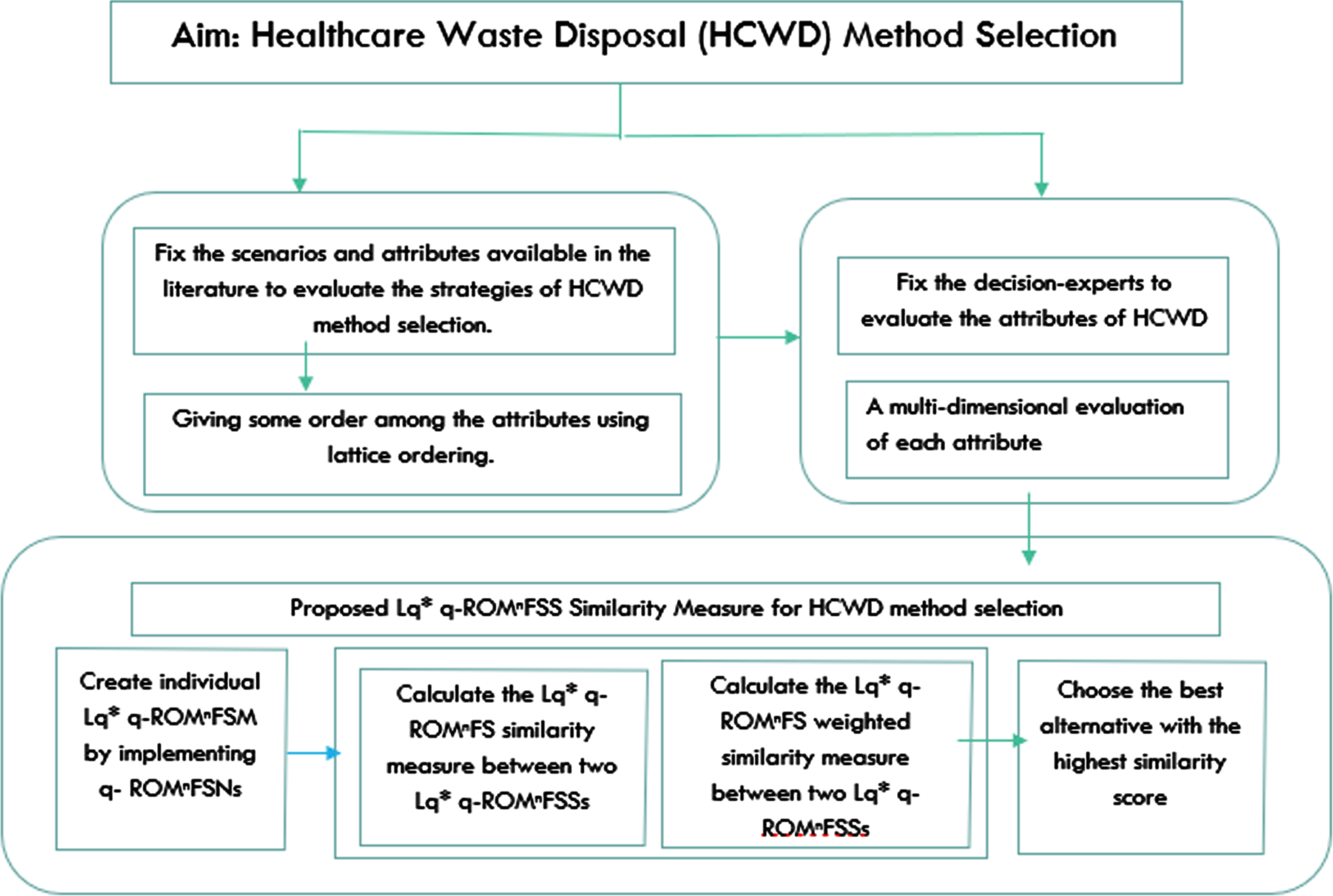
Procedural framework of L q * q-ROM n FSS
L q * q - ROM 4 FS decision matrix for strategy decision-making S A (assuming q = 3)
L q * q - ROM 4 FS decision matrix for strategy decision-making S B (assuming q = 3)
L q * q - ROM 4 FS decision matrix for strategy decision-making S C (assuming q = 3)
L q * q - ROM 4 FS decision matrix for strategy decision-making S M (assuming q = 3)
The similarity measure of three alternatives S A , S B and S C with S M are calculated by using L q * q-ROM n FS similarity measure, which are shown in Table 8. This innovative approach considers the degrees of multi-membership values (M-MVs) and non-membership values (M-NMVs) within the domain of L q * q-ROM n FSSs. From Table 8 we can get S A is the best strategy for medical waste disposal.
L q * q - ROM 4 FS similarity measure for strategy decision-making(assuming q = 3)
In practical decision-making problems, it’s essential to consider the element weights. Suppose we assign criteria weights as ω = [(0.2, 0.3, 0.1, 0.4) , (0.07, 0.2, 0.13, 0.07) , (0.07, 0.2, 0.13, 0.6) , (0.4, 0.3, 0.2, 0.1) , (0.05, 0.15, 0.7, 0.1)] T respectively. In this context, we have applied the weighted similarity measures proposed in this study to calculate similarity. The results are presented in Table 3 (assuming q = 3). Based on the findings in Table 3, it’s evident that the degree of similarity between S A and S M is the highest when compared to other similarity measures. This suggests that among the two similarity measures, alternative S A is the closest to being the optimal choice compared to S M according to the principle of maximum similarity within L q * q-ROM n FSSs (see Fig. 3). Consequently, S M emerges as the most favorable strategy.
Among several concerns regarding the incineration approach, it remains the most practical alternative for securely disposing of healthcare waste.

Ranking of the alternatives.
Utilizing the framework of lattice ordered q-rung orthopair multi-fuzzy soft sets (L q * q-ROM n FSSs), we have introduced a novel approach to measuring similarity. This innovative method takes into consideration the degrees of multi-membership values (M-MVs) and non-membership values (M-NMVs) within the realm of L q * q-ROM n FSSs. The resultant L q * q-ROM n FSSs similarity model stands out as a more effective and versatile approach compared to other techniques, owing to its adept utilization of lattice order in attribute management. Further, within the context of L q * q-ROM n FSSs, we have not only provided a comprehensive set of similarity measures but also introduced weighted similarity measures that account for both M-MVs and M-NMVs. By incorporating the concept of raising M-MVs and M-NMVs to the power of q, we have established a more adaptable and efficient foundation for modeling fuzzy systems and facilitating decision-making under uncertain conditions. This approach effectively bridges the gap between existing structural models and the broader domain of M-MVs and M-NMVs, enhancing its overall applicability and adaptability. It is important to highlight that an increase in the value of q results in the expansion of the decision-making space, providing greater latitude to represent a wider array of fuzzy data. We have successfully implemented the proposed Multiple Criteria Decision-Making (MCDM) methods, as demonstrated through a case study involving the selection of a healthcare waste disposal strategy. Our findings affirm the suitability and stability of the current decision-making approach, showcasing its efficacy in addressing complex multi-criteria group decision-making challenges.
In future research Research related to L q * q-ROM n FSSs could explore diverse categories of decision-making complexities including product development strategy,supply chain optimization, environmental impact analysis,resource allocation in healthcare, inventory management and restocking strategy.
Footnotes
Acknowledgments
The article has been written with the joint financial support of RUSA-Phase 2.0 grant sanctioned vide letter No.F24-51/2014-U, Policy (TN Multi-Gen), Dept. of Edn. Govt. of India, Dt. 09.10.2018, DST-PURSE 2nd Phase programme vide letter No. SR/PURSE Phase 2/38 (G) Dt. 21.02.2017 and DST (FIST - level I) 657876570 vide letter No.SR/FIST/MS-I/2018/17 Dt.20.12.2018.