



Abstract
As technology advances, it becomes easier to share large amounts of data over the internet. Cloud computing is one of the technologies that allows for easy data sharing over the internet. It is critical to provide security for this data when they are being shared across the internet. The security of data saved in cloud storage, as well as data transport and transmitting a key required to encrypt data between two parties, has been a source of concern for the industry, as a result of the growing use of cloud services in recent years. Collective attacks are significantly more powerful than individual strikes, according to our research. Despite the fact that additional research works were studied in the previous literature review, there are some study concerns for not correcting third-party data hacking. Therefore, this paper focuses on the design of Secured Quantum Key Distribution (SQKD) with Fuzzy logic to improve the security of the shared key. Quantum Key Distribution, Post Quantum Key Distribution, and the EPR Proto-col are technologies that increase the security of data sharing. We have incorporated the Secured Quantum Key Distribution (SQKD) with Fuzzy logic in our proposed work to improve the security of the shared key. The proposed systems include some additional characteristics in addition to the existing approaches. The proposed model uses shifting algorithms and the fuzzification procedure to assure the security of the secret key in the Fuzzification of Quantum Key approach. The experimental results states that the mean value of security losses in SFQ is 1.8306051, and the mean value of QKD is 14.6448416, with standard deviations of 1.7329 and 13.863 for SFQ and QKD, respectively.
Introduction
Cloud computing makes use of a centralized server that is located in multiple locations and linked over the internet. Cloud computing technology makes it simple and efficient to compute, process, and exchange data across the globe. It provides a large storage and processing area for data. Cluster computing removes the barriers of distributed systems. Grid computing, for ex-ample. In recent years, practically all industries and IT sectors have turned to cloud services to run their businesses. It provides the working environment as a foundation, eliminating the requirement for the business to purchase and setup hardware. It lowers infrastructure and maintenance costs, and one of the most advanced methods is pay-per-use. As a result, the initial in-vestment in industry is decreasing.
Cloud computing servers being geographically separated, they are electronically linked. As the computing landscape shifts to the east, it brings extra challenges, including security, such as virtualized security, to corporate server rooms. To solve these challenges many authentication concepts are implemented [26–32]. When migrating industries to cloud services, it is critical to ensure that their data is kept confidential and secure. There are numerous problems in cloud computing that must be overcome in order to achieve efficiency. Many methods and methodologies have been developed to achieve confidentiality, security, data privacy, data integrity, and authentication [26–32]. Any encryption algorithm, such as AES and DES [16], can be added to the advanced security mechanism for encryption and decryption process. Quantum Key Distribution and Quantum Cryptography, Quantum Key Distribution is a technique for securing keys that uses the BB84 protocol [14, 18], which follows two fundamental physics principles namely Heisenberg’s Uncertainty Theorem and No Cloning Theorem [11–13].
The QKD and Post Quantum QKD Techniques [12, 13], as well as EPR protocol models, are based on these two theorems to increase the security of the secret key. In QKD methods, the given data is first encrypted using any of the encryption algorithms available, such as AES and DES, and then we have two types of information: encrypted data and encryption key, both of which are binary data. Both encrypted data and keys are transferred in the same channel in traditional data transmission systems (classical channel) [17].
Even though the data is encrypted using traditional methods, third parties such as eavesdroppers can readily access it using advanced systems and algorithms [15]. Another disadvantage of the current system is that both encrypted data and the encryption key are exchanged over the same channel. As a result, there are several opportunities for a hacker to access data because both are present in the same channel. The BB84 protocol was created to address these issues. Following the encryption procedure, two channels, the conventional channel and the quantum channel, are utilized to transmit the encrypted data and encryption key. The encrypted data is sent over a conventional channel, while the encryption key is sent through a quantum channel.
It is important to transform the encryption key (Binary Data) to Q-bit while using quantum channel. The binary key is converted to Q-bit format via the polarization method. Data in the traditional sense takes the form of either a 0 or a 1. The type of data is Q-bit, and its state ranges from 0 to 1, making it difficult for an eavesdropper to identify. Polarization is the process of transforming conventional information into a Q-bit [21]. Two distinct types of polarizers are utilized to entangle photons [23] in this experiment. Orthogonal polarizers and rectilinear polarizers are two types of polarizers. Whereas an orthogonal polarizer oscillates photons in a +45 or –45 degree angle, a rectilinear polarizer oscillates photons in a 0 or 90 degree angle. As a result, based on the type of polarizer employed by the sender, the receiver will be notified, and they will be able to obtain the key on the receiver’s side. If the receiver receives the key without interruption, only the encrypted data will be sent over the classical channel [20], and the receiver will then decode the original encrypted data using the encryption key received in the quantum channel [33]. If an eavesdropper tries to get information from a quantum channel, the state of the q-bit will be disturbed due to Heisenberg’s Uncertainty theory and the no cloning theorem, allowing the receiver to easily identify that there is an eavesdropper between the communication parts and stop sending encrypted information [24].
There is a problem here if the eavesdropper tries to collect data from the primary channel that the receiver can identify. However, if the eaves-dropper tries to retrieve the q-bit from the side channel, the receiver may not recognize him, allowing him to authorize the delivery of encrypted data. When an eavesdropper accesses the q-bit from the side channel, he has a 50% chance of getting the key because the sender might employ either a rectilinear or orthogonal polarizer.
The contribution of the paper is given as follows. This paper presents Secured Quantum Key Distribution (SQKD) with Fuzzy logic to improve the security of the shared key. Quantum Key Distribution, Post Quantum Key Distribution, and the EPR Protocol increase the security of data sharing. The proposed systems include some additional characteristics in addition to the existing approaches. Even when data is uploaded using encryption techniques with QKD Servers, there is a risk of side channel attacks with existing technologies. These issues are solved in this part with the assistance of using shifting algorithms as well as the fuzzification [34] procedure to assure the security of the secret key in the Fuzzification of Quantum Key approach. In that proposed system data owner will encrypt the original data with the AES algorithm first. There are two different out comes at the end of the encryption procedure. The data owner will then directly transfer the encrypted data to the cloud server, where it will be stored. The encryption keys are then converted in to quantum key and the fuzzified using fuzzification methods to improve security. The inclusion of two types of encryption model with fuzzificiation of QKD shows the novelty of the work. To ensure more confidentiality, two different types of algorithms are used in this process. A detailed experimental validation process is involved to assure the enhanced performance of the proposed model on accomplishing cloud security.
Related works
In this system, the works related to side channel attacks in quantum key distribution are collected from many reference and as well as implementation papers. From that the Table 1 was constructed. that shows the relative study of various solutions for side channel attacks and its demerits in the following table. Many academics have devised a large variety of techniques to safeguard data in a cloud environment in order to ensure data confidentiality and security. En-hancement of the quantum key distribution protocol for cloud data security [1] was proposed by Yasser Hassen Jassem and Alharith Abdulkareem Abdullah, in which the data owner first encrypts the data before uploading the original encrypted data with any of the encryptions standards in the cloud environment [22, 25]. They shared the Quantum key with the receiver using the QKDS server.
Literature Review
Literature Review
An upgraded quantum key distribution system for security authentication was proposed by Ankit Kumar, Pankaj Dadheech, Vijander Singh, Linesh Raja, and Ramesh C. Poonia [2], in which they employed qkd and EPR protocols to secure Quantum Keys. R.C. Diovu and J.T. Agee develop a new approach that uses quantum key distribution features to increase the security of a cloud-based smart grid AMI network. To accomplish so, they used the SG AMI sys-tem Model, which is cloud-based [3]. Roszelinda Khalid and Zuriati Ahmad Zukarnain found a Cloud Computing Security Threat with Quantum Key Distribution Defense Model [4]. The Quantum Defense Model is utilized to implement security in the cloud, and the Multiparty QKD (MQKD) technique is used to implement the security level.
Cloud QKDP: G.Murali and Dr.R.Sivaram Prasad introduce Cloud QKDP, a Quantum Key Distribution Protocol for Cloud Computing. The QKDP method is used in the cloud to boost security [5]. Geeta Sharma and Sheetal Kalra have developed an identity-based safe authentication technique for cloud computing based on quantum key distribution. To improve cloud security, it’s a must [19], a viable long-distance entanglement-based QKD approach is implemented. A 100-kilometer optical connection can generate shifted keys with a key rate of 4.11 bits per second and a 9.21 percent error rate, according to this notion [6].
Dr. R. Rajesh, Ambily Pramitha, and Sureshkumar P.H. In this case, security based on quantum key distribution (qkd) improved cloud data center connection. The Quantum Key Distribution technique is used to secure data centers [7]. Post-quantum cryptography and Artificial Intelligence (AI) are utilized to increase the security in the cloud environment, according to Ankur Lohachab, Karambir’s discovery Quantum Key Distribution and ECC in IoT Infrastructure for Secure Inter-Device Authentication and Communication [8]. According to Roszelinda Khalid and Zuriati Ahmad Zulkarnain, MQKD is a multi-party quantum key distribution system that uses a tighter finite key approach to boost cloud security [9]. Cloud implementation using Quantum Key distribution, as described in Cloud Quantum Calculating Concept and Improvement: A Regular Literature Review by Anzaludin Samsinga Perbangsa and Haryono Soeparno. It employs qiskit as well as visual programming [10].
Gali et al. [35] introduced a dynamic and scalable virtual machine placement method in which the processing of the collection of moves is restricted by the Previously-Selected-Server-First (PSSF) Policy. After examining the attained chosen collection of moves, the greedy baseline model is defined. In PSSF, maximum priority is provided to the server which is earlier hosted or previously hosted virtual machine from a comparable user, when a new VM placement request is processing. Tao et al. [36] proposed SCAMS, an effectual model for the mitigation of the CSCAs in the multi-tenant IaaS cloud. It encompasses three major stages namely capture susceptible cryptographic operation, pre-emptive event notification, and cache anomaly examination. At the time of capturing, the cryptographic library in the secure VM enables subtle cryptographic functions for trapping to the handler functions in the hypervisor in an active way. During notification stage, the hypervisor handler functions frontward sensitive cryptographic events to the unified event notifier module, and the event notifier sends monitoring instructions to the cache monitoring module. In [37], a Security in Quantum side Channel (SQSC) model is derived where Shifting and Binary Conversions (SBC) algorithm is designed. Lu et al. [38] proposed a secure data deduplication model over an untrusted cloud with confrontation to two classic side-channel attacks, such as probe attack and key-cache attack. The presented model exploits fog computing for deriving novel approaches for resolving two side-channel attacks with new security and efficiency trade-offs.
Table 1 provides a summary of the reviewed works. Collective attacks are significantly more powerful than individual strikes, according to our research. Despite the fact that additional research works were studied in the previous literature review, there are some study concerns for not correcting third-party data hacking. In this paper, a new SFQ framework has been proposed in which PBS algorithm is implemented in this framework to stop the hacking of data through side channel in the quantum channel. Table 1 shows the results of the above survey’s extensive analysis.
Cloud computing has a slew of security issues that are only becoming worse, and it’s impossible to guarantee the secrecy of a user’s data. Client data is not encrypted by some cloud computing service providers, whereas it is encrypted by others, such as iCloud. However, cloud computing is still successfully attacked, and in general, our proposed system (solution) encrypts the client’s data (owner data) and uploads it to the cloud, where it can subsequently be accessed and decrypted by the user, as illustrated in Fig. 1.
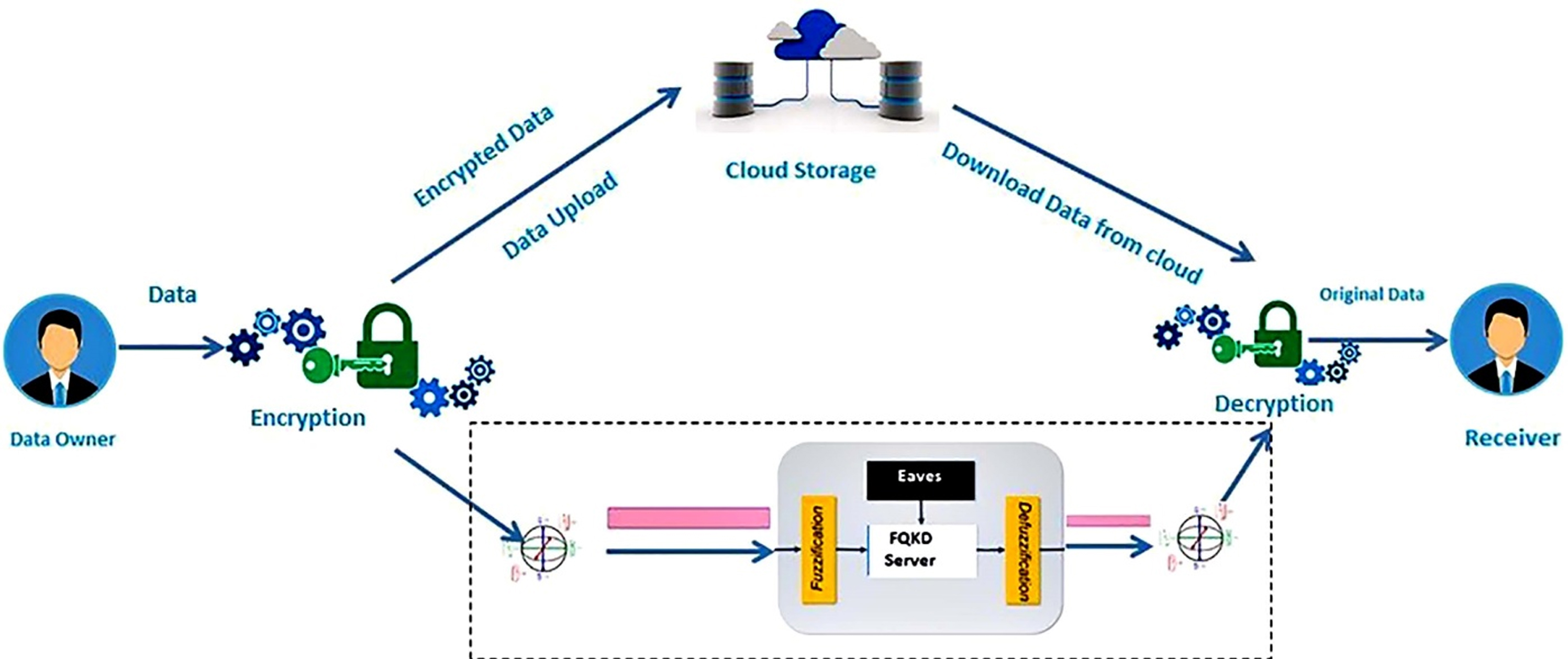
Proposed Work: SFQ frame work based QKD.
The proposed systems include some additional characteristics in addition to the existing approaches. Even when data is uploaded using encryption techniques with QKD Servers, there is a risk of side channel attacks with existing technologies. These issues are solved in this part with the assistance of using shifting algorithms as well as the fuzzification [34] procedure to assure the security of the secret key in the Fuzzification of Quantum Key approach. In that proposed system data owner will encrypt the original data with the AES algorithm first, as shown in the diagram above. There are two different out comes at the end of the encryption procedure. that is, encrypted data as well as the encryption key Binary information is used in both cases. The data owner will then directly transfer the encrypted data to the cloud server, where it will be stored. The encryption keys are then converted in to quantum key and the fuzzified using fuzzification methods to improve security. To ensure more confidentiality, two different types of algorithms are used in this process. The shifting and method (S&C Algorithm) is used to rearrange the secret key’s initial order, and then the reordered information is turned to a Q-bit using the polarization process. In the polarization process, any of the two polarizers is utilized to entangle photons in order to turn a classical bit into a Q-bit using the S&C method. The Q-bit will be treated in the fuzzification process once more to provide extra security. The Q-bits are fuzzified throughout the fuzzification process and will be shared with the user who is requesting the data from the cloud.
The receiver Convert that fuzzified q-bit into an original q-bit in the receiver end defuzzification procedure. Then it’s sent to the polarizer as an input to be converted to a Classical bit. The receiver will reassemble the secret key using the correct shifting technique, and then use the decryption key to decrypt the data which is accessed from the cloud.
The process of fuzzifying is transforming a set of data into a fuzzy function, such as fuzzy
Membership values [0,1]. The basic element of quantum computers is qubit, which is represented in terms of |0 > or |1 > .
This qubit can be represented in a variety of ways. In Dirac notation qubit is represented as
And in vector notation it is represented as
With the help of circle and square conversion method we can calculate the fuzzy sets of the given input. From that we can calculate the membership functions for the given input.
Equation number 1 and 2 gives the transformation formula of the qubits.
From that equations we can calculate the various fuzzy representation of the qubit i.e member-ship functions of the fuzzified qubit. that is showed in the Table 2.
Fuzzification of Qubit
The following table represents the fuzzified qubit values.
The SFQ (Shifting and Fuzzification of Q-Bit) framework employs two distinct approaches to protect the key. This is the core of the Qubit Algorithm, as well as the Parity Bit and Shifting (PBS) Algorithm. In the first situation, the PBS approach is used to change the order of the classical data, which is the secret key. In this scenario, the encryption key is used as an input to the PBS algorithm. The secret key is processed first, using the parity bit testing approach. The classical information is shifted two bit right if the parity is odd; otherwise, one bit is added at the MSB and one bit is shifted left if the parity is even. The receiver has already received that information. Depending on which condition is selected, another piece of information sent with the receiver is whether an orthogonal or rectilinear polarizer will be utilized. An orthogonal polarizer will be utilized if odd parity is used; otherwise, a rectilinear polarizer will be used. As a result, the data will be more accurate. Even if an eavesdropper tries to get the data, he won’t be able to get the exact data because it has been preprocessed. The SFQ framework’s second phase is the fuzzification of qubit. The polarization process will produce qubit information, which will be fed into the fuzzfification process, which will produce a fuzzified qubit. The Quantum channel is used to send this confusing qubit. In the receiver side defuzzification method, the fuzzified qubit will be transformed to original qubit information. Finally, from the reconstruction of that qubit, the receiver will recover the original secret key. If someone tries to retrieve the secret key via the side channel, they will not get the original data because it has been preprocessed with the PBS Algorithm. Because no cloning theorem will be monitored ex-clusively in the main channel, existing methods have a 50% chance of predicting the correct polarizer from the side channel. Birds, on the other hand, can get it via the side channel and can easily tell if the polarizer is orthogonal or rectilinear. Obtaining the original key, however, is not possible in this case. The original data will be unavailable to the provision. As a result, all of the top-secret data has been safeguarded
The fuzzification of Qubit is the second step in the SFQ framework. The output of the polarization process will be qubit information, which will be given as an input to the fuzzfification process, from which a fuzzified qubit will emerge. This perplexing qubit is sent through the Quantum channel. The fuzzified qubit will be converted to original qubit information in the receiver side defuzzification procedure. Finally, the receiver will obtain the original secret key from the reconstruction of that qubit. Because the secret key is preprocessed with the PBS Algorithm, if someone tries to retrieve it via the side channel, they will not get the original data. Because no cloning theorem will be monitored in the main channel exclusively, there is a 50% possibility of predicting the correct polarizer from the side channel in existing systems. How-ever, birds can acquire it from the side channel, and they can readily predict if the polarizer is orthogonal or rectilinear. However, in this instance, obtaining the original key is not possible. The provision will not be able to access the original data. As a result, all of the top-secret in-formation has been saved.
SFQ framework (PBS Algorithm & fuzzification of Qubit)
The following algorithm explains the concepts of SFQ framework as well as Fuzzification of Q-bit process.
Implementation results
The proposed model is simulated using a PC MSI Z370 A-Pro, i5-8600k processor, 16GB RAM. The java script language was used to create the SFQ framework. Initially, the sender gives the original data as input and gets encrypted data and encryption key. Polarizers are used in the side channel of the quantum channel to protect both the key and the data. The suggested algorithm outperforms existing systems by 99 percent in terms of security. With the use of mathematical testing, the proposed algorithms are compared to existing methodologies, and the pro-posed work is quantified at more than 99 percent security. Two stages were used to calculate the security key. The number of side channels was computed in the first stage by multiplying the number of photons by 2. The quantity of photons was multiplied with side channels in the second stage to get the security in percentages.
Number of Cross Channel (NCC) = No.of Particles (n)*2
Security (Si) = n*NCC/3
The plot of the quantity of photons against the number of side channels is shown in Fig. 2 using Table 3.

Photons per side channel vs. photons per side channel.
Photons per side channel vs. photons per side channel
The following picture depicts the current situation, in which increasing the number of pho-tons increases the number of side channels, and thus increasing the number of side channels increases the possibilities for side channel assaults. The security key has been calculated using first formula. In the table below, statistics on the number of side channels and security loss as a percentage are tabulated.
The graph is produced with respect to security loss and number of side channels using the Table 4 values, as shown in Fig. 3.
Calculation of the Percentage of Security Loss
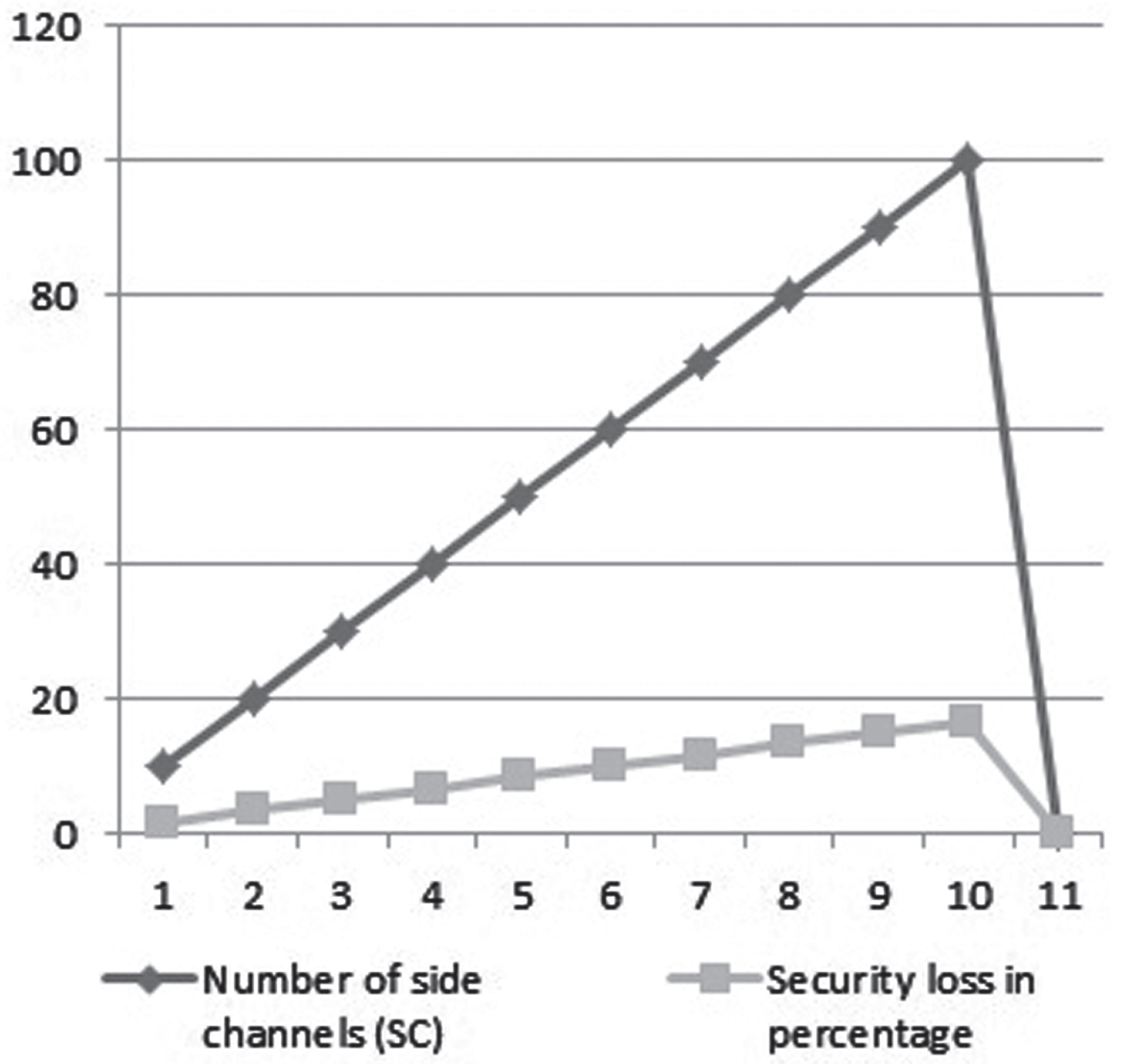
Number of side channels vs. security loss.
The formula 3 can be used to compute the security loss. To begin, multiply the shifting and complements values by the amount of bits. Finally, the likelihood value is divided by the multiplied value to obtain the security loss.
Where
LS: Losses in Security
N: The amount of bits
PBS&FQ: Process of parity calculation, shifting technologies, and fuzzification.
P.S: Probability of a security breach. Because there are two polarizers are in use.
The security loss for the proposed technique is obtained using formula 3 and can be tabulated as shown in Table 3. The existing model is defined as follows.
Where
LS: Losses in Security
N: The amount of bits
P.S: Probability of a security breach. Because there are two polarizers are in use.
The security loss for the Existing technique is determined using formula 4 and can be tabulated as shown in Table 5.
Security Loss analysis
The size of the secret data is used to calculate the security loss.
Fig. 4 Shows how the SFQ framework’s security is improving.
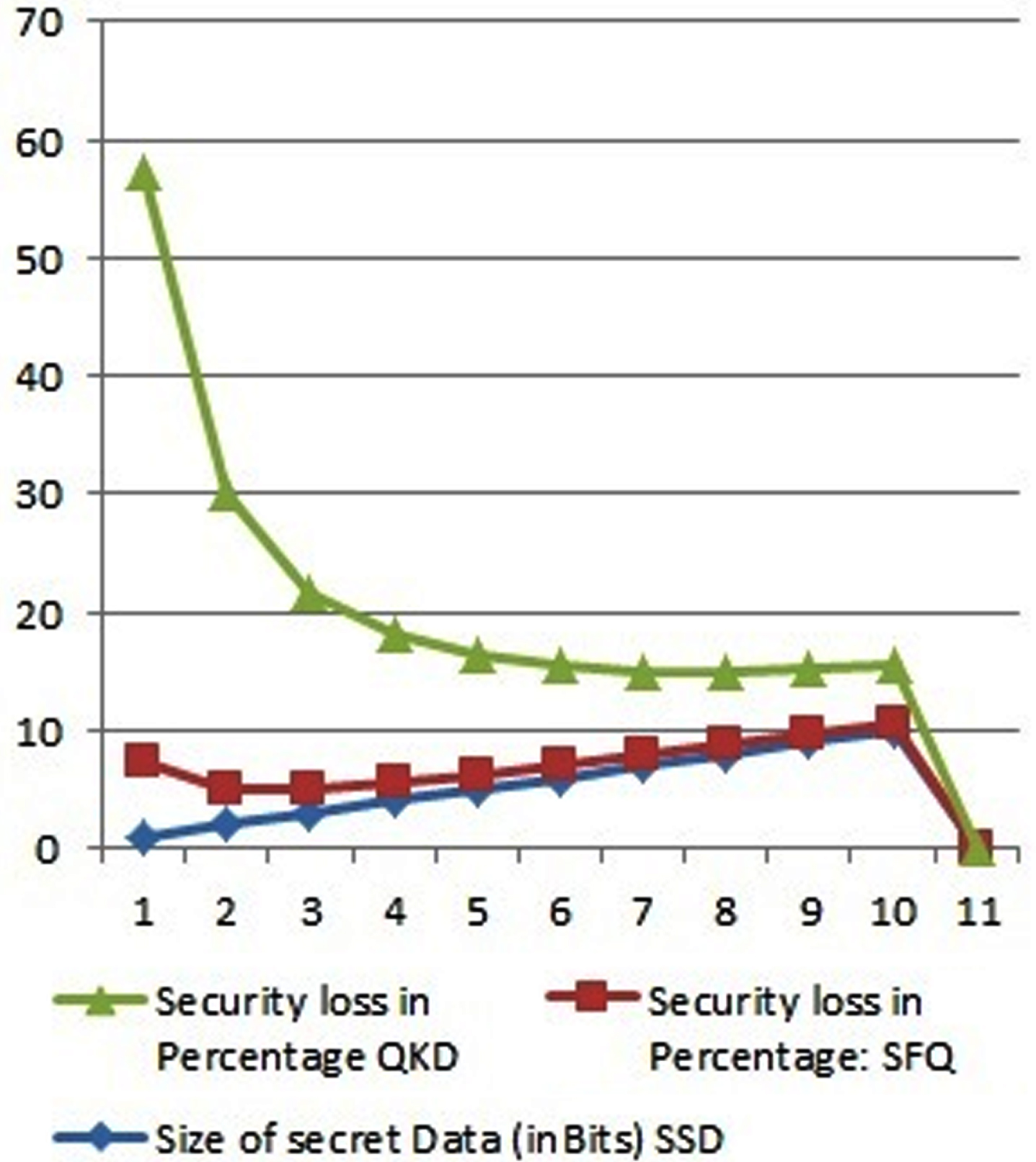
Security losses between Existing QKD and SFQ framework.
The difference in security losses between the old qkd procedure and the SFQ framework is depicted in the diagram above.
When the value of a scaling term in the test statistic is known, the test statistic will most likely follow a normal distribution. When the scaling term is unknown, the test statistic follows a Student’s T distribution (under specific conditions) and is replaced with an approximation based on the data.
According to the results of the foregoing analysis, the mean value of security losses in SFQ is 1.8306051, and the mean value of QKD is 14.6448416, with standard deviations of 1.7329 and 13.863 for SFQ and QKD, respectively. The two-tailed t value is 2.90 and the value of P is 0.0095 which is fewer than 0.05, representing that the differences in both situations are statistically significant. SFQ’s mean value (1.8306051) is significantly lower than QKD’s (14.6448416). When comparing the security losses of the SFQ framework to the security losses of the QKD framework, it can be seen that the security losses of the SFQ framework are substantially lower and appear to be better.
In the real world, cloud security is required for all transactions, particularly those involving government agencies and banks, because all enterprises rely on cloud services. Because there are so many cloud servers connected to deliver cloud services to users, security must be pro-vided in those servers. Despite the fact that they can be hacked by attackers utilizing advanced strategies, a range of security algorithms are now utilized to improve security in the cloud environment. One such technology is the QKD protocols, which were created earlier to improve the security of key transfer. While attacking the side channel in this manner, it is feasible to hack the q-bits from the side channel. The SFQ framework was created to address these difficulties by addressing side channel attack vulnerabilities in cloud sharing environments. This strategy use a mixture of mathematical phrases to improve security. The experimental results states that the mean value of security losses in SFQ is 1.8306051, and the mean value of QKD is 14.6448416, with standard deviations of 1.7329 and 13.863 for SFQ and QKD, respectively. The proposed security paradigm performs brilliantly to a large extent. In the future, this SFQ QKD will be used in big data and block chain technologies to protect data in the real world, together with a side channel.
Ethical Approval
This article does not include any of the authors’ studies involving human or animal participants.
Funding
The authors declare that no funds, subsidies, or other forms of assistance were used in the preparation of this research.
Conflict of interest
There are no relevant financial or non-financial interests for the authors to expose this re-search work.
Informed consent
This article does not include any of the authors’ studies involving human or animal participants.
Authorship contributions
Conceptualization: N.Gopinath; Formal analysis and investigation: N.Gopinath; Methodology: N.Gopinath; Writing - review and editing: N.Gopinath; Writing - original draft preparation: N.Gopinath; Resources: Dr.S.Prayla Shyry,N.Gopinath; Supervision: Dr.S.Prayla Shyry.
Data availability
The Image repository contains the datasets created during development and analysed during this research, http://www.vision.caltech.edu/Image_Datasets/Caltech101/ and Quantum bit re-pository, https://pure.strath.ac.uk/ws/portalfiles/portal/92638035/dataset.zip