



Abstract
A set S ⊆ V in a graph G is a MED-set if every vertex in V - S has a monophonic eccentric vertex in S. The MED-number γ me (G) is the cardinality of a minimum MED-set of G. A set S ⊆ V in a graph G is a CMED-set if S is a MED-set and the induced subgraph is connected. The CMED-number γ cme (G) is the cardinality of a minimum CMED-set of G. We investigate some properties of the CMED-sets. Also, we determine the bounds of the CMED-number and find the same for some standard graphs. The CMED-number has applications in security based communication networks in real life situations. This motivated us to introduce and investigate CMED-set in a graph.
Keywords
Introduction
We refer to a graph G = (V, E) as a non-trivial simple connected graph with |V (G) | = p and |E (G) | = q. The order and size of G are denoted by p and q, respectively. We refer to [1, 3] for basic graph theoretic terminology and results. The distance d (u, v) represents the length of a shortest u - v path in G. If d (u, v) is either 0 or 1, then v dominates u (or u dominates v). If S is a set of vertices of G and every vertex of G is dominated by some vertex in S, then S is called a dominating set and the minimum cardinality of S is called the domination number of G. The domination number is denoted by γ (G). Berge [1] and Ore [5] introduced the concept of domination. Then Haynes et al. [4] published a textbook on domination in the year 1998. If S ⊆ V is a dominating set of G and its induced subgraph is connected, then S is called a connected dominating set of G. The connected domination number γ c (G) is the minimum cardinality of a connected dominating set of G and it was studied in [6].
The detour distance D (u, v) represents the length of a longest u - v path in G. Define D- (v) = min {D (u, v) : u ∈ V - {v}} for each vertex v in G. A vertex u (≠ v) is a detour neighbor of v if D (u, v) = D- (v). If u = v or u is a detour neighbour of v, then the vertex v is said to detour dominate the vertex u. If S is a set of vertices of G and each vertex of G is detour dominated by some vertex in S, then S is called a detour dominating set of G. The detour domination number γ D (G) is the minimum cardinality of a detour dominating set of G. Chartrand et al. [2] introduced and explored these topics.
The distance and detour distance between any two vertices in a connected graph are respectively, based on a shortest path and a longest path between the vertices. In the year 2011, Santhakumaran and Titus [7] introduced a new distance known as monophonic distance based on a chordless path between any two vertices in a connected graph and further it was studied in [8].
A path’s chord is an edge that connects two non-adjacent vertices. If a path P is chordless, it is called a monophonic path. The monophonic distance d m (u, v) represents the length of a longest u - v monophonic path in G. The monophonic eccentricity e m (v) of a vertex v is defined as e m (v) = max {d m (u, v) : u ∈ V}. The monophonic radius of G is defined as rad m (G) = min {e m (v) : v ∈ V}. The monophonic diameter of G is defined as diam m (G) = max {e m (v) : v ∈ V} . If e m (u) = d m (u, v), then v is a monophonic eccentric vertex of u in G. If e m (v) = rad m (G), a vertex v in G is a monophonic central vertex, and the monophonic center of G is the subgraph induced by the monophonic central vertices of G. The graph G is called monophonic self-centered if every vertex of G is a monophonic central vertex.
Let S be a set of vertices of G. If every vertex in V - S has a monophonic eccentric vertex in S, then S is called a monophonic eccentric dominating set or MED-set of G. The monophonic eccentric domination number or MED-number γ me (G) is the minimum cardinality of a MED-set of G. Titus et al. [9] introduced and investigated these topics.
In the sequel, the following theorems will be applied.
The CMED-number
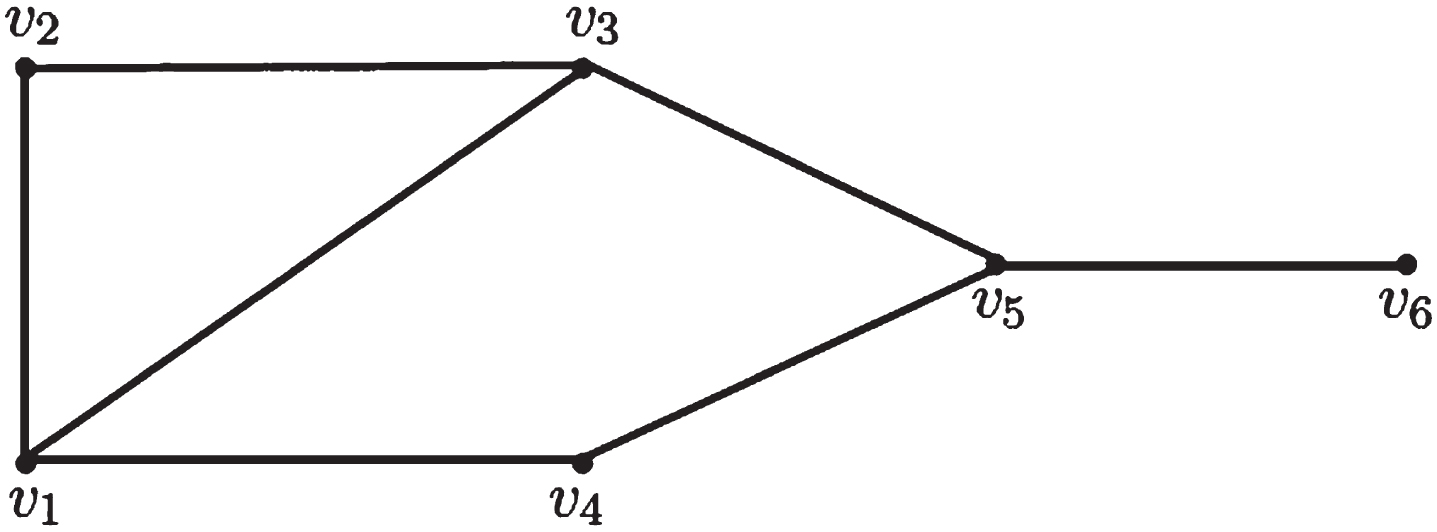
A graph G with γ cme (G) =3.
Since any CMED-set is necessarily a MED-set, the following theorem is obvious.
If r = 1, let S = {v i } (1 ≤ i ≤ s) and if s = 1, let S = {u j } (1 ≤ j ≤ r). Clearly, S is a minimum CMED-set of Kr,s and so γ cme (Kr,s) =1.
Clearly, no single vertex set is a minimum CMED-set of Kr,s. Let S = {u i , v j } (1 ≤ i ≤ r, 1 ≤ j ≤ s). It can be easily seen that every vertex in V1 - {u i } has a monophonic eccentric vertex u i (1 ≤ i ≤ r) and every vertex in V2 - {v j } has a monophonic eccentric vertex v j (1 ≤ j ≤ s). Since is connected, S is a minimum CMED-set of Kr,s. Thus γ cme (Kr,s) =2.□
Clearly, x is not a monophonic eccentric vertex of any vertex in G. Since ∑m j ≥ 2, G - x has at least two components. Let u be a monophonic eccentric vertex of some vertex in G. Then u is a vertex of a component, say G1, of G - x. Since j ≥ 2, G1 has at least one more vertex other than u, say v. Since G1 is a complete graph, we have d m (u, v) =1. Also, since G has two or more components, we have u is not a monophonic eccentric vertex of v. Hence a MED-set of G contains at least two vertices. Let S = {u, w}, where u and w belong to two different components, say G1 and G2, respectively. Then the vertex u is a monophonic eccentric vertex of every vertex in G - G1 and the vertex w is a monophonic eccentric vertex of every vertex in G - G2. But the induced subgraph is not connected. Next, we choose a set S1 = S ∪ {x} . It is clear that x is a common neighbor of both u and w. Hence S1 is a minimum CMED-set of G and so γ cme (G) =3.
The graph G contains at least one end vertex, say v. It is clear that the vertex v is the monophonic eccentric vertex of every vertex in G - v and so γ cme (G) =1.
The graph G = K1 + ∪ m j K j is a complete graph. Then by Theorem 8, γ cme (G) =1.□
The corona of two graphs G1 and G2 is G1 o G2 which is made up of one copy of G1 and |V (G1) | copies of G2, where i th vertex of G1 is adjacent to every vertex in the i th copy of G2. Next theorem gives the CMED-number of the corona product of two non-trivial paths.
Let
Clearly, the vertex v1,j (1 ≤ j ≤ s) is a monophonic eccentric vertex of u
i
Clearly, the vertex vr,j (1 ≤ j ≤ s) is a monophonic eccentric vertex of u
i
Let
Let
Clearly, the vertex vr,j (1 ≤ j ≤ s) is a monophonic eccentric vertex of u
i
Let
If r is odd, then the vertex vr,j is a monophonic eccentric vertex of u
i
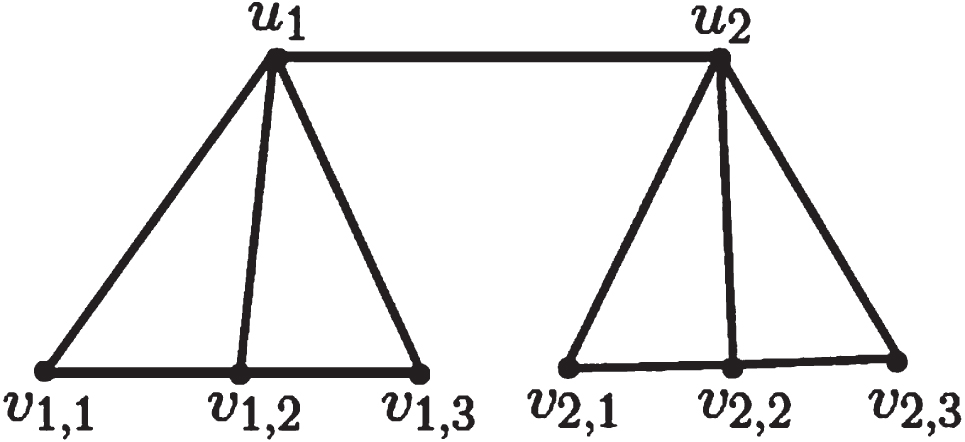
The corona product graph G = P2 o P3 with γ cme (G) =4.
Let C i : u i , v i , w i , x i , y i , u i (1 ≤ i ≤ l) be l copies of a cycle with order 5 and let K1,p-5l-1 be a star with the cut-vertex x and the set of end vertices Z = {z1, z2, …, zp-5l-1}. Form the graph G from the cycles C i (1 ≤ i ≤ l) and the star K1,p-5l-1 by (i) joining every vertex in C i (1 ≤ i ≤ l) with the vertex x in K1,p-5l-1, and (ii) joining the vertices v l and x l in C l . Then the graph G has order p and is shown in Fig. 3.

The graph G in Case 1 of Theorem 19.
Clearly, for any vertex v in C
i
(1 ≤ i ≤ l - 1), e
m
(v) =3; for any vertex v in {u
l
, w
l
, y
l
}, e
m
(v) =3; for any vertex v in Z ∪ {v
l
, x
l
}, e
m
(v) =2; and for the vertex x, e
m
(x) =1. Therefore, any two non-adjacent vertices in C
i
(1 ≤ i ≤ l - 1) are mutual monophonic eccentric vertices, every vertex in C
i
(1 ≤ i ≤ l) is a monophonic eccentric vertex of any vertex in Z and every vertex in V (G) - {x} is a monophonic eccentric vertex of x in G. Hence it is verify that
Let C i : u i , v i , w i , x i , y i , u i (1 ≤ i ≤ l - 1) be l - 1 copies of a cycle with order 5. Let P : v1, v2, …, v6 be a path with order 6 and let K1,p-5l-2 be a star with the cut-vertex x and the set of end vertices Z = {z1, z2, …, zp-5l-2}. Form the graph G from the cycles C i (1 ≤ i ≤ l - 1), the path P and the star K1,p-5l-2 by joining every vertex in C i (1 ≤ i ≤ l - 1) with the vertex x in K1,p-5l-2, and joining every vertex in P with the vertex x in K1,p-5l-2. Then the graph G has order p and is shown in Fig. 4.

The graph G in Case 2 of Theorem 19.
Clearly, the monophonic eccentricity of the vertex v
i
(i = 1, 6) in P is 5, the monophonic eccentricity of the vertex v
i
(i = 2, 5) in P is 4, the monophonic eccentricity of any vertex in C
i
(1 ≤ i ≤ l - 1) and the vertex v
j
(j = 3, 4) in P is 3, the monophonic eccentricity of any vertex in Z is 2 and the monophonic eccentricity of the vertex x is 1. Then the vertex v6 is the monophonic eccentric vertex of v
i
(i = 2, 3) in P and the vertex v1 is the monophonic eccentric vertex of v
i
(i = 4, 5) in P. Also, by an argument similar to Case 1,
Next theorem gives a realization result for the ineqality rad m (G) +1 < diam m (G) with suitable conditions.
If d = 3, let P i : wi,1, wi,2, wi,3, wi,4 (1 ≤ i ≤ n - 1) be n - 1 copies of a path of order 4. Let G be the graph obtained from the paths P i (1 ≤ i ≤ n - 1) by joining every vertex in P i (1 ≤ i ≤ n - 1) with the new vertex v. The graph G is shown in Fig. 5.

The graph G in Case 1 of Theorem 20.
It is clear to observe that 1 ≤ e
m
(x) ≤3 for any vertex x in G, e
m
(v) =1 and e
m
(wi,1) =3 (1 ≤ i ≤ n - 1). Then rad
m
(G) =1 and diam
m
(G) =3. Also, the vertex wi,1 is the monophonic eccentric vertex of wi,j (1 ≤ i ≤ n - 1, j = 3 or 4) and the vertex wk,1 (k ≠ i) is a monophonic eccentric vertex of wi,2 (1 ≤ i ≤ n - 1). Clearly,
If d > 3, let P
i
: wi,1, wi,2, wi,3, wi,4 (1 ≤ i ≤ n - 3) be n - 3 copies of a path of order 4. Let G be the graph obtained from the paths P
i
(1 ≤ i ≤ n - 3) and the graph H by joining every vertex in P
i
(1 ≤ i ≤ n - 3) with the vertex u1 in H. The graph G is shown in Fig. 6. It is clear to observe that 1 ≤ e
m
(x) ≤ d for any vertex x in G, e
m
(u1) =1 and e
m
(u2) = d. Then rad
m
(G) =1 and diam
m
(G) = d. Also, the vertex ud+2 is the monophonic eccentric vertex of u
i
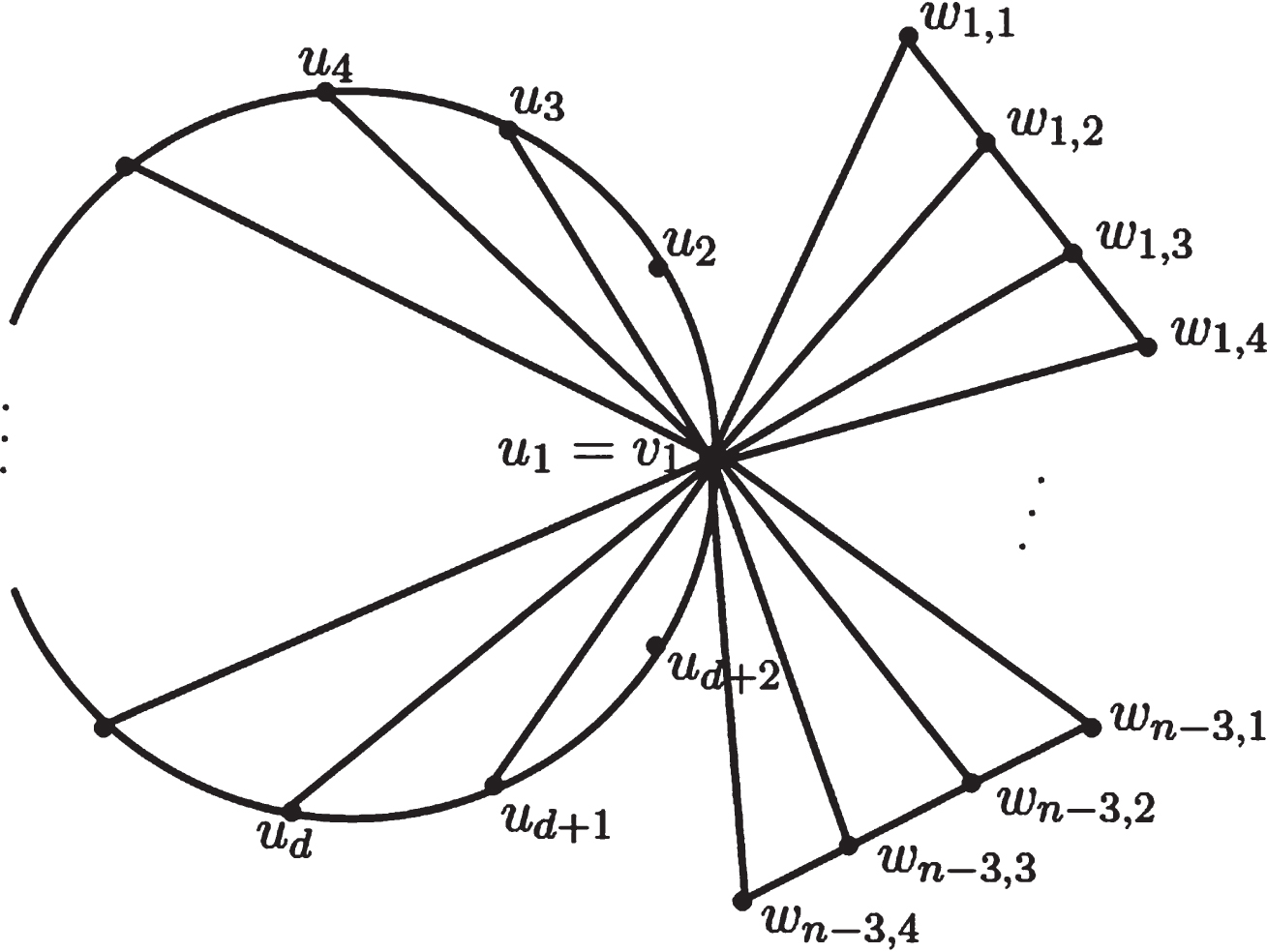
The graph G in Case 1 of Theorem 20.
Let P
i
: wi,1, wi,2, …, wi,d+1 (1 ≤ i ≤ n - 3) be n - 3 copies of a path of order d + 1 and let P : v1, v2, …, v
r
be a path of order r. Let G be the graph obtained from the paths P
i
(1 ≤ i ≤ n - 3), the path P and the graph H by (i) joining every vertex in P
i
(1 ≤ i ≤ n - 3) with the vertex v
r
in P, (ii) identifying the vertices u1 in H and v1 in P, (iii) joining every vertex in P with the vertex u
d
in H, and (iv) joining the vertices u2, ud+2 in H with the vertex v
r
in P. The graph G is shown in Fig. 7. It is clear to observe that r ≤ e
m
(x) ≤ d for any vertex x in G, e
m
(u1) = r and e
m
(u2) = d. Then rad
m
(G) = r and diam
m
(G) = d. Also, the vertex wi,1 is the monophonic eccentric vertex of wi,d+1 (1 ≤ i ≤ n - 3), the vertex u3 is the monophonic eccentric vertex of wi,j (1 ≤ i ≤ n - 3, 2 ≤ j ≤ d), the vertex wi,j (1 ≤ i ≤ n - 3, 1 ≤ j ≤ d + 1) is a monophonic eccentric vertex of u1 and u
i
(3 ≤ i ≤ d - 1), and the vertex u2 is the monophonic eccentric vertex of u
i
(d ≤ i ≤ d + 2). If r ≥ 3, the vertex u2 is the monophonic eccentric vertex of v
i
(2 ≤ i ≤ r - 1). It is clear that

The graph G in Case 2 of Theorem 20.
In this paper, we identified a new parameter known as connected monophonic eccentric domination number in graphs and it has many real life applications. Several interesting results with regard to this parameter have been developed. The bounds for this parameter are determined and the same is also determined for some standard graphs. More interestingly, this parameter is determined for the Petersen graph and the corona product of two non-trivial paths. A connected graph with connected monophonic eccentric domination number 2 is characterized. Some realization theorems are developed for this parameter with suitable conditions. As for future work is concerned, this parameter can be studied with regard to other conditional domination parameters as well as fuzzy graphs.
Footnotes
Acknowledgement
The authors are thankful to the referees for their useful suggestions.