



Abstract
This study aims to define the adoption barriers to Industry 4.0 for sustainable supply chain and define their causalities and, dependencies, hierarchical levels of these barriers. Firstly, a framework for critical barriers to Industry 4.0 for sustainable supply chain management is created with literature review and experts for the first time. Then an integrated approach of Grey DEMATEL – ANP is proposed to analyze the adoption barriers to Industry 4.0 in sustainable supply chain management. The proposed method determines the cause-effect relationship among barriers, the strength of interactions, and the relative weights of critical barriers to Industry 4.0 in a sustainable supply chain. The results show that uncertainty about economic benefits, resistance to change, and lack of infrastructure and tools for Industry 4.0 in the Sustainable supply chain are crucial barriers to implementing Industry 4.0 technologies in SSC. This study can help decision-makers and managers define the barriers and provide the theoretical guideline to implement Industry 4.0 technologies across the sustainable supply chain successfully.
Introduction
Industry 4.0 can lead to the intelligent supply chain period that enables every object with a particular economic value to interact with each other by using artificial intelligence, three-dimensional printers, robotics, and space technology. In this period, it is mentioned about the manufac-turing system in which virtual and physical systems are integrated [20]. To achieve a robust, sustainable supply chain, it is necessary to adopt the new digital technologies in the Industry 4.0 process and apply them to supply chain management. It is aimed that all entities in the sustainable supply chain (SSC) network can communicate with each other, access big data in real-time, and thus obtain outputs that satisfy the expectations of Industry 4.0.
Industry 4.0 technologies lead to digital supply chain transformation. Digitalization changes traditional supply chains, making the chain a fully integrated system that is entirely transparent to all actors involved. The digital supply chain aims to create an interactive supply network that is robust and responsive [45].
Businesses that can transform their processes into digital supply chains will have advantages in customer service, flexibility, efficiency, and cost reduction [60]. By using Industry 4.0 with information flow and self-controlled intelligent machines and innovative products, the supply chain will be fully integrated, supported by interconnected systems, and perfectly coordinated. All these factors reduce costs and ensure the optimization and flexibility of the procurement process, especially in the purchasing, production, and distribution stages. In Industry 4.0, systems can identify and manage the demand. In addition, distribution activities can manage processes such as autonomous decision-making, control, and planning of logistics activities [14].
Companies emphasizing Industry 4.0 processes know that the digital transformation journey is a long-term process [66]. Companies need to be aware of the difficulties in this process and produce effective solutions for these problems. To ensure success in the digital transformation journey, all stakeholders in the SSC have essential responsibilities. The transition of companies to Industry 4.0 requires both time and a high budget. Miscalculations cause to increase in the transition time and even waste theinvestment.
While the developments of Industry 4.0 provide significant effects in every area, they also cause severe difficulties in adopting this process. For this reason, the SSC sector must be able to fulfill the requirements of the Industry 4.0 trend. Therefore, evaluating the adoption barriers at the beginning of the process accelerates the transition to Industry 4.0.
In the digital transformation process, it is inevitable that keep up with the Industry 4.0 trend and strengthen their economies for all stakeholders in the supply chain. At this juncture, SSC managers need to define the adoption barriers to Industry 4.0 clearly and plan their strategic steps by prioritizing these barriers according to their importance. At this point, this study aims to determine the adoption barriers to Industry 4.0 in sustainable supply chain management (SSCM) in the presence of literature reviews and experts. It contributes to the managers in the SSCM and gives foresight. According to the literature research, the methods and the practical implications of the results obtained are presented. In this way, this study fits the aims and objectives of JEIM.
More specifically, the study aims to investigate answers to the following four research questions: What are the critical adoption barriers to Industry 4.0 in SSCM? What are the causalities and dependencies between these barriers? What are the hierarchical levels among these barriers? How do the identified barriers interact with each other while influencing the adoption of industry 4.0 in SCCM?
This study uses an integrated approach of Grey Decision-Making Trial and Evaluation Laboratory (DEMATEL) – Analytic Network Process (ANP) to model the adoption barriers to Industry 4.0 in SSCM. The DEMATEL technique has been extensively used for better decision making many systems that involve uncertain information. The DEMATEL method can determine the cause-effect relationship among barriers and their weight coefficient better than the other multi-criteria decision-making (MCDM) methods [74, 75]. However, the classical DEMATEL method does not work well in the fundamental processes that include uncertainties of human judgments [31, 70]. At this point, Grey-DEMATEL can effectively identify the total degree of influence of each adoption barrier on other barriers by handling the uncertainties in human judgment [53]. Therefore, the Grey-DEMATEL is exploited to examine the causal relationship in an uncertain situation in this study. Then, the ANP method is employed to determine the relative weight of adoption barriers based on the relation obtained with Grey-DEMATEL. Analytic Hierarchy Process (AHP) method assumes that the criteria and sub-criteria are independent. Compared to ANP, AHP is not practical in many situations because ANP evaluates the interdependencies and feedback among criteria [50, 62].
The integrated Grey-DEMATEL and ANP technique is the best suitable methodology for this study. It helps the SSCM managers prioritize the adoption barriers to Industry 4.0 based on their relative importance, it also helps to understand the interrelationships between them under uncertain expert judgments. In this way, the Grey DEMATEL-ANP provides many strategies for implementing industry 4.0 by determining the critical barriers to achieving sustainability objectives for SSCM managers.
Four elements are analysed to comprehend the research findings: prominent barriers, influencing barriers, resulting barriers, and ranking of these barriers. The comprehensive analysis provides vital information about critical barriers in the adoption process of Industry 4.0. UEB is determined to be the most crucial barrier under the economic dimension. RC (Resistance to change) is the most important barrier to Industry 4.0 in SSC related to the social dimension. LIT (Lack of trust and tendency in stakeholders about Industry 4.0 technologies) is the third crucial barrier in transitioning to Industry 4.0 technologies in the scope of the technological dimension. Based on the Grey-DEMATEL results, LIT is the cause barrier and has a strong influence that contributes significantly to the adaptation process of Industry 4.0 in SSC. Besides, RC and UEB are also important barriers to this process because of their prominence ranks and the relatively low net effect values.
The rest of this paper is organized as follows. Section 2 presents the background literature on barriers to Industry 4.0 in SSCM. Section 3 illustrates the research methodology adopted in this study. The key findings are presented in Section 4. The results and analysis relating to the application are presented in Section 5. Finally, conclusions and future research directions are given in Section 7.
Literature review
This section provides the existing literature on the adoption barriers to Industry 4.0, following which the used MCDM methods for the adoption of Industry 4.0 to evaluate the relationships between barriers are outlined.
Barriers to the adoption of Industry 4.0
Industry 4.0 is an important area that can be used in manufacturing and service systems and deal with new technologies. However, this process creates adoption barriers because the application of Industry 4.0 comes together with various uncertainty. Most researchers indicate that the investigation of barriers related to Industry 4.0 needs to be considered more in further research [34, 65].
There are many studies on identifying adoption barriers to Industry 4.0 for different sectors in different developing countries and examining the relationships between them. These studies offer the opportunity to look at these barriers from different perspectives. Kamble et al. [58]. study were developed to identify industry 4.0 adoption barriers and hierarchical relationships between them using ISM and fuzzy MICMAC methodology in Indian manufacturing. Saatçioğlu et al. [44] use ISM and DEMATEL methods to determine the Industry 4.0 barriers in the implementation process in Turkey’s condition and examine the interrelations among them. The authors indicate that the most critical barrier is the lack of digital vision since it affects all the other barriers. Stentoft et al. [32] investigate drivers and barriers to Industry 4.0 for small and medium-sized enterprises (SMEs) about their readiness and practice in digitalized manufacturing. According to their empirical analysis, it can be concluded that drivers and barriers to Industry 4.0 lead to increased readiness. Besides, barriers to Industry 4.0 do not have a significant impact on practice, while drivers lead to a higher degree of practicing Industry 4.0. Another study that includes the SME perspective belongs to by Türkeş et al. [36]. The authors identify the drivers and barriers to implementing Industry 4.0 for SME managers in Romania. This study’s findings highlight that Romania is in a transition process from industry 2.0 to industry 4.0 and has a low level of resources to implement Industry 4.0 technologies. Horv
Müller [30] assess the barriers to Industry 4.0 from the workers’ perspective. The author presents the first insights on how workers assess challenges in Industry 4.0. Unlike studies that aim to identify adoption barriers to industry 4.0, this study takes more social aspects into account regarding skills, shortages, fears of job losses, and further aspects. Raj et al. [9] study are one of the first to analyze barriers to implementing Industry 4.0 technologies in the manufacturing sector. The authors precipitate that the barrier of ‘lack of a digital strategy alongside resource scarcity emerges as the most prominent barrier. Another study on the barriers to transition to Industry 4.0 in the manufacturing sector belongs to Bakthari et al. [8]. The authors examine the barriers to Industry 4.0 and interactions with each other in manufacturing industries based on the ISM model integrated with MICMAC analysis. According to their results, it can be said that the main challenge toward Industry 4.0 implementation in manufacturing industries is the lack of vision and leadership from top management. Kumar et al. [52] focus on the adoption barriers to Industry 4.0 from the manufacturing organizations framework like Bakthari et al. [8] and Raj et al. [9]. The authors use the ISM and MICMAC methods to establish relationships among determining barriers and analysis for further classification.
Industry 4.0 and circular economy adoption barriers in India’s agriculture supply chain (ASC) are identified by Kumar et al. [52]. The authors employ an integrated ISM-ANP strategy. In [11], Sarkar and Shankar’s goal is to identify and analyze challenges to port logistics for emerging economies in the Industry 4.0 era. They apply MICMAC analysis to categorize the barriers into clusters depending on dependence and driving power. Based on their results, it can be said that the significant barriers are determined. Majumdar et al. [6] study are the first to identify and analyze the Industry 4.0 barriers in the textile and clothing industry. The authors use the ISM method to elicit the relationships between these barriers. They propose a triple helix-based framework to overcome barriers that significantly affect Industry 4.0 adoption. Chauhan et al. [13] present structural equation modeling to understand the intrinsic and extrinsic barriers to Industry 4.0 adoption. Cugno et al. [15] investigate openness to Industry 4.0 and performance by considering the impact of barriers. The authors apply quantitative and qualitative analysis via an OLS regression-based path in their study.
Mastos et al. [64] provide evidence of the impact of an Internet of Things (IoT) solution on the SSCM. The authors present a case study from a scrap metal producer and a waste management company to indicate that the IoT improves economic and environmental sustainability at the firm and supply chain level. Another study that provides an overview of Industry 4.0 barriers in terms of sustainability belongs to Kumar et al. [52]. Their study identifies the criteria of sustainable operations and barriers to achieving the sustainable goals in a circular economy with an integrated AHP and Elimination and Choice Expressing Reality (ELECTRE) approach. In [40], Sharma et al. evaluate drivers and barriers to implementing Industry 4.0 in multi-tier manufacturing supply chains. The drivers and barriers are technological, organizational, economic, environmental, and social. They use a two-phase methodology comprising AHP and DEMATEL to identify the relationship between dimensions influencing the industry 4.0 implementation according to drivers and barriersseparately.
Research gap
Based on the literature research, it is seen that the barriers to the implementation of Industry 4.0 in different sectors and different developing countries have been discussed broadly by researchers. It can be said that the frequently used areas are SMEs, manufacturing organizations, and the textile and clothing sector in terms of determining the barriers to the implementation of Industry 4.0. In addition, the literature reveals that a substantial number of studies have investigated drivers and barriers to Industry 4.0 technologies simultaneously.
In recent years, the importance given to the evaluation of barriers to Industry 4.0 in terms of sustainability has been increasing with the studies [22, 64]. Implementing state-of-art Industry 4.0 technologies in SSCM is very important for the improvements. However, the uncertainty brought by Industry 4.0 causes various barriers in the implementation process. Identifying these barriers is fundamental to accomplish in supply chain activities. From this point of view, no study has been found in the literature that directly determines the adoption barriers to Industry 4.0 in the SSCM. In this respect, a significant gap is filled in the literature. All key barriers encountered in implementing Industry 4.0 tech-nologies in SCM are defined comprehensively, and the relationships between them are examined in detail in this study.
When considering the literature research and expert opinions, adaptation barriers are created in Table 1. Details of the proposed framework, including these dimensions and critical barriers, are given.
Adoption barriers to Industry 4.0 technology in SSCM
Adoption barriers to Industry 4.0 technology in SSCM
Based on the literature review and expert opinions, 14 key adoption barriers are presented relevant to implementing Industry 4.0 in the SSCM. These key barriers are determined within the scope of 4 main dimensions consist of social, economic, technological, and organizational.
To stay in a competitive environment, it is necessary to move into digital and sustainable supply chains integrated with the concept of Industry 4.0. For this reason, in this study, the adoption barriers to the industry 4.0 process are defined to ensure sustainability orientation in supply chains. Details of barriers are given in the sub-sections.
Social barriers
Lack of Government policy guide and support
Governments might be reluctant to apply Industry 4.0 technology adoption and sustainable supply chain practice [9]. For this reason, governments may not have revealed the protocol for transforming the traditional business [66]. This situation can be caused to legal and collaboration issues and unavailability of financial subsidies and incentives [52].
Lack of qualified personnel
Analyzing the data in Industry 4.0 technology and reaching interdisciplinary knowledge competency necessitate a qualified workforce. When Industry 4.0 technologies are adopted in the SSC, there is a need for qualified personnel with advanced IT skills who can control and manage intelligent machines. A trained staff contributes to solving the difficulties of digital culture, language, and process digitalization [52].
Lack of knowledge and expertise about which Industry 4.0 technology is appropriate and should be used for SSC processes
There is a need for critical research and development activities in current computer science, information and communication systems, network technologies, and production automation. For this reason, a lack of technical expertise and knowledge about Industry 4.0 technology and sustainable supply chain causes the deficiency of SCmanagement.
Disruption risk of existing jobs in sustainable supply chain
Technological advancements can affect some nations where cheap labor is an essential resource [9].This risk can be defined as disruptions of jobs due to emerging technologies and automation. Because technological developments bring automation that shifts current jobs’ structure and results in human job losses. The current jobs convert to knowledge-based, short-term, and hard-to-plan tasks.
Lake of customer awareness
Customer awareness is a need for Sustainable row materials, products, the followed adoption process for Industry 4.0, the manner of work of machines, and their impact on the environment. If this is not the case, it may be challenging to adapt to sustainable practices for some departments in SSC[6, 40].
Resistance to change
Firms have some difficulties adopting new systems. This issue may cause a tendency to resist the changes and fear of failure among partners in SSC. Besides, employees can be unwilling to participate in these initiatives because of no satisfactory evidence regarding the success of Industry 4.0 adoption in SSC [9, 52].
Economical barriers
Huge resource (Energy & capital requirements)
As shown in Table 1, the first of these barriers is the vast resource. With Industry 4.0, new technologies should be developed, and current tools and equipment should be tested. Depending on technological developments, it is inevitable to transition to production with intelligent machines and improve production processes’ capabilities. These modifications create high energy and capital investments [9].
Uncertainty about economic benefits
Implementing Industry 4.0 technologies under the uncertain infrastructure brings an unclear assessment of economic benefits and low return on productivity. Performed significant capital investment may cause potential monetary losses [9].
Technological Barriers
Security and privacy challenges
The data and information may cause security concerns such as hacking, phishing attacks, the stealing of privileged credentials, inaccurate information dispersal, and access to sensitive information. In addition to this, the use of Cyber-Physical Systems in the supply chain requires sensors (including Micro and Nano-sensors), embedded system designs, and interfaces that enable communication [9, 37].
Lack of infrastructure and tools for Industry 4.0 in SSC
Poor internet coverage and lack of IT infrastructure result in system failure and chaos across the chain in the implementation of Industry 4.0 and sustainable processes. In addition to this, the lack of appropriate tools and techniques like Sensor integration, infrastructure standardization, and interface platforms harms the compatibility and sustainability performance [40, 52].
Lack of data quality
Processing of large volume of data gathered through machines, processes, sensors, and products leads to difficulty in the adoption process of Industry 4.0 in SSC. Another challenge, however, is extracting valuable data from this massive volume of data [9, 52].
Organizational challenges
Challenges integrating sustainable practices and Industry 4.0 technology through SSC
Providing integration between different technologies and network systems and creating interoperability with the three dimensions of sustainability creates this risk. While integrating Industry 4.0 technology, it should be known that it interacts with economic, social, and environmental sustainability. Integrating these three dimensions with technology may cause integration risks at different stages [37].
Lack of trust and tendency in stakeholders about Industry 4.0 technologies
The stakeholders in SSC may be exposed less to the benefits of Industry 4.0. This situation can be caused by poor collaboration, communication, and coordination among partners [37]. For this reason, the stakeholders may not trust the Industry 4.0 implementation process and may not adapt to their new practices.
Organizational culture and process challenges
Adopting Industry 4.0 technology in SSC necessitates advocating this process at all organization levels and some process changes. Organizational culture and functions may change or transform because of this adoption [6, 39].
Research methodology
As discussed in the introduction section, the integrated Grey DEMATEL-ANP method is used to analyze and prioritize adaption barriers to Industry 4.0 technologies in SSC at various levels in this study. Grey DEMATEL can investigate the causative relationship in an unpredictable environment. The ANP approach is used to compute the relative weight of adoption barriers based on the influencing relationship obtained from grey DEMATEL. Each step of the integrated Grey DEMATEL-ANP methodology adopted in this study is explained below. Figure 1 depicts the proposed framework for analyzing barriers to the implementation of Industry 4.0 in sustainable supply chain management.

Flowchart of the research methodology.
To evaluate the relationships of adoption barriers to Industry 4.0 in SSCM processes, grey theory integration with the standard DEMATEL method is used. The steps are below [9, 46].
Let n represent the number of identified adaption barriers to Industry 4.0 in the SSCM. K represents experts are asked to measure the direct interdependent relationships among these barriers with the five leveled scales of 0–5, representing “no influence,” “very low influence,” “low influence,” “medium influence,” “high influence” and “very high influence” respectively. Thus, k initial relation matrices aregotten.
Table 2 converts expert linguistic evaluations into grey values [9].
Grey scale for linguistic evaluations
Grey scale for linguistic evaluations
From the K grey-relation matrices, the average grey-relation matrix
The crisp values of the grey number,
X, a normalized direct crisp-relation matrix, can be calculated with the below equations. Each element in this matrix should be between 0 and 1 [9].
The total-relation matrix, T, can be calculated with the following equation [9, 69]:
Where I indicates the identity matrix and t ij means the overall influence of the ith factor over the jth factor.
In matrix T, the sum of rows and columns is determined as follows [69]:
R i denotes the impact of the ith factor on other indicators, while D (j) denotes the jth factor’s impact on others. When i = j, (R i + D j ), also known as “prominence,” exposes the intensity of the ith value element’s interaction with others; (R i - D j ), also known as “relation,” reveals the ith factor’s net influence degree on others. Furthermore, elements with positive (R-D) values are causal factors that predominantly affect others. In contrast, those with negative (R-D) values are effect elements dependent on the fulfillment of other value factors [69]:
The total-relation matrix T depicts the influence of one barrier on another. Experts must determine a threshold value (θ) to avoid similarly minor effects [28]. If T ij ⩾ 0, factor/barrier i influences or causes factor/barrier j, the analysis includes a directed arrow. The data collection can be used to create a digraph that depicts causal relationships: ((R i + D j ) , (R i - D j )) ∀ i = j [9]:
The grey DANP technique is used with the grey DEMATEL results [18, 71]:
In Section 4.1, the total relation matrix T is partitioned into sub-matrices based on the dimension of barriers and stated as Tc in Equation (15), where Vn denotes the nth dimension. V
nm
n
depicts the m
n
th indication in the nth dimension.
Sub-matrix
Then
To obtain the weighted super matrix, the total relation matrix of dimensions
The weighted super matrix W
w
is acquired with Equation (18) [26, 73].
The weighted super matrix W
w
is raised to limiting powers to obtain global priorities using Equation (19) [26]. Then, W* limit super matrix can be calculated. The weight of a barrier is the corresponding element of each row in matrix W* .
The initial phase of the research is to identify Industry 4.0 adoption barriers in SSCM. Firstly, the literature review is carried out on research databases, and experts’ opinions are taken to determine these barriers. According to this, 14 adoption barriers to Industry 4.0 are determined. There is a need for qualitative evaluation by experts as data input to apply the integrated GDANP method. For this reason, four experts who have a deep understanding of barriers to Industry 4.0 in SSCM from academia and industry are included in this study to evaluate these barriers.
Findings of the study
DEMATEL is used to depict interrelations among dimensions and sub-barriers in the methodology. An integrated approach can test the interdependency’s strength among the dimensions and sub-barriers. The ANP method is then used to determine the relative importance of the critical barriers to Industry 4.0 in SSC and used to identify how the key barriers are weighted and prioritized by academic and industry experts.
Determination of the causal relationship
To determine the interrelationship between the adoption barriers to Industry 4.0 in SSCM, key barriers are evaluated with the Grey-DEMATEL approach. For these 14 criteria, four initial direct grey relation matrices (14 x 14) are formed on the ratings obtained from the experts. The total relation matrix of key barriers is constructed with Equation (1) – (12). This matrix is presented in Table 3. The prominence and relation values are determined using the total relationship matrix for each key barrier with Step 7. Table 4 shows the values of R, D, R + D, and R-D of key barriers.
The total relation matrix of key barriers
The total relation matrix of key barriers
The prominence and net cause-effect of key barriers
The sum of the element values for each key barrier in the relevant row (R) indicates how this barrier influences others (effect given). The sum of the element values for each barrier in the relevant column (D) indicates the extent to which this barrier is influenced by others (effect received). Thus, (R + D) indicates the overall prominence. The greater the value of (R + D) , the greater the overall prominence (i.e., the influence, importance, and visibility) of the factor/barrier i in terms of its real relationship with other factors and/or barriers. (R - D) indicates the difference in the influences of the barrier (net effect). If (R - D) > 0 for the barrier, then the barrier is a net cause or the foundation for other barriers. These barriers are known as influencing barriers. If (R - D) < 0 for the barrier, then the barrier is the net effect of other barriers. These types of barriers are known as resulting barriers. This nomenclature is adopted from [12]. Based on this information, the causal diagram of key barriers is acquired by taking the (R + D) horizontal axis and (R - D) as vertical axis [9]. This causal diagram can be represented in Fig. 2.

Causal diagram of key barriers in SSCM.
The key barriers can be divided into four sub-groups according to the average value of all (R + D) values. The average is 8.602267143.
Prominent barriers can also be called causal barriers. They can have a high prominence score to display a higher correlation with other barriers. These barriers have a substantial impact on other barriers. Therefore, it is crucial that supply chain managers precisely identify and analyze these barriers to implement Industry 4.0 in their sustainable plan [9, 12].
As shown in Table 4 and Fig. 2, RC (Resistance to change) has the most potent strength of influence with the highest (R + D) value of 10.931. That is, it has the highest interaction with others. This barrier is followed by UEB (Uncertainty about economic benefits) with the value of 10.339, LKE (Lack of knowledge and expertise about which Industry 4.0 technology is appropriate and should be used for SSC processes) with the value of 9.51283, and DR (Disruption risk of existing jobs in the sustainable supply chain) with the value of 9.46362. In the process of Industry 4.0 adoption, it is essential to identify all barriers that are in high interaction with other barriers. Therefore, supply chain managers should tackle these root prominent barriers to Industry 4.0 in SSC to accomplish the digital revolution. A ranking in terms of prominent barriers is given in Table 5.
Ranking of barriers
Ranking of barriers
Based on the highest net effect or (R - D) value, the most crucial cause factors with critical effects on the deployment of Industry 4.0 in SSC are determined. These barriers are also known as influencing barriers. As shown in Table 4 and Fig. 2, LIT (Lack of infrastructure and tools for Industry 4.0 in SSC) has the highest (R - D) value and is the most crucial influencing barrier for barriers to Industry 4.0 in SSCM. This barrier is followed by SP (Security and Privacy Challenges) with the value of 0.982753 and LGP (Lack of Government Policy guide and support) with 0.794058. This finding indicates that the ‘Lack of infrastructure and tools for Industry 4.0 in SSC’ denoted by LIT is the barrier that most influences the implementation of Industry 4.0 in SSC. For this reason, the necessary infrastructure and tools for adaptation to Industry 4.0 must be provided in supply chain companies to eliminate this most critical barrier. A ranking in terms of cause barriers is given in Table 5.
Effect (resulting) barriers
The most-influenced barriers, i.e., those most affected by other barriers, are the effect (resulting) barriers. Firms can focus on these aspects after evaluating other ones, according to Bai and Sarkis [12] and Raj et al. [9]. As shown in Table 4, TTS (Lack of trust and tendency in stakeholders about Industry 4.0 technologies) has the least negative (R - D) value of –1.73621. So, it is most easily affected by other barriers. This barrier is followed by LCA (Lack of customer awareness) and OCP (Organizational culture and process challenges). A ranking in terms of effect barriers is given in Table 5.
Figure 2 has a significant influence on a more comprehensive analysis. Because unlike Table 5, (R + D) and (R - D) values are evaluated for each barrier simultaneously in Fig. 2. According to this; The core factors have been identified as LKE, DR, and LIT. Because the scores of (R - D) are larger than zero and (R + D) values are greater than their mean, and they are driving indicators with significant influence strengths. Because LKE has a prominence rank of three, it is especially important for the SSC. LGP, HR, SP, and LDQ are net cause barriers with low influence strengths since the scores of (R-D) are greater than zero and (R + D) values are smaller than their mean. LCA, OCP, TTS, and LQ have small influence and relation. Thus, these barriers have a limited effect on SSC. RC, UEB, and CIT are receivers or effect barriers, but they have top-ranking prominences since the scores of (R - D) are smaller than zero, and (R + D) values are more significant than their mean. RC and UEB rank first and second in all barriers according to (R + D) values. Thus, they are crucial barriers and significantly impact the accomplishment plan for Industry 4.0 in SSC.
In examining the patterns and correlations between barriers in four dimensions, and IRM threshold value must be determined. Several components are included if the threshold value is too low and the IRM becomes too complicated to interpret. However, some important aspects may be ignored if the threshold is set too high [53].
For this reason, the threshold value (θ) is calculated as the mean and the standard deviation of the barriers of the total relation matrix (θ = μ + σ) by using Step 8. The IRM is shown in Fig. 3, and the arrow indicates the direction of influence. Then, the threshold value is set as 0.4099.
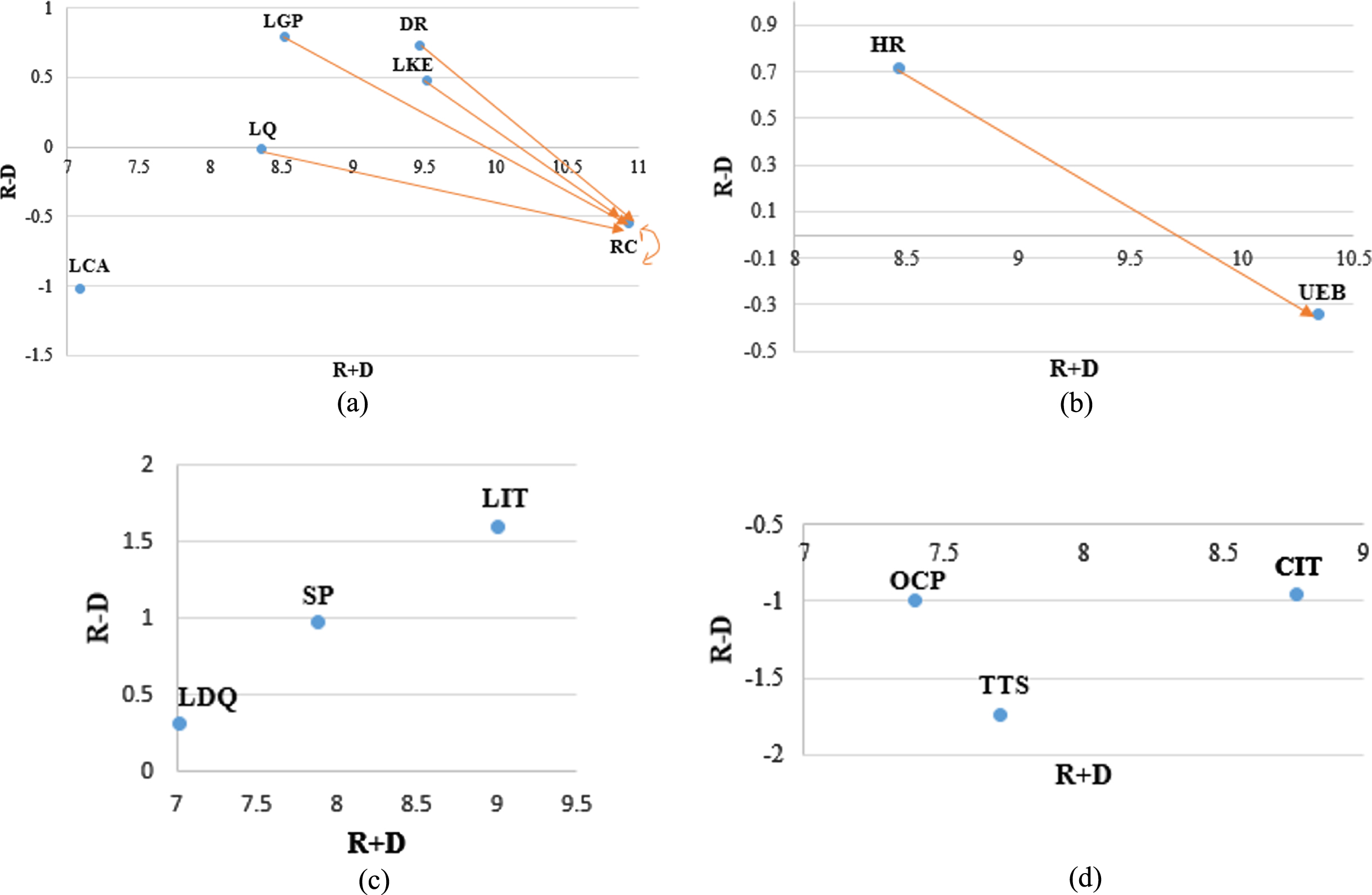
IRM of key barriers within dimensions.
According to Fig. 3(a), RC (Resistance to change) is a major effect (resulting) factor by receiving four arrows. That is, LQ, LGP, LKE, and DR substantially influence RC. In Fig. 3(b), only the relationship between HR and UEB is notable, and HR dispatches influence to UEB. According to Fig. 3(c), SP, LIT, and LDQ, which belong to the technological dimension, do not influence each other. As shown in Fig. 3(d), there are no relationships and influences between CIT, TTS, and OCP barriers in terms of organizational dimension.
In this study, the ANP technique is used to determine the weight of barriers. Firstly, the total relation matrix is calculated for four main dimensions consist of social, economic, technological, and organizational, using Steps 1–7 of the Grey-DEMATEL technique. Then, the threshold value is set as 0.3243, and the IRM of dimensions is drawn using Step 8. The total relation matrix, (R + D) and (R - D) values are shown in Table 6. IRM of dimensions is obtained, as shown in Fig. 4.
Total relation matrix of dimensions
Total relation matrix of dimensions

IRM of four dimensions.
As shown in Table 6 and Fig. 4, the organizational dimension has the lowest value of (R - D). Thus, this dimension is the most important effect (resulting) dimension by receiving the impact of Economic, Social, and Technological dimensions. The social dimension promotes sustainable benefits to cross a hurdle for implementing Industry 4.0 in SSC as it has the highest (R - D) value. Besides, it is influenced by the Organizational dimension. The economic dimension is a fundamental cause, producing significant effects on customer demands with (R - D) value greater than zero.
After calculating the total relation matrix, the unweighted and weighted super matrices are obtained using Steps 9 & 10 in Section 3. Tables 7 and 8 show the unweighted super matrix and weighted super matrix, respectively. Applying Step 11, the limit super matrix is calculated, finally. According to the calculations conducted and the limit super matrix, the final priorities of barriers are obtained based on the weight, as illustrated in Table 9. The weight of a barrier is the corresponding element of each row in the limit matrix [53].
The unweighted super matrix of key barriers
The weighted super matrix of key barriers
Relative weights of key barriers to Industry 4.0 in SSC
Table 9 shows that UEB has the priority with the highest weight of 0.1338, while LGP is the least important barrier with the lowest weight of 0.0416. The top seven important criteria are UEB, CIT, TTS, OCP, HR, RC, and LIT, respectively, which affect Industry 4.0 for SSC with a more significant influential weight.
Based on the Grey-DEMATEL results, LIT, DR, and LKE are cause barriers and have a high influence which contributes significantly to the adaptation process of Industry 4.0 in SSC. Besides, RC and UEB are also essential barriers to this process because of their prominence ranks and the relatively low (R - D) values. On the other hand, it can be seen that UEB, CIT, TTS, OCP, HR, and RC have critical priority for the adaptation of Industry 4.0 in SSC with larger weights in the Grey-DANP results. According to the separate analysis of correlation and weight of the barriers, there are some differences between the importance degrees of barriers. This situation causes inaccuracy in determining the most crucial barriers to sustainability concerning Industry 4.0 in the supply chain. Thus, the overall contributions of the crucial barriers should be determined by considering both Grey-DEMATEL, IRM results, and relative weight simultaneously.
As can be seen in IRM results, LIT (Lack of infrastructure and tools for Industry 4.0 in SSC), which belongs to the top seven barriers according to the prioritization of relative weights, is a cause barrier and have a significant influence. For this reason, LIT is inevitably a critical key barrier to achieving sustainable goals in adapting to Industry 4.0 in the supply chain. On the other part, RC (Resistance to change), UEB (Uncertainty about economic benefits), and CIT (Challenges integrating sustainable practices and Industry 4.0 technology through SSC) belong to the top seven barriers concerning the prioritization of relative weights, are effect barriers and have high influence. CIT (Challenges integrating sustainable practices and Industry 4.0 technology through SSC) has top-ranking weight, but its (R - D) score is far less than zero. It reveals that this barrier can be easily affected by others. Therefore, challenges integrating sustainable practices and Industry 4.0 technology through SSC can be considered due to the cause factors and is not evaluated as a crucial barrier. As for UEB (Uncertainty about economic benefits) and RC (Resistance to change), with the (R - D) slightly smaller than 0, the first two ranking of impact strength and comparatively high weight are just slightly affected by causal factors, but their contribution to the adaptation process to Industry 4.0 in SSC is significant and cannot be ignored. Therefore, uncertainty about economic benefits and resistance to change are crucial barriers to this process. In addition to these, TTS (Lack of trust and tendency in stakeholders about Industry 4.0 technologies) and OCP (Organizational culture and process challenges), which belong to the top seven barriers according to the prioritization of relative weights, have the relatively top-ranking weights according to the prioritization, but these barriers show weak correlation with others, having limited contributions to system target.
From the comprehensive analysis above, three key barriers affecting the adaptation process to Industry 4.0 in SSC are acquired by considering the intensity of interactions and influential weights. These barriers are determined as UEB (Uncertainty about economic benefits), RC (Resistance to change), and LIT (Lack of infrastructure and tools for Industry 4.0 in SSC). UEB (Uncertainty about economic benefits) causes the implementation of Industry 4.0 technologies under the uncertainty infrastructure. It brings an unclear assessment of low return on productivity and may cause to loss of money. Hence, supply chain managers should devote a large part of their resources to dealing with this uncertainty during the Industry 4.0 adaptation process. In addition to these, HR (Huge resource) indicates that new technologies should be developed, and current tools and equipment should be tested with the integration of Industry 4.0. All these modifications create a need for high energy and capital investments.
For this reason, HR is a barrier that belongs to the economic dimension like UEB. According to the IRM results, UEB is influenced by the huge resource under this dimension. RC (Resistance to change) is another one of the key barriers to Industry 4.0 in SSC. For years, firms that perform operations in conventional ways have come up against the tendency to resist the changes and the fear of failure among partners and employees. Therefore, this tendency in these companies, which transition to a new system, such as adapting to Industry 4.0 technologies in their supply chain networks, becomes one of the most significant barriers to success in the transition process. Managers should direct their focus to this issue and engage in encouraging activities. LIT (Lack of trust and tendency in stakeholders about Industry 4.0 technologies) is the third crucial barrier in transitioning to Industry 4.0 technologies in SSC. The stakeholders may consider exposure less to the benefits of Industry 4.0. This situation can be caused by poor collaboration, communication, and coordination among partners. In this respect, managers should provide confidence to stakeholders and cooperate with them in their adaptation of new practices related to Industry 4.0.
Implications to theory and practice
In this study, a framework for key barriers to Industry 4.0 for sustainable supply chain management is created with a literature review and experts. This framework fills a gap in the literature. Then, the causal relationship and intensity of interaction are formed by constructing grey-relation matrices according to experts’ evaluations and following the steps of the method. Combined with the relative weight, the contributions of each barrier to the adaptation process to Industry 4.0 in SSC are determined, and the key barriers are identified.
The uncertainty brought by Industry 4.0 causes various barriers in the implementation process. From this point of view, no study has been found in the literature that directly identifies the adoption barriers to Industry 4.0 in the SSCM. All key barriers encountered in implementing Industry 4.0 technologies in SCM are defined comprehensively, and the relationships between them are examined in detail in this study. The proposed Grey DEMATEL-ANP model serves as a more realistic and effective decision-making process to identify key barriers to Industry 4.0 in SSC. The crucial barriers of Industry 4.0 are determined by analyzing in detail the cause-effect interrelationships, influential weights, and dimensions. Thus, this study allows supply chain managers to make decisions by eliminating inaccuracy results. In this respect, this study provides a contemporary and robust perspective for scientific research in the future.
Using this study, some practical effects of the sustainable supply chain are as follows. The Decision-making processes of managers are facilitated by technology adaptation. The probability of making mistakes is reduced, thus facilitating technology adaptation to SSC processes. With the easy technology adaptation, SSC processes are facilitated. It can be a roadmap that gives managers better knowledge and better control of every aspect of their operations. It enables businesses to develop and improve sustainability processes, increase productivity, and drive growth. Precautionary measures can be taken for significant adaptation barriers.
Managerial insights
Industry 4.0 is a vision for the sustainable future of the supply chains. This research work offers several implications for SSC practitioners and stakeholders. The study’s findings identify critical adoption barriers to Industry 4.0 for SSC, their causalities, dependencies, and hierarchical levels by giving meaningful insights. The present research work was undertaken to help the SSC managers plan a timely strategy to eliminate the identified adoption barriers. This study reveals these important managerial insights: It is crucial to consider all aspects of the decision-making process to identify key adoption barriers to Industry 4.0 in SSC. For this reason, by integrating the Grey-DEMATEL with ANP, decision makers and managers can take important strategic decisions that will provide the priority barriers and prevent focusing on redundant barriers. Managers should include uncertainty about economic benefits (UEB), resistance to change (RC), and lack of infrastructure and tools for Industry 4.0 in SSC (LIT) in planning the sustainable supply chain strategy. In this way, they will be able to be prepared for uncertain circumstances regarding monetary resources, the willingness of employees, and infrastructure standardization. Supply chain companies will have a practical and useful decision-making process in the transition to Industry 4.0 applications, considering their own managerial, social, technological, and economic priorities with this study. The findings of this study will provide a saving time, labor income, monetary expansion, and heightened awareness for managers. Moreover, they will gain competitive advantages in implementing Industry 4.0 technologies. The highly prioritized adoption barriers help improve tactical or operational performance, while the barriers classified as cause-and-effect groups help enhance the strategic performance. Besides, strategic results can be achieved by continually improving causal group factors.
Conclusions
Due to the increased awareness of sustainability, SSCM is captivating attention day by day. To achieve a robust, sustainable supply chain, it is necessary to adopt the new digital technologies in the Industry 4.0 process and apply them to supply chain management. In this context, SSC managers need to define the adoption barriers to Industry 4.0 clearly and plan their strategic steps by prioritizing these barriers according to their importance. At this point, this study highlights the crucial barriers to the adaptation of Industry 4.0 by considering both intensities of interactions and influential weights simultaneously. In this study, an integrated Grey DEMATEL-ANP model is established to determine the priorities of key barriers.
The results of the comprehensive analysis show that UEB (Uncertainty about economic benefits), RC (Resistance to change), and LIT (Lack of infrastructure and tools for Industry 4.0 in SSC) are crucial barriers that deserve more priority when implementing Industry 4.0 technologies in SSC. Thus, to achieve sustainability goals for Industry 4.0 applications in the supply chain, managers should use their resources for the handling of UEB (Uncertainty about economic benefits), RC (Resistance to change), and LIT (Lack of infrastructure and tools for Industry 4.0 in SSC) barriers especially. According to the analysis, uncertainty about economic benefits has the highest relative weight. In this respect, the transition to Industry 4.0 will result in no loss of money and high productivity gains by removing this barrier. Firm managers operating in the supply chain should develop judicious strategies to remove the potential risks and the resistance of employees and stakeholders to change and practice these strategies before the transition process to Industry 4.0 technologies. In addition to these, managers should become good communicators and provide confidence and substantial coordination to stakeholders to achieve sustainable goals in the adaptation process of Industry 4.0 in SSC.
The comprehensive analysis of this study provides evidence that Industry 4.0 adoption in SSC improves firm performance. Therefore, managers must think about building a vision and strategy for its implementation. From this point of view, the rapid development and employment in the adoption process of Industry 4.0 in SSC can potentially transform the financial services industry in the real economy. When this potential is realized, Industry 4.0 technologies will have substantial implications for financial conduct. Moreover, this adoption process in SSC will help regulators better anticipate the impact of regulation changes. Governments can actively take measures to enhance this process by creating and facilitating the infrastructure necessary to boost the supply chain sector’s performance and gather speed for industry 4.0 adoption in the country. Policy intervention can shape the discourse on Industry 4.0, institutionalize its adoption, and further help alleviates the negative impact of extrinsic barriers [23].
This study has a few limitations that can be considered opportunities for future work. The work suggests fourteen adoption barriers; the analysis of drivers of Industry 4.0 technologies from the literature may be included in future studies. Further, some quantitative decision-making methods may be applied to benchmark the results, and the different enabling factors could be analyzed to help overcome these barriers. The key barriers were ranked according to experts’ views. Experts were not randomly selected. The opinion of the experts may be biased. In future work, sensitivity analysis may be performed. In future research, other fuzzy sets (type 1 and type 2) can be used to address the vagueness and uncertainty.
Further studies in this direction are recommended. Hybrid methods such as AHP-VIKOR-TOPSIS can be considered. In addition, the integration with other grey-based multi-criteria methods can be a promising area for interested researchers.