In this paper, a class of Clifford-valued neutral fuzzy neural-type networks with proportional delay and D operator and whose self feedback coefficients are also Clifford numbers are considered. By using the Banach fixed point theorem and some differential inequality techniques, we directly study the existence and global asymptotic stability of pseudo almost periodic solutions by not decomposing the considered Clifford-valued systems into real-valued systems. Finally, two examples are given to illustrate our main results. Our results of this paper are new.
Clifford algebra was proposed by British mathematician William K. Clifford in 1878 [1]. It is a generalization of complex numbers and quaternions. At present, Clifford algebra has been widely used in many fields of natural science and engineering technology. For example, it has been successfully applied to neural computing, image and signal processing, computer and robot vision, control problems and other fields [2]. In particular, Clifford-valued neural network has been proved to be superior to real-valued neural network in many aspects [3]. Therefore, the study of Clifford-valued neural networks has attracted the interest of many researchers [4–16]. However, because the multiplication of Clifford algebra does not satisfy the commutative law, the known results of Clifford-valued neural network dynamics obtained by direct method are still few [17–22]. Therefore, it is of great theoretical and practical significance to further study the dynamics of Clifford valued neural networks by direct methods.
As we all know, the application field of neural network is becoming wider and wider [23–26]. At the same time, the time delay is ubiquitous. Therefore, it is more reasonable to introduce time delay into the mathematical model describing the real process. In recent years, mathematical models with proportional time delay have important applications in many application fields, such as physics, biological systems, neural network systems and control science. Therefore, the dynamics of neural networks with proportional delay has been widely studied [27–32]. On the other hand, periodic oscillation and almost periodic oscillation are one of the important dynamics of neural networks. In the past decades, many researchers have studied the existence and stability of periodic and almost periodic solutions of various types of neural networks, including neutral-type neural networks with D operator and fuzzy neural networks [33–43].
Inspired by the above analysis, the main purpose of this paper is to study the existence and attraction of pseudo almost periodic solutions for a class of Clifford-valued fuzzy neural networks with proportional delay and D operator whose self feedback coefficients are also Clifford numbers. As far as we know, this is the first paper to study the existence and attraction of pseudo almost periodic solutions for Clifford-valued neural networks with proportional delay and D operator whose self feedback coefficients are also Clifford numbers.
The rest of the paper is organized as follows. In the second section, we review some definitions, introduce some lemmas and give a description of the model. In Section 3, we study the existence and uniqueness of pseudo almost periodic solutions for the network under consideration. In Section 4, we study the global asymptotic stability of the pseudo almost periodic solution. In Section 5, we give two numerical examples to illustrate the feasibility of our results. Finally, we draw a brief conclusion in Section 6.
Model description and preliminaries
The real Clifford algebra over is defined as
where eA = eh1eh2 ⋯ ehv = eh1h2⋯hv with A = h1h2 ⋯ hv, 1 < h1 < h2 < ⋯ < hv < m. Moreover, e∅ = e0 = 1 and eh, h = 1, 2, ⋯ m are said to be Clifford generators and satisfy , where s < m, and epeq + eqep = 0, p ≠ q, p, q = 1, 2, …, m. Let Ω = {∅ , 1, 2, ⋯ A, ⋯ , 12 ⋯ m}, then it is easy to see that , where ∑A is short for ∑A∈Ω and .
For , we define and for , we define , then and are Banach spaces. For x = ∑AxAeA, we define xc = ∑A≠∅xAeA and x∅ = x - xc. The derivative of x (t) = ∑AxA (t) eA is given by . For more knowledge about Clifford analysis, we refer to [44].
According to [8], for , we define
and For x = ∑A∈ΩxAeA and , we define
In this paper, we are concerned with the following Clifford-valued neutral-type fuzzy neural network with proportional delay and D operator:
where , corresponds to the state of the ith unit at time t, and is a Clifford algebra; represents the rate with which the ith unit will reset its potential to the resting state when disconnected from the network and external inputs at time t, correspond to the connection weights of the neural network; is the fuzzy feedback max template; is the fuzzy feedback min template; is the fuzzy feed-forward max template, is the fuzzy feed-forward min template; represents the input of the jth neuron; are the activation functions; ηi, qij ∈ (0, 1) are proportional delay factors; is the external input at time t.
For convenience, we will adopt the following notations:
The initial values of system (2.1) are given by
where
Let denote the set of continuous and bounded function from to . Then is a Banach space with the norm
where .
Definition 2.1. [10] A function is said to be almost periodic, if for every ɛ > 0, it is possible to find a real number l = l (ɛ) such that, for any interval with length l (ɛ), there is a number τ = τ (ɛ) in this interval satisfying
for all . The collection of all such functions will be denoted by .
Let
Definition 2.2. [10] A function is said to be pseudo almost periodic if it can be expressed as
where and . The collection of all such functions will be denoted by .
Similar to the proof of Corollary 1 in [47], one can easily show that
Lemma 2.7.If . Then we have
The assumptions used in this paper are as follows:
For i, j = 1, 2, ⋯ n, with , .
For and there exist positive constants such that, for any ,
where fj (0) = gj (0) = hj (0) = lj (0) =0.
For i = 1, 2, ⋯ n, there are positive functions and constants Ki > 0 satisfying
for all , t - s ≥ 0, and .
There are positive constants ξi > 0, i = 1, 2, ⋯ n satisfying
where is defined in (H3).
There are positive constants ξi > 0, i = 1, 2, ⋯ n satisfying
The existence of pseudo almost periodic solutions
In this section, we will use the contracting mapping principle to study the existence of pseudo almost periodic solutions.
Let . For φ ∈ X, we denote the norm of φ as , then X with this norm is a Banach space.
Let
and take a positive constant R ≥ ∥ φ0 ∥ 0. Set
then, for every φ ∈ X0, we have
Theorem 3.1.Assume that (H1)-(H4) hold, then system (2.1) has a unique pseudo almost periodic solution in X0.
Proof. By making the following transformation: , system (2.1) is transformed into
It is easy to see that if y = {yi, i = 1, ⋯ , n} is a solution of system (3.1), then x (t) = {ξiyi, i = 1, ⋯ , n} is a solution of system (2.1).
For i = 1, 2, ⋯ , n, we denote
It is easy to check that if y = {yi, i = 1, ⋯ , n} is a solution of the following integral equation
then x = {ξiyi, i = 1, ⋯ , n} is a solution of system (2.1).
Define an operator by
where for φ ∈ X0, i = 1, 2, ⋯ , n and
First of all, it follows from Lemmas 2-2 that Tφ ∈ X for every φ ∈ X. Now, we will prove that the mapping T is a self-mapping from X0 to X0. In fact, for each φ ∈ X0, we have
Hence, T is a self-mapping.
Then, we will prove that T is a contracting mapping. Indeed, for any φ, ψ ∈ X0, we have that
noticing that u < 1, T is a contracting mapping. Therefore, T has a unique fixed point in X0, that is, system (2.1) has a unique pseudo almost periodic solution in X0. The proof is complete.
Global asymptotic stability
In this section, we study the global asymptotic stability of pseudo almost periodic solutions of system (2.1).
Theorem 4.1.Suppose that (H1)-(H5) hold. Let x (t) be the pseudo almost periodic solution of system (2.1) with initial value φ and x* (t) be an arbitrary solution of system (2.1) with initial value ψ. Then there exist positive constants σ and M such that
where .
Proof. Using the following transformation
then system (2.1) can be written as
Without loss of generality, let
In view of (H5), we have that there exists a constant such that and
By (4.2), we have
Multiply both sides of formula (4.4) by and integrating over the interval [t0, t], we have
Take a constant M such that
then, for any ɛ > 0, it is clear that
We claim that for any ɛ > 0,
If (4.8) does not hold, then there must be some θ > t0 such that
By (4.1), we have
for all v ∈ [ρt0, t0] , i = 1, 2, …, n. From (4.10), we have
From (4.3), (4.5), (4.6), (4.9) and (4.11) it follows that for i = 1, 2, …, n,
Consequently, we obtain
This contradicts (4.9), hence, (4.8) holds. Letting ɛ → 0+, we get
Therefore, the pseudo almost periodic solution of system (2.1) is globally asymptotically stable. The proof is completed.
Two examples
In this section, we present two examples to show the feasibility of our main results of this paper.
Example 5.1. In system (2.1), let n = m = 2, s = 1, , , and for i, j = 1, 2, take
Let Ki = 0.6, ξi = ξj = 1, i, j = 1, 2, by calculation, for j=1, 2, we have . So (H1) and (H2) are satisfied. Besides, we can get u1 ≈ 0.601794, u2 ≈ 0.6319332, ν1 ≈ -0.8971, ν1 ≈ -0.7367996, then
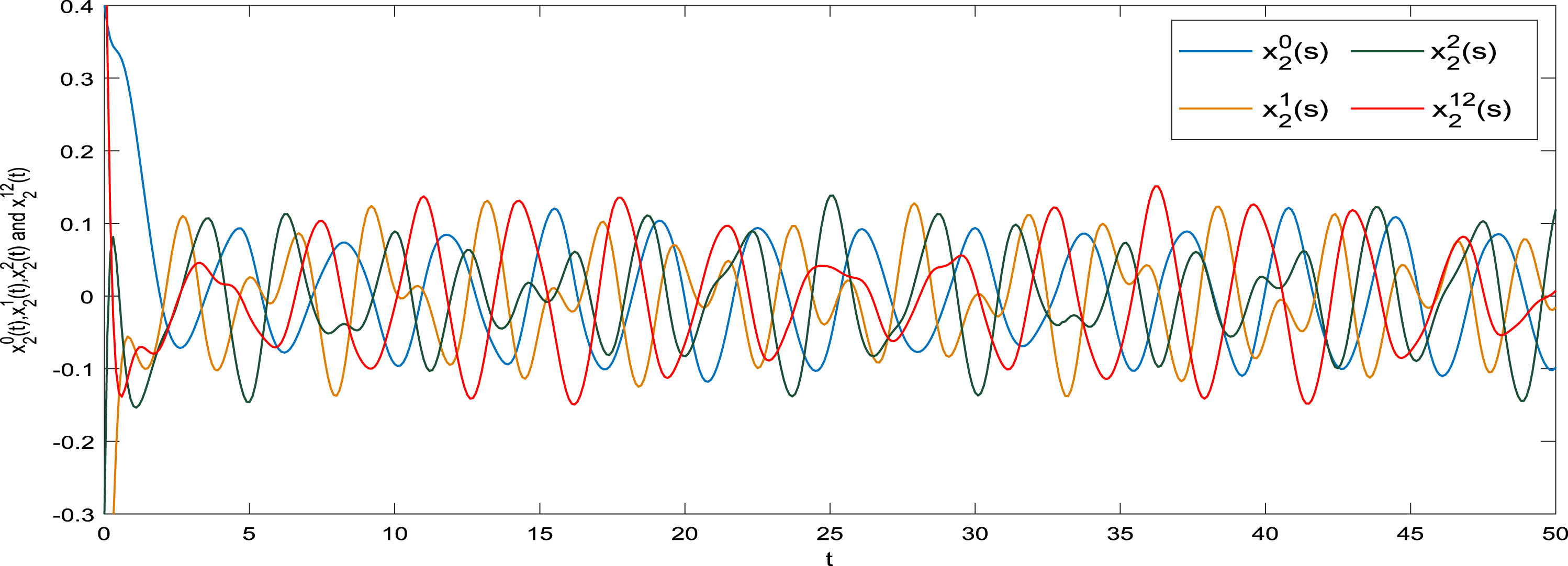
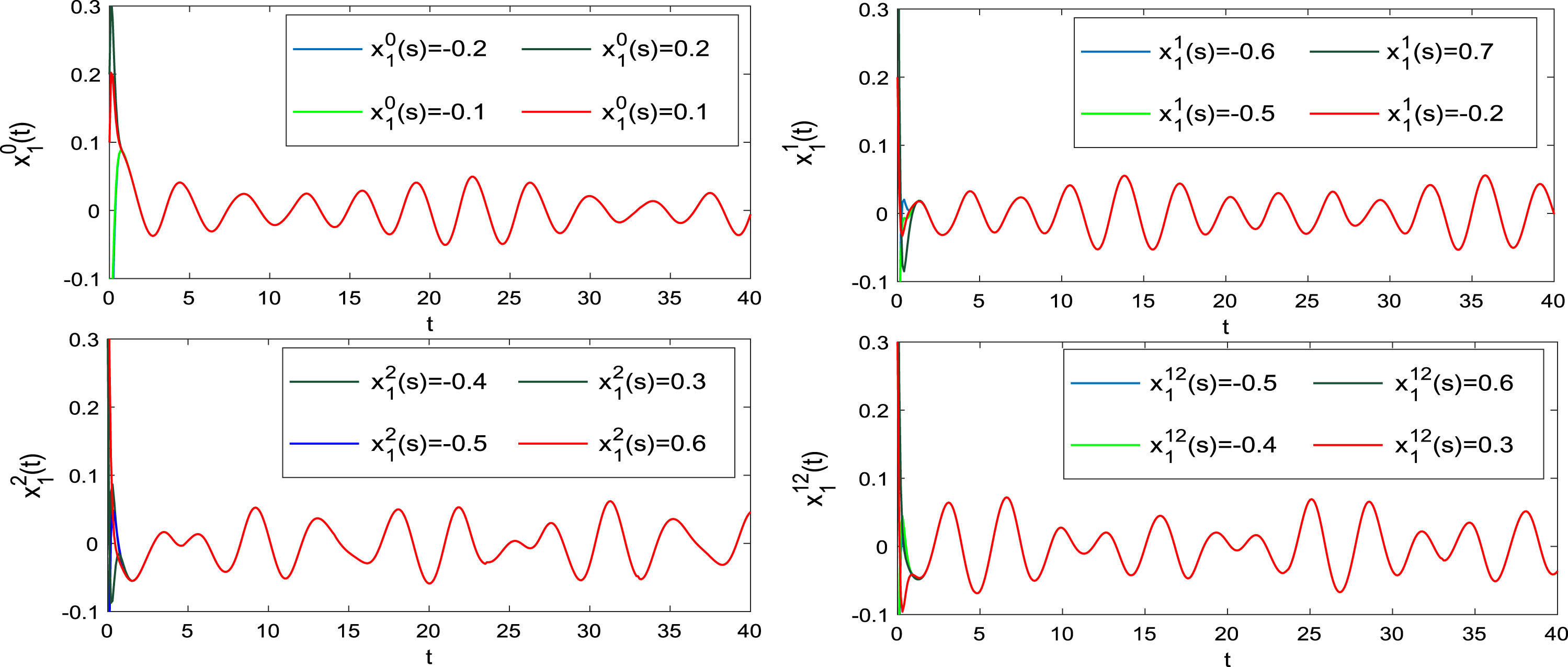
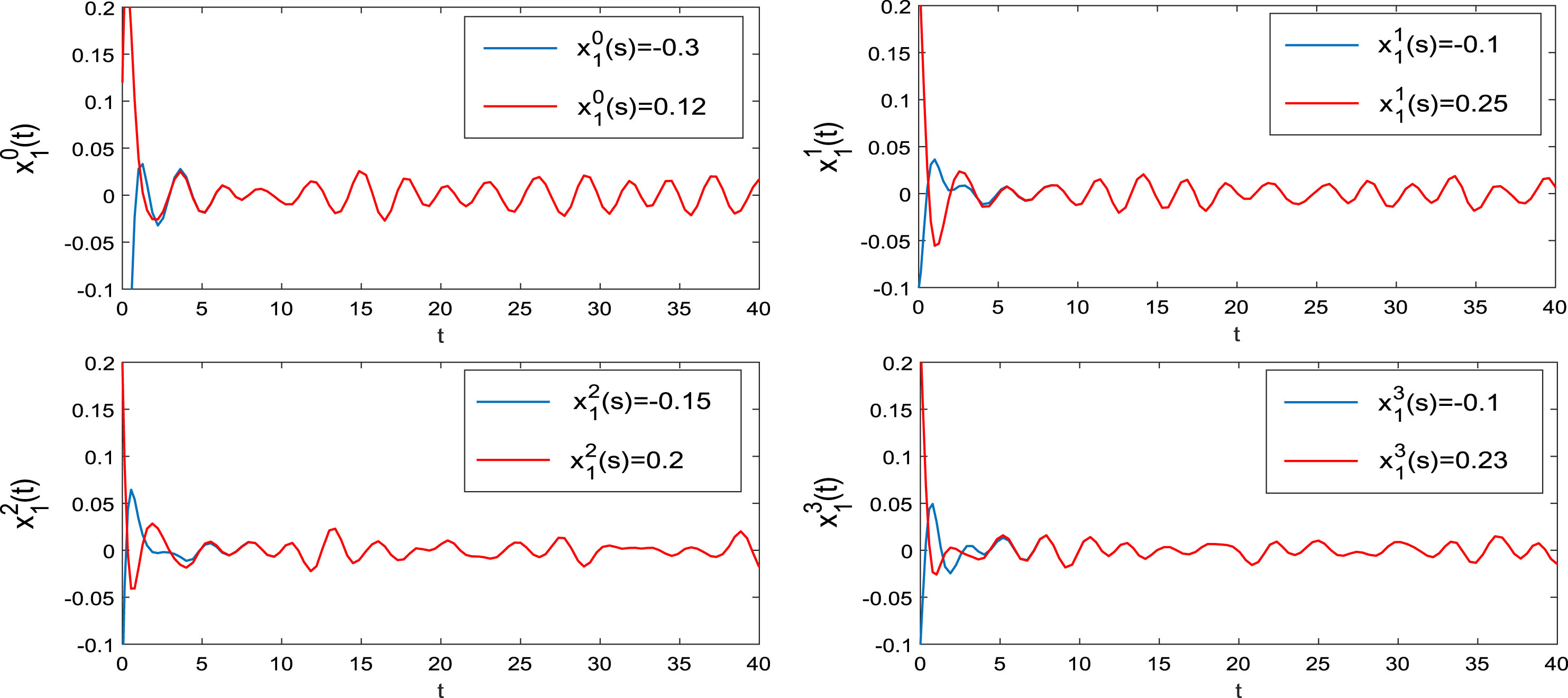
Therefore, all of the conditions of Theorem 4.1 are satisfied. Hence, system (2.1) has a unique pseudo almost periodic solutions that is globally asymptotically stable (see Figs.1-4).
States , , and of (2.1) with different initial values.
States , , and of (2.1) with different initial values.
Global asymptotic stability of states , , and of (2.1) with different initial values.
Global asymptotic stability of states , , and of (2.1) with different initial values.
Example 5.2. In system (2.1), let n = 2, m = 3, s = 1, , , and for i, j = 1, 2, take
Let Ki = 1, , ξj = 1, i, j = 1, 2, by calculate, for j=1, 2, we have , , , , , , , , , , , , , , , , , , , , , , , , , , , . So (H1) and (H2) are satisfied. Besides, we can get u1 ≈ 0.4403286, u2 ≈ 0.46526539, ν1 ≈ -2.2515 and ν1 ≈ -2.262, then
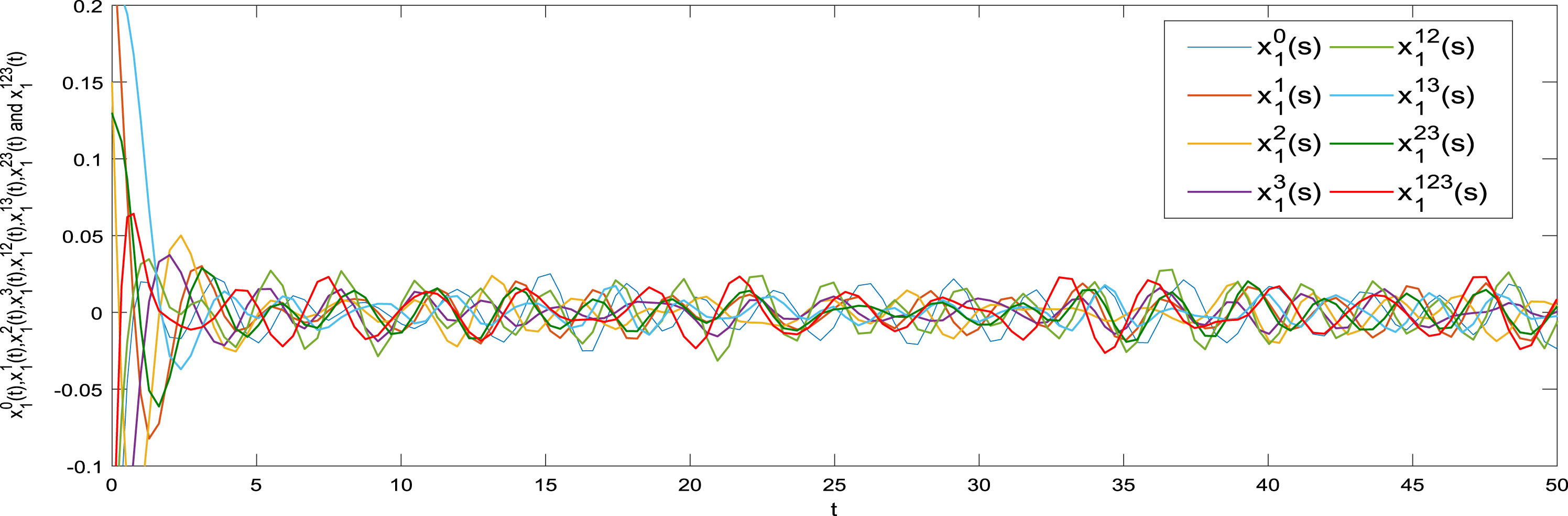
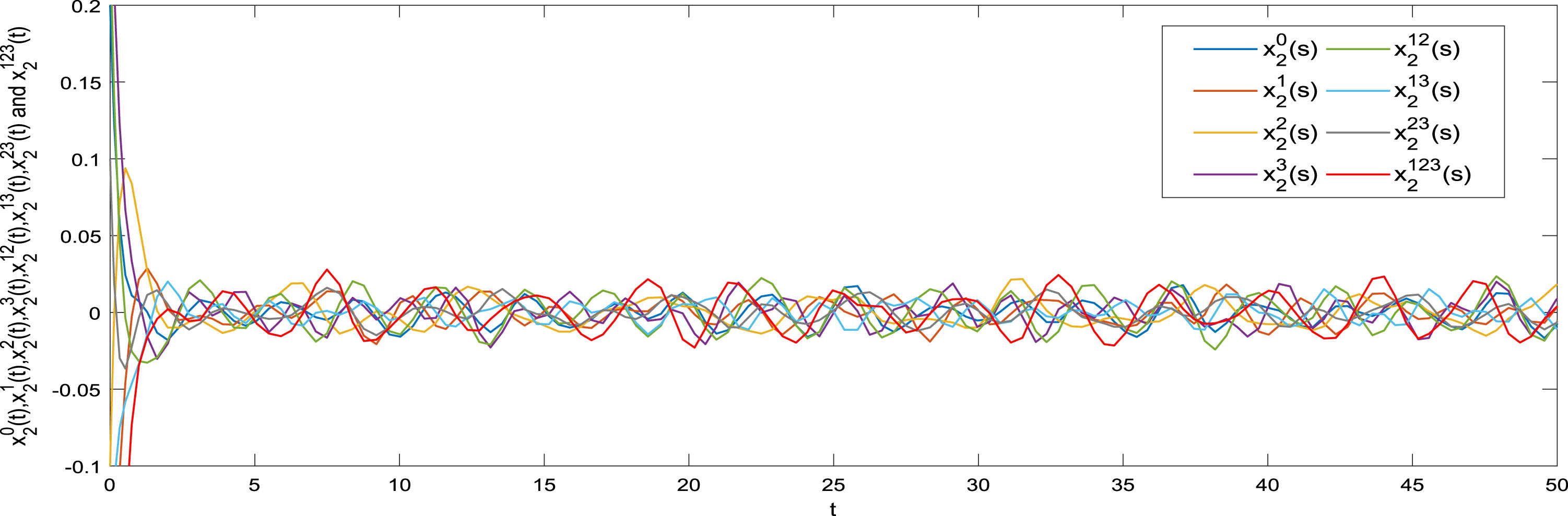
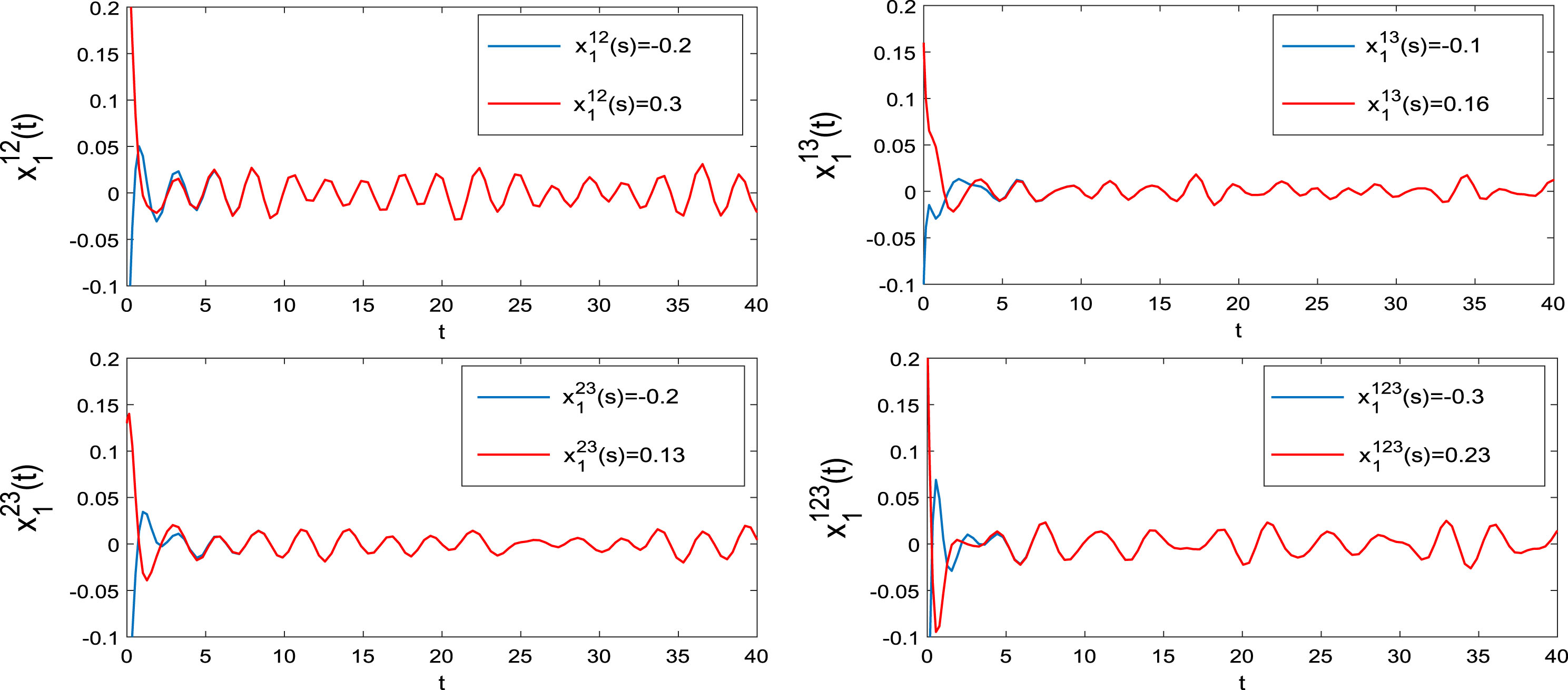
Therefore, all of the conditions of Theorem 4.1 are satisfied. Hence, system (2.1) has a unique pseudo almost periodic solution that is globally asymptotic stable (see Figs.5-10).
States , , , , , , , of (2.1) with different initial values.
States , , , , , , , of (2.1) with different initial values.
Global asymptotic stability of states , , and of (2.1) with different initial values.
Global asymptotic stability of states , , and of (2.1) with different initial values.
Global asymptotic stability of states , , and of (2.1) with different initial values.
Global asymptotic stability of states , , and of (2.1) with different initial values.
Remark 5.1. The results of Examples 5.1 and 5.2 cannot be deduced from [6–11, 28] and any other known results.
Conclusions
In this paper, we obtain the existence and global asymptotic stability of pseudo almost periodic solutions for a class of Clifford-valued neutral-type fuzzy neural networks with proportional delay and D operator and whose self feedback coefficients are also Clifford numbers by direct method. Our results are new. Our method can be used to study the existence of almost automorphic solutions for Clifford-valued neural networks with proportional delay and D operator.
HitzerE., NittaT. and KuroeY., Applications of Clifford’s geometric algebra, Adv Appl Clifford Algebras23(2) (2013), 377–404.
3.
BuchholzS., A theory of neural computation with Clifford algebras, Ph.D. thesis, University of Kiel, (2005).
4.
ZhuJ. and SunJ., Global exponential stability of Clifford-valued recurrent neural networks, Neurocomputing173(3) (2015), 685–689.
5.
LiuY., XuP. and LuJ., Global stability of Clifford-valued recurrent neural networks with time delays, Nonlinear Dyn84 (2016), 767–777.
6.
LiY. and HuoN., (μ,ν)-pseudo almost periodic solutions of Clifford-valued high-order HNNs with multiple discrete delays, Neurocomputing414 (2020), 1–9.
7.
ShenS. and LiY., Weighted pseudo almost periodic solutions for Clifford-valued neutraltype neural networks with leakage delays on time scales, Adv Differ Equ2020 (2020), 286.
8.
ShenS. and LiY., Sp-almost periodic solutions of Clifford-valued fuzzy cellular neural networks with time-varying delays, Neural Process Lett51 (2020), 1749–1769.
9.
LiB. and LiY., Existence and global exponential stability of almost automorphic solution for Clifford-valued high-order Hopfield neural networks with leakage delays, Complexity2019 (2019), 6751806.
10.
LiB. and LiY., Existence and global exponential stability of pseudo almost periodic solution for Clifford-valued neutral high-order Hopfield neural networks with leakage delays, IEEE Access7 (2019), 150213–150225.
11.
LiY., HuoN. and LiB., On μ-pseudo almost periodic solutions for Clifford-valued neutral type neural networks with delays in the leakage term, IEEE Trans Neural Netw Learn Syst32(3) (2021), 1365–1374.
12.
RajchakitG., SriramanR., VigneshP. and LimC.P., Impulsive effects on Cliffordvalued neural networks with time-varying delays: An asymptotic stability analysis, Appl Math Comput407 (2021), 126309.
13.
LiY. and LiB., Pseudo compact almost automorphy of neutral type Clifford-valued neural networks with mixed delays, Discrete Contin Dyn Syst-B27(9) (2022), 4703–4724.
14.
AouitiC. and GharbiaI.B., Dynamics behavior for second-order neutral Clifford differential equations: inertial neural networks with mixed delays, Comput Appl Math39 (2020), 120.
15.
AouitiC., DridiF., HuiQ. and MoulayE., (μ,ν)-pseudo almost automorphic solutions of neutral type Clifford-valued high-order Hopfield neural networks with D operator, Neural Process Lett53(1) (2021), 799–828.
16.
QiW. and LiY., Almost anti-periodic oscillation excited by external inputs and synchronization of Clifford-valued recurrent neural networks, Math10(15) (2022), 2764.
17.
LiY. and WangX., Almost periodic solutions in distribution of Clifford-valued stochastic recurrent neural networks with time-varying delays, Chaos Solitons Fractals153 (2021), 111536.
18.
LiY., WangX. and HuoN., Besicovitch almost automorphic stochastic processes in distribution and an application to Clifford-valued stochastic neural networks, Commun Nonlinear Sci Numer Simulat111 (2022), 106488.
19.
LiY., WangX. and LiB., Stepanov-like almost periodic dynamics of Clifford-valued stochastic fuzzy neural networks with time-varying delays, Neural Process Lett54 (2022), 4521–4561.
20.
LiY., WangX. and HuoN., Weyl almost automorphic solutions in distribution sense of Clifford-valued stochastic neural networks with time-varying delays, Proceedings of the Royal Society A478(2257) (2022), 20210719.
21.
LiY. and WangX., Besicovitch almost periodic stochastic processes and almost periodic solutions of Clifford-valued stochastic neural networks, Discrete Contin Dyn Syst-B28(3) (2023), 2154–2183.
22.
LiY. and HuangX., Besicovitch almost periodic solutions to stochastic dynamic equations with delays, Qual Theory Dyn Syst21 (2022), 74.
23.
SaltariF., PizzoliM., GambioliF., JetzschmannC. and MastroddiF., Sloshing reducedorder model based on neural networks for aeroelastic analyses, Aerosp Sci Technol127 (2022), 107708.
24.
SharmaK., CerezoM., CincioL. and ColesP.J., Trainability of dissipative perceptronbased quantum neural networks, Phys Rev Lett128(18) (2022), 180505.
25.
SridharC., PareekP.K., KalidossR., JamalS.S., ShuklaP.K. and NuagahS.J., Optimal medical image size reduction model creation using recurrent neural network and GenPSOWVQ, J Healthc Eng2022 (2022), 2354866.
26.
AlnuaimA.A., ZakariahM., ShashidharC., HatamlehW.A., TaraziH., ShuklaP.K. and RatnaR., Speaker gender recognition based on deep neural networks and ResNet50, Wirel Commun Mob Com2022 (2022), 4444388.
27.
LuoD., JiangQ. and WangQ., Anti-periodic solutions on Clifford-valued high-order Hopfield neural networks with multi-proportional delays, Neurocomputing472 (2022), 1–11.
28.
LvW. and LiB., Existence and global attractivity of pseudo almost periodic solutions for Clifford-valued fuzzy neural networks with proportional delays, Math9(24) (2021), 3306.
29.
HuangC., SuR., CaoJ. and XiaoS., Asymptotically stable high-order neutral cellular neural networks with proportional delays and D operators, Math Comput Simulat171 (2020), 127–135.
30.
AouitiC., AssaliE.A., CherifF. and ZeglaouiA., Fixed-time synchronization of competitive neural networks with proportional delays and impulsive effect, Neural Comput Appl32(17) (2020), 13245–13254.
31.
AouitiC., SakthivelR. and TouatiF., Global dissipativity of fuzzy cellular neural networks with inertial term and proportional delays, Int J Syst Sci51(8) (2020), 1392–1405.
32.
JianJ. and DuanL., Finite-time synchronization for fuzzy neutral-type inertial neural networks with time-varying coefficients and proportional delays, Fuzzy Sets Syst381 (2020), 51–67.
33.
AouitiC., GharbiaI.B., CaoJ. and LiX., Asymptotic behavior of Clifford-valued dynamic systems with D-operator on time scales, Adv Differ Equ2021 (2021), 145.
34.
GaoJ. and DaiL., Anti-periodic synchronization of Clifford-valued neutral-type recurrent neural networks with D operator, IEEE Access10 (2022), 9519–9528.
35.
RajchakitG., SriramanR., LimC.P. and UnyongB., Existence, uniqueness and global stability of Clifford-valued neutral-type neural networks with time delays, Math Comput Simul201 (2022), 508–527.
36.
StamovG.T. and StamovaI.M., Almost periodic solutions for impulsive neural networks with delay, Appl Math Modelling31(7) (2007), 1263–1270.
37.
OuC., Almost periodic solutions for shunting inhibitory cellular neural networks, Non-linear Anal Real World Appl10(5) (2009), 2652–2658.
38.
ZhangH. and ShaoJ., Almost periodic solutions for cellular neural networks with timevarying delays in leakage terms, Appl Math Comput219(24) (2013), 11471–11482.
39.
JiangQ. and WangQ.R., Almost periodic solutions for quaternion-valued neural networks with mixed delays on time scales, Neurocomputing439 (2021), 363–373.
40.
LiY., XiangJ. and LiB., Almost periodic solutions of quaternion-valued neutral type high-order Hopfield neural networks with state-dependent delays and leakage delays, Appl Intell50(7) (2020), 2067–2078.
41.
BohnerM., StamovG.T. and StamovaI.M., Almost periodic solutions of Cohen-Grossberg neural networks with time-varying delay and variable impulsive perturbations, Commun Nonlinear Sci Numer Simulat80 (2020), 104952.
42.
HuangZ., Almost periodic solutions for fuzzy cellular neural networks with multiproportional delays, Int J Machine Learn Cyber8(4) (2017), 1323–1331.
43.
TangY., Exponential stability of pseudo almost periodic solutions for fuzzy cellular neural networks with time-varying delays, Neural Process Lett49(2) (2019), 851–861.
44.
HuangS., QiaoY.Y. and WenG.C., Real and complex Clifford analysis, Springer, New York, (2006).
45.
YuY., Exponential stability of pseudo almost periodic solution for cellular neural networks with multi-proportional delays, Neural Process Lett45(1) (2017), 141–151.
46.
LiangJ., QianH. and LiuB., Pseudo almost periodic solutions for fuzzy cellular neural networks with multi-proportional delays, Neural Process Lett48(2) (2018), 1201–1212.
47.
YangT., YangL., WuC. and ChuaL., The global stability of fuzzy cellular neural network, IEEE Trans Circ Syst I43(10) (1996), 880–883.