In this paper, the existence, uniqueness and global exponential stability of pseudo almost periodic solutions for a class of octonion-valued neutral type high-order Hopfield neural network models with D operator are established by using the Banach fixed point theorem and differential inequality techniques. Compared with most existing models, in this class of networks, all connection weights and activation functions are assumed to be octonion-valued functions except for time delays. And unlike most of the existing methods of studying octonion-valued neural networks, our method is a non-decomposition method, that is, the method of directly studying octonion-valued systems. The results and methods in this paper are new. In addition, an example and its numerical simulation are given to illustrate the feasibility of our results.
In recent years, the study of various algebra-valued neural networks, such as complex-valued [1–4], quaternion-valued [5–8], and Clifford-valued neural networks [9–13], has aroused increasing interest among researchers. This is because these neural networks are superior to real-valued neural networks in dealing with high dimensional data and geometric transformation [14–19]. Octonions are a non-commutative and non-associative algebra, a generalization of complex numbers and quaternions, and are not contained by Clifford algebras [20]. Octonions have applications in fields such as geometry [21], physics [22], and signal processing [23]. Octonion-valued neural networks have potential applications in signal processing and high-dimensional and multi-layer data processing. Since Popa [24] first proposed octonion-valued neural networks, some scholars have devoted themselves to the study of the dynamics of octonion-valued neural networks [25–32]. And some potential applications of octonion-valued neural networks have been continuously discovered [33–35]. However, octonions are neither commutative nor associative. This makes it difficult to study the dynamics of octonion-valued neural networks. Currently, results from octonion-valued neural networks are rare. Therefore, it has important theoretical significance and potential application value to study various dynamic behaviors of octonion-valued neural networks.
On the one hand, it is well known that time delays are unavoidable in real systems. Therefore, the neural network systems described by functional differential equations are more reasonable than those described by ordinary differential equations. Hopfield neural networks were originally expressed by ordinary differential equations and are an important class of neural network models. Due to the fact that high-order Hopfield neural networks are superior to low-order Hopfield neural networks in terms of storage capacity and fault tolerance, in recent years, high-order Hopfield neural networks described by functional differential equations have gradually become a research hotspot. Consequently, many scholars have conducted extensive research on high-order Hopfield neural networks governed by functional differential equations [36–42]. Moreover, in many practical applications of neural networks, it is more efficient to use a neutral type neural network with D operator than a neural network without D operator [43–46]. Therefore, the study of neutral neural network with D operator is of great significance in practice.
On the other hand, the existence and stability of almost periodic solutions are important dynamics of neural networks. But so far, there is no paper published on the existence of almost periodic solutions to octonion-valued neutral type high-order Hopfield neural networks with D operator.
Inspired by the above discussion, the main purpose of this paper is to study the existence and global exponential stability of pseudo almost periodic solutions of octonion-valued neutral type high-order Hopfield neural networks with D operator by direct method.
The main contributions of this paper are as follows:
1. This is the first paper to study the existence and global exponential stability of pseudo almost periodic solutions of octonion-valued neutral type higher-order Hopfield neural networks with D operator by direct methods.
2. The method in this paper can be used to study the existence and stability of almost periodic solutions and almost automorphic solutions of other types of octonion-valued neural networks.
The rest of this paper is organized as follows. In Section 2, we introduce some basic definitions and some known results used in this paper, and give a description of the model. In Section 3, we investigate the existence of pseudo-almost periodic solutions for octonion-valued neutral type high-order Hopfield neural networks with the D operator. In Section 4, we study the global exponential stability of pseudo almost periodic solutions. In Section 5, we give a numerical example to illustrate the feasibility of our results. In Section 6, we give a brief conclusion.
Model description and preliminaries
The algebra of octonions is defined as
where el, 0 ≤ l ≤ 7, represent the octonion units and meet the following multiplication table [22]:
By Table 1, we can obtain that eiej = - ejei ≠ ejei for all i ≠ j, 0 < i, j ≤ 7, that is, is not commutative. And (eiej) ek = - ei (ejek) ≠ ei (ejek) for i, j, k distinct, 0 < i, j, k ≤ 7, that is, is also not associative.
The octonion units’ multiplication table
×
e0
e1
e2
e3
e4
e5
e6
e7
e0
e0
e1
e2
e3
e4
e5
e6
e7
e1
e1
-e0
e3
-e2
e5
-e4
-e7
e6
e2
e2
-e3
-e0
e1
e6
e7
-e4
-e5
e3
e3
e2
-e1
-e0
e7
-e6
e5
-e4
e4
e4
-e5
-e6
-e7
-e0
e1
e2
e3
e5
e5
e4
-e7
e6
-e1
-e0
-e3
e2
e6
e6
e7
e4
-e5
-e2
e3
-e0
-e1
e7
e7
-e6
e5
e4
-e3
-e2
e1
-e0
The addition of octonions is denoted by , where , and the scalar multiplication is defined as , where . An octonion-valued function is described by , where ul (t) , i = 0, 1, 2, …, 7, are real-valued functions. The derivative of u (t) is given by . For , the norm of x can be defined as , and for , we define , then and are Banach spaces.
For readers interested in octonion algebra, see [20].
In this paper, we are concerned with the following octonion-valued neutral type high-order Hopfield neural networks with D operator:
where i = 1, 2, ⋯ , n, corresponds to the state of the ith unit at time t; is an octonion-algebra; represents the self feedback coefficient at time t; ai (t), hij (t), are the connection weights; is the second-order synaptic weight of the neural network; fj, gj, are the activation functions; is the external input to the ith unit; denote the transmission delays.
Throughout this paper, for any , we stipulate that abc = (ab) c, and for convenience, we use the following notations:
The initial values of system (2.1) are described by
where i = 1, 2, …, n, φi are bounded and continuous functions from [- ι, 0] to .
Let be the set of all bounded continuous functions from to . Note that is a Banach space with the norm:
where .
Definition 2.1. A function is said to be almost periodic, if for every ɛ > 0, it is possible to find a real number l = l (ɛ) >0 such that every interval of length l contains a number τ = τ (ɛ) such that ∥f (t + τ) - f (t) ∥ < ɛ for all . The collection of all such functions will be denoted by .
Let
Definition 2.2. [47] A function is called pseudo almost periodic if it can be expressed as f = f1 + f0, where and . The collection of such functions will be denoted by .
Lemma 2.3. [48] Let and satisfy the Lipschitz condition. If , then
The following two lemmas can be proved in the same way as Lemma 5 and Lemma 6 in [49], respectively.
Lemma 2.4.Let , with |σ (t) | ≤ σ+ and , then .
Lemma 2.5.Let , where , with , then .
The hypotheses used in this paper are as follows:
Functions with , , ηi, σij, τijl, and , where i, j, l = 1, 2, ⋯ , n.
For and there exist positive constants Fj, Gj, Kj, Mj such that for any ,
moreover, fj (0) = gj (0) = kj (0) =0.
There exist positive constants βi, i = 1, 2, …, n such that
where and ci is mentioned in (A1).
The existence of pseudo almost periodic solutions
Consider the space with the norm ∥ · ∥ ∞. By Lemma 2.2, is a Banach space.
Let and choose a constant R such that R > ∥ vI ∥ ∞. Define
Then, for every , one can easily get
Theorem 3.1.Let (A1)-(A3) be fulfilled. Then system (1) admits a unique pseudo almost periodic solution in .Proof. Let and Yi (t) = yi (t) - ai (t) yi (t - ηi (t)) , i = 1, 2, ⋯ , n, then, system (2.1) is transformed into the following form:
For the function defined in (A1), we multiply the both sides of (??) by , and integrate it over (- ∞ , t], then, for i = 1, 2, …, n,
Taking the derivative of (2), we can infer that
From the above arguments, we can deduce that if is a solution of (??), then is a solution of system (2.1).
Let us consider an operator described by Sφ = (S1
φ, S2
φ, ⋯ Sn
φ) T, where
and
Then by Lemmas 2.1-2.4, we have , i = 1, 2, ⋯ , n. Moreover, by Lemma 2, we infer . In order to prove this theorem, we divide the rest of the proof into the following two steps.
Step 1. We will show that S maps into . In fact, for each , we have
which implies that .
Step 2. We will prove that S is a contracting mapping. Indeed, for any φ, , we deduce that
which means that S is a contraction mapping because of r < 1. Consequently, S possesses a unique fixed point. Subsequently, system (1) admits a unique pseudo almost periodic solution. The proof is complete.
Global exponential stability
Definition 4.1. A solution of system (1) with the initial value φ = (φ1, φ2, ⋯ , φn) T is called globally exponentially stable if for an arbitrary solution x = (x1, x2, ⋯ , xn) T of system (1) with the initial value ψ = (ψ1, ψ2, ⋯ , ψn) T, there exist constants λ > 0 and M > 1 such that
where
Theorem 4.1.Suppose that all of the conditions of Theorem 3 are fulfilled. Then the unique pseudo almost periodic solution of system (1) is globally exponentially stable.
Proof. Let be the pseudo almost periodic solution of system (2.1) with the initial value φ = (φ1, φ2, ⋯ , φn) T and x = (x1, x2, ⋯ , xn) T an arbitrary solution of system (2.1) with the initial value ψ = (ψ1, ψ2, ⋯ , ψn) T, and denote . Then, by (2.1), we deduce
For any ɛ > 0, it is easy to see, from the definition of ∥ · ∥
ι, that
We assert that
On the contrary case, if (4.2) is not valid, then there exists a certain t1 > 0 such that
Subsequently, we deduce
for all v ∈ (- ι, t], t ∈ (- ι, t1), j = 1, 2, ⋯ , n, these inequalities imply that
For J = 1, 2, ⋯ , n, let us consider the following continuous functions from [0, ∞) to :
where
By virtue of (A3), it holds θi (ω) >0. Due to the fact that θi (ω)→ - ∞ as ω→ + ∞, we infer that there exists a such that and θi (ω) >0 for i = 1, 2, ⋯ , n. Hence, we obtain that for i = 1, 2, ⋯ , n,
Let , then for i = 1, 2, ⋯ , n, one gets
From (4.1), we can get
This, with the help of (4.3), (4.5), (4.6) and (4.7) for i = 1, 2, …, n, one gains
thus, we arrive at
invoking of (4.3), this is a contradiction. As a consequent, (4.2) is valid. Passing the limit ɛ → 0+, we obtain
Then, using a similar derivation in the proofs of (4.4) and (4.5), with the help of (4.8), we can infer that
Denote , then it holds
This ends the proof. □
{From the proof of Theorem 4.1, one can easily see that if we replace condition (A1) with the following condition:
Functions with , , ηi, σij, τijl, and , where i, j, l = 1, 2, ⋯ , n,
then one has∥Corollary 4.1.Suppose that , (A2) and (A3) are fulfilled. Then every solution of system (2.1) is globally exponentially stable.
A numerical example
Example 5.1. In system (1), let n = 2, for i, j, l = 1, 2, we choose
Then by calculations, we obtain
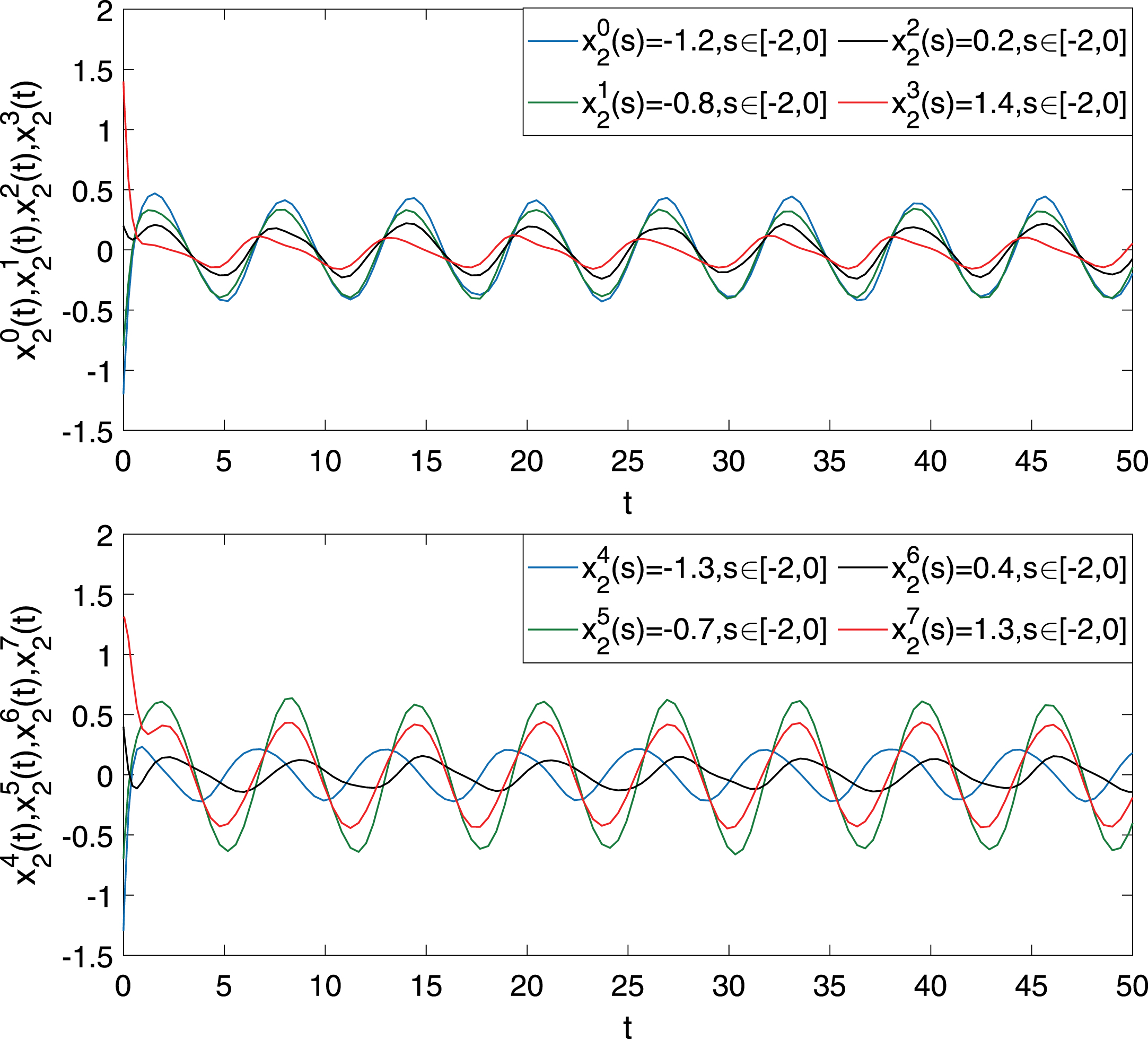
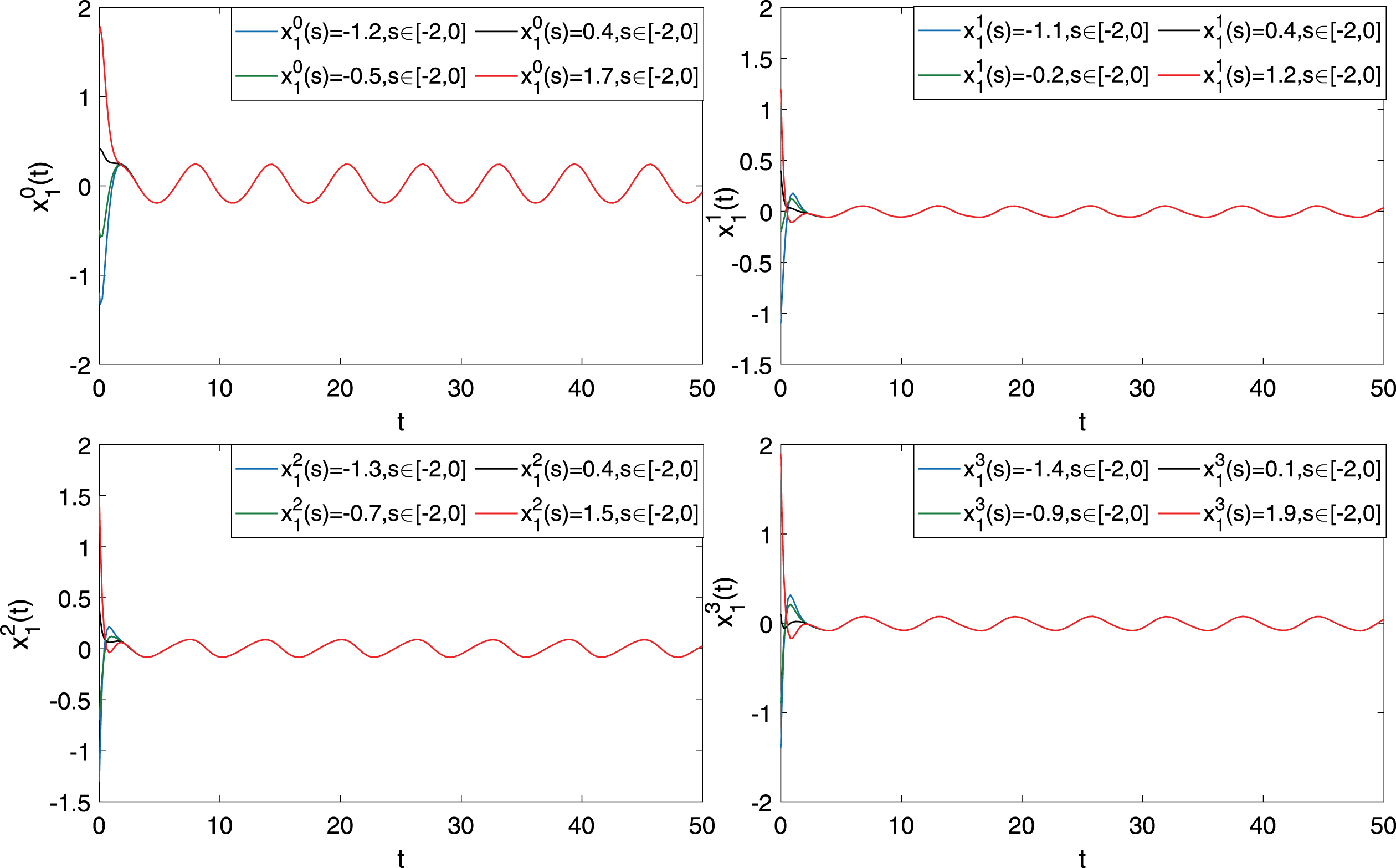
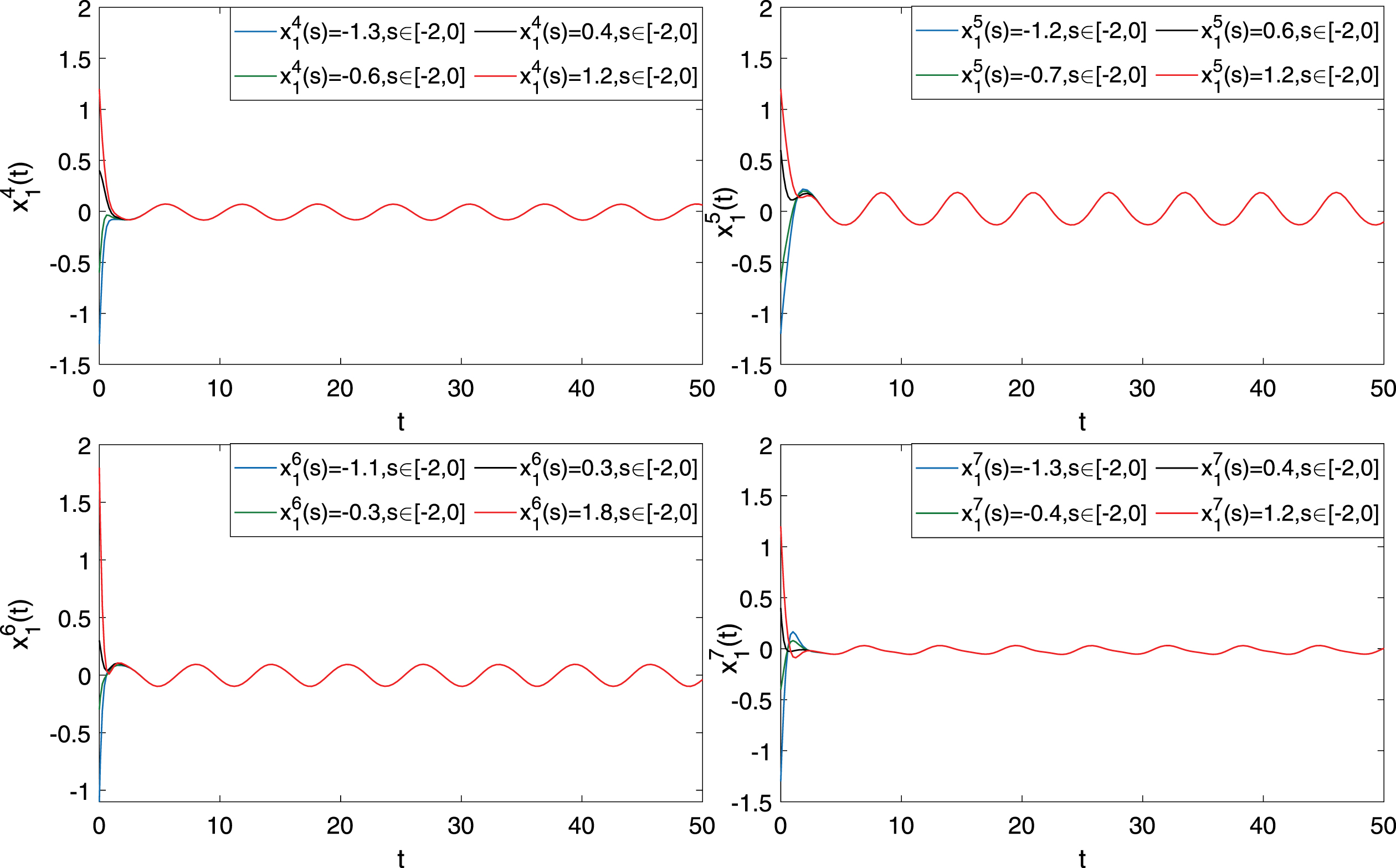
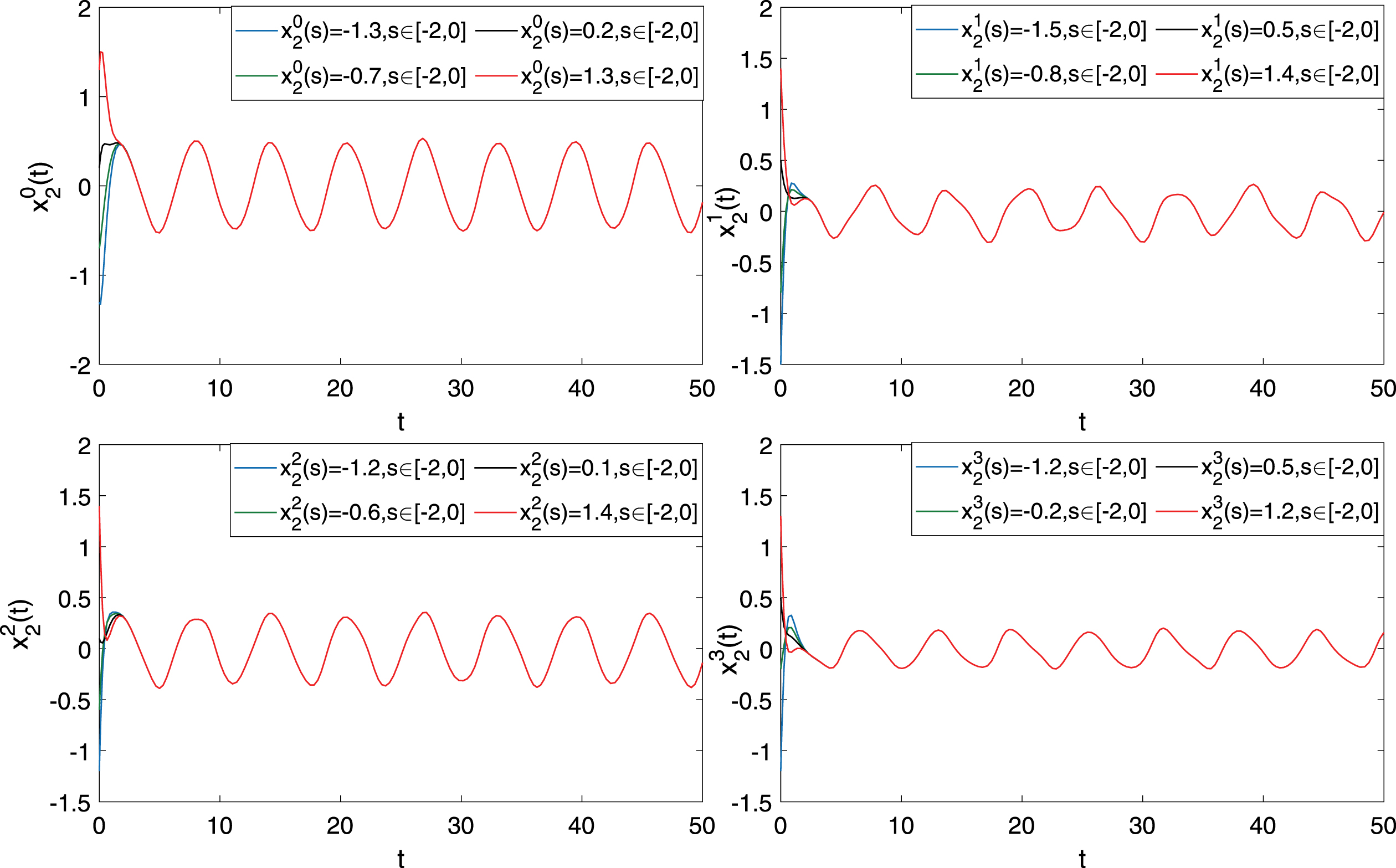
So conditions (A1)-(A3) are verified. Hence, by Theorem 4, we see that system (1) admits a unique pseudo almost periodic solution that is globally exponentially stable (see Figs. 1–6).
States of (2.1) with different initial values.
States of (2.1) with different initial values.
Global exponential stability of states of (2.1) with different initial values.
Global exponential stability of states of (2.1) with different initial values.
Global exponential stability of states of (2.1) with different initial values.
Global exponential stability of states of (1) with different initial values.
Conclusion
In this paper, we have investigated the existence and global exponential stability of pseudo almost periodic solutions for octonion-valued neutral type high-order Hopfield neural networks with D operatorby direct method. It is worth mentioning that the parameters of this system are all octonions except the time delay. The results of this paper are new. The method in this paper can be used to study the almost periodic and almost automorphic solutions of octonion-valued neural networks with or without D operator. Finally, it is worth mentioning that studying the almost periodic dynamics of octonion-valued neural networks with random perturbations and fuzzy terms [50, 51], or even octonion-valued neural networks described by fuzzy differential equations [52–54], is our future direction.
Data availability statement
Not applicable.
Declaration conflict of interest
The authors declare that they have no conflict of interest.
References
1.
LeeD.L., Relaxation of the stability condition of the complex-valued neural networks, IEEE Trans Neural Netw12(5) (2001), 1260–1262.
2.
DongT. and HuangT., Neural cryptography based on complex-valued neural network, IEEE Trans Neural Netw Learn Syst31(11) (2019), 4999–5004.
3.
LiL., WangZ., LiY., ShenH. and LuJ., Hopf bifurcation analysis of a complex-valued neural network model with discrete and distributed delays, Appl Math Comput330 (2018), 152–169.
4.
ShenY. and LiuX., Event-based masteslave synchronization of complex-valued neural networks via pinning impulsive control, Neural Netw145 (2022), 374–385.
5.
LiY., HuangM. and LiB., Besicovitch almost periodic solutions for fractional-order quaternion-valued neural networks with discrete and distributed delays, Math Meth Appl Sci45(8) (2022), 4791–4808.
6.
TuZ., ZhaoY., DingN., FengY. and ZhangW., Stability analysis of quaternion-valued neural networks with both discrete and distributed delays, Appl Math Comput343 (2019), 342–353.
7.
LiH.L., ZhangL., HuC., JiangH. and CaoJ., Global Mittag-Leffler synchronization of fractional-order delayed quaternion-valued neural networks: Direct quaternion approach, Appl Math Comput373 (2020), 125020.
8.
LiY., QinJ. and LiB., Existence and global exponential stability of anti-periodic solutions for delayed quaternion-valued cellular neural networks with impulsive effects, Math Meth Appl Sci42(1) (2019), 5–23.
9.
HuoN., LiB. and LiY., Anti-periodic solutions for Clifford-valued high-order Hopfield neural networks with state-dependent and leakage delays, Int J Appl Math Comput Sci30(1) (2020), 83–98.
10.
BreuilsS., TachibanaK. and HitzerE., New applications of Clifford’s geometric algebra, Adv Appl Clifford Algebras32 (2022), 17.
11.
RajchakitG., SriramanR., VigneshP. and LimC.P., Impulsive effects on Clifford-valued neural networks with time-varying delays: An asymptotic stability analysis, Appl Math Comput407 (2021), 126309.
12.
RajchakitG., SriramanR., LimC.P. and UnyongB., Existence, uniqueness and global stability of Clifford-valued neutral-type neural networks with time delays, Math Comput Simul201 (2022), 508–527.
13.
LiY. and LiB., Pseudo compact almost automorphy of neutral type Clifford-valued neural networks with mixed delays, Discrete Contin Dyn Syst-B27(9) (2022), 4703–4724.
14.
MatsuiN., IsokawaT., KusamichiH., PeperF. and NishimuraH., Quaternion neural network with geometrical operators, J Intell Fuzzy Syst15 (2004), 149–164.
15.
YoshidayasuakiM., KuroeY. and MoriT., Models of Hopfield type quaternion neural networks and their energy functions, Int J Neural Syst15 (2005), 129–135.
16.
HitzerE., NittaT. and KuroeY., Applications of Clifford’s geometric algebra, Adv Appl Clifford Algebras23 (2013), 377–404.
17.
BuchholzS. and SommerG., On Clifford neurons and Clifford multi-layer perceptrons, Neural Netw21(7) (2008), 925–935.
18.
BuchholzS., A Theory of Neural Computation with Clifford Algebras, Ph. D. thesis, University of Kiel, Kiel, 2005.
19.
PopaC.A., Octonion-valued neural networks, in International Conference on Artificial Neural Networks (pp. 435–443), Springer, Cham, 2016.
20.
BaezJ., The octonions, Bull Am Math Soc39 (2002), 145–205.
21.
DrayT. and ManogueC., The Geometry of the Octonions, World Scientific, Singapore, 2015.
22.
OkuboS., Introduction to Octonion and Other Non-Associative Algebras in Physics, Cambridge University Press, 1995.
23.
SnopekK.M., Quaternions and octonions in signal processing –fundamentals and some new results, Przeglad Telekomunikacyjny + Wiadomosci Telekomunikacyjne6 (2015), 618–622.
24.
PopaC.A., Octonion-valued neural networks, in: Artificial Neural Networks and Machine Learning – ICANN 2016, 2016, pp. 435–443.
25.
PopaC.A., Global exponential stability of octonion-valued neural networks with leakage delay and mixed delays, Neural Netw105 (2018), 277–293.
26.
PopaC.A., Global exponential stability of neutral-type octonion-valued neural networks with time-varying delays, Neurocomputing309 (2018), 117–133.
27.
KandasamyU. and RajanR., Hopf bifurcation of a fractional-order octonion-valued neural networks with time delays, Discrete Contin Dyn Syst-S13(9) (2020), 2537.
28.
SaoudL.S. and GhorbaniR., Metacognitive octonion-valued neural networks as they relate to time series analysis, IEEE Trans Neural Netw Learn Syst31(2) (2019), 539–548.
29.
WangJ. and LiuX., Finite time stability of octonion-valued neural networks with delays, in 2021 36th Youth Academic Annual Conference of Chinese Association of Automation (YAC) (pp. 55–60), IEEE 2021.
30.
LiY. and HuangX., Almost periodic oscillation of octonionvalued neural networks with delays on time scales, Int J Syst Sci (2022), in press. doi: 10.1080/00207721.2022.2145859
31.
XiaoJ., GuoX., LiY., WenS., ShiK. and TangY., Extended analysis on the global Mittag-Leffler synchronization problem for fractional-order octonion-valued BAM neural networks, Neural Netw154 (2022), 491–507.
32.
ChouhanS.S., KumarR., SarkarS. and DasS., Multistability analysis of octonion-valued neural networks with time-varying delays, Inform Sci609 (2022), 1412–1434.
33.
SaoudL.S. and GhorbaniR., Metacognitive octonion-valued neural networks as they relate to time series analysis, IEEE Tran Neural Netw Learn Syst31(2) (2019), 539–548.
34.
ShishegarS., GhorbaniR., Saad SaoudL., DuchesneS. and PelletierG., Rainfall–runoff modelling using octonion-valued neural networks, Hydrolog Sci J66(13) (2021), 1857–1865.
35.
CariowA. and CariowaG., Fast algorithms for deep octonion networks, IEEE Trans Neural Netw Learn Syst34(1) (2023), 543–548.
36.
XuB., LiuX. and LiaoX., Global asymptotic stability of high-order Hopfield type neural networks with time delays, Comput Math Appl45 (2003), 1729–1737.
37.
DuanL., HuangL. and GuoZ., Stability and almost periodicity for delayed high-order Hopfield neural networks with discontinuous activations, Nonlinear Dyn77(4) (2014), 1469–1484.
38.
AlimiA.M., AouitiC., ChérifF., DridiF. and M’hamdiM.S., Dynamics and oscillations of generalized high-order Hopfield neural networks with mixed delays, Neurocomputing321 (2018), 274–295.
LiY. and XiangJ., Existence and global exponential stability of almost periodic solution for quaternion-valued high-order Hopfield neural networks with delays via a direct method, Math Meth Appl Sci43(10) (2020), 6165–6180.
41.
ChenY., ZhangX. and XueY., Global exponential synchronization of high-order quaternion Hopfield neural networks with unbounded distributed delays and time-varying discrete delays, Math Comput Simul193 (2022), 173–189.
42.
LuoD., JiangQ. and WangQ., Anti-periodic solutions on Clifford-valued high-order Hopfield neural networks with multi-proportional delays, Neurocomputing472 (2022), 1–11.
43.
AyachiM., Measure-pseudo almost periodic dynamical behaviors for BAM neural networks with D operator and hybrid time-varying delays, Neurocomputing486 (2022), 160–173.
44.
KongF. and ZhuQ., Finite-time stabilization of discontinuous fuzzy neutral-type neural networks with D operator and multiple time-varying delays, Fuzzy Sets Syst (2022), in press. doi: 10.1016/j.fss.2022.02.006.
45.
KongF., ZhuQ., WangK. and NietoJ.J., Stability analysis of almost periodic solutions of discontinuous BAM neural networks with hybrid time-varying delays and D operator, J Frankl Inst356(18) (2019), 11605–11637.
46.
HuangC., LiuB., QianC. and CaoJ., Stability on positive pseudo almost periodic solutions of HPDCNNs incorporating D operator, Math Comput Simul190 (2021), 1150–1163.
47.
ZhangC., Almost Periodic Type Functions Ergodicity, Science Press, Beijing, 2003.
48.
DiaganaT., Almost automorphic type and almost periodic type functions in abstract spaces, Springer,NewYork, 2013.
49.
LiB. and LiY., Existence and global exponential stability of pseudo almost periodic solution for Clifford-valued neutral high-order Hopfield neural networks with leakage delays, IEEE Access7 (2019), 150213–150225.
50.
AbudusaimaitiM., AbdurahmanA., JiangH. and HuC., Fixed/predefined-time synchronization of fuzzy neural networks with stochastic perturbations, Chaos Solitons Fractals154 (2022), 111596.
51.
ZhangT. and LiY., Global exponential stability of discrete-time almost automorphic Caputo–Fabrizio BAM fuzzy neural networks via exponential Euler technique, Knowl-Based Syst246 (2022), 108675.
52.
AbuO., Arqub, Adaptation of reproducing kernel algorithm for solving fuzzy Fredholm-Volterra integrodifferential equations, Neural Comput Appl28 (2017), 1591–1610.
53.
AlshammariM., Al-SmadiM., Abu ArqubO., HashimI. and AliasM.A., Residual series representation algorithm for solving fuzzy Duffing oscillator equations, Symmetry12 (2020), 572.
54.
Abu ArqubO., SinghJ., MaayahB. and AlhodalyM., Reproducing kernel approach for numerical solutions of fuzzy fractional initial value problems under the Mittag-Leffler kernel differential operator, Math Meth Appl Sci2021 (2021), 1–22.