



Abstract
This manuscript proposes a hybrid method for optimum sizing and energy management (EM) of hybrid energy storage systems (HESSs) in Electric vehicle (EV). The proposed hybrid method is combined performance of Honey Badger Algorithm (HBA) and recalling-enhanced recurrent neural network (RERNN), commonly called HBA-RERNN method. The major objective of proposed system is reducing the vehicle life time cost. The HESSs are incorporated with battery and super capacitor (SC). The proposed method is utilized to solve combined energy management and optimization size. Based on the variables, such as size of battery pack and super capacitor pack, HESS size is reflected. Depend on various sensitivity factors, optimum hybrid energy storage systems size and financial costs are analyzed. At last, the performance of proposed system is implemented on MATLAB site and compared with several existing systems. From this simulation outcome, it concludes that the proposed system diminishes the overall cost and battery degradation cost as 66625 USD than the existing systems. The efficiency of the proposed system achieves 94.8763%.
Keywords
Introduction
To minimize pollution from automobile users, the California Air Resources Board (CARB) first recommends the use of electric vehicles (EVs) [1]. Initial works suggested that battery designers could work directly with the development team of automotive electrical system to improve power, energy density, battery life, overcoming the barriers against the widespread adaptation of EVs, and meet fuel economy requirements [2]. Many factors, such as properties of electro-active material, conductivity and chemical stability of current collectors, selection of electrolytes that confirm the morphology of electrodes, redox functions of additives in electrodes or electrolytes, high charge, internal and external environmental and utility specifications are affects the performance of battery [3]. Over the past decades, battery performance is significantly improved but peak utilization of battery provides the main issue [4]. Sudden use of battery power can cause battery damage, even on small electronic devices, like laptops and mobile phones [5]. Due to the various factors like driving style, road, etc., leads to high changes in the consumption of power, due to these factors, EVs are stable from the sudden use of battery power [6]. Since the electrochemical reaction associated with it is remaining the same, it works well when a battery is discharged uniformly [7].
Due to the acceleration, EV needs high consumption of power but the battery pack cannot discharge quickly to meet this requirement [8]. During braking of EV, this also applies to high current storage in batteries generated [9]. The electrolyte is affected because of the fluctuating currents of high current inside and outside the battery [10–14]. The life of battery is shortening while this acceleration/braking are repetitive [10]. Hence, to overcome this drawback, there are various types of batteries are utilized in EVs [15]. Among the batteries, lithium-ion (Li-ion) batteries are mostly utilized in EV because of its advantages, like high cell voltage, rate capability or cyclability [16]. The limitation of this battery is not suitable. For surviving the increasing power loads, the battery only energy storage systems (ESS) are generally heavier [18]. Other technologies or individual battery systems, especially within the critical range offered by the power store, can offer performance benefits when utilized to deliver high power pulse with no delay [18].
One possible solution is meet the performance limit of batteries and it uses the super capacitors (SCs) as 2nd energy storage device and it works with batteries [19]. SCs are same of electrochemical systems for energy storage, but the main difference is that they have fast charge / discharge rate [20]. Because of their low energy density compared to batteries, they cannot be used as a source of energy for EVs [21]. Nevertheless, when battery power is not sufficient, SCs are the best way to offset high peaks of usage [22]. Together, the benefits of the Battery-super capacitors hybrid ESS (HESS) [23]. Various research is focused this HESSs for reduce the consumption of energy and degradation of battery compared to battery only ESS [24].
In EV, the battery management system (BMS) carries the important role. BMS ensures the safety, stable installations as well as long lifespan of ESD in electric vehicle driving [25]. BMS is comprehensive context has architectures and general performance evaluation mechanisms for dissimilar sorts of ESD, health status, charge/discharge events, lifetime as well as cell protection thermal management [26]. At ESD, based on electrochemical reaction, a cell voltage happened through the charge or discharge time. Voltage balance systems are the key work spaces on BMS to improve voltage balance systems. To recover voltage balancing systems, defend the cell on explosions, and recover their durability [27].
The major objective of proposed system is reducing the cost of vehicle life time. Organization of proposed work is illustrated in Fig. 1.
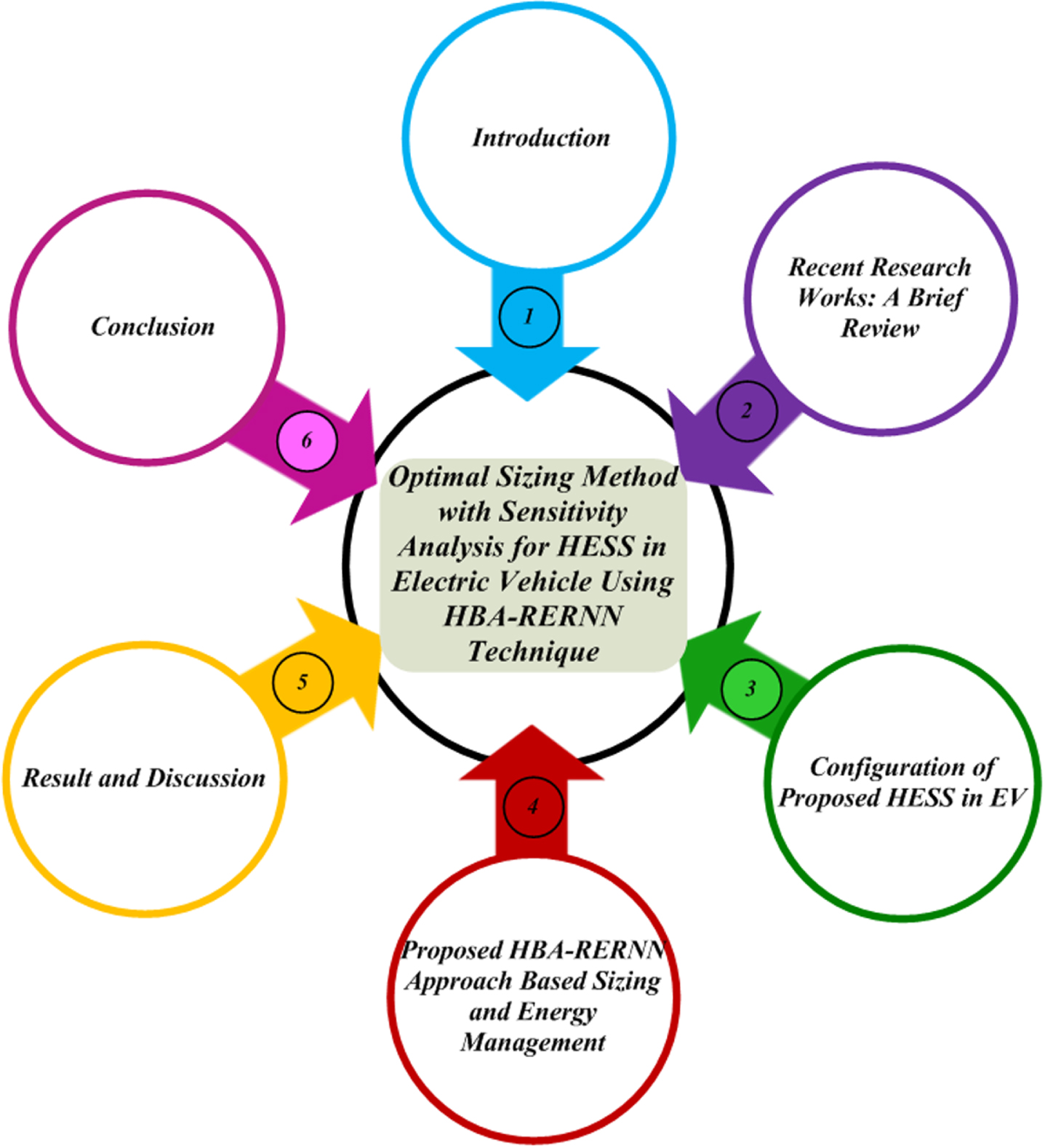
Organization of proposed work.
The major contribution of this research work is recorded as below, A hybrid system for optimal sizing and energy management (EM) of hybrid energy storage systems (HESS) on EV. The proposed system is joint execution of Honey Badger Algorithm (HBA) and RERNN, commonly called HBA-RERNN method. Initially, the architectural model of HESS, like battery and SCAP, is modeled, and the EV parts are also separated. To maximize energy management, the simulation platform, is offered. At MATLAB/Simulink site, the mastery of the proposed system is evaluated by comparing existing systems. The proposed study consists of two key purposes to solve the optimization problem. The primary function is accomplished through Honey Badger Algorithm (HBA). HBA algorithm is utilized to solve the optimization problems, such as cost minimization, emission and loss reduction. The second function of proposed system is performed with RERNN. In the proposed system, the RERNN is utilized for choosing the perfect cost of system and optimal sizing and energy management is achieved.
Several research works are earlier existed on the literatures based on hybrid energy storage system in electric vehicle using several systems and features. Few of them were revised here.
Baek et al., [28] introduced the investment approach for sizing of BESS under regulation of frequency. The suggested approach considered the lifespan of BESS and aging process of BESS. The reduction of size of SC was important because it is expensive and contains forty percentage of discharging rate. Innovative variable capacity model (VCM) was utilized to determine the lifespan of super capacitor size. Determination of optimal size of super capacitor extends the life of BESS at an effective cost. Zhu et al., [29] have suggested neural network and rule-based approaches for EM of EV. The major purpose of introduced method was dropping the operating cost of HESS (battery, SC). The suggested approach mange the energy in online and adopted based on real-time electric vehicle driving conditions. The suggested approach was analyzed offline benchmarks. Bansal et al., [30] have introduced the sizing of ESS in electric vehicles based on driving cycle uncertainties. The introduced method focused uncertainty depends on the unpredictability of upcoming state of speed, acceleration. Velocity-magnitudes and time-windows of velocity profile were modeled for analysis. Chen et al., [31] have suggested the new cost model for large-scale BES power station. Economic analysis was performed to derive the most economic battery sort and build size in view of the comprehensive economic benefits of joint operations over the load factor range. The sensitivity analysis and economic parameters of economic indicators were controlled to show the economic feasibility of joint action.
For sharing the power among battery and SC, C. R. Arunkumar et al., [32] have explored a low pass filter (LPF) based frequency sharing approach. The battery and SC current of HESS was controlled using 2 current controllers. The direct current (DC) bus voltage was regulated using voltage controller. The DC bus voltage and current was controlled based on fast operation of every control loop and delay by low pass filter. Li et al., [33] have suggested the dynamic programming (DP) for EMS of HESS based EV system. The design of SC was based on the lifetime of the system. The suggested method enhances the energy management of EV system. Gomez-Gonzalez et al., [34] suggested teaching-learning-based optimization (TLBO) approach, wavelet transform (WT) for HESS sizing with renewable system. TLBO was four-dimensional optimization strategy and WT was utilized for optimizing the management policies. The purpose of suggested approach was depending on economic factors, like exchange of energy, cycling, investment, and Frequency containment reserve (FCR) provision, between other costs. The optimal management and overall component sizing was determined by the suggested approach.
Khorram-Nia et al., [35] have executed a intelligent optimization system for optimal switching on reconfigurable microgrids to reduce microgrids with the presence of distributed generation resources and electric vehicles. Babic et al., [36] have demonstrated a novel framework based on discrete event simulations and queuing theory. The framework can approximate the perfect number of EV chargers and charging price. Shubin Wang et al., [37] put forward to plan an EVCS deeming dissimilar sources such as photovoltaic system, battery and diesel. Thus, the optimal station design for grid-connected mode was twisted into optimization problem and an established hybrid PSO and gray wolf algorithm was utilized.
The review of recent research work is based on energy management scheme for hybrid ESS in EVs which are revealed. The energy management of HESS designing the controller to get the optimal performance. The HESS diminish energy consumption and battery dissipation related to battery Energy storage systems. To determine the size of HESS is important because it is incorporated with battery, SC and one or more dc to dc converter. But, the sizing of HESS is not only representing the physical size, in contrast, measurement often involves specific objectives as optimization issues. Hence, in the sizing problem included the energy management of HESS. When ignoring the energy management, then it leads to unreasonable size results. The performance of the motor of EV is highly sensitive to HESS size and financial cost. The pack size of super capacitor is affected using the intensity of driving cycle. Battery unit cost has been revealed to significant impact on financial costs, thus affecting optimal size outcomes. Hence, it is essential to evaluate the optimal sizing with various inputs. Previously, there are several methods are presented to manage the energy of HEV. Few of them are genetic algorithm (GA), Fuzzy Logic Control (FLC), etc. The fuzzy logic control is used to manage the HESS and it is cheaper, minimized calculation, but the limitation of FLC is the formation of rule and it is very complex. The benefit of GA is less only for the few applications and it has an increasing chances of getting optimal solution, but its limitations are complexity. Various approaches are introduced which only analysis the driving range. The topology of HESS is not analyzed and various inputs still missing in hybrid energy storage system research. Hence, a promising approach is required to solve the problem. These disadvantages motivated to do this research.
Configuration of Proposed HESS in EV
In this manuscript proposes the hybrid method for HESS sizing and energy management. The structure of proposed system displayed on Fig. 2. The HESS [38] is incorporated with battery and super capacitor. The reduction of financial cost over vehicle life time is the major objective of the proposed method. The introduced approach solves both sizing and energy management optimization. The proposed system is analyzed under various sensitivity factors, like driving range, HESS component parameter and topology of hybrid ESS. Its size depends on the combination of battery size and super capacitor. The energy management is incorporated with reduction of overall cost of HESS system. Dc to dc converter is depending on size of battery or SC, therefore, not considered the dc-to-dc converter size.
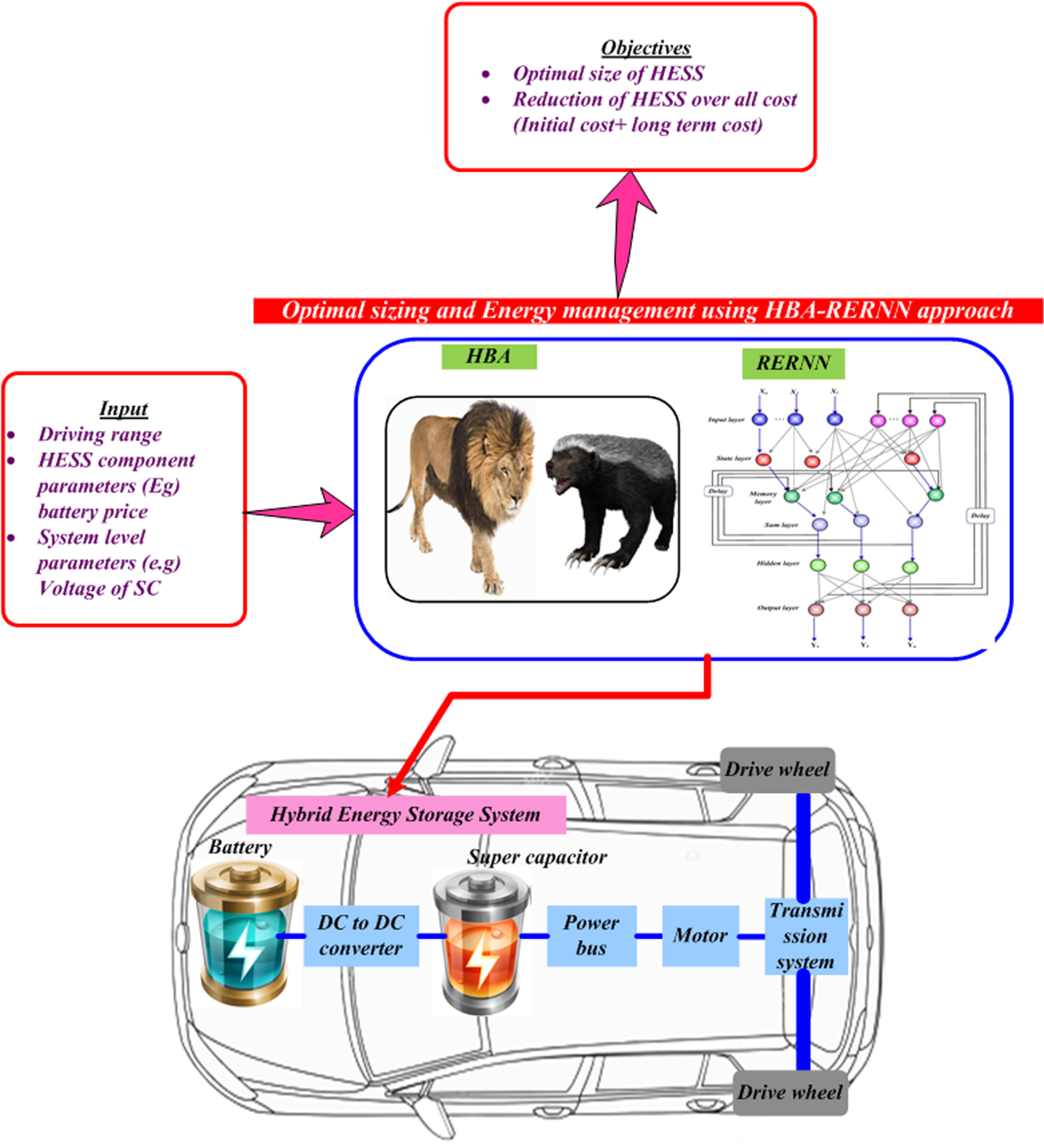
Configuration of proposed system.
To control the necessary energy for electric driving force and power, this modeling is utilized the theoretical EV load is determined. In this modelling, various forces, road, velocity are utilized [39]. Load force is defined as the summation of every vehicle force and it is mentioned below,
The resistances of driving are rolling resistance force, aerodynamic drag force, and gravitational forces. The maximal energy provided to battery is mentioned as follow,
In this manuscript, dc voltage is considered as constant, the force from the road grade becomes zero, then the load power is described as,
The load current is described based on the constant dc bus/battery voltage is,
The SC is act as the secondary source that has many advantages, such as high power density, high charging or discharging effectiveness, high lifespan. In SC [40], large counts of cells are connected on series to obtain high voltage. The equivalent circuit of SC is displayed on Fig. 3.
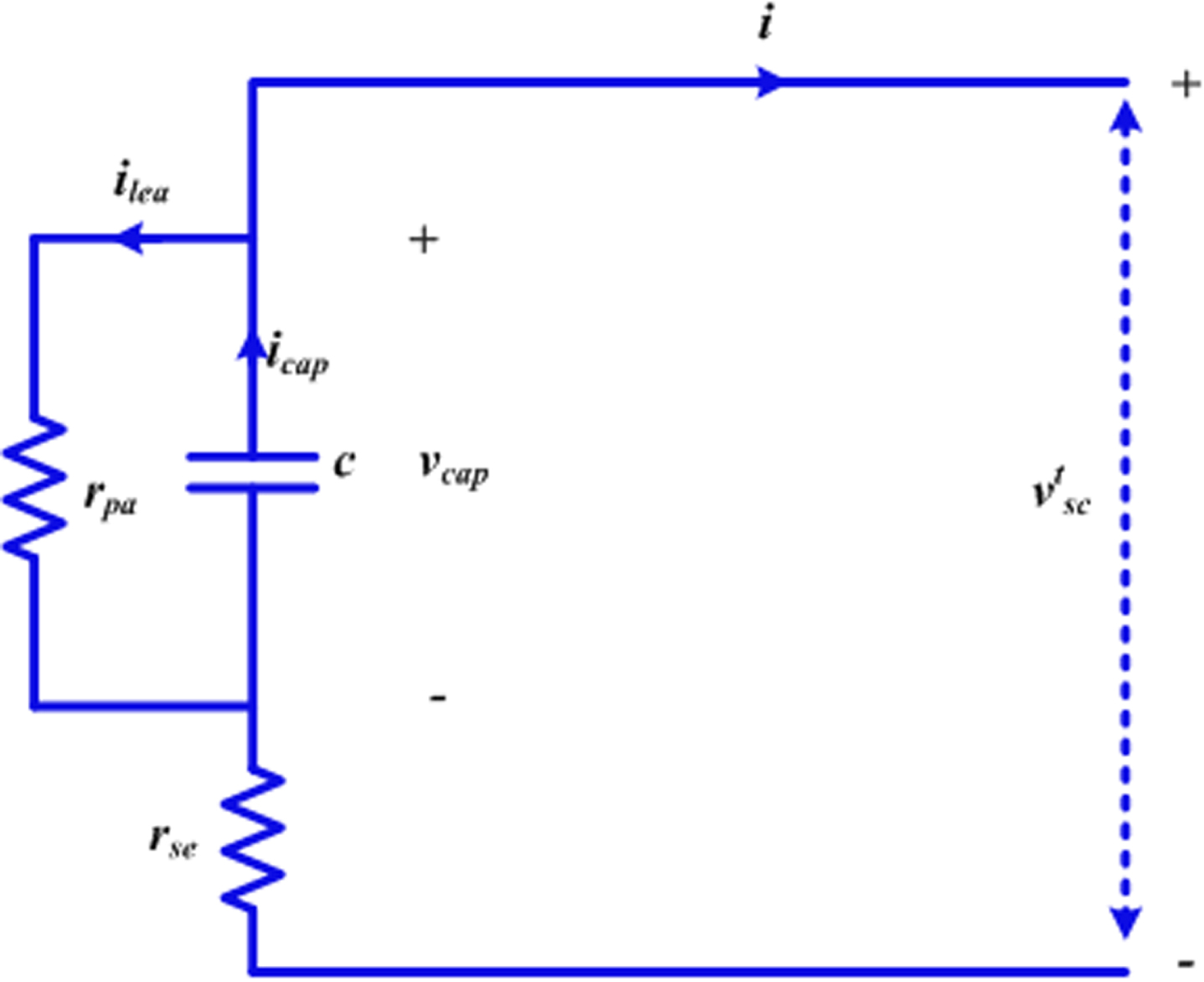
Equivalent circuit of the SC.
The performance of SC is determined by using the discharging and charging of SC with various current rates of terminal voltage. Figure 3 is incorporated with parallel leakage resistance (
The leakage current of the SC is described by,
The division of terminal voltage to maximal voltage of super capacitor is described as SOC of SC and it is described by,
The efficiency of the SC is based on the internal series resistance as well as capacitance and it is described by,
The primary energy storage system (ESS) battery is connected to DC bus directly on semi-active HESS [41, 42]. The parameters such as temperature, SOC of battery are used in charging and discharging of battery. Figure 4 depicts the schematic diagram of battery.
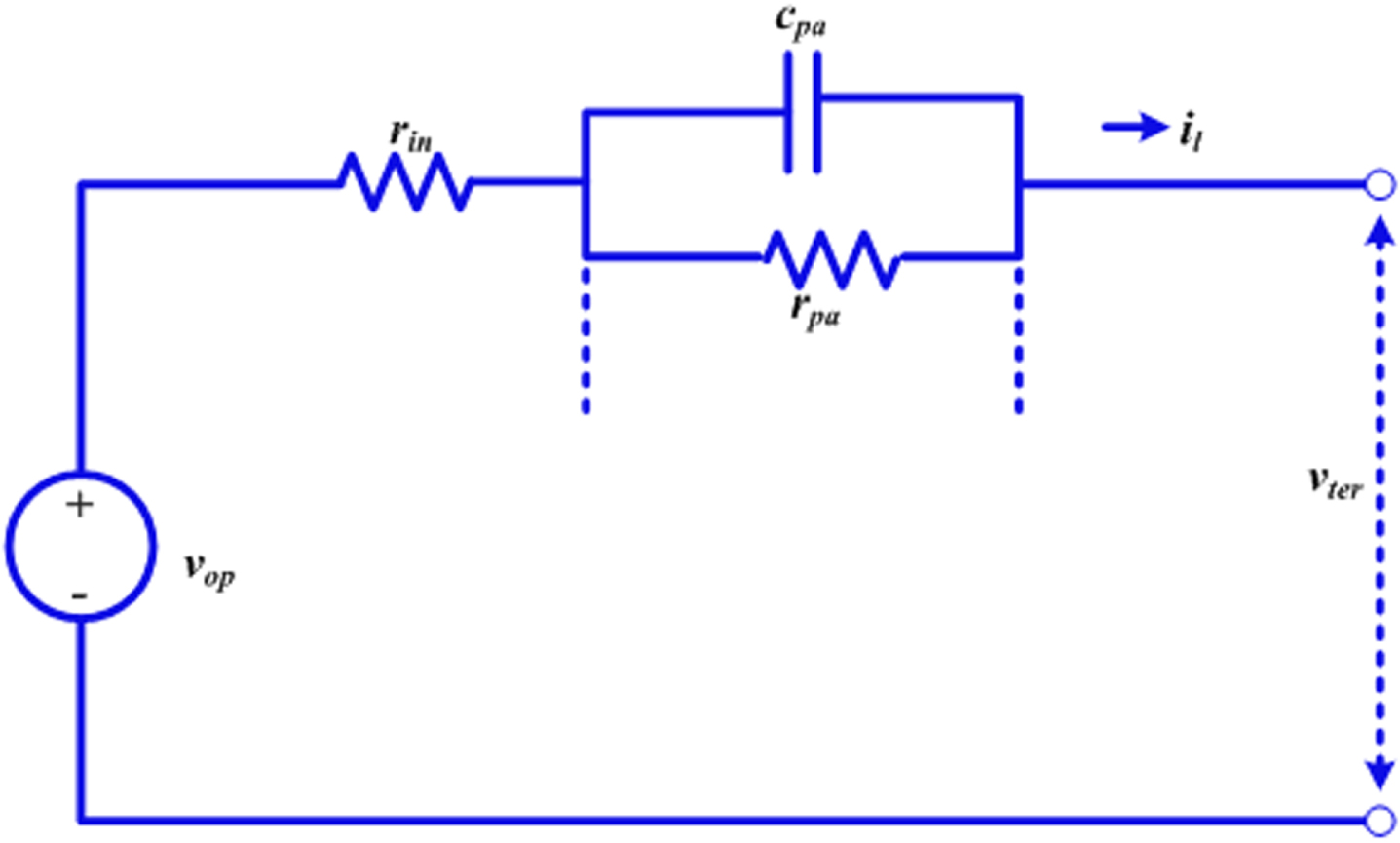
Schematic diagram of battery.
It is incorporated with open circuit voltage and battery’s inner resistance. The parallel connection of resistance and capacitance is utilized to analyze the transient behavior of battery. The characteristic of battery is described by,
The battery model is utilized for determining the loss of power in battery electric vehicle and semi-active hybrid energy storage system. The relative ohmic loss of internal resistance is determined by RMS current value. The battery current reduction ratio is described by,
The initial SOC is needed to determine the variation of SOC, change in charge. The SOC of battery is described by,
The resistive heat and the entropic heat are the classification of heat generation in the battery. For simplicity, the resistive heat is considered and it is described by,
Here, mass is denoted as M, specific heat capacity is denoted as
The capacity of battery and super capacitor is based on DC bus voltage. If the losses of HESS are minimized then easily achieve the dc bus voltage [43, 44]. It is described in terms of power of SC and power of battery. The bus voltage in differential form is expressed as,
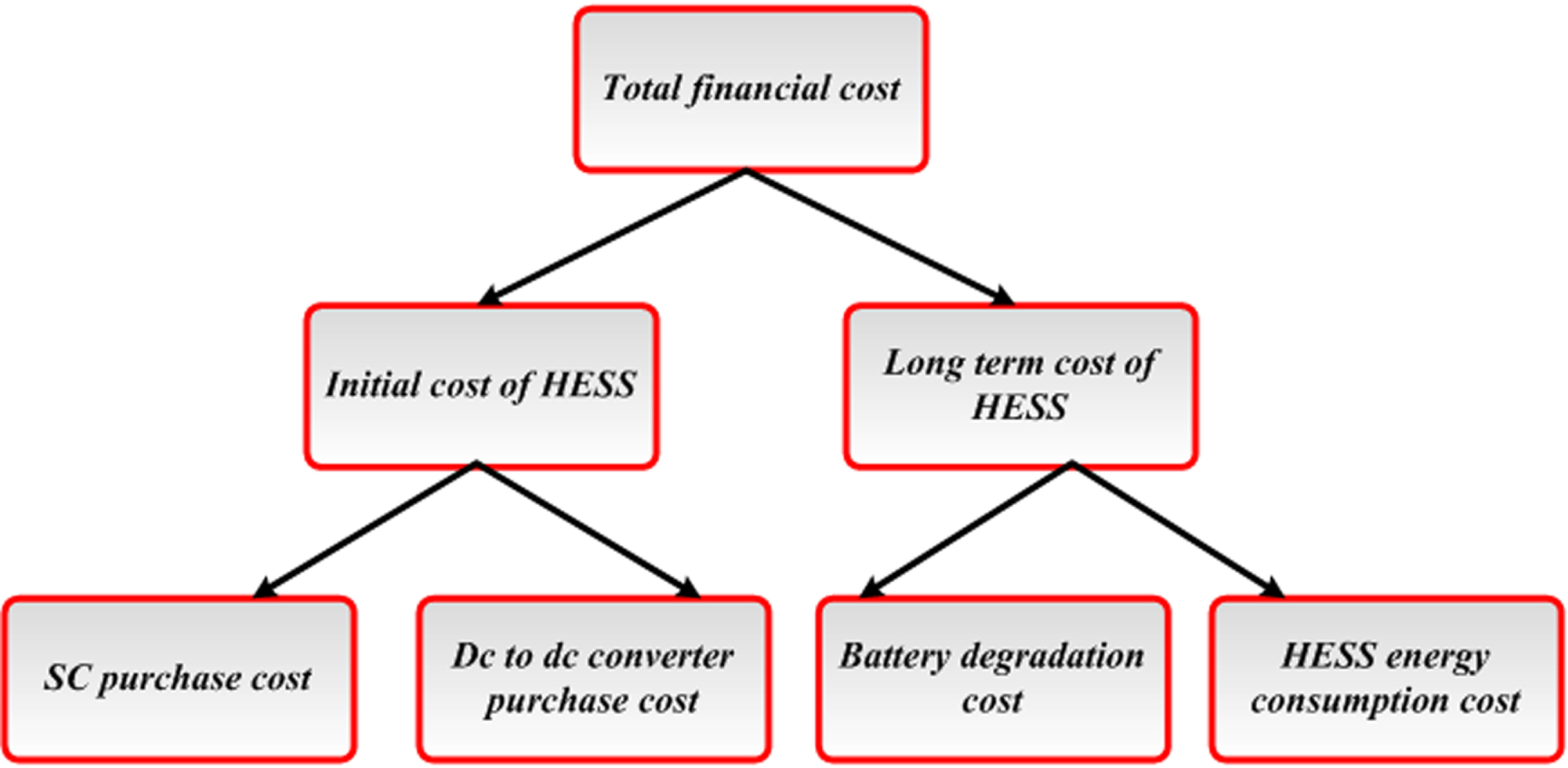
HESS financial costs under vehicle lifetime.
The dc bus voltage is determined by,
The total capacitance of the DC bus is described by,
Using the voltage of DC bus, reference voltage is produced. The SC power reference is determined by the process of adaptive PI controller. The ripples of battery are reduced by first order filter. Using the SC current voltage saturation functions, the limitations are minimized. The minimum as well as maximum current of SC is described by,
The total financial cost of HESS is connected from initial placement to long life and end of the vehicle’s useful life. The purchase of the HESS component is the initial cost and the replacement of the component based on component degradation and energy consumption. The SC and dc to dc converter [45] has a long-life cycle, therefore it is not replaced during the life of the vehicle and only has a current purchase cost and not the current degradation cost [46]. It has both purchase cost and degradation cost due to less life time of battery than the vehicle life time. The battery pack is changed many times under the vehicle life time. Here, the purchase cost of battery is considered to be same for battery degradation cost and it occurs at the first time replacement of battery [47]. Hence, the purchase and degradation cost is combined and it is considered as long-term costs. HESS financial costs under vehicle lifetime are displayed in Fig. 5.
The purchase cost of the SC is described by,
Based on energy capacity loss, the degradation cost is calculated. Range drive cycle is the distance of a single driving cycle in km, whereas Range vehicle life reflects the vehicle mileage when range vehicle life is regarded to expire. This transfers the battery degradation cost of a single driving cycle to those of range vehicle lifetime. The loss occurs depends on degradation of battery. The battery loss is determined by,
The consumption of energy is described the utilization of energy in battery and SC. The overall financial cost of HESS is described as,
Some of the constraints [48] are followed by the proposed method based on HESS. The range of current and voltage of battery and SC is described as,
SOC and SOE limit is described by
The size of the battery also some limit which is described as
This manuscript utilized the HESS system and proposed HBA-RERNN method for sizing HESS and simultaneously manages the energy of system. The proposed method lessens the overall cost of system. Here, considered the purchase cost of battery, SC and dc to dc converter and energy consumption cost of HESS. The overall cost of the system is optimized and optimal size is provided by the proposed method. The sensitive factors of proposed system are examined with several numbers of parameters. The complete description of proposed method is defined as below,
Optimization of objective using HBA approach
The HBA is the meta-heuristic optimization and it is stimulated by intelligent foraging behavior of honey badger (HB) [49]. The phases of exploration and exploitation phases of HB Algorithm are formulated. Honey badger digs or follows the scent of honeydew bird to find the food source. In this manuscript, HBA algorithm is utilized to solve the optimization problems, such as cost minimization, emission and loss reduction. The stepwise process of HBA is explained below,
Initializing the number of honey badgers that is population size, driving Range, HESS topology, HESS component parameters, max iteration and constraints.
The initialized populations are generated randomly with the random generation, and it is described by,
Fitness is depend on objective function,and it is described by,
Determine the intensity of the solution based on the strength of prey and distance between them. It is described by,
For keeping the smooth transition from exploration to exploitation, the density factor (α) controls is utilized and it is described by,
This step is utilized to escape the local search and flag F is utilized to escape the local optimal value.
Here, two phases, such as digging and honey phase are utilized to update the position.
The updating is performed by,
The updating is performed by,
The exploration and exploitation is calculated by,
Check the ending criteria, if it met the condition means optimal outcome is obtained, otherwise repeat the process. Flowchart of HSA approach is displayed in Fig. 6.
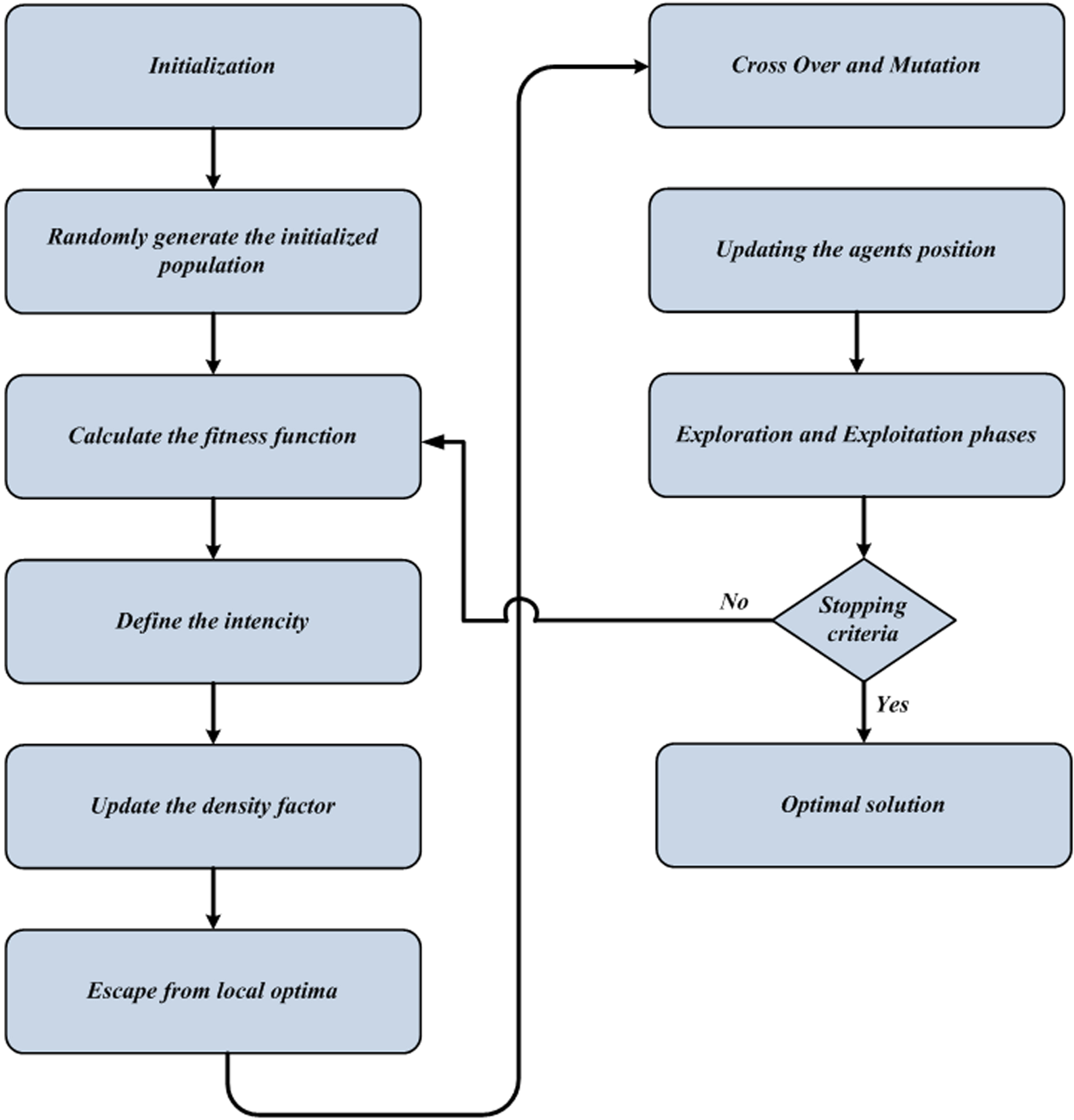
Flowchart of HBA approach.
The RERNN is radial basis function based on training process. It is operated based on the artificial Neural Network. The difference amid the RERNN and Elman recurrent neural network (RNN) are number of layers. RERNN has six layers but the Elman RNN has 3 layers. The layers of RERNN are input layer, memory layer, state layer, sum layer, delay layer, hidden layer, and output layer [50]. The memory layer is processed using the outcome of sum and state layer. The memory layer is utilized to determine the size of earlier sum layer information. Summation function is executed by sum layer. The hidden layer provides last probabilistic value of output layer. The delay layer performs the back propagation of hidden layer outcome. The RERNN structure is displayed on Fig. 7. In the proposed system, the RERNN is utilized for choosing perfect cost of system and optimal sizing and energy management is achieved. The stepwise procedure of RERNN is described in the following steps,
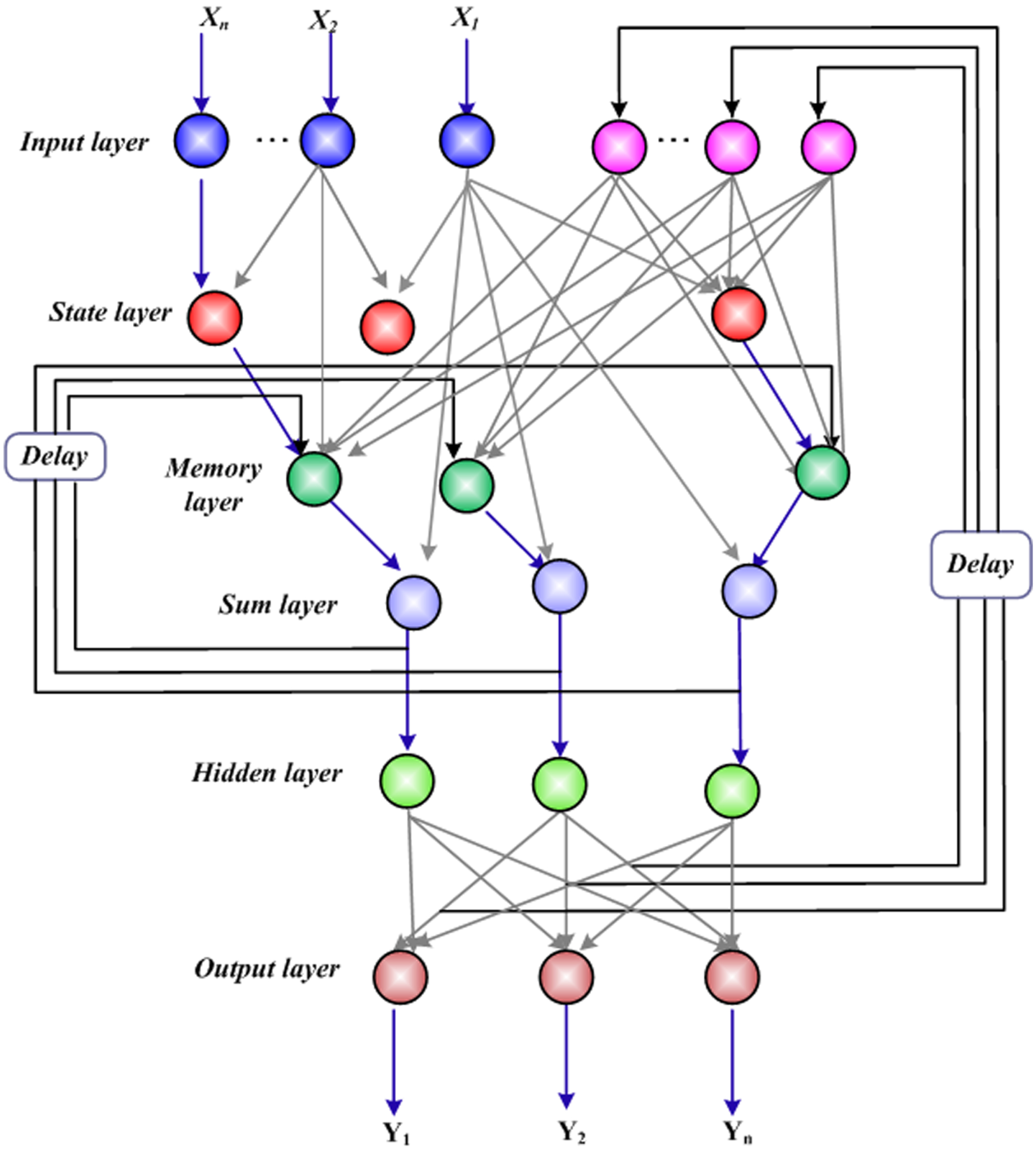
Structure of RERNN.
This is used to create the new input,
The simulation outcome and its description are discussed. To optimize the sizing of HESS and energy management of HESS, in this manuscript proposed the HBA-RERNN method. The major contribution of proposed method is reducing the long term and initial cost of HESS through which obtains the energy management of system. The proposed system is performed on MATLAB site and compared with several existing systems. The proposed system is compared with existing methods, like Grey Wolf Optimizer (GWO), Slime Mould Algorithm (SMO), and Bear Smell Search Algorithm (BSSA). Under the base condition, the overall cost and degradation cost are analyzed. The sensitivity factors, like driving cycle, dc to dc converter efficiency and various component cost based on performance of the system is analyzed.
In this section, the performance of proposed system is analyzed under base case. The base case is considered as driving cycle and HESS topology in EV. Analysis of overall cost and battery degradation cost based on size of SC is displayed in Fig. 8. The overall cost of the system is varied based on SC pack size. When the size of SC is 10 Wh then the total cost become 8.15×10⁴USD and then the cost of the system is decreased to 7.58×10⁴USD at the SC size of 100 Wh. Again the cost increased to 7.79×10⁴USD at the SC size of 250 Wh. Battery degradation cost of proposed method is initially high. The battery degradation cost is at SC size 10 Wh, then it decreased to 6.78×10⁴ USD at the SC size 110 to 250 Wh. From this outcome, it is concluding that the battery degradation cost is decreased when the SC pack size increases. Hence, small size of SC provides less degradation of battery. From the total cost, the cost of battery degradation is high. Analysis the cost of HESS energy consumption and purchase cost of super capacitor and dc to dc converter is displayed in Fig. 9. The HESS energy consumption cost is constant to 3900 USD at the SC size of 70 to 280 Wh. The purchase cost of SC is increased based on size. If the size is high then the cost is also high. If the SC size is low, then the cost becomes low. At 70 Wh size SC pack cost become 1000 USD and it increased to 4000 USD at size of 270 Wh. The purchase cost of dc to dc converter is 2000 USD at size of SC as 70 Wh. At initially, the dc to dc converter cost is increased from 2000 USD to 2500 USD and then it decreased.

Analysis of overall cost and battery degradation cost.

Analysis the cost of HESS energy consumption and purchase cost of SC and dc to dc converter.
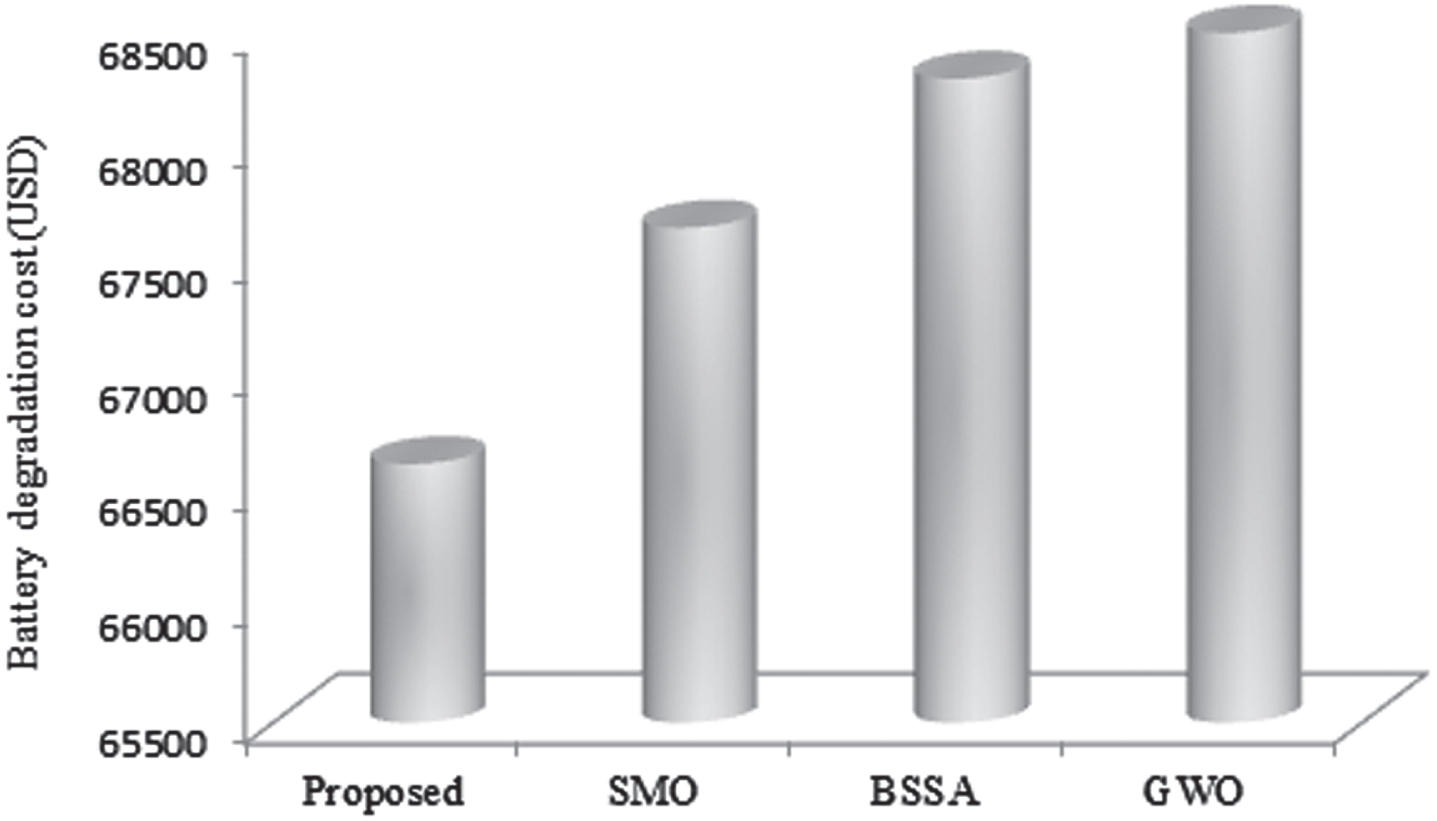
Analysis of working power of battery and SC is shown in Fig. 10. By using this working condition, the HESS size and the energy management is optimal. The battery working power is less around –5 kW to 45 kW due to the discharging process. Like power buffer, SC is working. The working range of SC is varying around –60 kW to 100 kW. Comparison of battery degradation cost of proposed method and existing methods is displayed in Fig. 11. The degradation cost of proposed method becomes 66625 USD but the existing methods, like SMO, BSSA and GWO battery degradation cost becomes 67580 USD, 68300 USD and 68500 USD. From this results, it is conclude that the proposed method based battery degradation cost is low than the existing methods.
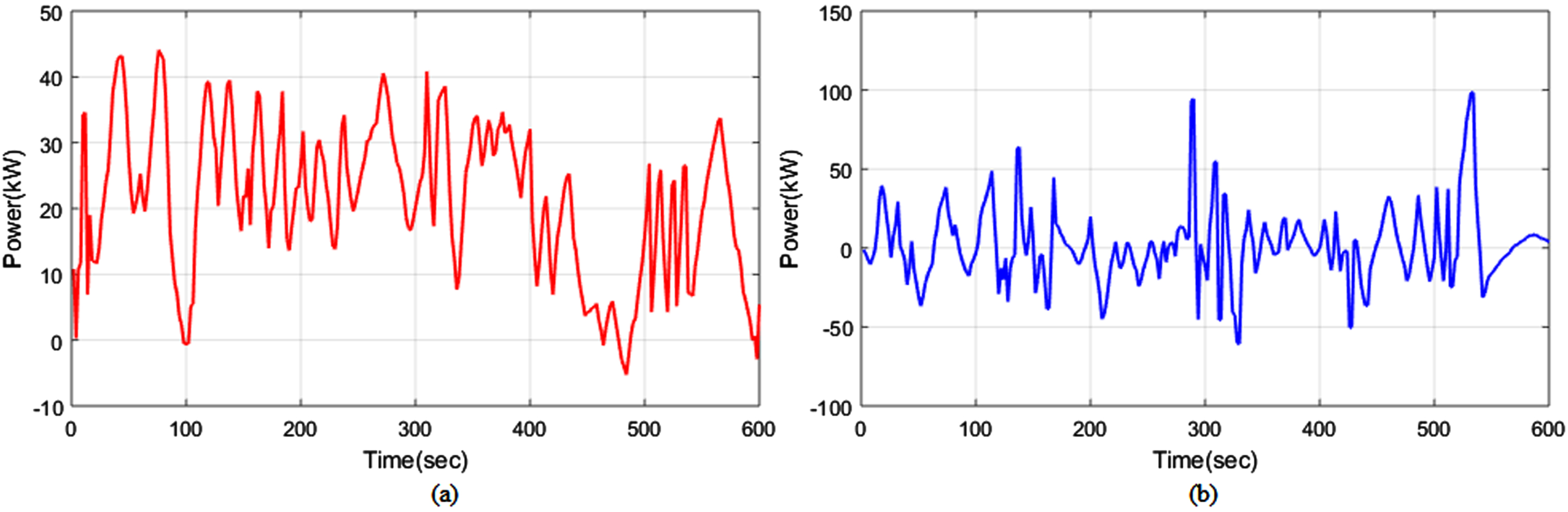
Analysis of working power of (a) Battery (b) SC.
Comparison of battery degradation cost of proposed method and existing methods.
In this section, the performance of the proposed method depends on sensitive factors, like vehicle driving cycle and dc to dc converter efficiency is analyzed.
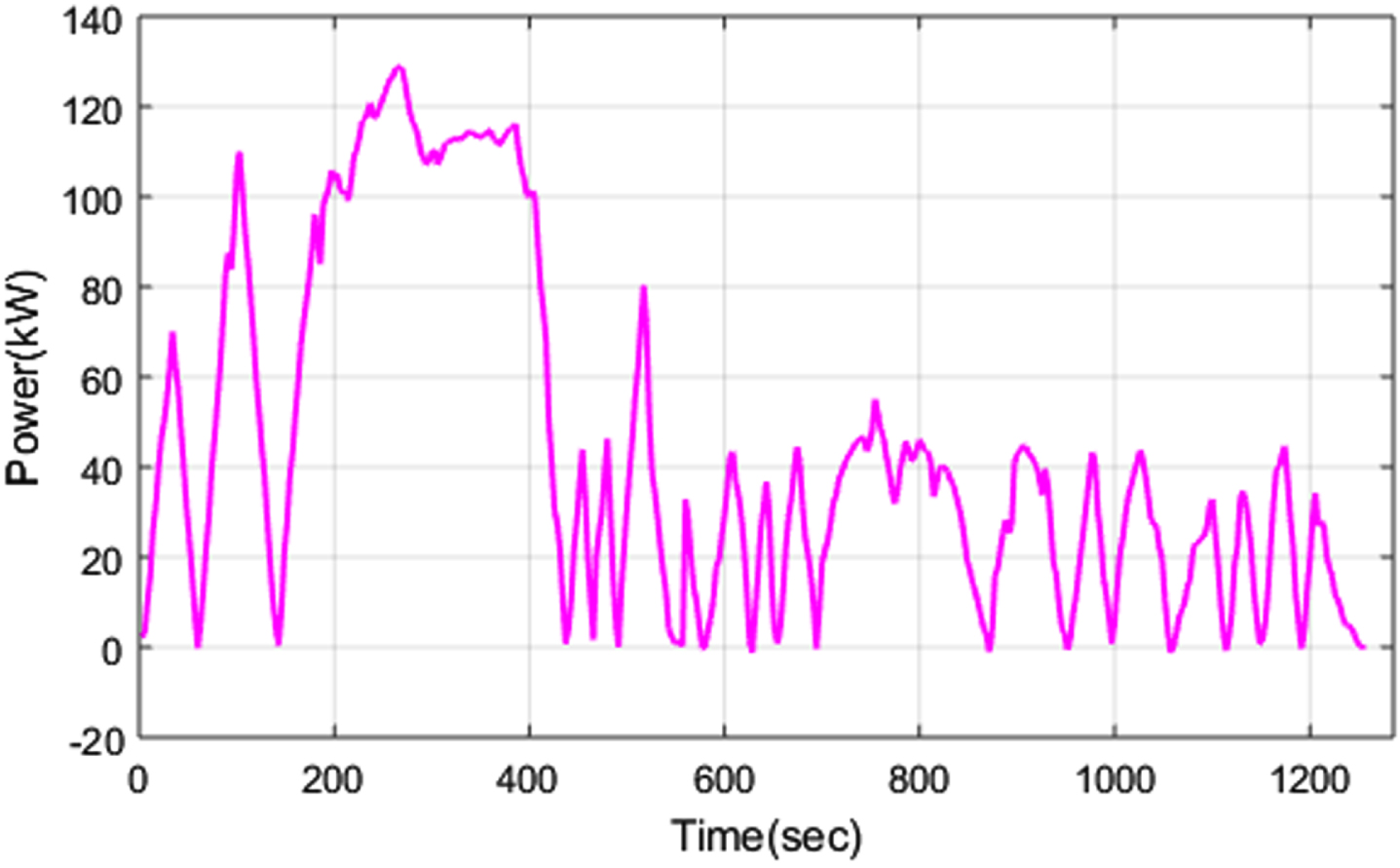
It describes the longitudinal speed of electric vehicle based on time. The electric vehicle demanded the energy for working based on this speed. The driving cycle has various statistic characteristics. Analysis of power demand based on EV driving cycle is displayed in Fig. 12. The power demand is varied from sec to sec. The peak demand is 130 KW at180 to 420 sec.
Analysis of power demand based on EV driving cycle.
The division of energy output to energy input is known as dc to dc converter efficiency. The efficient energy storage is SC which efficiency is depends on the dc to dc converter efficiency. If the converter efficiency is low means than the energy loss is high as well as the consumption of energy at HESS is also high. Moreover, when the efficiency of dc to dc converter is low then SC power is rapidly deplete, hence, the battery is utilized simultaneously. Generally, the voltage using input and output, dc to dc converter current is the reason of variation of dc to dc converter efficiency.
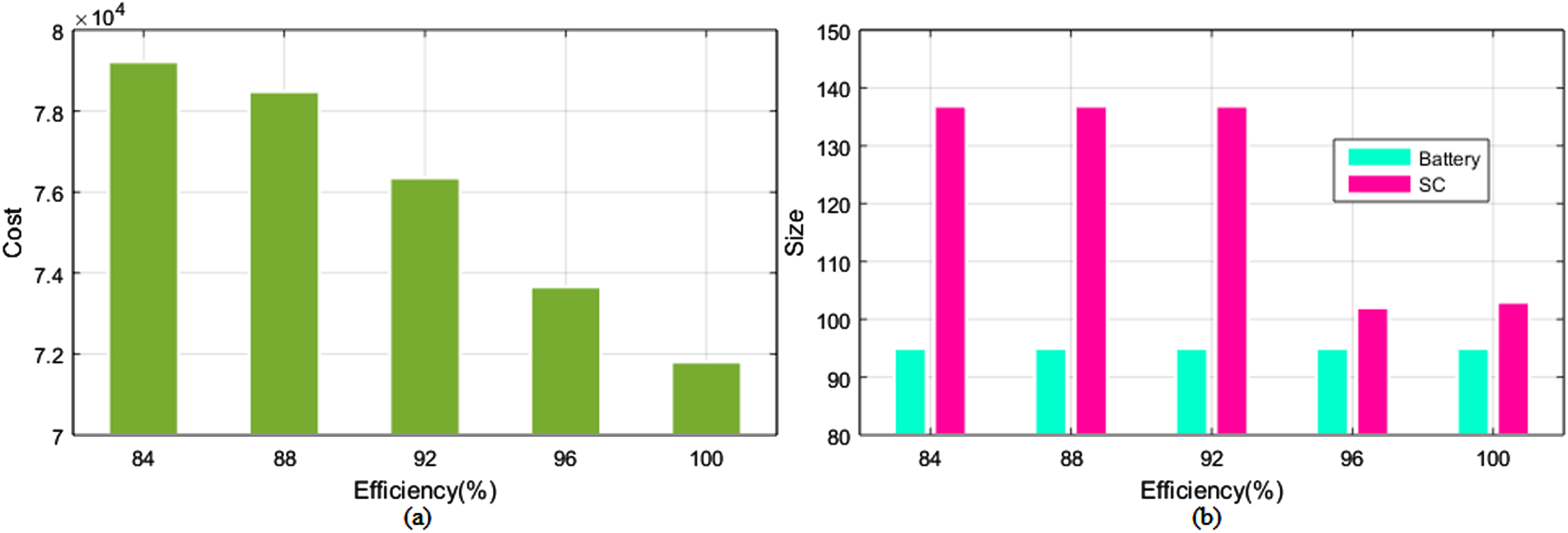
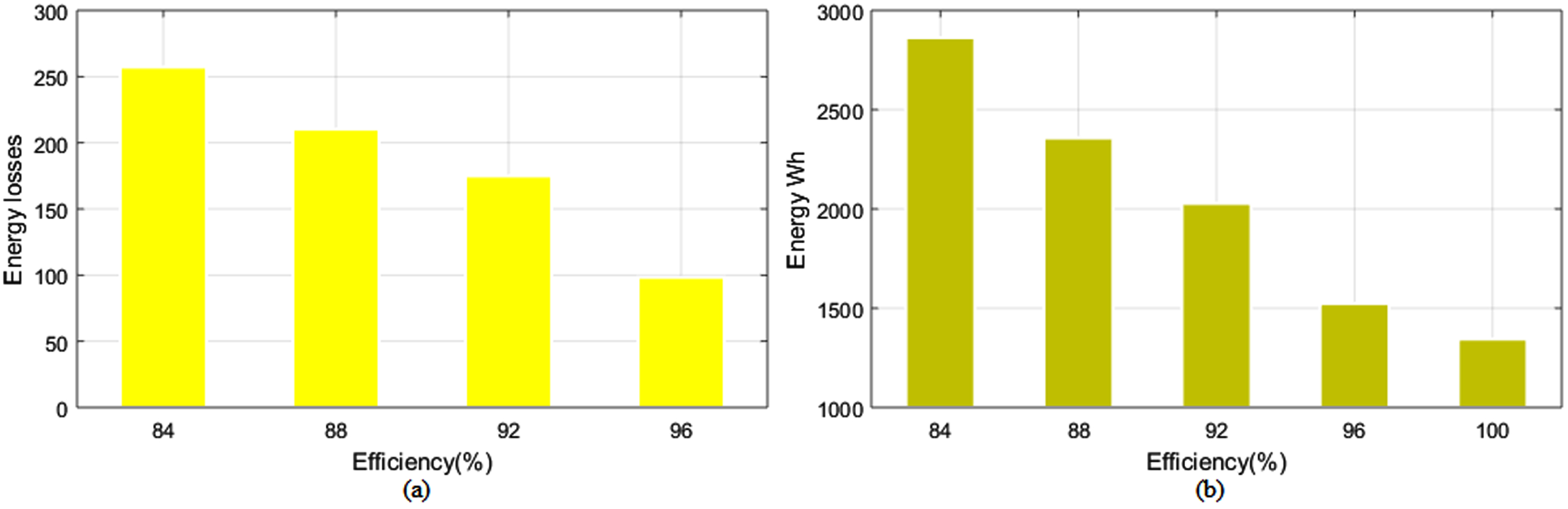
The total optimal cost, battery size and SC is displayed in Fig. 13. When the effectiveness of dc to dc converter is low then the total cost is high and efficiency is increased to high means cost is less displays on Fig. 13(a). Hence, the efficiency of dc to dc converter must be high. Based on effectiveness of dc to dc converter, the battery size is not affected which is shown in Fig. 13 (b), but the efficiency increased means, the SC pack size is reduced. Sensitive factor of dc to dc converter efficiency analysis the energy loss and energy is displayed in Fig. 14. Figure 14(a) is depicted under the increased condition of effectiveness and the loss is also reduced. Under the increased condition of effectiveness, the energy through put is reduced. It shows that more valuable energy throughput is increased through dc to dc converter. i.e, super capacitor pack is used better by withstanding more power and energy that releases the workload of battery pack, thus it significantly reduces the battery dissipation.
Dc to dc converter efficiency fed analysis the (a) total optimal cost (b) Size of battery and SC.
Dc to dc converter efficiency-fed analysis (a) Energy losses (b) Energy throughput.
The cost of component is less, and then reduces the overall cost. Sensitive factor of cost of component based analysis the battery price and energy is displayed in Fig. 15. The price of battery is high, then the total cost also high which displays in Fig. 15 (a). The battery size is not affected by the total cost and SC pack size reduction is reduces the total cost is displayed in Fig. 15 (b). Cost of component based analysis the cost of battery degradation is displayed in Fig. 16. When the cost of battery is maximized, then battery cost degradation is decreased. Hence to reduce the battery, more SC is needed. Cost of component based analysis the total cost and size is displayed in Fig. 17. Based on the SC pack cost, the total cost is not affected. It is constant to 7.6×10⁴USD which displayed in Fig. 17 (a). Size of battery and SC analysis based on SC price is displayed in Fig. 17 (b). The battery size is constant and not changed based on SC cost and the SC price is decreased from 170 to 140 USD, that is based on the SC cost increment the SC size is decreased.
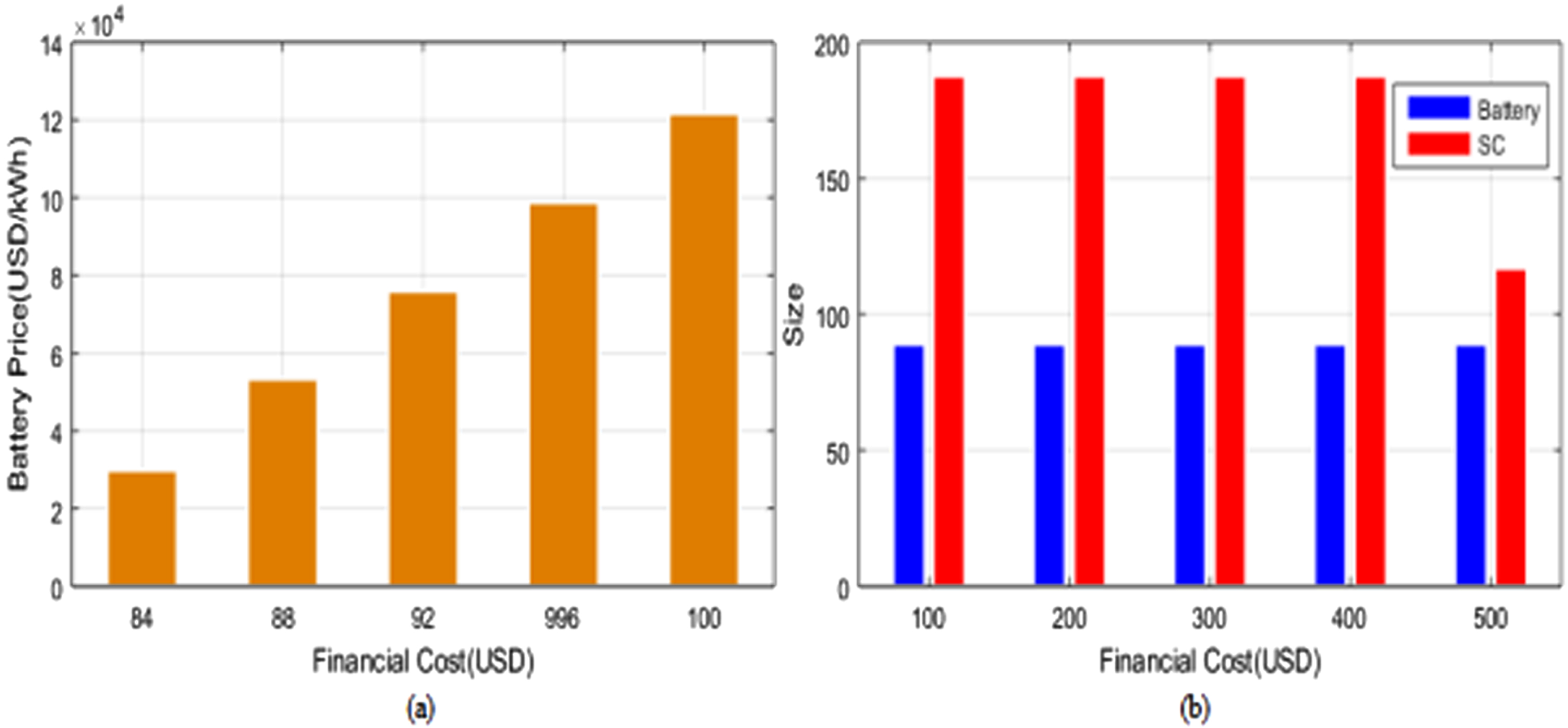
Cost of component based analysis the (a) battery price (b) Size of battery, SC.

Cost of component based analysis the battery degradation cost.

SC cost based analysis the (a) Total cost (b) Size of battery, SC.
The total cost and size is displayed in Fig. 18. Based on the dc to dc converter cost, the total cost is not affected. It is constant to 7.6×10⁴USD which displays in Fig. 18 (a). Size of battery and SC analysis based on dc to dc converter cost is displayed in Fig. 18(b) . The battery size is constant and not changed based on dc to dc converter cost and the SC size also not affected. Dc to dc converter based analysis the purchase cost and percentage of purchase cost is displayed in Fig. 19. The dc to dc converter purchase cost is increased from low to high under the converter price is increased condition which displays in Fig. 19 (a) and percentage of converter purchase also increased from low to high under the converter price is increased which displays in Fig. 19 (b). Efficiency comparison is shown on Table 1.
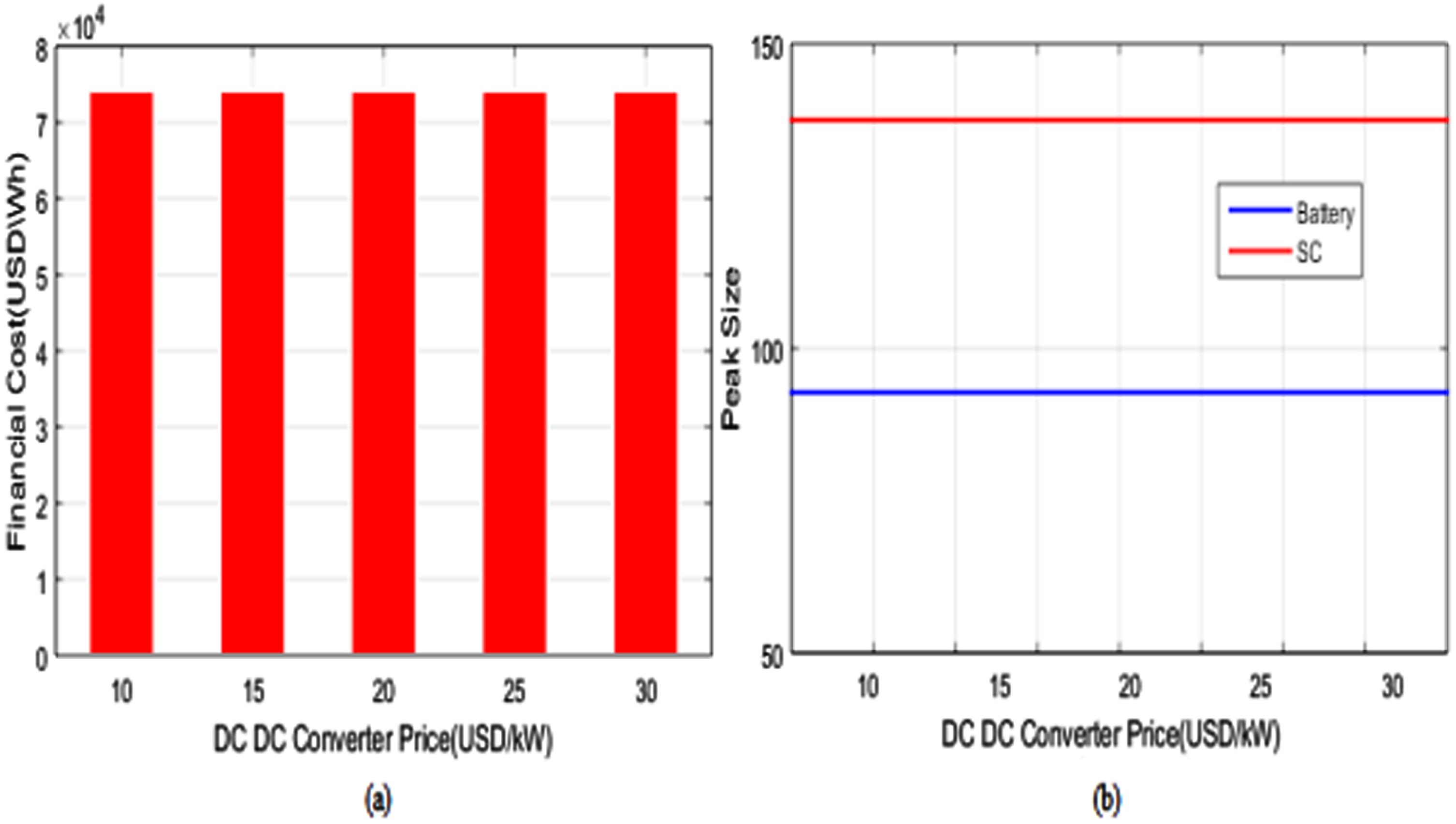
Dc to dc converter price (a) Total cost (b) Size of battery, SC.
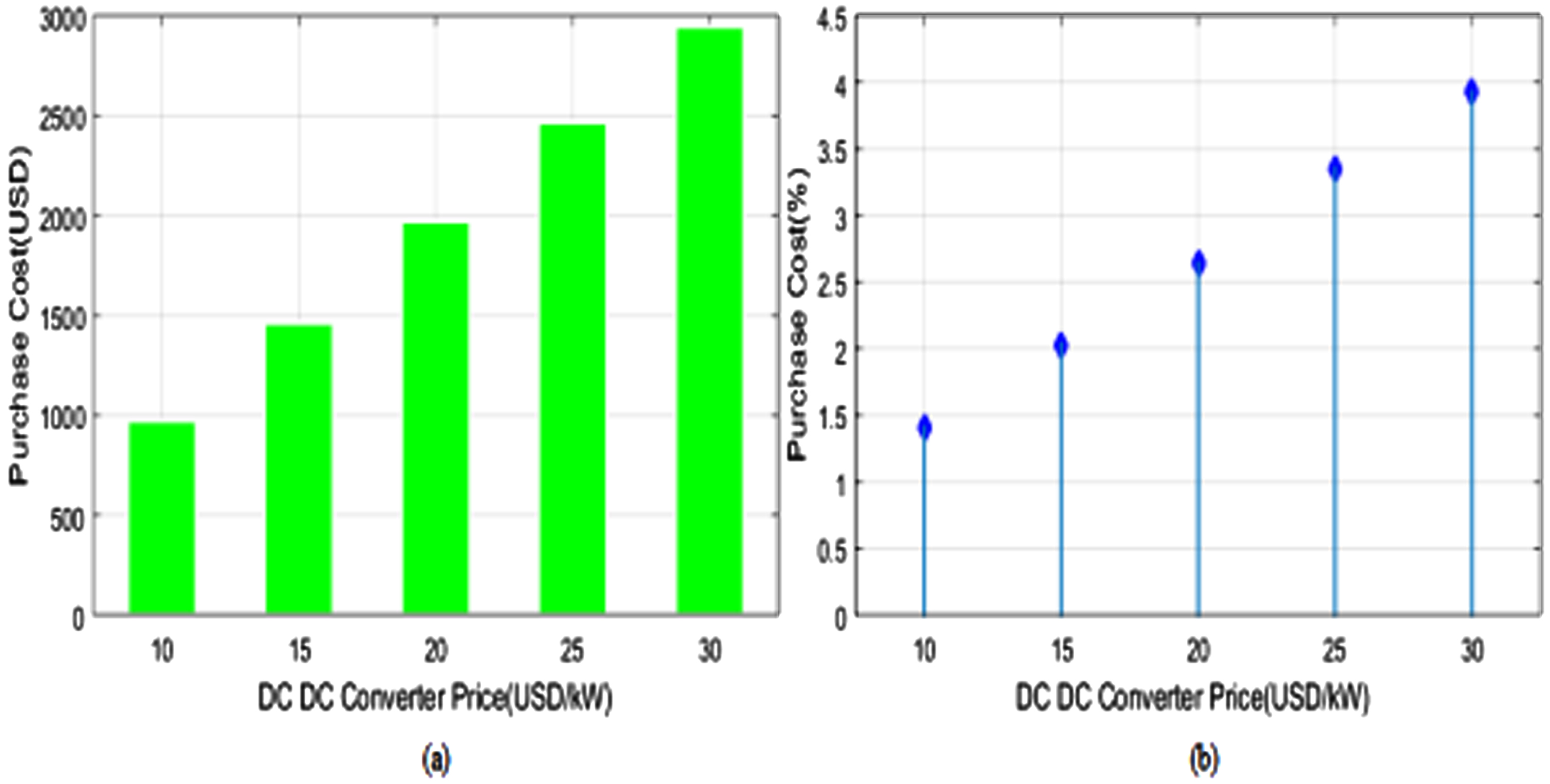
Dc to dc converter price (a) Purchase cost (b) Percentage of purchase cost.
Efficiency comparison
In this paper proposed HBA-RERNN method for optimizing the size of HESS and energy management of HESS. HESS is combined with battery and super capacitor. The major contribution of the proposed method is reducing long term and initial cost of the HESS obtain the energy management of system. The proposed method is accomplished on MATLAB platform and compared with various existing methods like GWO, SMO, and BSSA. Under base condition the overall cost and degradation cost are analyzed. The sensitivity factors like driving cycle, dc to dc converter efficiency and various component cost based analyzed the performance of the system. From the sensitivities factor analyses, it is conclude that the optimal SC size reduce the cost of HESS. Battery degradation cost is reduced using the proposed approach and it is the major part of the system. Without reducing the cost of HESS, the cost of battery degradation is reduced by the efficiency of DC-to-DC converter. The fuel economy and kinetic performance of the HEV depends on the gear change approach. Additionally, gaining a deeper understanding of optimal HESS operation may further enhance system efficiency extend the life cycle of electrical components. These two topics will be our future work.
Footnotes
Appendix
| List of abbreviations and notations | |
| EM - energy management | HESSs - hybrid energy storage systems |
| EV - Electric vehicle | HBA - Honey Badger Algorithm |
| RERNN - recalling-enhanced recurrent neural network | SC - super capacitor |
| ESS - energy storage systems | VCM- variable capacity model |
| LPF - low pass filter | DP - dynamic programming |
| PHEV - plug-in hybrid electric vehicle | TLBO - teaching-learning-based optimization |
| WT - wavelet transform | FCR - Frequency containment reserve |
| GWO - Grey Wolf Optimizer | SMO - Slime Mould Algorithm |
| BSSA - Bear Smell Search Algorithm | f l - load force |
| f r - rolling resistance force | f g -gravitational force |
| f acc - acceleration force | φ - electric density |
| S- area | c d - constant |
| - vehicle speed | m ev , m ess - mass of electric vehicle and energy storage system |
| g- gravitational constant | - parallel leakage resistance |
| r se - series resistance | c- capacitance |
| - terminal voltage | - capacitor voltage |
| -terminal current | i lea - leakage current |
| - capacitor internal current | η - efficiency |
| c t - total capacitance | dt- discharging time |
| - rate of heat generation | M- mass |
| - specific heat capacity | - rate of heat generation |
| - rate of convection heat | - maximum charging SC current |
| - minimum charging SC current | - maximal SC voltage |
| - measured SC voltage | -minimum SC voltage |
| Δv- change of voltage | - SC unit price |
| - energy capacity of super capacitor | - unit price of dc to dc converter |
| - maximum working power of battery | - maximal working power of super capacitor |
| - unit price of battery | Rveh.life - range of vehicle life time |
| Rdri..cycle - range of driving cycle | γ - battery degradation coefficient |
| i Rate - battery current rate | ΔSOC- state of charge (SOC) of battery |
| ΔSOE- state of energy (SOE) of SC | , - initial cost |
| , - long term cost | n bs - number of battery |
| X I - solution in the population of n | R1 - random number |
| U BI , L BI - lower and upper bounds of the search domain | Intensity I - intensity of prey |
| s- concentration strength | D I - distance among the prey and ith badger |
| t MAX - maximum number of iteration | (V1t, V2t, . . . , V Nt ) t ∈ r N - weight of vector connected to hidden layer |