



Abstract
In recent years, finger vein recognition has gained a lot of attention and been considered as a possible biometric feature. Various feature selection techniques were investigated for intrinsic finger vein recognition on single feature extraction, but their computational cost remains undesirable. However, the retrieved features from the finger vein pattern are massive and include a lot of redundancy. By using fusion methods on feature extraction approaches involving weighted averages, the error rate is minimized to produce an ideal weight. In this research, a novel combinational model of intelligent water droplets is proposed along with hybrid PCA LDA feature extraction for improved finger vein pattern recognition. Initially, finger vein images are pre-processed to remove noise and improve image quality. For feature extraction, Linear Discriminant Analysis (LDA) and Principle Component Analysis (PCA) are employed to identify the most relevant characteristics. The PCA and LDA algorithms combine features to accomplish feature fusion. A global best selection method using intelligent water drops (GBS-IWD) is employed to find the ideal characteristics for vein recognition. The K Nearest Neighbour Classifier was used to recognize finger veins based on the selected optimum features. Based on empirical data, the proposed method decreases the equal error rate by 0.13% in comparison to existing CNN, 3DFM, and JAFVNet techniques. The overall accuracy of the proposed GBSPSO-KNN is 3.89% and 0.85% better than FFF and GWO, whereas, the proposed GBSIWD-KNN is 4.37% and 1.35% better than FFF and GWO respectively.
Keywords
Introduction
Several biometric technologies are available, such as fingerprints, DNA, palm prints, iris scans, ear scans, facial scans, voice scans, and finger vein scans. Blood that contains deoxygenated haemoglobin is more sensitive to near-infrared (NIR) light than blood from other tissues or from other skin types [1]. In the acquired picture, finger-vein patterns are visible as darker regions due to NIR illumination and the camera [2]. Due to low blood pressure, a vein’s shape is non-uniform, presenting distinguishing features for identification [3]. Finger veins are easy to get but difficult to fabricate due to their inside location [4]. However, shades and variations in light impair the visual observation of finger-vein patterns, resulting in a reduction in identification accuracy [5]. If noise induced by shades and variations in lighting in pictures is not appropriately adjusted during pre-processing, existing feature-based approaches for finger vein detection, like Discriminative Binary Descriptor and local binary pattern, have lower recognition accuracy [6–8]. Feature extraction methods have been used to investigate intrinsic finger characteristics; however, they are still unsuitable for extracting big features because of high redundancy and computational expense. This research proposes a novel combinational model based on the aforementioned concerns. The major contribution of the proposed method is given as follows; An authentication system based on finger veins is designed to improve the recognition rate of the system, and the fusion principle has been applied to feature selection and feature fusion. Initially, the finger vein images are pre-processed to eliminate the noise and enhance image quality. Consequently, principle component analysis and linear discriminant analysis techniques are used to identify high value features. These selected features are concatenated using the PCA and LDA techniques for feature fusion. The proposed system uses Global Best Selection Intelligent Water Drops [22] (GBSIWD) to determine the relevant features for vein recognition. K Nearest Neighbour Classifier is used for Finger vein recognition of authorized person. The proposed method’s performance is assessed using accuracy, sensitivity, specificity, and Equal Error Rate (EER).
There is no research paper previously available for the range of best features. Minimum features degrade the accuracy. Maximum features will take more time. The main novelty is finding the best k for accurate classification with minimum time.
The remaining paper is ordered in a resulting manner. literature survey is summarized in Section 2, Section 3 discuss the proposed model and related algorithms, Section 4 examines the suggested method’s performance and compares it to existing techniques. Finally, Section 5 brings the paper to a conclusion and future work.
Related works
H. Liu, [9] LBP or Gabor descriptors are used to extract the local feature, and it is then mapped to improve its discriminative performance by utilizing a discriminative feature learning approach. Multi-directional pixel difference vectors allow for the discrimination of this feature by comparing each pixel with its neighbouring pixel. The classification of finger veins is performed using a histogram of the characteristics of the veins.
A finger-vein extraction strategy was designed by Y.H. Liu and C. Liu Kim [10] using a random forest training method, a regression method, and an efficient local binary pattern feature. They accomplished cutting-edge finger-vein recognition by combining it with a vein pattern matching approach that is resistant to finger misalignment. Extensive tests were carried out on two prominent databases to demonstrate the efficacy and resilience of the suggested strategy.
Yang, J. et al. [11] used adaptive vector field estimation to establish an effective solution to finger-vein feature encoding. Because vein networks are built up of vein curve segments, an initial collection of spatial curve filters (SCFs) with varied curvature and orientation is formed. The experimental findings suggest that the proposed technique improves finger-vein matching accuracy significantly.
Darwish, S.M., [12] proposed a personal identification system based on finger veins. The vein pattern was created using the Gabor transformation by combining the vein images with local and global features. Comparing the performance of the suggested model with some of the most complex finger vein recognition systems, the results show an improvement of 6% in accuracy.
F. Saadat and M. Nasri [13] suggested a multi-biometric approach for human authentication. The suggested approach fused three different finger vein patterns that used a score-level fusion mechanism. The gravitational search Algorithm is employed in the suggested system to optimize the weights of the sum fusion technique. The experimental findings show that the suggested technique outperforms the standard fusion strategy in human detection.
Xiong et al. [14] provide a modified chaotic binary particle swarm optimization (MCBPSO) technique and it is used for feature selection so that the fusion of features at the face and iris level is reduced in complexity. It starts particle swarms using chaotic binary sequences and uses the kernel extreme learning machine (KELM) as a fitness function.
Garg et al. [15] have developed an automatic method for iris identification based on 2-D iris images. In this, for selecting a subset of iris features without compromising sensitive information, the 2DPCA (two-dimensional Principal Component Analysis) and GA (Genetic Algorithm) are being used as feature extraction and feature selection methods.
Xie, C., and Kumar, A., [16] proposed an approach based on supervised discrete hashing and CNN for fingerprint vein authentication. In this experiment, finger-vein data from two sessions is available for public use. When supervised discrete hashing is added to a CNN trained with a triplet-based loss function, the accuracy is higher.
Kang, W et al. [17] suggested a 3D reconstruction method for generating a full-view 3D finger vein image. In addition, a lightweight CNN with depth wise separable convolution is used for 3D finger vein matching and feature extraction. Although the suggested approach generates promising results for finger vein verification, much work has to be done to reduce time consumption and increase verification accuracy.
A joint attention (JA) module was proposed by Huang, J., et al. [18] that focuses on fine-grained features through dynamic adjustment and information aggregation of the channel and spatial dimensions of feature maps. In this manner, vein patterns can contribute to extracting identifying characteristics more effectively. According to the experimental results, the suggested technique performs better on numerous self-built and public datasets: EER of SDUMLA-HMT is 0.35% and FV-SCUT is 0.49%.
According to K. Kapoor et al. [19], a robust finger vein identification method was developed by combining hybrid Local Phase Quantization (LPQ) for robust feature extraction with Grey Wolf Optimization-based SVMs (GWO-SVMs) to optimize the SVM parameter combination. SVM and kNCN-SRC two-stage algorithms were outperformed by this technique, with a recognition accuracy of 98%.
According to the literature study, Various feature selection methods were investigated for intrinsic finger vein recognition on single feature extraction, but their computational cost remains undesirable. In this work, for Finger vein recognition, the optimization technique Intelligent Water Drops (IWD) is implemented with the proposed Global Best Solution technique to select the subset of features which achieves the best accuracy for KNN classification show in Fig. 1.
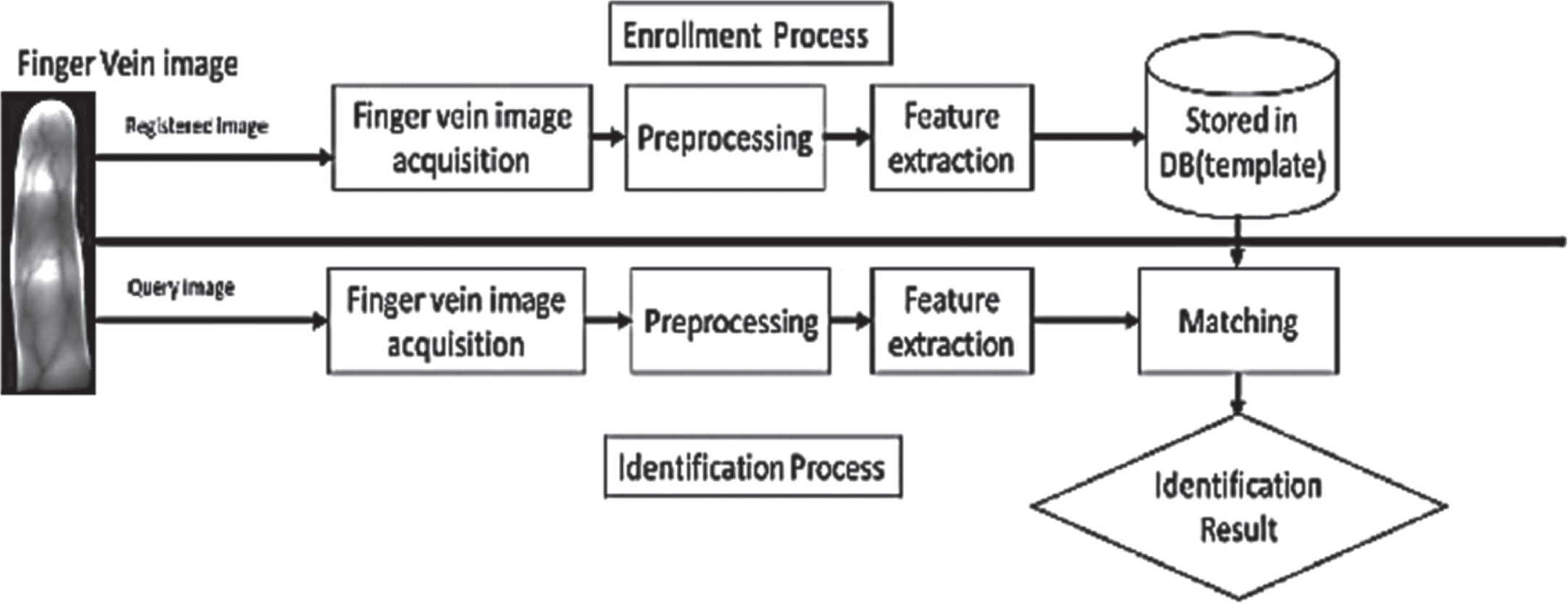
Finger vein recognition system.
In this section, a novel combinational method of intelligent water drops with hybrid PCA_LDA feature extraction has been proposed to enhance the recognition of finger vein patterns. The Proposed model for finger vein recognition consist of following phases, which includes hybrid subspace feature extraction techniques such as PCA and LDA, feature fusion, Global Best Selection Intelligent water Drops optimization technique for feature selection and finally feature classification on the optimal set of features. Figure 2 depicts the entire workflow of the proposed finger vein recognition system.
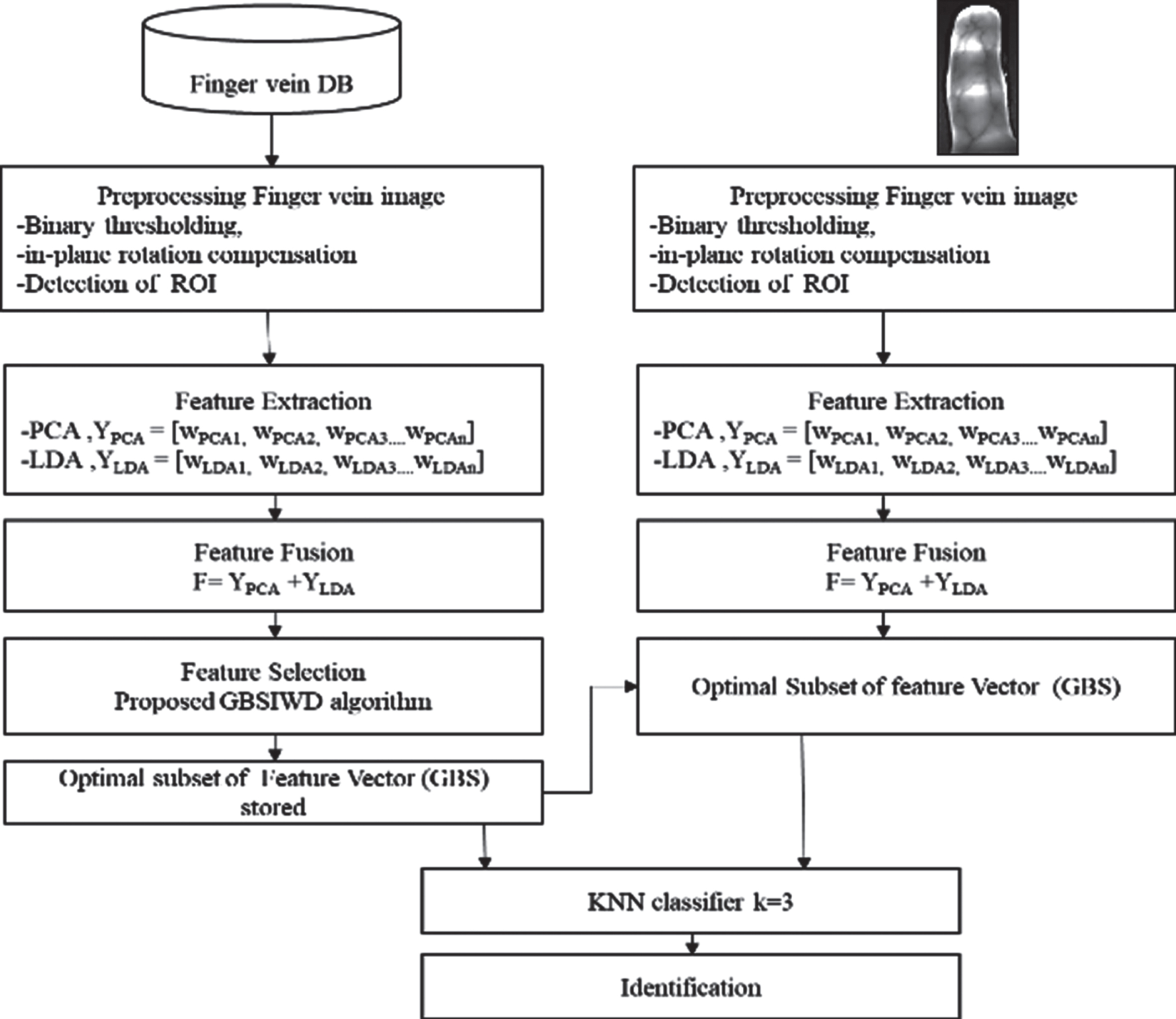
Overall workflow of the proposed model.
Initially, the pre-processed image will be subjected to feature extraction (PCA LDA), with two subspace approaches used to choose significant features. Those extracted features will be concatenated in order to perform feature fusion. To obtain the ideal set of features for the finger vein classifier, concatenated features are used in feature selection. In order to find the most useful subset of attributes for vein detection, Global Best Selection Intelligent Water Drops (GBS-IWD) was used. Finally, the K-NN classifier is utilised to classify or recognise features.
For feature extraction, principal component analysis (PCA) is utilised to create the most distinctive features. PCA is used to build a collection of training data that may be segregated as much as feasible and compressed as closely as possible. It is used to analyse visual objects, find patterns, and express the object in order to emphasise distinctions. It characterises the image’s subject in terms of variance. Each primary component of the picture describes the largest degree of variation. Because patterns might be difficult to identify in high-dimensional data, PCA can find these patterns by lowering the number of dimensions without considerable information loss.
Linear discriminant analysis feature extraction
Fisher’s criterion function is used to choose a solution vector for linear discriminant analysis, which will ensure that after projection in this direction, the homogeneous samples in the original data set will be as close as possible to each other and as far apart as possible from each other. As the name implies, the LDA method is merely concerned with finding the optimal transformation vector. In this case, a scatter matrix is used to reduce the feature space before determining the ideal solution vector.
The ideal feature set was generated by utilizing linear discriminant analysis. It also normalized correlated features from the variance of the object. When two or more vectors are evaluated linearly, dimensions are reduced.
Feature level fusion
For recognition, feature fusion aims to combine information from two or more feature vectors into a single feature vector with higher discriminating power than any of its inputs. Using linear discriminant analysis models in low dimension space, concatenated features are constructed by combining perceptually salient picture characteristics. Correlation analysis has been demonstrated to be effective in identifying vector relationships in decreased feature sets [20]. A fused vector is generated by combining these two homogeneous vectors.
Where X PCA represents vein feature Vector extracted by the PCA
Where X LDA represents Vector feature of vein extracted by the LDA, n denotes the training samples.
The distance vectors of the PCA X PCA extracted features and the LDA extracted features X LDA were combined after computing the distance vectors of d PDA and d LDA of each vector. By maximizing pairwise correlation, these two vectors are joined using the combination rule. According to this study, the vector combination rule is the sum of all the feature vectors. Equation (4) displays the resulting vectors after adding the distance vector to the mean vector (equation 3).
Feature selection maximizes classification accuracy and reduces computation costs by removing the least important features from a feature set. Figure 3 depicts the work flow of IWD employing a unique combinational model for feature selection using Global Best Selection-Intelligent Water Drops model to create the ideal features for vein detection.

Flow chart for IWD algorithm with HUD search.
Shah-Hossein was the first to develop intelligent water droplets as an optimization method that was inspired by nature. Shah-Hossein overcame the Traveling Salesman Problem (TSP), the Knapsack Problem, and the n-Queen Problem with this approach. The optimization technique has recently been used in a variety of domains, including shop scheduling, task scheduling in a Grid environment, practical multi-echelon supply chain, and sentiment analysis feature selection [21].
Intelligent water drops construct the optimal best features by collaborating on various heuristics, particularly scatter search and iterated local search. Probabilistic Selection using a roulette wheel based on velocity and F score computation are two-step processes. A set of population vectors is chosen based on probability distribution in the roulette wheel selection process. To determine the trial vector, the f score is computed for each parameter vector and instance. Tuba Parlar and Esra Sarac explore IWD optimization for feature selection in sentiment analysis.
The basic nature of rivers is that they flow along their path, and the flow of water is referred to as water drops here. The characteristics considered for the optimization problem are the optimal path distance and flow speed. Soil and velocity are the two most important characteristics of flowing water. The flow of water carries small amount of soil and its velocity (speed) is based on the soil the water carries.
Mathematic modelling of IWD
Intelligent water drops optimization technique [23] is constructed on the natural flow of water. The flow of water drops owns some properties and the main two properties considered in this technique is Soil (Soil IWD ) and Velocity (Velocity IWD ). Here the problem is to find the optimal feature subset. The graph is constructed and the flow of water drops traverse to all the features (nodes) based on the shortest path (edge) and find out the best subset features with minimal time.
The probability function of water drop is shown in below equation
The ΔVelocity IWD of the time depends upon the Soil (i, j), the flow of the water in the path between i and j and is derived from the equation (6)
a v , b v , cv, are positive static parameters. Soil (i, j), amount of the soil carried from i to j. It is the amount of soil that is added to the water drops that determines the flow of the water drops. As a result of the water drop removing soil from the local path, it is represented by
a s , b s , c s , are positive static parameters. In equation (8), the duration of time taken by the IWD to move from location i to j is defined as the velocity of the IWD is proportional to the distance between the two locations.
HUD(I, j) is a heuristic function used to calculate the objectionable move of water drops. In addition to soil delivered by a water drop, soil on the path between nodes ‘i’ and ‘j’ can be updated using equations (9 and 10).
The best solution for each iteration, based on the collection of solutions obtained by each IWD, the FIA can be calculated as follows:
The optimum solution for all IWDs in equation (11), F IA , has the fewest features. Following receipt of this solution from F IA , the soil of the path that best solves the problem of the existing way is updated as indicated below.
The procedure is repeated until the maximum number of iterations has been achieved. It is depicted below-
The selection of parameters may influence the quality of the computational results.
Here, the traditional Practical Swarm Optimization (PSO) approach is utilized to calculate the effectiveness of the proposed GBSIWD feature selection. PSO is a swarm intelligence based on global evolutionary search techniques.
The algorithms in the wrapper technique, which implies they all, require a learning algorithm to measure the classifier accuracy of the selected feature subset during the evolutionary training phase. Here KNN learning algorithm is used. We set the maximum number of runs to 30, and set the maximum number of iterations to 3000 to terminate the algorithm. The following table shows the initial parameter settings for the feature selection model utilising GBS PSO and GBS-IWD.
The training settings utilised for GBS-PSO feature selection are shown in Table 1. It creates the best feature from a given fusion vector using a fitness calculation based on an objective function.
Parameter setting for feature selection using Global Best Selection PSO
Parameter setting for feature selection using Global Best Selection PSO
Table 2 displays the training settings utilised for GBS-IWD feature selection. GBS-IWD generates the feature vector on 30 runs, for each run 100 iteration. IWD based feature selection algorithm selects a predefined number of features for each water drop. They update soil and velocity values, as well as feature selection probabilities, based on the performance of the selected features. This process is repeated until only the best traits remain. After selecting the best features, the dataset is classified using the specified feature set.
Parameter Setting for Feature Selection using Intelligent Water Drops
GBSIWD is used to construct the graph for the finger vein features. The parameters have been set to their default values. Initially the water drops spread over randomly to construct the graph and then starting node is initiated with the probability of selecting node i as in (14)
Here p(i) is the probability of the selection node i and f (soil (i)) is the fitness function. And is inversely proportional to the entire soil value as in equation (15)
Where
Soil(i) is quantity of the soil in the node (feature) and soil(new) refers to the node unvisited and the new node is added to the list L. After selection the possible nodes using equation (14) and training dataset is classified according to the selected features.
As a fitness function, classification accuracy is employed to assess the quality of the features. The high accuracy features are chosen, and the velocity and soil values are updated based on the accuracy.
For each water drops the velocity is updated as in (17) follows
The soil quantity of selected features are constructed using
Where
Here L refers to the selected subset features and Accuracy (L) refers to the accuracy of the selected subset features. The soil content of the selected feature L is removed and updates using (20)
Until the termination, the above steps are computed. Here we use 100 iteration as termination for each run and totally 30 runs are experimented.
The KNN classifier was used to classify the optimum feature subset generated through feature selection. It is a non-parametric approach. The approach is termed instance-based since it finds the k nearest points to forecast the class label for the feature sample. Using the distance weighting estimate, the closest k points are predicted as classes for training feature samples.
Assume that X represents an ideal feature vector for which the nearest neighbour must choose the class that it represents; the distance measure can be used to determine which class T ij . Distance (d) is calculated using Euclidean distance.
Where n is a number of dimensions, x and y are data points.
Finger vein identification was tested using a novel combinational model in this study. Based on the results of the experiment and the K-fold cross validation test described in the sections below, its performance has been evaluated in various settings.
Experimental environment and dataset description
The experiment is run on a Windows 7 Intel Core i7 CPU with an operating frequency of 2.53 GHz and an useable memory of 8GB. The THU-FVFDT1 finger vein dataset utilised in this study was collected from 40 people, with 5 fingers veins from each person, yielding 200 samples. The photos were taken in three sessions, each with four photographs, with at least one week between each session. The database image has a resolution of 720x576.
Evaluation criteria
The different classifiers are introduced and evaluated based on the evaluation criteria to show which one performs better in the proposed work. Performance measures like accuracy, FAR, FAR, and EER are used to calculate the FKP recognition’s results. Equations (22), (23), (24), and (25) include general formulas for calculating precision, FAR, and FRR.
The preprocessing is done to enhance the quality of the finger vein image. Typically, the finger vein image has low contrast, noise, and shades. This is due to changes in the light, the finger’s rotation and translation, and the functionality of the capturing device. To alleviate these issues, the preprocessing step is used. In this work, the ROI (region of interest) is extracted and histogram equalization is used in image enhancement. The preprocessing finger vein images are given in Fig. 4a) input finger vein image, b) ROI of finger vein and c) enhanced FV image using Histogram equalization.

a) Input Finger vein b) ROI FV image c) After Histogram Equalization.
The pre-processed finger vein images are used to extract the more relevant features using hybrid feature PCA_LDA feature extraction technique. For each image, the decreased dimension of fusion vector length is 72. Photographs of three images from each of the 40 patients are utilised for training in the first fold validation. The vein patterns were extracted as single dimension feature vectors using principle Component Analysis and Linear Discriminant Analysis during the training of the finger vein detection model. In addition, Feature fusion is employed using Concatenation process of hybrid PCA_LDA feature extraction.
Feature selection with GBSPSO and GBSIWD optimization technique
Comparisons of the proposed techniques’ recognition performance with existing PCA LDA Euclidean and PCA LDA KNN methods are shown in Tables 3 and 4. The cutting-edge approaches are contrasted by categorising them as non-training-based or training-based.
Performance evaluation of existing models using PCA-LDA euclidean
Performance evaluation of existing models using PCA-LDA euclidean
Performance evaluation of existing models using PCA-LDA-KNN
In this part, we describe experiments that demonstrate the efficacy of the proposed strategy in merging feature sets generated from the hybrid PCA LDA model on finger vein pictures. Because neighbouring pixels in a picture are frequently associated [24], down sampling the feature images can decrease information redundancy.
A hybrid PCA LDA feature vector is formed by combining the N-dimensional feature vectors generated at each point. Moreover, the Fused Feature vector increases recognition, which is then subjected to feature selection using the suggested IWD. For the comparison of the proposed GBSIWD feature selection the traditional PSO optimization technique is implemented in the same procedure.
In a research of finger vein recognition, the optimization strategies for feature selection are applied. Therefore, the comparison the Practical Swarm Optimization is implemented in the same procedure and the results compared with the proposed GBSIWD. Both IWD and PSO, which are optimization algorithms, produce better results for the feature summary. When comparing PSO and IWD in terms of classification accuracy, IWD outperforms PSO with fewer features and faster computation. As a result, the error case for each method appears differently. As a result, the error rate of each approach differs in the first and second folds. Because of the misalignment, the erroneous rejection case varies greatly [25].
In this experiment, we use hybrid PCA_LDA features to select the optimal subset features based on proposed IWD-based feature selection techniques. The features of the Global Best Solution are chosen based on the relevant features. Table 5 depict the number of features selected form various feature vectors reliable to counts from 1 to 5 using GBSIWD and GBSPSO-based feature selection algorithms.
Comparative analysis of GBSIWD and GBS PSO features for number of runs
Comparative analysis of GBSIWD and GBS PSO features for number of runs
For feature selection, the hybrid PCA LDA features are extracted and fed into the IWD and PSO algorithms. For runs 10, 15, 20, 25, and 30, the global best solution of features is selected by eliminating repeated feature values and here the increasing count in optimization algorithms such as IWD and PSO results in subset of optimal features. In count 5, for 30 runs it shows 26 selected features for GPSIWD and 30 features for GPSPSO respectively. Finally, the feature count 5 reveals that, as compared to PSO, the proposed GBSIWD performs well with a reduced number of features.
According to Table 6, when IWD and PSO-based feature selection are used, fewer features are selected, the subset of features is optimal, and recognition accuracy is improved. As the number of generations increases, both feature selection algorithms improve their classification accuracy. In every evaluated feature, the accuracy of GBSIWD and GBSPSO is comparable, but with a reduced number of features. GBSIWD and GBSPSO feature selection algorithms have accuracy of 99.4 percent and 99.6 percent, respectively. Besides that, IWD has 26 selected features, while PSO has 30 for 30 runs.
Performance accuracy of the proposed GBSIWD with GBSPSO
Table 7 shows the number of features reduced and selection of relevant features based on users. Each class contain 5 finger vein images 70% for training and 30% for testing. 10, 15, 20, 25, 30, 35, classes contain 50, 75, 100, 125, 150, 175, 200 users respectively. The hybrid PCA_LDA feature vector is performed with count 5 for different class levels. The GBSIWD selected optimal feature vectors are 19, 28, 32, 29, 25, 22, 20 for 10, 15, 20, 25, 30, 35, classes, which is comparatively less than GBSPSO. This shows that the number of features selected for the GBSIWD feature selection algorithm is less than the GBSPSO. The GBSIWD-based feature selection algorithm, takes more time to execute than the GBSPSO feature selection algorithm. However, GBSIWD is good in finding the optimal number of features, which compensate for computational inefficiency.
Analysis of Recognition time of the GBSIWD and GBSPSO
Performance comparison of existing Finger vein verification techniques
However, the feature selection of the PSO has been carried out on the same iteration of the IWD for regeneration of optimal features. Optimal feature generates on the parameter setting which is in table. With KNN, a feature identified with GBS-IWD is used to recognize the finger vein in the query image. As described above, KNN uses a number of neighbours (K = 3) to measures the performance accuracy of the described methods: it increases the probability that neighbours will be close so that noise can be reduced (increasing the chance of a close neighbor).
Compared to existing finger vein verification techniques, the proposed technique performs better shown in Fig. 9. From the table the equal error rate (EER) of the proposed technique is 0.15% and 0.31% is less than the existing JAFVNet, 3DFM and CNN respectively.
The proposed feature selection technique for finger vein recognition achieves good accuracy with 99.35% for the IWD and 98.85% for the PSO, respectively. Furthermore, the processing time for the proposed approach takes 0.2s, whereas existing methods GWO and FFF takes 1.23s and 5.1s, respectively [26]. As a result, the suggested feature selection algorithm consumes less time and reduces computing costs. Further, the proposed feature selection algorithm works well with the hybrid PCA LDA features extraction technique for finger vein recognition. Therefore, in comparison to other existing approaches shown in Table 8, the proposed approach improves accuracy and reduces the computational cost.
Performance Comparison with existing methods
Performance Comparison with existing methods
For finger vein recognition, we developed and implemented a new combinational model. The use of feature extraction techniques such as PCA & LDA, which yielded high relevant features, resulted in an improved finger vein detection system in this study. Furthermore, those features are combined to form feature fusion. Further, population-based optimization techniques such as Practical Swarm Optimization based global Best Selection (PSOGBS) and Intelligent Water Drops (IWDGBS) have been developed to provide a technique of categorization of features besides that, IWD has 26 selected features, while PSO has 30 for 30 runs. The IWDGBS selected optimal feature vectors are 19, 28, 32, 29, 25, 22, 20 for 10, 15, 20, 25, 30, 35, classes, which is comparatively less than PSO-GBS. The proposed feature selection technique for finger vein recognition achieves good accuracy with 99.35 % for IWD and 98.85 % for PSO respectively. The processing time for the proposed takes 0.2 s whereas existing methods GWO and FFF take 1.23s and 5.1s. Therefore, the proposed feature selection algorithm takes only lesser time consuming and reduces the computational cost. For finger vein recognition, hybrid PCA_LDA features extraction technique, which supports well for the proposed feature selection algorithm. In comparison to existing approaches, the proposed approach improves accuracy and reduces the computational cost. The proposed technique will be tested on large number of datasets in the future. Also, the proposed techniques intend to conduct experiments by combining more robust meta-heuristic optimization tools for further inquiry in this domain.