



Abstract
A Mobile Ad-hoc Network (MANET) is a self-constructed network consisting of spatially distributed nodes that cooperatively arrange themselves without any centralized manager or fixed based stations. In MANET, the nodes are deployed in a dynamic scenario, so, the nodes may fail as a result of energy depletion, hardware failure, communication link errors, and malicious attacks. Therefore, it is necessary to design energy-efficient fault-tolerant algorithms and protocols for MANETs. Since the development of Mobile Ad-hoc networks was originally motivated by military applications, such as battlefield surveillance and healthcare applications it is required to have a fast recovery mechanism to overcome the fault condition. In this research work, a fault-tolerant Routing mechanism is designed and implemented to address the fault conditions such as node failure, link failure, and critical battery issues called Fault tolerant cluster based AODV with Error Reporting Routing (CAODVERR) protocol, and to improve the stability of the MANET. Also, an Error reporting mechanism has been incorporated with the Ad-hoc On-Demand Distance Vector (AODV) routing protocol.
Introduction
In MANET, each node can collect and route data either to other nodes or back to a source node. A mobile node has capable of connecting the source node with other nodes by creating its infrastructure or to the Internet, where a user can have the access to the reported data. The important operations in a Mobile Ad-hoc Network are data dissemination and data gathering. The data dissemination is the process of routing data or queries throughout the network and data gathering is the collection of observed data from each neighbor node where it traversed.
Routing in Mobile Adhoc Networks is the process of the route of the data from source to destination. A Routing protocol should ensure that the MANET can reconfigure, be energy efficient, and resilient to failures. Most of the existing routing protocol in MANET has focused upon methods for constructing the best route, or routes, from the data source to the destination before routing the packets. Due to the inherent nature of these networks, a mobile node may fail and hence the route between the nodes may also fail. When a routing path between the source and the destination fails, the data packet is unable to reach the intended recipient and it is discarded. Hence, a mechanism to report routing errors (occurs typically when a data packet is discarded) is desirable. Fault tolerance is the ability of a system to provide its services/functions even in the presence of faults. Due to the fault-prone nature of MANETs and since they are deployed in a hostile environment it is required that the MANET should provide its functions even in the presence of node or path failures. Hence, providing for fault tolerance is an important requirement of this network.
This work proposes a Fault-Tolerant Cluster-based AODV Routing protocol that works for MANET. The function of the proposed protocol is to typically send error messages to the source of the data packets whenever a data packet along the route path is discarded. It also provides a control message which can be used to find alternate active neighbors of a node to continue its process. This protocol provides alternate paths called a backup path for fault tolerance. The rest of the paper was organized as follows: Section 2 explains the similar works related to the proposed system. Section 3 depicts the architecture of the CAODVERR Protocol and explains its process in detail. Section 4 discusses about the experimental setup for the given technique and provides the detailed analysis for the experiments conducted with comparison of the existing systems. Finally, section 5 gives the conclusion with the further enhancements needed in the proposed work.
Literature survey
Cluster based routing protocols use specific clustering algorithms for cluster-head election. In ad hoc networks, mobile nodes are grouped into clusters and cluster-heads take the responsibility for membership management and routing functions. There are few works in the literature that deal with cluster based routing protocols and error reporting scheme in [1] elaborated a new energy based AODV protocol which maintains the energy level of nodes after the packet transmission takes place at each node. The energy level is also depending on the packet size transmitted. It is also very helpful to know the node energy levels when the routing paths are selected for transmission of data. The threshold value is maintained to select the node for the routing path. By choosing the energy efficient nodes, failure in transmission due to node failure is reduced. Meanwhile, the packet delivery ratio is increased with high throughput.
In [2], authors developed a proactive routing protocol for MANET based on different objective which is suited for reduced end-to-end delay, increased network energy lifetime, and increased packet delivery ratio. This approach used three different metrics such as link stability, energy value of the node and delay at each node. This helps to predict the reason for failure at each node and improves the ability of system to identify the efficient path for packet transmission. In [3], researchers discussed about network coding based AODV protocol to support multipath routing. This work mainly concentrates on bandwidth of data transmission. It also provides better load balancing than existing system when compared based on experimental results.
In [4], recently designed the dynamic topology to enhance the efficient routing in infrastructure less environment. In general, the dynamic movement of nodes and the mobility nature of this network are the main causes for routing overhead, and packet drops. The author describes about multipath routing strategy, which selects multiple routes that are stable. The stable routes maintains in the routing table helps to reduce the energy consumption. This kind of data transmission depends on residual energy and Link Expiration Time (LET). By this multipath routing strategy, the reliability, load balancing and aggregation of bandwidth can be attained which increases the life time of the available networks.
The dynamic topology of the MANET and its challenges in routing mechanism was discussed in [5]. The network needs the resources to be shared among the nodes to fulfill their requirements by enhancing the routing path in dynamic topology. The two protocols namely Hybrid Geo-cast Routing and Signal Strength and Congestion Avoidance protocol is illustrated by the researchers to provide the reliable high quality links. The article [6], provides the study about constructing an efficient routing protocol in MANET with obstacles. It is assumed that the wireless nodes are equipped with a Global Position System (GPS) chip. We take advantage of the location information by GPS to propose a novel greedy propagation territory-based routing mechanism to establish the routing path between a source and destination.
A secure routing algorithm for wireless sensor networks with respect to the energy level was proposed in [7]. This works maintains the table which will update the energy level of the node after each transmission. And also, the error occurrence during the transmission is considered to avoid the node in future transmission. This will reduce the path failure for communication. Ali [8] concentrates on exchanging the multimedia content through MANET nodes in a reliable and scalable manner. In [9], discussed about routing mechanisms for packet delivery with high transmission capacity. In general, heterogeneous networks provide the path for sharing different resources among different routes. The route discovery includes mathematical expressions and conditions for route discovery with minimum time delay.
The article [11] discussed about connectivity issues between end to end points in MANET for providing connectivity with fault tolerant. The author implements cook-ahead approach to overcome the disadvantages in traditional routing process of MANET. It helps to maintain the uniform traffic which increases the node lifetime and reduced energy consumption. In [13], authors proposed a clustering approach for wireless sensor networks using spectral graph. The nodes which grouped by using spectral graph based on the traversal of nodes for maintaining the specific path. A fuzzy clustering based intelligent and secure energy aware routing for wireless sensor networks proposed in [20]. In this, clustering the nodes for message transfer is managed by using fuzzy rules.
The article [21] gives the framework for secure trust aware routing mechanism for MANET. The challenges in multimedia connectivity discussed in [12]. It mainly focuses on fault tolerance by BeeHive routing approach. Another work in [16] used a cluster based framework for optimizing the multimedia transmissions over wireless network. In general multimedia traffic is happened in the wireless networks due to the congestion among transmission nodes. In [14], authors structured the fragile nature of MANET and the computing potential of the available network to enhance the fault tolerant environment. The check pointing is used to recover the failed transaction of rollback approach. The location of the nodules in MANETs alters ultimately in [17]. Moreover, a nodule gathering appropriately at solitary spot in moment can turn into defective shortly. Consequently, a fault-tolerant direction-finding procedure is required on behalf of relocating statistics by unambiguous data liberation velocity.
The main issues with MANET is Topology control arising due to its dynamic nature addressed in [18]. Efficient control of topology in MANET is possible only when mobility prediction is done to avoid any kind of interruption in the communication. In this work, neural network based mobility prediction model for topology control is proposed. In [19], discussed about node responsibility for relaying data to neighboring nodes for ensuring communication between distant nodes. This information dissemination mechanism pattern consumes extra node energy thus making energy a critical parameter for ensuring increased network lifetime. From the above observations, the proposed cluster-based routing with error reporting based on AODV protocol is discussed and experiments are conducted to show the advantages of the proposed system.
Aa routing protocol for WSN which considers energy consumption in node mobility mode in [10]. They considers node mobility as important factor which requires more energy than normal mode which reduces the lifetime of the node. For that, the proposed algorithm will reduce the energy consumption even the node in mobility. Another similar work carried out in [15] by considers node mobility to improve the quality of service in less energy consumption. The sense-based routing mechanism by reconstructing the data which was lost during the link failure was given in [22]. The error reporting mechanism in our proposed system is an added advantage when compared to this work. Cluster based geographical routing (LVT-CGBR) in MANET which includes encryption mechanism to protect the confidentiality over the location viewed by eavesdropping attack given in [23]. The articles [24] and [25] discusses about the secure routing mechanism for MANET to improve the QoS of the overall system. They targeted and mentioned that improvement in security will increase the efficiency of the system.
Based on the examination of the existing works, the system requires efficient routing protocol to avoid the data loss due to link failure or network error. And also, the nature of mobility in MANET will require some added concern over the node location and energy consumption. This was considered in this proposed CAODVERR system by designing the fault tolerant mechanism specifically for analyzing the link failure during communication. In addition, error messages will be send to the source whenever data packet will be lost. The backup path was constructed immediately was reduce the delay path reconstruction.
Cluster based routing with error reporting AODV protocol
Cluster-based routing has been rewarded with many advantages when you compare to other routing mechanisms. One of the main advantages of this routing is to provide a routing table with reduced size and makes the routine faster. It also decreases the transmission overhead by making the changes in the routing table based on the changes in the existing topology. And also, it helps to save energy and increase the bandwidth in ad-hoc networks is shown in Fig. 1. The Fault-tolerant cluster-based AODV with Error Reporting Routing (CAODVERR) protocol consists of two important tasks namely, Cluster-based Routing and Error Reporting.
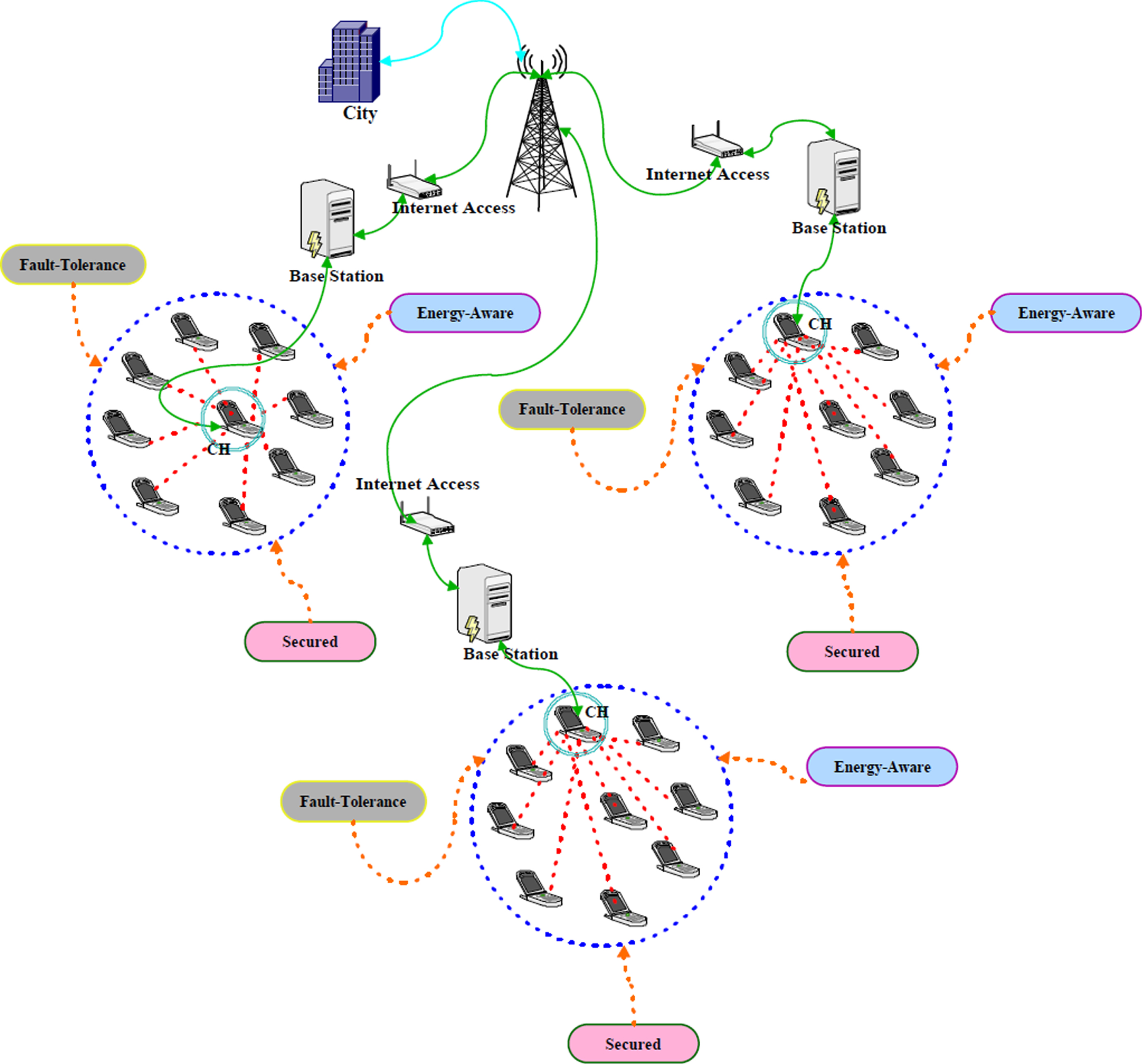
System architecture of CAODVERR protocol in MANET.
The routing of data from the source node to the destination node is the primary goal in MANET. In this research work, routing has been designed and implemented with an error reporting mechanism to maintain the stability of the network by upgrading the available AODV with an error reporting mechanism. In this regard, a routing scheme has been implemented with the following four phases namely the Advertisement phase, Route discovery phase, Route Construction phase and backup route construction.
Advertisement phase
In this phase, nodes are initially broadcasting an advertisement packet to indicate that they are ready to receive the data packets from other nodes or routing the packet to other nodes. When a neighboring node to the other node receives this advertisement packet, it stores the route to the advertised node in its routing table. Nodes that receive the advertisement packet do not propagate it, thereby reducing the number of transmissions that occur due to the broadcast of the packet.
Route discovery phase
After the advertisement phase, nodes enter into a route discovery phase in which nodes that do not have a route to the receiver node broadcast a Route Request (RREQ) packet asking for a route to the node. When a hub receives an RREQ packet, it broadcasts a Route Reply (RREP) packet. Similarly, when a node receives an RREQ packet, it broadcasts an RREP packet if it has a route to a hub. Otherwise, it ignores the RREQ packet. When a node receives an RREP packet, it stores the route in its routing table.
Route construction phase
A routing table is used to build and maintain the routes. The route selection is based on the remaining energy of the nodes. i.e. if two routers with the same sequence number compete for entering into the routing table then the one with more remaining node energy is admitted into the table. Along with remaining energy, the past performance of the link and the distance to the Base station is also considered for selecting the routes.
Backup route construction
In this protocol, the backup route is provided for all nodes in the network. Whenever a node receives a Route Reply (RREP) packet, it stores the route to the destination in the routing table. If it does not have a route to the destination, an error message is sent. If the node already has a route to the destination, it stores the other RREP packets in the Backup route table. Each node has a Backup route table to maintain the backup paths. The backup route table has two fields namely the node’s ID and energy of the node.
Consider the scenario shown in Fig. 2 for backup route construction. If node 1 does not have a route to the destination but nodes 3, 4, and 5 have a valid route to the destination. During the route discovery phase, node 1 which does not have a route to the destination broadcasts a Route Request (RREQ) packet. The RREQ packet which was broadcasted by the Node1 is heard by nodes 2, 3, 4, and 5 which are within the transmission range of node 1. Now, Nodes 3, 4, and 5 will send a Route Reply (RREP) packet to node 1. Node 1 will thus get RREP from three nodes that already have a valid route to the destination. Node1 stores the route information of the node which has the highest residual energy as the main route and the remaining nodes as the backup nodes in the backup route table. When a node fails to deliver a data packet through the existing path, it immediately utilizes its backup route which will become a new path for the next coming data packets. This facility reduces the number of data packets dropped and maintains the continuity of data packet transmission in the presence of the faulty condition.
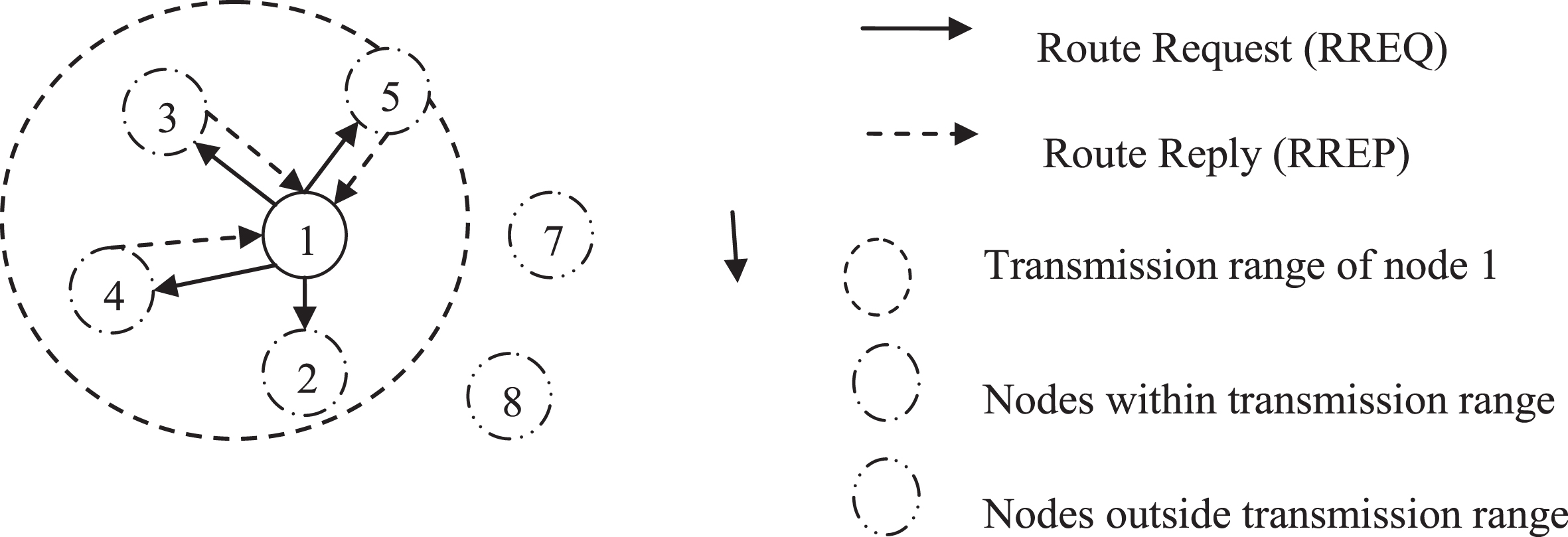
Backup route construction.
The Error reporting features incorporated into the cluster-based routing protocol has the following types of failures namely route node unavailability, Critical signal strength, and Destination Unreachable message.
The Steps of the algorithm that is used for fault tolerance and Error Reporting scheme is shown in Fig. 3.
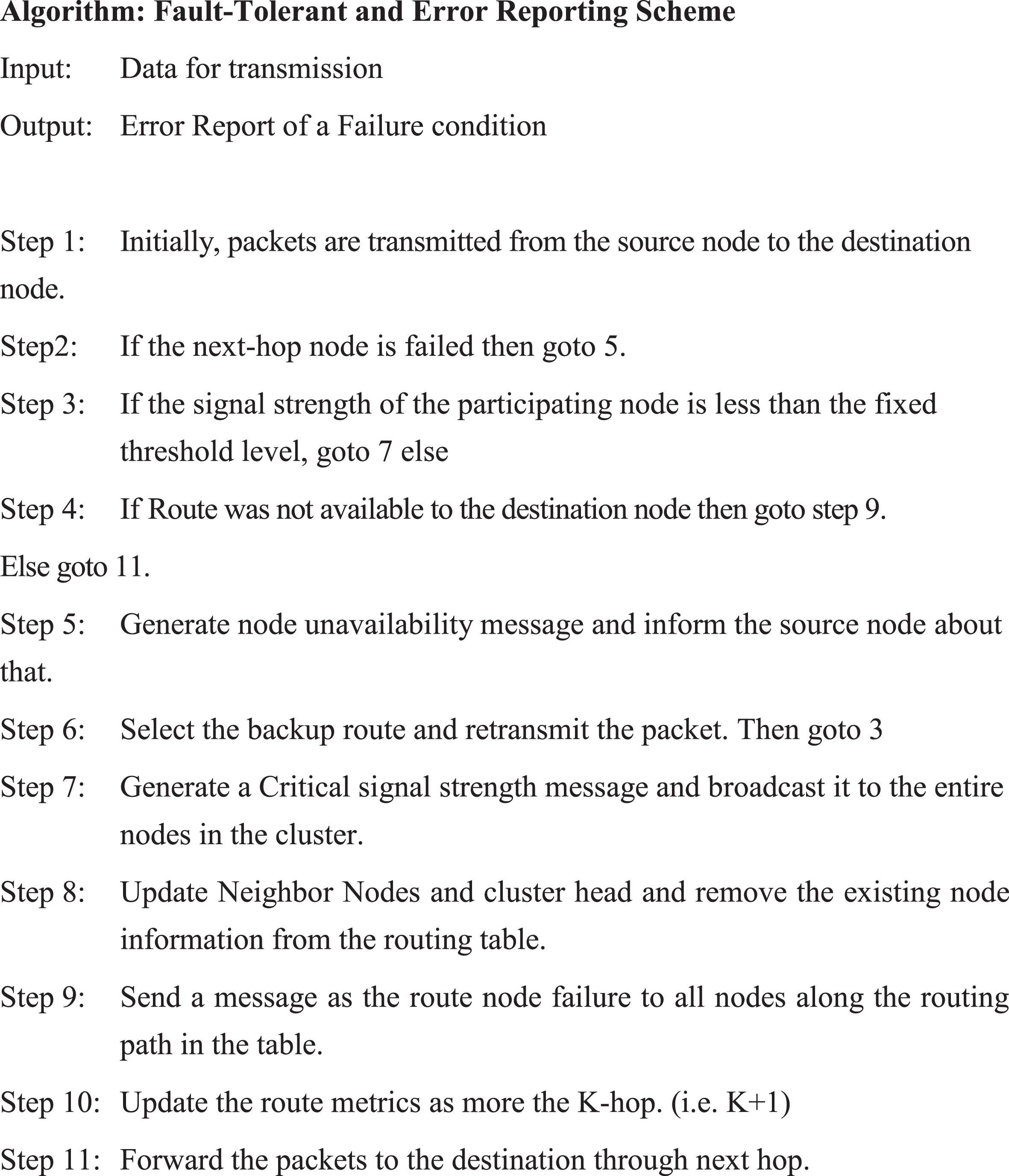
Fault-tolerant manager.
The route node unavailability message is generated in two cases. The source node or the node which wants to send the packet initially sends the Request to Send (RTS) message to the next node or the receiver node to verify that the node is ready to receive the packets. If the acknowledgment is not received after a certain log time then the sender node decided that the node is not ready to receive the packet. The next case is based on the information received from the destination node when it informs the source node that it doesn’t receive the packet after a specific time out. After this, the sender sends the test packets to all the nodes in the path to detect the failure mode based on the received reply for the test packets. From which nodes it doesn’t receive the reply test packets then it announces to all other nodes that failure node is not available to receive packets. All other nodes that receive this message will remove the failed node’s ID from their routing table.
Critical signal strength
The signal strength is one of the main concerns while creating the route between the nodes. Always the nodes in ad-hoc networks need a minimum level of the signal at which the node receives or sends the packet from other node or transmit the packet. The minimum signal strength is defined based on the transmission range of the node and this may vary due to the mobility of the node. Initially, some nodes are with the signal level but later on its move towards some other locations where the initial neighbor nodes cannot access the available node. The critical signal strength message is generated when the mobility of the node is out of the range and sent to the source of the data packet and also to the neighbors of the node. The nodes that receive this message will remove the failed node’s ID from their routing table or neighbor table.
Destination unreachable message
Destination unreachable message is generated when the data packet is discarded without being forwarded to the destination node due to the unavailability of the route to the destination. This unreachable happens due to node unavailability due to the low signal or scalability of the node.
Backup path selection
Each node has a backup routing table in which it stores the backup route to the destination. The nodes enter into the backup route selection algorithm when it enters any one of the given failure condition. The steps involved in finding the alternate path are shown in Fig. 4.
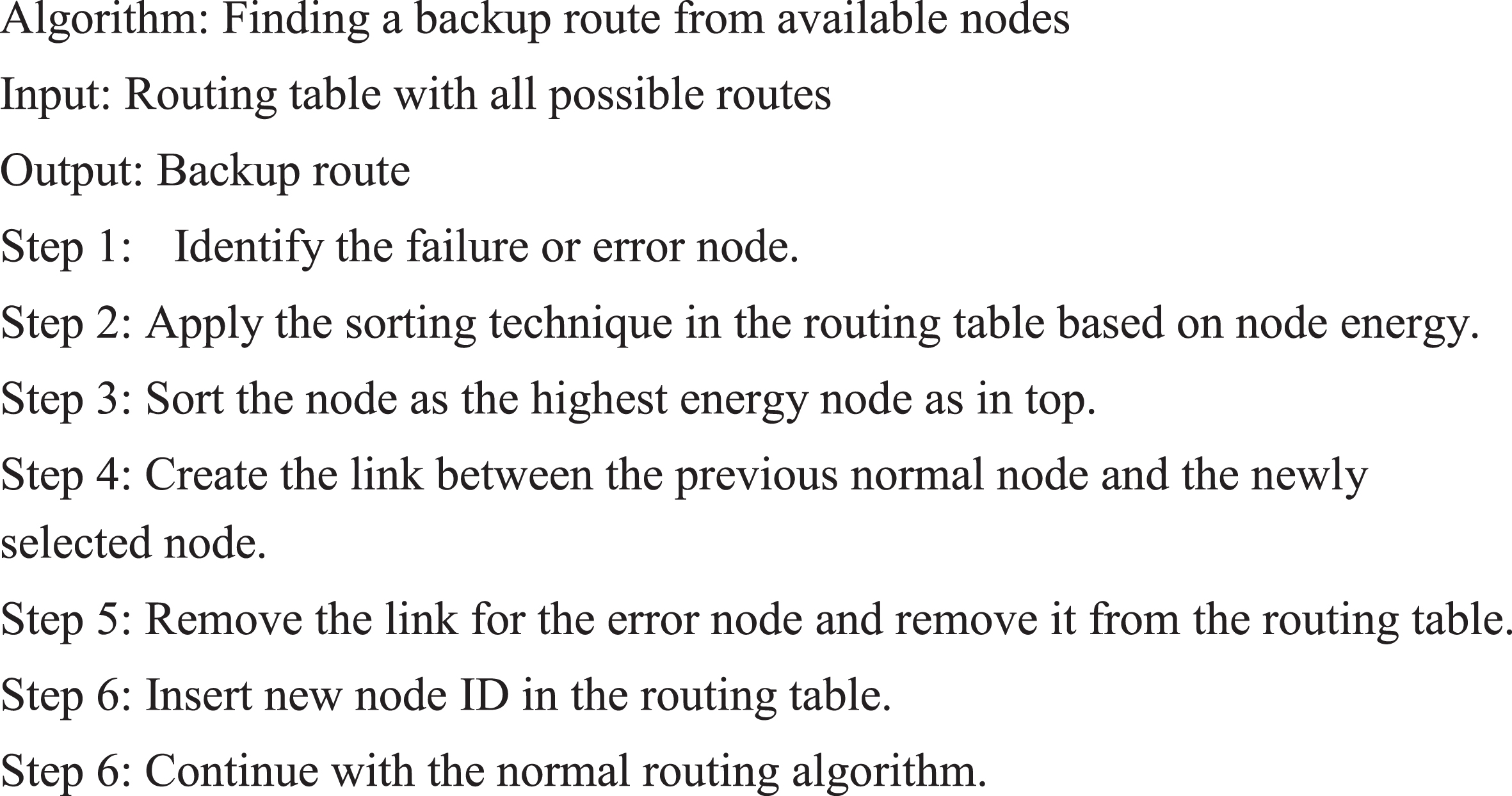
Backup route selection process.
The Backup Path selection is shown in Fig. 5. Here, there is the main path through node 1 and node 2 through which data transmission takes place between source and destination. Let node 5 and node 4 be the backup paths stored in node1’s backup table. If node 2 fails which can be got from link-level acknowledgments, node1 enters into the backup path selection. If node 5’s remaining battery energy is greater than node 4’s remaining battery, the route from node 1 to node 5 is selected as the backup path for data transfer.

Backup path selections.
The proposed CAODVERR protocol performance is analyzed using the NS-2 simulator. The assumptions are made that nodes are moved dynamically in any direction. The mobility scenario of the nodes is generated using a random walk which includes 100 nodes in an area of 1000 x 1000 m. The energy levels of all nodes are initially maintained at 50J and this may be reduced based on the packet transmission carried out by the nodes. Table 1 shows the parameters and simulation environment for the proposed system.
Simulation environment for proposed CAODVERR protocol
Simulation environment for proposed CAODVERR protocol
The results obtained from the fault-tolerant cluster-based routing are analyzed based on the three metrics namely delay, energy consumption, and packet delivery ratio.
Table 2 shows the comparison of the packet delivery ratio between traditional AODV, LVT-CGBR and the proposed Fault-Tolerant CAODVERR protocol. Figure 6 shows the pictorial representation of the comparison of the Packet delivery ratio between the proposed Fault-Tolerant CAODVERR protocol and exiting recent rtechniques. Experiments are conducted with a different set of nodes as 10, 25, 50, 75, and 100.
Comparison of packet delivery ratio between AODV and Fault-Tolerant CAODVERR
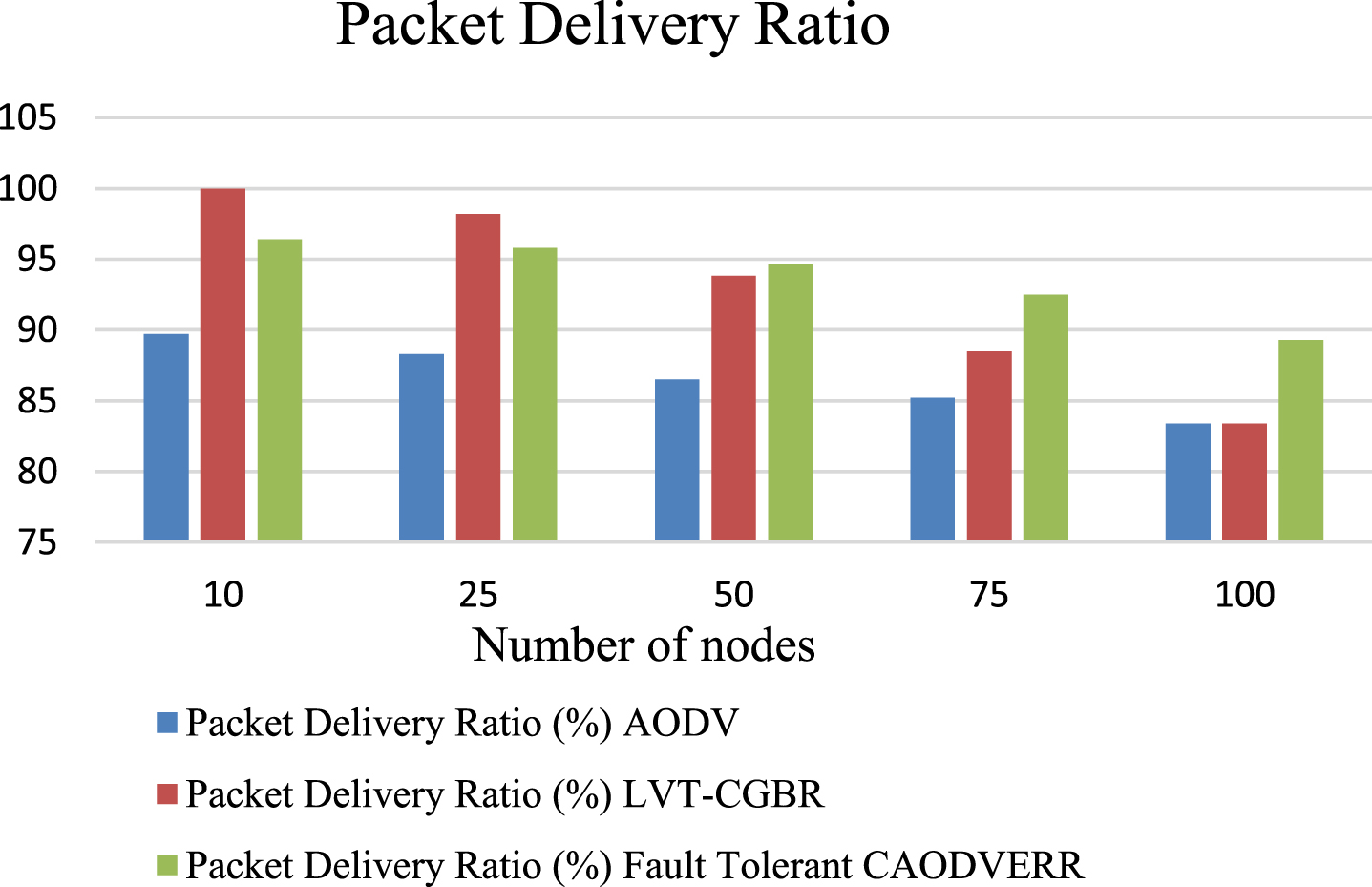
Comparison of packet delivery ratio between AODV and fault-tolerant CAODVERR.
From the results, it can be observed that the proposed Fault-tolerant CAODVERR protocol increases the packet delivery ratio of the network in comparison with the AODV protocol and LVT-CGBR. This is because the fault tolerance in the cluster heads reduces the number of nodes failures during routing. This leads to an increase in the packet delivery ratio. Table 3 shows the comparison of energy consumption of the nodes between the proposed Fault-Tolerant CAODVERR protocol and the AODV Protocol. Figure 4.7 shows the graphical view of the comparison of energy consumption of the nodes between the proposed Fault-Tolerant CAODVERR protocol and the AODV Protocol.
Comparison of Average Energy Consumption of nodes using AODV and Fault-Tolerant CAODVERR
From Fig. 7, it can be observed that the proposed Fault-Tolerant CAODVERR protocol reduces the average energy consumption of the nodes in comparison with the AODV protocol. This is because the Fault tolerance reduces the number of node failures while routing and therefore, it reduces the number of retransmissions and hence consumes less energy. And also, cluster-based routing reduces the energy consumption of the node by already maintaining the path between the cluster nodes. The percentage of average energy consumption of nodes is reduced by 2 to18 for proposed routing when compared with traditional AODV.
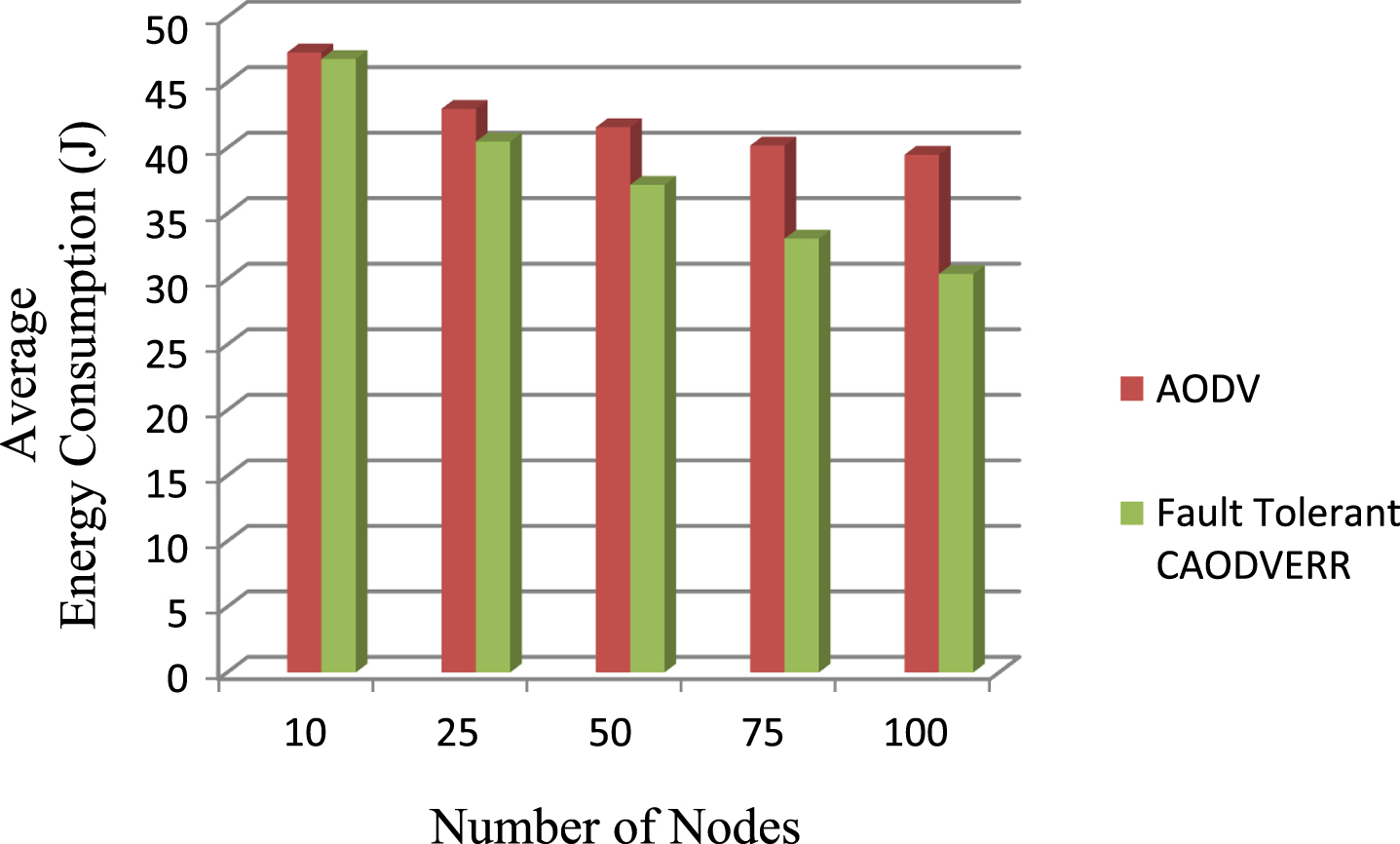
Comparison of average energy consumption of nodes using AODV and Fault-Tolerant CAODVERR.
Table 4 shows the comparison of delay in packet delivery to the destination of the nodes between the proposed Fault-Tolerant CAODVERR protocol and the AODV Protocol. Figure 8 shows the delay in packet delivery to the destination while using AODV protocol and the proposed fault-tolerant Cluster-based AODV with Error Reporting Routing (CAODVERR) Protocol in a diagrammatic representation.
Comparison of delay in packet delivery between the nodes using AODV and Fault-Tolerant CAODVERR
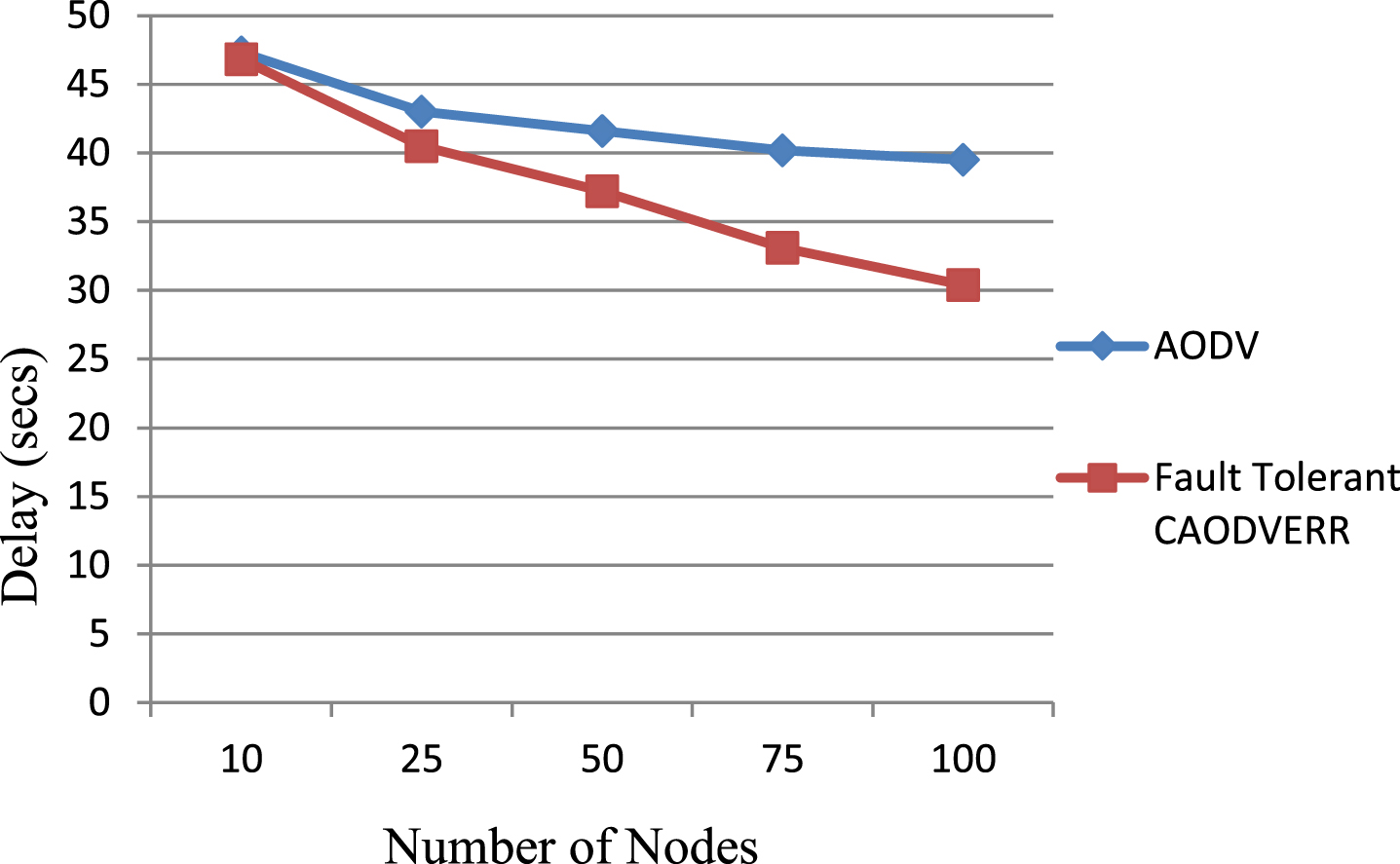
Comparison of delay in packet delivery between the nodes using AODV and Fault-Tolerant CAODVERR.
From Fig. 8, it can be observed that the proposed Fault-tolerant CAODVERR protocol reduces the delay in packet delivery to the destination in comparison with the AODV protocol. This is because fault tolerance reduces the number of failures occurs during routing based on the error reporting mechanisms. Error reporting strategy helps to avoid the failure nodes for packet transmission and select the route as given backup path selection.
In this work, a fault tolerant cluster-based routing protocol has been proposed and implemented to improve the QoS in MANETs. The QoS metrics considered in this work are delay, energy consumption and packet delivery ratio. From the experiments conducted, it can be observed that the proposed Fault tolerant CAODVERR protocol reduces the delay in packet delivery to the destination, reduced energy consumption and increased packet delivery ratio in comparison with the AODV protocol and LVT-CGBR. This is due to the fact that the fault tolerance reduces the number of failures occurs during routing based on the error reporting mechanisms. Error reporting strategy helps to avoid the failure nodes for packet transmission and select the route as given backup path selection. In future work, we can extend the functionalities of the cluster heads so that cluster-heads themselves are responsible to provide the security in the corresponding cluster. Cluster-heads may maintain additional rules in the rule base regarding the behavior of the nodes that are in the cluster.