



Abstract
Since the IPv6 Wireless Personal Area Network (6LoWPAN) can be utilized for information dissemination, this network gains significant attention in recent years. Proxy mobile IPv6 (PMIPv6) is standard for mobility control based on network at entire IP wireless applications. But, group-based body area networks cannot respond effectively. A new improved group flexibility system decrease the number of control messages contain router requests as well as advertising messages when compared to the group-based PMIPv6 protocol, in order to minimize delay and signaling costs. The IEEE 802.15.4 standard for low-power personal area networks (6LoWPAN) complies through IPv6-compliant MAC and physical layers. If the default parameters, excessive collisions, packet loss, and great latency occur arbitrarily in high traffic by default MAC parameters while using a great number of 6LoWPAN nodes. The implemented Whale optimization algorithm is based on artificial neural network optimization, genetic algorithm or particle swarm optimization to choose and authenticate MAC parameters. This manuscript proposes a novel intelligent method for choosing optimally configured MAC 6LoWPAN layer set parameters. Results of simulations based on the metrics such as Average delay time (ADT), Average signaling cost, Delivery ratio, Energy consumption, Latency, Network Life time (Nlt), Packet Overhead (PO), Packet loss. The performance of the proposed method provides 19.08%, 25.87%, 31.98%, 26.98%, 31.98%, 26.98% and 23.89% lower Latency, 12.67%, 25.98%, 31.98%, 26.98%, 27.98%, 31.97% and 27.85% lower Packet Overhead and 19.78%, 27.96%, 37.98%, 18.09%, 28.97%, 27.98% and 56.04% higher Delivery ratio compared with the existing methods such as 6LoWPAN-NUM-OHCA-FFA, 6LoWPAN-GTCCF-PSO, 6LoWPAN- DODAG-ACO, 6LoWPAN- MAC-GA-PSO, 6LoWPAN-NCG-DTC-NGIPSA and 6LoWPAN-TDMA-GTS-SHJA algorithms respectively.
Keywords
Introduction
Theory
There are several trends that require to be considered when deeming Internet-of-Things (IoT) development [1] that involve IEEE 802.15.4 compliant protocols [2], future Internet [3], Machine-to-Machine (M2M) networks [4]. At present, IEEE 802.15.4 is a general standard applied by Low power Wireless Personal Area Network (LoWPAN) devices for lesser protocol layers. Nevertheless, issues arise while suggesting upper layers of protocol stack [5]. Future Internet is suggested to portray the Internet architecture as well as protocols research in upcoming twenty years [6, 7]. Numerous European projects aiming the research of future Internet are existed (EU 4WARD [8]), but they won’t focuse on embedded Internet devices with LoWPANs. Internet integration does not deemed in typical LoWPAN, because it is assumed as fully isolated. At the present and future global Internet, EU SENSEI project [9] focuses on the incorporation of embedded devices with IPv6 over 6LoWPAN operation. M2M is cognitive system that contains capacity for communicating each other without human interference [10, 11]. Typical M2M devices comprise cellular modems including Internet based back end system for IP communications. In recent years, M2M gateway is employed to bridge local embedded networked device including IP base networks. 6LoWPAN is linked with Internet through the gateway of M2M [12]. For lower data rate and lower power wireless devices, IEEE 802.15.4 standard scales the Medium Access Control (MAC) and Physical (PHY) layers properties [13]. Internet Engineering Task Force (IETF) suggested 6LoWPAN [14] to adopt the execution of Internet protocols over wireless embedded devices that are characterized by limited memory size, being power constrained [15]. 6LoWPAN protocol stack is parallel to TCP/IP stack. Even though, a certain variations among them owing to huge IPv6 packet size estimated to IEEE 802.15.4 packet. IETF working group including additional layer to 6LoWPAN protocol stack named adaptation layer [16]. It responds to header compression, fragmentation, IPv6 packet reassembly when it is forward or receives over the IEEE 802.15.4 standard [17]. Wireless M2M sensor networks are comprised of hundreds to thousands of energy constraint and short range communication devices. These constraints affect one protocol stack selection [18–20]. Indeed, the growing interest in M2M sensor networks leads to various communication protocols range development, but its diversity has limited the consolidation of diverse networks [21]. With respect to MAC with PHY layers, a broadly employed solution is provided by IEEE 802.15.4 standard and IPv6, because of IP layer isolated network incorporation complexities [22, 23]. This paper focuses on optimizing the MAC layer parameters of the 6LoWPAN protocol stack depending on the specifications released by IETF working group. Any MAC protocol for M2M sensor network must assure prudent energy consume in every M2M nodes to enlarge the network lifespan. The level of contention at the MAC layer influences the network throughput and end-to-end delay. In addition, the performance indicators at MAC and PHY layers showed that the selection of appropriate MAC parameters led to minimize the energy consumption, enhance reliability and reduce the end-to-end delay.
Motivation of the proposed work
In WBAN, the sensors forever move together and transfer in a similar time. During routing on these networks, data loss occurs because of its lack of security. The existing group-based protocol [24] relies at initial newly connected node to carry the remaining link information from the nodes for reaching the aim of signal reducing cost along handoff delay. The sensors equipped in human body forever connect with novel access link in similar time. Therefore, it is enhanced for utilizing a control message to transport information from the sensors throughout the body to lower the cost of signaling. To group the body sensors perform the transfer procedure is too feasible solution. Several deep learning based methods were presented previously for 6LoWPAN complies through IPv6-compliant MAC and physical layers. But, 6LoWPAN process is maximizing the energy consume and increase end-end delay. To deal these issues, some solutions required to be presented. The existing method does not provide sufficient low-power personal area network. These are motivated to do this research.
For reaching the objectives of dropping the delay time with signal cost due to transfer process, in this manuscript an improved group mobility protocol [25] is proposed that is based on wireless body area networks in terms of artificial neural network (ANN) [26]. To lessen the number of control messages, decrease signal expense and time delay in a group-based PMIPv6 protocol.
Related work
Several studies in the literature presented on a wireless body area network with a variety of distinct views, dependent upon the collective mobility protocol, using distinct methods. A few recent works are divulged here,
Wireless Body Area Network (WBAN) transfer problem was addressed by [27] when portable patients have at any moment pick the highest access technology in a number of ways. They concentrate in particular on the decision-making schemas and examine the MADM techniques of making multiple attributes. The MADM methods ’ basic aim was to identify a limited number of options. They offer an attribute-specific decision that makes a handover algorithm (MADMHA) that enables the portable terminal to pick the finest network dynamically by placing an order among the lists of applicants accessible. The findings of their simulation show the effectiveness of our suggested strategy in comparison to the handover methods depending on the received signal strength index and data rates (DR). Indeed, MADMHA considerably decreases the overhead packet and handover amount opposed to these latter, while reducing the loss ratio of packets.
In order to evaluate their efficiency in meeting WBANs lifetime and quality service demands, [28] have suggested, medium access techniques of IEEE 802.15.6 standard. Sleeping plans for dispute and voting entry systems are then proposed, to extend the lifespan of the unit. For the inquiry simulation tests were performed using the typical medical device setup discovered in the hospital environment. The priority voting method is discovered to produce a mixture of long life and low latency. Different other findings provide significant insights into the conduct under WBAN circumstances of these methods.
The Wireless Body Area Network (WBANs) [29] was assisting healthcare implementations at an early stage but provide useful insight at the level of monitoring, diagnosis and therapy. They contain the collection of medical information from distinct detectors with safe data transmission and low power consumption in real time. Due to the growing concern in the use of this form of networking, several papers were lately released covering various elements of such schemes. In this article, we compile, compare and use techniques and protocols released in the latest investigations to pick the most helpful network-related alternatives for WBAN problems for medical monitoring reasons. The assessment includes wireless communication and movement. Our research shows that certain features of the protocols interviewed are very helpful for medical devices and WBAN patients.
In the last years, the MAC protocol for Wireless Sensor Nets (WSNs) has been suggested to [30] as an energy efficient duty-circuit media access control (MAC). However, most of these people are experiencing a substantial decline in efficiency in case of burst traffic owing to random wake up to interact. They suggest a fresh MAC protocol called HKMAC, which is initiated by a fresh asynchronous duty cycle receiver. In the HKMAC suggested, it may attain low-end packet service latency together with elevated energy efficiency in explosive traffic by changing the receiver’s beacon time and planning the sender’s hearing time during planned times. Detailed ns-2 simulation assessed an efficiency of HKMAC. In comparison to RI-MAC, state-of-art MAC protocol for WSNs, the results of the simulation displays that HKMAC is forever able to decrease packet delivery and energy consumption by different data rates at end to end.
[31] suggested an optimized BSN transfer approach to achieve RBS (Sink) and a technique for maximizing network output through stable paths in order to prevent inter and intra-flow interference depending on mobility predictions. Body sensor (BSN) network connected to a wireless network interface will not be able to disperse the WBAN or Remote Base Station (RBS) via covers area to another area where interference is generated between the wireless-body-area networks (WBAN). When a wireless body network becomes mobile, inter process interference problems arise. Efficient WBAN tracking information extraction, elevated spatial reuse and the surveillance method is dynamically adjusted to fit the data quality is required.
[32] Had suggested a vibrant slot assignment regime that covers the GTS (IEEE 802.15.4 normal) bandwidth underuse system. Data rate is small and requires devoted bandwidth to contain free communications. This system was relevant for various apps like house automation, remote sensing, patient monitoring, and so on. Instead of allocating GTSs to various super-frame slots as required by the computer, as required by IEEE 802.5.4, the supervisor assigns GTSs to prevent bandwidth wastage. In terms of the bandwidth and amount of endorsed appliances, the system was evaluated for results and it was found that the suggested system was superior to IEEE 802.15.4.
A novel direct-M2 M method, using D2D communication and downloading concepts, has been suggested by [33]. In the scheme proposed, M2 M equipment near contact can interact straight with each other by D2D communication instead of interacting via gateway nodes. The communication from machine-to-machine (M2 M) should in the near future be one of the main fields of implementation for cellular communication. In cellular M2 M, the Gateway Layer offers soft operation of the underlying cellular networks, but it overburdened the network with regards to delay and bandwidth use. However, the gateway layer offers smooth handling of underlying cellular networks. Therefore it became an effective strategy for the application of D2D techniques in the cellular M2 M networks with the newest advances to guide device to device (D2D) interaction on Long-Term Evolution network (LTE).
A profound survey of layer protocols of medium access control (MAC) used in IoT, divided by the breakdown of these protocols (brief and long range transmission) was submitted by [34] The following is taken into consideration with brief scale detection procedures: RFID, Near Field Communication (NFC), Bluetooth IEEE 802.15.1, Bluetooth Low Energy, IEEE 802.15.4, REM protocol (Wireless-HART), Z-Wave and Weightless Wireless Highway Addressable Remote Transducer Protocol (WWH). For a long range group the LTE CAT-M, LTE CAT-N, (LoRa) Long Range Protocol with SigFox protocol was studied. For this group the following protocols will be studied: NB-IoT, CAT-0 Long Term Evolution (LTE). A comparison research was conducted on the basis of the specific features, constraints and behaviors of each set of protocols to provide ideas and reference studies for IoT apps, showing a notable result. There were also open research problems on the subject.
Illapu and Sivakumar [35] have presented an efficient chaos-LSA integrated game theory algorithm for a QoS-assured delay time control mode with a unique parent selection for 6LOWPAN wireless body area network. The presented model improved the delay performance of 6LoWPAN wireless body area network. Initially, non-cooperative gaming method-based delay time control (NCG-DTC) scales ideal data transfer rate of entire source nodes to evade delay in among IN. To optimize the parameter of power consumption and delay in non-cooperative gaming method-based delay time control, chaotic lion swarm algorithm (Chaos-LSA) was presented. New genetic inspired parent selection algorithm (NGIPSA) was presented to further improve the network efficiency. The presented method attains low average signaling cost 8.9% and 5.29% and low delay17.34% and 11.36%.
Mana and Rachedi [36], have presented an on the issues of selective jamming in IEEE 802.15. The beacon-enabled mode of IEEE 802.15.4 provides a Time Division Multiple Access (TDMA) method for low power devices by adopting Guaranteed Time Slots (GTS). A new efficient version of GTS attacks was introduced that benefits from standard behavior and superframe effect on the periodic traffic to conserve the adversary’s resources for the longest period. The presented solution specially developed to mitigate the harm from detrimental attack. It follows that the attack was economic under jamming duration and jamming packets ratio and the solution was efficient in terms of packet delivery ratio, energy consumption and delay overhead. It provides lower delay with lower throughput.
Outline of the proposed work
The optimal MAC parameters allow the extension of network lifespan at a reduced delay. Before the optimization stage, the analyzed data (training system) is provided to the ANN for full output prevision. Input data constitute the MAC layer parameters whereas throughput and latency constitute the ANN presentation; validate the ANN training and reliability with the test data collection. Once the ANN efficiency is checked, whale optimization techniques (WOA) [37] are used individual basis to choose the optimum MAC parameters for 6LoWPAN and its performance is contrasted to Genetic Algorithms (GA) [38] and PSO [39]. To decrease the time delay and signal cost, such Evolutionary Algorithms (EAs) are contrasting one another, providing a stronger understanding of the ideal MAC layer parameters and that, in the analysis with the proposed methodology are more beneficial than the other.. In this paper an upgraded group mobility protocol [40] dependent on Artificial Neural Network (ANN) [41] based Wireless Body Area Networks to lessen the number of control messages which diminishes the signaling expense and time delay in a group based PMIPv6 protocol was proposed.
Organization of the work
The rest of this manuscript is organized as: Section 2 portrays existing works related to GA and PSO and describes that proposed methodology on Group based mobility protocol system at Wireless Body Area Networks, Selection of optimal MAC parameter and Whale Optimization algorithm (WOA). Section 3 explains experimental setup used for simulation and Section 4 introduces performance assessment along with the obtained simulation outcomes. At last, Section 5 concludes this manuscript.
Methodologies
Particle swarm optimization
PSO is computational system attempts by using an iterative approach, for finding solutions to complicated problems by the candidate for a particular performance. Algorithm 1, every particle contain adaptive speed and direction that regulates their subsequent move inside the search space. The PSO consists of a number of particles, each of which constitutes a possible alternative to this issue. This particle consists of a velocity value to show the extent of artificial neural network methodology contain over-fitting issue often simple to trap in local minima; while as Genetic Algorithms are useful to larger and more difficult issues. To overwhelm such problems, the PSO model is familiarized to solve that portfolio selection and optimization problem. PSO data may be altered in n-dimensional search area through the location co-ordinates. The PSO algorithm monitors three of the global variables in order to achieve the destination: (1) the destination status or condition; (2) the highest global value suggests the actual particle information nearest it; (11) the stop-value shows while algorithm must end if the goal is not discovered.
There is a set of speeds for upgrading every positions k particle, each of whom has its capacity as the part location and can be determined in the same way as described in Equation (1). IW is the inertia weight, r1 and r2 implies random interval numbers [0,1], Pc1 and Pc2 are positive constants and A
kl
implies better position (Pbest) for k particles as regards Each particle’s location is returned to the Equation (2).
While, B kl (s + 1) implies present position and B kl (s) implies earlier position of particle, C is represented as the weight of the each particle.
A Genetic Algorithm (GA) is a process to solve constrained and unconstrained optimization issues. Individuals known as chromosomes that make up generation population, also generate new population. Such populations are produced by selection rules and other genetic operators, like mutation and crossover, which evaluate fitness of each population. The rules of choice focus on individuals who are fit. Mutation and crossover try to mimic the natural approach of breeding which emulates breeding.
GA is carried out through the algorithm 2 process, in which s, f and n are populated, the intended fitness of option recovered and highest number of generations permitted. Operations will be reiterated until the specific fitness is approved or until the pre-defined amount of iterations (generations) is achieved (intergovernmental threshold is reached). Selection in GA is intended to seek out better individuals and preserve population diversity. The offspring population selects that individual with the fitness value providing greater quality individual a better chance of being selected.
Crossover
In the premature development of population, it is essential to upsurge the number of individual crossings for a fast search in the entire definition space. In the late phase of population development, the population is concentrated under neighborhood of optimal solution, and the number of individual crossovers need be condensed to avoid loss of good individual genes to accelerate GA convergence. When the population average fitness value methodologies that optimal solution, the individual crossover probability should be condensed. In summary, the adaptive crossover probability under genetic operation L
c
is specified as below:
With the intensification of population evolutionary algebra, the value of Lc0 diminutions and Lc1 diminutions the average fitness value of population tends toward the perfect value. In this case, Lcmax refers maximal crossover probability, Lcmin refers minimal crossover probability, fmin refers minimal fitness value of cut-off, fmax refers maximal fitness value of cut-off for the current population, m refers current evolutionary algebra, and M refers evolutionary algebra of the whole population.
Mutations may change individual chromosomal genes under parent population, out coming at great number of novel individual offspring. Through the rise of evolutionary algebra, the population grows closer to the optimal solution set. Selecting a higher mutation probability creates numerous novel individuals. Such novel individuals are dispersed all over the search space. Thus the late phase of population development, a higher mutation probability affects that proportion of dominant individuals and delays that convergence of algorithm. Thus the mutation probability L
mut
is specified below:
where Lmutmax refers maximal mutation probability, and Lmutmin refers minimal mutation probability.
WOA is introduced by [42]. This method simulates that hunting process of bouncing whales. Unique hunting mechanism is the bubble-net technique of forging, which occurs by distinct blisters in a circular or 9-form path, while the under whales cover the prey. Humpback whales can glide approximately 10–15 m by unique exercises then generate spirals across its prey and float to surface. Supporting whales contain monster, holding it shut, and to avoid it [43]. This section discusses the circular whale, the circular fodder classification and whale search mathematical model:
Prey Encircling
Humpback whales may identify that location of their prey and circle around them. As the position of optimal design under search space is not recognized a priori, the WOA algorithm accepts that current best candidate solution is the target prey. After defining the best search agent, the other search agents try to inform its locations towards the better search agent.
This behavior is produced quantitatively as follows:
Here
Two techniques are developed mathematically investigate the activity of bubble net of humpback dolphin:
1) Minimizing encircling method: the importance of the reduction between 2 and 0 in Equation (5) is the outcome during the cycle of iteration. The initial location of an identifier unit may be defined anywhere between the initial place of the officer and that of the current better officer via creating random digits
2) Upgrading spiral place: Spiral balance of prey and the whale position imitate humpback bale helix movement:
Humpback whales swim around their prey in enlarging circle and next to spiral path at similar time. To shape the behavior, assume that they have a 50% chance of choosing the detour process. This procedure is based on the given mathematical model:
Where
For prey search, i.e. exploration, vector variations
Where
In algorithm 3, the pseudo code of WOA algorithm is displayed. The first stage on algorithm is to initialize the whale population. For controlling the exploration and exploitation system, the parameters of WOA algorithm, exactly S, w, s, j and k are initialized. Then all the whales began fitness is assessed in the search region. In Equation (5), the current fine search officer continues to update its position, if the control parameter value is S < 1. Also, if a parameter S≥1 is chosen and a place upgraded with Equation (9) to perform a random whale if new search agents exist improved to last, from present finest search agent. The fitter whale is revamped chronologically and can finally be achieved first place as an optimum alternative. In the iteration process, the value’s’ parameter is changed. In final repetition, most suitable search officer is highest fit weight vector with WOA algorithm.
System model
The proposed protocol for WBAN has 6LoWPAN detectors and PAN.6LoWPAN utilizes the IEEE 802.15.4 standard as protocol link layer. Adaptive layer is utilized for modulating IPv6 file header (40 frames) in 2 bytes of input data (6LoWPAN). 6LoWPAN domain comprises entire-function equipment (FFDs) supporting all functionalities and characteristics of IEEE 802.15.4. Mobile Body Sensors (MBSs) deliver this packet to MAG via FFD, with two end-to-end interaction links. It gets the packet and after that serializes packet to IPv6 packet structure in adaptive layer. After the packet has been received from the MAG, the Local Mobility Anchor (LMA) sets binding condition of MBSs. When MBS connects to MAG via cable, a signal is sent by the Router Request (RS) which contains the Mobile Node Identifier (MN-ID) to use the home network (HNP) address. The MAG recreates the house MBS connection by answering the MBS signal from the router advertisement. This allows the MBS to set the same email in the PMIPv6 domain via HNP. At PMIPv6 domain consists of distributed LMA that operates as a home officer in all portable nodes. 6LoWPAN is available at beacon-active mode and is equipped by FFDs for multi-hop connectivity in order to increase the coverage for one MAG range. Therefore, the packet can deliver multiple hops and vice versa to MAG effectively. Figure 1 illustrates 6LoWPAN protocol layer and the MAG and sensor system model on WBAN.
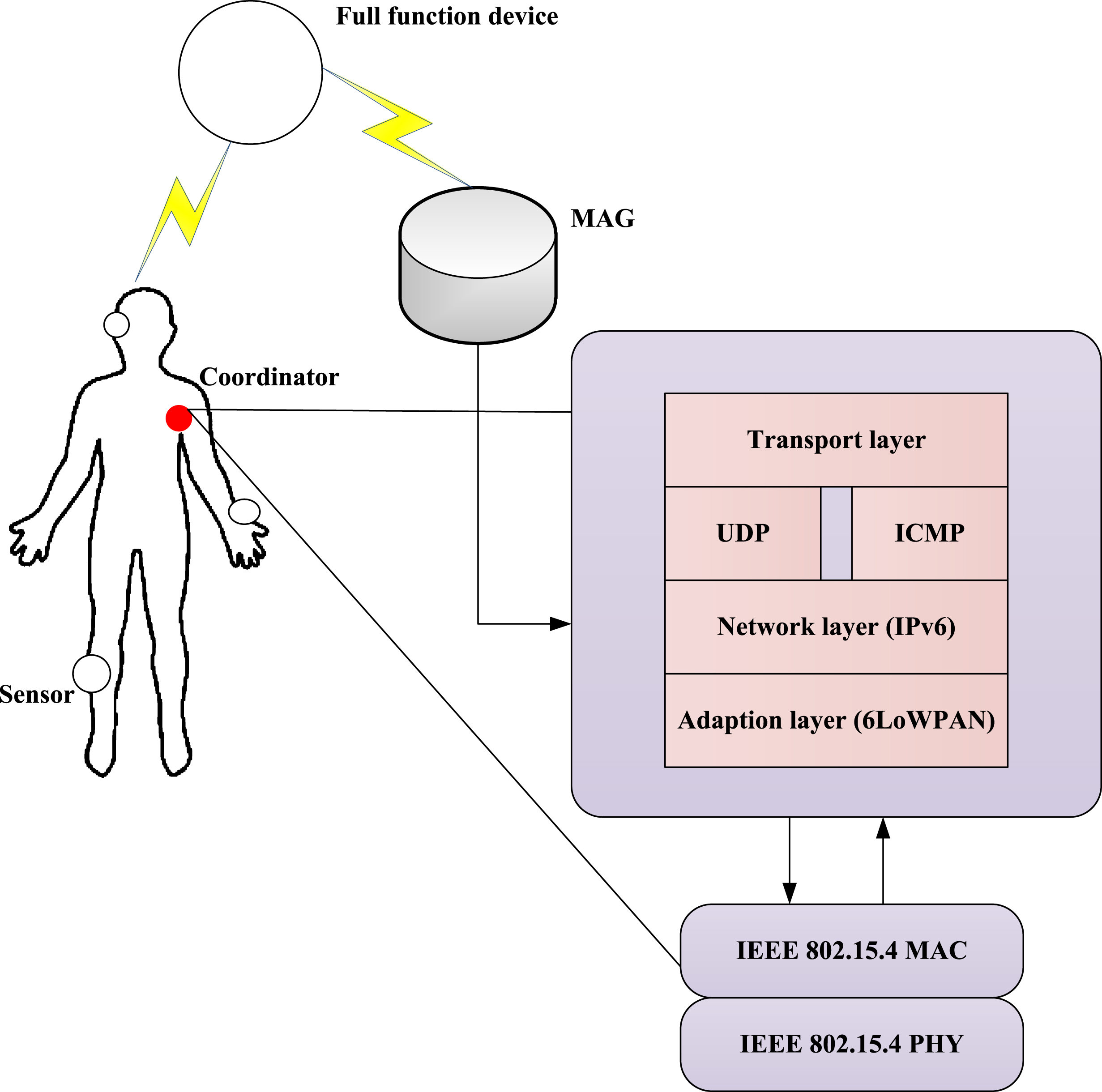
6LoWPAN protocol layer and System model of Mobile Access Gateway (MAG) and sensors at WBAN.
To reduce signaling costs and time, three stages, i.e. registration, uplink handoff and downlink handoff stages are suggested. While a device group enters PMIPv6 domain and attach them to access link, recording stage will be started. The proposed group-based handoff system works the following way: The assistant should be one of the body sensors in the community and only the assistant should exchange control signals with the MAG. Only one RSPD, RAPD, PBUPD and PBAPD are transmitted during the application stage, thus reducing a lot of signaling and enrollment costs. By issuing a light request to the neighboring FFDs, the body sensor conducts a regularly engaged test. The neighboring FFD receiving the photo sensor application advertises a lightning message with its MAG-IDs. When the light is received, it is decided to compare current MAG ID by earlier MAG ID that detector itself is still in the same MAG or transferred to another. If the body sensor identified it shifted into the fresh MAG, then the uplink handoff stage is associated with the fresh MAG. The down-link handoff stage begins after the up-link handoff stage.
2.4.2.1. Format of new packet. To achieve this objective, a new RS and RA formats is considered for decreasing cost of signaling with handoff delay. The new proposed RS together with RAPD format respectively is represented by RSPD and RAPD. The following components are present in the RSPD message: <Header, ICMP, Body Number (BN), MN_ID1, LL_ID1, MN_ID2, LL_ID2,...,MN_IDn, LL_IDn > indicating Sk sensor attached to human body. MN_IDk signify a mobile node recognization and link-layer recognization from Sk. This message contains: <Header, ICMP, Bl, HNP1, HNP2, HNP3, etc. The message is as follows: HNPn, where the l-th body is indicated by Bl and HNPk is the home network prefix of Sk. The following elements in the PBUPD message are as follows: <flag(p), Bl, MN_ID1, LL_ID2, MN_ID2,., MN_IDn, LL_IDn > .. The following components are included in the message: <flag(p), Bl, HNP1, HNP2, HNP3, . . . ., HNPn > .
Suppose that MAGs and LMAs can be used to identify the Body Node (BN) option. Initial ALL ZERO (0×00) is the BN option. If the BN possibility is indeed designated a value, the MAG can recognize and transcript MN’s identifier in a ratification cache. The BN option is dealt with by two types of behavior. The LMA assigns a value of BN, which has not designated in a ratification cache, to a BN option if it is the ALL ZERO value. If the BN option value is hitherto granted access, the LMA searches and utilizes the BN value to keep updating the information to the ratification cache. The RAPD message is utilized for reacting to RSPD message and utilized for transmitting entire HNPs.
2.4.2.2. Enrollment stage. The aim is for reducing number of control messages during the enrollment stage. In the 6LoWPAN environment, body sensors intervene from planner that might socialize by other sensors. The DHCP setup is used for all sensors. Figure 2 shows the proposed enrollment stage signal call flow. The group-based registry method is as follows:

The proposed enrollment stage signal call flow.
2.4.2.3. Up-link handoff stage: The body detector conducts an active test to search for a list of accessible channels by returning a phone request regularly to neighboring FFDs. Close by FFD receiving body sensor’s lightning requests announces a light message with its MAG-IDs. When beacon messages are received, body sensor determined, in comparison by prior MAG-ID involved at beacon signal, whether it is still present in the same MAG or transferred to a different MAG. The resistance intra-PAN mobility symbolizes the similar comparable results from all MAG-IDs under garnered beacon messages, then the body sensor consists of relocated in similar PAN zone. On contrary, body sensor is willing to detect their motion as former MAG (p-MAG) to following MAG (n-MAG), as present MAG-ID is distinct as prior MAG-ID as written beacon messages. Sensor also detects its motion. The new MAG can be used to connect the body sensor. The protocol envisioned is capable of reducing (n–1) RS messages by substituting all identifiers for each RS message. It is also possible for handoff messages such as deregistration PBU, PBU, and PBA to be saved (n –1) by using the assigned BN. This is the description of the proposed group handoff system.
2.4.2.4. Down-link handoff stage. Suppose the node 1 sensor is the body sensor group coordinator. At initial step, MAG sends only LL_ID1. Once that signal is received by the LMA, LMA knows the data of the remainder of the detectors by the allocated B1 value placed in the cache. The body sensor in B1 send the message RSPD (<Header, ICMP, 0×01 0×0001, LL_ID1 0×0002, LL-ID2 0×0003, LL_ID3 0×0004, LL_ID4 > and 0×01 in B1 to the n-MAG, Fig. 3 shows the proposed handoff stage signal call flow, when it is close to novel MAG (name n-MAG). Information of this stage will be defined as follows:

The proposed handoff stage signal call flow.
2.4.2.5. Established and operated tunnels. The body detector receives the registration message (i.e., RSPD) into MAG while a body set devices enters a PMIPv6 field and join to access connection. MAG and appropriate LMAs (i.e., PBUPD and PBAPD) may create and, if tunnel among MAG and LMA do not occur, create a bidirectional tunnel with IPv6-in-IPv6 mutability. If it is emitted by the body sensor that this is being moved into the new MAG, it registers into the novel MAG and, if there is no tunnel, it can trigger a novel tunnel among novel MAG and concomitant LMA. A timer is utilized to manage the life of the tunnel and to maintain a score of all the body sensor groups in the tunnel. The tunnel should be removed if the life span of the tunnel comes to an end or when there is no body sensors dividing the tunnel.
The proposed mechanism of optimum MAC choice is briefly and clearly explained here. In M2 M sensor networks, low power usage is essential; nodes can attain elevated output by expanding net-life or decreasing packet falls. Packets are discarded while the channel is operated or when the highest amount of tests is attained. Network life expansion with decreased time may be accomplished via choosing optimal MAC parameters is shown in Fig. 4 [43, 44]. The comprehensive steps are as described:
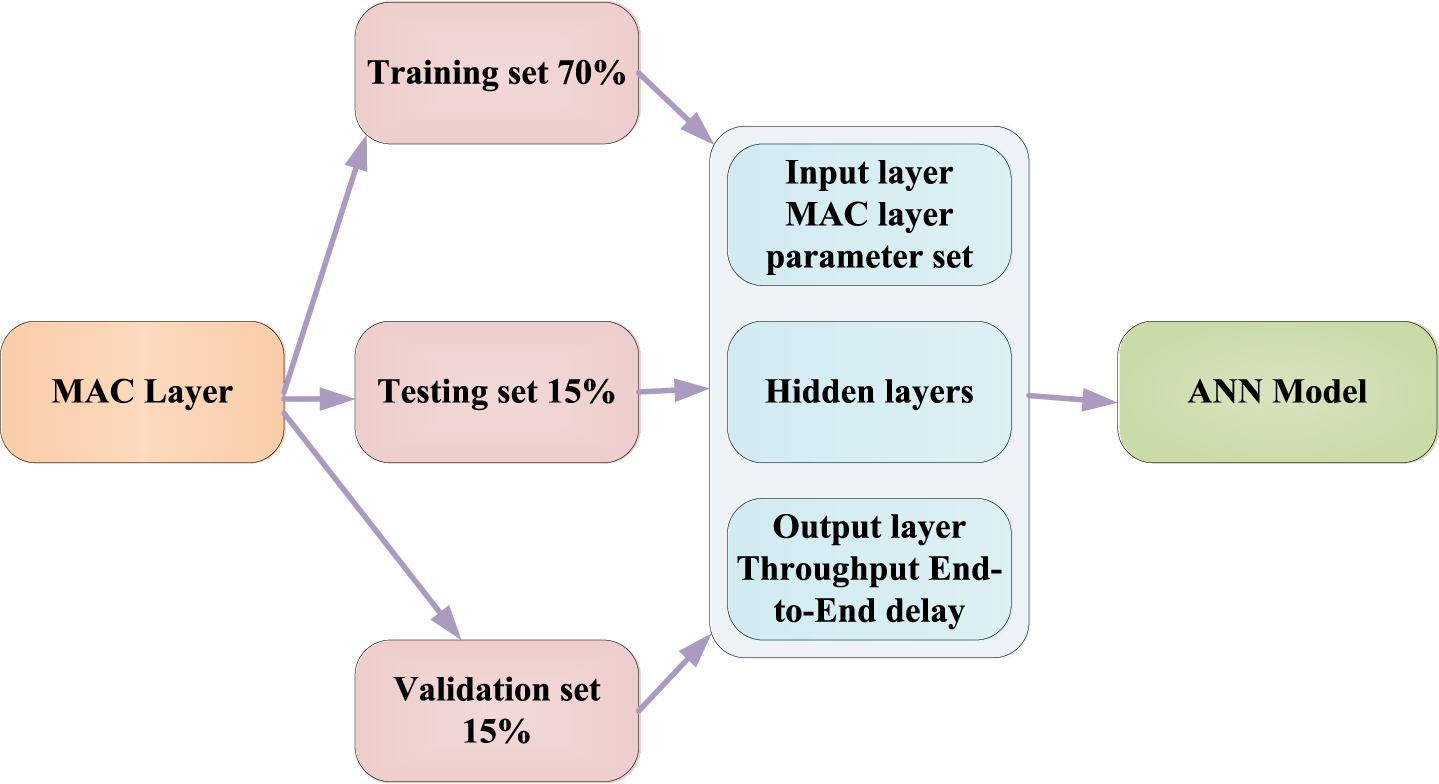
Selection of optimal MAC layer in ANN model.
Information collection: full information sets is gathered for different network dimensions from the suggested mathematical model in [45] by Zayani; Information analysis: pre-training information is analyzed and pre-processed. Data sets are divided by inputs and outputs and separated as the set of training 70%, testing 15%, validation 15%; ANN Training: information analyzed is supplied as ANN inputs to a full prediction for performance before the optimizing phase. The parameters of the MAC layer are set by the information entry while the yield and the latency of the ANN were depicted; Data Post-Processing and Testing: ANN forecast system is fully demonstrated using the invisible raw (validation set) information for authenticating ANN instruction and decide their accuracy by testing timeline; Data Optimization; ANN output is checked by WOA optimization techniques and compared with GA and PSO; The MAC layer parameter displayed by the input information; the throughput and latency is the ANN output; These AEs are contrasted amongst others to ensure the appropriate parameters chosen from the MAC layer, one more efficiently to other while presented on approach evolved.
The effectiveness of RNA depends on number of neurons and cells hidden at every layer. Later, it defines the architecture of the neural network. The competence of the ANN in modeling the problems is limited by lower concealed neurons. ANN like this may not correctly train to make a sensible mistake. On the other hand, a greater amount of concealed neurons pushes the ANN to store the information instead of studying it.
ANN is trained using the Levenberg Marquardt algorithm (LM). The data set is experimented on single hidden layer during training phase, but, the training not achieve any good results in terms of the MSE error. Multiple parts of the ANN are studied to determine in a nested circuit the highest amount of neurons, as illustrated by Fig. 4. Therefore, an exhaustive search is made for the optimum topology for ANN.
The amount of cached cells is calculated by changing the amount of cells, starting with a few cached cells, and adding then cells up to a minimum of the calculation of MSE for the teaching models. The amount of concealed cells is considered to be ideal at that stage. Because ANN parameters (weights and biases) have been randomly initiated, every selected topology has been 10 times educated to guarantee that the system was not caught in the local minimum requirements. Due to random initialization of ANN parameters each preferred topology is qualified 10 times to make sure that the network doesn’t trap under local minima. IEEE 802.15.4 is a norm of lower cost, lower performance, lower cost network (PAN) in the personal area. It consists of a combination of 2 distinct techniques for accessing channels, beacon mode and beaconless mode. This manuscript focuses on beaconless mode only as 6LoWPAN channel communication system uses unslotted carrier meaning to evade multi-sense / collision (CSMA / CA).
Figure 5 demonstrates the suggested optimization scheme for choosing the appropriate 6LoWPAN network MAC layer parameter set. ANNs are usually organized in layers, which are made up of several interconnected neurons, containing an activation function. Input data is suggested with ANN through input layer that related to single or many hidden layers for real data process. Hidden layers are related to output layer wherever intended output is located. The forecasted output may originate by diminishing the error among ANN and actual output(s). The exact learning procedure on ANN is Feed-Forward then the collection of the appropriate ANN topology based upon count of neurons in input, hidden, output layers. In addition, 2 methodologies to perform topology selection: a) evolutionary algorithms, like GA and PSO; b) exhaustive search depending on predicted number of neurons in every layer. This document is depend upon a comprehensive search process to structure the ideal ANN topology. While comparing with GA and PSO, WOA provides better results for diminishing the error among ANN output(s). WOA provides simulated hunting behavior through random or the best search agent to chase the prey and the use of a spiral to simulate bubble-net attacking mechanism of humpback whales. The performance of WOA algorithm established in this investigation is assessed through solving mathematic optimization and six structural optimization issues. The detailed optimization techniques are explained in section 2.2, 2.3, 2.4.To obtain peak output with baseline end-to-end delay, optimizer recommended the appropriate input parameters:
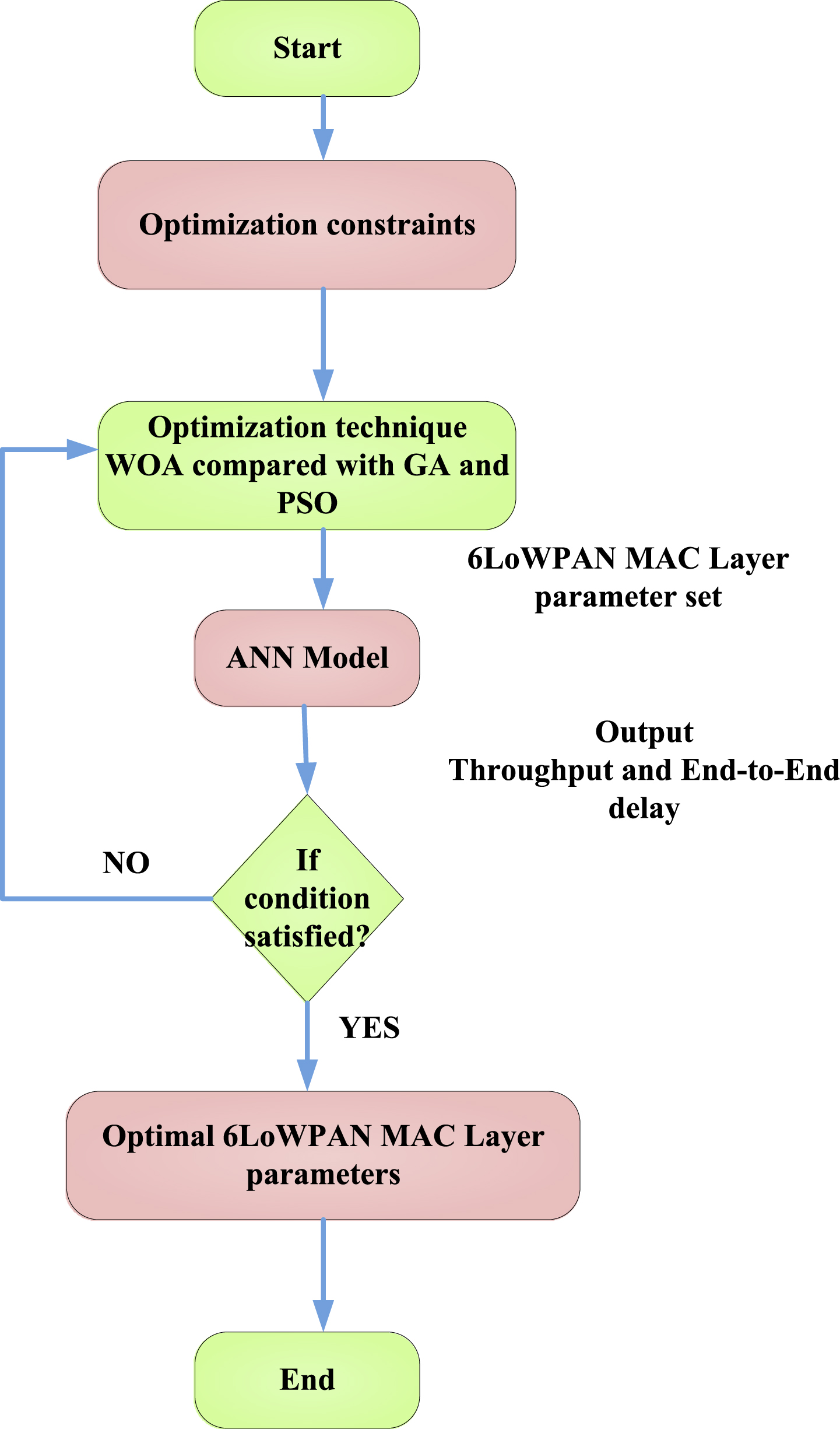
Optimization technique of MAC layer parameter.
Back off exponent (BE) means that the random back off interval before detecting the stream is determined by a random number. The BE minimal and maximal for IEEE 802.15.4 MAC layer is macMinBE, macMaxBE; The highest possible CSMA back off (macMasxCSMAbackoffs) represents the numerous times the node remains back off after the failure of the channel to sensor the packet is eliminated; The optimum frame retry restriction (macMaxFrameRetries) is the threshold for the number of retransmissions while acknowledgment is not obtained and packet is eliminated
Additionally, the size of network (number of nodes), such parameters of MAC are entered in ANN as inputs, while outputs are performed and delayed. The ANN was instructed, as previously indicated in this subsection, to estimate the actual production and to get ready information for optimization phase. The objective function tries to achieve a optimized MAC layer collection which provides highest performance at minimum delay for a specified amount of nodes.
This research proposes a new optimization system to pick optimum 6LoWPAN MAC layer parameters set of proper and safe connectivity when lowering 6LoWPAN node energy efficiency. To assess the optimized sets, a limited optimization issue is used. The objective feature (TE consumed ) is linked to the total energy consumed by 6LoWPAN servers when IPv6 packets are transmitted and received by IEEE 802.15.4. The channel throughput and average service moment are provided the optimization limitations.
The restricted optimization problem can be stated as: for a 6LoWPAN transmitter sensor node:
where CT refers channel throughput and where CTmin refers channel transmission mini-mum on demand. MST implies average time of service to good packet and MSTmax indicates optimal latency required in the 6LoWPAN node layer MAC. The limited optimizing variable G0 ⩽ G ⩽ G g implements the standard MAC parameter values of IEEE 802.15.4 in Table 1. The sign ∼ indicates that the energy consumption by the ANN is approximated by the output, average service times and 6LoWPAN node. These probabilities improve the suggested method precision and reduce computer complexity optimization.
Standard parameter values of MAC
An appropriate set of 6LoWPAN MAC layer parameters offers the response to the restrictive optimization problem used for minimizing their energy consumption by each 6LoWPAN node. The matrix G = g0, g1, g, h indicates the choice factors for the 6LoWPAN optimizer, and each variable is provided in Equation (7–10) pursuant to network exchange and end-to-end limitations.
The issue of optimization is combined because only discrete values are taken up in the decision factors. The decision vector G is economical if and only if the network output and limitations for end-end delays implies true. On several cases, each mix of vector G components leading to minimal objective function can be analyzed to achieve the ideal solution. This methodology is obviously subject to elevated computer overhead and time intensive procedures: the 6LoWPAN MAC layer parameters are to be analyzed and verified to include 8×6×7×8 = 2688 combinations. The objective of this study is to introduce a smart ANN algorithm for assessing an optimizer’s goal role faster and thus alleviate computational complexity and processing time.
For evaluating the proposed improved group mobility protocol and improved group flexibility system, [46] Network Simulator-2 (NS2) by 6LoWPAN and PMIPv6 modules is utilized for simulating such protocols. In Table 2, the initial parameter setup was tabulated.
Initial parameter setup
Initial parameter setup
In this segment, we evaluate the performance of Matrix through simulations
Performance metrics
The The The The P
Performance analysis
This segment reports the performance evaluation and analysis of the Wireless Body Area Networks based on Enhanced Group Mobility Protocol method that have been proposed in this paper. The analysis emphasizes on comparing the proposed solution with most recent methods in terms of the Average delay time (ADT), Average signaling cost, Delivery ratio, Energy consumption, Latency, Network Life time (Nlt), Packet Overhead (PO), Packet loss, Residual energy and Throughput. Then the proposed 6LoWPAN MAG-WOA method is compared with the existing algorithms, such as Optimization-based hybrid congestion alleviation for 6LoWPAN networks firefly optimization algorithm (FFA) in (6LoWPAN-NUM-OHCA-FFA) and Congestion control for 6LoWPAN networks particle swarm optimization algorithm (PSO) in 6LoWPA-WBAN (6LoWPAN-GTCCF-PSO), Implementation of Ant Colony Optimization in Routing Protocol for Internet of Things (6LoWPAN- DODAG-ACO), A New Intelligent Approach for Optimizing 6LoWPAN MAC Layer Parameters (6LoWPAN- MAC-GA-PSO), delay time control mechanism and new genetic inspired parent selection algorithm for a 6LOWPAN wireless body area network (6LoWPAN-NCG-DTC-NGIPSA) [35] and Time Division Multiple Access (TDMA) method for 6LOWPAN wireless body area network (6LoWPAN-TDMA-GTS-SHJA) [36] respectively.
Average Delay Time (ADT)
Table 3 shows the efficiency of Average Delay Time (ADT). The ADT usually falls with an increasing number of body sensors. An explanation is every handoff the RS and RA messages are constant based on number of body sensors and body sensors must therefore transmission less messages and a lower average delay time is obtained as number of body sensors maximizes. At number of body sensors 2 the performance of the proposed 6LoWPAN MAG-WOA shows 23.63%, 27.34%, 32.65%, 42.84%, 18.94%, 21.04% and 32.67% lower delay and compared with the existing method such as 6LoWPAN-NUM-OHCA-FFA, 6LoWPAN-GTCCF-PSO, 6LoWPAN- DODAG-ACO, 6LoWPAN- MAC-GA-PSO, 6LoWPAN-NCG-DTC-NGIPSA and 6LoWPAN-TDMA-GTS-SHJA algorithms respectively. At number of body sensors 4 the performance of the proposed 6LoWPAN MAG-WOA shows 24.97%, 34.86%, 43.97%, 39.08% 24.86%, 35.98% and 42.89% lower delay and compared with the existing method such as 6LoWPAN-NUM-OHCA-FFA, 6LoWPAN-GTCCF-PSO, 6LoWPAN- DODAG-ACO, 6LoWPAN- MAC-GA-PSO, 6LoWPAN-NCG-DTC-NGIPSA and 6LoWPAN-TDMA-GTS-SHJA algorithms respectively. At number of body sensors 6 the performance of the proposed 6LoWPAN MAG-WOA shows 32.89%, 26.98%, 43.97%, 23.98%, 32.98%, 33.98% and 24.67% lower delay and compared with the existing method such as 6LoWPAN-NUM-OHCA-FFA, 6LoWPAN-GTCCF-PSO, 6LoWPAN- DODAG-ACO, 6LoWPAN- MAC-GA-PSO, 6LoWPAN-NCG-DTC-NGIPSA and 6LoWPAN-TDMA-GTS-SHJA algorithms respectively. At number of body sensors 8 the performance of the proposed 6LoWPAN MAG-WOA shows 33.90%, 27.97%, 32.98%, 32.94%, 31.86%, 30.67% and 35.78% lower delay compared with the existing method such as 6LoWPAN-NUM-OHCA-FFA, 6LoWPAN-GTCCF-PSO, 6LoWPAN- DODAG-ACO, 6LoWPAN- MAC-GA-PSO, 6LoWPAN-NCG-DTC-NGIPSA and 6LoWPAN-TDMA-GTS-SHJA algorithms respectively. At number of body sensors 10 the performance of the proposed 6LoWPAN MAG-WOA shows 28.96%, 26.97%, 29.08%, 34.97%, 29.43%, 18.97% and 21.89% lower delay compared with the existing method such as 6LoWPAN-NUM-OHCA-FFA, 6LoWPAN-GTCCF-PSO, 6LoWPAN- DODAG-ACO, 6LoWPAN- MAC-GA-PSO, 6LoWPAN-NCG-DTC-NGIPSA and 6LoWPAN-TDMA-GTS-SHJA algorithms respectively.
Performance of average delay time (ADT)
Performance of average delay time (ADT)
Table 4 shows the efficiency of Average signaling cost (ASC). ASC in proposed system is lesser to the scheme in community since the proposed protocol could minimize the control message through sending a single message with data from other sensors. Generally, the ASC decreases with increasing body sensor. At number of body sensors 2 the performance of the proposed 6LoWPAN MAG-WOA shows 23.63%, 27.34%, 45.78%, 32.65%, 42.84%, 18.94% and 78.67% lower ASC compared with the existing method such as 6LoWPAN-NUM-OHCA-FFA, 6LoWPAN-GTCCF-PSO, 6LoWPAN- DODAG-ACO, 6LoWPAN- MAC-GA-PSO, 6LoWPAN-NCG-DTC-NGIPSA and 6LoWPAN-TDMA-GTS-SHJA algorithms respectively. At number of body sensors 4 the performance of the proposed 6LoWPAN MAG-WOA shows 25.97%, 33.67%, 31.97%, 45.97%, 18.08%, 26.98% and 28.09% lower ASC is compared with the existing method such as 6LoWPAN-NUM-OHCA-FFA, 6LoWPAN-GTCCF-PSO, 6LoWPAN- DODAG-ACO, 6LoWPAN- MAC-GA-PSO, 6LoWPAN-NCG-DTC-NGIPSA and 6LoWPAN-TDMA-GTS-SHJA algorithms respectively. At number of body sensors 6 the performance of the proposed 6LoWPAN MAG-WOA shows 25.97%, 35.98%, 22.67%, 37.98%, 36.98%, 32.97% and 34.67% lower ASC compared with the existing method such as 6LoWPAN-NUM-OHCA-FFA, 6LoWPAN-GTCCF-PSO, 6LoWPAN- DODAG-ACO, 6LoWPAN- MAC-GA-PSO, 6LoWPAN-NCG-DTC-NGIPSA and 6LoWPAN-TDMA-GTS-SHJA algorithms respectively. At number of body sensors 8 the performance of the proposed 6LoWPAN MAG-WOA shows 21.90%, 32.97%, 27.97%, 37.97%, 28.9%, 31.97% and 33.89% lower ASC compared with the existing method such as 6LoWPAN-NUM-OHCA-FFA, 6LoWPAN-GTCCF-PSO, 6LoWPAN- DODAG-ACO, 6LoWPAN- MAC-GA-PSO, 6LoWPAN-NCG-DTC-NGIPSA and 6LoWPAN-TDMA-GTS-SHJA algorithms respectively. At number of body sensors 10 the performance of the proposed 6LoWPAN MAG-WOA shows 22.89%, 31.97%, 26.97%, 25.97%, 37.97%, 27.97% and 23.89% lower ASC compared with the existing method such as 6LoWPAN-NUM-OHCA-FFA, 6LoWPAN-GTCCF-PSO, 6LoWPAN- DODAG-ACO, 6LoWPAN- MAC-GA-PSO, 6LoWPAN-NCG-DTC-NGIPSA and 6LoWPAN-TDMA-GTS-SHJA algorithms respectively.
Performance of Average signaling cost (ASC)
Performance of Average signaling cost (ASC)
Table 5 shows the performance of Delivery ratio. In case of packet delivery ratio of power control function is improved as interfering sensor power nodes can decrease leading to low interference with greater PDR. At number of body sensors 2 the performance of the proposed 6LoWPAN MAG-WOA shows 32.97%, 25.89%, 43.97%, 23.97%, 18.97%, 27.97% and 39.09% higher Delivery ratio compared with the existing method such as 6LoWPAN-NUM-OHCA-FFA, 6LoWPAN-GTCCF-PSO, 6LoWPAN- DODAG-ACO, 6LoWPAN- MAC-GA-PSO, 6LoWPAN-NCG-DTC-NGIPSA and 6LoWPAN-TDMA-GTS-SHJA algorithms respectively. At number of body sensors 4 the performance of the proposed 6LoWPAN MAG-WOA shows 19.08%, 26.85%, 48.97%, 28.97%, 29.08%, 21.98% and 29.06% higher Delivery ratio is compared with the existing method such as 6LoWPAN-NUM-OHCA-FFA, 6LoWPAN-GTCCF-PSO, 6LoWPAN- DODAG-ACO, 6LoWPAN- MAC-GA-PSO, 6LoWPAN-NCG-DTC-NGIPSA and 6LoWPAN-TDMA-GTS-SHJA algorithms respectively. At number of body sensors 6 the performance of the proposed 6LoWPAN MAG-WOA shows 19.78%, 27.96%, 37.98%, 18.09%, 28.97%, 27.98% and 56.04% higher Delivery ratio compared with the existing method such as 6LoWPAN-NUM-OHCA-FFA, 6LoWPAN-GTCCF-PSO, 6LoWPAN- DODAG-ACO, 6LoWPAN- MAC-GA-PSO, 6LoWPAN-NCG-DTC-NGIPSA and 6LoWPAN-TDMA-GTS-SHJA algorithms respectively. At number of body sensors 8 the performance of the proposed 6LoWPAN MAG-WOA shows 17.56%, 25.98%, 36.98%, 29.08%, 25.87%, 32.98% and 56.90% higher Delivery ratio compared with the existing method such as 6LoWPAN-NUM-OHCA-FFA, 6LoWPAN-GTCCF-PSO, 6LoWPAN- DODAG-ACO, 6LoWPAN- MAC-GA-PSO, 6LoWPAN-NCG-DTC-NGIPSA and 6LoWPAN-TDMA-GTS-SHJA algorithms respectively. At number of body sensors 10 the performance of the proposed 6LoWPAN MAG-WOA shows 22.45%, 27.98%, 19.08%, 39.67%, 26.97%, 21.87% and 28.67% higher Delivery ratio compared with the existing method such as 6LoWPAN-NUM-OHCA-FFA, 6LoWPAN-GTCCF-PSO, 6LoWPAN- DODAG-ACO, 6LoWPAN- MAC-GA-PSO, 6LoWPAN-NCG-DTC-NGIPSA and 6LoWPAN-TDMA-GTS-SHJA algorithms respectively.
Performance of Delivery ratio
Performance of Delivery ratio
Table 6 shows the performance of energy consumption. At number of body sensors 2 the performance of the proposed 6LoWPAN MAG-WOA shows 23.90%, 26.87%, 32.98%, 18.97%, 32.98%, 42.87% and 49.09% lower energy consumption compared with the existing method such as 6LoWPAN-NUM-OHCA-FFA, 6LoWPAN-GTCCF-PSO, 6LoWPAN- DODAG-ACO, 6LoWPAN- MAC-GA-PSO, 6LoWPAN-NCG-DTC-NGIPSA and 6LoWPAN-TDMA-GTS-SHJA algorithms respectively. At number of body sensors 4 the performance of the proposed 6LoWPAN MAG-WOA shows 29.67%, 21.98%, 31.98%, 26.98%, 32.98%, 33.87% and 28.90% lower energy consumption compared with the existing method such as 6LoWPAN-NUM-OHCA-FFA, 6LoWPAN-GTCCF-PSO, 6LoWPAN- DODAG-ACO, 6LoWPAN- MAC-GA-PSO, 6LoWPAN-NCG-DTC-NGIPSA and 6LoWPAN-TDMA-GTS-SHJA algorithms respectively. At number of body sensors 6 the performance of the proposed MAC- WOA shows 20.90%, 25.87%, 31.87%, 42.98%, 21.87%, 26.98% and 44.89% lower energy consumption compared with the existing method such as 6LoWPAN-NUM-OHCA-FFA, 6LoWPAN-GTCCF-PSO, 6LoWPAN- DODAG-ACO, 6LoWPAN- MAC-GA-PSO, 6LoWPAN-NCG-DTC-NGIPSA and 6LoWPAN-TDMA-GTS-SHJA algorithms respectively. At number of body sensors 8 the performance of the proposed 6LoWPAN MAG-WOA shows 23.89%, 42.87%, 21.87%, 36.98%, 21.87%, 45.97% and 21.89% lower energy consumption compared with the existing method such as 6LoWPAN-NUM-OHCA-FFA, 6LoWPAN-GTCCF-PSO, 6LoWPAN- DODAG-ACO, 6LoWPAN- MAC-GA-PSO, 6LoWPAN-NCG-DTC-NGIPSA and 6LoWPAN-TDMA-GTS-SHJA algorithms respectively. At number of body sensors 10 the performance of the proposed 6LoWPAN MAG-WOA shows 26.89%, 23.87%, 32.87%, 27.98%, 29.08%, 31.98% and 33.89% lower energy consumption compared with the existing method such as 6LoWPAN-NUM-OHCA-FFA, 6LoWPAN-GTCCF-PSO, 6LoWPAN- DODAG-ACO, 6LoWPAN- MAC-GA-PSO, 6LoWPAN-NCG-DTC-NGIPSA and 6LoWPAN-TDMA-GTS-SHJA algorithms respectively.
Performance of energy consumption
Performance of energy consumption
Table 7 shows the performance of Latency. Generally, latency decreases with decreasing numbers of body sensors. By maximizing number of body sensors, the latency of protocol is lesser with group protocol. At number of body sensors 2 the performance of proposed 6LoWPAN MAG-WOA shows 33.78%, 34.86%, 24.86%, 26.98%, 35.97%, 31.98% and 34.89% lower Latency compared with the existing method such as 6LoWPAN-NUM-OHCA-FFA, 6LoWPAN-GTCCF-PSO, 6LoWPAN- DODAG-ACO, 6LoWPAN- MAC-GA-PSO, 6LoWPAN-NCG-DTC-NGIPSA and 6LoWPAN-TDMA-GTS-SHJA algorithms respectively. At number of body sensors 4 the performance of the proposed 6LoWPAN MAG-WOA shows 23.65%, 32.97%, 25.98%, 31.98%, 35.87%, 29.08% and 29.56% lower Latency compared with the existing method such as 6LoWPAN-NUM-OHCA-FFA, 6LoWPAN-GTCCF-PSO, 6LoWPAN- DODAG-ACO, 6LoWPAN- MAC-GA-PSO, 6LoWPAN-NCG-DTC-NGIPSA and 6LoWPAN-TDMA-GTS-SHJA algorithms respectively. At number of body sensors 6 the performance of the proposed 6LoWPAN MAG-WOA shows 33.8%, 32.98%, 31.87%, 36.98%, 26.92%, 33.87% and 14.90% lower Latency compared with the existing method such as 6LoWPAN-NUM-OHCA-FFA, 6LoWPAN-GTCCF-PSO, 6LoWPAN- DODAG-ACO, 6LoWPAN- MAC-GA-PSO, 6LoWPAN-NCG-DTC-NGIPSA and 6LoWPAN-TDMA-GTS-SHJA algorithms respectively. At number of body sensors 8 the performance of the proposed 6LoWPAN MAG-WOA shows 19.08%, 25.87%, 31.98%, 26.98%, 31.98%, 26.98% and 23.89% lower Latency compared with the existing method such as 6LoWPAN-NUM-OHCA-FFA, 6LoWPAN-GTCCF-PSO, 6LoWPAN- DODAG-ACO, 6LoWPAN- MAC-GA-PSO, 6LoWPAN-NCG-DTC-NGIPSA and 6LoWPAN-TDMA-GTS-SHJA algorithms respectively. At number of body sensors 10 the performance of the proposed 6LoWPAN MAG-WOA shows 24.56%, 27.98%, 35.98%, 31.98%, 27.98%, 33.98% and 32.90% lower Latency compared with the existing method such as 6LoWPAN-NUM-OHCA-FFA, 6LoWPAN-GTCCF-PSO, 6LoWPAN- DODAG-ACO, 6LoWPAN- MAC-GA-PSO, 6LoWPAN-NCG-DTC-NGIPSA and 6LoWPAN-TDMA-GTS-SHJA algorithms respectively.
Performance of latency
Performance of latency
Table 8 shows the performance of Network Life time (Nlt). Generally, Nlt decreases with decreasing numbers of body sensors. By maximizing number of body sensors, the Nlt of protocol is lesser to group protocol. At number of body sensors 2 the performance of proposed 6LoWPAN MAG-WOA shows 22.67%, 24.97%, 27.98%, 27.98%, 32.98%, 31.97% and 34.89% higher Network Life time (Nlt) compared with the existing method such as 6LoWPAN-NUM-OHCA-FFA, 6LoWPAN-GTCCF-PSO, 6LoWPAN- DODAG-ACO, 6LoWPAN- MAC-GA-PSO, 6LoWPAN-NCG-DTC-NGIPSA and 6LoWPAN-TDMA-GTS-SHJA algorithms respectively. At number of body sensors 4 the performance of the proposed 6LoWPAN MAG-WOA shows 23.89%, 26.97%, 31.97%, 26.98%, 42.98%, 22.98% and 33.89% higher Network Life time (Nlt) compared with the existing method such as 6LoWPAN-NUM-OHCA-FFA, 6LoWPAN-GTCCF-PSO, 6LoWPAN- DODAG-ACO, 6LoWPAN- MAC-GA-PSO, 6LoWPAN-NCG-DTC-NGIPSA and 6LoWPAN-TDMA-GTS-SHJA algorithms respectively. At number of body sensors 6 the performance of the proposed 6LoWPAN MAG-WOA shows 21.89%, 22.43%, 30.67%, 33.98%, 32.97% and 25.78% higher Network Life time (Nlt) with the existing method such as 6LoWPAN-NUM-OHCA-FFA, 6LoWPAN-GTCCF-PSO, 6LoWPAN- DODAG-ACO, 6LoWPAN- MAC-GA-PSO, 6LoWPAN-NCG-DTC-NGIPSA and 6LoWPAN-TDMA-GTS-SHJA algorithms respectively. At number of body sensors 8 the performance of the proposed 6LoWPAN MAG-WOA shows 28.90%, 30.12%, 27.98%, 32.98%, 27.98% and 28.95% higher Network Life time (Nlt) compared with the existing method such as 6LoWPAN-NUM-OHCA-FFA, 6LoWPAN-GTCCF-PSO, 6LoWPAN- DODAG-ACO, 6LoWPAN- MAC-GA-PSO, 6LoWPAN-NCG-DTC-NGIPSA and 6LoWPAN-TDMA-GTS-SHJA algorithms respectively. At number of body sensors 10 the performance of the proposed 6LoWPAN MAG-WOA shows 29.45%, 31.98%, 25.98%, 31.98%, 35.98%, 42.08% and 26.75% higher Network Life time (Nlt) compared with the existing method such as 6LoWPAN-NUM-OHCA-FFA, 6LoWPAN-GTCCF-PSO, 6LoWPAN- DODAG-ACO, 6LoWPAN- MAC-GA-PSO, 6LoWPAN-NCG-DTC-NGIPSA and 6LoWPAN-TDMA-GTS-SHJA algorithms respectively.
Performance of network life time (Nlt)
Performance of network life time (Nlt)
Table 9 shows the performance of Packet Overhead (PO). At number of body sensors 2 the performance of the proposed 6LoWPAN MAG-WOA shows 22.12%, 25.87%, 24.87%, 25.97%, 31.98%, 45.97% and 25.56% lower Packet Overhead (PO) with the existing method such as 6LoWPAN-NUM-OHCA-FFA, 6LoWPAN-GTCCF-PSO, 6LoWPAN- DODAG-ACO, 6LoWPAN- MAC-GA-PSO, 6LoWPAN-NCG-DTC-NGIPSA and 6LoWPAN-TDMA-GTS-SHJA algorithms respectively. At number of body sensors 4 the performance of the proposed 6LoWPAN MAG-WOA shows 12.67%, 25.98%, 31.98%, 26.98%, 27.98%, 31.97% and 27.85% lower Packet Overhead (PO) compared with the existing method such as 6LoWPAN-NUM-OHCA-FFA, 6LoWPAN-GTCCF-PSO, 6LoWPAN- DODAG-ACO, 6LoWPAN- MAC-GA-PSO, 6LoWPAN-NCG-DTC-NGIPSA and 6LoWPAN-TDMA-GTS-SHJA algorithms respectively. At number of body sensors 6 the performance of the proposed 6LoWPAN MAG-WOA shows 15.67%, 23.86%, 17.98%, 23.87%, 12.98%, 33.94% and 23.78% lower Packet Overhead (PO) compared with the existing method such as 6LoWPAN-NUM-OHCA-FFA, 6LoWPAN-GTCCF-PSO, 6LoWPAN- DODAG-ACO, 6LoWPAN- MAC-GA-PSO, 6LoWPAN-NCG-DTC-NGIPSA and 6LoWPAN-TDMA-GTS-SHJA algorithms respectively. At number of body sensors 8 the performance of the proposed 6LoWPAN MAG-WOA shows 20.90%, 21.98%, 26.98%, 26.97%, 21.98%, 32.97% and 33.78% lower Packet Overhead (PO) compared with the existing method such as 6LoWPAN-NUM-OHCA-FFA, 6LoWPAN-GTCCF-PSO, 6LoWPAN- DODAG-ACO, 6LoWPAN- MAC-GA-PSO, 6LoWPAN-NCG-DTC-NGIPSA and 6LoWPAN-TDMA-GTS-SHJA algorithms respectively. At number of body sensors 10 the performance of the proposed 6LoWPAN MAG-WOA shows 22.56%, 26.97%, 26.87%, 33.98%, 21.98%, 32.98% and 28.90% lower Packet Overhead (PO) compared with the existing method such as 6LoWPAN-NUM-OHCA-FFA, 6LoWPAN-GTCCF-PSO, 6LoWPAN- DODAG-ACO, 6LoWPAN- MAC-GA-PSO, 6LoWPAN-NCG-DTC-NGIPSA and 6LoWPAN-TDMA-GTS-SHJA algorithms respectively.
Performance of packet overhead (PO)
Performance of packet overhead (PO)
Table 10 shows the performance of Packet loss. At number of body sensors 2 the performance of the proposed 6LoWPAN MAG-WOA shows 22.78%, 14.75%, 34.43%, 22.8%, 25.97%, 25.98% and 23.67% lower Packet loss compared with the existing method such as 6LoWPAN-NUM-OHCA-FFA, 6LoWPAN-GTCCF-PSO, 6LoWPAN- DODAG-ACO, 6LoWPAN- MAC-GA-PSO, 6LoWPAN-NCG-DTC-NGIPSA and 6LoWPAN-TDMA-GTS-SHJA algorithms respectively. At number of body sensors 4 the performance of the proposed 6LoWPAN MAG-WOA shows 22.89%, 34.87%, 25.87%, 26.98%, 27.98%, 26.98% and 33.78% lower Packet loss compared with the existing method such as 6LoWPAN-NUM-OHCA-FFA, 6LoWPAN-GTCCF-PSO, 6LoWPAN- DODAG-ACO, 6LoWPAN- MAC-GA-PSO, 6LoWPAN-NCG-DTC-NGIPSA and 6LoWPAN-TDMA-GTS-SHJA algorithms respectively. At number of body sensors 6 the performance of the proposed 6LoWPAN MAG-WOA shows 22.67%, 43.87%, 41.98%, 42.87%, 24.87%, 22.87% and 28.56% lower Packet loss compared with the existing method such as 6LoWPAN-NUM-OHCA-FFA, 6LoWPAN-GTCCF-PSO, 6LoWPAN- DODAG-ACO, 6LoWPAN- MAC-GA-PSO, 6LoWPAN-NCG-DTC-NGIPSA and 6LoWPAN-TDMA-GTS-SHJA algorithms respectively. At number of body sensors 8 the performance of the proposed 6LoWPAN MAG-WOA shows 13.90%, 21.87%, 33.32%, 32.64%, 26.87%, 41.97% and 34.89% lower Packet loss compared with the existing method such as 6LoWPAN-NUM-OHCA-FFA, 6LoWPAN-GTCCF-PSO, 6LoWPAN- DODAG-ACO, 6LoWPAN- MAC-GA-PSO, 6LoWPAN-NCG-DTC-NGIPSA and 6LoWPAN-TDMA-GTS-SHJA algorithms respectively. At number of body sensors 10 the performance of the proposed 6LoWPAN MAG-WOA shows 23.89%, 31.98%, 33.93%, 31.98%, 32.87%, 32.97% and 34.78% lower Packet loss compared with the existing method such as 6LoWPAN-NUM-OHCA-FFA, 6LoWPAN-GTCCF-PSO, 6LoWPAN- DODAG-ACO, 6LoWPAN- MAC-GA-PSO, 6LoWPAN-NCG-DTC-NGIPSA and 6LoWPAN-TDMA-GTS-SHJA algorithms respectively.
Performance of packet loss
Performance of packet loss
Table 11 shows the performance of Residual energy. At number of body sensors 2 the performance of the proposed 6LoWPAN MAG-WOA shows 40.12%, 32.87%, 26.98%, 22.98%, 18.98%, 42.98% and 34.89% lower Residual energy compared with the existing method such as 6LoWPAN-NUM-OHCA-FFA, 6LoWPAN-GTCCF-PSO, 6LoWPAN- DODAG-ACO, 6LoWPAN- MAC-GA-PSO, 6LoWPAN-NCG-DTC-NGIPSA and 6LoWPAN-TDMA-GTS-SHJA algorithms respectively. At number of body sensors 4 the performance of the proposed 6LoWPAN MAG-WOA shows 33.67%, 32.98%, 27.98%, 32.98%, 37.98%, 22.98% and 23.89% lower Residual energy compared with the existing method such as 6LoWPAN-NUM-OHCA-FFA, 6LoWPAN-GTCCF-PSO, 6LoWPAN- DODAG-ACO, 6LoWPAN- MAC-GA-PSO, 6LoWPAN-NCG-DTC-NGIPSA and 6LoWPAN-TDMA-GTS-SHJA algorithms respectively. At number of body sensors 6 the performance of the proposed 6LoWPAN MAG-WOA shows 23.89%, 25.98%, 26.98%, 27.98%, 29.43%, 33.97% and 23.89% lower Residual energy compared with the existing method such as 6LoWPAN-NUM-OHCA-FFA, 6LoWPAN-GTCCF-PSO, 6LoWPAN- DODAG-ACO, 6LoWPAN- MAC-GA-PSO, 6LoWPAN-NCG-DTC-NGIPSA and 6LoWPAN-TDMA-GTS-SHJA algorithms respectively. At number of body sensors 8 the performance of the proposed 6LoWPAN MAG-WOA shows 10.56%, 32.98%, 21.98%, 32.87%, 34.87%, 24.98% and 34.89% lower Residual energy compared with the existing method such as 6LoWPAN-NUM-OHCA-FFA, 6LoWPAN-GTCCF-PSO, 6LoWPAN- DODAG-ACO, 6LoWPAN- MAC-GA-PSO, 6LoWPAN-NCG-DTC-NGIPSA and 6LoWPAN-TDMA-GTS-SHJA algorithms respectively. At number of body sensors 10 the performance of the proposed 6LoWPAN MAG-WOA shows 22.90%, 32.98%, 25.98%, 32.88%, 21.98%, 33.98% and 38.56% lower Residual energy compared with the existing method such as 6LoWPAN-NUM-OHCA-FFA, 6LoWPAN-GTCCF-PSO, 6LoWPAN- DODAG-ACO, 6LoWPAN- MAC-GA-PSO, 6LoWPAN-NCG-DTC-NGIPSA and 6LoWPAN-TDMA-GTS-SHJA algorithms respectively.
Performance of residual energy
Performance of residual energy
Table 12 shows the performance of throughput. At number of body sensors 2 the performance of the proposed 6LoWPAN MAG-WOA shows 14.56%, 13.78%, 27.98%, 33.876%, 27.98%, 42.87% and 29.67% higher throughput compared with the existing method such as 6LoWPAN-NUM-OHCA-FFA, 6LoWPAN-GTCCF-PSO, 6LoWPAN- DODAG-ACO, 6LoWPAN- MAC-GA-PSO, 6LoWPAN-NCG-DTC-NGIPSA and 6LoWPAN-TDMA-GTS-SHJA algorithms respectively. At number of body sensors 4 the performance of the proposed 6LoWPAN MAG-WOA shows 22.67%, 27.98%, 41.87%, 32.98%, 26.86%, 25.98% and 34.89% higher throughput compared with the existing method such as 6LoWPAN-NUM-OHCA-FFA, 6LoWPAN-GTCCF-PSO, 6LoWPAN- DODAG-ACO, 6LoWPAN- MAC-GA-PSO, 6LoWPAN-NCG-DTC-NGIPSA and 6LoWPAN-TDMA-GTS-SHJA algorithms respectively. At number of body sensors 6 the performance of the proposed 6LoWPAN MAG-WOA shows 13.78%, 26.98%, 33.98%, 16.98%, 21.96%, 25.99% and 56.78% higher throughput compared with the existing method such as 6LoWPAN-NUM-OHCA-FFA, 6LoWPAN-GTCCF-PSO, 6LoWPAN- DODAG-ACO, 6LoWPAN- MAC-GA-PSO, 6LoWPAN-NCG-DTC-NGIPSA and 6LoWPAN-TDMA-GTS-SHJA algorithms respectively. At number of body sensors 8 the performance of the proposed 6LoWPAN MAG-WOA shows 12.56%, 32.98%, 21.98%, 34.98%, 31.98%, 32.87% and 20.90% higher throughput compared with the existing method such as 6LoWPAN-NUM-OHCA-FFA, 6LoWPAN-GTCCF-PSO, 6LoWPAN- DODAG-ACO, 6LoWPAN- MAC-GA-PSO, 6LoWPAN-NCG-DTC-NGIPSA and 6LoWPAN-TDMA-GTS-SHJA algorithms respectively. At number of body sensors 10 the performance of the proposed 6LoWPAN MAG-WOA shows 22.89%, 32.87%, 31.98%, 44.85%, 23.87%, 37.98% and 45.78% higher throughput compared with the existing method such as 6LoWPAN-NUM-OHCA-FFA, 6LoWPAN-GTCCF-PSO, 6LoWPAN- DODAG-ACO, 6LoWPAN- MAC-GA-PSO, 6LoWPAN-NCG-DTC-NGIPSA and 6LoWPAN-TDMA-GTS-SHJA algorithms respectively.
Performance of throughput
Performance of throughput
This paper proposes an enhanced method for team mobility. A new controller message format is utilized to incorporate the required sensors information in one message so that the number of control messages may be decreased. In order to decrease the handoff time among LMA and MAG, a strengthened group-mobility schema is also proposed. According to group management, the communication costs can also be limited. An ANN with WOA is considered to find the link among most effective input and output MAC parameters. The results obtained with a simulation and displayed that channel output could be maximized by setting the MAC layer for certain number of nodes on network with optimized parameters. Additionally, the optimized MAC parameters displays that performance of IEEE 802.15.4 Standard MAC parameters is much higher than that of the network. The results of simulation showed that handoff delay and signal costs may be minimized with the improved team handoff system suggested. The Experimental performance of the proposed 6LoWPAN MAG-WOA shows 34.78%, 27.98%, 41.87%, 32.98%, 26.86%, 25.98% and 37.89% lower delay, 23.63%, 27.34%, 32.65%, 42.84%, 18.94%, 34.785 and 30.90% lower ASC, higher throughput, 23.78%, 31.98%, 33.93%, 31.98%, 32.87%, 32.97% and 23.89% lower Packet loss, 34.86%, 23.75%, 24.86%, 26.98%, 35.97%, 31.98% and 29.08% lower Latency, 31.98%, 26.98%, 31.98%, 33.98%, 22.78%,32.97% and 25.89% higher Network Life time (Nlt) and the proposed 6LoWPAN MAG-WOA method is compared with the existing method such as 6LoWPAN-NUM-OHCA-FFA, 6LoWPAN-GTCCF-PSO, 6LoWPAN- DODAG-ACO, 6LoWPAN- MAC-GA-PSO, 6LoWPAN-NCG-DTC-NGIPSA and 6LoWPAN-TDMA-GTS-SHJA algorithms respectively. Future work is required to apply single as well as dual hidden layers by various neuron number are checked for various ANN topologies and activating the ideal parameters in real 6LoWPAN network and examined the simulation outcomes by experimental indoor tested.
Data Availability Statement
Data sharing does not apply to this article as no new data has been created or analyzed in this study.
Declaration of interest Statement
The authors declare that they have no known competing financial interests or personal relationships that could have appeared to influence the work reported in this paper.
Funding
No funding has been received.
Conflicts of interest
Authors declare that they have no conflict of interest.
Ethical approval
This article does not contain any studies with human participants performed by any of the authors.
Code availability
Not applicable.
Consent to participate
Not applicable.