



Abstract
The assignment problem is one of the core combinatorial optimization problems in the optimization branch, and the theory and applications of fractional programming have made great strides in recent years. Usually, the possible coefficient values of linear fractional programming and real-world problems are frequently only known to the decision in vague or uncertain terms. Hence, it would be more acceptable to interpret the coefficients for as fuzzy numerical information. In this paper, a fuzzy bi-objective fractional assignment (FBOFAP) has been formulated. A problem has been defined. Here, triangular shapes are used to indicate the parameters. The fuzzy problem is turned into a typical crisp problem through α-cut using a fuzzy number and then the compromise solution is generated by fuzzy programming.
Keywords
Introduction
Assigning n people to n jobs at a minimum cost is the goal of an assignment problem, a special kind of linear programming problem. Votaw and Orden [1] are the pioneers to use the term “Assignment Problem” (AP). Kuhn [2] Hungarian technique is frequently used to solve assignment problems. [3] developed the solution of a multi-objective multi-index generalized assignment problem using the Fuzzy Programming Technique. It has been used to consider linear, exponential, and hyperbolic (non-linear) membership functions to get optimal solutions. It is used to deal with ambiguity and imprecision in real-world circumstances. Zadeh [24] introduced the idea of fuzzy sets. Since then great progress has been achieved in the development of several approaches and applications. A lot of work has been put into numerous problems with decisions. In recent years, there has been a lot of attention paid to fuzzy assignment difficulties. [4] used in a non-linear membership function to solve the multi-objective transportation problem. A flexible assignment problem that incorporates fuzzy theory, multiple criteria decision-making, and constraint-directed methodology. It was proposed by Dubois and Fortemps [19]. [10] presented a preference degree algorithm to rank intuitionistic fuzzy values (IFVs) and applied it to multi-attribute group decision-making with IFVs. [31] explored a fuzzy assignment problem where the price depends on the quality of work done. In a wide range of applications, including industrial planning, financial planning, etc., the decision-maker might be interested in optimizing an objective function with a ratio of a linear function. Techniques for solving linear fractional programming problems (LFPP) can be applied to solve these types of problems. The Hungarian mathematician named B. Matros established linear fractional programming problems in 1960 [20]. In most circumstances, linear fractional problems are used to represent real-world issues with one or more objectives, such as profit costs, inventory sales, actual costs, standard costs, and so on. [5] derived the acceptable ranges for an objective to solve a multi-objective linear fractional programming problem(MOLFPP). It is also used in the Taylor series expansion. The interval-valued fractional objectives are then transformed into intervals of linear functions. [6] established an approach to solve the linear programming problem with an intuitionistic fuzzy parameter with no ranking function for the problem. It decomposes the triangular intuitionistic fuzzy objective function to a multiobjective function, and the problem is converted to a multi-objective crisp problem. [7] used the goal programming approach is used to achieve the highest degree of each of the membership goals by minimizing their deviational variables for solving the fuzzy fractional programming problem. [8] suggested a novel method to solve the fully fuzzy linear fractional programming problem. [9] presented an approach to solving the multi-objective linear fractional programming problem with fuzzy coefficients using α –cuts. It changes the fuzzy numbers into intervals then it is transformed into a linear programming problem (LPP) using a parametric approach through the weighted sum method. [11] presented an efficient approach to solve the fully fuzzy linear fractional programming problems, using alpha-cuts on the objective function and the constraints. The problem is transformed into a bi-objective linear programming problem and then converted into two crisp linear programming problems. [12] applied a fuzzy programming approach to solve the fractional programming problem. [13] presented a Mehar approach to solving fuzzy linear fractional minimal cost flow problems. A polynomial time algorithm for the fractional assignment problem was proposed by Shigeno et al. [23]. [14] uses linear, exponential, and hyperbolic membership functions in an intuitionistic fuzzy constraint related to each objective. [15] defined the non-membership functions of hyperbolic and also exponential functions. He suggested a unique approach to obtain a Pareto-optimal solution to a multi-objective fixed-charge solid transportation problem. [16] developed an iterative technique to obtain the best preferred optimal solution of a multi-objective linear fractional programming problem. [22] Neha solves a bi-objective fractional assignment problem using a fuzzy programming model. She was done with the help of two different membership functions. With the help of this method, the bipartite graph with vertex and edge sets is used to represent the fractional assignment problem. Later, some researchers such as Bajalinov [17], Charnes and Cooper [18], Panday and Punnen [21], and others suggested various methods for solving the LFPP. [26] Sadia et al. developed an algorithm to solve a multi-objective capacitated fractional transportation problem Akkapeddi [25] established a quadratic membership function to solve the multi-objective fractional transportation problem. Kar et al. [27] solved a generalized fuzzy assignment problem with cost constraints in a fuzzy environment. Kumar et al. [28] use triangular fuzzy numbers to solve fully fuzzy assignment problems. Kumar and Hussain [29] studied the balanced intuitionistic fuzzy assignment problem. Lin [30] presented a simplex-based labeling technique to solve the LFAP. The Type II range for the LFAP can also be determined using this approach, it also offers better initialization.
There are many objectives at issue in the majority of real-life circumstances. The decision-maker must manage several goals. Bi-objective optimization issues are those that have two objectives that are at odds with one another. Multi-objective optimization issues are those that have numerous competing objectives. The authors have solely addressed single-objective optimization issues when working on fractional assignment problems. Therefore, the researcher has used a fuzzy environment and two competing objective functions to formulate the fractional assignment problem(BOFAP) in the research paper. Triangular Fuzzy Numbers are used to describe the parameters like cost, time, profit, etc (TFN). Fuzzy problems were first transformed into conventional crisp problems using the alpha cut method before being subjected to fuzzy programming optimization. This is done to arrive at a compromise and ideal solution.
Mathematical formulation of the problem
Assume n tasks (i.e. i = 1, 2, …, n) are to perform by n persons (i.e. j = 1, 2, …, n). The following notations are as follows:
nij : profit associated with assignment of ith task to jth person,
dij : cost of assigning ith task to jth person,
aij : actual time taken in assignment of ith task to jth person,and
sij : standard time taken in assignment of ith task to jth person.
The assignment problem is to assign a person to only one task in such a way that each task gets covered by exactly one person and the efficiency of the assignment is maximized while the time is minimized. Hence, a fractional assignment problem with two conflict objective functions as stated below:
Subject to
where (1)
The above formulation is used to find the optimal assignment when the values of parameters such as profit, cost, time, etc, are precisely known in advance. But in most realistic situations, the parameters like profit, cost, and time may not be precisely known in advance due to several factors like human prediction, market fluctuations, etc. In such situations, considering the values of uncertain parameters as fuzzy numbers is better than approximating them as crisp values.
In this section, formulate problem (1) as a fuzzy fractional assignment problem with two objectives. Here considered the profit, cost, and time parameters are triangular fuzzy numbers and a fuzzy problem is as follows:
Subject to
where (2)
A triangular fuzzy number
Methodology for Defuzzification of triangular fuzzy numbers
To defuzzify the triangular fuzzy numbers, problem (2) can be converted into crisp numbers by alpha –cut method as follows:
where
For the prescribed value of α, the fuzzy problem (2) can be written as the lower and upper bounds of their α - cuts, (i.e.)
For maximization objective
For minimization objective
Hence, for a prescribed value of α, the problem (2) can be converted to crisp problem:
subject to
where
The problem described in section 2.3 has been solved by the fuzzy programming considering fuzzy membership function viz., hyperbolic membership function. The step by step algorithm as follows:
Step 1: First, solve the bi-objective fractional assignment problem by considering only one objective function and ignoring other.
Step 2: Compute the pay off matrix of each objective function at a solution derived in step 1.
Step 3: Computethe L
m
and U
m
,
Step 4: Define membership functions to formulate the fuzzy model. Use L
m
andU
m
derived in step 3 to define the membership function:
Step 5: Finally, the fuzzy model is formulated by the fuzzy decision theory of Bellman & Zadeh [2] to find x ij , i = 1, 2, . . . , n ; j = 1, 2, . . . , n as follows
Fuzzy Model with Hyperbolic Membership Function
Subject to
and
and
Fuzzy Model with Hyperbolic Membership Function
Subject to
and
and
Step 6: Apply the fuzzy model derived in step 5 and obtain the compromise solution of different values of α.
Table1
Consider problems of four employees are perform to four jobs. The fuzzy time taken by each person to perform each job, and the fuzzy profit and fuzzy cost associated with each possible assignment (person ↔ job) given in the Tables 2 and 3, and the Defuzzification method discussed in Sect 2.3, the corresponding equivalent crisp problem (4) will be:
Efficiency (profit/cost)
Efficiency (profit/cost)
;In order to obtain the compromise solution of problem (6), the fuzzy programming method discussed in Section 3 is used. Hence, the individual optimum solutions of problem (6) are derived by optimizing each objective separately as follows:
At α = 0.5,
Now, compute the pay off matrix of each objective function at a solution derived in step 1.
By Step 4 and Step 5 using upper and lower tolerance limits, the membership function can be constructed as follows:
Finally, Model with Hyperbolic Membership Function
Subject to
and, α1 = 69.28, α2 = 17.06 λ ∈ [0, 1] , x ∈ X∥An optimization software LINGO-19 is used to derive the solution of fuzzy model at different values of α are discussed in the next section.
In view of fuzzy environment problems, this research article presents a bi-objective fractional assignment problem with fuzzy parameter as time, cost, profit etc. The problem has been converted into certain problem by –cut method and then using fuzzy model with hyperbolic membership function. The compromise optimal solution has been derived by solving the model with an optimization software LINGO-19. The results are summarized in Table 3 and Fig. 3. It can be seen that the model gives the best fit trend.
Time (actual time/standard time)
Time (actual time/standard time)
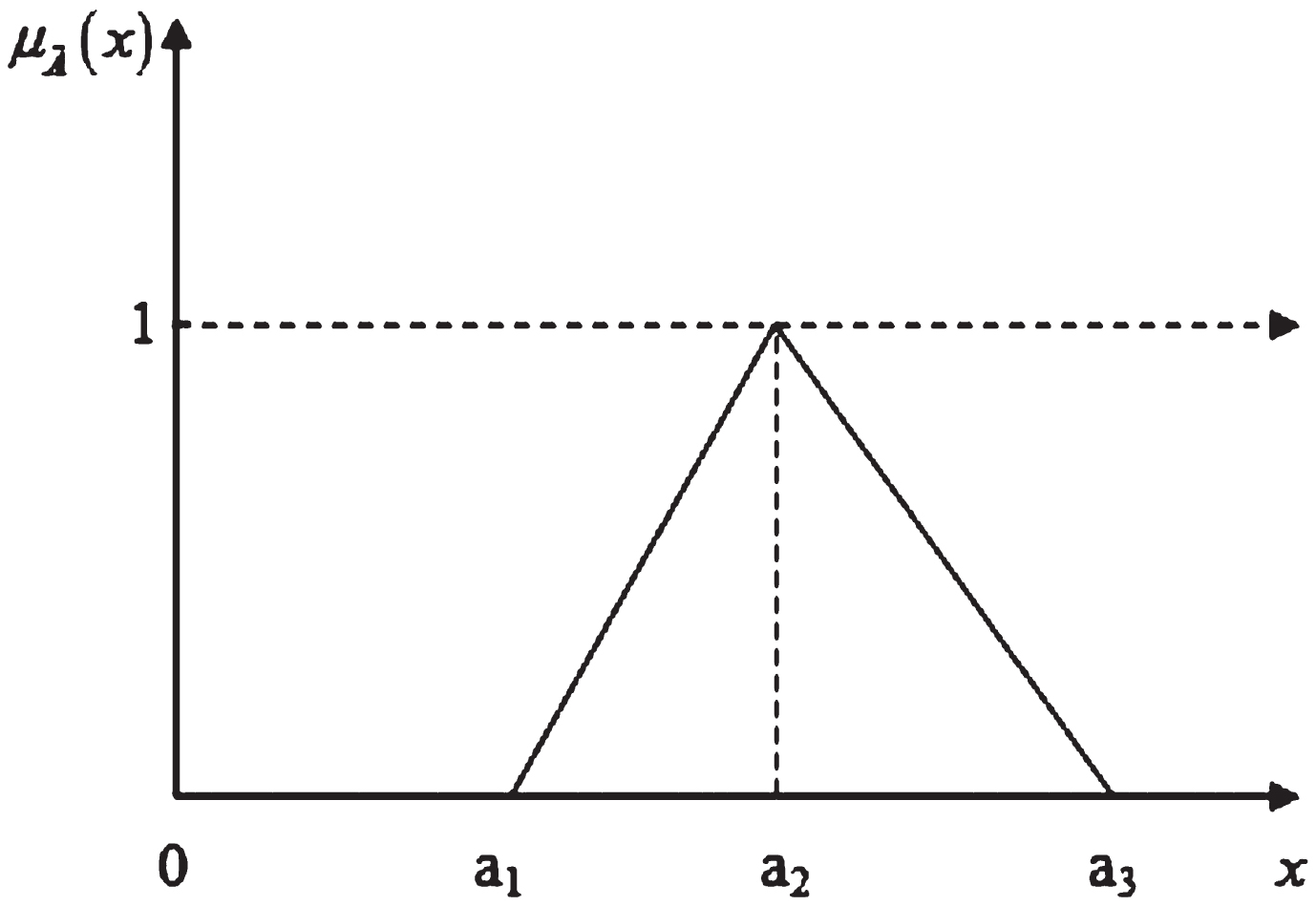
: Membership function of a Triangular Fuzzy Number
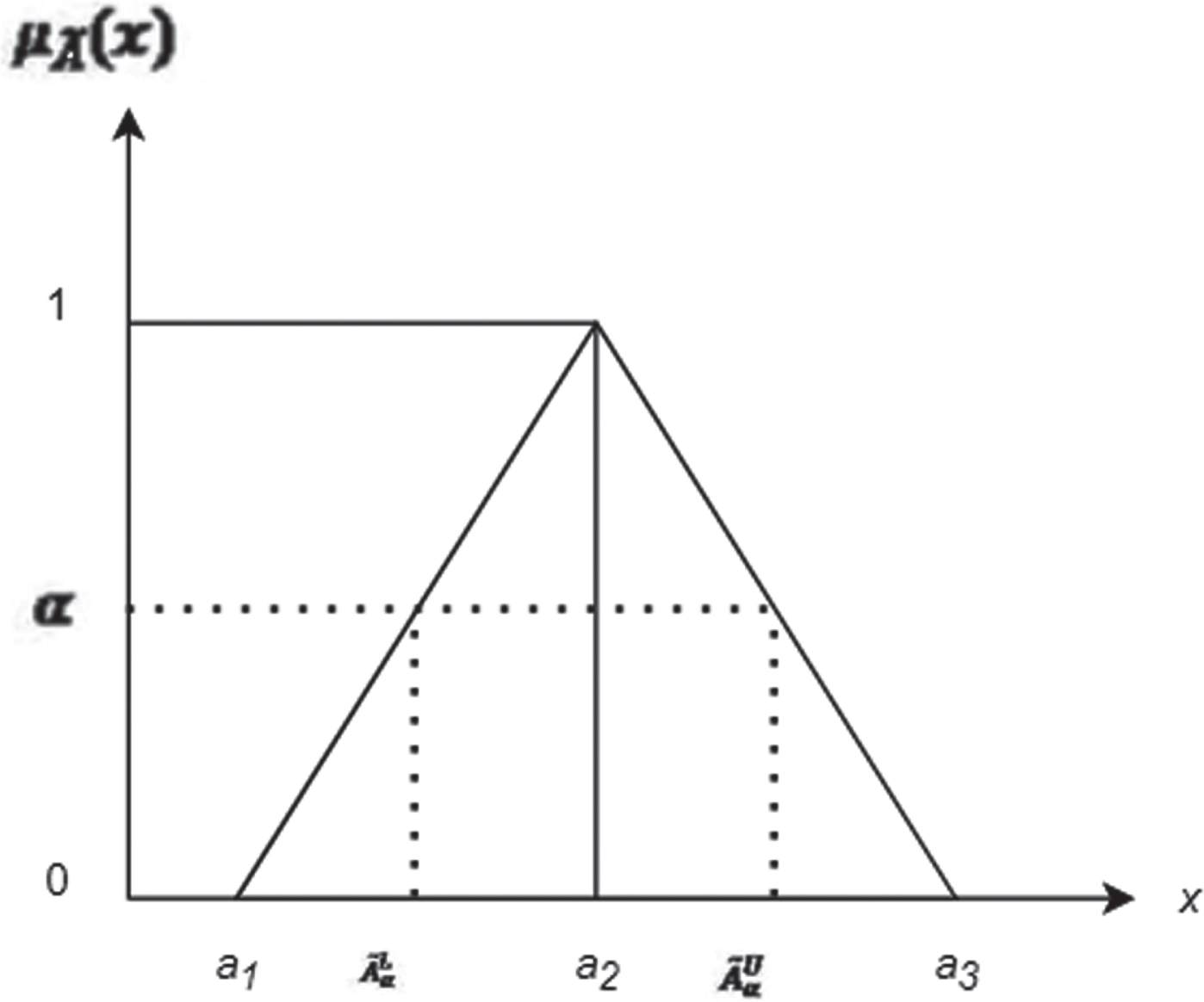
[22]: Triangular Fuzzy Number
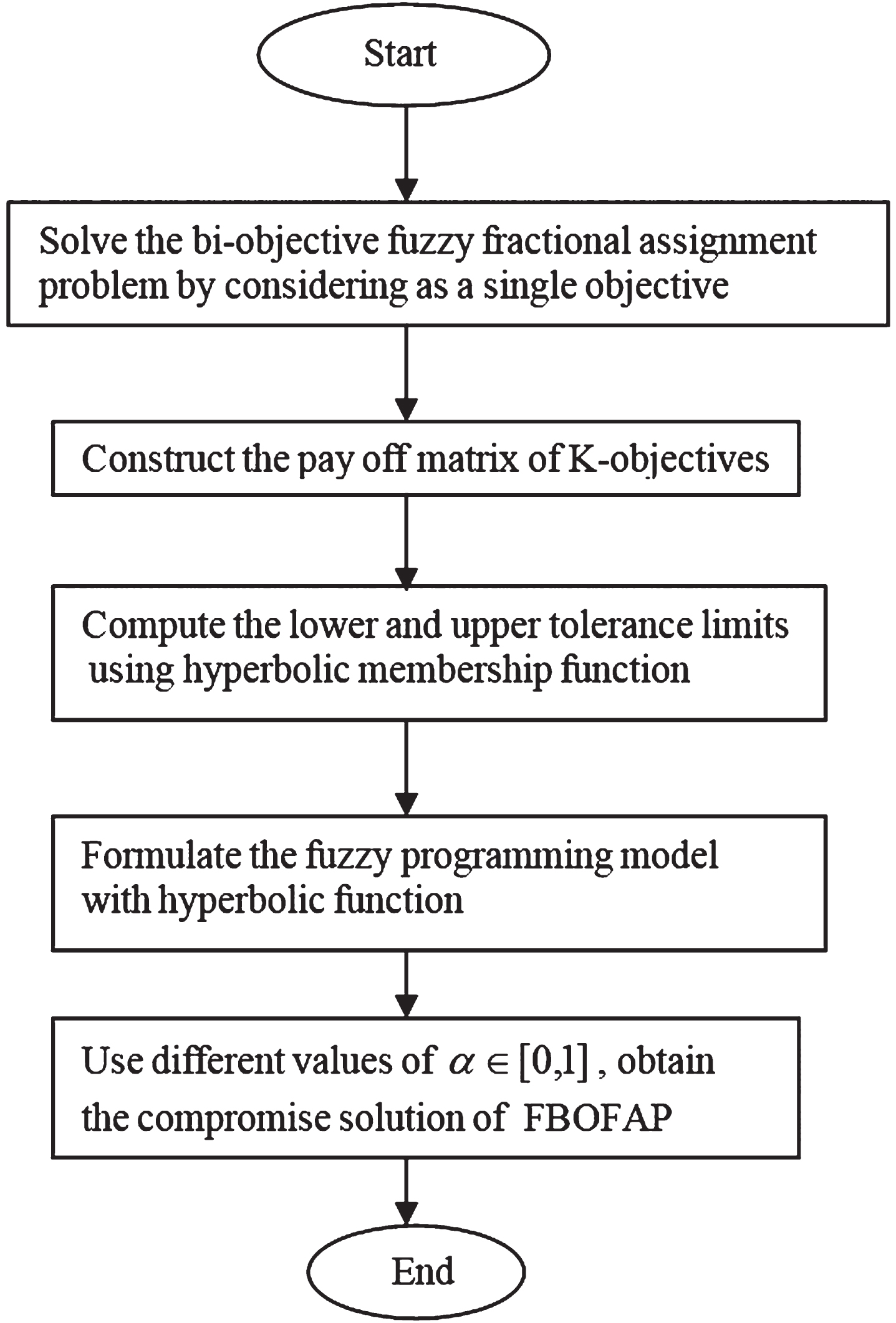
The flowchart of the proposed solution model.
Here, we consider the fuzzy constraints, the degree of acceptance is the highest and degree of rejection is the least, thus providing more satisfaction level to the decision maker as compared to hyperbolic membership functions. [8] Established the results using the membership function as, quadratic membership > linear membership. Hence in general, we can conclude that Hyperbolic membership > quadratic membership > linear membership.
That means, while using hyperbolic membership function to handle the fuzzy constraints, the degree of acceptance is the highest and degree of rejection is the least, thus providing more satisfaction level to the decision maker as compared to linear or quadratic membership functions.
The existing method [22] can be used for fuzziness either in the constraint inequalities or in the aspiration level of the decision-makers with two different membership functions. The proposed method has been studied on the FBOFAP with triangular fuzzy coefficients and defuzziffied using the ranking function. Many defuzzification methods are used in the related literature review. Each has its own merits and demerits. The proposed model yields the best compromise solution with different alpha values. It reduces the complexity of the problem-solving FBOFAP and is easy to compute.
Conclusion and future scope
The primary objective of this paper is to formulate a bi-objective fractional assignment problem under uncertainty because of previous research in the field of assignment problems. The ideal solution doesn’t need to be found when there are competing objective functions. When one purpose is solved, the other objectives are likewise satisfied. In some circumstances, a compromise approach is recommended. Consequently, to reach a compromise solution that accomplishes both goals, minimizing time as well as maximizing efficiency is sought. The solutions for various values are listed in Table 4 and also depicted graphically (Fig. 3). Future studies can be carried out using multi-objective intuitionistic fuzzy assignment problems to test the effectiveness of the recommended models.
Compromise solutions at different values of α
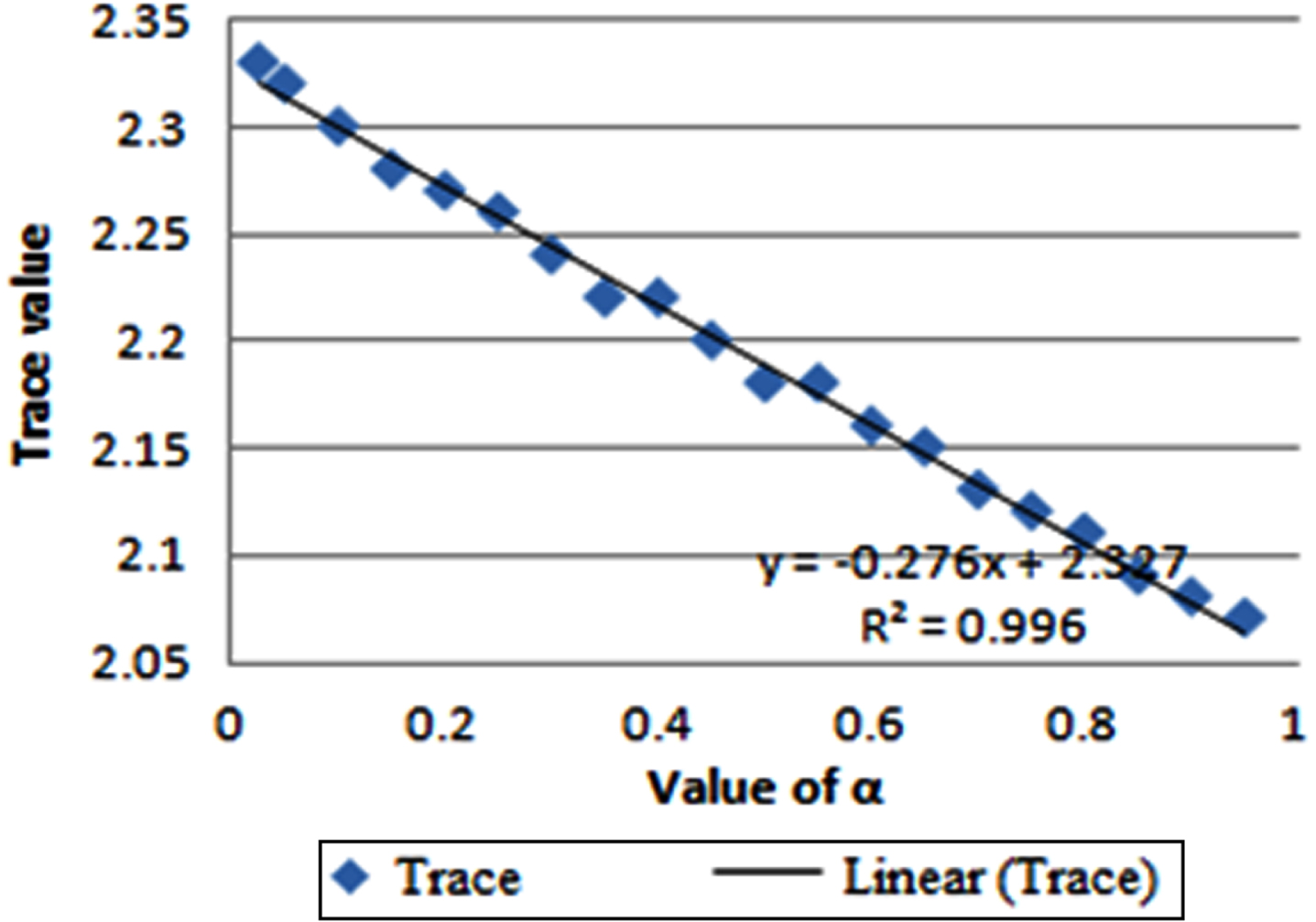
Compromise solution by fuzzy Programming model.