



Abstract
As an extension of picture fuzzy sets (PFSs), interval-valued picture fuzzy sets (IVPFSs) can better model and handle incomplete, indeterminate and inconsistent information in some practical applications. One of the important topics in IVPFSs is the similarity measure of IVPFSs, for which few studies have been proposed within the literature. Moreover, some existing similarity measures cannot adequately meet the conditions of similarity measure with some counterintuitive cases. In this work, we devise a novel similarity measure between IVPFSs based on the effect of the margin of the degree of refusal membership. First, the interval-valued picture fuzzy numbers will be transformed into two right-angled triangular-based pyramids in a spatial rectangular coordinate system. Then, a new parameter distance measure for IVPFSs is defined to assess the similarity between IVPFNs according to the centers of gravity of their corresponding right-angled triangular-based pyramids. Meanwhile, a comparison between different similarity measures is performed to illustrate that the proposed similarity measure can overcome the deficiencies of other extant measures. Finally, we apply it to handle pattern recognition problems. The comparison results indicate that the proposed algorithm can adequately meet the conditions of similarity measure, produce more reasonable and creditable results and perform well in complex contexts.
Keywords
Introduction
In the past decades, with the increasing volume of information available for decision-maker from modem detection technologies [58], pattern recognition has attracted great attention of decision-makers in the areas of computer science and applied mathematics [7, 42]. Pattern recognition inevitably involves different kinds of incomplete and inconsistent information [12, 61]. Generally, a certain feature indicates some uncertain indications of a test pattern, which implies relations between the sample pattern and the referral patterns. Therefore, one of the important topics in pattern recognition is about how to find out the ways of dealing effectively with the uncertainty, incomplete and inconsistent information to achieve more accurate results, which can be biased by referral patterns [27]. In most of the pattern recognition problems, one of the underlying ideas is to assess the closeness between a pair of the unknown sample and referral patterns and to find the nearest neighbor or best match to the unknown sample, in a collection of such referral patterns. Up to now, many researchers paid enormous attention on different technologies to hand the problems of pattern recognition, and one of them is fuzzy sets theory, which has already been successfully applied in various fields, such as soft sets [22, 52], Z-numbers [57], hesitant fuzzy set [43, 68], intuitionistic fuzzy sets [11, 38], interval-valued intuitionistic fuzzy sets (IVINFSs) [50, 53], Neutrosophic sets (NS) [9, 49], interval type-2 fuzzy sets [5, 18], Pythagorean fuzzy sets [17, 56], linguistic term set [29], and picture fuzzy sets [10, 30], etc...
In a pursuit to reasonably deal with the uncertainties in decision fields, Zadeh [64] originally put forward the notion of fuzzy sets (FSs). To handle incomplete information more accurately, Atanassov [1] further extended FSs to IFSs in 1986, which depends on a membership function and a non-membership function. Furthermore, Atanassov et al. [2] presented the theory of interval-valued intuitionistic fuzzy set (IVIFS) to strengthen the ability of describing the uncertainty and ambiguity. In general, the idea of IVIFSs is considered as another improved version of FSs and IFSs since IVIFS depends on a membership and non-membership function whose values are a closed subinterval of [0, 1] rather than crisp numbers [65]. However, FSs, IFSs and IVIFSs cannot deal with indeterminate and inconsistent information existed in real-life scenarios [45]. To do that, Smarandache [46] originally introduced a novel evaluation format of Neutrosophic set (NS) from a philosophical point of view. NS is characterized by three types of terms, including the truth, indeterminacy and falsity membership functions, which can be used to describe the incomplete and inconsistency information [46]. Recently, Cuong et al. [10] innovatively proposed anther notion called picture fuzzy set (PFS), which is a generalization of FSs and IFSs, to handle incomplete and inconsistency information. Compared with FSs, IFSs and NSs, PFSs depend on the four dependent terms, called the degrees of positive, negative, neutral and refusal membership. The only constraint is that the sum of the four types of membership degrees is equal to 1. Moreover, Cuong et al. [10] also proposed the notion of interval-valued picture fuzzy sets (IVPFSs). In IVPFSs, the degrees of the positive, negative and neutral membership are respectively given in closed subintervals of [0, 1] with a constraint that the sum of the supremum of the three subintervals cannot exceed 1. Obviously, IVPFSs can describe fuzzy information more suitable than IFSs, IVFSs and PFSs. In this regard, IVPFSs plays a more important role in describing the uncertainty, incomplete and inconsistency information in some practical applications.
As one of the important challenges in FS theory, the extant literature has given enormous attentions on the distance and similarity measures in various fields, such as medical diagnosis, pattern recognition and multiple attribute decision making, etc... It has been well known that various similarity measures have been introduced for IFSs [4, 28], IVFSs [33, 67], NSs [25, 40] and PFSs [25, 55] in the last few decades. Various methodologies were exploited, in which most measures are mainly based on geometric distance model and set-theoretic approach [59]. Recently, some works put their interesting on handling the problem of similarity measure between IVPFSs. For instance, Liu et al. [30] proposed some similarity measures between IVPFSs, including set-theoretic similarity measures and grey similarity measures, etc... However, few studies have addressed the similarity measure for IVPFSs within the literature. Moreover, other extant similarity measures for IVPFSs [30] must be improved for the following reasons: Although Smarandache [46] has proved that PFS is a special case of NS, the similarity measures between NSs cannot be applied directly to PFSs since some differences exist in the constraint condition on three types of membership functions. This phenomenon also exists in interval-valued picture fuzzy information. Among these extant similarity measures between IVPFSs, some of them cannot compute the degree of similarity because of “the division by zero problems”; others fail to distinguish the negative differences from positive differences in some counterintuitive examples. In FS contexts, one of the important properties of similarity measures is the triangle inequality. Both PFSs and IVPFSs originated from the FSs and IFSs. Thus, the similarity measures between IVPFSs should fulfill all the properties of the metric for FSs and IFSs. However, most of the extant similarity measures for IVPFSs cannot fully meet the property of the triangle inequality in some counterintuitive examples.
It should be noted that the definition of the similarity measure for IVPFSs is still an open problem requiring more attentions. Therefore, more optimized measures between IVPFSs are needed to be introduced to overcome the restrictions of other existing measures for handling pattern recognition problems within interval-valued picture fuzzy environment. Recently, a few studies established the similarity measure for IFSs based on the transformed technologies in a rectangular coordinates system, in which the intuitionistic fuzzy number is transformed into the right-angled triangular or isosceles triangle to define the distance/similarity measure for IFSs. For example, Boran et al. [4], Chen et al. [69, 70] and Shen et al. [71] respectively proposed some similarity and distance measures for IFSs base on the transformed right-angled triangles of intuitionistic fuzzy numbers. Later, Jiang et al. [72] defined a new distance measure of IFSs based on the transformed isosceles triangles of intuitionistic fuzzy numbers. All of which can avoid some restrictions of other extant intuitionistic fuzzy similarity measures.
As is well known to all, multi-channel digital signals can be better denoted by elements of multi-dimensional Euclidean space in a certain or precise environment [73]. When using crisp multidimensional vectors to represent multi-channel digital signals in an uncertain environment, however, the signals themselves become unwise. Therefore, Wang et al. [73] introduced a new notion called fuzzy n-cell number (i.e., n-dimensional Euclidean fuzzy space) to describe imprecise multi-channel digital signals and constructed a new type of clustering algorithm within an imprecise or uncertain environment. Motived by the above ideas, in this work, we define some novel distance and similarity measures in a multi-dimensional Euclidean space under interval-valued picture fuzzy environment.
In this work, we concentrate on the theoretical and practical deficiencies of the extant similarity measures between IVPFSs. To overcome their deficiencies, we strive to put forward some new distance and similarity measures based on the marginal effect of the refusal membership degree of the interval-valued picture fuzzy number (IVPFN). To do that, IVPFNs will be converted into two right-angled triangular pyramids in a spatial rectangular coordinate system. Then, a new parameter distance measure is devised to assess the differences between IVPFNs according to the centers of gravity of their corresponding right-angled triangular pyramids. We also prove some properties. Meanwhile, some new parameter similarity measures of IVPFSs are defined based on the proposed distance measures. Later, some comparison analyses are elucidated that the proposed similarity measure has some advantages, in which it not only meets the properties of the similarity measurement without counterintuitive results, but also can better indicate the discrimination degree between different IVPFSs. Finally, a new algorithm is designed to handle pattern recognition problems. The main contribution of this work is as follows: Define a new similarity measure between IVPFSs based on the marginal effect of the refusal membership degree of the interval-valued picture fuzzy number. It enlarges the detailed information in interval-valued picture fuzzy similarity measures and has a better recognition ability. The properties of the proposed similarity measure meet all properties for a similarity measure in IVPFS environment, which is found to be superior to the extant similarity measures between IVPFSs in handling pattern recognition problems. Great improvement on the proposed similarity measure is verified. The proposed similarity measure between IVPFSs is carefully compared and analyzed with some classical similarity measures through some counterintuitive cases. The results demonstrate that the proposed measure avoid unreasonable results and outperforms other metrics to measure uncertainty. An extension of pattern recognition method within the interval-valued picture fuzzy scenario is proposed. The value of the criterion is expressed as IVPFSs, which can describe more ambiguous information due to the shortage of experts’ experience and knowledge. Hence, the proposed method can appropriately handle real-life pattern recognition problems.
The paper is managed as follows. Section 2 outlines related notions as regards the PFSs and IVPFSs [10] and some axiom definitions of distance and similarity measures between IVPFSs. In Section 3, we devise a novel similarity measure between IVPFNs to assess the similarity between IVPFSs. Section 4 presents a comparative analysis to illustrate that our measure can better discern diverse patterns without counterintuitive cases. Section 5 compares the advantage of the different algorithms in IVPFSs scenario using several classical pattern recognition examples. Finally, Section 6 summarizes the conclusions.
Preliminaries
In the following, we give a brief outline of some basic concepts on PFSs and IVPFSs, the basic axioms definitions of distance and similarity measures, and some extant similarity measures between IVPFSs.
Picture fuzzy sets and Interval-valued picture fuzzy sets
Later, Cuong [9] proposed the concept of interval-valued picture fuzzy sets (IVPFSs) to better express uncertain information, which is characterized by a positive membership function, a negative membership function and a neutral membership function whose values are intervals rather than crisp numbers.
Specially, for any x ∈ X, if
A ⊆ B iff ∀x ∈ X, A = B iff ∀x ∈ X, A ⊆ B and A ⊇ B,
0 ⩽ d (A, B) ⩽ 1, d (A, B) =0 iff A = B, d (A, B) = d (B, A), If A ⊆ B ⊆ C, then d (A, B) ⩽ d (A, C) and d (B, C) ⩽d (A, C).
0 ⩽ S (A, B) ⩽1, S (A, B) =1 iff A = B, S (A, B) = S (B, A), If A ⊆ B ⊆ C, then S (A, C) ⩽ S (A, B) and S (A, C)⩽S (B, C).
Some extant similarity measures between IVPFSs
In the following section, we present some similarity measures between IVPFSs [30] to handle patterns recognition, which are necessary to understand the established measure and its applications.
Let there be two IVPFSs A = { < x
j
, μ
A
(x
j
) , ν
A
(x
j
) , γ
A
(x
j
)> |x
j
∈ X } and B ={ < x
j
, μ
B
(x
j
) , ν
B
(x
j
) , γ
B
(x
j
) > | x
j
∈ X } in the universe of discourse X ={ x1, x2, ⋯ , x
n
}, where
Moreover, others cannot get the value of similarity measure between IVPFSs because of the problem of “the division by zero” in some cases. For example, for two IVPFSs A and B, when μ A (x j ) = ν A (x j ) = γ A (x j ) = [0, 0] and/or μ B (x j ) = ν B (x j ) = γ B (x j ) = [0, 0], SWCSM1 (A, B), S WSTSM (A, B) and SWSDSM4 (A, B) are unreasonable because of “the division by zero problems”. Therefore, some extant similarity measures of IVPFSs are undefined or un-meaningful in practical applications. We need to construct some new similarity measures to avoid the weaknesses of other extant measures.
In the following, a novel similarity measure between IVPFSs is introduced.
Let
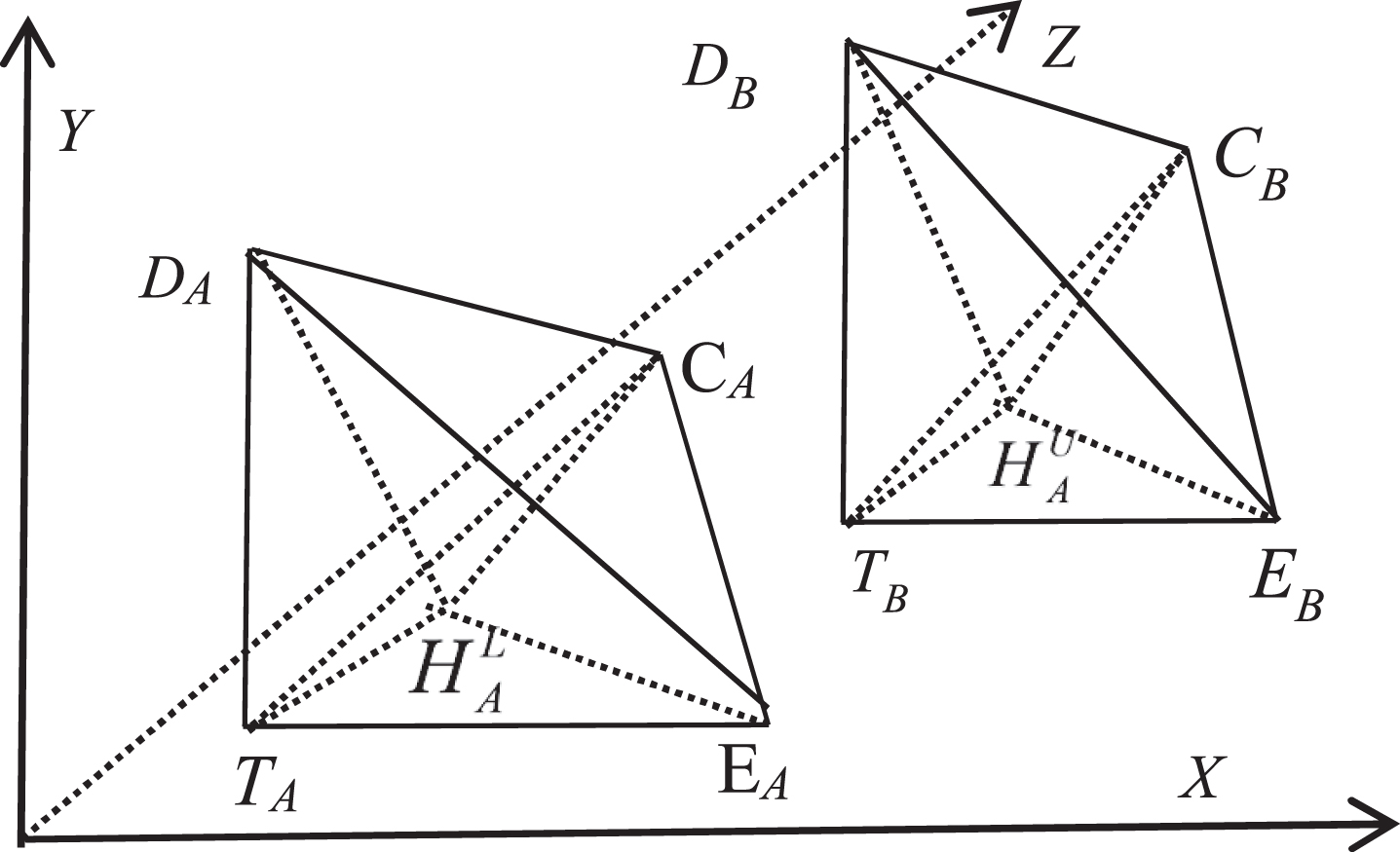
The right-angled triangular-based pyramids for the IVPFN A.
According to the Definition 2, we can make it easy to obtain the following equality, such that:
And
Then, let
According to the Equations (15)–(18), the distance between the IVPFNs A and B is defined as:
Now, we parameterize
Let
and
According to Equations (21), it is clearly see that
Similarly, we get
Thus, we have
Then, the following inequalities are hold:
Finally, the following inequality is hold:
Thus,
Case 1: if A = B, then
Let A and B be two IVPFSs. When A = B, according to the Definition 3, we can get
Case 2:
As
Then, we can write the following equations:
For this system, we’ll replace the first equation S1 by adding the equation S2 and S3, the obtained result is as follows:
As t ⩾ 3, we have
Notice that we can eliminate
As t ⩾ 3, we obtain
Therefore, the defined distance measure,
From cases (1) and (2), we can see that the distance measure,
Now, we prove that
Then the following equations are obtained as:
Let A, B, and C be three IVPFSs. The parameter Euclidean distance measures
Then, the following equations can be obtained:
If A ⊆ B ⊆ C, we have
Therefore, the following inequalities are hold:
This means
From the above analysis, we can say that
where t ⩾ 3, and w
i
(i = 1, 2, ⋯ , n) is the weight of the features (x
i
), w
i
∈ [0, 1] and
According to the relation between distance measure and similarity measure, a weighted distance measure between IVPFSs will be defined in the following.
A comparison of similarity measures between IVPFSs
In order to illustrate the rationality and superiority of the proposed similarity measure, a comparison between different extant similarity measures between IVPFSs is conducted. The obtained results are listed in the Table 1. Moreover, the extant similarity measures between IVPFSs are summarized in Section 2. 2.
A comparison of existing similarity measures of IVPFSs
A comparison of existing similarity measures of IVPFSs
Where t = 3 when using the proposed measure. (“Bold” signifies counter-intuitive results; “N/A” signifies results fails to get the similarity value because “the division by zero problem”; “underline” signifies results fail to satisfy the definitions (A8) of similarity measure).
Next, we use 8 groups of interval-valued picture fuzzy sets to compare the proposed similarity measure with other extant similarity measures. The comparison results are also shown in Table 1. From Table 1, we can elaborate on the six types of limitations of the extant similarity measures between IVPFSs as follows:
Where t = 3 when using the proposed measure. (“Bold” signifies
From Table 1, it is deduced that the extant similarity measures with their own measuring focus can meet most of properties of similarity measure for IVPFSs. However, the existing measures sometimes cannot distinguish IVPFSs accurately in practical applications. Besides, the proposed measure between IVPFSs is the only one measure has no unreasonable results as shown in Table 1, which is consistent with actual case.
As a whole, the results obtained from Table 1 means that the proposed similarity measures between IVPFSs can produce disparate similarity values for different IVPFSs, which indicates that the proposed measure can produce efficiency results in this experiment. Based on the above analysis, we can infer that the proposed similarity measure can achieve better performance than the extant similarity measures between IVPFSs.
In order to investigate the influences of different value for parameters t on the similarity value between different patterns, a sensitivity analysis is applied to see the robustness of the proposed measure in the following. When the value for parameter t in Eq (18) is determined as a certain integer from 3 to 10 in the computational process, the similarity values can be obtained as shown in Fig. 2, which illustrates the possible changes in the value of similarity between different patterns.
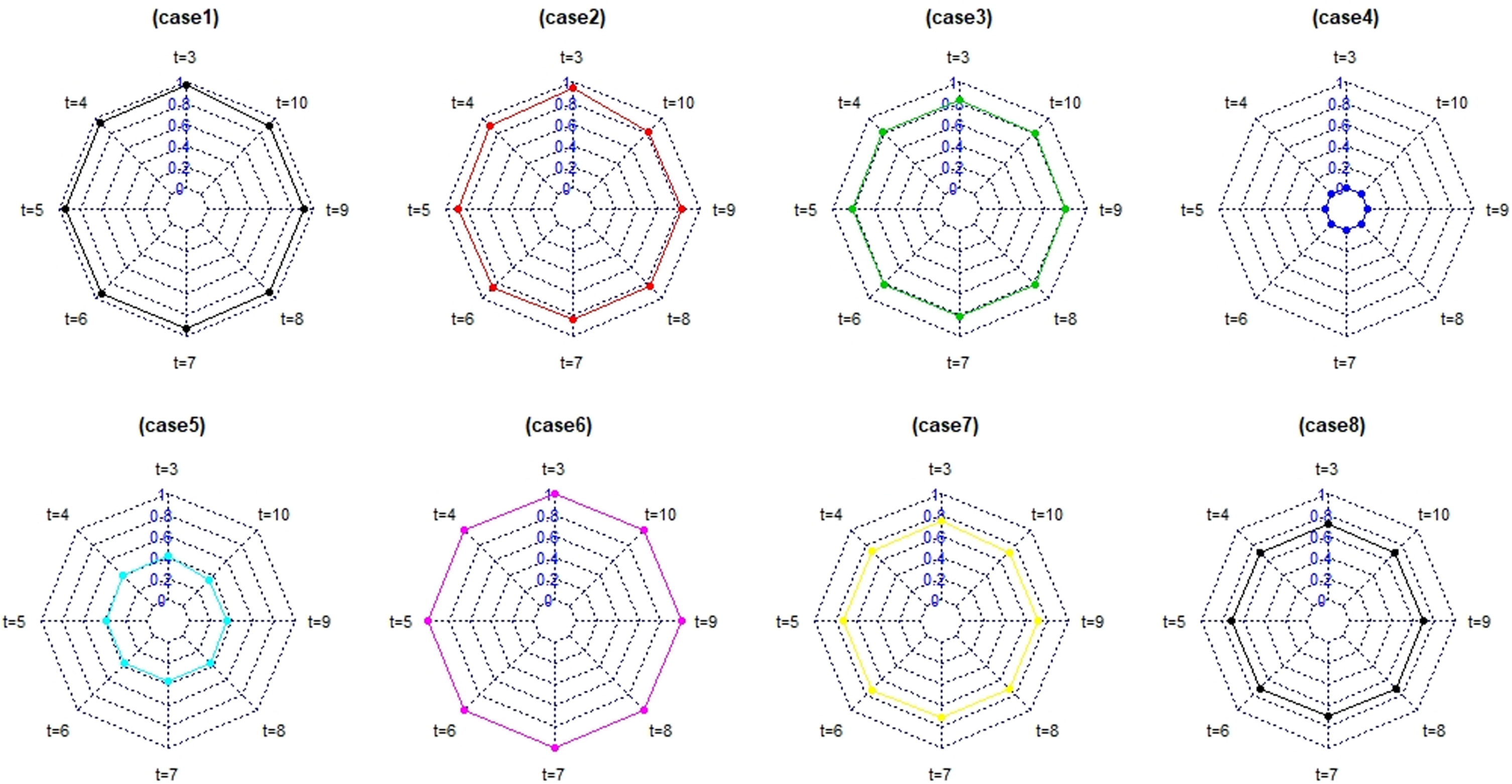
Final similarity value for different values t.
According to the results obtained in Fig. 2, it is clear that the different values for parameters t can produce some influences on computing the values of similarity between IVPFSs, which are decreased by increasing the values for parameter t in the formula (18). When using the proposed measure to assess the similarity between the maximum IVPFSs and the minimum IVPFSs (see case 6 in Fig. 2.), however, the values of similarity remain unchanged even when increasing the values for parameter t. This phenomenon also exists in case 4, in which a pair of PFNs is equal to each other. Thus, the advantages of our measure are validated.
To further illustrate the efficiency of the proposed similarity measure between IVPFSs in applications, we apply it to the pattern recognition problems.
Algorithms for pattern recognition and pattern recognition
Let X = (x1, x2, ⋯ , x n ) be a feature set. There are m known patterns, all of which are denoted by IVPFSs P j = {x i , < μ P j (x i ) , v P j (x i ) , γ P j (x i ) > |x i ∈ X} (j = 1, 2, ⋯ , n) in the feature set X. And there are t test samples to be recognized, all of which are also expressed by IVPFSs Q k = {x i , < μ Q k (x i ) , v Q k (x i ) , γ Q k (x i ) > |x i ∈ X}, (k = 1, 2, ⋯ , t) in the feature set X. We need to recognize the classification of unknown sample Q k according to the known pattern P j . The processes of pattern recognition are designed as follows:
where t ⩾ 3, and w
i
is the weight of the features (x
i
), w
i
∈ [0, 1] and
The similarity measure between IVPFSs can be used to calculate the degree of the distinction of different IVPFSs. Thus, it can be frequently used to handle pattern recognition problems, which are also utilized to test the rationality of the proposed similarity measure by researchers. Using the traditional way, some classic examples are used to verify it rationality. It should be pointed out that an effective measure should produce reasonable outputs and make correct decisions, and this section introduces the experiments in detail. In the next section, let the parameters be λ = 0.5 in S
WDSM
(A, B) and t = 3 in
Applications in pattern recognition
Evaluation values for mineral fields recognition
Evaluation values for mineral fields recognition
Our aim is to identify the classification of a test sample Q into one of the known mineral fields P i (i = 1, 2, 3). In order to do that, the value of the similarity measures between the test mineral field Q and the known mineral fields P1, P2 and P3 are respectively calculated and shown in Table 3 and Fig. 3. We can see from Table 3 that S(P1, Q)=0.8106, S(P2, Q)=0.8677 and S(P3, Q)=0.8853. Since the largest the value of similarity between the known mineral fields and the unknown sample indicates the proper mineral field, it is clear that the unknown mineral field Q should be classified into the known mineral field P4.
The results of similarity measures and pattern recognition
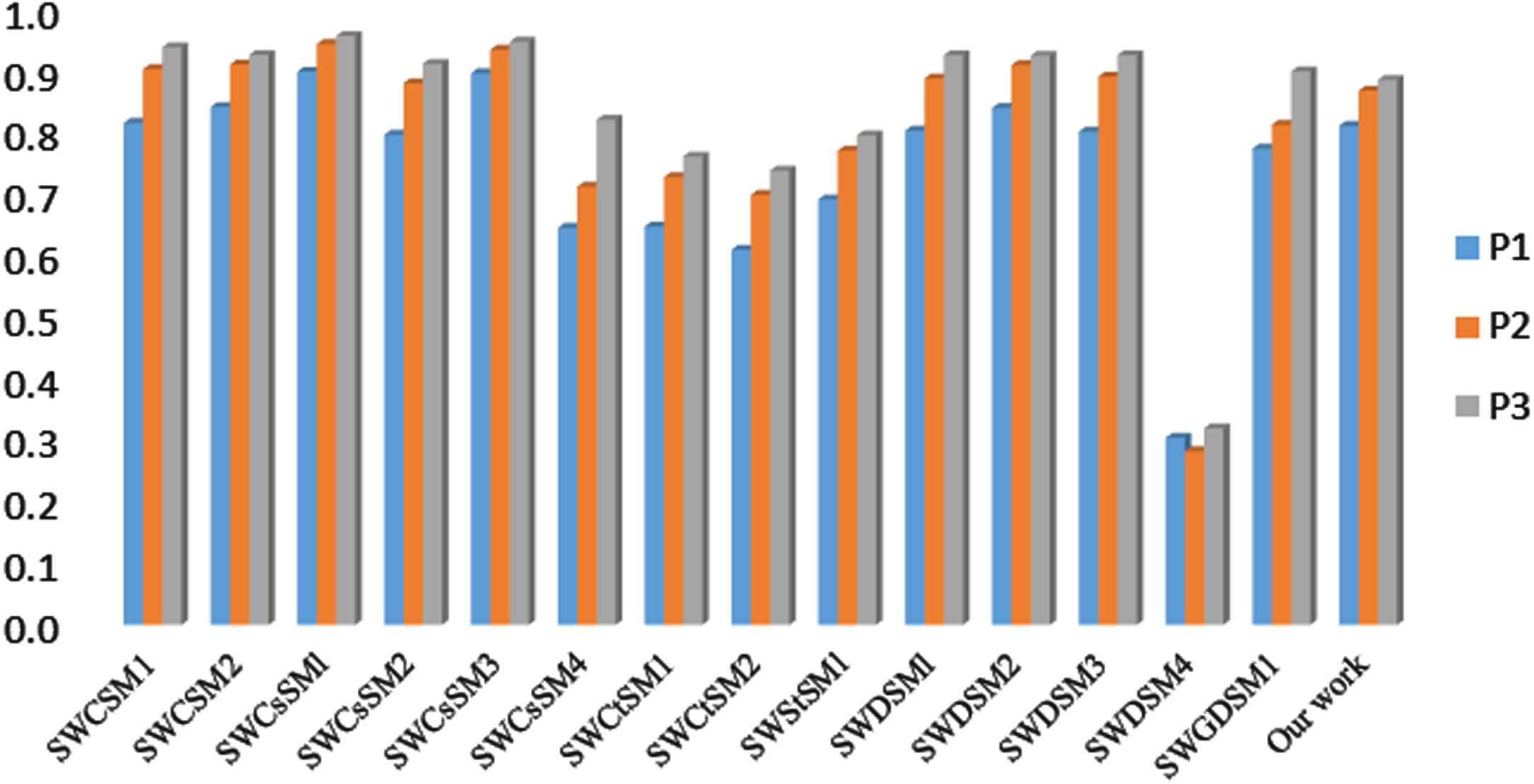
Comparison results of various similarity between IVPFSs.
To prove the advantage of the proposed measure, the classification result is compared with the ones of extant similarity measures between IVPFSs as shown in Table 2 and Fig. 4. As can see from Table 2 and Fig. 4 that the comparison results using various similarity measures between IVPFSs confirm that all of the classification results are identical, which indicates that our proposed measure is consistent with the other extant measures in IVPFS environment. The experimental results mean that the improved measure can make correct decision, and it is an effective pattern recognition algorithm.
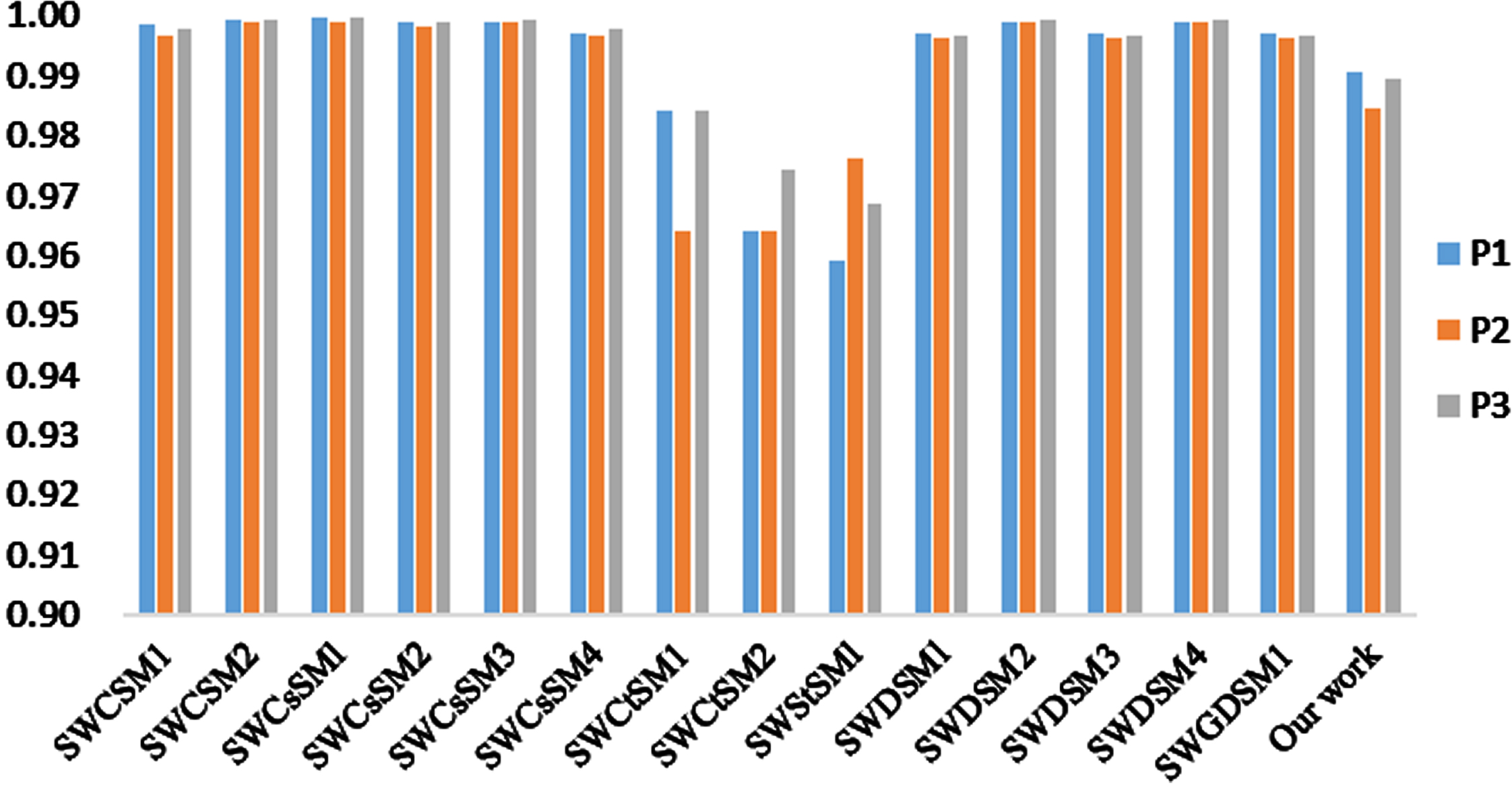
Comparison results of various similarity between IVPFSs.
3-Class/3-features problem
By implementing the proposed algorithm for pattern recognitions of Example 5.2, the results are shown in Table 5 and Fig. 3. According to the results in Table 5, we can obtain S(P1, Q)=0.9905, S(P2, Q)=0.9845 and S(P3, Q)=0.9894. According to Eq. (26), the unknown pattern Q should be classified into the known pattern P3. Furthermore, to illustrate the practicability of the proposed algorithm, we compare it with other existing methods under IVPFSs environment. The classification results are also shown in Table 5 and Fig. 4.
The results of similarity measures and pattern recognition
Note: “Bold type” denotes that patterns cannot obtain reasonable outcome. “Undo” denotes that patterns cannot be determined.
From Table 5, we can also see that this example has three classification results for these similarity measures: P1, P2 and P3. We find that the proposed measure and the similarity measures SWStSMl(A, B), SWDSM2(A, B) and SWDSM4(A, B) obtain the identical recognition results and avoid the deficiencies of the similarity measures SWCsSMl(A, B), SWCsSM2(A,B), and SWCtSM1(A, B), which cannot correctly determined the classification results of the sample Q. However, the extant similarity measures SWCsSMl(A, B), SWCsSM2(A, B),and SWCtSM1(A, B) cannot be correctly determined the classification results because these measures have the problem that the maximal values of the similarity measures S(P1, Q), S(P2, Q) and S(P3, Q) have the equal values, which inevitable leads to the inability to make a decision. Moreover, although the similarity measures SWCtSM1(A, B) and SWCtSM2(A, B) can obtain classification results, they lead to the equal values of the similarity measures S(P1, Q) and S(P2, Q), which is a counterintuitive results because IVPFSs P1 and P2 are not equal to each other. According to the above analysis, it can be considered that the proposed measure can achieve better performance than the extant similarity measures between IVPFSs in this experiment.
Symptoms characteristic for the diagnoses represented by the form of IVPFSs
Symptoms characteristic for the diagnoses represented by the form of IVPFSs
Symptoms characteristic for the diagnoses represented by the form of IVPFSs
For each patient, to make a reasonable diagnosis conclusion according to their symptoms, the value of similarity measure between a known diagnosis pattern and each patient is computed by the proposed method in terms of his symptoms, respectively. The obtained results are shown in Table 8 and Fig. 5.
The results measured by the proposed similarity measure
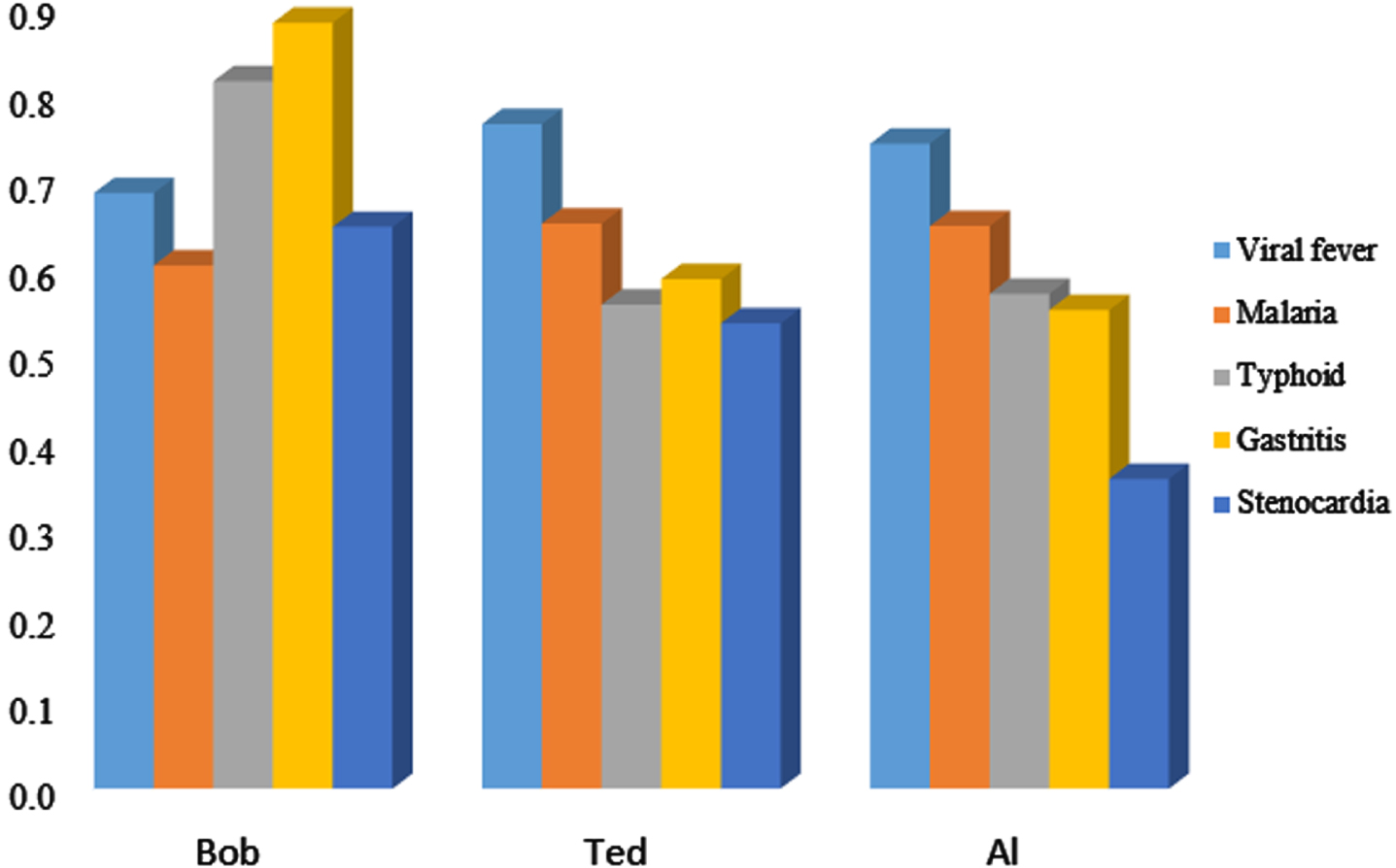
The results of the proposed similarity between IVPFSs.
According to the obtained results in Table 8, we can obtain S(P1, Q1)=0.6843, S(P1, Q2)=0.6011, S(P1, Q3)=0.8128 and S(P1, Q3)=0.6454. On the principle of the maximum value, we can see from Table 8 and Fig. 4 that patient Bob should be diagnosed as suffering with Gastritis. Similarly, we also can see from Table 8 and Fig. 4 that patients Ted and Al should be diagnosed as suffering from Viral fever, respectively. The results are identical with the extant results in literatures [3, 47, 51]. Furthermore, to illustrate the effectiveness of our newly proposed algorithm, we compare it with extant traditional methods within different fuzzy environment, such as intuitionistic fuzzy sets [3, 41, 47, 51, 59] and Neutrosophic cubic sets [9]. The obtained diagnostic results with different fuzzy environment are also shown in Table 5 and Fig. 4, respectively.
Moreover, the diagnostic result of patient Bob, all of five diagnosed methods obtain a consistent result, i.e. Gastritis. As for patient Ted, it is worth noting that it is not easy to come to a diagnostic conclusion. According to the Table 9 and Fig. 4, it is clear that patient Bob should be diagnosed as suffering from Gastritis since all methods provide the coincident diagnostic results. However, three of the five methods imply that patient Al diagnosed as suffering from Viral fever, but other two methods indicate that Al should be diagnosed as suffering from Malaria.
The comparison of the result with other existing ones
There are two reasons contribute to different results regarding as patient Bob and Ted. One of these is that the existing diagnostic conclusions are based on the similarity measure in different fuzzy environment. For example, in [3, 41, 47, 51, 59], the results obtain from different similarity measures between IFSs, which only considers two types of membership degrees but not the third membership degree. Moreover, in [9], the results originate from the similarity measure between NSs, which include three type of membership function with a condition that the sum of three type of membership function take value in [-0, 3 +]. Different from IFSs and NSs, our diagnosis method is based on the proposed similarity measure between IVPFSs, which contains more information, including the degrees of the positive, negative, neutral membership and refusal. The second reason is that the symptoms of Viral fever and Malaria are interacting. It is difficult to distinguish between the two symptoms. Nonetheless, our diagnostic results are consistent with most of the extant methods. According to the above analysis, we could draw a conclusion that our proposed similarity measure between IVPFSs is most reliable and reasonable to obtain a diagnose result in comparison with other extant traditional methods in IFSs and NSs environment.
Symptoms characteristic for the diagnoses represented by the form of IVPFSs
In the following, let us consider a colorectal cancer patient Q characterized by an IVPFS, as shown in Table 10. To recognize the state of an unknown patient Q according to his/her symptoms Si, we can compute the value of the similarity between the four known patterns and unknown patient Q with Eq. (25), respectively. The obtained results are respectively shown in Table 11 and Fig. 6. From Table 11, we have S(P1, Q)=0.8378, S(P2, Q)=0.8279, S(P3, Q)=0.4448 and S(P4, Q)=0.6269. Thus, we find that patient Q should be diagnosed as suffering from metastasis. We also see from Table 11 and Fig. 5 that all of these extant similarity measures obtain the identical diagnoses conclusions, which are consistent with the previous works on the subject [3, 24, 41], and prove that our result is reliable and accurate.
The results of medical diagnosis
Note: “Bold type” denotes that patterns cannot obtain reasonable outcome.
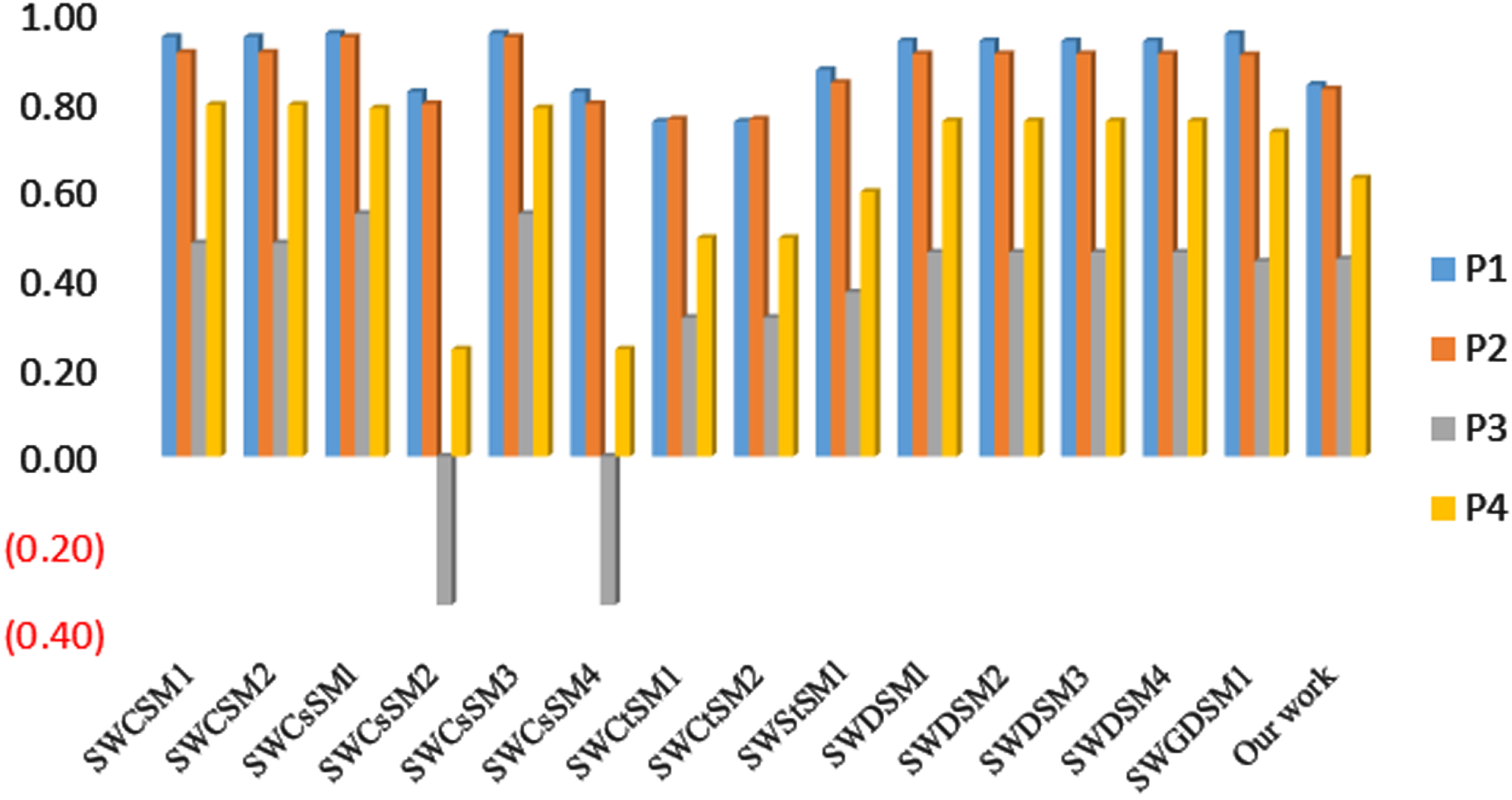
Comparison results of various similarity between IVPFSs.
Let S be a known patient who already have suffered with COVID-19 issues, which is described with respect to three symptoms in IVPFSs, and given by S = {〈[1.0, 1.0] , [0.0, 0.0] , [0.0, 0.0] 〉, 〈[0.0, 0.0] , [1.0, 1.0] , [0.0, 0.0] 〉, 〈[0.0, 0.0] , [0.0, 0.0] , [1.0, 1.0] 〉}.
Let the assessment of the three patients be given in IVIFSs, and written as follows:
P1 = {〈 [0.0, 0.0], [0.4, 0.4], [0.4, 0.6]〉, 〈[0.4, 0.5], [0.0, 0.0], [0.3, 0.5〉, 〈[0.2, 0.4], [0.4, 0.6], [0.0, 0.0]〉}.
P2 = {〈[0.0, 0.0], [0.4, 0.6], [0.4, 0.4]〉, 〈[0.3, 0.5], [0.0, 0.0], [0.4, 0.5]〉, 〈[0.4, 0.6], [0.2, 0.4], [0.0, 0.0]〉}.
P3 = {〈[0.0, 0.0], [0.2, 0.4], [0.4, 0.6]〉, 〈[0.4, 0.5], [0.0, 0.0], [0.3, 0.5]〉, 〈[0.4, 0.4], [0.4, 0.6], [0.0, 0.0]〉}.
Let wi be the weight of symptoms characteristic Si, where wi = 0.25 and 1≤i≤4. Our goal is to determine patient with the highest probability of illness among the three peoples. According to this requirement, the proposed similarity measure between IVPFSs will be applied to determine the value of similarity measure between known patient S and potential patient Pi. The bigger the value of the similarity measure between reference patient and potential patient is, the more possible the potential patient falls ill. Thus, the value of similarity between A, B, C and S by our newly proposed methods are depicted in Table 12 and Fig. 7.
The results of medical diagnosis
Note: “Bold type” denotes that patterns cannot obtain reasonable outcome. “Undo” denotes that patterns cannot be determined.
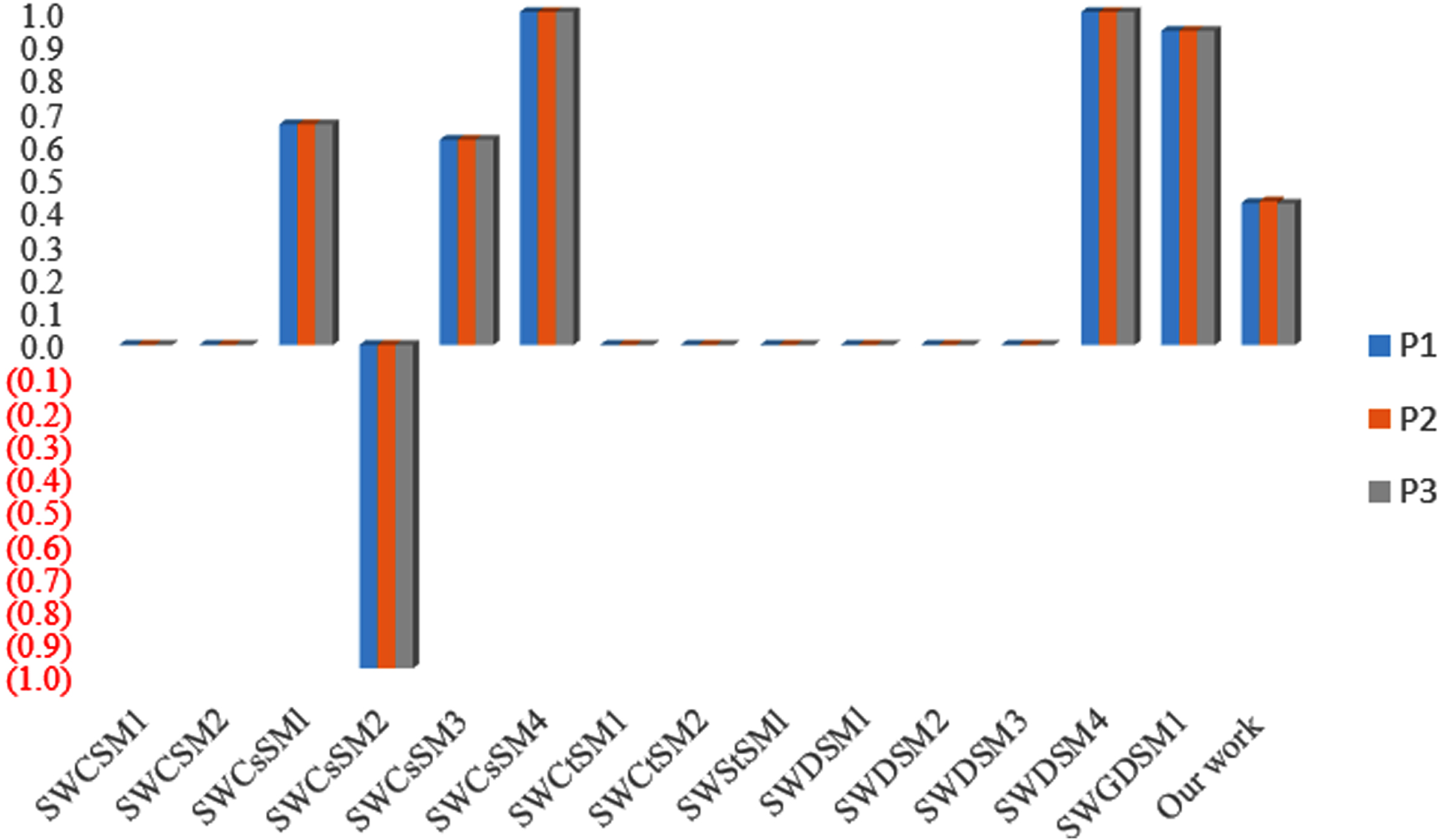
Comparison results of various similarity between IVPFSs.
According to the obtained results in Table 5, we can see that S(P1, S)=0.4264, S(P2, S)=0.4316 and S(P3, S)=0.4250. On the principle of the maximum value of similarity, the patient P2 should be highest probability of illness. Furthermore, to illustrate the practicability of the proposed method, we compare it with other existing methods in IVPFSs environment. The obtained results are also shown in Table 5 and Fig. 4, respectively. As can be seen from Table 12 that obtained results of most extant methods cannot be determined, such as SWCSM1(A, B), S WCSM2 (A, B), SWCsSMl(A, B), SWCsSM2(A, B), SWCsSM3 (A, B), SWCsSM4(A, B), SWCtSM1(A, B), SWCtSM2(A, B), SWStSMl(A, B), SWDSMl(A, B), SWDSM2(A, B), SWDSM3(A, B), SWDSM4(A, B) and SWGDSM1(A, B). It shows that all of these extant methods have equal values of similarity in this example, and fail to generate reasonable outcome. Considering the relation between distance measure and similarity measure, we can apply the extant distance measure between interval-valued spherical fuzzy sets in [75] to determine patient with the highest probability of illness among the three peoples A, B and C, in which the distance measure can be written as
According to Equation (27), we can see that the distance measure between interval-valued spherical fuzzy sets is an extension of the distance measure between interval-valued intuitionistic fuzzy sets by adding the deviation of the fourth membership function. The lesser the value of the distance from the reference patient to potential patient, the more possible the potential patient is to the reference patient. According to Equation (27), we can obtain d(P1, S)=0.5756, d(P2, S)=0.5756 and d(P3, S)=0.5756, respectively. The obtained results imply that there is no difference among the three patients. Thus, we cannot determine the highest probability of illness. As a whole, the distance measure in [75] also face the limitations of the extant similarity measures between IVPFSs SWCsSMl(A, B), SWCsSM2(A, B), SWCtSM1(A, B), SWCtSM2(A, B), SWDSM4(A, B) and SWGDSM1(A, B), because all of these measures are based on the deviation of the four type of membership functions. However, our proposed measure is the only one method that can well produce definite diagnosis result due to it can well distinguish different the values of similarity between P1, P2, P3 and S. The diagnosis result of our proposed measure is P2, which is a larger value of all the results and signify that our newly proposed similarity measure between IVPFSs is effective, reasonable and superior to other extant method in [30, 74].
According to the above analysis, we note that our proposed similarity measure between IVPFSs is the most reasonable similarity measure in comparison with other extant measures. From Table 1, we can see that most of the extant similarity measures between IVPFSs cannot completely be determined the output with some counterintuitive cases, and the established similarity measure is the only one that can fully generate the reasonable output for all special cases. Therefore, we can say that the established similarity measure between IVPFSs is a reasonable similarity measure between IVPFSs, which meets all the axiomatic propensities.
Since all of the extant similarity measures between IVPFSs can cause unreasonable results, which further limits their practical applications in pattern recognition and medical diagnosis. By taking advantage of the proposed similarity measure of IVPFSs, an improved algorithm is designed to handle the pattern recognition problems in IVPFSs environment. Through comparing the experimental results obtained by different measures between IVPFSs in Tables 3, 8 and 11, it is obvious that the results obtained by the proposed algorithm are in accordance with that of other existing studies in IVIFSs scenario.
Furthermore, we can also find that different pattern recognition methods, with different kinds of fuzzy information represented by IFSs, IVIFSs and IVPFS, may obtain different classification results. Therefore, the extant techniques in [3, 51] cannot handle the pattern recognition problems in IVPFSs information and may produce some unreasonable results in some real-life applications, while the proposed method can handle the classification problems with interval-valued picture fuzzy information and overcome the indicated drawbacks of the existing similarity measures between IVPFSs. Therefore, the proposed method is superior to other existing algorithms in IVPFSs environment [30].
Although some similarity measures between IVPFSs have been established to handling the uncertainty in pattern recognition problems, most of them have some counterintuitive cases. In this paper, we construct a new similarity measure of IVPFSs depending on the effect of refusal margin of the interval-valued picture fuzzy numbers, which can provide reasonable results in some counterintuitive cases. Moreover, we use the improved similarity measure between IVPFSs to solve the pattern recognition problems. From the experimental results, we can obtain reasonable results and higher confident measure in pattern recognition problem. And it could refer to the introduced method based on the proposed similarity measure, which comparative analysis fully supports the effectiveness and approves the method’s performance. In further work, it is necessary to apply the established similarity measures to other areas, such as linguistic summarization, decision making, image processing and data mining, and so on.
Footnotes
Acknowledgments
This research was partially supported by The project of The National Social Science Fund of China (NO. 21BGL036) during which the study was completed.