Uncertain differential equations are widely used in the fields of finance, chemistry, and so forth. In this paper, the problem of parameter estimation in uncertain differential equations is discussed. The trapezoidal scheme is derived to approximate the uncertain differential equations, then a difference scheme named the composite Heun scheme is proposed to obtain the difference equations of uncertain differential equations. The method of moments based on the composite Heun scheme is given to estimate the parameters in uncertain differential equations. Several examples are used to illustrate the viability of the composite Heun scheme.
In 2007, the uncertain theory was proposed by Liu [1] in order to model the human uncertainty. After that, based on the normality, duality, subadditivity and product axioms, Liu [2] perfected the uncertain theory in 2009. Similar to Wiener process in probability theory, Liu process was introduced based on the uncertain measure. The uncertain differential equations involving Liu processes describe dynamic uncertain systems with uncertain noises. In recent ten years, there has been an increasing interest in uncertain differential equations about the analytical and numerical solutions. If the coefficients in uncertain differential equations satisfy the linear growth and Lipschitz continuous conditions, the existence and uniqueness of solution were obtained by Chen and Liu in [3]. The analytical methods for solving the linear uncertain differential equations were also proposed. Moreover, Liu [4] and Yao [5] studied analytical methods for several special types of nonlinear uncertain differential equations. In [6], Yao and Chen pioneered a numerical method for solving the uncertain differential equations. Then several numerical schemes based on the method were designed by Gao [7], Zhang et al. [8], Yang and Ralescu [9], etc.
In recent years, the uncertain differential equations have been developed in many applications such as chemical reaction [10], population model [11], optimal control [12], pharmacokinetics [13], finance [14], and so on. For uncertain differential equations, there always exist unknown parameters in practical problems. Consequently, it is an essential problem to estimate the parameters based on the observations. By means of Euler scheme which is used to approximate the uncertain differential equations, the method of moments was given by Yao and Liu [15]. Motivated by this method, Liu [16] presented the generalized moment estimation method. Sheng et al. [17] explored the least squares estimation method. Following that, Zhang et al. [18] used the method of least squares to estimate parameters in the high-order uncertain differential equations. Liu and Yang [19] proposed the method of moments based on the Euler scheme for the high-order uncertain differential equations. Gao et al. [20] estimated the parameters in uncertain delay differential equations by the method of moments. For uncertain differential equations with time-varying parameters, Zhang and Sheng [21] used the least squares estimation method to obtain estimates of a set of time-varying parameters and presented the time-varying parameter function by regression fitting. These methods were all based on the Euler scheme. Tang and Yang [22] derived the Milstein scheme for uncertain differential equations and proved that it was superior to the Euler scheme.
In order to increase the accuracy of the difference scheme, we derive the composite Heun scheme to approximate uncertain differential equations and use the method of moments to estimate the parameters in uncertain differential equations. The rest of the paper is organized as follows. The composite Hean scheme and the trapezoidal scheme for uncertain differential equations are introduced in Section 2. In Section 3, the two schemes are used to estimate parameters by the method of moments. After that, several examples are given to illustrate the viability of the composite Heun scheme in Section 4. Finally, conclusions are presented in the last section.
The composite Heun scheme
Consider the general uncertain differential equation
where Ct is a Liu process, f (t, x) and g (t, x) are the drift and diffusion terms which are known functions. In this work, we assume that f (t, x) and g (t, x) satisfy the Lipschitz continuous condition and the linear growth condition [3], then the uncertain differential equation (1) has a unique solution with an initial value X0.
Note that if the solution Xt satisfies the uncertain differential equation (1), it must be the solution of the following uncertain integral equation
Given a partition of the interval [0, T] with
we have
for the subinterval [tn, tn+1]. Assume that f (t, x) is twice continuously differentiable, then based on the linear interpolation, there exits ηn ∈ (tn, tn+1) which is dependent on t such that
where
For the second term in the RHS of (3), we have
where Δtn = tn+1 - tn and
Because the solution Xt depends on time t and Liu process Ct, we suppose that g (t, Xt) = p (t, Ct) and g (t, Xt) is continuously differentiable with respect to t and Xt. From the fundamental theorem of uncertain calculus, we obtain
Therefore, it follows that
For the third term in the RHS of (3), by integrating g (t, Xt) with respect to Ct on the interval [tn, tn+1], we have
where
From (5) and (6), for the increment of Xt during the time interval [tn, tn+1] in (3), we obtain the following trapezoidal scheme by ignoring the residual terms Rn1 and Rn2
Compare with the Euler scheme
the implicit trapezoidal scheme (7) offers a substantial improvement. Considering that the expected value of increment Ctn+1 - Ctn is zero, we use
as the predicted value of Xtn+1. Then, combining the trapezoidal scheme, we obtain the Heun scheme
More generally, we introduce a relaxation parameter λ in the process and obtain the following composite Heun scheme
Obviously the composite Heun scheme is a predictor-corrector method, its approximation is more accurate than the Euler approximation. When λ = 0, the composite Heun scheme degenerates to the Euler scheme.
Parameter estimation
The problem of parameter estimation is very important in applications of uncertain differential equations. By means of the composite Heun scheme and the trapezoidal scheme, we propose two parameter estimation methods.
Theorem 1.Consider the uncertain differential equationwhere
θ is the unknown vector which contains K parameters to be estimated. Suppose that f (t, Xt ;
θ) is twice continuously differentiable and g (t, Xt ; θ) is continuously differentiable. Then for the observations xt0, xt1, ⋯ , xtN of Xt, the moment estimateof
θbased on the composite Heun scheme satisfieswhereandwith Bk is the k-th Bernoulli number.
Proof. From the composite Heun scheme (9), the following difference form of the uncertain differential equation (10) is given by
Rewriting the above equation, we have
Note that the term in right hand side is a standard normal uncertain variable. Thus the terms in the left hand side of (12) satisfy
We replace Xtn and Xtn+1 with the observations xtn and xtn+1 respectively, and obtain
with n = 0, 1, ⋯ , N - 1, which can be regarded as N samples of . Note that the k-th population moment is
From the method of moments, we obtain that the moment estimate satisfies the following equations
where k = 1, 2, ⋯ , K.□
Similarly, it is easy to obtain the following parameter estimation method based on the trapezoidal scheme.
Theorem 2.Consider the uncertain differential equationwhere
θ is the unknown vector which containsK parameters to be estimated. Suppose that f (t, Xt ;
θ) is twice continuously differentiable and g (t, Xt ;
θ) is continuously differentiable. Then for the observations xt0, xt1, ⋯ , xtN of Xt, the moment estimate of
θ based on the trapezoidal scheme satisfieswhereandwith Bk is the k-th Bernoulli number.
Numerical examples
In this section, we present some numerical results obtained by the above two parameter estimation methods as shown in Section 3. In the following numerical experiments, a number of observations of an uncertain process are needed in computations. Thus an algorithm is designed to obtain the samples of . With the true values of unknown parameters, the observations of uncertain process can be calculated.
Step 1 Generate samples ηn of , n = 1, ⋯ , N, whose uncertainty distribution is
Step 2 Compute the corresponding values ξn = Φ-1 (ηn), n = 1, ⋯ , N, which are regarded as the samples of . The inverse uncertainty distribution Φ-1 (x) of the standard normal uncertain variable is
Step 3 Generate corresponding xt1, ⋯ , xtN with the initial value xt0 = X0.
Step 4 Based on the composite Heun scheme, calculate the moment estimate of
θ with the observations obtained in Step 3.
Example 4.1 Suppose the uncertain process Xt follows
with initial value X0 = 1. The two parameters μ and σ are unknown and need to be estimated. Based on the composite Heun scheme, we have
where n = 0, 1, ⋯ , N - 1. Because the first two moments of are 0 and 1, the system of equations in (11) becomes
By solving the above equations, we have the moment estimate (σ*, μ*) for (σ, μ).
Analogously, according to the trapezoidal scheme, we have
where n = 0, 1, ⋯ , N - 1. From (14), the moment estimate (μ*, σ*) satisfies
Obviously the above system of equations has a solution
Some observations of the solution Xt are needed to obtain the estimated values. Note that the uncertain differential equation \eqref N1 is equivalent to
Integrating from tn to tn+1, we get
which can be rewritten as
Then the samples of Xt can be obtained by
where n = 0, 1, ⋯ , N - 1, zn are the samples of . The parameters in the uncertain differential equation \eqref N1 are set as μ = 0.2 and σ = 0.5. Then the samples of Xt generated by \eqref N13 are obtained and shown in Table 1.
Observations of Xt in Example 4.1
n
1
2
3
4
5
tn
0
0.24
0.63
0.85
0.98
xtn
1
1.0949
0.8305
0.9637
1.0877
n
6
7
8
9
10
tn
1.24
1.51
2.62
2.98
3.07
xtn
1.2088
1.3889
1.7957
2.1051
1.9692
n
11
12
13
14
15
tn
3.35
1.87
2.06
2.38
3.59
xtn
1.9339
1.6585
1.6837
1.8998
1.6606
n
16
17
18
19
20
tn
3.84
4.08
4.32
4.67
5.12
xtn
1.4971
1.7392
1.9268
1.9191
3.0274
By solving the system of equations \eqref N11 with λ = 0.9, we get the estimated values
Hence the estimated equation is
Based on the trapezoidal scheme, we have
The estimated values based on the Euler scheme and the Milstein scheme are also shown in Table 2. In this example, the composite Heun scheme performs best compared to the Euler scheme and the Milstein scheme, and as good as the trapezoidal scheme. From Fig. 1, all the observations of Xt fall into the area between the 0.05-path and the 0.90-path, so these four estimates are plausible.
The estimated values and the biases of Example 4.1
μ*
σ*
|μ - μ*|
|σ - σ*|
Euler
0.2303
0.5425
0.0303
0.0425
Milstein
0.2236
0.5420
0.0236
0.0420
trapezoidal
0.2223
0.5257
0.0223
0.0257
composite Heun
0.2187
0.5417
0.0187
0.0417
Observations and α-paths of Xt in Example 4.1.
Example 4.2 Suppose the uncertain process Xt follows
with initial value X0 = 1, the parameters μ1, μ2 and σ are unknown numbers. Using the composite Heun scheme, we have
where n = 0, 1, ⋯ , N - 1. Because the first three moments of are 0, 1 and 0, the system of equations in (11) becomes
By solving the above nonlinear system of equations, we can get the moment estimate for (μ1, μ2, σ).
Analogously, according to the trapezoidal scheme, we have
for n = 0, 1, ⋯ , N - 1. From (14), the moment estimate satisfies
From Corollary 3.1 in [3], the analytic solution of (19) satisfies
Then we have
For tn and tn+1, it follows that
and
Subtracting \eqref N24 from \eqref N23 implies that
which means
Using Theorem 13.6 in [1], one has
Thus the samples of Xt can be calculated by
where n = 0, 1, ⋯ , N - 1, zn are the samples of . The parameters in the differential equation \eqref N2 are set as μ1 = 15, μ2 = 2.4 and σ = 1.5. Then the samples of Xt generated by \eqref N25 are shown in Table 3.
Observations of Xt in Example 4.2
n
1
2
3
4
5
tn
0
0.35
0.72
0.96
1.21
xtn
1
4.3373
5.7263
5.9637
5.8546
n
6
7
8
9
10
tn
1.44
1.67
1.92
2.31
2.54
xtn
5.9622
5.8114
5.4736
6.5186
6.2817
n
11
12
13
14
15
tn
2.87
3.12
3.34
3.68
3.96
xtn
6.1006
6.0600
6.1193
6.3097
5.6643
n
16
17
18
19
20
tn
4.28
4.57
4.83
5.34
5.82
xtn
6.2876
6.3098
6.5647
6.1897
6.1799
By solving the equations \eqref N21 with λ = 0.6, we get the estimated values
Hence the estimated equation is
Based on the trapezoidal scheme, we have
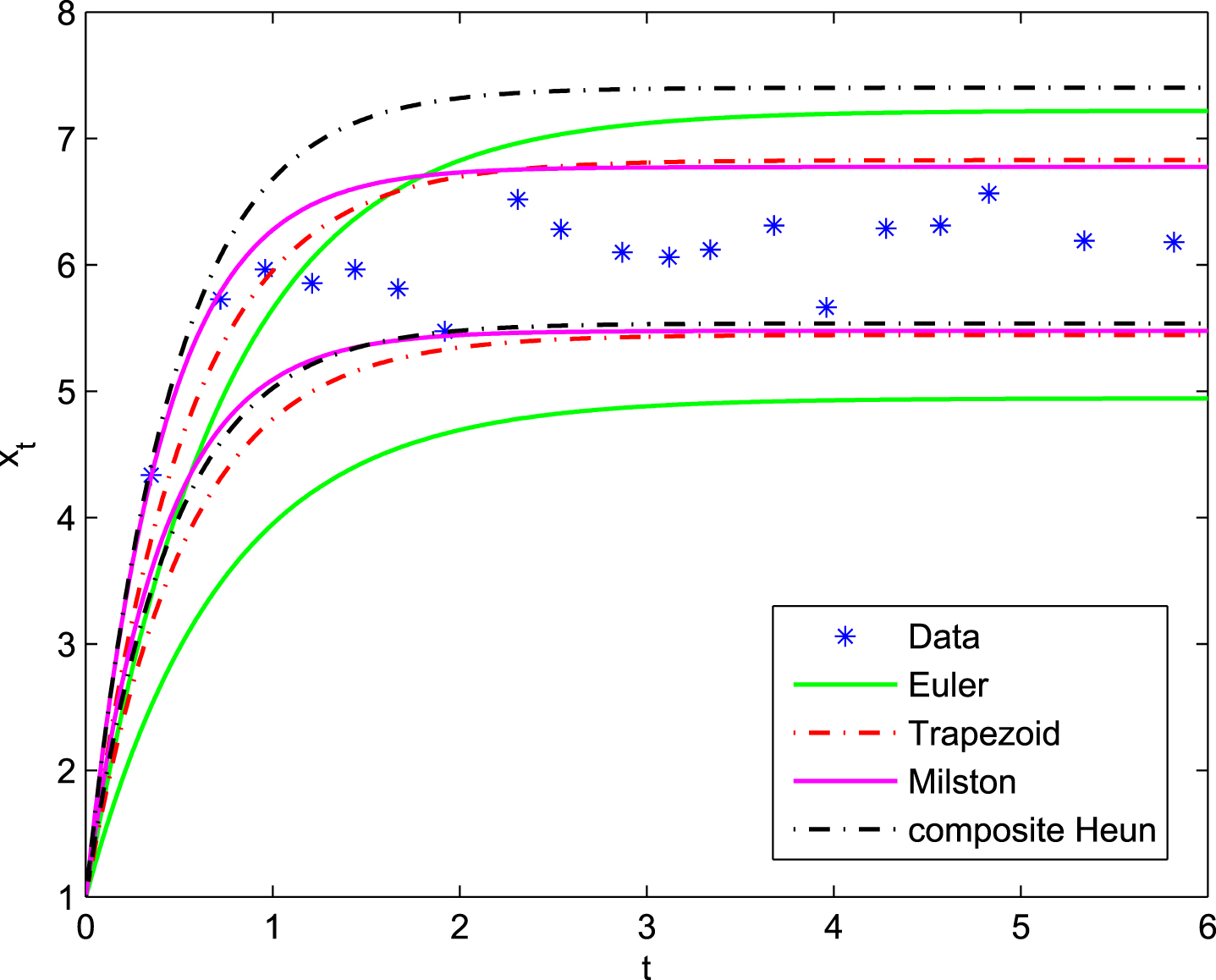
The estimated values of μ1, μ2 and σ based on the Euler scheme and the Milstein scheme are also shown in Table 4. Table 5 shows that the composite Heun scheme performs best compared to the Euler scheme, the trapezoidal scheme and the Milstein scheme. However, the observations fall into the area between the 0.05-path and the 0.90-path of the uncertain differential equations based on the composite Heun scheme and the Milstein scheme as shown in Fig. 2. That means only these two estimates are plausible for this case.
The estimated values of Example 4.2
σ*
Euler
8.6127
1.3786
1.1068
Milstein
15.2445
2.4510
1.1208
trapezoidal
11.8253
1.8958
0.9243
composite Heun
15.2088
2.3550
1.3263
The biases of Example 4.2
|σ - σ*|
Euler
6.3873
1.0214
0.3932
Milstein
0.2445
0.0510
0.3792
trapezoidal
3.1747
0.5042
0.5757
composite Heun
0.2088
0.0450
0.1737
Observations and α-paths of Xt in Example 4.2.
In the following two numerical examples, the observations of Xt are given to estimate the unknown parameters in uncertain differential equations.
Example 4.3 Suppose the uncertain process Xt follows
where the three parameters μ, c and σ are unknown numbers. Assume that there are twenty groups of observed data of Xt as shown in Table 6.
Observations of Xt in Example 4.3
tn
1
2
3
4
5
xtn
0.0350
0.0384
0.0428
0.0492
0.0583
tn
6
7
8
9
10
xtn
0.0624
0.0719
0.0805
0.0921
0.1096
tn
11
12
13
14
15
xtn
0.1126
0.1203
0.1326
0.1452
0.1563
tn
16
17
18
19
20
xtn
0.1676
0.1612
0.1872
0.1795
0.2341
By using the composite Heun scheme, we have
where Fn = μ (1 - clnxtn) xtn. Thus the system of equations (11) becomes
By solving the system of equations \eqref N31 with λ = 0.4, we get the estimated values
Hence the estimated equation is
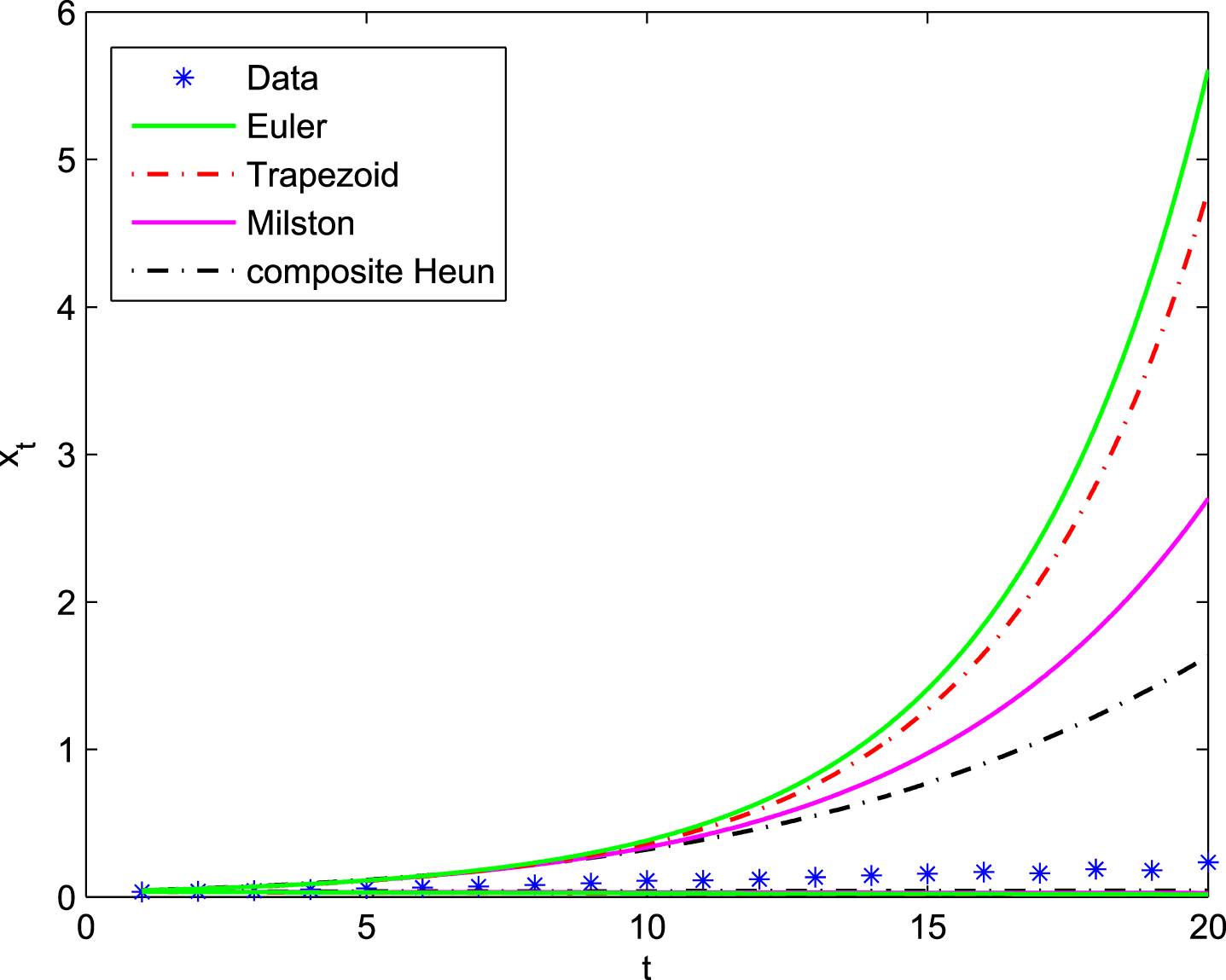
The estimated values based on the trapezoidal scheme, the Euler scheme and the Milstein scheme are also shown in Table 7. In order to compare the numerical results of the four schemes, the up (down) errors [23] which are the sum of absolute errors between the sample data and the 0.90-path (0.05-path) at each time tn are computed as shown in Table 8. In this example, the composite Heun scheme has the least up error and down error. From Fig. 3, all the observations of Xt fall into the area between the 0.05-path and the 0.90-path, so these four estimates are plausible.
The estimated values of Example 4.3
μ*
c*
σ*
Euler
0.1356
-0.0857
0.0794
Milstein
0.0834
0.0988
0.0768
trapezoidal
0.1263
-0.0813
0.0799
composite Heun
0.0307
1.0145
0.0758
Up errors and down errors of Example 4.3
up errors
down errors
Euler
21.1128
1.7409
Milstein
11.9876
1.6241
trapezoidal
18.4098
1.7660
composite Heun
8.3317
1.4616
Observations and α-paths of Xt in Example 4.3.
Example 4.4 Suppose the uncertain process Xt follows
where the parameters μ and σ are unknown numbers. Assume that there are twelve groups of observed data of Xt as shown in Table 9.
Observations of Xt in Example 4.4
n
1
2
3
4
tn
0
60
120
180
xtn
0.8812
0.4652
0.3112
0.2345
n
5
6
7
8
tn
240
300
360
420
xtn
0.2081
0.1724
0.1513
0.1166
n
9
10
11
12
tn
480
530
600
700
xtn
0.0964
0.0812
0.0669
0.0464
By using the composite Heun scheme, we have
Thus the system of equations (11) becomes
By solving the system of equations \eqref N41 with λ = 0.7, we get the estimated values
Hence the estimated equation is
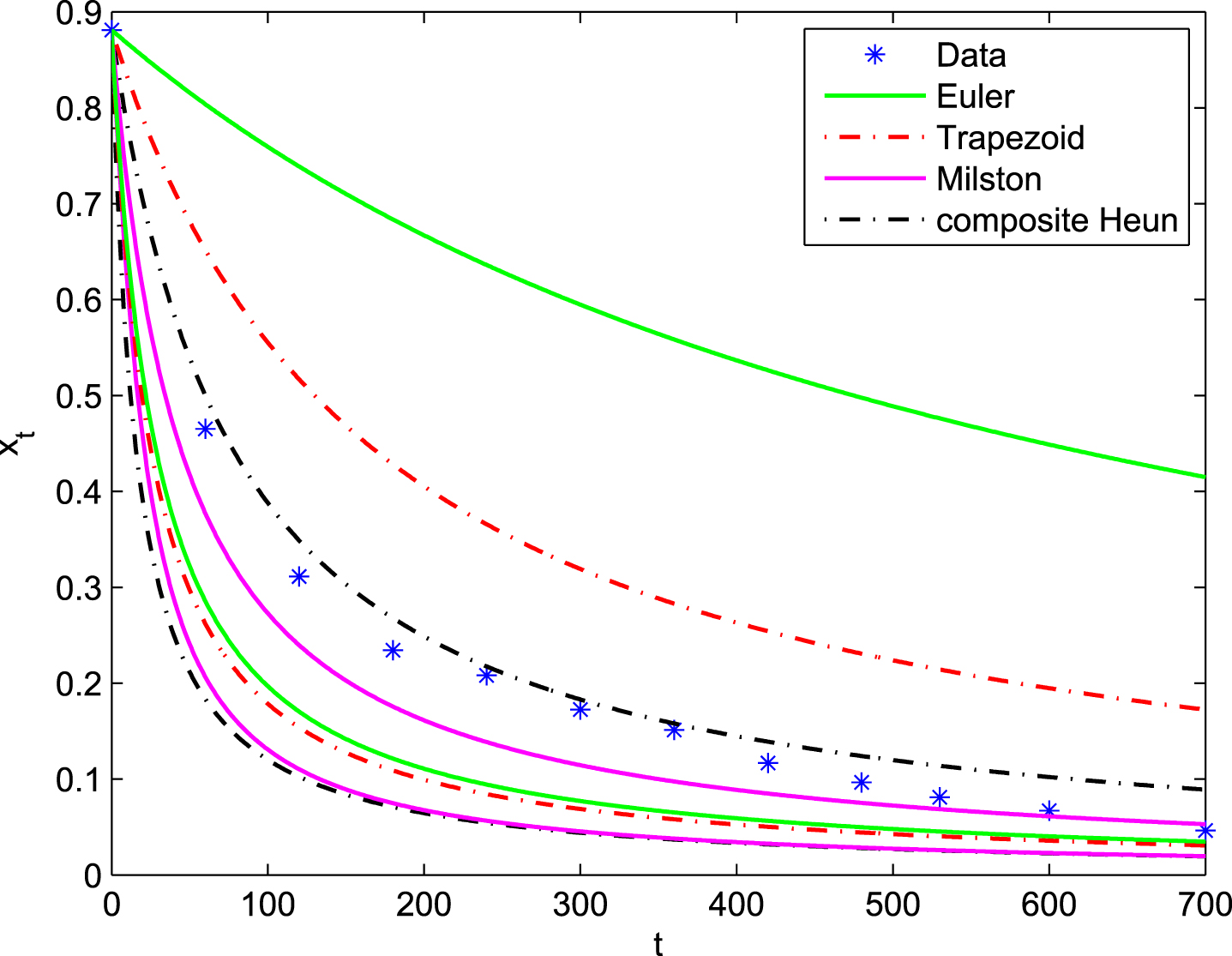
The estimated values based on the trapezoidal scheme, the Euler scheme and the Milstein scheme are shown in Table 10. Moreover, the up (down) errors of the four schemes are also given in Table 10. In this example, the composite Heun scheme has the least up error and down error compared to the Euler scheme and the Milstein scheme, and has less total error (the sum of up error and down error) than the trapezoidal scheme. However, the observations of Xt fall out of the area between the 0.05-path and the 0.90-path based on the Milstein scheme. For this example, the other three estimates are acceptable.
The estimated values, up errors and down errors of Example 4.4
μ*
σ*
up error
down error
Euler
0.0206
0.0116
4.4294
1.7409
Milstein
0.0324
0.0045
0.4897
1.3839
trapezoidal
0.0257
0.0117
1.6806
1.0129
composite Heun
0.0432
0.0177
0.2927
1.3305
Observations and α-paths of Xt in Example 4.4.
Conclusions
We presented the composite Heun scheme which is more accurate than the Euler scheme to discretize the uncertain differential equations. For the unknown parameters in the uncertain differential equations, we proposed the method of moments based on the composite Heun scheme to estimate parameters. The numerical results indicated that the composite Heun scheme performs best compared to the Milstein scheme and the Euler scheme for the examples in this paper.
Footnotes
Acknowledgments
This work was supported by the National Natural Science Foundation of China (No. 61873084).
LiuB., Some research problems in uncertainty theory, Journal of Uncertain Systems bf 3(1) (2009), 3–10.
3.
ChenX. and LiuB., Existence and uniqueness theorem for uncertain differential equations, Fuzzy Optimization and Decision Making bf 9(1) (2010), 69–81.
4.
LiuY., An analytic method for solving uncertain differential equations, Journal of Uncertain Systems bf 6(4) (2012), 244–249.
5.
YaoK., A type of nonlinear uncertain differential equations with analytic solution, Journal of Uncertainty Analysis and Applications bf 1 (2013), 8.
6.
YaoK. and ChenX., A numerical method for solving uncertain differential equations, Journal of Intelligent & Fuzzy Systems bf 25(3) (2013), 825–832.
7.
GaoR., Milne method for solving uncertain differential equations, Applied Mathematics and Computation bf 274 (2016), 774–785.
8.
ZhangY., GaoJ. and HuangZ., Hamming method for solving uncertain differential equations, Applied Mathematics and Computation bf 313 (2017), 331–341.
9.
YangX. and RalescuD.A., Adams method for solving uncertain differential equations, Applied Mathematics and Computation bf 270 (2015), 993–1003.
10.
TangH. and YangX., Uncertain chemical reaction equation, Applied Mathematics and Computation bf 411 (2021), 126479.
11.
ShengY., GaoR. and ZhangZ., Uncertain population model with age-structure, Journal of Intelligent & Fuzzy Systems bf 33(2) (2017), 853–858.
12.
ZhuY., Uncertain optimal control with application to a portfolio selection model, Cybernetics and Systems bf 41(7) (2010), 535–547.
13.
LiuZ. and YangX., A linear uncertain pharmaco kinetic model driven by Liu process, Applied Mathematical Modelling bf 89 (2021), 1881–1899.
14.
LiuB., Toward uncertain finance theory, Journal of UncertaintyAnalysis and Applications bf 1 (2013), 1.
15.
YaoK. and LiuB., Parameter estimation in uncertain differential equations, Fuzzy Optimization and Decision Making bf 19(1) (2020), 1–12.
16.
LiuZ., Generalized moment estimation for uncertain differential equations, Applied Mathematics and Computation bf 392 (2021), 125724.
17.
ShengY., YaoK. and ChenW., Least squares estimation in uncertain differential equations, IEEE Transactions on Fuzzy Systems bf 28(10) (2020), 2651–2655.
18.
ZhangJ., ShengY. and WangX., Least squares estimation of high-order uncertain differential equations, Journal of Intelligent & Fuzzy Systems bf 41(2) (2021), 2755–2764.
19.
LiuZ. and YangY., Moment estimation for parameter in high-order uncertain differential equations, Applied Mathematics and Computation bf 433 (2022), 127399.
20.
GaoY., GaoJ. and YangX., Parameter estimation in uncertain delay differential equations via the method of moments, Applied Mathematics and Computation bf 431 (2022), 127311.
21.
ZhangG. and ShengY., Estimating time-varying parameters in uncertain differential equations, Applied Mathematics and Computation bf 425 (2022), 127084.
22.
TangH. and YangX., Moment estimation in uncertain differential equations based on the Milstein scheme, Applied Mathematics and Computation bf 418 (2021), 126825.
23.
YangX., LiuY. and ParkG., Parameter estimation of uncertain differential equation with application to financial market, Chaos Solitons and Fractals bf 139 (2020), 110026.