



Abstract
Wireless Sensor Networks (WSNs) are a group of devices/sensors which are connected as a network for transferring and receiving the data observed from the environment through intermediate links. Energy efficiency and security during data broadcasting are considered challenging tasks in the WSN. These challenging tasks are considered as a motivation of this research and the Multi-Objective - Trust Aware Average Inertia Weighted Cat Swarm Optimization (MO-TAIWCSO) is proposed for achieving secure reliable transmission over the WSN. Due to an effective velocity update of searching process, the AIWCSO is selected for discovering an optimal solutions. The developed MO-TAIWCSO is optimized by using the trust, energy ratio, communication cost, and degree of SCH. This MO-TAIWCSO performs optimal Secure Cluster Head (SCH) and secure path discovery for the secure transmission of data under malicious attacks. The main objective of this MO-TAIWCSO is to improve the data delivery while minimizing the energy usage of the nodes. The performance of the MO-TAIWCSO method is analyzed by using the throughput, Packet Delivery Ratio (PDR), energy consumption, network lifetime, Normalized Routing Load (NRL) and End to end delay (EED). The existing researches namely ETOR and TBSEER are used to evaluate the MO-TAIWCSO. The PDR of MO-TAIWCSO for 100 nodes is 99.97%, which is high when compared to the ETOR and TBSEER.
Keywords
Introduction
WSN technology is utilized to bridge the space between the physical world of humans and the virtual world of electronics. WSN is a distinct type of ad-hoc network which has tiny devices namely sensors which are positioned in the sensing field for observing certain parameters such as vibration, temperature, motions, and sound [1–3]. WSN uses low-cost sensors that have the capacity for data observation, processing, and wireless broadcasting over the network [4]. It is predicted that WSN creates essential variations in future technologies with numerous applications such as smart monitoring, virtual reality, healthcare services, artificial intelligence, machine learning, intelligent transportation systems, smart home, military systems, and so on [5]. WSN provides flexibility to the interconnected devices for observing and handling the framework which helps to integrate the physical world and computational model. Next, the interconnection among the devices has the capacity for broadcasting the data with less human interaction [6]. Energy efficiency is considered the main issue in WSN because the sensors are stimulated by using a battery power source. Therefore, energy utilization is required to be controlled for increasing the lifetime [7].
The lifetime is improved based on the selection of the appropriate Cluster Head (CH) by accomplishing the clustering process [8, 9]. The CH is chosen from each cluster that has the responsibility of data broadcasting with the remaining members of the cluster. CH receives the data from cluster members and the data is broadcasted to the Base Station (BS) [10]. On the other hand, the network is susceptible to various attacks, because of the open and unsafe data transmission channel among the sensors, as well as the dynamic topology, which causes difficulty in central communication [11]. Therefore, secure routing is mandatory in the network and it is utilized for identifying malicious attacks before accomplishing the data delivery to the sink node [12, 13]. The trust value is utilized for protecting the network from malicious attacks and it is used to select SCH [14]. Trust is considered an essential security factor to examine traffic and node behavior. Further, this trust evaluates the risk included in the data broadcasting over unauthorized nodes [15]. The MO-TAIWCSO is used to perform an optimal SCH selection from the clusters created by the K-means algorithm. Since, the AIWCSO is chosen, because of its effective velocity update during the searching process which helps to identify the optimal solutions in this research. Further, the trust based routing is accomplished using the same MO-TAIWCSO which helps to avoid malicious attacks. The developed MO-TAIWCSO is used to enhance the PDR while minimizing the energy consumption of the network.
The rest of the paper is arranged as follows: Section 2 provides the existing secure routing approaches of WSN. The MO-TAIWCSO is detailed in Section 3 whereas the outcomes of MO-TAIWCSO are provided in Section 4. Next, the conclusion is given in Section 5.
Related work
Feroz Khan, and Anandharaj, [16] presented the multi-attribute-based routing approach for accomplishing secure routing in the WSN. Here, the trust computation of the nodes was performed using the stability rate, reliability rate and elapsed time. An improved detection approach was developed for securing the network where a higher coincidence rate was used to discover the malicious attack according to the trust calculation. The developed multi attribute-based routing provided preference only to the trust, but it does not consider the energy of the nodes during route discovery.
Gopinath, et al. [17] developed the Secure Cluster based Efficient Energy Routing (SCEER) for increasing the lifetime of WSN. Three different phases were accomplished in SCEER. Initially, the packet broadcasting was initialized according to the considerations of the network and routing process. The energy efficiency was improved in the second phase by computing the stability metric. Further, the integrity of the network and energy efficiency were balanced by designing an appropriate cluster architecture. The routing protocol considered here was LEACH which used higher energy over the network.
Hajiee, et al. [18] presented secure routing using Energy-aware Trust and Opportunity-based Routing (ETOR) with mobile nodes for WSN. The developed ETOR was comprised of two stages such as the discovery of secure sensors and opportunistic sensors for accomplishing the routing. The energy consumption was reduced by using the multipath approach with intra and inter-cluster multi-hop data broadcasting approach. A huge number of control packet usage caused higher overhead in the network.
Hu, et al. [19] developed the Trust Based Secure and Energy Efficient Routing (TBSEER) approach for achieving secure data broadcasting in WSN. Different trust metrics such as direct, indirect and energy trust values were utilized to compute the comprehensive trust value in TBSEER. The computation of trust value was used to enhance the data delivery. However, the developed TBSEER does not consider the distance during the route discovery. If the route has a higher distance, then the energy utilization was high in WSN.
Hu, et al. [20] presented Trust-aware Secure Routing Protocol (TSRP) for enabling security against malicious attacks. The comprehensive trust value was computed for each node for avoiding malicious attacks. Next, the transmitter broadcasted the request packet to the adjacent nodes in multipath mode and it was continued until the request message was received by the sink. However, clustering was required to be developed in TSRP for improving energy consumption.
MO-TAIWCSO method
In this research, secure clustering and routing are developed against the attackers for enhancing the data transmission over the WSN. An optimal SCH and secure route discovery are accomplished by utilizing the MO-TAIWCSO method. The developed MO-TAIWCSO is optimized by considering the trust, energy ratio, communication cost, and degree of SCH. Here, trust is considered a primary fitness value for mitigating malicious attacks from the network. The block diagram of MO-TAIWCSO is shown in Fig. 1.

Block diagram of MO-TAIWCSO method.
At first, the sensors are located randomly in the WSN and then K-means clustering is applied to cluster the network according to the Euclidian distance. The MO-TAIWCSO is used to discover the SCH and secure path that helps to enhance the data broadcasting in the network.
Discovery of SCH using MO-TAIWCSO
In this phase, the SCHs are chosen by using the MO-TAIWCSO with unique fitness values. The conventional CSO mainly depends on the resting and hunting behavior of the cats. The standard CSO has the condition on the velocity expression for controlling the cat’s velocities of each dimension and verifying whether the velocities are in the maximum range or not. To handle the issue of velocity update, the parameter of inertia weight (w) is used in AIWCSO. The MO-TAIWCSO-based SCH selection is detailed in the following section,
Representation and Initialization
A set of sensors are assumed as candidate SCHs during the initialization where each cat’s dimension is equal to the number of SCHs. Each cat is initialized with a random sensors ID among 1 to N, where N is the total nodes in the network. The ith solution of MO-TAIWCSO is represented as X i = (Xi,1, Xi,2, …, Xi,D), where D is the dimension of each cat.
Iterative process
The initialized cat positions are given as input to the iterative process to obtain optimal SCHs according to the fitness value. These behaviors are divided into two modes such as seeking mode and tracing mode which are given as follows:
Seeking mode: The cats in the seeking mode always spend their time resting and also it is in an alert position whereas the cats in this mode move slowly. Four essential parameters used in the seeking mode are seeking memory pool (SMP), seeking a range of the selected dimension (SRD), counts of dimension to change (CDC), and self-position considering (SPC). The seeking memory size of cats is denoted by SMP which represents the location that is going to be selected from overall candidate locations. The parameters of CDC and SRD are used to randomize the new locations. Next, the amount of dimensions required to be modified in the range of [0, 1] is defined by CDC. The mutative ratio for the selected dimensions is denoted as SRD whereas this SRD represents the number of mutations and modifications for the respective dimensions chosen by the CDC. The SPC is a Boolean value that denotes whether the current locations of the cat are chosen for the next iteration or not.
The steps processed in the seeking mode are given as follows: Generate the possible amount of SMP copies for the current location of Cat
k
. Randomly choose the possible amount of CDC dimensions for mutation. Next, randomly add/ subtract the values of SRD current values that substitute the old locations as expressed in Equation (1).
Where, the current and new location is represented as X
jd
old
and X
jd
new
respectively; the amount of cats is denoted as j; the dimension is denoted as d and the random number among [0, 1] is denoted as rand. For all candidate locations, compute the fitness value (F). Choose one candidate point as the next location according to the probability of the cat. This is done for the cat who has optimal fitness value with a higher probability of selection as the best solution which is expressed in Equation (2).
The F b = F max , when the objective is minimization; otherwise F b = F min .
Tracing mode: Cats are effective in tracing mode and hunt their target with higher speed and energy compared to the seeking mode. This tracing mode mimics the tracing performances of cats. For all dimensions of cat locations, the random velocity values are given for the first iteration. The velocity values are required to be updated for the next steps. AIWCSO with w is converged in certain situations even without utilizing v
max
. Therefore the velocity of cats in AIWCSO is updated as shown in Equation (3).
Where the acceleration coefficient is denoted as c1; a random value between [0, 1] is denoted as r1.
Moreover, the position of the cat is updated by using two different terms where the 1st term is the average information of current & previous locations and the 2nd term is the average of current and previous velocity data as shown in Equation (4).
The multiple fitness values considered in the MO-TAIWCSO during the selection of SCH. The fitness values trust (f1), energy ratio (f2), communication cost (f3), and degree of SCH (f4). The fitness value (F) mentioned in Equation (2) is expressed in Equation (5).
Where the weight parameters allocated for fitness values are denoted as β1 - β4. The fitness values are described below: The trust value of Equation (6) is the primary fitness of selecting the SCH. Mutual trust is mainly used for data exchange among the nodes because this trust is used to mitigate malicious attacks. The trust is measured according to the data transmission among the nodes which is the ratio of received packets and sent packets among the nodes a and b
The energy is an essential factor while selecting the SCH, therefore the energy ratio is used in the MO-TAIWCSO. An energy ratio is a proportion of the initial and remaining energy of the sensors as expressed in Equation (7). The sensor with higher remaining energy is preferred in SCH discovery.
The communication cost required for data exchange with neighbor node is expressed in Equation (8). The SCH with lesser communication cost is used to minimize the delay and energy usage during packet transmission.
Where, Additionally, the amount of hops connected to CH is the degree of SCH that is shown in Equation (9). The SCH with less amount of hops is preferred for minimizing the energy utilization.
Where, CM i is the number of nodes connected to the i th SCH.
Hence, the aforementioned fitness formulation is used to discover optimal SCHs. The attackers in the network are mitigated by using the trust value which leads to avoiding the packet drop and unwanted energy utilization. The energy ratio is employed to choose the node with a higher energy level that helps to avoid a failure node. Next, the transmission distance is reduced based on the communication cost. The lesser distance helps to minimize the delay and also reduces the energy usage in the network. Accordingly, the security and energy-aware SCHs are chosen that help to achieve reliable data transmission.
The MO-TAIWCSO based route discovery is initialized, once the SCH is chosen from the clusters. The control messages of a route request, route reply, route error and hello messages are used by MO-TAIWCSO for discovering the route. Similar to SCH discovery, route discovery also uses the same fitness values. Initially, the route request is broadcasted by the transmitter SCH to all adjacent SCHs in WSN. The relay node with optimal fitness value responds with a route reply message for the route request. The same process is continued until the route request reached the receiver i.e., BS. The secure route is discovered, when the transmitter SCH receives the route reply message. Further, the route error and hello messages are used by the MO-TAIWCSO for maintaining the route.
The secure and energy aware data broadcasting is achieved by using the MO-TAIWCSO. The malicious attacks are avoided while choosing the SCH and secure route that helps to avoid unwanted energy dissemination and packet drop though the network. The reduction in unwanted energy dissemination leads to eliminate the issue of node failure that used to enhance the data delivery of WSN.
Results and discussion
The execution of MO-TAIWCSO is performed in the Network Simulator (NS) – 2.34, where the system has functions with an i5 processor and 6GB RAM. The NS-2.34 is chosen as a simulation software for this work, because of the following advantages such as it doesn’t require any costly equipment for testing and complex scenarios are easily evaluated for analyzing the data broadcasting conditions. The MO-TAIWCSO is developed for accomplishing secure clustering and routing over the network. Table 1 shows the simulation parameters of the MO-TAIWCSO method.
Simulation parameters
Simulation parameters
The parameters of throughput, PDR, energy consumption, network lifetime, NRL and EED are used to evaluate the MO-TAIWCSO. Further, the MO-TAIWCSO is compared with ETOR [18] to evaluate the performances.
Throughput is the number of successful packets gathered in the BS at a particular time over the WSN. The throughput comparison for MO-TAIWCSO with ETOR [18] is shown in Fig. 2 which shows that the MO-TAIWCSO achieves huge throughput when compared to ETOR [18]. The mitigation of malicious attacks in the MO-TAIWCSO avoids the packet drop also the developed clustering is used to minimize the network traffic. Therefore, the MO-TAIWCSO achieves increased throughput when compared to ETOR [18]. Further, the failure nodes are avoided while transmitting the data which helps to increase the throughput.
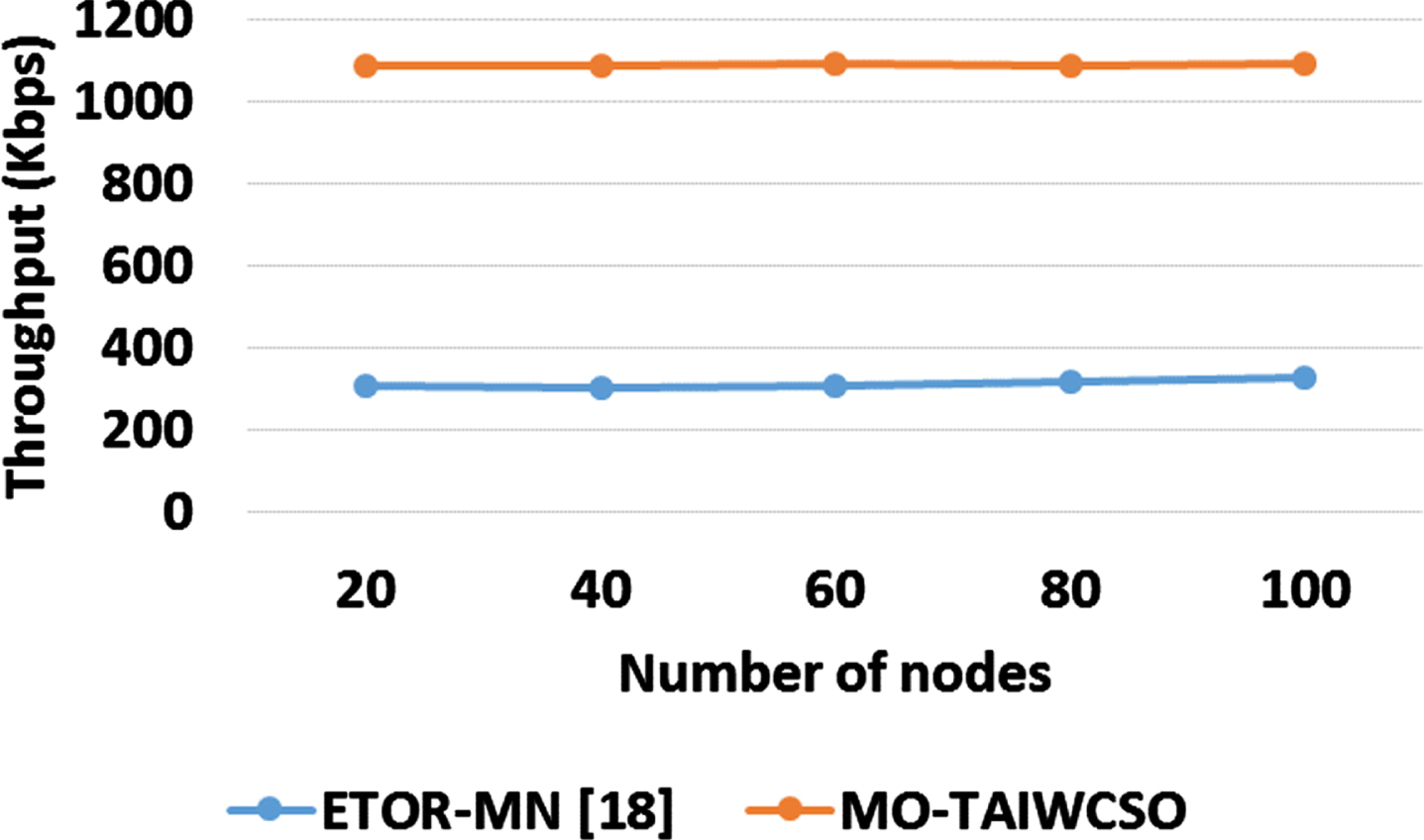
Throughput vs. Nodes.
PDR is the proportion of the data collected by the receiver and data generated by the transmitter SCH. The PDR comparison between ETOR [18] and MO-TAIWCSO is shown in Fig. 3. Figure 3 illustrates that the MO-TAIWCSO has a large PDR when compared to ETOR [18]. The developed secure clustering and routing using MO-TAIWCSO avoids the attacker nodes and improves the data delivery in the WSN. The mitigation of attacker nodes is used to eliminate the unwanted packet drop over the network.
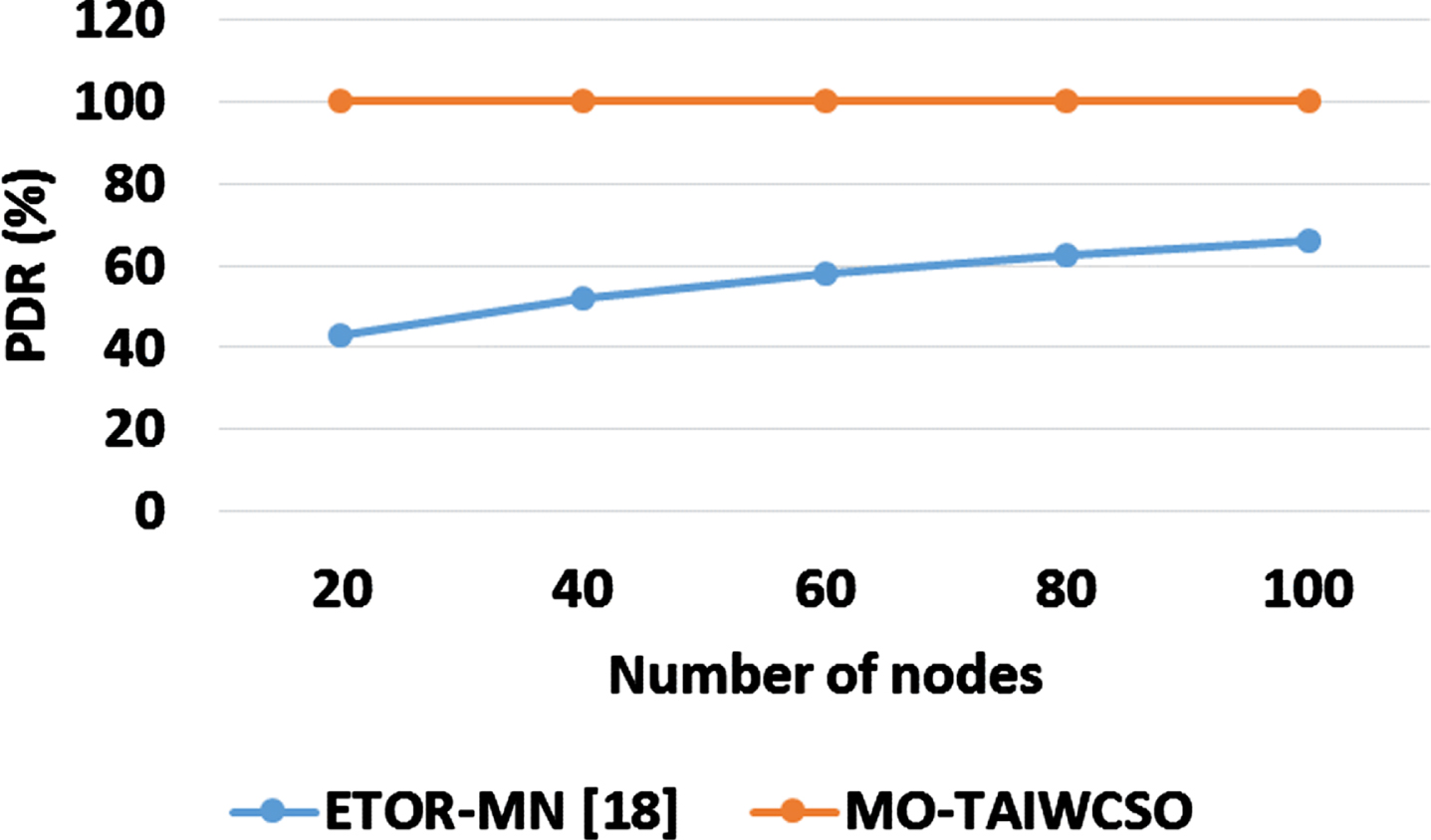
Packet delivery ratio vs. Nodes.
Energy consumption is the quantity of energy used while transmitting and receiving the data by the sensor. Energy usage for MO-TAIWCSO with ETOR [18] for varying nodes is illustrated in Fig. 4. Figure 4 shows that the MO-TAIWCSO achieves less energy usage when compared to ETOR [18].
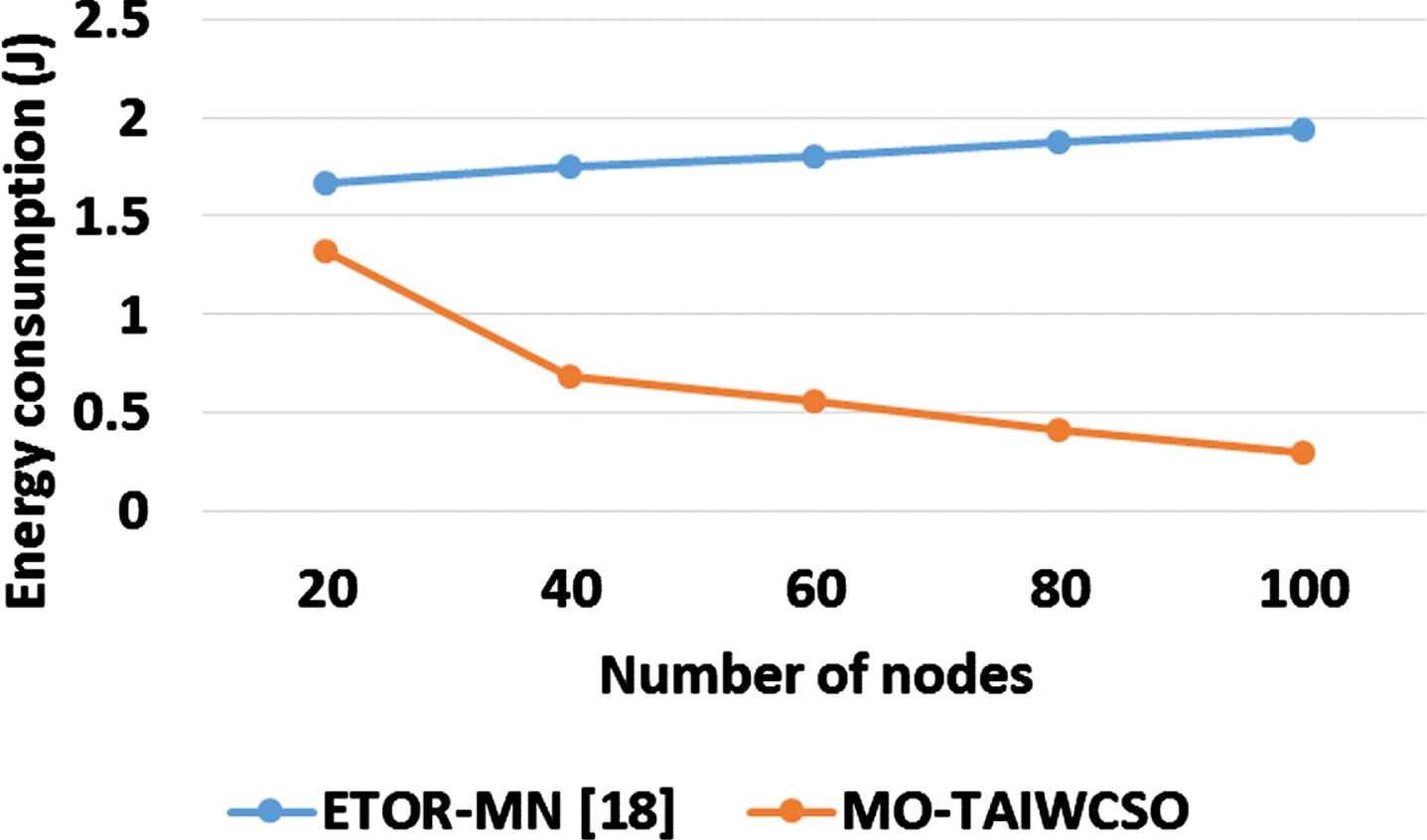
Energy consumption vs. Nodes.
The energy usage of the MO-TAIWCSO is minimized based on the following two ways: 1) an inappropriate energy depletion caused by malicious nodes is avoided based on secure routing and 2) the transmission distance is minimized by considering the communication cost in the MO-TAIWCSO. The reduction in transmission distance is used to reduce the energy usage of the nodes.
Lifetime is defined as the measure of time when the sensors in the WSN drain their energy in WSN. The lifetime evaluation between ETOR [18] and MO-TAIWCSO is shown in Fig. 5. Figure 5 displays that the MO-TAIWCSO has an increased life when compared to ETOR [18]. The energy consumption of MO-TAIWCSO is less when compared to the ETOR [18]. Therefore, the lifetime of the MO-TAIWCSO is increased because of the balanced energy utilization over the network.
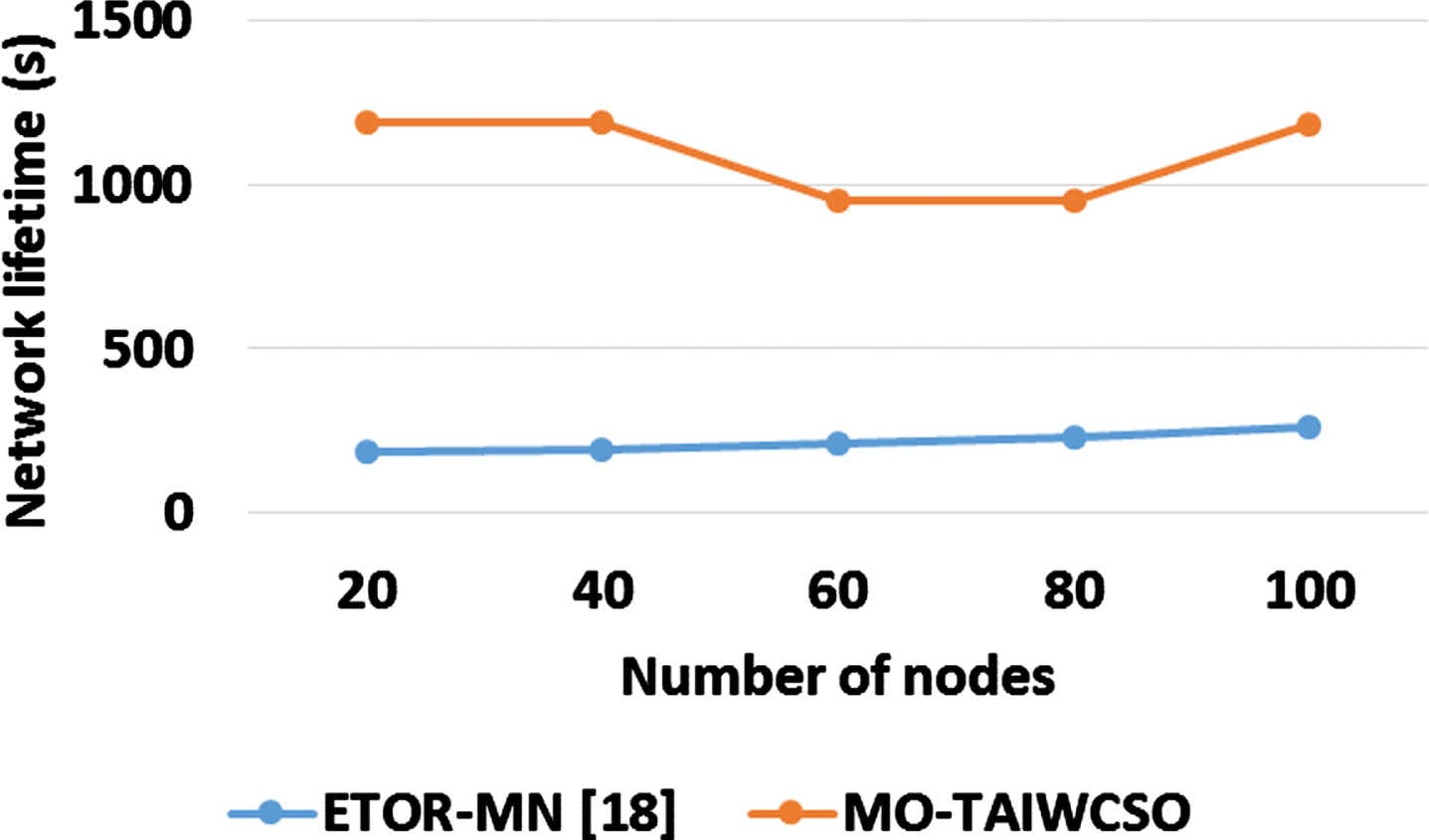
Network lifetime vs. Nodes.
The ratio between the amount of transmitted routing packets and amount of data packets is the NRL. The NRL evaluation for MO-TAIWCSO with ETOR [18] for varying nodes is shown in Fig. 6 where the MO-TAIWCSO achieves less NRL when compared to ETOR [18]. The usage of unique fitness values in MO-TAIWCSO reduces the control packets required for path identification. The reduction in control packets of MO-TAIWCSO is used to minimize the NRL.
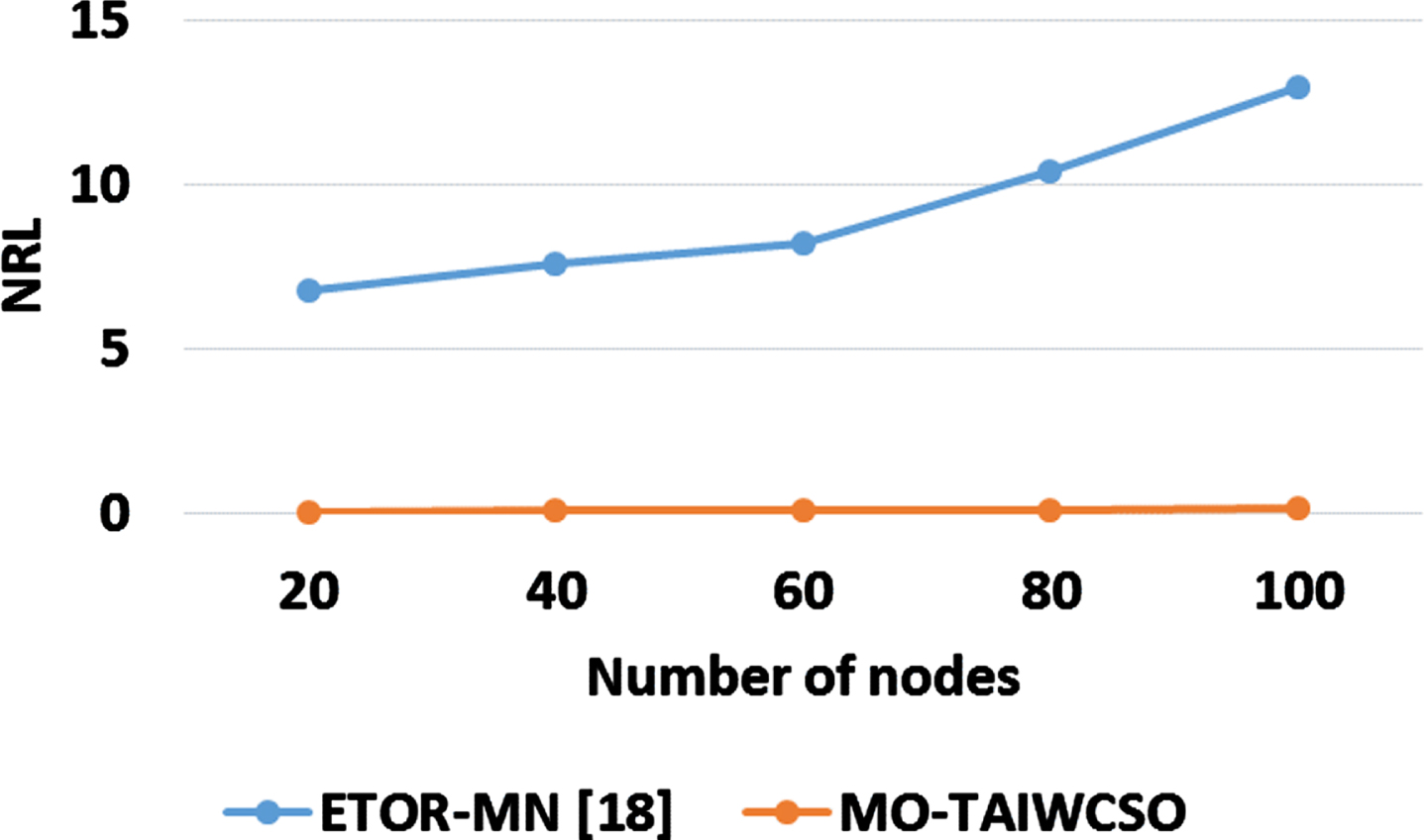
Normalized routing load vs. Nodes.
EED is defined as the time consumed while transmitting the data from the Transmitter SCH to the BS. The EED comparison between ETOR [18] and MO-TAIWCSO is shown in Fig. 7. Figure 7 shows that the MO-TAIWCSO has lesser EED than the ETOR [18]. The transmission distance over the WSN is minimized in MO-TAIWCSO by considering the communication cost which helps to minimize the EED.
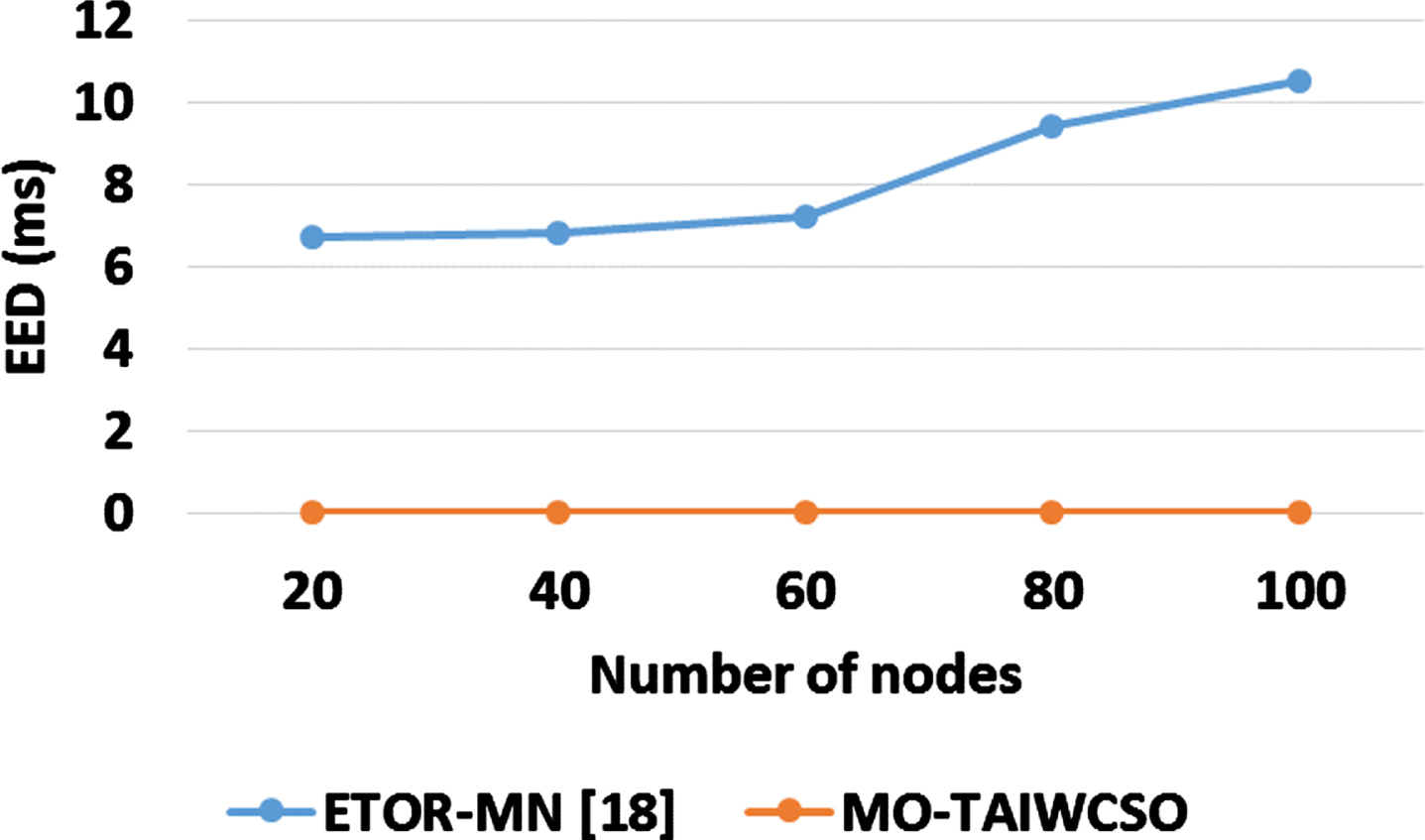
End to end delay vs. Node.
Table 2 shows the comparison of MO-TAIWCSO with ETOR [18] and TBSEER [19]. This comparison shows that the MO-TAIWCSO outperforms well than the ETOR [18] and TBSEER [19]. The trust value based clustering and routing using MO-TAIWCSO is used to avoid the malicious attacks which leads to minimize the unwanted energy consumption and packet drop. The energy ratio considered in the MO-TAIWCSO is further used to avoid the packet drop. Moreover, the communication cost and node degree considered in the MO-TAIWCSO is used to minimize the energy usage of the nodes.
Comparison of MO-TAIWCSO
In this paper, the MO-TAIWCSO based SCH and secure route discovery are performed for accomplishing reliable data transmission over the WSN. The combination of K-means clustering and SCH selection using MO-TAIWCSO helps to minimize the energy utilization of the nodes. The considered trust value is used to avoid malicious attacks while choosing the SCH that helps to avoid unwanted packet drop and energy usage of sensors. Further, trust-based route is discovered using the MO-TAIWCSO from the transmitter SCH to BS. The MO-TAIWCSO uses only less amount of control packets which leads to minimizing the normalized routing load. The lifetime of the MO-TAIWCSO is also increased by balancing the energy usage of the sensors. Hence, the MO-TAIWCSO obtains improved performance when compared to the ETOR and TBSEER. The PDR of MO-TAIWCSO for 100 nodes is 99.97%, which is high when compared to the ETOR and TBSEER. In the future, a novel optimization algorithm can be utilized for improving WSN performances.