



Abstract
Wireless sensor networks consist of a large number of randomly distributed nodes in a given area. WSN nodes are battery-powered, so they lose all their energy after a certain period and this energy constraint affects the network lifetime. This study aims to maximize network lifetime while minimizing overall energy use. In this study, a novel Energy Efficient Cluster based Adaptive Routing (ECAR) approach has been proposed for large-scale WSNs. Initially, the Genetic Bee Colony algorithm (GBCA) is introduced, which provides an effective way for selecting cluster heads based on node degrees, node centralities, distances to neighbors, and residual energy. Consequently, the Quantum Inspired African Vulture Optimization algorithm (QIAVO) is utilized to find a routing path between the source and the destination over the cluster heads. To optimize the network performance, QIAVO considers multiple objectives, including residual energy, distance, and node degree. The proposed method is evaluated based on average packet delivery ratios, energy consumption, and average end-to-end delays. According to simulation results, the proposed protocol successfully balances the energy consumption of all sensor nodes and increases network lifespan.
Introduction
In a wireless sensor network (WSN), multiple sensors can be deployed in a deployment environment, and their data can be sent to a gateway for further processing and monitoring [1]. There are several uses for WSNs, including medical, defense, numerous commercial, weather forecasting, and industrial applications [2–4]. Sensor nodes essentially have minimal battery life, a small range of memory sizes, and low processing power. Due to the decentralized deployment of WSNs and limited energy resources, it may not be possible to refuel or replace dead batteries of sensor nodes [5]. Lack of power supply for sensor nodes is considered a core problem of WSNs. Furthermore, optimal use of energy in WSNs is necessary to extend the life of WSNs and improve WSN performance [6–8].
The most significant impact on a sensor node’s energy usage comes from energy consumed for wireless data transmission [9]. One of the WSNs’ most energy-efficient methods for reducing communications energy usage is routing. [10, 11]. Cluster-based routing architectures are widely used in wireless sensor networks for their energy efficiency and network load balancing [12]. Sensors are grouped into clusters to reduce network power consumption and boost network scalability [13]. Clustering is the organization of sensor nodes into groups, with one node acting as the cluster head (CH) for each group. The CH gathers data from the SN, aggregates the data, and either directly or indirectly sends the aggregated packets to the BS. [14–16] Cluster head selection plays an important role in energy-efficient data transmission.
Routing data transmissions play a significant effect in lowering energy consumption and consequently increasing network lifetime in addition to clustering processes [17, 18]. Therefore, routing protocol design in WSNs is difficult because it imposes constraints on the energy efficiency of the network [19, 20]. The purpose of this research is to reduce node energy consumption during data transmission. This reduces the power consumption of the sensor node and increases the total packet transmission to the base station. A novel Energy Efficient Cluster based Adaptive Routing (ECAR) approach has been proposed for large-scale WSN. The major contributions of the proposed technique are stated below: Clustering and routing techniques in WSNs provide reliable data transmission. Since the clustering approach is utilized to minimize network traffic. Initially, the Genetic Bee Colony Algorithm (GBCA) method is used to select cluster heads in wireless networks because of its low computational complexity and high stability. GBCA chooses the CH based on, distance to neighbors, node centrality, residual energy, and node degree. In WSN, QIAVO provides rapid discovery of solutions for determining the shortest route from CH to BS. QIAVO is designed to overcome the node/link fault limitation by optimizing distance, residual energy, and node degree. Cluster heads are selected and routes are generated for data transmission in a highly energy-efficient manner, which maximizes network life. Furthermore, minimizing node power consumption while transmitting data packets increases the total number of packets received by the BS.
The remaining parts of the investigation are structured as follows. Related studies are examined in Section 2. Section 3 explains the concepts behind the suggested ECAR strategy. Section 4 includes the performance and comparative analyses. Section 5 encloses with a conclusion and future work.
Literature survey
Recently, a lot of research has been done to address the problem of power consumption in WSNs. This section explains the most recent routing and clustering strategies used in WSNs.
In 2019 Mazinani, A., et al. [21] introduced a Fuzzy Multi Cluster-Based Routing with a Constant Threshold (FMCR-CT) for WSN. The research’s major goal is to offer methods for extending the lifespan of wireless sensor networks by minimizing the number of cluster heads chosen and the volume of messages sent during each cycle. Simulated results indicate that FMCR-CT might outperform competing methods.
In 2019, Sackey, S.H., et al., [22] developed an Energy Efficient Clustering-Brain Storm Optimization (EEC-BSO). Additionally, the enhanced BSO approach is used to find the optimum CHs, which can increase the packet data rate, coverage percentage, and energy efficiency. They also investigated cluster transmission with a precise WSN-based energy consumption model. The outcomes of the simulation show that the suggested protocol performs better than existing methods.
In 2020, Moussa, N. et al. [23] introduced an energy-aware cluster-based routing protocol (ECRP). In this protocol, the role of the CH not only cycles through all cluster members based on energy until the network is functional but also avoids frequent re-clustering. Additionally, it can adjust to alterations in network topology. The suggested ECRP outperforms existing approaches in several ways, according to experimental results.
In 2021, S. Al-Otaibi et al. [24] suggested a hybridization of the metaheuristic cluster-based routing (HMBCR) method for wireless sensor networks. The energy efficiency and network lifetime performance of the HMBCR technology is ensured by extensive experimentation analysis. Experimental results showed that the HMBCR methodology performed better than the comparison methods in several areas.
In 2021, Nandhini, P., and Suresh, A., [25] presented a Harmony search (HS) and Charged system search (CSS) to improve the CHs for the routing process. The system’s choice of effective CHs with routing optimization extends the network’s general lifespan. The efficient performance of the suggested HS model is demonstrated by the experimental findings, which also show better network lifetime, decreased ETE delay, increased cluster structures, and average packet loss rates.
In 2021, Maheshwari, P., et al. [26] introduced combining ACO with BOA to decrease overall energy usage and lengthen the lifetime of the network. Alive nodes, dead nodes, and energy usage are considered performance indicators for this suggested methodology. Experimental results show that the proposed method outperforms existing methods in terms of network lifetime, energy consumption, and so on.
In 2021, Sahoo, B.M., et al. [27] suggested a GAPSO-H (GA and PSO-based hybrid) for the selection of the Cluster Head and to optimize the sink mobility to obtain the best network performance. According to the result, the suggested GAPSO-H technique outperforms the existing techniques for various metrics.
In 2021, Moussa, N. and El Belrhiti El Alaoui, A. [28] introduced the Energy-efficient Cluster-based Routing Protocol using Unequal Clustering (ECRP-UCA) and enhanced Ant Colony Optimisation (ACO) Techniques. Numerous experiments and comparisons with other protocols have been conducted on the proposed routing protocol. Experimental findings demonstrate that the ECRP-UCA outperforms existing methods based on various metrics.
In 2022, Jaiswal, K., Anand, V., et al [29] developed a fault-tolerant routing protocol utilizing a hybrid algorithm named FAGWO-H, which integrates Firefly Optimisation and Grey Wolf Optimisation. The method considers the fault tolerance and energy efficiency of the sensor nodes and CHs to improve network performance while still meeting QoS requirements. Utilizing a variety of WSN scenarios, they evaluated the strategy’s efficiency and contrasted it with existing techniques.
In 2022, Lakshmanna, K., et al. [30] proposed the IMD-EACBR strategy, an Improved metaheuristic-driven energy-aware cluster-based routing approach, to extend the network lifetime of WSNs. The effectiveness of the proposed IMD-EACBR approach was evaluated taking into account a variety of criteria. The IMD-EACBR approach outperformed other methods, according to the simulation findings.
In 2021, Singh, A., et al. [31] studied two meta-heuristic algorithms, the Improved Genetic Algorithm and Binary Ant Colony Algorithm (IGA-BACA) and Lion Optimisation (LO), that compute optimal coverage in WSNs. Simulation results indicate that LO offers better coverage, while its convergence rate is faster than that of IGA-BACA. Additionally, the ideal coverage is achieved faster in LO as compared with IGA-BACA.
In 2013, Fister Jr., I., et al. [32] reviewed Swarm intelligence and nature-inspired algorithms for optimization. The algorithms can be classified into four categories based on the sources of inspiration: swarm intelligence, bio-inspired, physics-based, and chemical-based algorithms. Several algorithms have shown to be quite effective, making them popular tools for solving real-life problems.
In 2010, Zang, H., et al. [33] examined four nature-inspired algorithms Bees Algorithm (BA), Genetic Algorithm (GA), Ant Colony Optimisation (ACO), and Firefly Algorithm (FA). As a result, nature-inspired algorithms may combine with other algorithms to improve themselves and become faster, more effective, and more reliable.
According to a literature survey, various strategies have been suggested to optimize sensor node battery life while balancing energy usage. However, these protocols face challenges by a lack of fault tolerance, significant overhead gained by repeated clustering, and storage issues. To overcome these challenges, a novel Energy Efficient Cluster based Adaptive Routing (ECAR) approach has been proposed. A detailed explanation of the proposed method is described in section 3.
Proposed ECAR methodology
In this section, a new approach for large-scale and energy-efficient cluster-based adaptive routing (ECAR) for WSNs is proposed, Fig. 1 shows the overall block of the proposed technique. From the figure, the WSN is classified into two main phases. In the first phase, the Genetic Bee Colony (GBC) optimization algorithm is introduced which provides an effective way to select cluster heads based on node degree, distance to neighboring nodes, node centrality, and residual energy. Second, the routing path between the source and the destination across the cluster heads is discovered using the QIAVO (Quantum Inspired African Vulture Optimisation) method. To maximize network performance, QIAVO’s fitness function takes multiple objectives into account, including distance, node degree, and residual energy.
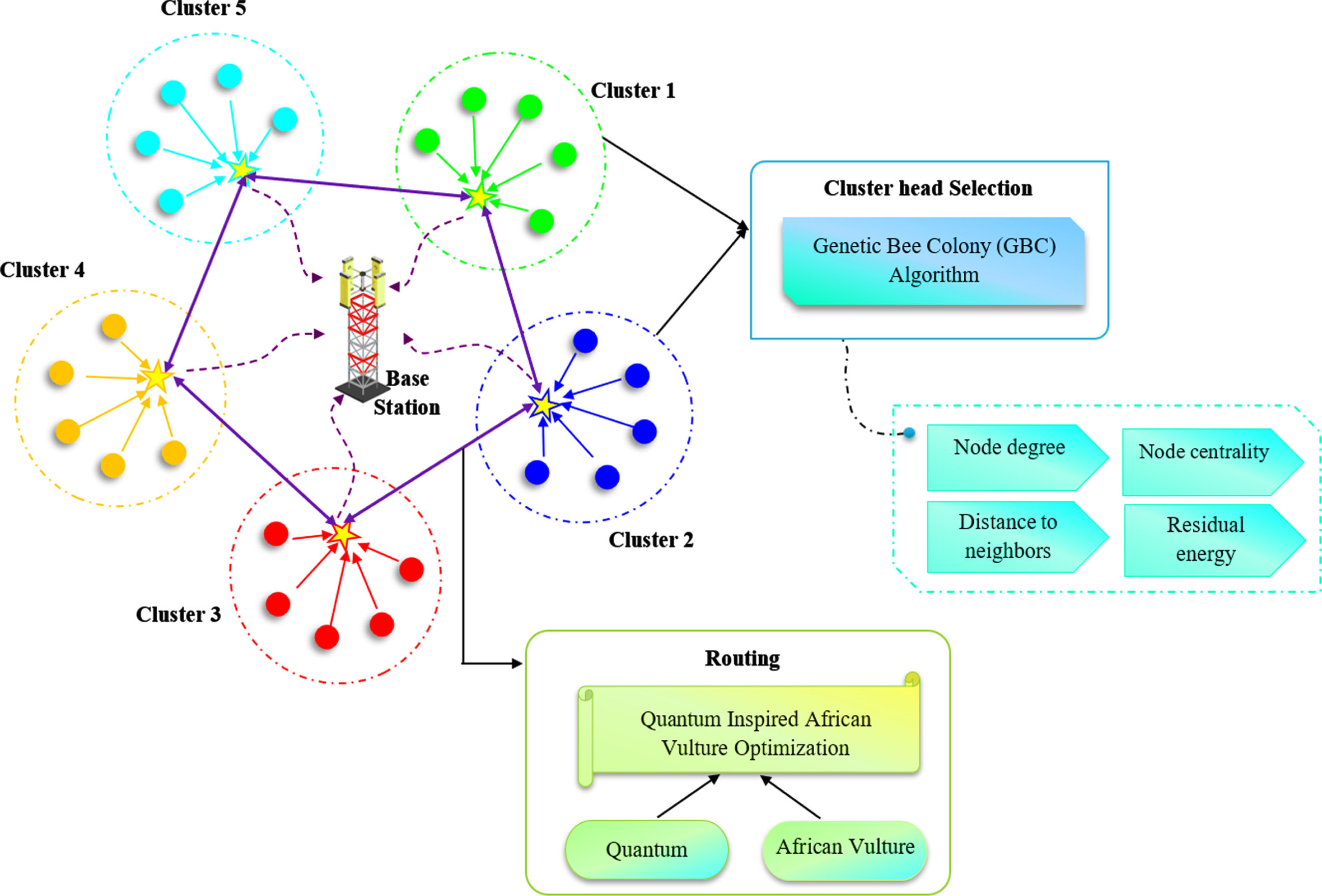
Architecture of proposed ECAR methodology.
The energy consumption in the WSN configuration is calculated using an energy model. The energy model used in this study is comparable to that of [25]. Nodes in WSNs are distributed at random, and their positions are not planned. Depending on the distance between the nodes, transmission between them uses up most of a node’s energy. Energy is used in both data transmission and receiving. The energy needed by the transmitter to convey a message in f bits over the distance d i is
During the transmission and reception of 1 bit of data, EC T x the node consumes energy and EC elec dissipates energy, which is defined as ɛ fs the coefficient of energy dissipation in a free-space model, ɛ lp the coefficient of energy dissipation in a multipath attenuation model, and d co the transmission distance threshold.
However, the following formula is used to determine how much energy the recipient node needs to use to receive an m-bit data packet.
Optimal cluster heads are selected by Genetic Bee Colony Optimization (GBC) based on the distance to neighbors, node degree, residual energy, and node centrality. Artificial bee colony (ABC) optimization algorithm and Genetic Algorithms (GA) are two bio-inspired techniques that are combined to create the innovative hybrid meta-heuristic algorithm known as GBC. The GBC consists of five phases. In the proposed method food source denotes the cluster head.
Objective function for clustering
Choosing the best set of strategically positioned CHs will help cluster-based WSNs maximize their network lifetime. To accomplish this, a fitness function is developed that takes into account four variables: residual node energy, node degree, intra-cluster distance, and coverage rate. Following is a definition and derivation of these parameters:
Here, |C m x | is the x th cluster head’s number of cluster members.
Each objective value is given its weight value. In this instance, the goals are combined into a single objective function. The weighted values are ϑ1, ϑ2, ϑ3, and ϑ4. Equation (8) displays the single objective function.
Where I (L p , L q ) evaluates the mutual dependence of the p th and q th genes. It is the mutual information between these two genes. The major goal of using the MRMR approach is to identify a subset of nodes from S n with n nodes, p x that either collectively have the biggest dependency on the target class c or have the least amount of redundancy on the chosen nodes’ subset S n . Therefore, balanced solutions are sought through multiple goals. This criterion is a combination of maximum relevance and minimum redundancy criteria as follows:
The objective is to maximize forecast accuracy while reducing the number of nodes chosen. The ABC approach can filter undesired noisy sensors while reducing computing burden since clusters are formed by the more contiguous and less redundant nodes picked by the MRMR method.
This is designated as F ab , where a stands for a specific solution, denoted by a = (1, 2, … P S ), and b = (1, 2, … G), where G stands for the number of informative nodes that need to be optimized in each solution. The following equation randomly initializes each cell F ab
Where, Z = rand (- 1, 1) × (F ab - F ac ).

Workflow of Crossover operation.
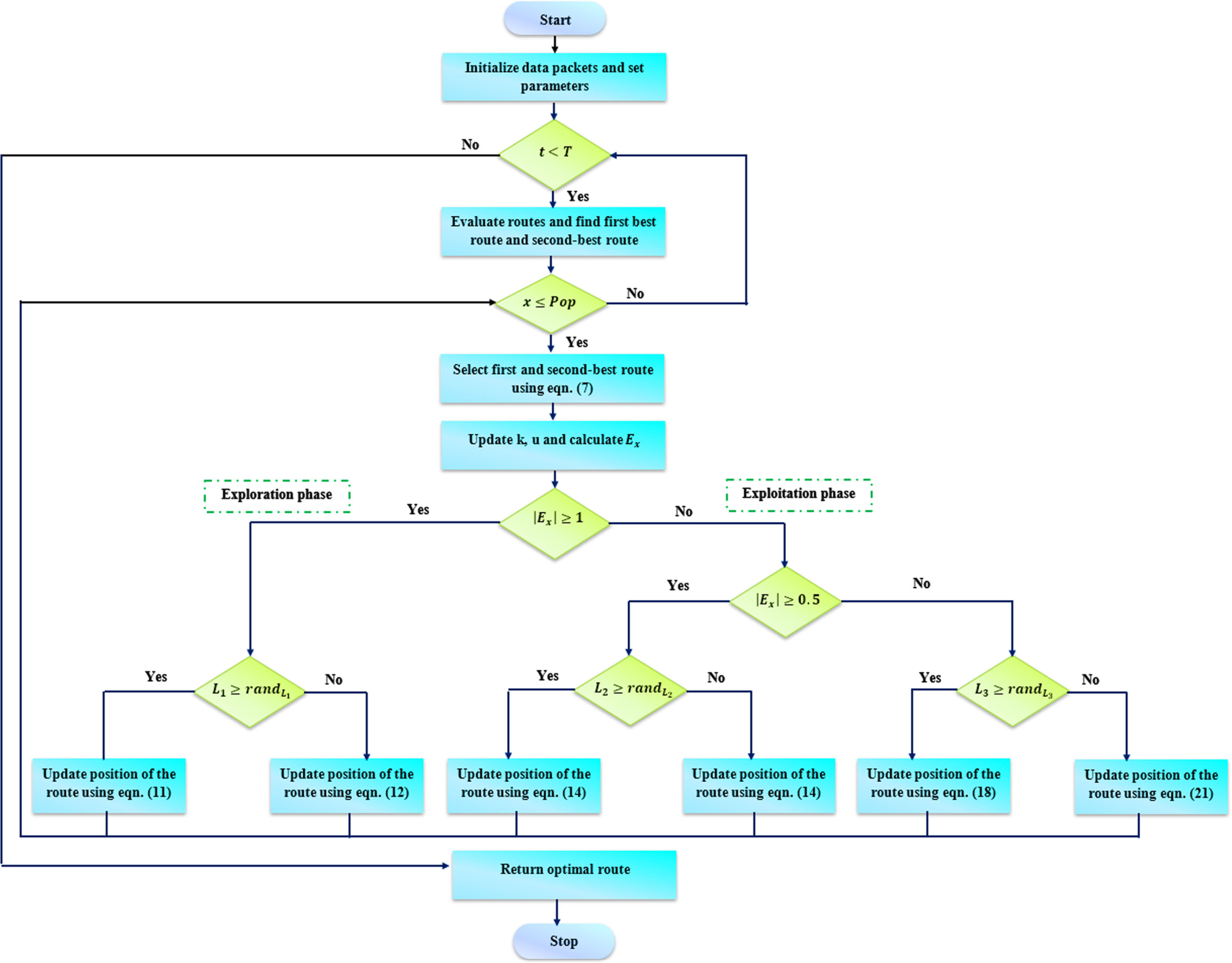
Flowchart of QIAVO.
Each gene is treated independently in a uniform crossover, and a random decision is made regarding which parent it should inherit from. However, our algorithm only accepts new solutions that are close to the top fitness solution (Queen Bee). From Fig. 2, each gene is handled independently in a uniform crossover, and a random decision is made on which parent it should inherit. As a result, random variables with a uniform distribution over [0, 1] are generated. The Crossover Probability Rate (CPR), a regulated parameter in the suggested algorithm that is not modifiable because the system is not highly sensitive to its modifications, was then set to 0.6. If the random string value in any given place is lower than a CPR, Offspring1 adopts the node as the queen bee, and Offspring2 adopts the node as the random neighbor. Otherwise, Offspring1 takes the node as a random neighbor and Offspring 2 takes the node as queen bee.
Where, Z = rand (- 1, 1) × (Queen bee a - F ac ).
After Cluster head selection, the Quantum Inspired African Vulture Optimization (QIAVO) approach is utilized to produce the optimum routes in the WSN. AVOA has a more distinct exploration process and exploitation mechanism than other metaheuristic optimization algorithms. AVO still has significant drawbacks, such as the ease with which it can settle on a locally optimal solution and the imbalance between its capacities for exploration and exploitation. New techniques based on quantum mechanics theories and trajectory analysis have been applied to the AVO framework in order to make it more widely used and have a better impact. The QIAVO algorithm’s key advantages are its simplicity, rapid exploration rate, and faster convergence to the best route. A new meta-heuristic algorithm called the African Vulture Optimization (AVO) was developed in response to the eating and navigational habits of African vultures. It has strong operators and balances exploration with effectiveness when tackling issues involving continual optimisation. The default AVOA is presented as follows. The vulture population in Africa consists of N individuals, each of which has a d-dimensional position space. The vulture population is divided into three different subgroups. The first vulture is the best, followed by the second best, and the other vultures are gathered in the third group. The reason this algorithm separates groups is because it represents the most important natural function of vultures: living in groups to find food. Each group of vultures finds different food and exhibits an inability to eat. The vultures attempt to stay away from the worst answer and come up with the best one by assuming that the population’s worst solution is the weakest and hungriest. The other vultures in the AVOA strive to be as close to the best as possible, and the two strongest and best solutions are regarded as the strongest and best vultures.
The QIAVO method can be broken down into five stages based on the aforementioned four requirements to mimic the behavior of different vultures throughout the foraging stage. Here, the data packets are represented as vultures the base station is represented as prey and the optimal path find by the vulture is represented as an optimal route of data packets.
Here, E x is used to represent the fitness value of the first and second groups of vultures, and n represents their combined number.
While iter x represents the current iteration, maxiter represents the total number of iterations, k is a random integer between [-1,1] that changes with each iteration, and g is a random number between [-2, 2], all of which are random numbers. rand x is the random value of [0, 1].
The best vulture in the current iteration is selected as S (x) using Equations (18), (19) is used to calculate the rate of vulture satiation Ex for the current iteration rand2 and ub and lb denotes upper and lower bounds. The xth vulture’s position is shown by A (x) while I is a probability value [0, 2].
If |E x | is less than 0.5, this step of the algorithm is executed. This step begins with the rand3 being created in the [0,1] range. To encourage competition among the vultures, the strategy is to draw a variety of vultures to the food source if the parameter L3 is greater than or equal to rand3. Therefore, the location of the vulture can be updated using Equation (27).
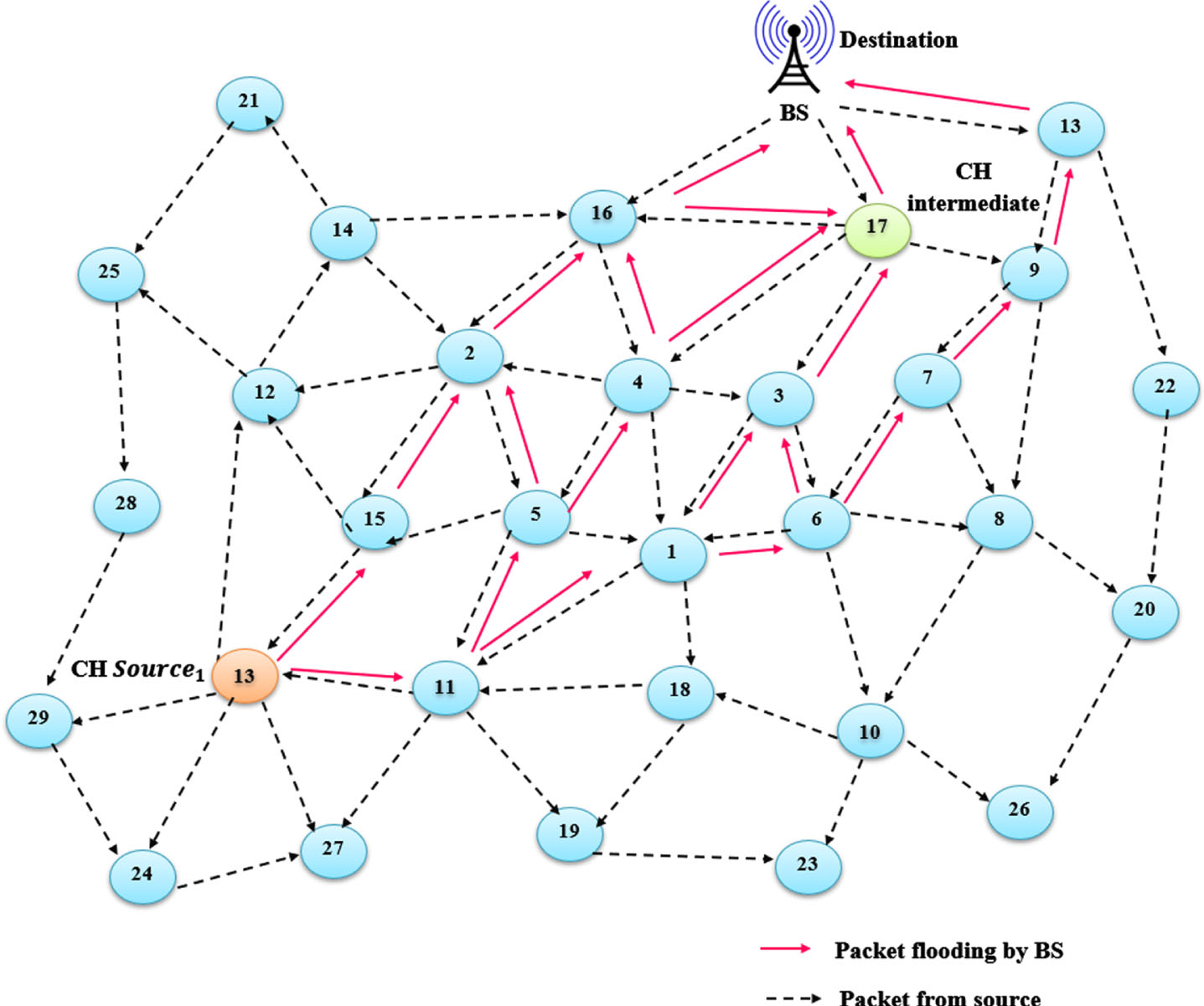
Graphic description of routing in WSN via QIAVO.
In Wireless Sensor Networks, Sybil, Wormhole, Denial of Service, HELLO Flooding, and Sinkhole attacks are possible. All the above-said attacks are induced by an external attacker which consists of more powerful and more distance coverage. The proposed ECAR works based on four vital parameters such as node degree, distance, node centrality, and residual energy for selecting the optimal cluster head. In this case, a node that has more than the upper threshold distance and upper threshold energy is treated as an external node which will not include in the cluster and therefore, this external node is not chosen as a cluster head at any cost of time.
Where LTE denotes the lower threshold, UTE denotes the upper threshold value. If the remaining energy of a sensor node is greater than the threshold, that sensor node is considered an attacked node and cannot be selected as a CH.
Result and discussion
In this section, the proposed ECAR method is evaluated and compared with existing HMBCR [24], GAPSO-H [27], FAGWO-H [29], and IMD-EACBR [30] methods. Experimental findings are provided for networks with 100–1000 nodes and 0-1400 rounds, respectively. The proposed method’s simulations were put into practice using MATLAB 2020b, a system configuration of 8GB RAM, 1TB HD, an Intel i8 processor running at 2.60 GHz, and Windows 10. The parameters used in the implementation procedure are listed in Table 1. Real-time experiments have been conducted in remote hospitals, such as the cancer care center and Covid patient care center. In real time, the sensors measure the temperature, pressure, oxygen level, and humidity of a patient. Data from remote hospitals were securely sent to the district medical center using the proposed ECAR methods.
Parameter setting
Parameter setting
Throughput, Packet Loss Ratio (PLR), Packet Delivery Ratio (PDR), Network Lifetime, End-to-End Delay, and Energy Consumption parameters are used to assess the efficacy of the suggested method.
The performance of the proposed ECAR method is compared with existing HMBCR [24], GAPSO-H [27], FAGWO-H [29], and IMD-EACBR [30] approaches given in this section. Additionally, the effectiveness of the ECAR algorithm is evaluated against existing approaches for energy efficiency, network resilience, packet delivery rate (PDR), end-to-end delay (ETE), and packet loss rate (PLR).
Figure 5 displays the network lifetime for various numbers of nodes. The analysis demonstrates that the proposed ECAR model extends the network lifespan even when there are many nodes. This is because there are more nodes present, which increases the chance of minimal retransmissions. As compared to the existing methodology, the proposed ECAR method has the lowest lifetime up to 1200 rounds, and the highest lifetime up to 2800 rounds. When the number of nodes is 500, the corresponding network lifetime (rounds) values computed by existing IMD-EACBR, FAGWO-H, GAPSO-H, HMBCR, and proposed ECAR are 1900, 1750, 1500, 1400, and 2200, respectively.
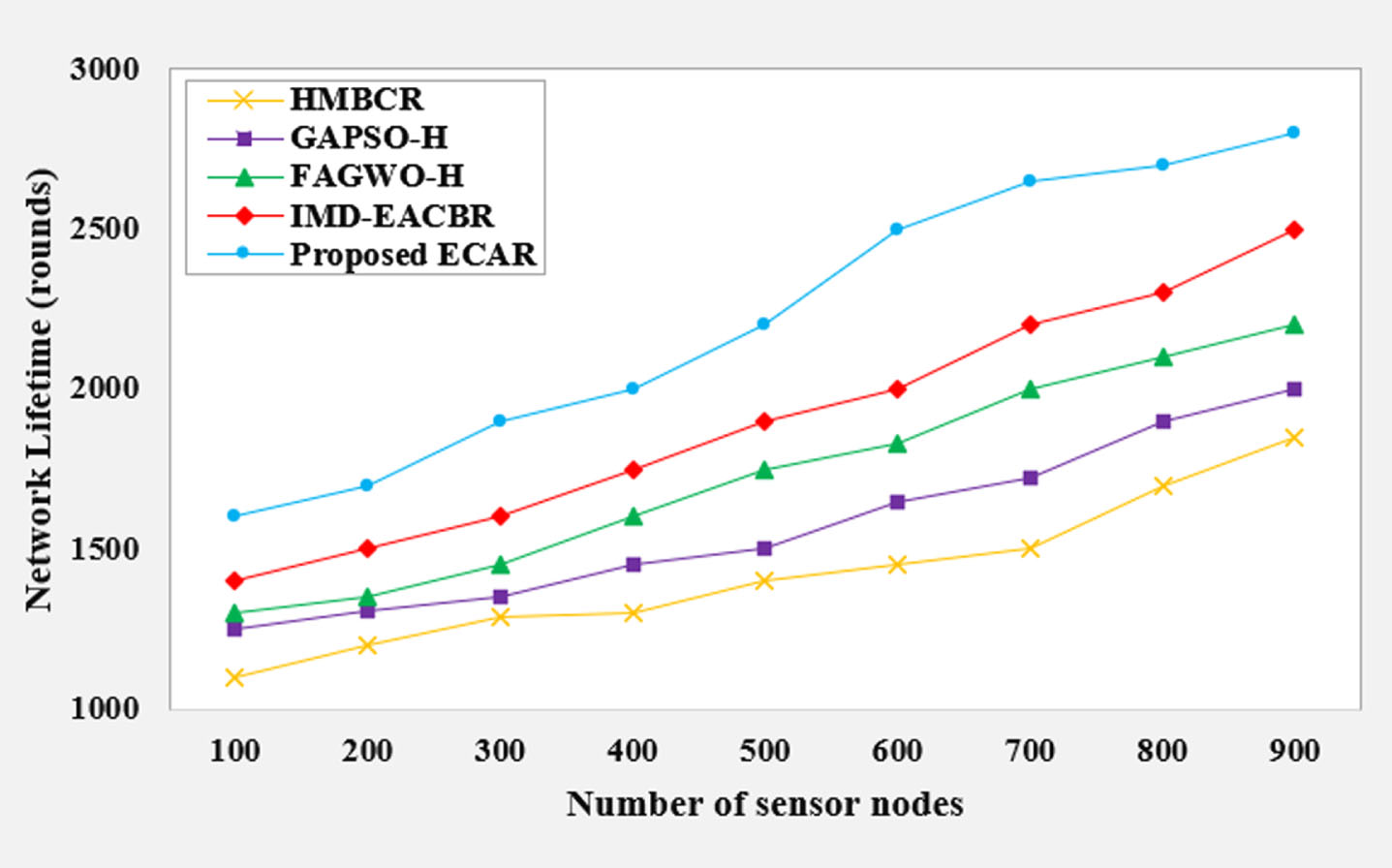
Comparison of network lifetime.
The suggested ECAR method produces a significant number of alive nodes, as shown in Fig. 6, in comparison to the earlier HMBCR [24], GAPSO-H [27], FAGWO-H [29] and IMD-EACBR [30] methods. When compared to earlier methods, the ECAR method is seen to improve the network’s active node percentage. The results show that the HMBCR technique produced successful results with minimal numbers of alive nodes.
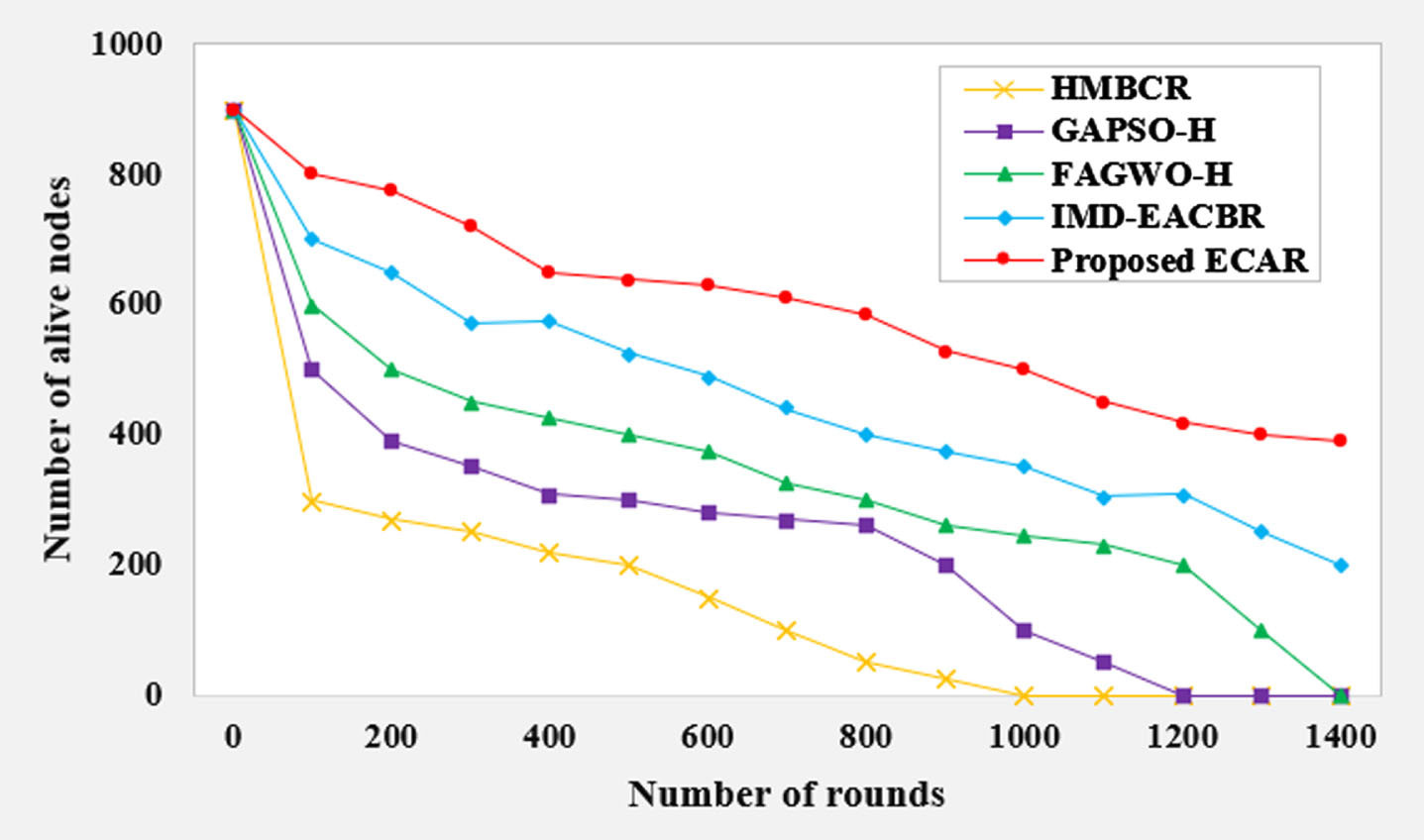
Analysis of alive nodes.
The proposed ECAR with existing techniques is shown with an End-to-End Delay analysis in Fig. 7. From the following analysis, it is clear that our suggested work provides a reduced End-to-End Delay than other approaches. The proposed method has a 0.54 s End-to-End Delay for 100 nodes at the beginning. When the node is 500, the existing HMBCR, GAPSO-H, FAGWO-H, and IMD-EACBR techniques offer End-to-End Delay values of 1.9 s, 1.65 s, 1.15 s, and 0.99 s, respectively.
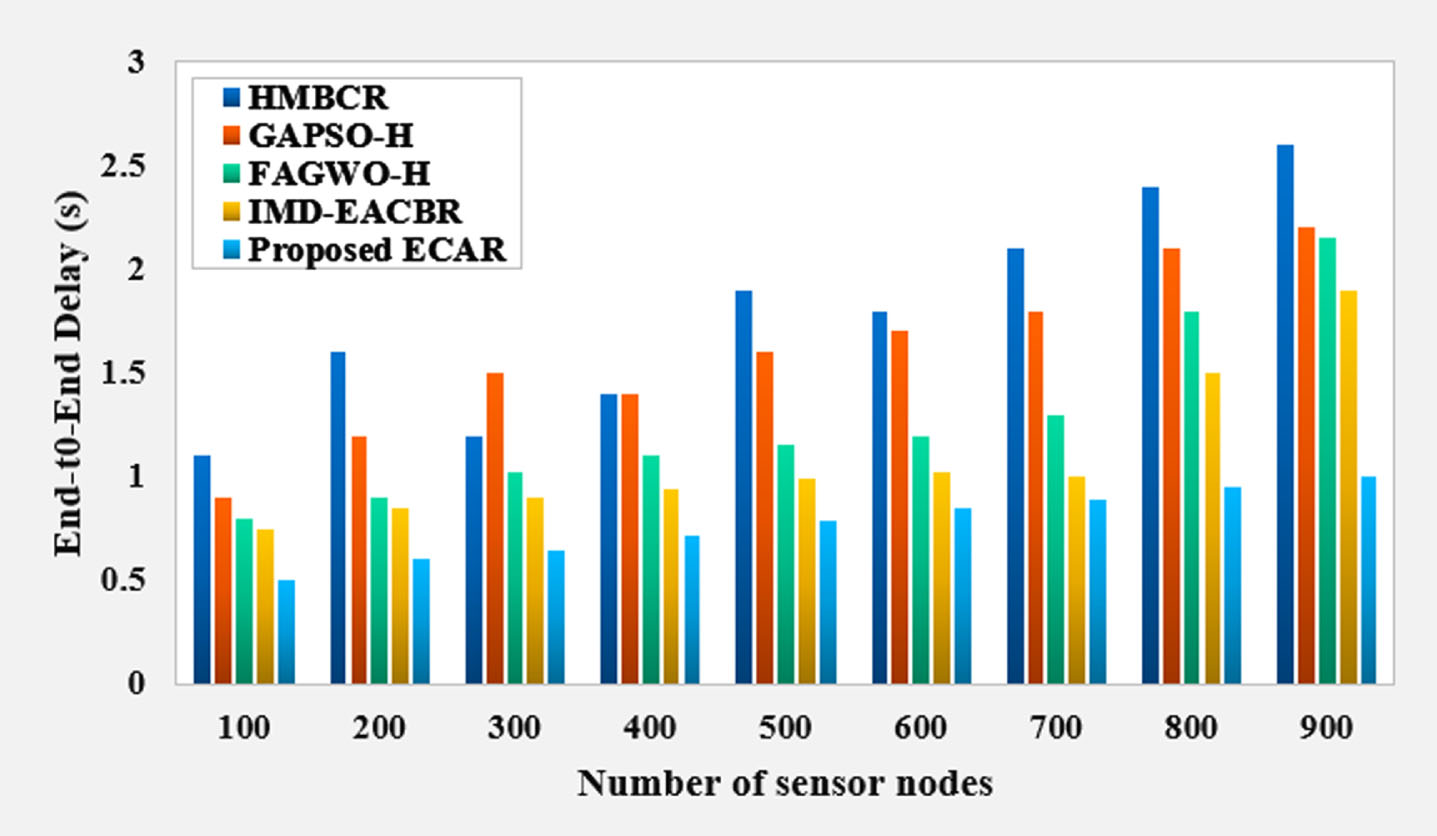
End-to-end delay analysis.
By extending the nodes from 100 to 900, the suggested ECAR method is contrasted with prior methods based on overall energy consumption. It should be reliable and energy-efficient to find the best route from the base to the terminal. Figure 8 further demonstrates how energy consumption increases as the number of nodes increases. When a node is 200, the energy consumption of the proposed methods is 0.1 mJ and the existing HMBCR [24], GAPSO-H [27], FAGWO-H [29] and IMD-EACBR [30] yield 0.34 (mJ), 0.24 (mJ), 0.19 (mJ) and 0.15 (mJ) respectively. As the number of nodes increases, so does the amount of Energy Consumption.
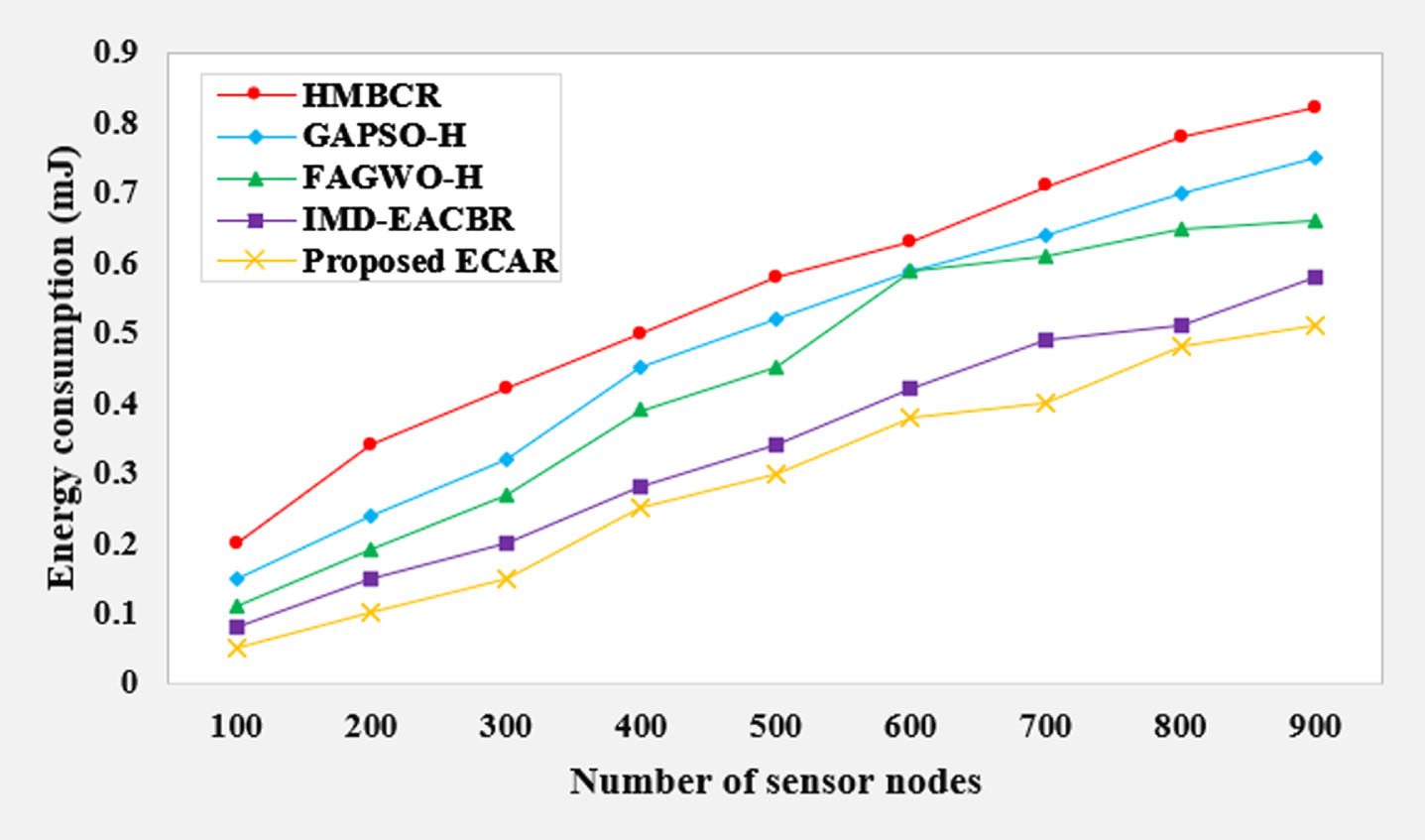
Energy consumption analysis of the ECAR technique under various nodes.
A throughput comparison of the ECAR approach with prior techniques is shown in Fig. 9. The findings show that the proposed approach exhibits exceptional throughput across all sensor nodes. For instance, the proposed ECAR model produced a throughput of 0.93 Mbps with 500 SNs, compared to 0.88 Mbps, 0.79 Mbps, 0.73 Mbps, and 0.68 Mbps for the HMBCR, GAPSO-H, FAGWO-H, and IMD-EACBR approaches. The proposed ECAR strategy eventually achieved a better throughput of 0.87 Mbps with 900 nodes, while the existing HMBCR, GAPSO-H, FAGWO-H, and IMD-EACBR strategies provided a lower throughput. When a node is 200, the throughput of the proposed model is 12.48%, 10.5%, 9.35%, and 5.1%, better than HMBCR, GAPSO-H, FAGWO-H, and IMD-EACBR approaches. Throughput is one of the most important parameters for quality of service (QoS) development. This ensures network scalability. Network lifespan alone does not play a large role in achieving the best network performance. Therefore, QoS parameters play an important role in improving network performance and making routing protocols more reliable. The scalability of any routing protocol in a network is directly proportional to its throughput. Here, when the number of nodes increases beyond 1000, the scalability decreases, which is the limit of the proposed method.

Throughput analysis of the proposed with existing method.
Figure 10 depicts the packet delivery ratio. This chart shows that the suggested ECAR approach performs better than the existing methods in terms of PDR. According to the findings, the ECAR model had the highest PDR under all of the sensor nodes. Furthermore, the PDR ratio appears to be high when single and binary values are communicated. PDR will increase with a greater number of nodes. The proposed scheme displayed the highest PDR for all network densities up to 98% when node is 900. The PDR of the proposed method achieve 14.5%, 12.57%, 7.15% and 4.68% better than HMBCR, GAPSO-H, FAGWO-H, and IMD-EACBR respectively.
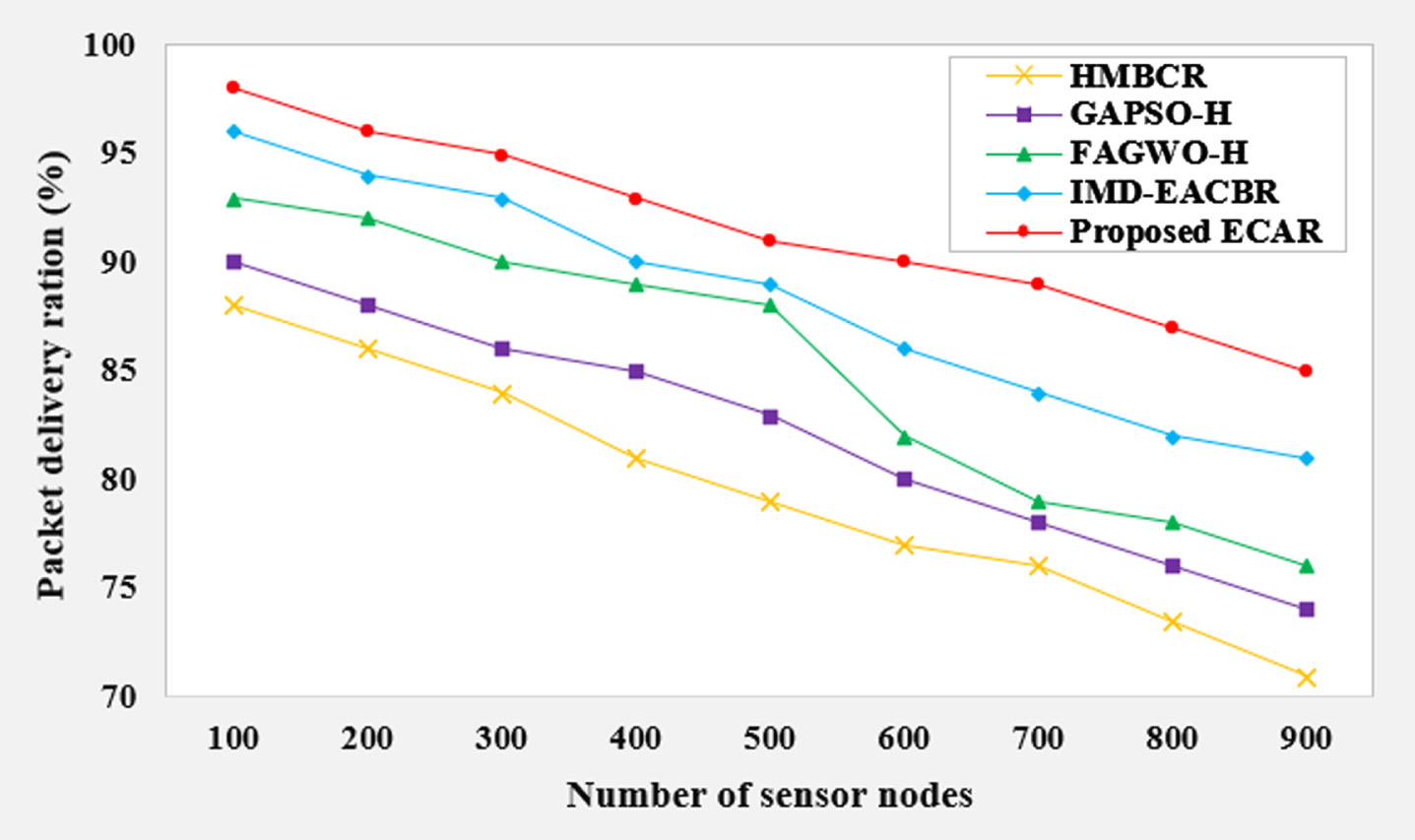
Packet delivery ratio (%) with varying nodes.
The total amount of packets transmitted from the CHs and received at the base station to the number of iterations is shown in Fig. 11. Transmission of more packets of data results in better performance. The suggested method sends more packets to the intended location than the HMBCR, GAPSO-H, FAGWO-H, and IMD-EACBR approaches. When the number of the round is 800, data packets are received at BS for the proposed model 1050, whereas existing HMBCR, GAPSO-H, FAGWO-H, and IMD-EACBR approaches achieve only 420, 500, 680, and 780 respectively.
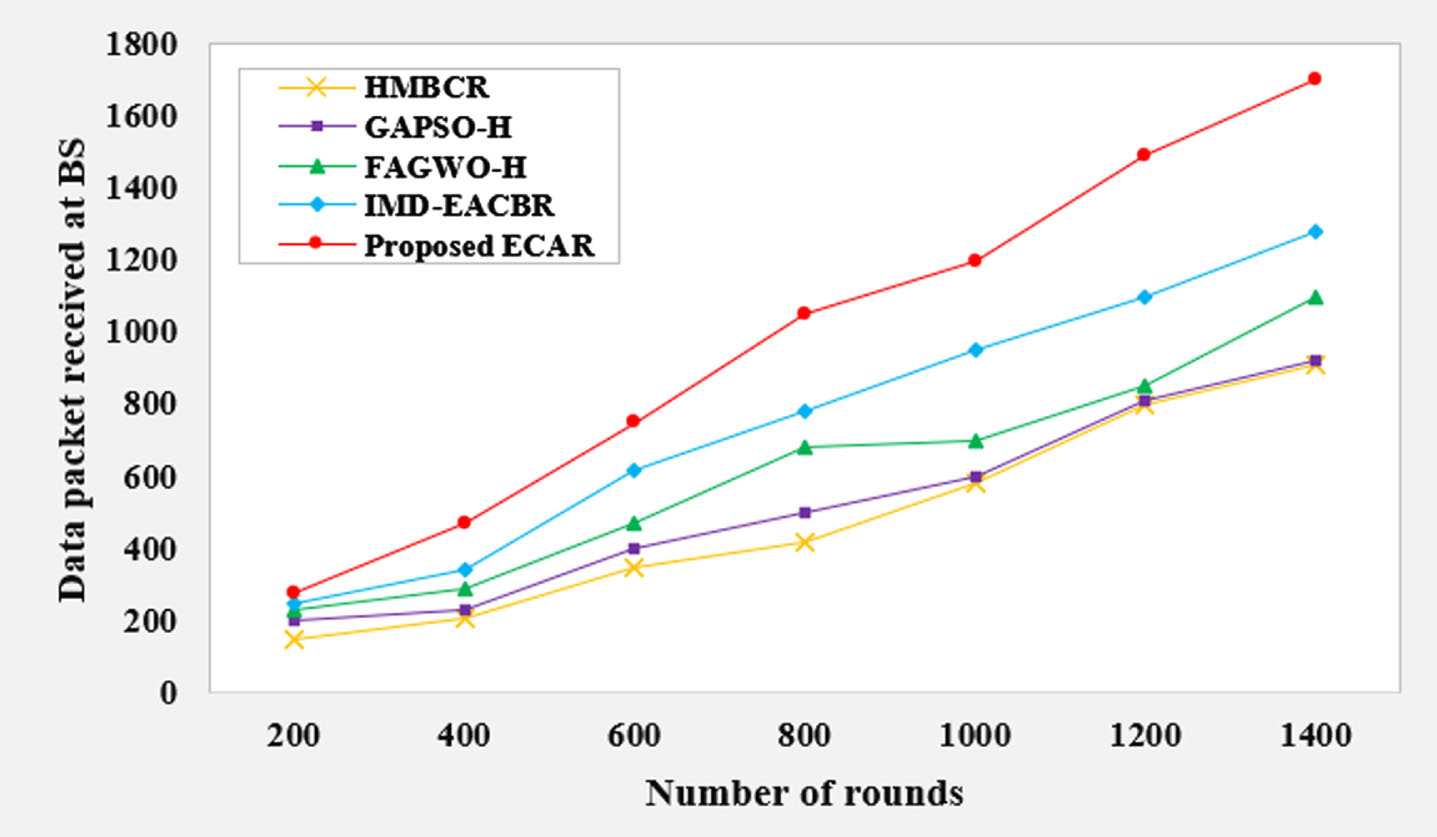
Received data packet at BS versus the number of iterations.
An increase in the coverage ratio indicates a significantly higher network lifetime, according to evaluations performed against the number of iterations in Fig. 12. The proposed method offers an optimized CH grouping after clustering, whereas the current method has an uneven CH selection, which subsequently significantly influences the amount of energy used. At iteration 1000, the proposed ECAR has a 95% coverage. As can be observed, at the beginning of its iteration steps, the HMBCR achieved the lowest starting coverage ratio%, dropping below 60%. From Fig. 12, at the 800th iteration, the proposed ECAR model is 15.2% superior to HMBCR, 13.47% superior to GAPSO-H, 11.05% superior to FAGWO-H, and 8.77% superior to IMD-EACBR approaches
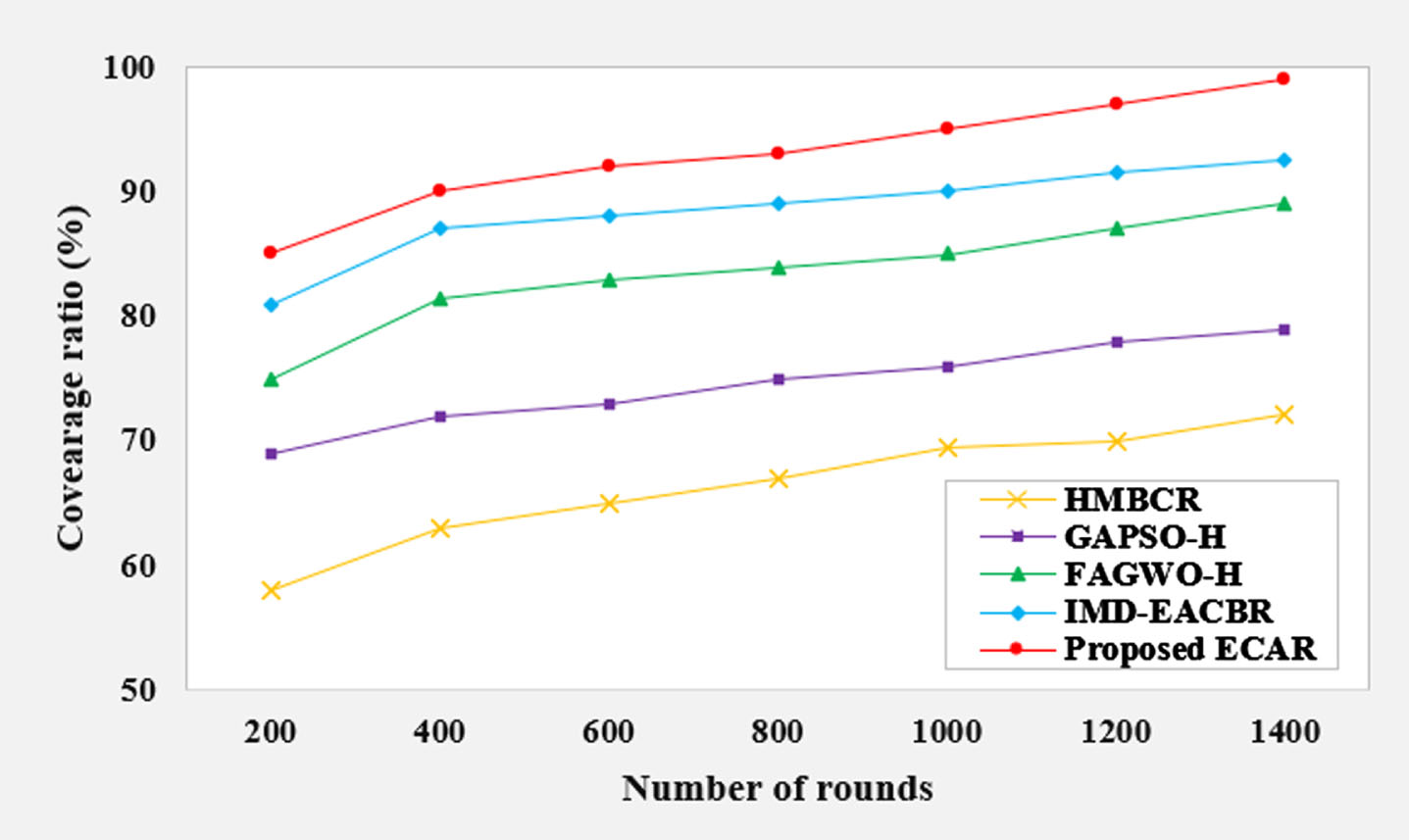
Analysis coverage ratio (%).
The average residual energy with several rounds is shown in Fig. 13. It can be demonstrated that as the number of rounds rises, the residual energy and network lifetime of sensor nodes decrease. All of this results in a decrease in their energy and network lifetime. Additionally, based on the aforementioned metrics, suggested ECAR outperforms the other routing systems. The suggested routing protocol maximizes energy resource conservation, extending network lifetime. Figure 13 shows that the suggested strategy maintains average residual energy better than the existing methods by 22.15%, 19.45%, 15.45%, and 10.34%, respectively.
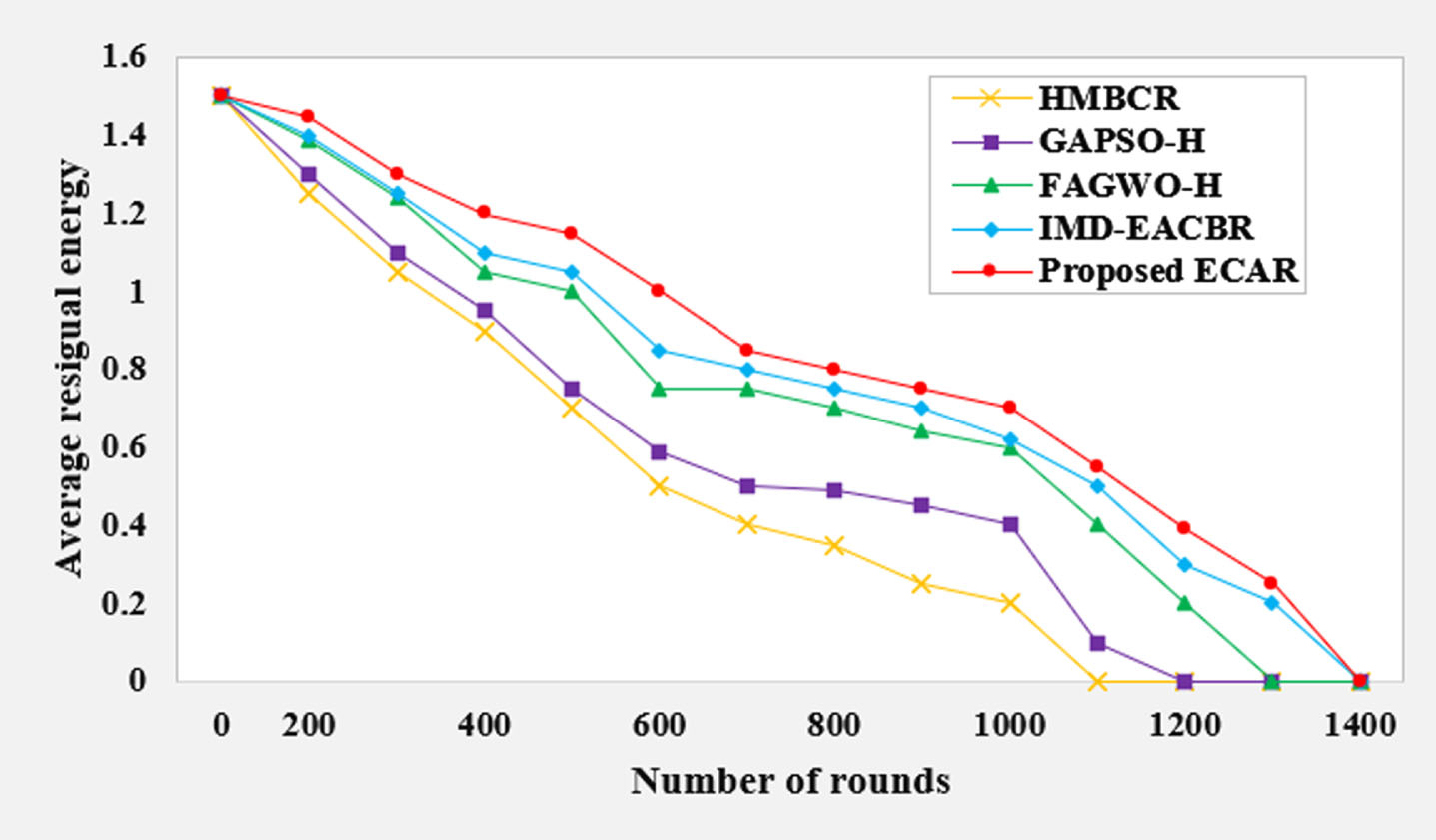
Average residual energy with varying rounds.
Figure 14 shows how the suggested framework behaves in comparison to alternative alternatives when there are different numbers of network nodes. It has been found that the suggested framework lowers the packet loss ratio when compared to current techniques. Because of data link instability and congestion, the current solutions drastically reduce the performance that can be achieved for data delivery. On the other hand, our suggested framework reduces the packet drop ratio by choosing routes that use the least amount of energy. The packet delivery loss of the proposed model is relatively 12.48%, 10.5%, 9.35%, and 5.1%, better than HMBCR, GAPSO-H, FAGWO-H, and IMD-EACBR approaches.
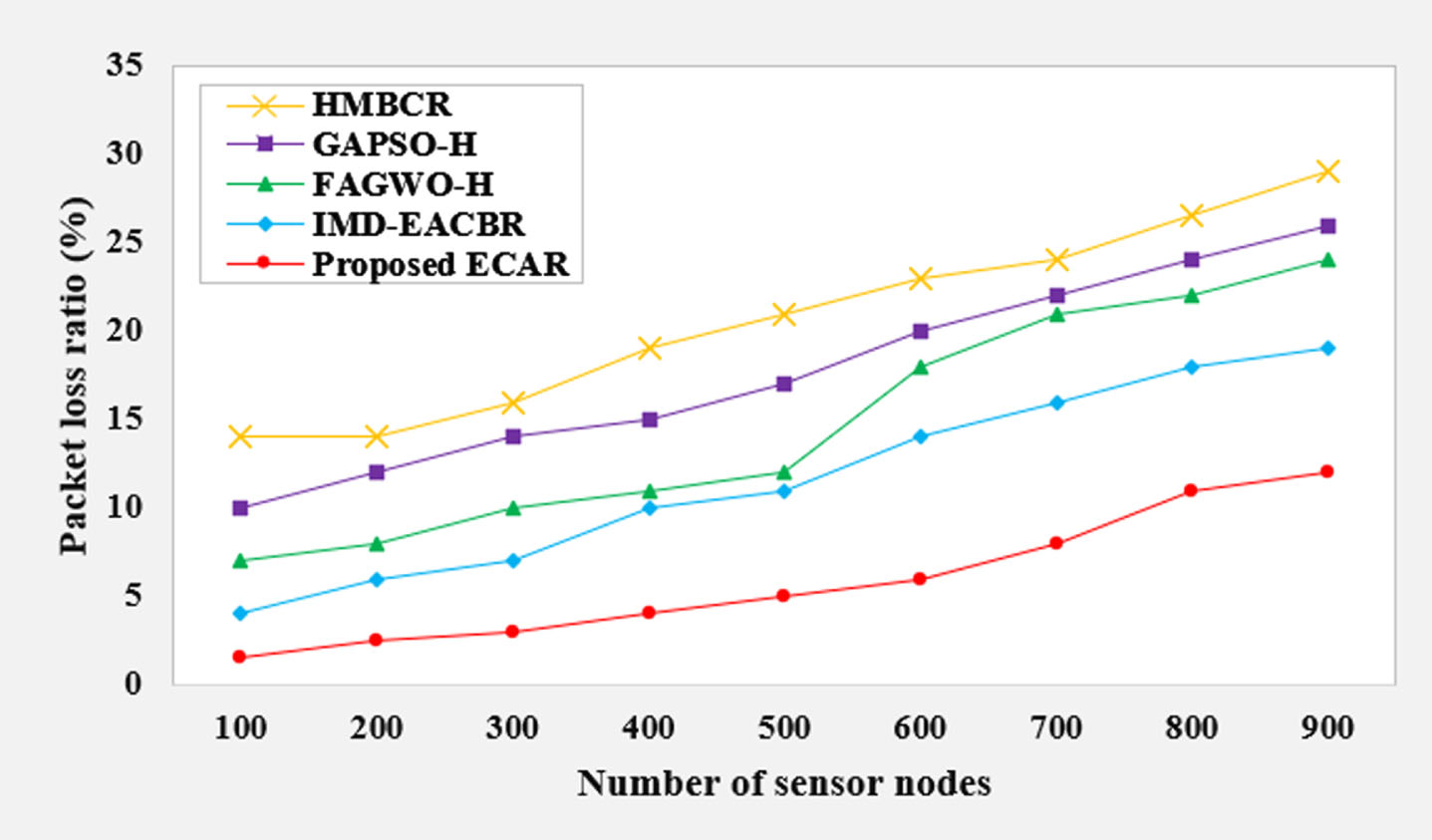
Average packet loss ratio for the proposed method.
In this study, a novel ECAR scheme was developed to maximize the energy efficiency and lifetime of WSNs. ECAR technology works on two levels: clustering and QIAVO-based routing. The proposed ECAR technique mainly uses the GBC (Genetic Bee Colony Optimization) approach to select cluster heads and organize clusters. The best route is then selected using QIAVO technology (Quantum Inspired African Vulture Optimization). Once the best route is identified, the CH uses the best route to send data to the BS. The performance of the suggested ECAR technique was validated using a various number of simulations. Experimental results confirm that ECAR technology outperforms State-of-the-art techniques based on packet loss rate, energy efficiency, lifetime of the network, packet delivery rate, and ETE delay. Comparative analysis shows that the efficiency of the proposed ECAR is 98.6%, 0.975%, and 0.54 seconds in maximum PDR, throughput, and minimum delay, respectively. The simulation results demonstrated the efficacy of the proposed ECAR routing method when compared to the existing approaches. In the future, the proposed approach can be expanded to include networks with mobile nodes and various sinks. In addition, quality of service (QoS) parameters such as reliability, fault tolerance, and delay should be further optimized in the routing protocols.