



Abstract
Internet of Things (IoT) technology now has a new purpose and relevance as a result of the digitalization wave. In this setting, businesses start to plan how they will use IoT technology. But some critical factors can prevent the successful deployment of IoT, and businesses must get beyond these critical factors if they want to do so. The literature review, system literature review, and Delphi technique are used to identify 15 critical factors. These critical factors are then divided into four categories: organization, technology, process, and environment. The PFN-weighted power harmonic operator is proposed with the aim of more effectively obtaining assessment data from experts and lessening the inaccuracy of outcomes caused by information loss. The best and worst method (BWM) is used to determine the ideal weight of critical factors. Results indicate that the primary critical factors to the effective adoption of the Internet of Things are talent, resource limitations, integration complexity, technical operations, equipment power consumption, technical dependability, and data governance. This research will benefit corporate managers in recognizing the significance of the effective deployment of the Internet of Things, identifying major critical factors to this achievement, and making decisions to remove these factors. Thus, an organization may support the effective adoption of the animal Internet of Things.
Introduction
Businesses now create a lot of data as a result of the ongoing development of digital technologies [1]. To accomplish data connectivity, businesses must integrate data produced by many departments both within and outside the business as well as by various pieces of equipment within the business. This will enable businesses to examine the data more effectively and come up with high-caliber choices that will provide them with a competitive edge. In the context of the digital era, the Internet of Things is an emerging technological platform. It is extensively dispersed over a network of embedded intelligent and autonomous devices. It seeks to increase productivity, efficiency, and profitability through the application of predictive analytics and big data technologies [2]. Any location, any time, and any movement across the Internet may share data and information with the Internet of Things. The Internet of Things has been successfully implemented in current research across all fields of endeavor. The genuine interconnectedness of all things has been demonstrated, for instance, by the relationship between the Internet of Things and the supply chain, the retail industry, warehousing, and urban management. By 2020, the Internet of Things will be made up of 50 billion devices worldwide. By 2025, the Internet of Things is predicted to deliver an average yearly economic inflow to all businesses. The Internet of Things is a category of digital technology that is frequently coupled with other categories of technology, including blockchain, big data, artificial intelligence, and the Internet of Things. No industry is immune to the Internet of Things’ effect in this situation, which has continued to grow [3]. The Internet of Things has encouraged the acquisition of new capabilities from a management and control standpoint.
As a result, an increasing number of businesses are starting to deploy the Internet of Things, however, due to a number of internal and external critical factors, the Internet of Things has had to lay off some of its employees. According to this study, it’s critical to identify or get rid of whatever factors to the success of the Internet of Things. So that businesses may begin with the right influencing variables, this article seeks to study and analyze the critical factors that impact the effective deployment of the Internet of Things. Remove hurdles to the Internet of Thing’s successful deployment.
The subsequent study aims are established in light of the discussion above: What are the critical factors that have an impact on the successful implementation of IoT? What are the major critical factors to successful IoT implementation?
These are the contributions that this article is making. Initially, a system of obstacles to the effective adoption of IoT technologies in manufacturing industries is built, and the interrelationships between each obstacle are investigated. Moreover, based on this, we will develop a barrier system to research the major impediments to the effective adoption of IoT in manufacturing enterprises, assist managers in identifying these impediments, and encourage IoT adoption in their organizations. In addition, by integrating PFN and BWM, we enhance the current MCDM study methodology. Lastly, we incorporate a weighted power harmonic operator into the expert knowledge aggregation process. Prior to integrating the data, the interrelation-ship is taken into consideration to offer the correctness of the gathered data and further minimize the loss of measurement data.
Following are the remaining paragraphs of this article. Section 2 establishes the research index system for this page and simply examines the Internet of Things’ growth history and associated literature. The research techniques are thoroughly described in Section 3 along with particular implementation processes. Section 4 introduces the research’s findings and examines how PFN, weighted power harmonic operator, and BWM are applied in real-world scenarios. The study findings are covered in Section 5, along with the article’s theoretical and practical contributions, gaps in the literature, and prospects for the future.
Literature review
Internet of things
After computers, the Internet, and mobile communication networks, the Internet of Things is seen as the third wave of the global information business. It is viewed by nations all over the world as a crucial technical area for reacting to the global financial crisis and reviving the economy since it represents the next generation of information development technology. A growing number of digital technologies are being coupled with the Internet of Things, especially in light of the ongoing advancement of digital technology. For instance, Scholars suggested a framework for blockchain technology with the Internet of Things, which may increase the security and dependability of information transfer in the organization [5]. The Internet of Things and big data together can help an organization successfully implement its digital strategy [6]. However, in the digital age, the Internet of Things has the potential for close integration with more sectors. The conventional Internet of Things is mostly employed in the warehousing and logistics of the organization. The development of the Internet of Things has the potential to increase value for businesses, particularly in light of the COVID-19 worldwide experience.
The results of the available research indicate that the following variables have been identified as factors: senior managers’ support, organizational resources, IT infrastructure, strategic vision, project management, organization culture, user education, and training, data and information integrity, etc. [7–9]. Additionally, scholars have also investigated the critical factors that impact the effective use of big data analysis [10]. According to the findings of his study, factors that affected the quality and amount of time spent included a lack of resources, a lack of security and privacy, a lack of financial support, employee behavior, the length of the investment return period, top-level support, employee abilities, technological procedures, data dependability, and others [11, 12].
Scholars have studied 15 factors that are barriers to the application of IoT in smart cities [13]. Security and privacy, dependability/ lack of mobility, lack of transparency, cost of use and payback period, standards, regulatory policy, and direction, lack of common information systems, lack of integration between IT networks, lack of technical knowledge among planners, lack of skilled workforce, poor network connectivity, system failure issues, data availability, high energy consumption, and IT infrastructure are some of these factors. Studies have investigated the following IoT and big data critical factors on effective corporate strategy implementation: business process innovation, company model and organizational culture, privacy and ethics, and marketing tactics [6]. Scholars used the DEMATEL-ISM methodology to identify the following critical factors to the implementation of IoT in the food supply chain: lack of resources, lack of public awareness, lack of trust and privacy, high investment costs, lack of government regulation, optimal timing for settlement, lack of industry standards, lack of IT infrastructure, lack of data regulation, low attitude towards adoption, lack of consensus protocols, low worker capacity, lack of scalability and interoperability [14]. By reading academic literature, researchers have determined the following factors that prevent the retail supply chain from adopting IoT: a lack of government regulation, a lack of standardization, high energy consumption, security, and privacy concerns, high operational and adoption costs, lengthy payback periods, a lack of Internet infrastructure, a lack of readily available human skills, problems with seamless integration and compatibility, scalability issues, problems with validation and identification, and a lack of Internet infrastructure [15]. Another researcher used a literature analysis and employee interviews to identify the aspects that are critical factors to the deployment of IoT in project implementation: integrating technology, security, data management, collection and management, innovation, efficiency matrix, cost, delivering value, and business solutions, and people [16].
Undoubtedly, the research done by the aforementioned experts is quite valuable and aids in our understanding of the aspects that are barrier to the success of IoT adoption. However, they do not concentrate on the key factors to successful IoT implementation. These factors are critical to the deployment of IoT in pertinent industries. The study in this paper expands on earlier research and incorporates critical factors relevant to the study’s topic. This research has important implications for the successful implementation of IoT in manufacturing companies.
Relevant methods of weight calculation
The traditional techniques for obtaining indicator weights in multi-criteria decision-making (MCDM) include the analytical hierarchy process (AHP), decision experiment and decision experiment (DEMATEL), full unanimity method (FUCOM), and best-worst method (BWM). It is necessary to contrast many criteria while applying the AHP approach. When there are many criteria, there are also many comparisons, which complicates the assessment model (Zavadskas et al., 2016). Particularly, it is difficult to make comparisons that are entirely consistent when there are more than nine criteria, which might potentially have an impact on the study’s findings (Zhu et al., 2015). Although the DEMATEL approach is equally popular for analyzing correlations between indicators, its crucial flaw is that it involves n(n-1) times as many pairwise comparisons. As a result, the DEMATEL approach was utilized to examine the relationship and causation between the criteria (Parezanovic et al., 2019). The minimal solution is utilized as a threshold to test consistency, and the FUCOM approach is employed to reduce the bias between the priority weights and the comparison information. It is difficult to quantify the FUCOM’s subjective rating, though. When the number of individuals with opposing ranking attitudes is equal, the evaluation procedure will be more challenging.
BWM is a method that has become particularly popular in recent years [33]. Its main objective is to compare the best choice criterion chosen by the decision maker with other criteria in order to acquire different indicator weights and to compare those other criteria to the worst criterion also chosen by the decision maker. BWM is frequently used in supplier evaluation, performance evaluation, education, technology evaluation, and the identification of critical factors. The BWM approach doesn’t demand as many pairwise comparisons as the AHP and DEMATEL methods do. The computing effort is reduced while the consistency of the output is increased. The BWM approach for the FUCOM method may take into account various aspects and weights among factors using linear and nonlinear models and provide optimal solutions.
The BWM method reduces the workload of the model with a lower number of comparisons, is also applicable to decision-making problems with a large number of criteria, and has the characteristics of flexibility and high consistency to further improve the reliability of research results.
Selection of relevant fuzzy linguistic
Decision makers conducted assessments in earlier research using exact numerical scales. Due to knowledge gaps, the complexity of the issue, and time constraints, decision-makers may provide inadequate evaluation information. The emergence of fuzzy linguistic has changed this phenomenon, and scholars have proposed different linguistic models for different research objects and purposes.
The BWM method can be combined with different fuzzy languages for different research objects and purposes. Through an examination of the literature, we provide a summary of the use of BWM and fuzzy sets in the literature in this work (Table 1).
The combination of BWM and fuzzy sets
The combination of BWM and fuzzy sets
For example, combining triangular fuzzy linguistic with BWM for sustainable supplier selection and hospital performance evaluation [35, 36]; hesitant fuzzy linguistic with BWM for wastewater site selection and healthcare performance evaluation [37, 38]; probabi-listic hesitant fuzzy linguistic with BWM to study dominance-based fuzzy information in MCDM [39]; combining Z-number with BWM to study supplier development [40]; the combination of rough numbers and BWM can study the supplier selection problem in Libya [41]; the combination of interval fuzzy linguistic and BWM for group decision making under multiple criteria [42]; the combination of interval fuzzy linguistic and rough numbers and BWM can better handle expert evaluation information [43]; the combination of intuitionistic fuzzy linguistic and BWM is used to deal with group decision making [44, 59]. In different decision environments, decision makers often have uncertainty and hesitation in making decisions. Their decision linguistic exhibits the personalized individual semantics(PIS) pheno-menon [60], and this preference information is presented as distributed linguistic representations [61]. Therefore, on the basis of distributed linguistic being widely used in complex decision problems, scholars propose models to deal with linguistic preferences in decision making.
Pythagorean fuzzy linguistic was defined in [34], and the size comparison technique, which is its algorithm, was presented. Scholars in the United States and overseas have expanded Pythagorean fuzzy sets to include TOPSIS, VIKOR, TOMID, and other approaches on the basis of the theory relating to these sets. The PFN language has more relaxed requirements for affiliation and non-affiliation than other languages, which fits well with the mental activities of decision-makers. Based on the object and purpose of the study, this paper uses Pythagorean fuzzy linguistic.
The treatment of fuzzy data is a significant advancement of BWM since it addresses the ambiguity, imprecision, and uncertainty of data in subjective criteria. When combining the assessments of several experts, there are a variety of pooling operators that may be employed, including PFWA, PFWG, COWA, PFOWA, and others. These, however, do not account for the link between the pooled data, which leaves flaws in the findings. As a result, the power sum average operator is introduced in this study as the pooling operator, which accounts for the impact of the mutual support level between the integrated data on the weights and improves the accuracy of the findings.
We identified three research gaps that provided opportunities for our investigation based on the prior literature. Comprehensive study on the obstacles to the effective adoption of IoT in industrial organizations is lacking. Fewer research that already exists on BWM techniques has combined BWM with PFN. Utilizing a more dependable pooling operator is advised. Traditional PFN operators do not take into account the interdependence and support of indicators, which causes the assessment information to deteriorate more and decreases the accuracy of the outcomes.
We identified three research gaps that provided opportunities for our investigation based on the prior literature. This investigation is distinctive in that it closes the gap by creating a framework. The combination of BWM and PFN expands upon the already used research methodologies, while the system of indicators discovered by literature review, systematic literature review technique, and Delphi method extend upon related studies. To further reduce the loss of evaluation information and improve the accuracy of the study results. We proposed the PFN- weighted power harmonic operator to take into account the interrelationship and support between indicators to improve the accuracy and reliability of the results.
Critical factors to successful IoT implementation in manufacturing companies
The critical factors to the successful implementation of IoT are described in this section. A systematic literature review (SLR) method is used to find pertinent publications over the last three years and identify these factors [55]. Then, by the study of relevant literature, relevant critical factors are initially discovered (Table 2). We have first evaluated the body of research on IoT adoption hurdles. Second, we used a systematic literature review strategy to find pertinent literature in the journal repositories of Research Gate, Google Scholar, Ebsco Host, Science Direct, Springer Link, Emerald, and Web of Science. The original list of the identified IoT research critical factors was compiled using these academic works. We incorporated the critical factors that suit the study object and the study’s goal more closely before deciding on the final critical factors using expert opinion and Delphi conferences. Table 2 lists the last critical factors that were discovered. The results demonstrate that the critical factors we chose are representative and scientific.
Factors affecting the successful implementation of IoT
Factors affecting the successful implementation of IoT
Finally, using expert opinion and the Delphi technique, the remaining critical factors are discovered and divided into organizational, process, technological, and environmental components. SLR is a strategy and procedure that is dependable and precise. This approach may be utilized in this study to identify critical factors to effective IoT adoption by locating and assessing all prior research on a certain research question, topic, or phenomena of interest. Figure 1 depicts the SLR implementation process flow, while Fig. 2 depicts the method and findings of the literature search.
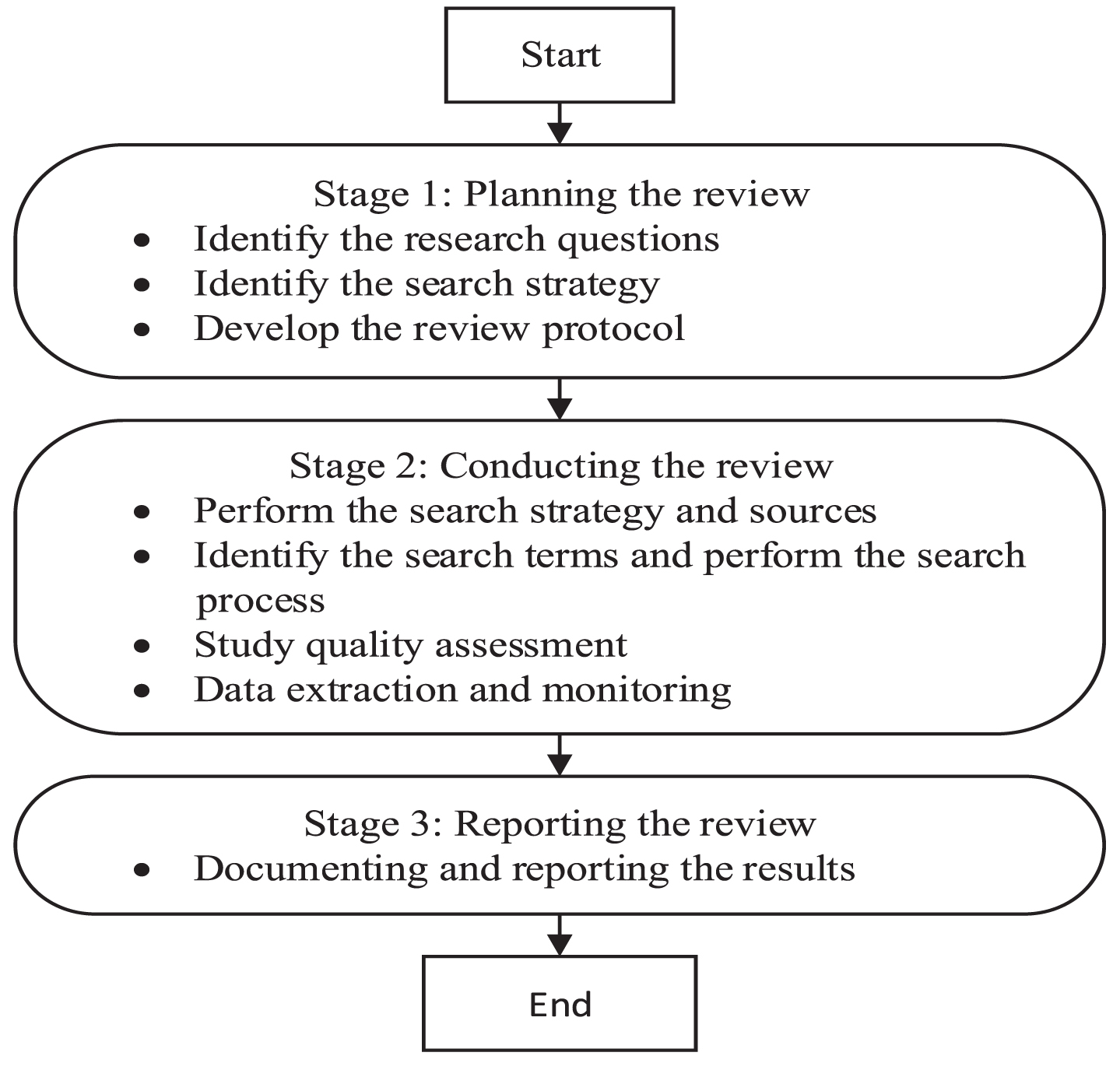
The process flow of SLR implementation.
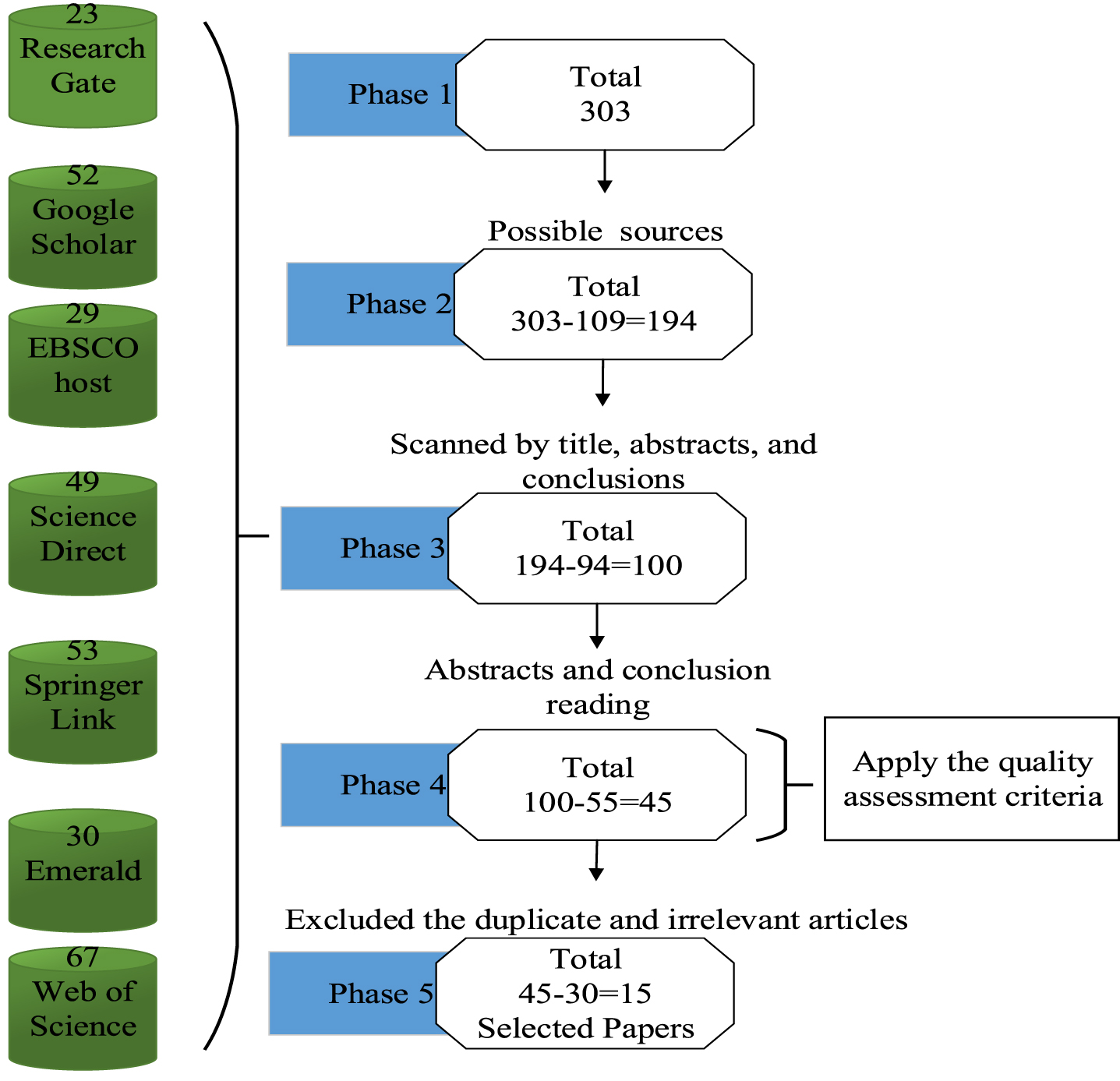
Literature search process and results.
IoT cannot be adopted without the assistance of senior management since it is one of the digital technologies and is particularly one of the technologies with a high commitment to mentation. Therefore, the adoption of IoT is greatly influenced by the top management’s commitment to the technology [17, 18]. Lack of senior management support may prevent the allocation of resources needed for successful IoT implementation.
Strategic vision
Companies will only invest in the IoT if they understand the value of a successful implementation and the enormous advantages that can be obtained from this project, from a strategic point of view. The introduction of IoT, however, may be hampered if organizations fail to proactively assess the function that it should serve in their company. According to research, the main factor in companies adopting IoT is the absence of strategic vision [1].
Resource limits
Resources including money, technology, and labor are needed in huge quantities to adopt IoT within an organization. These resources will put pressure on the enterprise’s current operations, which will unavoidably have an impact on the regular growth of other enterprises. Additionally, businesses must identify or create new resources to enhance the business risk if the current resources are insufficient for the successful deployment of IoT [19, 20].
Employee attitude
Employees are typically reluctant to alter their employment status due to excessive work hours. As a result, when a firm adopts new technology, employees generally have a negative attitude toward it [22]. In addition, when new technologies are implemented in businesses, adjustments are made to workflows, jobs, and responsibilities. Employee resistance to the newly introduced technology is a result of these developments [1].
Technical operation
The deployment of IoT necessitates connections to numerous devices both inside and outside the organization, necessitating a variety of appropriate abilities from the enterprise’s staff [21]. Employees’ technical operations are being constrained by the way the organization is governed and the few resources as the IoT’s scope and diversity of linked devices expand. One of the key factors for the effective adoption of IoT, according to research, is employees’ inadequacies in terms of technical operation [22].
Available talents
Professionals with the necessary training must create and implement IoT solutions. To ensure the system’s flexibility, the user-friendly IoT network interface, setup, and administration processes are essential. To set up and update the IoT to make it more suited for the firm itself, it is necessary to have not only highly advanced technical and functional capabilities but also the essential talent that is already present in the organization [23]. The cornerstone for the corporate utilization of the Internet of Things is a huge talent pool, and the absence of available talents will impede the effective adoption of the Internet of Things.
Complexity of integration
In order to gather, aggregate, store, and utilize systems and databases both inside and outside of the company. During deployment, the IoT exchanges and transmits information with a large number of devices, and because the information standards and transmission channels used by the devices differ, the integration of the information is complicated. Integration capability is a critical factor in successful IoT adoption since the ultimate product of IoT depends on its strength [13, 23].
IT infrastructure
The adoption of IoT technologies in businesses is hampered by a lack of IT infrastructure, which is required for the proliferation of digital technologies [23]. Advanced and interoperable information infrastructures must be established first for the successful application of IoT technologies in businesses. IoT may be better linked with other devices in this way to collect the data transmitted by various devices. IoT implementation in businesses will be extremely challenging without the required software and hardware [24].
Security and privacy
The more substantial data that the IoT can produce when it is implemented in the business. The security of the network’s systems is in danger from threats including fake data, sensitive access, and unlawful breaches that can cause network paralysis. Additionally, exposure to external hazards includes data transfer, Internet connections, and software licensing [15, 25]. All stakeholders must feel confident that their data and information will not be lost, sold, or otherwise misused.
Technical reliability
Information may be sent more quickly and easily with the effective adoption of IoT, and a lot of data is also produced. IoT technology indirectly influences every part of the business since businesses may utilize this data and information for decision-making. When managers implement IoT into their systems, the dependability of IoT technology becomes a significant problem because of the heterogeneous nature of the chosen technology [26]. IoT technology’s unreliability may potentially cause serious issues for commercial operations.
Data governance
It is a concern how businesses would manage the information gathered from numerous devices using IoT. Enterprises gather a lot of data and information, and they should manage that data and information in line with applicable laws, rules, and policies. Businesses should avoid overprocessing and mining user data, which is acquired specifically in a sensitive form [27]. Information governance that violates the law or is overly mined can pose a risk to companies applying IoT technology, so companies must take this issue seriously.
Scalable and flexible systems
Using IoT to gather and transmit data and information while using that data and information to make more qualitative judgments is the goal of business IoT applications. In light of this, an enterprise’s IoT technology platform should be scalable and adaptable to new data sources, properties, and dimensions. Because the definitions of data types in various systems may change, and mistakes in the data translation process may result in serious issues [28, 29]. Lack of a scalable and flexible system increases information loss and affects the quality of the output.
Operating and usage costs
IoT deployment involves a variety of resources, in particular technical, financial, and human resources. Early on in the building process, the enterprise’s resources will ineluctably be skewed toward IoT, and they will also have to deal with significant maintenance and depreciation expenses [25]. Thus, organizations need to assess their financial standing because the high cost of IOT may discourage them from implementing these systems.
Payback period
Numerous devices are required for IoT deployment, for which businesses must make large expenditures. Companies should be aware of the payback period of IoT because they also have to repair and maintain the devices. The payback period may be longer than anticipated depending on the scope of the IoT installation and the amount of cash spent [15, 30]. Thus, a long payback period may prevent companies from using IoT technologies.
Device power consumption
International society is today extremely concerned about environmental conservation. One of the key factors for the effective adoption of IoT is device power consumption. When IoT is used in businesses, various gadgets will continually exchange information while using a lot of electricity. The energy requirement will expand along with the expansion of IoT networks, data centers, and devices, which will result in an increase in device power consumption [31, 32]. Excessive device power consumption increases operational costs, has a bigger environmental effect, and raises business risks. So, a critical factor in IoT adoption for businesses is device power consumption.
Methodology
This study’s primary goal is to provide a new technique of decision-making for identifying the major critical factors to the successful application of IoT technology. In light of this, we provide the power summation operator, a set operator that can more accurately gauge the correlation between expert assessment data. The following is the study’s technical schedule (Fig. 3).
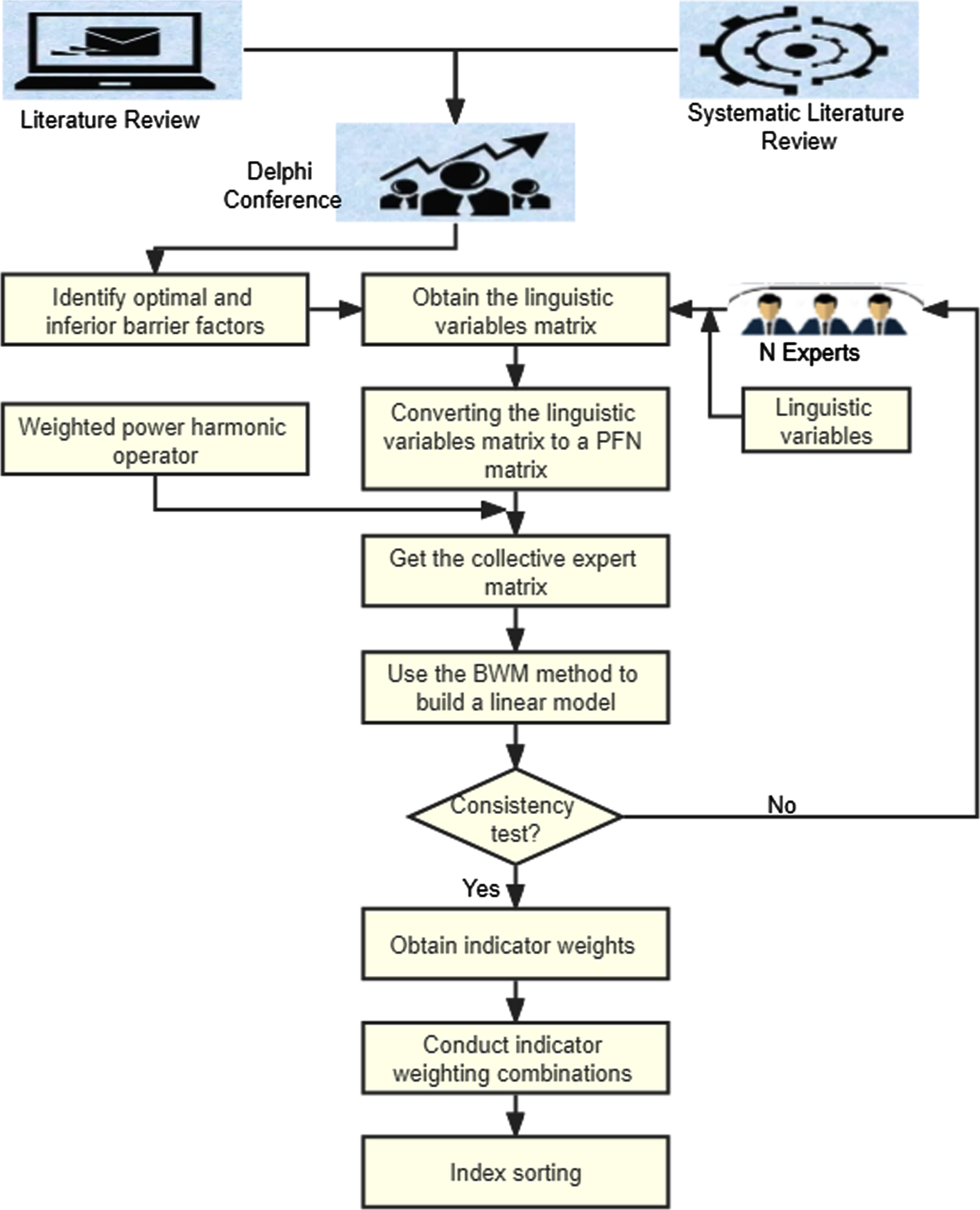
Technology roadmap.
The main PFNS features, ideas, and a few operating guidelines are introduced in this part. It has been advocated to relax the restrictions on associativity and unassociativity by constructing Pythagorean sets based on intuitionistic fuzzy sets [46, 47]. By enabling the evaluator to provide larger values, it is possible to more properly and realistically characterize the uncertainty of a situation.
The modified function satisfies S* (x) , H* (x) ∈ [0, 1].
Traditional Pythagorean fuzzy operators do not take into account how the collected data are interconnected. In this paper, we propose Pythagorean fuzzy set weighted power harmonic set operator based on the power operator [48], which better takes into account the mutual support relationship between the set data to improve the accuracy and reliability of the results.
It is evident from the aforementioned equation that Sup (a i , a j ) is a measure of how similar a i and a j are. The Sup (a i , a j ) value increases if a i approached a j more closely.
We assume that the qualities of the items are equally significant in Equation (10). However, the significance of each attribute’s data varies depending on the item in many scenarios, and experts would assign varying weights based on the circumstances, we give the weighted power harmonic operator.
In practical applications, the PFN-weighted power harmonic operator is used to assemble the evaluation matrices of different experts and the application process is as follows.
Where the support function satisfies the three properties in Equation (9). Especially, if S* (a ij (k))-S* (a ij (l)) =0, then Sup (a ij (k), a ij (l)) =1.
On the Analytic Hierarchy Process (AHP), BWM was proposed [33]. The benefits of BWM over AHP are more clear-cut: (1) Instead of comparing every influencing factor in AHP pair by pair, which takes a lot of time when there is only one influence factor, BWM only needs to compare the best influence factor with other factors and the worst influence factor with other factors. (2) The high number of pairwise comparisons in AHP not only makes the effort more difficult but also makes consistency less reliable. Contrarily, BWM not only lightens the burden but also significantly enhances consistency. The following are the PFN-BWM application stages.
The optimal weight for the criteria is the one where for each pair of
By solving Equation(19), the optimal weight w1, w2, . . . , w n and the minimum ζ-value can be obtained.
We then calculate the consistency ratio, using ζ and the corresponding consistency index (Table 3), as follows:
Consistency index
Predictive analytics and big data technologies are employed in embedded networks of intelligent and autonomous devices to increase productivity, efficiency, and profitability. This is known as the Internet of Things (IoT). With the full emergence of IoT technology, no industry is excluded from its impact, and this is especially true for the supply chain of manufacturing companies. The IoT solutions for a manufacturing company’s supply chain consist primarily of smart devices, which are used to deliver information from various segments by embedding electronic circuits. By creating digital ecosystems, manufacturing organizations may use connected devices to supply new goods and services while enhancing the consumer experience. The implementation of IoT is crucial because manufacturing organizations are seeing a transition in business choices from a discontinuous information processing paradigm to a data-driven approach. In reality, the application of IoT in the supply chain of manufacturing companies makes more sense because manufacturing companies are in an era of information explosion.
Implementing IoT technology may assist manufacturing organizations in obtaining data relevant to business choices; nevertheless, the absence of a solid framework to direct the successful adoption of IoT forces enterprises to overcome several hurdles. Therefore, in order to successfully implement IoT in a manufacturing company’s supply chain, it is important to determine what critical factors exist and which are the most critical ones. These key factors should be addressed with measures to reduce or even eliminate their impact.
Experts’ selection and weighting
Four of the most respected, experienced, and well-known specialists in their domains were enlisted to examine the problems that prevent the effective adoption of IoT technologies in industrial firms in order to meet the paper’s study objectives. The final important elements were chosen using expert interviews, expert opinion, and Delphi sessions based on the first discovery of essential variables. These experts come from a range of fields, including the IT sector, industry, research organizations, and smart city research. These four professionals will act as the study’s evaluation subjects.
Using the linguistic scales in Table 4, the experts were rated based on their knowledge, experience, and line of work. After that, the expert scores were performed using the score function S* (x) in Equation (5) and the expert weights were obtained by normalization (Table 5).
Linguistic scales
Linguistic scales
Expert weights
These critical factors are categorized as a result according to the technology-organization-environment (TOE). A methodical analytical framework built on the use of technology is the TOE framework. In general, the TOE framework divides the variables factor the use of technology into three areas, primarily relating to technological circumstances, organizational conditions, and environmental conditions. Technology conditions are one of them, and they refer to the features of the technology and the relationship between the technology and the organization, concentrating on whether the technology complements the company’s strengths and the advantages it offers the organization. The impact of organizational management factors on technology is referred to as organizational circumstances. Environmental circumstances are mostly the influencing factors of the local market environment and public policies of government agencies when they are offered relatively late. This article expands the process dimension on the basis of TOE since it discovers that certain additional influencing factors play a role in the IoT deployment process. Finally, these critical factors were divided into four categories: organization, process, technology, and environment (Fig. 4). The Delphi technique was used by the nine experts to get a consensus on the critical factors based on this information. The best and worst indicators were decided upon by the experts following the Delphi sessions and expert opinion. Technology (C3), resource limitations (C13), available talents (C23), and complexity of integration (C31) were the best indications. Environment (C4), strategic vision (C12), employee attitude (C21), scalable and flexible system (C36), and payback period (C42) were the worst indicators.

Classification of critical factors to successful IoT implementation.
After the criteria are determined, we conduct a survey of the experts to jointly select the best and the worst criteria among that main criterion and sub-criteria. Then, according to their own preferences, give a paired comparison evaluation without interference from each other. The pairwise comparison matrixes can be constructed. The final matrix tables are shown in Tables 6–10.
Best and worst matrix of primary indicators
Best and worst matrix of primary indicators
Secondary indicators (Organization) –Best and Worst Matrix
Secondary indicators (Process) –Best and Worst Matrix
Secondary indicators (Technology) - Best and Worst Matrix
Secondary indicators (Environment) - Best and Worst Matrix
Secondly, the linguistic scale given by the expert is converted to PFN linguistic based on the linguistic scale given in advance (Tables 11–15). After setting the PFN linguistic matrices of various experts in accordance with the processes for using the PFN-weighted power harmonic operator described in Section 4.2, the final expert set matrix is generated (Tables 16–20).
Primary indicator - PFN matrix
Secondary indicators (Organization) - PFN matrix
Secondary indicators (Process) - PFN matrix
Secondary indicators (Technology) - PFN matrix
Secondary indicators (Environment) - PFN matrix
Best and worst matrix of primary indicators
Secondary indicators (Organization) - Best and Worst Matrix
Secondary indicators (Process) - Best and Worst Matrix
Secondary indicators (Technology) - Best and Worst Matrix
Secondary indicators (Environment) - Best and Worst Matrix
Next, we must transform the complementary matrix into a mutual inverse matrix. Equation (12) can be used to carry out this procedure. The results are as follows: (Tables 21–25).
Primary indicators reciprocal inverse matrix
Secondary indicators (organization) - reciprocal inverse matrix
Secondary indicators (process) - reciprocal inverse matrix
Secondary indicators (technology) - reciprocal inverse matrix
Secondary indicators (environment) - reciprocal inverse matrix
Ultimately, using BWM for calculations. On the basis of obtaining the reciprocal inverse matrix, the BWM method introduced above can be used for calculation. The final weights of the barrier factors can be obtained by calculating. The results are as follows: (Table 26).
Indicator weights
Based on the consistency description described previously, the consistency calculation can be performed using Equation (20). When it means that the index consistency has passed the test and the weights that were acquired are the best weights. The results are displayed in Table 27.
Consistency test
Consistency test
The matrix of consistency check allows to combination of the weights of consistent indicators and secondary indicators. The results are as follows:
The weights of the combined secondary indicators are arranged in descending order, and the results are shown in Fig. 5.
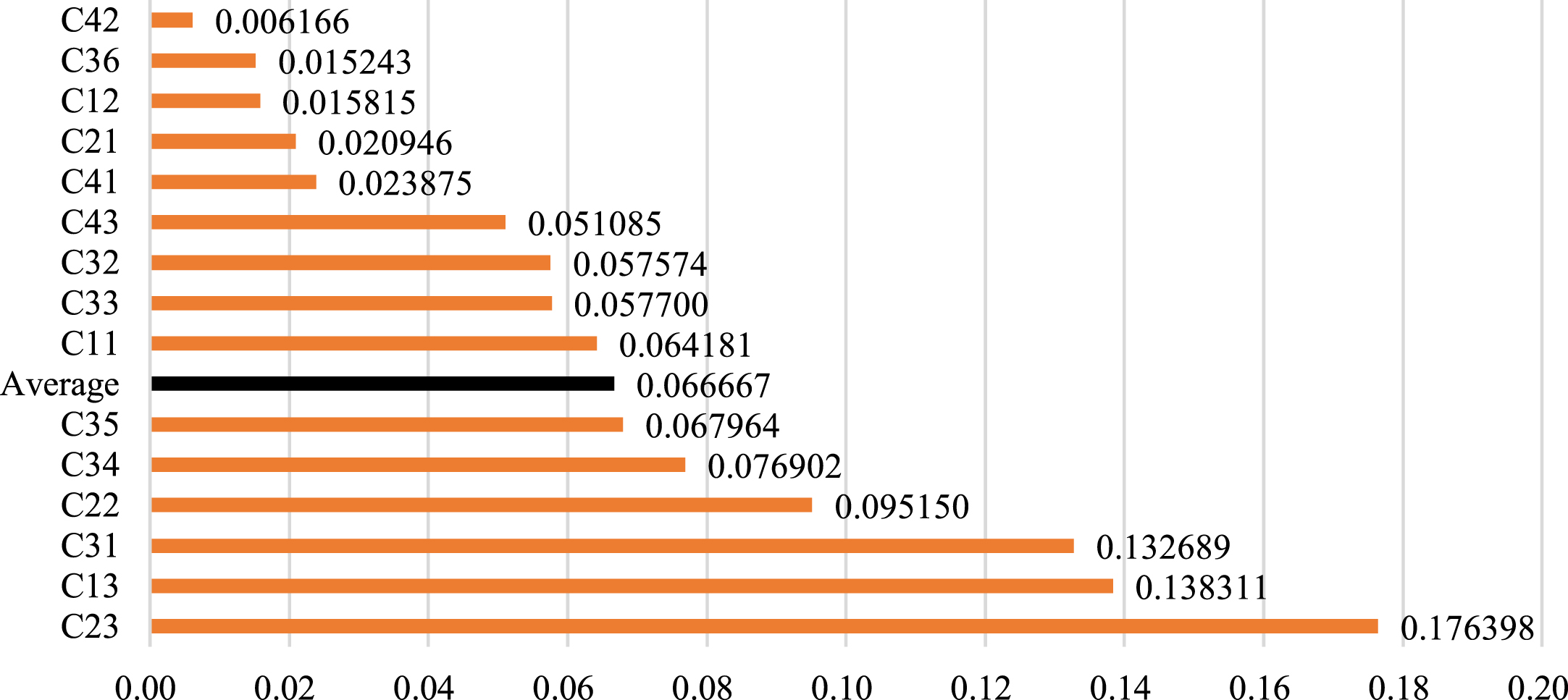
Ranking of indicator weights.
Indicator combination weights
Applying the methodological techniques outlined in the section above, we were able to determine the weights and ranks of the critical factors. The amount of weight of each critical factor and the related ranking are plainly visible in Fig. 5, which displays the ranking of the weights of all secondary indicators. Technology is ranked above process, followed by organization, and then the environment in terms of the weight of the primary indicators, as shown in Table 26. The major challenges impeding the proper deployment of IoT are, understandably, its technical characteristics as it is digital technology. The effective deployment of IoT is also influenced by a number of other aspects, some of which are even more crucial. Without the support of the organization, it is impossible to adopt a technology successfully. In addition, the business must consider environmental factors as it implements the technology. The resulting weights for the secondary indicators are shown in Table 26 as the combined weights. According to Table 26, the main critical factor for the organizational element is a lack of resources, the biggest critical factor for the process element is a lack of talent, the biggest obstacle for the technical element is integration complexity, and the biggest obstacle for the environmental element is equipment power consumption. Figure 5 displays the weighted average of all secondary indicators. Indicator weights above the average were taken into consideration as significant influencing variables for a successful IoT deployment after the average of the secondary indicator weights was first computed based on the size of the weights. It is evident from Fig. 5 that the critical factors that are above the average are: the availability of talent (C23), resource limitations (C13), the complexity of integration (C31), technical operations (C22), device power consumption (C43), technical reliability (C34), and data governance (C35).
Comparison of aggregation operator
The traditional aggregation operators are mainly the ordered weighted operator (OWA), the central ordered weighted operator (COWA), the Pythagorean fuzzy weighted operator (PFWA), etc.
In this paper, the weighted power harmonic operator is proposed. In this study the usage of the weighted harmonic operator can properly account for both the relative size connection between attribute values and the correlation between components, eliminating the issue of inappropriate weights that may arise in conventional algorithms. Most notably, the power process makes it possible to change the values of many qualities and lessens the impact of extreme values on the outcomes. The OWA, COWA, and PFWA operators are compared to the weighted power harmonic operator in Fig. 6. According to the Fig. 6, the weighted power harmonic operator is more consistent than the other operators, reducing information loss and enhancing the conclusion’s precision. This indicates that the weighted power summation operator has a significant advantage over other operators in the agglomeration process.

Aggregation operator consistency comparison.
The major techniques used in the current study to determine the index weights are analysis hierarchical process(AHP), best worst method (BWM), hierarchical weighting approach (LBWA), entropy weight method (EWM) and critical method (CM). This research compares four methods: the analytical hierarchical process (AHP), the level based weight assessment (LBWA), the entropy weight method (EWM) and the critical method (CM), etc. The most popular approach for analyzing and ranking complicated decision issues using several criteria is the analytical hierarchical process (AHP). However, it is necessary to compare each of the factors in the hierarchical analysis technique twice. This takes a lot of time, increasing the effort while decreasing consistency. The level-based weight assessment (LBWA) approach incorporates hierarchical analysis in determining the appropriate hierarchy, defining criteria, and assigning weights at different levels can be challenging and time-consuming. Decision makers may lack the necessary expertise or information to accurately assess the relative importance of different criteria. Inaccurate weight assignments can undermine the validity of the decision results. The entropy weighting method is very dependent on the input data. If the input data is biased, incomplete, or inconsistent, it may lead to inaccurate entropy values and thus unreliable weight assignments. The entropy weight method (EWM) also does not explicitly consider the subjective preferences or judgments of decision makers, and may not reflect all preferences of decision makers. The critical method (CM) is an objective weighting method based on data volatility, which completely uses objective attributes of data for evaluation, and does not explicitly consider the subjective preferences or judgments of decision makers, and may not reflect all preferences of decision makers. As a result of the above, the model shown in Table 29 is put up in this article.
Comparison of research methods
Comparison of research methods
*The method applied in this research is Model 2.
The similarity coefficients of the rankings allow to compare how different is the order of variants in both compared rankings. It is important to choose such coefficients that work well in the decision-making field. The paper uses three such coefficients, i.e., Spearman correlation coefficient, Spearman weighted correlation coefficient and WS similarity coefficients. The simplest way is to check whether the rankings are equal. The much more common way is to use one of the coefficients of the dependence for two variables, where the obtained rankings for a set of alternatives are our variables [21].
The most frequently used symmetrical coefficient is the Spearman’s coefficient. The weighted rank measure of correlation rw is also symmetric coefficient. WS coefficient is a new ranking similarity factor, which is sensitive to significant changes in the ranking. This new indicator is strongly related to the difference between two rankings on particular positions. The ranking top has a more significant influence on similarity than the bottom of the ranking.

Comparison of different methods for sorting results.
Sort consistency test
The ranking results of the five comparison models are essentially consistent, as shown in Fig. 7, demonstrating that the various research methodologies produce reliable findings. In Table 30, three correlation indicators for ranking consistency are also generated. The findings indicate that all three correlation indicators are larger than 0.95 when compared across various research methodologies. This shows that the ranking outcomes of the comparison models and those of the proposed model are quite consistent with one another, demonstrating the model’s high resilience and the validity of the ranking outcomes.
Conclusion
An enterprise will see significant effects and gains from a successful IoT adoption. Through research, this study pinpoints the crucial factors that prevent the application of IoT in manufacturing businesses. The following factors can be taken into account by manufacturing organizations that wish to successfully use the Internet of Things. Pay close attention to the high degree of technical talent. In the era of big data, the deployment of the Internet of Things requires a high level of technical employees, as high technical level personnel are to enhance the technical operation of the guarantee [12, 16]. The adoption of the Internet of Things is intended to improve the accuracy and dependability of decision-making by obtaining information and data through the correlation of internal and external devices in the company. However, the high degree of ability required for the Internet of Things cannot be isolated from any component of it, and certain devices even require crossover talent, thus the value of talent cannot be overstated. Appropriate resource allocation. Resources are a crucial element that cannot be overlooked while deploying the Internet of Things in businesses [14, 58]. However, because the firm only has a limited amount of resources, investing in a technology or project would necessarily limit the growth of other businesses within the enterprise. Enterprise managers should thus consider the topic of how to allocate the available resources. Adequate resources can ensure the smooth development of enterprise IoT technology and avoid the failure of IoT technology due to the lack of resources. Enhance the ability of their own integration. The Internet of Things is being implemented in businesses in an effort to connect internal and external devices and transport information and data securely, quickly, and in real-time [16]. This will enable company managers to make better, more informed decisions. However, there will inevitably be discrepancies in the protocols and techniques utilized to transport data between devices as well as in the way these devices are connected to one another. Another critical factor to the successful implementation of IoT in businesses is how to more efficiently connect these devices and the data transmitted between them [13, 52]. Successful integration of various devices and the information exchanged between them can lower corporate construction and operating expenses as well as device power consumption. In addition to minimizing information distortion, the reliability of IoT technologies can be enhanced.
Management implications, prospects, and weaknesses
Companies aspire to successfully adopt the Internet of Things (IoT) in order to enhance corporate operations and decision-making, simplify the acquisition of new capabilities through IoT, provide practitioners with fresh perspectives on value proposition and development, and help them build stronger customer connections. In this research, 15 implementation hurdles for the Internet of Things are discovered by literature review, a systematic literature review approach, and the Delphi method. The selected implementation critical factors are then examined using a PFN-weighted power harmonic operator-BWM framework. By categorizing the most important critical factors based on the size of the factor weights, the study methodology indicated the weight of the critical factors to effective IoT adoption. According to the report, businesses should concentrate on the following areas: talent availability, resource limitations, integration complexity, technology operations, device power consumption, technology dependability, and data governance. Enterprise IoT deployment needs the strong backing of enterprise resources as well as a big number of expert skills to function. Enterprise integration capabilities must be immediately improved due to difficulties like the method by which devices are connected through IoT. Enterprise internal and external devices are connected through IoT, and the information and data transmission protocols and formats across devices differ. At this stage, the outcome of business integration will decide the dependability of IoT technology, how much power devices use, and how well they can control data.
This study offers a longer list of potential critical factors along with reasons for each one. The many aspects and their significance to the successful adoption of IoT may be easily understood by company managers with the aid of this list. The conclusions of this article are based on both quantitative and qualitative data, both of which are critical for the effective deployment of IoT in businesses and the many changes that take place during the implementation process. The PFN-BWM research approach that is suggested in this work also expands on the research techniques already in use. The introduction of the weighted power reconciliation operator in data aggregation corrects earlier aggregation operators’ flaws and increases the scientific rigor of the aggregated data. This operator completely examines the effect of support degree and weight between data. This study has several drawbacks to other studies. Due to the complexity of the decision environment and the decision makers own limited expertise, the decision information offered by decision makers in group decision issues may be incomplete. Moreover, in order to secure the dependability of decisions, it is required to first gain group agreement on decision makers’ decisions in order to assure the non-randomness and logic of decision makers and to acquire decision outcomes agreed by the majority of decision makers. In the process of solving group decision issues, individual consistency control is taken into account.
Therefore, in future research, we can use consensus algorithms to obtain agreement among decision-makers, such the iterative consensus reaching method suggested by academics [62]. Additionally, a minimum adjustment perspective may be used to eliminate disagreements among decision-makers and enhance the reliability of outcomes when deciding the significance and ranking of indicators [63].
Footnotes
Acknowledgments
The authors are most grateful to the referees and the editors for their constructive suggestions. The work was partly supported by the National Natural Science Foundation of China (No. 71971190) and Postgraduate Research & Practice Innovation Program of Jiangsu Province (No. 1641).