



Abstract
An enhancing sparrow optimization algorithm with hybrid multi-strategy (EGLTA-SSA) is proposed, to improve the defects of the sparrow search algorithm (SSA), which is easy to fall into local optimum. Firstly, the elite backward learning strategy is introduced to initialize the sparrow population, to generate high-quality initial solutions. Secondly, the leader position is updated by fusing multi-strategy mechanisms. On one hand, the high distributivity of arithmetic optimization algorithm operators are used to deflate the target position, and enhance the ability of SSA to jump out of the local optimum. On the other hand, the leader position is perturbed by adopting the golden levy flight method and the t-distribution perturbation strategy to improve the shortcoming of SSA in the late iteration when the population diversity decreases. Further, a probability factor is added for random selection to achieve more effective communication among leaders. Finally, to verify the effectiveness of EGLTA-SSA, CEC2005 and CEC2019 functions are tested and compared with state-of-the-art algorithms, and the experimental results show that EGLTA-SSA has a better performance in terms of convergence rate and stability. EGLTA-SSA is also successfully applied to three practical engineering problems, and the results demonstrate the superior performance of EGLTA-SSA in solving project optimization problems.
Keywords
Introduction
A metaheuristic algorithm is an algorithm that performs global optimization search in the solution space by simulating the behavior patterns of things or organisms in nature. Due to its simplicity, flexibility, and efficiency, as well as its ability to possess a gradient-free mechanism and a high degree of local optimum avoidance, it has been widely used in engineering fields in recent years, such as vehicle path planning [1], data classification [2], anomaly detection [3], robot parameter tuning [4], and engineering cost control [5]. As the optimization effectiveness of swarm intelligence algorithms is approved by the people, population intelligence algorithms continue to develop, and increasingly new swarm intelligence algorithms are proposed, such as aptenodytes forsteri optimization algorithm (AFO) [6], multi-verse optimizer (MVO) [7], black widow optimization algorithm (BWOA) [8], whale optimization algorithm (WOA) [9], serpentine optimization algorithm (SO) [10], wild horse optimization algorithm (WHO) [11], harris hawk optimization algorithm (HHO) [12], and slime mould algorithm (SMA) [13].
The sparrow optimization algorithm (SSA) [14] is a novel algorithm proposed by Jiankai Xue and Bo Shen in 2020. The algorithm simulates the foraging and anti-predation behaviors of sparrows in nature. Compared with other metaheuristic algorithms, it has the advantages of simple structure, few parameters and easy implementation. The SSA has been successfully applied to practical engineering problems, such as infinite sensor network optimization [15], workshop scheduling optimization [16], image classification [17], logistics siting [18], and UAV flight path planning [19]. The good performance of SSA in engineering field shows that the algorithm has a broad prospect of engineering applications. However, according to the “no free lunch” theorem, no single algorithm can be applied to solve all optimization problems, and SSA is no exception, which has the disadvantages of decreasing population diversity, falling into local optimality, and having randomized results when solving optimization problems.
In response to the shortcomings of SSA, scholars have worked on designing enhancement strategies to improve SSA. Yang et al. [20] incorporated the game predatory mechanism and suicide mechanism based on the original SSA to improve the performance of the algorithm. Ouyang et al. [21] introduced the reverse learning mechanism in the leaders updating stage, which made leaders search more extensive. Then, it was introduced the variable spiral search method to update followers’ position, which made followers search more minute and agile. Finally, the simulated annealing method was combined to find the global optimal solution. In [22], the authors introduced an adaptive learning factor and proposed the adaptive sparrow search algorithm (ASSA) for solving the optimization and identification of the proton exchange membrane fuel cell (PEMFC) superposition parameters. Wang et al. [23] used the infinite folding iterative chaotic mapping method to initialize the population, which enriched the diversity of the population. Then, it used the lenticular imaging learning method to update the leaders’ location, and introduced the reverse learning strategy into followers’ location update, as well as the crossover strategy to update scouts’ location to balance the ability of individuals to explore and exploit. In [24], the authors proposed an improved sparrow search algorithm based on iterative local search (ISSA) to solve the path planning problem in 3D complex terrain. The main idea of the ISSA is to introduce variable spiral factors into the global search phase of the followers, besides, in the local search stage, it used the lens imaging learning method to update the followers’ position and improve the search accuracy of the individuals. In [25], the authors proposed the chaotic sparrow search algorithm and applied it to solve stochastic network configuration (SCN) problems, by combining adaptive control factors, which can automatically update the regularization parameters of SCN, and improve the performance of SCN in solving large-scale stochastic configuration problems. In [26], the authors improved SSA by fusing the neighborhood search strategies. In [27], the authors combined artificial immune algorithm and sparrow search algorithm, proposed artificial immune algorithm-sparrow search algorithm (AIA-SSA), and combined it with support vector machine SVM to apply to network intrusion detection. The experimental results show that the prediction accuracy of AIA-SSA-SVM for various network attacks has been greatly improved.
In summary, the above improvement strategies have enhanced the performance of SSA to some extent. However, the improved SSA suffers from the same drawbacks as other metaheuristic algorithms, including poor initial solution quality, slow convergence, and a tendency to fall into local optimum when solving larger-scale function optimization problems. Because SSA populations are randomly initialized without rules, SSA usually suffers from randomness that prevents the initial populations from being properly allocated in the search space of the actual problem. This can lead to a decrease in population diversity and make the algorithm converge to a local optimal solution earlier. Since the individuals of SSA converge to the current optimal solution by jumping directly to the vicinity of the current optimal solution or their own position, rather than moving toward the target position. This makes the individuals in the population smaller in each dimension, while causing SSA to have difficulty in balancing global exploration and local exploitation, thus causing the problem of poor SSA search accuracy. When the sparrow individuals are approaching the safety area, it is easy to have the phenomenon of aggregation of sparrow individuals, and the information exchange ability between sparrow individuals is weak. This will lead to the weak local exploitation ability of SSA and fall into local optimum.
Therefore, in this study, an enhanced sparrow optimization algorithm with hybrid multi-strategy (EGLTA-SSA) is proposed to solve these problems. In the population initialization stage, the elite backward learning strategy is introduced to initialize the sparrow population, so that the individuals in the population traverse the entire search space more uniformly and enrich the diversity of the population. Considering that the leader position update is the core of the whole SSA algorithm, a multi-strategy mechanism is used to update the leader’s position. When the presence of predators is not detected in the sparrow population and the search can be performed toward the location with better adaptation. On the one hand, the advantageous features of SSA and arithmetic optimization algorithm (AOA) are fused, and the high distributivity of multiplication and division operators in AOA is used to achieve the leader position update and shrink the target position, to improve the ability of SSA to jump out of local optimum. On the other hand, the golden levy flight strategy (GL) is adopted to improve the leaders position update formula and solve the problem that SSA is getting smaller in each dimension in the late iteration to enhance the global search ability of the leader. And a probability factor is introduced to randomly select the two strategies for more effective communication between leaders. In this way, to improve the search accuracy and search speed of the algorithm. When the sparrow population realizes the danger and approaches to the safe area. On the one hand, the high distributivity of the additive and subtractive operators in AOA is used to implement leader position updates, to improve the local development of leaders. On the other hand, the t-distribution perturbation strategy is introduced to perturb the leaders’ position, to improve the deficiency of the algorithm in the late iteration when the population diversity decreases and to enhance the ability of the algorithm to jump out of the local optimum. The probability factor is still used to randomly select the two strategies to enhance the information interaction among individual sparrows, so as to avoid the algorithm from converging to the local optimum solution prematurely.
The main contributions of this paper are as follows: An improved sparrow generation mechanism based on the elite backward learning method is developed to generate high quality populations while enriching population diversity. A multi-strategy fusion mechanism is designed to update the leader positions in sparrow populations. The mechanism incorporates the arithmetic optimization operator, the golden levy flight and the t-distribution perturbation strategy, with a probability factor for random selection, to overcome the limitations of individual sparrows themselves, when performing position updates, and to enhance the information exchange among individual sparrows more effectively, so as to avoid premature convergence of the algorithm to a local optimal solution. EGLTA-SSA is applied to solve twenty-three unimodal and multimodal function optimization problems, ten advanced benchmark functions, and three real-world engineering optimization problems, including the welded beam design problem, the pressure vessel problem, and the butterfly spring problem. The proposed method has better optimization accuracy, solution stability, convergence rate, and computational cost compared to state-of-the-art methods.
The rest of this paper is arranged as following. In section 2, the basic SSA is introduced in brief. Section 3 describes EGLTA-SSA in detail. Section 4 presents the experimental results of applying the EGLTA-SSA to CEC2005 and CEC2019 benchmark functions, and compared with the results of other methods. Section 5 demonstrates the performance of the EGLTA-SSA for solving engineering application problems. Finally, section 6 discussed the conclusion and the future research direction.
The conventional SSA
The SSA is a novel swarm intelligence optimization algorithm by imitating the foraging and anti-predatory behaviors of sparrows in nature. The SSA consists of three types of sparrows, which are the leaders, the followers and the scouts. The leaders are responsible for providing the foraging area and direction. And other sparrows act as followers. Meanwhile, a certain percentage of sparrows will be scouted for early warning during the following process, and if a predator is found, an alarm signal will be issued and the overall sparrows will make anti-predatory behavior.
The position update definition of the leader can be defined as follows:
Where α ∈ (0, 1] is a random number, Q obeys the normal distribution and is a random number, D is a matrix, l is the current number of iterations, M is the largest number of iterations, R2 ∈ [0, 1] is a warning value, and ST ∈ [0.5, 1] is a safe value. When R2 < ST, it means that the scouts have not found a predator and the leaders can conduct a global search. When R2 ⩾ ST, the scouts have found a danger and all sparrows are approaching the safe area.
The position update formula of the follower is shown below:
Where N is the size of the population, x
b
(l + 1) is the best position of the leader at the l + 1th iteration, and x
w
(l) is the worst position of the leader at the lth iteration. A is a vector of the same dimension as the individual sparrow, which is a matrix of 1 × d. And A* = A
T
(AA
T
) -1 is the internal elements are composed of 1 and –1. When
The position update definition of the scout is as follows:
The elite opposition-based learning mechanism
A good population initialization strategy allows individuals in the population to traverse the entire search space more uniformly, enriching population diversity. In the initialization population stage, SSA is usually disturbed by randomness and the phenomenon of sparrow individual aggregation. In this paper, the Elite opposition-based learning strategy (EOBL) [28] is introduced to initialize the sparrow population, so as to enhance the traversal ability of the algorithm on the solution space.
The opposition-based learning (OBL) [29] was proposed by Tizhoosh in 2005, which argues that the reverse solution is closer to the global optimum than the current solution. Therefore, the reverse solution can be found for the current feasible solution of the problem. Then, it ranks the original and inverse solutions and select the better of them as the new generation of individuals. This method can effectively avoid entering the premature state. It can define as follows:
The reverse solution: Suppose that x = (x1, x2, ⋯ , x
d
) , x
j
∈ [a
j
, b
j
] is a feasible solution for the current population on the D-dimensional space. Then its inverse solution can be expressed as:
The elite opposition-based learning (EOBL) [28] mainly relies on the feature that elite individuals contain more valid information than average individuals. It selects the elite individuals in the current population and constructs the reverse population to enrich the diversity of the population. And from the new population formed by the current population and the reverse population, the best individuals are selected as the next generation of individuals to enter the next iteration. It is defined as follows:
The elite reverse solution: Assuming that
Where γ ∈ [0, 1],
In this paper, we use the EOBL strategy to enrich the population diversity. The population selection mechanism is used to rank the current sparrow population and its inverse population according to their fitness values, from which the best s individuals are selected as the next generation of sparrow individuals to improve the quality of the population. Firstly, for the initialized population, the introduction of the EOBL strategy can enhance its diversity and lay the foundation for a better global search. Secondly, for each generation of populations, the EOBL strategy can enhance the algorithm’s global search capability by generating reverse solutions far from the local extrema, thus guiding the algorithm to jump out of the local optimum. Besides, the tracing search mode with dynamic boundaries it adopts can obtain a progressively smaller search space, which is beneficial to speed up the global convergence.
At the early stage of SSA search, the leader rapidly aggregates to the position of the global optimum, which leads to the decrease of population diversity and makes the algorithm converge to the local optimum solution earlier, thus causing the problem of poor SSA search accuracy. Therefore, we integrate arithmetic optimization operator, golden Lévy flight and t-distribution perturbation strategy in the leader’s position update formula to construct a strategy pool, and adds a probability factor P for random selection to more effectively achieve the ability to exchange position information of individual sparrows, thus avoiding the algorithm to converge on the local optimal solution prematurely.
The arithmetic optimization method
Arithmetic optimization algorithm (AOA) [30], proposed by Abualigah et al. in 2021, is a novel group intelligence algorithm for finding optimal solutions based on the distributional properties of arithmetic operators. Among them, the division operator (D) and the multiplication operator (M) calculate more decentralized results. This ensures that the search area is fully explored in the early stage of the search, thus effectively avoiding falling into local optimum. The addition operator (A) and subtraction operator (S) yield more focused results. This can ensure deeper exploration and exploitation of several dense regions in the later stages of the search to enhance the ability of local search.
The AOA are generally divided into two stages, the exploration phase and the exploitation phase. In the exploration stage, the arithmetic operations of M and D are used to guide the exploration of the search space. The position update formula for the exploration stage of AOA is as follows:
To diversify the solutions, a random parameter, the math optimizer probability (MOP), is introduced into the formula. It is calculated as follows:
The AOA is based on the addition operator (A) and subtraction operator (S) for local exploitation. The position update formula for the exploitation stage of AOA is as follows:
The golden levy flight strategy (GL) is actually a hybrid method of the golden sine algorithm [31] and the levy flight strategy [32].
The golden sine algorithm, proposed by Tanyildiz et al. in 2017, which is inspired by the sine function and takes the golden partition coefficients to make the population search in a more optimal search range, which can effectively accelerate the convergence of the algorithm. Denote the two golden partition coefficients in the golden sine algorithm by ϖ1 and ϖ2, respectively, then its mathematical definition is as follows:
where τ is the golden ratio, which is an irrational number with value
Subsequently, the levy flight strategy is introduced to balance the ability of the algorithm for global search and local exploration. Levy flight is a random tour whose step size obeys the levy distribution, which can search randomly in a small area with a large probability and generate a longer period of flight with a small probability, thus enhancing the global search ability of individuals in the population. However, in general, it is difficult to generate a random number that obeys the levy distribution. Therefore, the Mantegna algorithm proposed by Yang [32] is used to represent the levy flight step s, which is calculated as follows:
Where
The t-distribution is also known as the student distribution, the Corsi and Gaussian distributions are the two bounds of the t-distribution. t (n → ∞) → N (0, 1) , t (n = 1) = c (0, 1), where N (0, 1) is the Gaussian distribution and c (0, 1) is the Cauchy distribution. Lan [33] et al. argue that the Cauchy variation can enhance the global search ability of the algorithm, while the Gaussian variation can accelerate the convergence of the algorithm. Figure 1 below shows the probability density plots for the t-distribution, Gaussian distribution and the Corsi distribution.
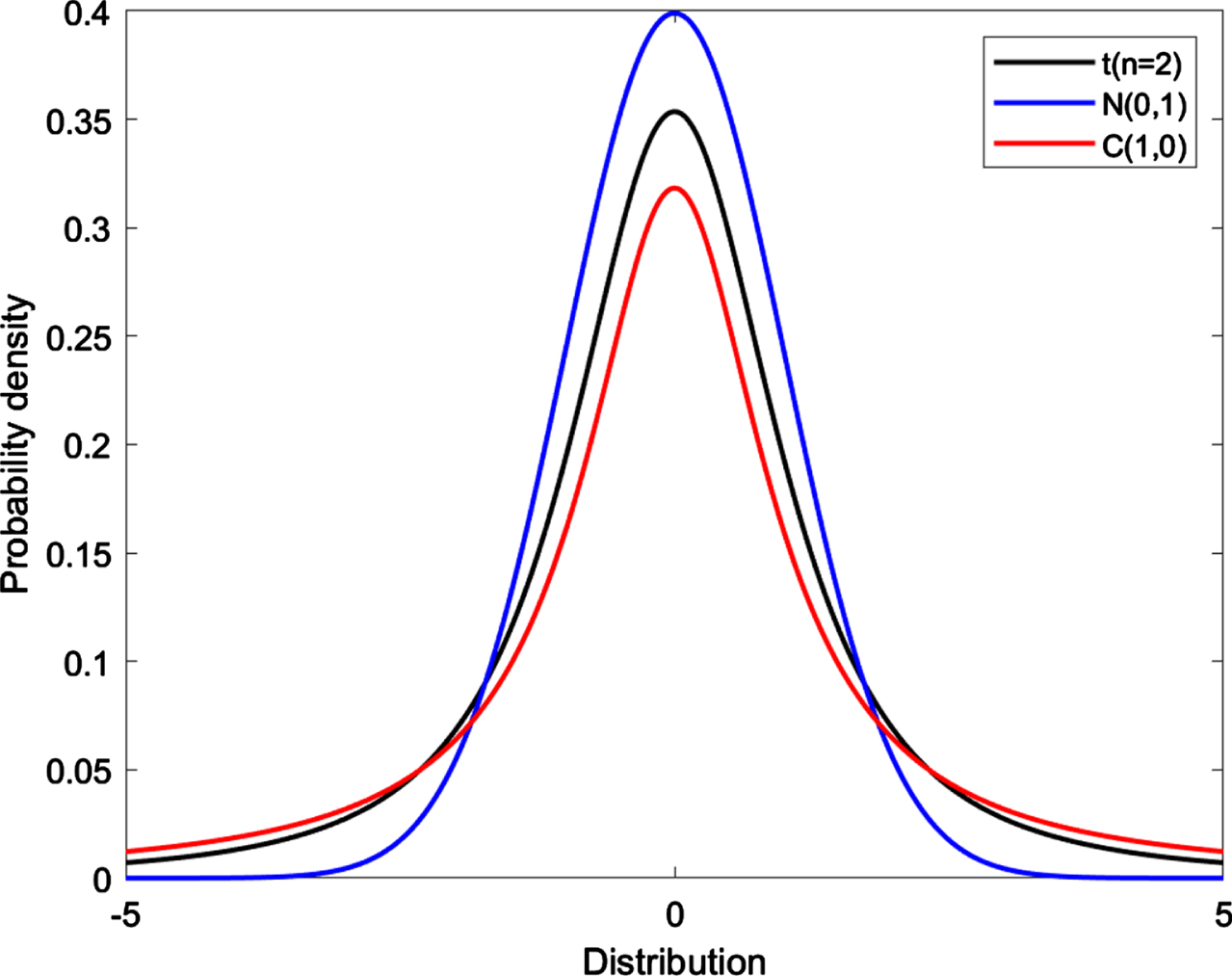
Probability density diagram of t-distribution, Gaussian distribution and Cauchy distribution.
As can be seen in Fig. 1, in the early stage of algorithm optimization, the number of iterations is relatively small, when the t-distribution is closer to the Cauchy distribution and the step size of the position transformation is long, which can well guide the individuals in the population for global exploration. In the middle stage of the algorithm, considering that exploration and exploitation are equally important in this stage, the t-distribution is between the Cauchy distribution and Gaussian distribution, and the step size of the mutation is relatively compromised, which can positively promote the performance of the algorithm. In the later stage of the algorithm’s optimization search, the t-distribution is closer to the Gaussian distribution at this time, and the step size of the location transformation is smaller, which can well guide the local exploitation of individuals in the population.
According to the strategy introduced earlier, the following fusion mechanism is designed in this paper:
When R2 < ST, the sparrow population does not detect the presence of predators and can search towards a better adapted position. However, at this time, each dimension of the leader in the population is becoming smaller, leading to a decrease in population diversity. In addition, because the individuals of SSA converge to the current optimal solution by jumping directly to the current optimal solution or near their own position, rather than moving toward the target position, resulting in the weak global search capability of SSA. Therefore, on the one hand, we fuse the advantageous features of SSA and AOA, use the high distributivity of multiplicative and divisive operators in AOA, to achieve leaders position update and deflate against the target position to improve the ability of SSA to jump out of the local optimum. On the other hand, the gold levy flight strategy is adopted to improve the leaders position update formula, to solve the problem that SSA is getting smaller in each dimension in the late iteration, in order to enhance the global search ability of the leader. A probability factor P is introduced to randomly select the two strategies for more effective communication between leaders. The leader position update equation incorporating the multiplication and division operator of AOA and the golden levy flight strategy is as follows:
When R2 ⩾ ST, the sparrow individual approaches to the safe area, at this time, the sparrow individual needs to be fully exploited in a small area. Therefore, on the one hand, we adopt the high distributivity of the additive and subtractive operators in AOA to achieve leader position update, in order to enhance the local exploitation ability of leader individuals. On the other hand, the t-distribution perturbation strategy is introduced to perturb the leader positions close to the origin as a way, to improve the algorithm’s optimization-seeking accuracy and speed. The probability factor P is still used to randomly select the two strategies, and the leader position update formulas that integrate the addition and subtraction operators of the AOA and the t-distribution perturbation strategy are as follows:
The multi-strategy fusion of the improved leader position update formula changes the operation of convergence of all individuals toward the origin to approaching their own position. This ensures that the leaders in the population adaptively select different target positions for convergence based on the individual fitness values. At the same time, different operators are also selected to achieve the operation of proximity according to the location merit of the sparrow, thus achieving adaptive step size. The above operations ensure the convergence of the algorithm without losing the population diversity.
For the Weakness of the SSA, an enhancing sparrow optimization algorithm with hybrid multi-strategy (EGLTA-SSA) is proposed. the pseudo-code of EGLTA-SSA is presented as follows, and its concrete implementation flow is shown in Fig. 2.

Flowchart of the proposed EGLTA-SSA.
As can be seen from the reference 14, the time complexity of the conventional SSA is O (M × N (D + f (D))). The computation steps of the time complexity of the EGLTA-SSA are as below.
Firstly, in the population initialization phase, the EOBL method is used to initialize the population, then its time complexity can be presented as O1 (N × D).
Secondly, for the leaders location update phase, S is the proportion of leaders, the time to generate r0, r′, r1, r2 as well as α is set to a1, where α is a random number, the time to compute levy (β) in each dimension is a2, and the time to generate t-distributed random parameters is noted as a3. Then, the theoretical time complexity of EGLTA-SSA leader location update is: O2 (s × N × (a1 + a2 + a3) + M × N × (D + f (D))), which can be transformed into: O2 (M × N × (D + f (D))).
Finally, the time complexity of the follower and scout position update phase, which is the same as the conventional SSA, is denoted as O3. In summary, the EGLTA-SSA’s time complexity can be shown as below:
In conclusion, it can be found that the time complexity of the EGLTA-SSA is the same as the conventional SSA, presenting that the EGLTA-SSA does not increase the time complexity of the SSA.
In this section, the performance of the proposed EGLTA-SSA is verified by the following two sets of experiments.
Experimental environment
The simulation test environment is Windows 10, the CPU is AMD Ryzen 5 5600U with Radeon Graphics, the main frequency is 2.30 GHz, the memory is 16.0GB, and the simulation software is MATLAB R2021a.
CEC2005 benchmark functions
Experimental setting
To evaluate the performance of the proposed EGLTA-SSA, this paper uses several CEC2005 test functions with different characteristics to examine its performance. The test functions and their specific information are shown in Table 1 below.
CEC2005 unimodal benchmark functions
CEC2005 unimodal benchmark functions
To further test the optimization effectiveness and stability of the EGLTA-SSA, this paper compares the EGLTA-SSA with several well-known algorithms. These comparison algorithms are as follows: Sparrow search algorithm (SSA) [14] Arithmetic optimization algorithm (AOA) [28] Multi-verse optimizer (MVO) [7] Whale optimization algorithm (WOA) [9] Slime mould algorithm (SMA) [13] Grey wolf optimizer (GWO) [34] Moth-flame optimization algorithm (MFO) [35] Harris hawks optimization (HHO) [12] Wild horse optimizer (WHO) [11]
For the parameter setting of the EGLTA-SSA, ST = 0.8, PD = 0.2, SD = 0.1, P = 0.5, MOA M ax = 0.9, MOA M in = 0.2, α = 5, μ = 0.499. In order to ensure the effectiveness of the comparison experiment, the population size of all methods is set to 100, and the maximum iteration number is set to 500, and all methods are tested independently for 30 times. In addition, The Wilcoxon sign rank analysis [36] and Friedman ranking test [37] are conducted on all the experimental subjects. The parameter settings of all comparison methods are presented in Table 2 below.
Parameters setting of the tested algorithms
In this section, the EGLTA-SSA is compared with several well-known algorithms, including SSA, AOA, MVO, WOA, SMA, GWO, MFO, HHO and WHO. The solution outcomes got by the algorithms are presented in Tables 3, 7. The worst, average, best, standard deviation, p value and h of the optimal solution of each algorithm are given.
The solution results of the CEC2005 functions (F1–F13), where dim = 10
The solution results of the CEC2005 functions (F1–F13), where dim = 10
The solution results of the CEC2005 functions (F1–F13), where dim = 10
The solution results of the CEC2005 functions (F14–F23)
For the benchmark test functions with thirteen non-fixed dimensions, this paper sets dim = 10 and dim = 100 respectively to better test the performance of the EGLTA-SSA. Table 3 presents the results of the simulation experiments obtained with a fixed dimension size of 10. In Table 3, for functions F5, F6, and F13, the solution results and stability performance of EGLTA-SSA are significantly better than other algorithms, indicating that the fusion mechanism of multiple strategies effectively enhances the global search and local exploitation capabilities of the algorithm. For functions F7 and F12, EGLTA-SSA has the best search performance among all algorithms, except for the slightly worse solution results for F7 than AOA and the inferior search performance for F12 than WHO, which further reflects the good search performance of EGLTA-SSA. For functions F1 to F4, the optimization effects of EGLTA-SSA, SSA and AOA are not very different, and they can basically find the theoretical optimal value of the function. For function F9, the optimization effects of EGLTA-SSA, SSA, AOA, WHO, and HHO are better, and all of them find the theoretical optimal value of the function. For functions F10 and F11, the optimization of EGLTA-SSA, SSA, AOA, and HHO also performed well, and they solved for better optimal values than the other algorithms. The results of the Wilcoxon rank sum test show that only 20 out of 117 h values are not 1, indicating that EGLTA-SSA significantly outperforms the other comparative algorithms in most cases. And its h-values are all 1 for the functions F5, F7, F8, and F13, indicating that EGLTA-SSA has better performance in finding the best compared with other comparison algorithms, and also more comprehensively demonstrates the effectiveness and robustness of the algorithm.
The results of the Wilcoxon rank sum test show that only 20 of the 117 h-values are not 1, indicating that EGLTA-SSA significantly outperforms the other comparison algorithms in most cases. And its h-values are 1 for the functions F5, F7, F8, and F13, indicating that EGLTA-SSA has better performance in finding the best performance compared with other comparison algorithms. This also shows more comprehensively the effectiveness and robustness of the algorithm.
To comprehensively assess the competitiveness of EGLTA-SSA in comparison with other algorithms, the Friedman ranking test is used to rank the above algorithms. Table 4 and Fig. 3 show the ranking results based on 13 benchmark measurement functions (F1–F13) for all comparative algorithms at dimension size 10. From Table 4 and Fig. 3, it can be seen that the EGLTA-SSA has achieved good results, it won the first, followed by SSA, HHO, AOA, GWO, WOA, SMA, MFO, MVO. The ranking results indicate that the EGLTA-SSA is more effective in solving the optimization problem compared to its comparative algorithms.
The ranking results of algorithms using CEC2005 functions (F1–F13) with dim = 10

The ranking results of algorithms using CEC2005 functions (F1–F13) with dim = 10.
As the search dimension of the test function increases, the difficulty of solving the optimal value also increases. Therefore, we set the search dimension of the benchmark test function to 100 for 13 non-fixed dimensions to further test the performance of the EGLTA-SSA. The outcomes of the simulation experiments with dimension size set to 100 are given in Table 5 below.
From the experimental results in Table 5, EGLTA-SSA remains relatively stable in the high-dimensional case in terms of its search performance. It is still able to solve for the theoretical minimum values of F1, F2, F3, F4, F6, F9, and F11. In almost all testing problems, the performance of the proposed EGLTA-SSA is more reliable than all comparison algorithms. The outcomes indicate that in the early iteration, the introduced elite backward learning strategy generates high-quality initial solutions and enriches the diversity of the population. In the late iteration, the golden sine coefficients narrow the solution space and speed up the convergence of EGLTA-SSA. And the t-distribution strategy is constantly perturbing the leader positions to avoid the algorithm from falling into local optimum. This also indirectly prove the effectiveness and feasibility of EGLTA-SSA for solving complex problems in real life. In contrast, other comparative algorithms do not have stable performance in the high-dimensional case for finding the optimum value. For example, the accuracy of F12 obtained by WHO solving in high dimensions drops very significantly compared to lower dimensions. However, it can be seen that for F6 and F13, the performance of the original SSA is better than that of EGLTA-SSA, indicating that there is room for further optimization of EGLTA-SSA.
The results of the Wilcoxon rank sum test show that only 19 of the 117 h-values are not 1, indicating that the EGLTA-SSA algorithm significantly outperforms the other comparative algorithms in most cases. Compared with the original SSA, nearly half of the distribution of the test function results could not prove to be significantly different. The analysis shows that the EGLTA-SSA retains the advantages of dynamic weights and adaptive conversion probabilities of the original SSA algorithm as much as possible, so the distribution does not appear to be significantly different, but the same has a large improvement in the solution accuracy, which can prove that the improvement strategy has a significant impact on the improvement of the solution accuracy of the algorithm.
For the comparison of the methods in high dimensions, the Friedman ranking test is also used to rank the above methods. Table 6 and Fig. 3 show the ranking results based on 13 benchmark measurement functions (F1–F13) for all comparative algorithms at dimension size 100. From Table 6 and Fig. 4, it can be seen that compared with other algorithms, the proposed EGLTA-SSA can solve the optimization problem more effectively. The proposed EGLTA-SSA obtained commendable outcomes, and it won the first, followed by SSA, HHO, SMA and AOA, GWO, WOA, MVO. The ranking results manifest that the EGLTA-SSA still outperforms all other comparative methods in the high-dimensional case.
The ranking results of algorithms using CEC2005 functions (F1–F13) with dim = 10
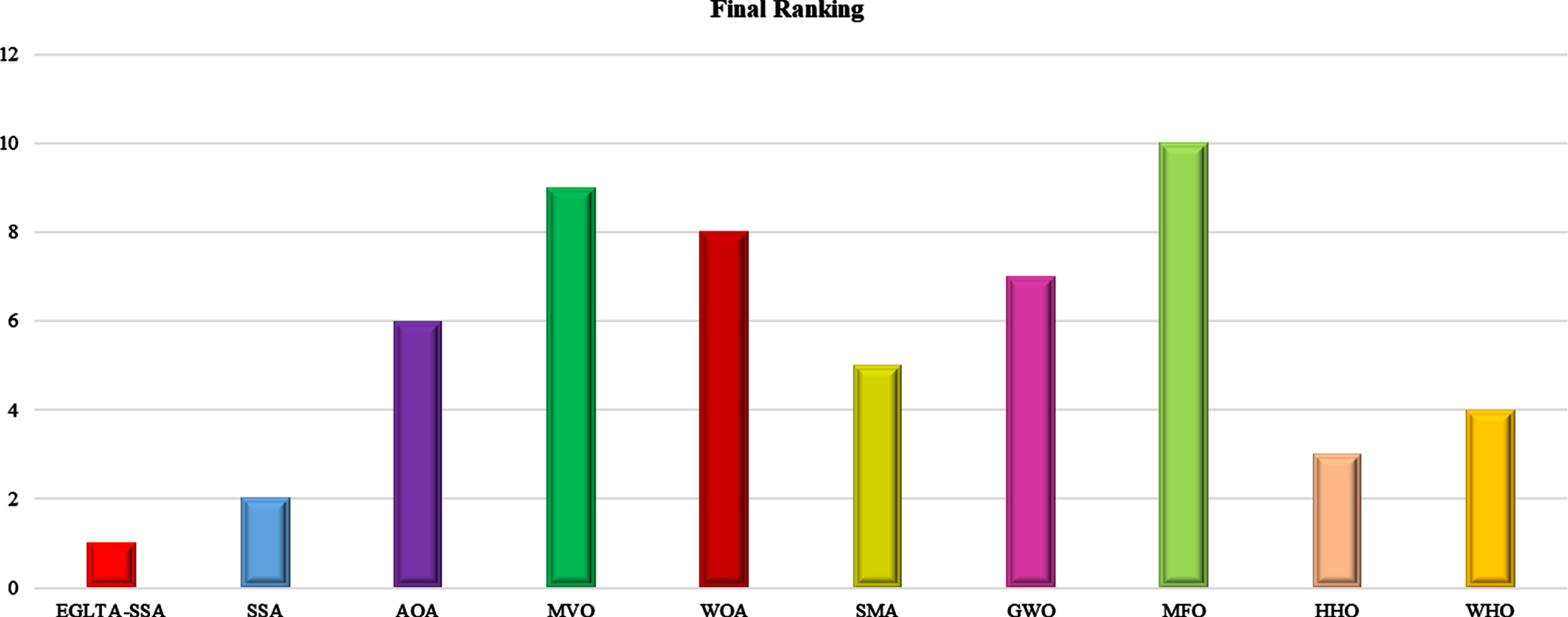
The ranking results of algorithms using CEC2005 functions (F1–F13) with dim = 10.
F14–F23 are the standard test functions with fixed dimensions. Table 7 presents the outcomes of the solutions of algorithms. From Table 7, we can see that the proposed EGLTA-SSA solves the theoretical optimal values on the test functions F15 to F23.And for functions F15 and F19 to F23, the average solution accuracy and stability of EGLTA-SSA perform better and more reliable compared to other comparative algorithms in almost all test cases. It indicates that the hybrid strategy improves the performance of EGLTA-SSA. As for functions F16 to F18, the optimization of each algorithm is excellent, and all algorithms can find the theoretical optimal value of the function except SMA. For function F14, MVO and WHO perform more excellent, while the accuracy of the average solution result of EGLTA-SSA is lower. It indicates that there is still room for further optimization of EGLTA-SSA.
From the Wilcoxon rank sum test results, 66 out of 90 h values were 1, indicating that EGLTA-SSA outperformed the other comparison algorithms in most cases.
Table 8 and Fig. 5 show the ranking test results of the comparison method using 10 test functions (F14–F23) with fixed dimensions. The proposed EGLTA-SSA obtained good ranking results, it ranked first, and followed by SSA, HHO, MFO, GWO, MVO, GWO, SMA, AOA. The ranking results indicate that compared with other comparison algorithms, the proposed EGLTA-SSA is more effective in solving the optimal value of the function.
The ranking results of algorithms using CEC2005 functions (F14–F23)
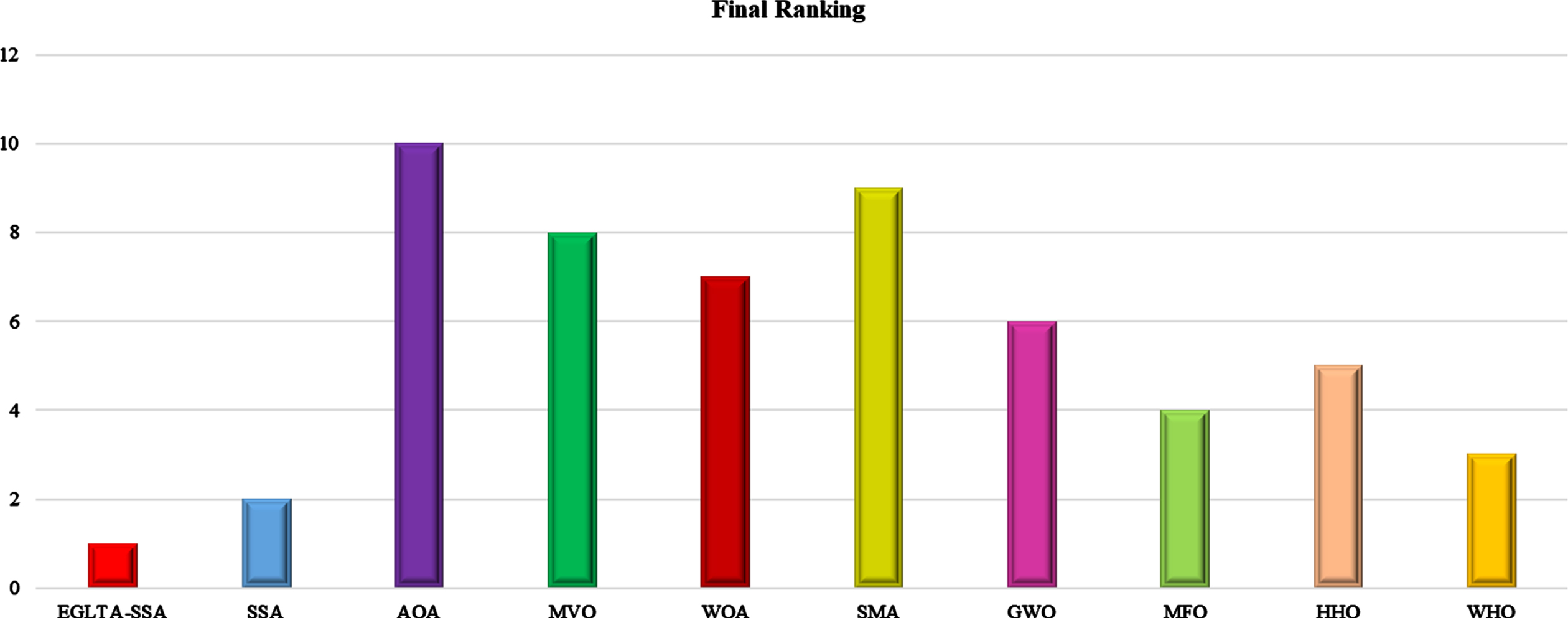
The ranking results of algorithms using CEC2005 functions (F14–F23).
In addition, in order to visualize the convergence and stability of the improved algorithm, we plot the convergence curves and the spatial morphology of each function of the EGLTA-SSA with the above comparison algorithm, as shown in Fig. 6. The legend of each algorithm curve remains consistent. In Fig. 6, It is observed that the EGLTA-SSA has the advantage of converging fast in the first period and maintaining a continuous search in the later period. This indicates that the inverse process and the arithmetic operator expand the search space in the first and middle stages, thus enabling the algorithm to find a better search direction quickly and accelerate the convergence. The arithmetic operator and the t-distribution perturbation method help the algorithm continue to refine in the late iterations and avoid the stagnation of the search. At the same time, the EGLTA-SSA has less variance between repeated calculations and more stability with guaranteed accuracy. This indicates that the features of reverse learning and arithmetic operator to expand the search space help keep the algorithm stable. Even if the reversal process enriches the diversity of the population and the golden Levy flight introduces new randomness, the combined algorithm still has better stability than the comparison algorithm thanks to the strategy of reverse reconstruction based on diversity. In conclusion, the EGLTA-SSA basically outperforms the other algorithms in terms of convergence speed and solution accuracy. This indicates that the EGLTA-SSA proposed in this paper not only helps to speed up the convergence of the algorithm, but also has a positive impact on preventing algorithm stagnation and enhancing algorithm stability.
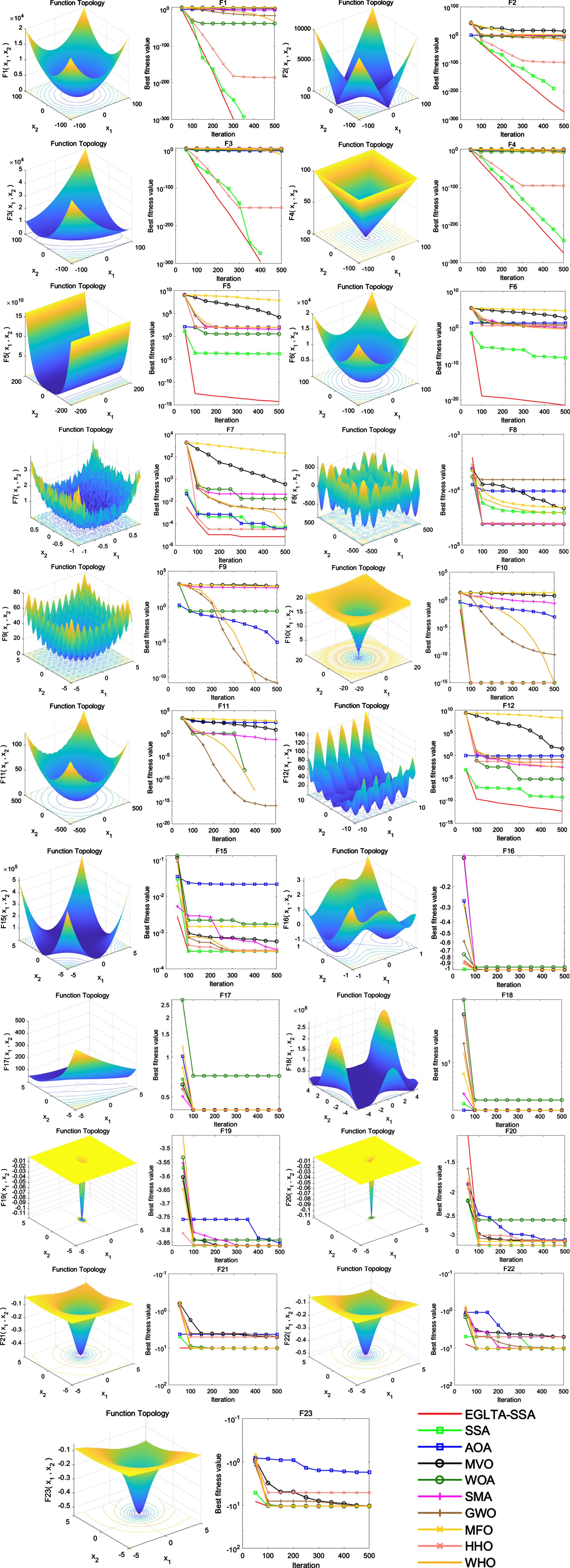
The convergence behavior of the comparative methods.
Experimental setting
In this experiment, the paper is further verified the performance of the EGLTA-SSA using the CEC2019 advanced benchmark test functions. The test functions and their specific information are shown in Table 9, which illustrate the optimal solutions, dimensions and search space of these 10 test functions.
CEC2019 benchmark functions
CEC2019 benchmark functions
To further verify the optimization effectiveness and stability of EGLTA-SSA, the paper compares EGLTA-SSA with some state-of-the-art algorithms, which are as follows: An elite reverse golden sine whale optimization algorithm (Egolden-SWOA) [38] A memetic particle swarm optimization algorithm (MPSO) [39] Autonomous particles groups for particle swarm optimization (TACPSO) [40] An enhanced marine predator algorithm (EMPA) [41] Success fail history based hybrid rungekutta optimizer and slime mould algorithm (SHFRUN-SMA) [42] Unscented sigma point guided quasi-opposite slime mould algorithm (UQSMA) [43] An improved sparrow algorithm based on game predatory mechanism and suicide mechanism (GPSSA) [20] Multistrategy-Integrated Learning Sparrow Search Algorithm (IHSSA) [23] An improved sparrow search algorithm based on iterative local search (ISSA) [24]
The parameter settings of each comparison algorithm were the same as the original literature. To ensure the scientific validity of the comparison experiments, the parameters of the above algorithms are set uniformly, M = 500, N = 100, and all comparison algorithms are tested independently for 30 times. Besides, Friedman ranking tests are conducted for all the objects.
In this experiment, the proposed EGLTA-SSA is compared with the state-of-the-art algorithms. Table 10 presents the average, the standard deviation, and Friedman ranking results for all comparison algorithms. Figure 7 shows the ranking results of the algorithms more visually. From the algorithm solution results, Among the 10 CEC2019 test functions, the optimization effects of each algorithm on func02 and func03 do not differ much, but it is also obvious that EGLTA-SSA and TACPSO outperform the stability performance of the other algorithms. For func01 and func07, although the optimal value obtained by EGLTA-SSA solution is not optimal, its stability performance is better than the other algorithms. For func04, func05, and func06, each algorithm shows different advantages. SHFRUN-SMA excels on func04 and func06, and TACPSO solves to the optimal value on func05 that is better than the other algorithms. For func08, func09, and func10, although the optimal value of func08 obtained by TACPSO solving is better than that of EGLTA-SSA, its stability performance is not as good as that of EGLTA-SSA, and the average optimal solving results of EGLTA-SSA for func09 and func10 are better compared with those of other algorithms.
The solution results of the CEC2019 functions and algorithms ranking
The solution results of the CEC2019 functions and algorithms ranking
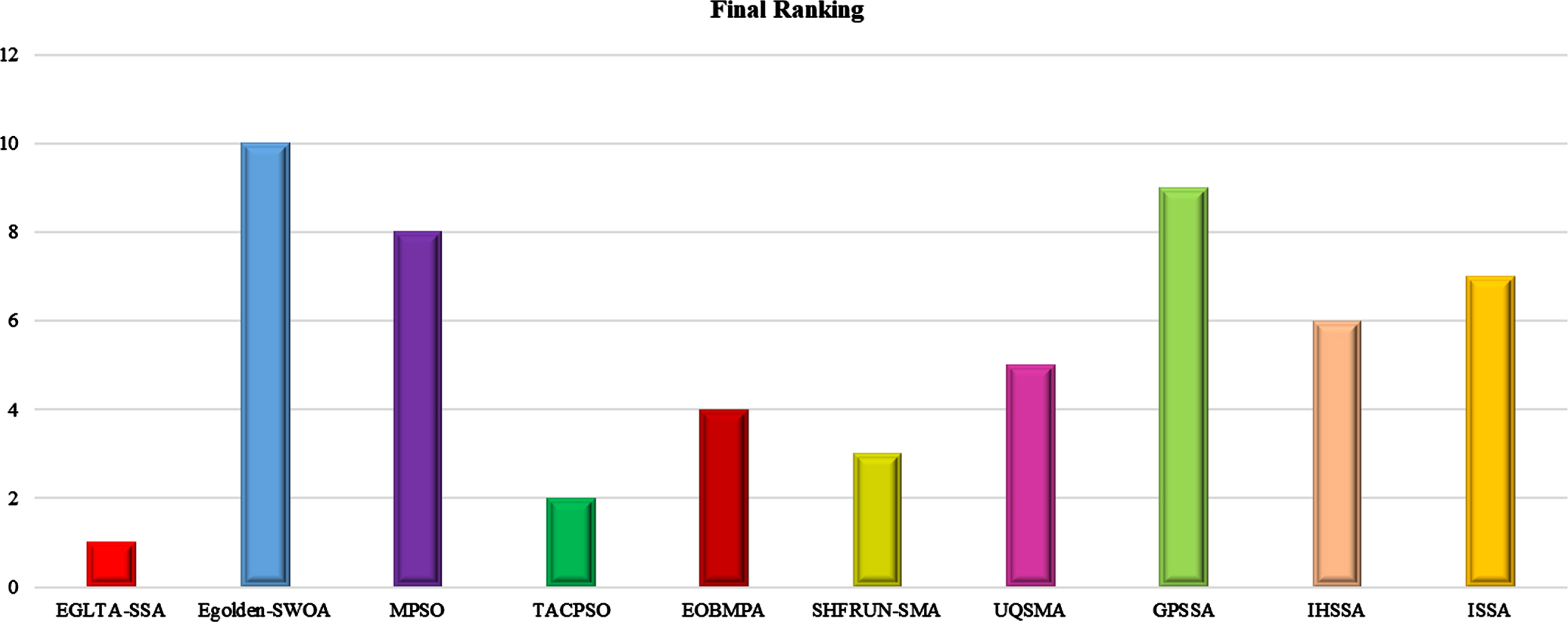
The ranking results of algorithms using CEC2019 functions.
From the final Friedman ranking results, EGLTA- SSA still ranks first among many improved algorithms, followed by TACPSO, SHFRUN-SMA, EOBMPA, UQSMA, IHSSA, ISSA, MPSO, GPSSA, and Egolden-SWOA. This indicates that EGLTA- SSA has a good performance in finding optimal value and is a promising intelligent algorithm. This also means that EGLTA-SSA can be used to solve complex engineering application problems, such as pressure vessel design problems. This is not only due to the fact that the elite backward learning strategy generates high-quality initial solutions at the beginning of the iteration, which enriches the diversity of the population and enhances the global search capability of EGLTA- SSA. It also shows that the fusion mechanism of multiple strategies enhances the ability of individual sparrows to communicate with each other, and keeps perturbing the sparrow positions in the late iteration to avoid the algorithm from falling into local optimum.
In addition, we made the distribution diagram of the fitness function values, as shown in Fig. 8. We can see that compared with other comparison algorithms, the EGLTA-SSA has the smallest optimal value, average value and median value in most cases, which indicates that EGLTA-SSA has superior performance and is the best solution.
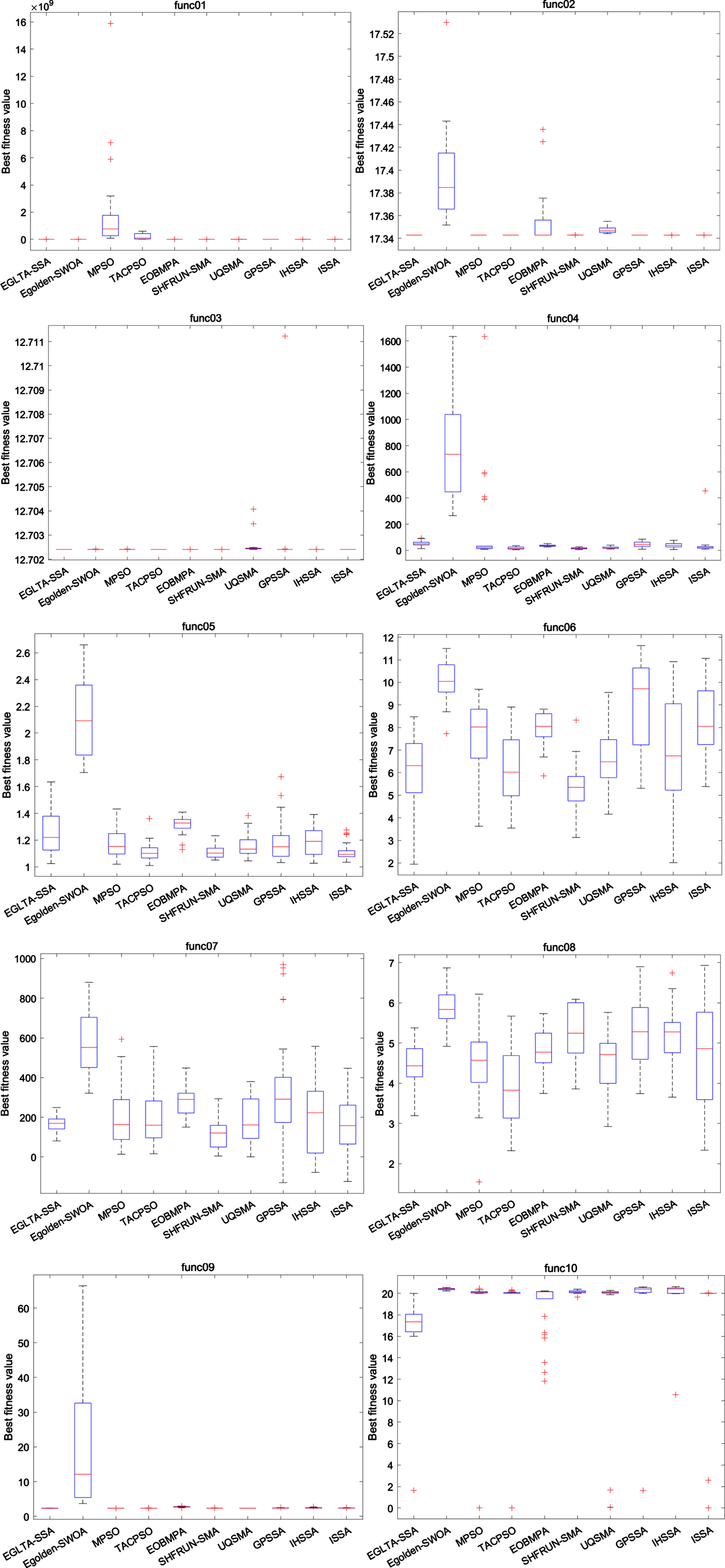
Boxplots of the fitness function values.
To verify the performance of EGLTA-SSA on solving engineering optimization problems, three famous engineering benchmark problems are selected for experiments. It is also compared with the current more advanced and classical optimization algorithms. The parameters of the above algorithms are set uniformly, M = 500, N = 100, and each method runs 30 times independently, and we select the best solution of each algorithm.
welded beam design problem
The welded beam design problem (WBDP) is a typical mathematical planning problem. It can be described as follows. Finding the optimal design variables h, l, t and b that minimize the cost of manufacturing the welded beam under constraints such as shear stress (τ), bending stress of the beam (σ), bending load on the rod (P c ), deflection of the beam end (δ) and boundary. The design diagram of the WBDP is shown in Fig. 9 below.
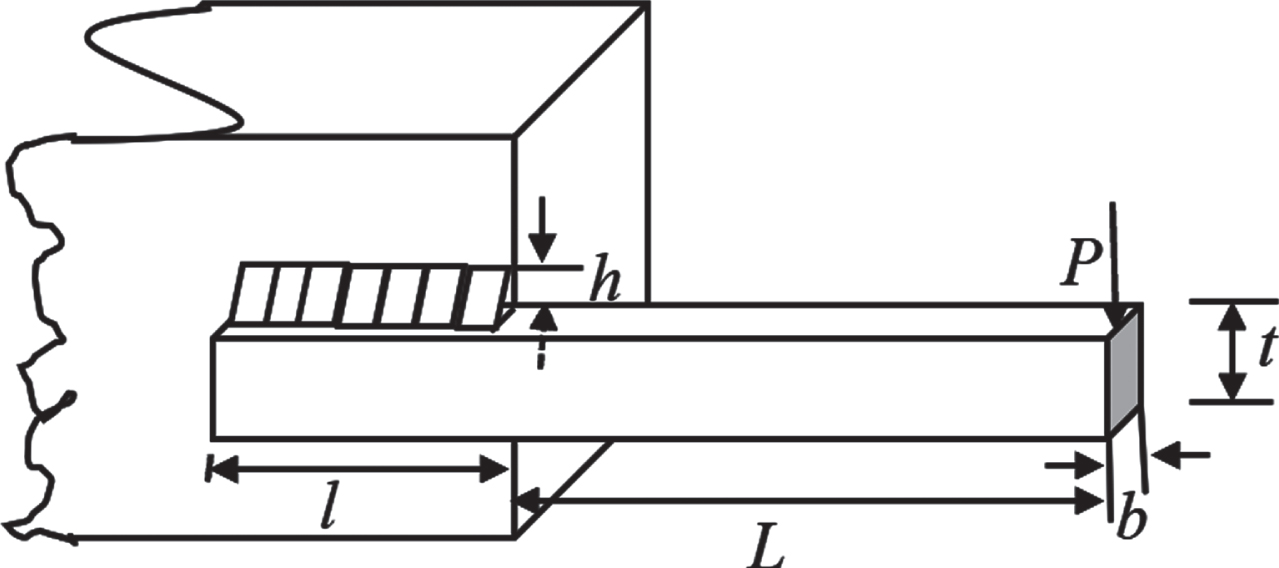
The design diagram of the WBDP
The mathematical model of the WBDP is as follows:
Consider A = [a1, a2, a3, a4] = [h, l, t, b],
Minimize
Variables range (0.1 ⩽ a1, a4 ⩽ 2) , (0 . 1 ⩽ a2, a3 ⩽ 10),
Where
Note that, P = 6000, L = 14, E = 30 × 106, G = 12 × 106, τmax = 13600, σmax = 30000, δmax = 0.25.
The proposed EGLTA-SSA is compared with the current advanced algorithms, including the algorithms compared in the previous section: HHO [12], SSA [14], AOA [28], GWO [34], MFO [35]. And additionally, the following advanced algorithms are added for comparison: Application of constriction coefficient-based particle swarm optimisation and gravitational search algorithm (CPSOGSA) [44] Swarm-based chaotic gravitational search algorithm (CGSA) [45] A novel differential evolution algorithm (NDE) [46] An improved teaching-learning-based optimization algorithm (ITLBO) [47] A sine cosine algorithm (SCA) [48] A gravitational search algorithm (GSA) [49]
To assure the fairness of the experiments, the parameters of each method are set the same as the original literature. The solution results are shown in Table 11. Figure 10 shows the convergence behavior of the proposed EGLTA-SSA and SSA in solving the welded beam design problem.
Solution results of the WBDP
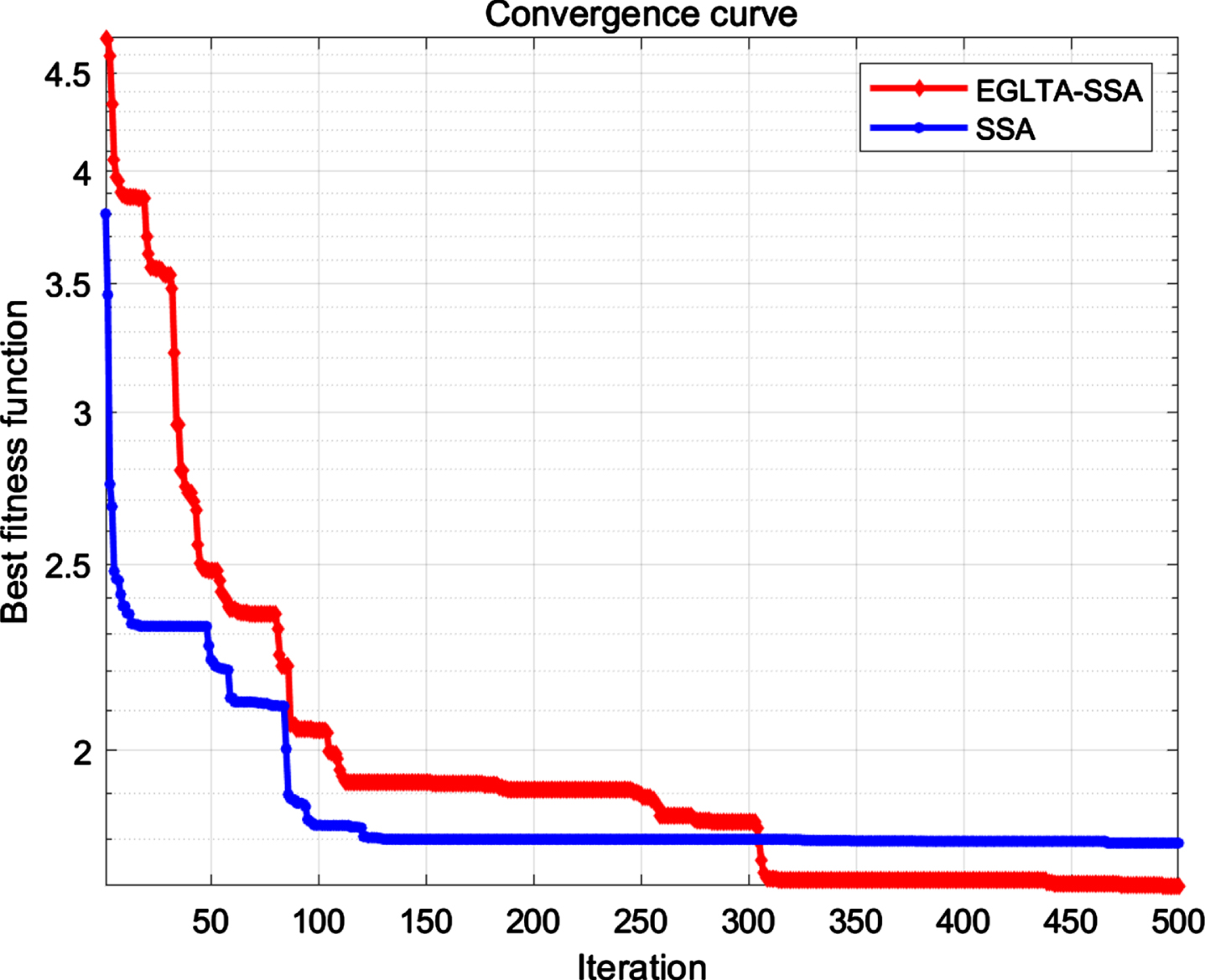
Convergence curves of EGLTA-SSA for solving the WBDP
From Table 11, it can be seen that in solving the WBDP, the optimal value of EGLTA-SSA is 1.69643, which is smaller than the solution results of all other optimization algorithms, and the optimization effect is more obvious by improving 0.00641 compared to the original SSA. This indicates that EGLTA-SSA has better performance and higher accuracy in finding the optimal value. From the convergence curve Fig. 10, it can be seen that the EGLTA-SSA and SSA start to converge at about the 120th iteration, SSA stabilizes after about the 120th iteration, but EGLTA-SSA jumps out of the local optimum after the 300th iteration due to the leadership mechanism of the elite sparrow population, and it obtains a better value than the basic SSA.
The pressure vessel is a cylindrical vessel with a hemispherical cap at one end of the cylinder. The pressure vessel design problem (PVDP) is to minimize the cost of making the pressure vessel by optimizing four variables: cylindrical vessel body length(L), cylindrical vessel inner diameter(R), cylindrical wall thickness (T a ) and head wall thickness (T h ), while satisfying the pressure conditions. The design diagram of the PVDP is shown in Fig. 11 below.
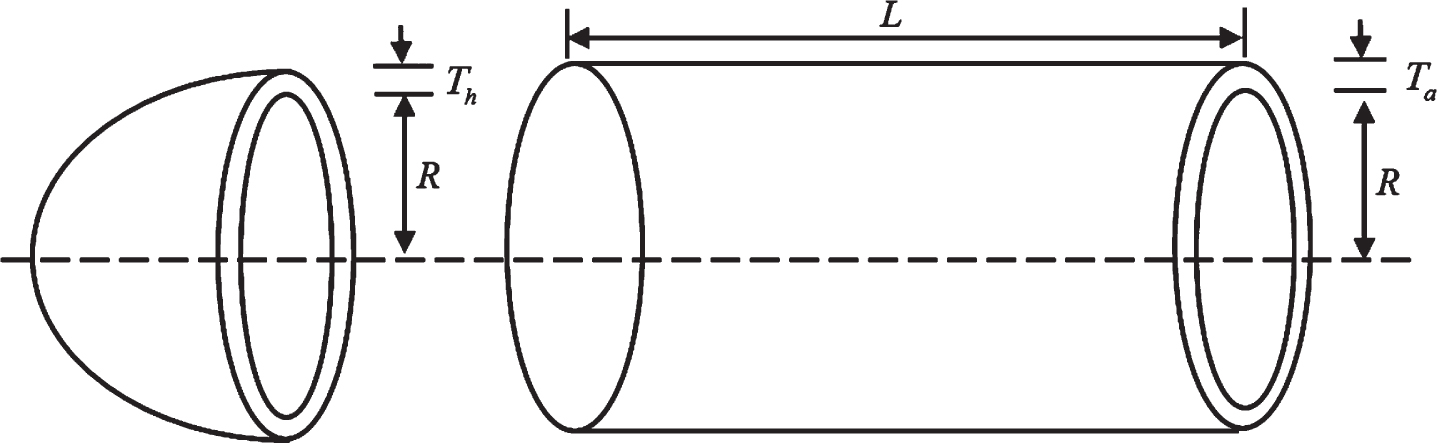
The design diagram of the PVDP
The mathematical formula of the PVDP is shown as follows:
Consider A = [a1, a2, a3, a4] = [T a , T h , R, L],
Minimize
Variables range (0 ⩽ a1, a2 ⩽ 100) , (10 ⩽ a3, a4 ⩽ 200).
In this paper, EGLTA-SSA is compared with the current advanced algorithms, including the algorithms compared in the previous section: SSA [14], AOA [28], GWO [34] CPSOGSA [44], CGSA [45], NDE [46], ITLBO [47], SCA [48], and GSA [49]. And additionally, the following advanced algorithms are added for comparison:
In order to ensure the fairness of the experiments, the parameter settings of each method are the same as those of the original literature. The solution results are shown in Table 12, and the convergence behavior of the EGLTA-SSA in solving the PVDP is shown in Fig. 12.
Solution results of the PVDP
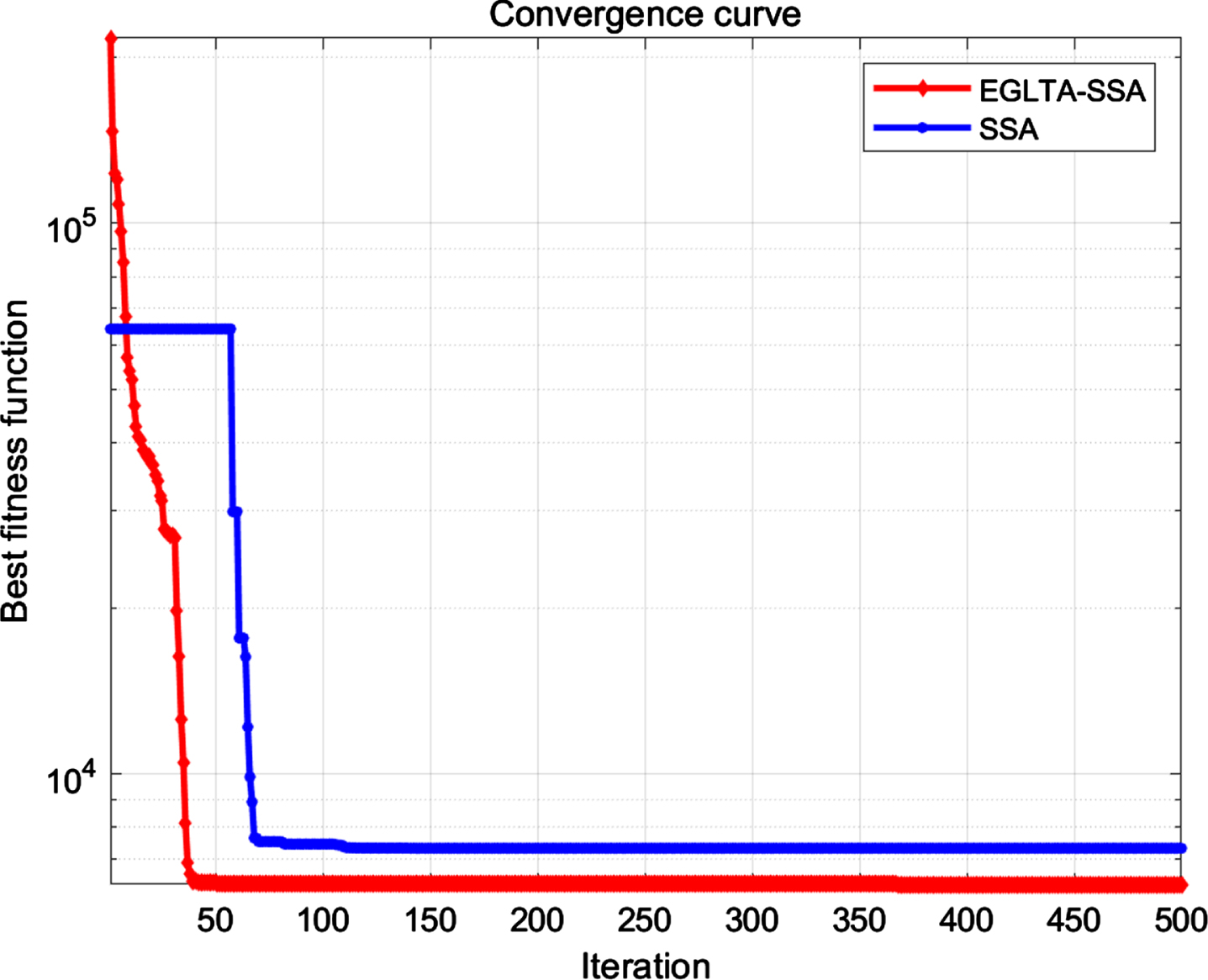
Convergence curves of EGLTA-SSA for solving the PVDP.
From Table 12, we can see that the optimal value of EGLTA-SSA for solving the PVDP is 5905.79505, which is an improvement of 106.46 over the original SSA, and is smaller than the results of all other algorithms. It shows that EGLTA-SSA has better performance and higher accuracy in finding the optimal value. The convergence curves in Fig. 12 show that the EGLTA-SSA obtains the optimal solution in about the 25th iteration, it converges faster than the basic SSA, and the solution accuracy of the EGTA-SSA is higher than that of the basic SSA. It indicates that the sparrow individuals selected by the elite reverse learning mechanism have stronger search and exploitation ability.
The tension/compression spring design problem (TCSD) is a famous engineering benchmark for a special type of spring with a circular shim-like outer shape. The problem is to minimize the weight of the spring by optimizing three variables: the average diameter of the spring coil(D), the diameter of the spring wire (d), and the number of active coils (N), while satisfying the warpage, shear stress, and surge frequency. The meaning of the three design variables can be found in Fig. 13.
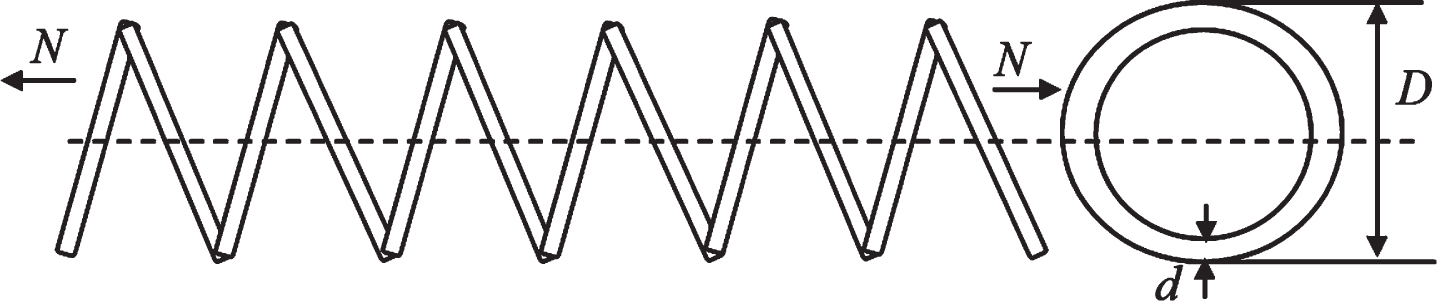
The design diagram of the TCSD.
The mathematical formula of the TCSD is shown as follows:
Consider A = [a1, a2, a3] = [d, D, N],
Minimize
Variables range (0.05 ⩽ a1 ⩽ 2) , (0.25 ⩽ a2 ⩽ 1.3) , (2 ⩽ a3 ⩽ 15).
In this paper, EGLTA-SSA is compared with the current advanced algorithms, including the algorithms compared in the previous section: WOA [9], SSA [14], AOA [28], GWO [34], CPSOGSA [44], CGSA [45], NDE [46], ITLBO [47], SCA [48], GSA [49], and CSCA [51]. And additionally, the following advanced algorithms are added for comparison:
To make sure the effectiveness of the experiments, the parameters of each algorithm are set the same as the original literature. The solution results are shown in Table 13, and the convergence behavior of the EGLTA-SSA in solving the TCSD is shown in Fig. 14.
Solution results of the TCSD
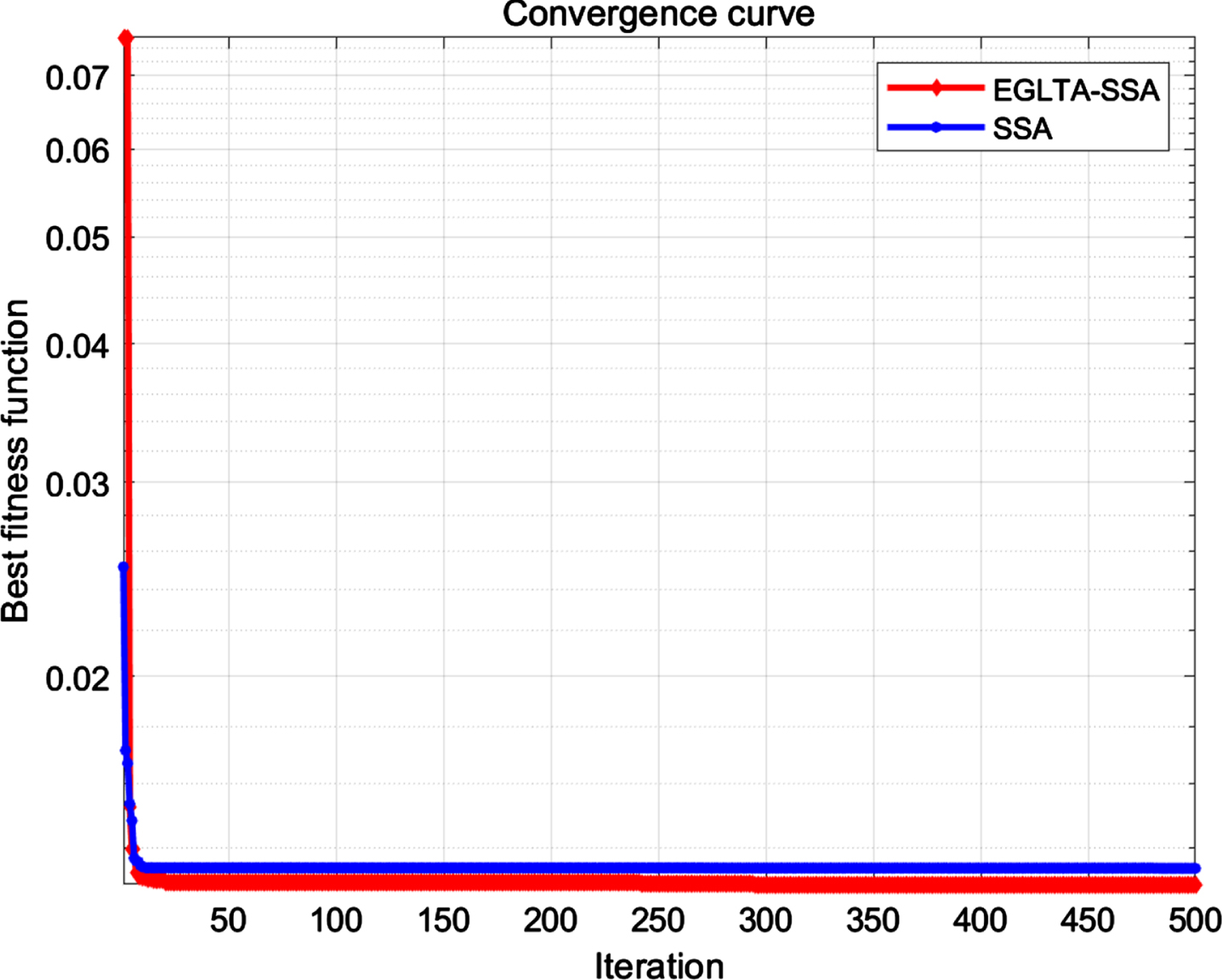
Convergence curves of EGLTA-SSA for solving the TCSD.
From Table 13, the optimal value of EGLTA-SSA is 0.0126636, which is smaller than the results of all other optimization algorithms and improves 0.0000114 compared to the original SSA, indicating that EGLTA-SSA has better performance and higher accuracy in finding the optimal solution. The convergence curves in Fig. 14 show that the convergence speed of EGLTA-SSA and basic SSA are comparable, but EGTA-SSA still maintains a smooth decreasing trend after convergence, making its final solution accuracy higher than that of basic SSA. It indicates that the multi-strategy improved sparrow leader guides the sparrow population foraging well, effectively improves the search ability of the sparrow population in the problem space, maintains a stable search efficiency, and therefore reduces the risk of premature maturation.
In this paper, to improve the weaknesses of the SSA, we propose a sparrow search algorithm incorporating multiple strategies, named as EGLTA-SSA, which is based on the conventional SSA and introduces the elite opposition-based learning method to initialize the sparrow population to improve the quality of the solution and enrich the diversity of the population. Meanwhile, the leader position is updated by integrating multi-strategy mechanisms. On the one hand, the high distributivity of the AOA operators are used to deflate the target position and improve the ability of SSA to jump out of the local optimum. On the other hand, the leader position is perturbed by adopting the golden levy flight strategy and the t-distribution perturbation strategy, to improve the shortcoming of SSA in the late iteration when the population diversity decreases. Further, a probability factor is added for random selection to achieve more effective communication among leaders. In this way, the optimization-seeking accuracy and convergence speed of the algorithm are improved.
To verify the performance of EGLTA-SSA, extensive experiments were done using the CEC2005 function and the CEC2019 function, and compared with advanced optimization algorithms. The results confirm that EGLTA-SSA has more stable performance and higher solution accuracy in finding the optimal solution. For the CEC2005 function, from the Wilcoxon rank sum test results, only 20 out of 117 h-values at dimension 10 are not 1, showing the good performance of EGLTA-SSA in finding the optimal solution. Only 19 out of 117 h-values in dimension 100 are not 1, which indicates that EGLTA-SSA is still stable in the high-dimensional case and has the potential to solve complex problems. The superior performance of EGLTA-SSA is further demonstrated by the fact that 66 out of 90 h-values of the fixed dimensional function are 1. For the CEC2019 function, the Friedman ranking result of EGLTA-SSA is located in the first place. This synthetically demonstrates the effectiveness and robustness of the EGLTA-SSA algorithm.
Further, EGLTA-SSA was used to solve engineering optimization problems, including the welded beam design problem (WBDP), the pressure vessel problem (PVDP) and the butterfly spring problem (TCSD). The experimental results show that the solution results of EGLTA-SSA are the best among all the compared algorithms and improve 0.00641 (WBDP), 106.46 (PVDP) and 0.0000114 (TCSD), respectively, compared with the original SSA. This shows the significant impact of the improvement strategy on the improvement of the algorithm solution accuracy.
In future work, the proposed EGLTA-SSA can be applied to solve other challenging optimization problems that need further research, such as other benchmark function optimization problems, text document clustering problems, industrial engineering problems, multilevel threshold image segmentation problems, network intrusion problems, multi-objective optimization problems, feature selection problems, classification problems, and some other problems. In addition, other strategies such as the aquila optimizer, the logical mapping, the neighborhood search strategy, political optimization operators, complex networks, and Mustang optimization operators can also be applied in the improvement of the SSA to further improve the performance of the algorithm.
Footnotes
Acknowledgments
This work was partially supported by National Natural Science Foundation of China (61673258 and 61075115) and Shanghai Natural Science Foundation (19ZR1421600).
Ethical approval
Not applicable
Competing interests
The authors declare that they have no conflict of interest.
Authors’ contributions
Xuemin Zhu: Conceptualization, Methodology, Writing original draft. Sheng Liu: Development or design of methodology, Creation of models, Writing. Xuelin Zhu: Revise manuscript and editing. Xiaoming You: Writing review & editing.
Availability of data and materials
The data obtained in this study are available from the corresponding author.