



Abstract
Fuzzy soft set as a tool to deal with uncertainty can effectively handle decision making problems. However, there are many redundant parameters in the decision making process. In order to remove redundant parameters to improve the efficiency of decision making, different parameter reduction algorithms for fuzzy soft sets based on different decision criteria have been proposed. This paper focuses on the problem of parameter reduction of fuzzy soft sets based on choice value criteria. The restrictions of the strict conditions about parameter reduction lead to a very low applicability of some previous algorithms based on choice value criteria. To address this limitation, we introduce a flexible definition of parameter reduction for fuzzy soft sets. Further a difference-based parameter reduction algorithm for fuzzy soft sets is proposed. Compared with some previous algorithms based on choice value criteria, the proposed algorithm not only has wider applicability, but also can reduce more redundant parameters making the found parameter reduction with a lower cardinality, and it is easier to find the parameter reduction of fuzzy soft sets.
Introduction
With the development of the times, we often encounter many uncertainty problems in real life. Soft set theory [1] is an effective mathematical tool for dealing with uncertainty proposed by Molodtsov, which avoids the shortcomings of other theories dealing with uncertainty such as probability theory, rough set [2], and fuzzy set [3] lacking parametric tools. Fuzzy soft set [4], as the effective extension of soft set, not only inherits the characteristics of parameterization of soft set, but also enhances the flexibility of dealing with uncertainty, and has been widely used in many fields such as decision making, data mining and medical diagnosis and so on.
Decision making problems can be found everywhere in daily life, and the decision making process exists in all aspects of daily life. It is evident that decision making plays a crucial role in life. After Maji et al. [5] first applied soft sets to decision problems, many researchers have studied the application of soft sets and their extended models in decision making, especially the fuzzy soft sets based decision making has been widely concerned and studied and has been widely applied to many fields [6–8]. Roy and Maji [9] proposed a decision making algorithm for fuzzy soft sets by constructing the comparison table of the fuzzy soft sets. Subsequently, the algorithm was improved in [10] and Feng et al. [11] proposed an adjustable approach to fuzzy soft sets based decision making using level soft sets. After that, many researchers have proposed different methods [12–18] to solve the decision making problems based on fuzzy soft sets. Recently, Wang et al. [16] presented a novel fuzzy soft sets based decision making approach by using modal-style operators. The article of [17] proposed Union-Intersection decision making method based on fuzzy soft relationship and level fuzzy soft relationship. Alkhazaleh [18] introduced the concept of effective fuzzy soft sets and gave an application of this concept in decision making problem.
In recent years, more and more researchers are interested in parameter reduction in soft set theory. Parameter reduction plays a very important role in dealing with decision making problems in soft set theory. There are often many redundant and unimportant parameters in the decision making process. In order to improve the decision making efficiency, the redundant parameters can be deleted by parameter reduction so that the decision making ability does not change before and after the reduction. At present, many researchers have proposed different parameter reduction methods for soft sets. The concept of parameter reduction of soft sets was first introduced by Maji et al. [19], after which Chen et al. [20] improved the method proposed in [19]. Kong et al. proposed the normal parameter reduction algorithm in [21]. After that, many researchers have improved the normal parameter reduction algorithm for soft sets [22–25]. However, the applicability of the algorithms in [21–25] is low due to the overly stringent conditions about normal parameter reduction. To address this problem, Qin et al. [26] proposed a parameter reduction method based on chi square distribution for soft sets.
Different parameter reduction methods for fuzzy soft sets based on different decision criteria are proposed in [21, 27–33]. Kong et al. proposed the normal parameter reduction algorithm for fuzzy soft sets in [21]. In order to remove more redundant parameters and improve the reduction effect, the proximate normal parameter reduction algorithm for fuzzy soft sets was proposed in [27]. After that, Ma and Qin [28] proposed the distance-based parameter reduction algorithm for fuzzy soft sets. Khan and Zhu [29] illustrated through specific examples that the algorithm proposed by Ma and Qin could not maintain the ranking order of decision alternatives, and proposed the rank-based parameter reduction algorithm of fuzzy soft sets and compared it with the above three algorithms [21, 28] from different aspects. All of these four parameter reduction methods for fuzzy soft sets above are based on the choice value criteria. Kong et al. [30] proposed a new normal parameter reduction method for fuzzy soft sets based on the score decision criterion. Ma et al. [31] found that the parameter reduction method proposed by Kong et al. was complex and had high computational complexity, and in order to overcome this drawback, Ma et al. proposed a new improved normal parameter reduction method. Zhang [32] proposed a parameter reduction method for fuzzy soft sets based on soft fuzzy rough approximation operators. A new approach to parameter reduction of fuzzy soft sets based on the three-way decision methodology was proposed by Khameneh et al. [33]. Parameter reduction problem for fuzzy soft sets has been studied in [32, 33] from a different perspective than the decision criteria mentioned above. The parameter reduction problem has been extended not only to fuzzy soft sets, but also to other extended models of soft sets, such as N-soft sets [34].
In this paper, we will focus on a kind of parameter reduction problem, which is the parameter reduction of fuzzy soft sets based on the choice value criteria. The overly strict conditions about parameter reduction lead to a very low applicability of previous parameter reduction methods [21, 29] for fuzzy soft sets based on choice value criteria. Moreover, these methods do not give specific steps to find the parameter subsets that satisfy the conditions. Therefore, when finding the parameter reduction, it is necessary to keep trying different parameter subsets to check whether they satisfy the conditions or not, which leads to the high computational complexity of these methods. And these methods may not be able to delete all redundant parameters. In order to overcome the shortcomings of these methods, we propose a difference-based parameter reduction method for fuzzy soft sets. The main contributions of this work can be summarized as follow. To introduce the definition of the difference-based parameter reduction of fuzzy soft sets. To propose a difference-based parameter reduction algorithm for fuzzy soft sets. Compared with some previous parameter reduction algorithms for fuzzy soft sets based on choice value criteria, the proposed algorithm has a wider range of applicability, and is able to remove more redundant parameters while keeping the ranking order of all the alternatives invariant, and is more likely to find the parameter reduction for fuzzy soft sets.
The rest of this paper is organized as follows. Section 2 reviews some basic concepts related to soft sets and fuzzy soft sets. Section 3 briefly discusses the algorithms proposed in [21, 29]. Section 4 presents a new method for parameter reduction of fuzzy soft sets based on the difference. Section 5 compares the proposed algorithm with the algorithms from references [21, 27] and [29] on certain aspects. Finally, Section 6 concludes the paper and outlook for potential future work.
Preliminaries
In this section, suppose U is an initial universe set and E is a set of parameters. We review some basic concepts related to soft sets and fuzzy soft sets.
Maji et al. [4] proposed fuzzy soft set by combining soft set and fuzzy set.
To better understand the definition of fuzzy soft sets, we introduce the following example.
Tabular representation of the fuzzy soft set (F, E)
Tabular representation of the fuzzy soft set (F, E)
Based on Definitions 2.3, we can calculate the choice values of u i (i = 1, 2, 3, 4) with respect to E and E - {e l } (l = 1, 2, 3, 4, 5) as given in Table 2.
Tabular representation of f E (u i ) and fE-{e l } (u i )
According to the choice values of u i for all i with respect to E in Table 2, all patients can be ranked from largest to smallest as u2 > u3 > u4 > u1. Obviously, the choice value of u2 is the largest and the choice value of u1 is the smallest among all patients. Based on the choice value criteria, the object u2 with the largest choice value is the patient most affected by SARS-CoV-2 and the object u1 with the smallest choice value is the patient least affected by SARS-CoV-2.
In this section the algorithms proposed in [21, 29] are briefly discussed.
The algorithm proposed in [21]
Based on the above definition, Kong et al. [21] proposed the normal parameter reduction algorithm of fuzzy soft sets given by Algorithm 1.
Tabular representation of the fuzzy soft set (F, E)
Tabular representation of the fuzzy soft set (F, E)
Based on the above definitions, the algorithm for the proximate normal parameter reduction of fuzzy soft sets is proposed in [27], as shown in Algorithm 2.
The algorithm proposed in [29]
According to Definition 3.5 and Definition 3.6, the rank-based parameter reduction algorithm of fuzzy soft sets is proposed in [29] as shown in Algorithm 3.
Obviously, according to Examples 3.1-3.3, we can find that the algorithms proposed in [21, 29] have low applicability due to overly stringent reduction conditions.
A novel difference-based parameter reduction method for fuzzy soft sets
In this section, the difference-based parameter reduction algorithm of fuzzy soft sets is presented. The algorithm avoids the disadvantage of the algorithms proposed in [21, 29] which have very low applicability due to the overly stringent reduction conditions. And the algorithm proposed in this paper is applicable to all fuzzy soft sets with high applicability.
Assuming that (F, E) is a fuzzy soft set over U = {u1, u2, ⋯ , u n }. Based on choice value criteria, the larger the choice value of an alternative with respect to E, the better the alternative is. Thus if the choice value of u i with respect to E is larger than the choice value of u j with respect to E, then u i > u j . Obviously if the difference between the choice values of u i and u j with respect to E is greater than 0, then u i > u j . If the difference between the choice values of u i and u j with respect to E is less than 0, then u i < u j . If the difference between the choice values of u i and u j with respect to E is equal to 0, then u i = u j . Therefore the preference orders of the alternatives can be discerned by the magnitude of the difference between the choice values of the alternatives with respect to E. Therefore, the preference orders of the alternatives can be discerned by the magnitude of the difference between the choice values of the alternatives with respect to E. If the magnitude of the difference between the choice values of all alternatives does not change in relation to 0 after deleting some of the parameters, then it means that the ranking of all alternatives before and after deleting the parameters has not changed.
Through the above analysis, we give the definition of difference between the choice values and present a new method for parameter reduction of fuzzy soft sets based on the difference.
To better understand the concept of difference in Definition 4.1, the following example is given.
Tabular representation of D
E
(u
i
, u
j
) and DE-{e
l
} (u
i
, u
j
)
Tabular representation of D E (u i , u j ) and DE-{e l } (u i , u j )
Clearly, if a parameter subset A satisfies the condition of Definition 4.2, then E - A must be the set that keeps the ranking order of all the alternatives unchanged.
Definition 4.2 provides a parameter reduction method for fuzzy soft sets according to the difference between the choice values with respect to E and E - A. However, it’s not easy to find a parameter subset A satisfying the condition of Definition 4.2 directly. To address this issue, we give the following theorem and corollary.
(1) If D
E
(u
i
, u
j
) ≠0, then
According to Theorem 4.1, the following Corollary 4.1 can be induced.
(1) If D
E
(u
i
, u
j
) ≠0, then
If D
E
(u
i
, u
j
) ≠0, then
Based on Definition 4.1, we have
Since
If D
E
(u
i
, u
j
) =0, then
Therefore, according to Theorem 4.1, we can get
Corollary 4.1 provides a method to find a parameter subset A such that A is the difference-based parameter reduction of E. When q = a, we need to check if
In order to reduce the computational complexity of finding the parameter reduction, we give the following theorems and corollaries.
(1) when D
E
(u
i
, u
j
) >0,
(2) when D
E
(u
i
, u
j
) <0,
(2) It is derived by the similar process used in (1).
(1) when D
E
(u
i
, u
j
) >0,
(2) when D
E
(u
i
, u
j
) <0,
(2) It is derived by the similar process used in (1).
(1) when D
E
(u
i
, u
j
) >0,
(2) when D
E
(u
i
, u
j
) <0,
(2) It is derived by the similar process used in (1).
(1) when D
E
(u
i
, u
j
) >0,
(2) when D
E
(u
i
, u
j
) <0,
(2) It is derived by the similar process used in (1).
(1) when D
E
(u
i
, u
j
) >0, M
q
(u
i
, u
j
) ≥ qD
E
(u
i
, u
j
) , then
(2) when D
E
(u
i
, u
j
) <0, m
q
(u
i
, u
j
) ≤ qD
E
(u
i
, u
j
) , then
According to our proposed definitions and theorems, the difference-based parameter reduction algorithm of fuzzy soft sets is presented, as shown in Algorithm 4.
A sketch map of the proposed algorithm for parameter reduction of fuzzy soft sets is shown in Fig. 1.

A sketch map of the proposed algorithm for parameter reduction.
By the proposed algorithm, the minimal subset of E that keeps the entire decision order constant can surely be found. The proposed algorithm not only gives the condition that a parameter subset is the parameter reduction that needs to be satisfied, but also gives the method to find the minimal parameter subset that satisfies that condition, such that the found parameter reduction is the subset with the smallest cardinality in the parameter subsets that keeps the decision order unchanged.
In order to show the applicability, feasibility and effectiveness of our proposed algorithm, we present the following examples.
Tabular representation of the fuzzy soft set (F, E)
Tabular representation of f E (u i ) and fE-{e l } (u i )
Tabular representation of D E (u i , u j ) and DE-{e l } (u i , u j )
For u1, u2 :
Since DE-{e1} (u1, u2) + DE-{e2} (u1, u2) + DE-{e3} (u1, u2) + DE-{e5} (u1, u2) = 0.65 < (5 - 1 -1) D E (u1, u2) =0.9, then e4 ∉ A.
For u1, u3 :
Since DE-{e2} (u1, u3) + DE-{e3} (u1, u3) + DE-{e4} (u1, u3) + DE-{e5} (u1, u3) = 2.75 < (5 - 1 -1) D E (u1, u3) =3.15, then e1 ∉ A.
For u1, u4 :
Since DE-{e1} (u1, u4) + DE-{e2} (u1, u4) + DE-{e3} (u1, u4) + DE-{e4} (u1, u4) = 0.05 < (5 - 1 -1) D E (u1, u4) =0.3, then e5 ∉ A.
Therefore, e1, e4, e5 ∉ A. That is, e1, e4, e5 are redundant and unimportant parameters, and their deletion does not change the decision making ability. The following determines the parameters that must belong to A from the remaining parameters according to Theorem 4.2.
For u1, u2 :
Since DE-{e2} (u1, u2) =0.3 = D E (u1, u2) =0.3, then e3 ∈ A.
If there exists a parameter reduction whose cardinality is 1, then A = {e3}. Verify whether {e3} is the difference-based parameter reduction of E by Corollary 4.1. Clearly {e3} satisfies the conditions of Corollary 4.1, so {e3} is the difference-based parameter reduction of E.
It is obvious to see that the ranking order of all the alternatives does not change after removing the redundant parameters, and remains u1 > u4 > u2 > u3. And {e3} is the minimal subset of E that keeps the decision capability unchanged.
Tabular representation of f E (u i ) and fE-{e l } (u i )
Tabular representation of D E (u i , u j ) and DE-{e l } (u i , u j )
For u1, u2 :
Since DE-{e1} (u1, u2) + DE-{e2} (u1, u2) + DE-{e3} (u1, u2) + DE-{e5} (u1, u2)
= -1.3 > (5 - 1 -1) D E (u1, u2) = -1.5,
DE-{e1} (u1, u2) + DE-{e2} (u1, u2) + DE-{e4} (u1, u2) + DE-{e5} (u1, u2)
= -1.3 > (5 - 1 -1) D E (u1, u2) = -1.5, then e3, e4 ∉ A.
For u1, u3 :
Since DE-{e1} (u1, u3) + DE-{e3} (u1, u3) + DE-{e4} (u1, u3) + DE-{e5} (u1, u3)
= 2.3 < (5 - 1 -1) D E (u1, u3) =2.4,
DE-{e2} (u1, u3) + DE-{e3} (u1, u3) + DE-{e4} (u1, u3) + DE-{e5} (u1, u3)
= 2.3 < (5 - 1 -1) D E (u1, u3) =2.4, then e1, e2 ∉ A.
If there exists a parameter reduction whose cardinality is 1, then A = {e5}. Verify whether {e5} is the difference-based parameter reduction of E by Corollary 4.1. Obviously, {e5} does not satisfy the conditions of Corollary 4.1, so {e5} is not the difference-based parameter reduction of E, that is, there is no parameter reduction whose cardinality is 1, i.e., |A|≠1.
For u2, u5:
Since DE-{e1} (u2, u5) + DE-{e4} (u2, u5) + DE-{e5} (u2, u5) =0 + 0.1 + 0.1 = 0.2 = (5 - 2 -1) D E (u2, u5) =0.2, then e3 ∉ A.
For u3, u4 :
Since DE-{e1} (u3, u4) + DE-{e2} (u3, u4) + DE-{e3} (u3, u4) = -0.1 - 0.1 - 0.1 = -0.3 > (5 - 2 -1) D E (u3, u4) = -0.4, then e5 ∉ A.
And then, by using Corollary 4.3, we can also find the parameters that must not belong to A.
For u4, u5 :
Since DE-{e4} (u4, u5) = -0.9 = (5 - 2 -1) D E (u4, u5) - (DE-{e3} (u4, u5) + DE-{e5} (u4, u5)), then e2 ∉ A.
Therefore, we have e2, e3, e5 ∉ A. If there exists a parameter reduction whose cardinality is 2, then A = {e1, e4}. Finally, determine whether A is the difference-based parameter reduction of E according to Corollary 4.1.
Obviously, the ranking order of all the alternatives has not changed before and after parameter reduction, which is u2 > u5 > u1 > u4 > u3. And {e1, e4} is the minimal subset of E that keeps the entire decision order invariant.
Tabular representation of the fuzzy soft set (F, E)
Tabular representation of f E (u i ) and fE-{e l } (u i )
Tabular representation of D E (u i , u j ) and DE-{e l } (u i , u j )
First, we get that e1, e2, e4, e6, e8 ∉ A by Theorem 4.3, and then we get that e5, e7 ∉ A by Corollary 4.3. If there exists a parameter reduction whose cardinality is 1, then A = {e3}. Finally, it is determined by Corollary 4.1 that {e3} is not the difference-based parameter reduction of E, i.e., |A|≠1.
First by Theorem 4.3 we have e4, e6, e8 ∉ A. Then by Corollary 4.3 we have e2 ∉ A. The following determines the parameters in {e1, e3, e5, e7} that must belong to A. According to Theorem 4.2 we get that e1, e3 must belong to A. If there is the difference-based parameter reduction of E whose cardinality is 2, then A = {e1, e3}. Finally, use Corollary 4.1 to determine whether {e1, e3} is the difference-based parameter reduction. Clearly {e1, e3} is not the difference-based parameter reduction, so |A|≠2.
Let L3 = {{e1, e2, e8} , {e1, e3, e8} , {e1, e5, e8} , {e1, e7, e8} , {e2, e3, e8} , {e2, e5, e8} , {e2, e7, e8} , {e3, e5, e8} , {e3, e7, e8} , {e5, e7, e8}}}.
When D E (u i , u j ) >0, calculate M3 (u i , u j ), and when D E (u i , u j ) <0, calculate m3 (u i , u j ). According to Theorem 4.4, we get that {e1, e2, e8}, {e1, e5, e8} , {e1, e7, e8} , {e2, e7, e8} are not the difference-based parameter reduction of E.
Let Z3 = {{e1, e2, e8} , {e1, e5, e8} , {e1, e7, e8} , {e2, e7, e8}} , H3 = L3 - Z3 = {{e1, e3, e8}, {e2, e3, e8} , {e2, e5, e8} , {e3, e5, e8} , {e3, e7, e8} , {e5, e7, e8}}.
The following check if there exists a parameter subset in H3 that satisfies Corollary 4.1. By calculation we find that {e2, e3, e8} and {e3, e5, e8} satisfy the conditions of Corollary 4.1, so both {e2, e3, e8} and {e3, e5, e8} are the difference-based parameter reduction of E.
The above three examples illustrate that our proposed algorithm is efficient and feasible.
In this section, we will compare our proposed algorithm with the algorithms from references [21, 27] and [29] in terms of scope of application, computational complexity and cardinality of parameter reduction, respectively. Suppose (F, E) is a fuzzy soft set over U = {u1, u2, ⋯ , u n }, E = {e1, e2, ⋯ , e m }. In the following, we compare the above four algorithms for parameter reduction of this fuzzy soft set (F, E) from the above three aspects.
Scope of application
(i) The algorithms in [21, 29]
The algorithms in [21, 29] do not work for all fuzzy soft sets. For the algorithm proposed in [21], we can find parameter reduction of fuzzy soft set based on this algorithm only if there exists a parameter subset A satisfying f
A
(u1) = f
A
(u2) = ⋯ = f
A
(u
n
). For the algorithm proposed in [27], the parameter reduction of the fuzzy soft set can be found by this algorithm only if there exists a parameter subset A satisfying
(ii) Our proposed algorithm
Our proposed algorithm is applicable to any fuzzy soft set. The proposed algorithm shows that if there exists a parameter subset satisfying the conditions of Corollary 4.1, we can find parameter reduction of a fuzzy soft set. And as long as a fuzzy soft set exists parameter reduction, then we must be able to find a parameter subset satisfying the conditions of Corollary 4.1, which is parameter reduction of this fuzzy soft set. Therefore, as long as there exists parameter reduction for a fuzzy soft set, the parameter reduction for that fuzzy soft set can definitely be found using our proposed algorithm.
Through Examples 3.1–3.3 and Example 4.4 we can find that using the algorithms proposed in [21, 27] and [29] cannot find any parameter reduction of the fuzzy soft set shown in Table 3. Whereas using the algorithm proposed in this paper, we find the parameter reduction of this fuzzy soft set as {e1, e4}.
Next, we use the algorithms proposed in [21, 27] and [29] to find the parameter reduction of the fuzzy soft set in Example 4.5, respectively. In Example 4.5, we cannot find any parameter subset of E satisfying f
A
(u1) = f
A
(u2) = f
A
(u3) = f
A
(u4) = f
A
(u5) = f
A
(u6) or satisfying
Computational complexity
Reduction path
(i) The algorithms in [21, 29]
It is known from the algorithms proposed in [21, 27] and [29] that if there exists a parameter subset A satisfying the conditions proposed in [21] or [27] or [29], then E - A is a parameter reduction of the fuzzy soft set. However, none of these algorithms gives a specific way to find A. When we use these algorithms to find the parameter reduction of a fuzzy soft set, we can only find the parameter reduction of a fuzzy soft set by continuously trying different parameter subsets to verify whether they satisfy the corresponding conditions until we find a parameter subset that meets the conditions. And the larger the cardinality of E is, the less easy it is to find the parameter subset A that satisfies the conditions, then the more difficult it is to find the parameter reduction of the fuzzy soft set using the algorithms proposed in [21, 27] and [29]. Obviously, these algorithms only give conditions to discriminate whether a parameter subset is a parameter reduction or not, and do not give a specific reduction path to facilitate us to find the parameter reduction of a fuzzy soft set.
(ii) Our proposed algorithm
Our proposed algorithm not only gives the conditions that need to be satisfied to discriminate whether a parameter subset is parameter reduction of a fuzzy soft set or not, but also gives a specific reduction path to find the parameter reduction. And the proposed algorithm gives a method to discriminate whether a parameter belongs to parameter reduction or not, which in turn reduces the difficulty of finding parameter reduction of fuzzy soft sets.
The number of parameter subsets checked
The algorithms proposed in [21, 29] and the algorithm proposed in this paper all aim at finding the parameter reduction with the smallest cardinality. Therefore, it is assumed that the algorithms of [21, 29] all search for the parameter subsets that satisfy the condition in the order of cardinality from the largest to the smallest, respectively. The search ends when a subset satisfying the condition is found. Since none of these algorithms gives a specific method to find the parameter subsets that satisfy the condition, it is necessary to keep trying different subsets to check whether they satisfy the condition, and thus the number of subsets to be checked is large, so the computational complexity of these algorithms is high. In contrast, our proposed algorithm is able to determine some redundant and non-redundant parameters, as well as the sets that are not the parameter reduction, and thus is able to determine the parameter reduction of the fuzzy soft set by checking fewer parameter subsets. Obviously the computational complexity of the proposed algorithm is less compared to the above three algorithms.
Next, in Examples 4.3–4.5, calculate how many parameter subsets need to be checked to find the parameter reduction of the fuzzy soft set using the algorithms proposed in [21, 29] and the algorithm proposed in this paper, respectively.
In Example 4.3 the algorithm proposed in [21] checks all the parameter subsets but does not find any subset A that satisfies f
A
(u1) = f
A
(u2) = f
A
(u3) = f
A
(u4). Clearly the number of parameter subsets checked by this algorithm is
The algorithm proposed in [27] successively checks whether the parameter subsets with cardinality 4 and cardinality 3 satisfy
In contrast, the algorithm proposed in this paper finds the parameter reduction of the fuzzy soft set by only checking whether {e3} satisfies the conditions of Corollary 4.1. Thus the number of parameter subsets checked by the algorithm is 1.
In Example 4.4, based on Examples 3.1–3.3 we find that the algorithms proposed in [21, 29] check all the parameter subsets without finding the parameter reduction of the fuzzy soft set. Obviously these three algorithms must check
Similarly, in Example 4.5, the algorithms proposed in [21, 29] all need to check
The above comparison on the number of parameter subsets checked is represented in Fig. 2.
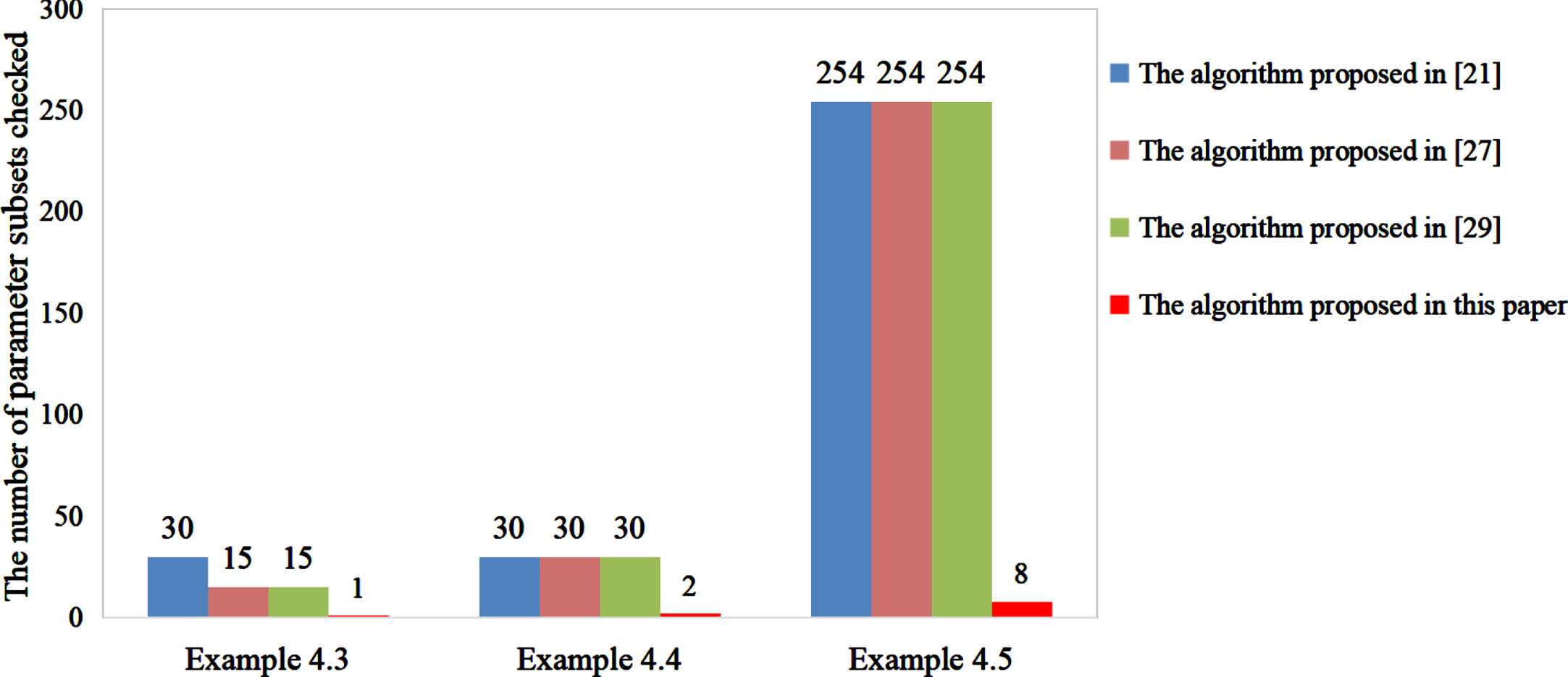
Comparison of the number of parameter subsets checked.
Comparison table
Compared with the algorithms proposed in [21, 27] and [29], our proposed algorithm is able to reduce more parameters and the final obtained parameter reduction has a smaller cardinality. Moreover, the parameter reduction of fuzzy soft sets derived by our proposed algorithm must be the subset with the smallest cardinality in the parameter subsets that keep the ranking order of all the alternatives unchanged.
It is known from [21] that the parameter reduction of the fuzzy soft set in Example 4.3 cannot be found using the algorithm proposed in [21]. The parameter reduction found using the algorithms proposed in [27] and [29] are all {e3, e4}. However the parameter reduction of the fuzzy soft set found using our proposed algorithm is {e3}. Obviously, based on this example, it can be seen that our proposed algorithm is not only able to find the parameter reduction of this fuzzy soft set, but also to reduce more parameters making the cardinality of the parameter reduction smaller compared to the algorithms proposed in [21, 29].
The results of the above comparison are summarized by Tables 13 and 14. It is obvious from Tables 13 and 14 that compared to the algorithms proposed in [21, 29], our proposed algorithm has wider applicability, is able to delete more redundant parameters, and is easier to find parameter reduction of fuzzy soft sets.
Comparison table
Comparison table
The purpose of this paper is to propose a new parameter reduction method for fuzzy soft sets based on the choice value criteria, aiming to overcome the drawbacks of existing parameter reduction methods for fuzzy soft sets with the same decision criteria.
The main contributions of this paper
(i) The definition of the difference-based parameter reduction of fuzzy soft sets has been introduced, which is easy to satisfy and relatively flexible.
(ii) A method is provided to identify partially redundant parameters, non-redundant parameters, and partially parameter subsets that are not parameter reduction, which reduces the computational complexity of our algorithm.
(iii) An algorithm with high applicability is proposed, which overcomes the shortcomings of the algorithms proposed in [21, 29] that have low applicability due to overly stringent reduction conditions.
(iv) The parameter reduction of fuzzy soft sets with the smallest cardinality can definitely be found using the proposed algorithm.
Limitations of the proposed method
(i) We have not yet proposed a method to determine the range of the cardinality of parameter reduction in fuzzy soft sets. Therefore, we can only search for the parameter reduction in ascending order of the cardinality. When |E| increases, the proposed algorithm inevitably faces a greater workload.
(ii) Through the relevant theorems and corollaries proposed in this paper, only some redundant and non-redundant parameters in fuzzy soft sets can be determined, and how to find more redundant and non-redundant parameters needs further research.
Future work
(i) Finding a way to determine the range of the cardinality of parameter reduction in fuzzy soft sets as well as finding a method to identity remove more redundant and non-redundant parameters can reduce the computational complexity of the proposed algorithm, which is very interesting work in the future.
(ii) We will apply the proposed difference-based parameter reduction algorithm to soft sets and other extensions of soft set theory as future work. For example, based on the definition of parameter reduction of fuzzy soft sets introduced in this paper, we will propose the definition of the difference-based parameter reduction in soft sets, and further investigate the difference-based parameter reduction algorithm for soft sets. And we also will apply the proposed theory and methods to other extensions of soft set theory like (a, b)- fuzzy soft sets, recently defined in [35].
Footnotes
Acknowledgments
This work was partially supported by the 2022 Annual Project of Educational Science of Shanxi Province “the 14th Five-Year Plan” (GH-220769), the Natural Science Foundation of Shanxi Province (202103021224254) and the Research Project of Shanxi Technology and Business College (202258).