



Abstract
Internet of things (IoT) is a recent developing technology in the field of smart healthcare. But it is difficult to transfer the patient’s health record as a centralized network. So, “blockchain technology” has excellent consideration due to its unique qualities such as decentralized network, openness, irreversible data, and cryptography functions. Blockchain technology depends on cryptography hash techniques for safe transmission. For increased security, it transforms the variable size inputs into a constant length hash result. Current cryptographic hash algorithms with digital signatures are only able to access keys up to a size of 256 bytes and have concerns with single node accessibility. It just uses the bits that serve as the key to access the data. This paper proposes the “Revised Elliptic Curve Cryptography Multi-Signature Scheme” (RECC-MSS) for multinode availability to find the nearest path for secure communications with the medical image as keys. Here, the input image key can be converted into an array of data that can be extended up to 512 bytes of size. The performance of the proposed algorithm is analyzed with other cryptography hash functions like Secure Hashing Algorithms (SHAs) such as “SHA224”, “SHA256”, “SHA384”, “SHA512”, “SHA3-224”, “SHA3-256”, “SHA3-384”, “SHA3-512”, and “Message Digest5” (MD5) by “One-way ANOVA” test in terms of “accuracy”, “throughput” and “time complexity”. The proposed scheme with ECC achieved the throughput of 17.07 kilobytes per 200 nano seconds, 93.25% of accuracy, 1.5 nanoseconds latency of signature generation, 1.48 nanoseconds latency of signature verification, 1.5 nanoseconds of time complexity with 128 bytes of hash signature. The RECC-MSS achieved the significance of 0.001 for accuracy and 0.002 for time complexity which are less than 0.05. From the statistical analysis, the proposed algorithm has significantly high accuracy, high throughput and less time complexity than other cryptography hash algorithms.
Keywords
Introduction
The combination of internet of things with blockchain technology is a developing area in distributed ledger applications mainly for financial and medical field. It is a public ledger technology that can be verified and maintained by distributed nodes. It uses a decentralized mechanism for tracking the participant nodes through transactional records and guarantying that all transaction information is trusted. It has the main feature that cryptography hash with digital signature to provide non-repudiation [1]. It supports digital signature algorithm by using keys. “Private-key” and “Public-key” can be used to signing and authentication of transaction to transfer the data or digital assets. Mainly digital signature algorithm has two types which are “single signature” and “multisignature” algorithm. “Single signature scheme” is used to allow only one transaction by signing its own user. But it leads to one node failure due to single transaction [2]. Multi signature algorithm is chosen to multiple node accessibility by signing multiple users. It generates multiple signatures by including all user’s public keys to enhance security.
Most blockchain technology uses the single signature scheme such as cryptographic hash functions and digital signature algorithms. Single signature algorithm used in blockchain technology is secure hash functions such as “SHA224”, “SHA256”, “SHA384”, “SHA512”, “SHA3-224”, “SHA3-256”, “SHA3-384”, “SHA3-512” and “MD5”. Previous multi signature algorithms can be implemented using secure hash functions. “Elliptic curve cryptography” is one of the digital signature algorithms which performs the operations like shape of elliptic curves within the finite range. Figure 1 shows the blockchain based healthcare application. One patient information can be stored in one block that can be linked in chain. All the information about the patient collected and stored in one block itself [3].
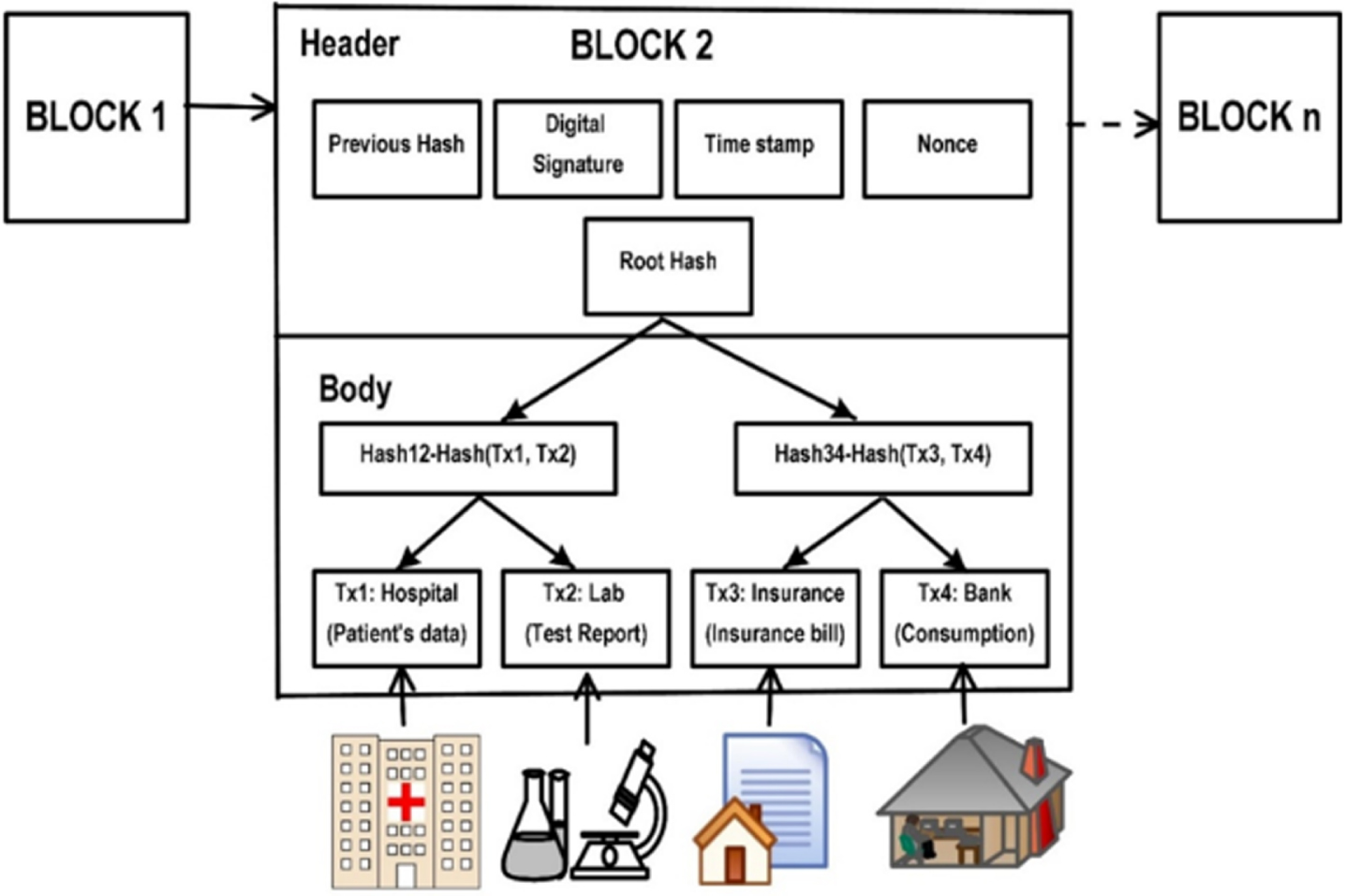
Blockchain based healthcare application.
Blockchain technology is a medium of creating, exchanging and storing the information electronically with use of encryption techniques. Its benefits include reduced costs, enhanced visibility, everlasting record, and lack of inherent value and physical form under centralized management. This research area is used in medical applications due to its features including encryption of strings for data integrity, protect the patient’s information with secure standards, real time updates of shared data, distributed and secured access, creates ownership through transparency, lower transaction cost, and system efficiency [4]. Figure 2 shows the some of the medical applications in blockchain technology.

Healthcare applications in blockchain technology.
This work focuses on the application of transferring the patient electronic health record without central authority. Here the security can be maintained by cryptography hash functions. The authority person uses the private key to store the patient information in blocks that can be linked in chain. It can be combined with message bytes to create digital signature which is approved by multiple nodes. If anyone need patient information, they can access the data by validating the public key image. Existing multi signature algorithm uses only data as keys and it can access up to 256 bytes of data. To overcome these issues, this work proposed to extend the key size up to 512 bytes by choosing images that can be converted into array of bytes. Then the proposed algorithm can be analyzed with other cryptography hash functions including “SHA224”, “SHA256”, “SHA384”, “SHA512”, “SHA3-224”, “SHA3-256”, “SHA3-384”, “SHA3-512” and “MD5” in terms of array of bytes, time complexity, accuracy, throughput and output hash bytes with multiple node accessibility. Finally, it can be statistically analyzed by one-way Anova test with mean accuracy, and mean time complexity.
The significant contributions of the RECC-MSS in Electronic Health Record management system are given below The random number key generation is developed instead of predictable number of keys. The patient image is used as key/password instead of string keys to enhance the security. The image is converted into array of bytes and accessible upto 512 bytes of size. This array of data can be performed the operation of modular multiplication of message bytes to generate constant signature hash to give guarantee for secure transaction. Proposed multi signature scheme is analyzed with various hash functions in terms of accuracy, time complexity, throughput, and signature size. The accuracy of message transaction of RECC-MSS is increased with zero error. The latency of signature generation and verification is reduced to speed up the transaction. The generated constant signature is used to identify the brute force attack and sybil attack easily before transmission. The proposed scheme with ECC achieves the throughput of 17.07 kilobytes per 200 nano seconds, 93.25% of accuracy, 1.5 nanoseconds latency of signature generation, 1.48 nanoseconds latency of signature verification, 1.5 nanoseconds of time complexity with 128 bytes oh hash signature.
The arrangement of this paper is as follows. The existing multi signature techniques are covered in Section 2. Third section provides an explanation of the various secure hash methods with digital signatures. Section four provides an explanation of the proposed RECC-MSS in healthcare applications. Section five discusses the outcomes and statistical analysis of the RECC-MS Scheme using various hash algorithms. The paper is concluded in Section 6.
“Blockchain technology” can be used to improve security in Internet of Things applications. Cryptography hash functions are the major reason behind this security. Because it converts the known plaintext into fixed and unalterable bytes. This unchangeable information is called as hash value. In cryptography, variable hash functions can be used for secure communication between nodes. Message digest (MD), Secure Hash Algorithms (SHA) are commonly used hash functions in block chain technology. These algorithms can be combined with digital signature to enhance accuracy, throughput and security. But compared to other digital signature algorithm, elliptic curve digital signature cryptosystem provides fast computation, reliable safety, minimal space solutions, and fixed hash value [5]. ECDS algorithm can be used in many sections of mathematical features with elliptic functions. Mainly medical and industries choose the ECDS algorithm due to its increased level of social safety.
In recent growing blockchain technology, secure transaction requires approval signatures from multiple nodes. So, it needs digital signature algorithm where each and every node verifies its digital signature with other nodes. It verifies the signature by followed the rules which is created by participating nodes in decentralized network. Three types of digital signature schemes are available in blockchain technology for validation of transaction. These are “Rivest, Shamir and Adleman”, and “elliptic curve cryptography”. “Single-signature” and “multi-signature” algorithms are the two types of digital signature methods. A “single-signature” method is a type of digital scheme that permits single node to sign a transaction. As a result, single-point assaults such as a one node attack can make this system susceptible to security challenges [6]. Previous signature schemes required more resources to verify the signatures. These signatures, which can take up a lot of space in a transaction, will be kept in a block and distributed across the whole system after they have been verified. Due to this communication overhead, it leads to less efficiency with more time consumption [7]. The join signature is used to sign multiple users on a single message. It has the same length of hash bytes as like single signature and check with “public key”. From this work, it should be noted that multi signature has many advantages when compared to single signature. These are less computation time, fast signature verification, less data storage, and reduced bandwidth [8]. As well as single signature algorithm is vulnerable to single node failure and sybil attacks. In multi signature algorithm, the multiple signatures can be verified by multiple nodes which is participated in network. It improves the security by distribution of signature to all nodes. Pay to script hash (P2SH) has been proposed to develop security in Bitcoin. In this multi signature scheme, the efficiency can be increased by reducing the number of transactions between nodes [9].
Now a days, elliptic curve digital signature algorithm has been used in many applications due to its small public key size. But existing digital signature schemes takes more time for verification than signature generation. “Threshold ECC” considers the multiperson signatures as one node-signature for validating the operation. But it is not efficient for larger key size and address [10]. The width non adjacent form (W-NAF) signature method was proposed to validate digital signature in effective manner. Similarly, Signature 1 and signature 2 schemes was developed for reduction of signature generation time. But it increases the signature verification time. These two techniques use the square root method in elliptic curve digital signature algorithms [11]. Another security method of homomorphic encryption by hiding the data in reversible manner was developed by anushiadevi et al. It has been used to secure the images effectively [12]. Similarly, histogram shifting in image pixels was developed for data hiding in medical applications. This can be used in storing of digital images in cloud environment. But it can be applicable for gray scale images only [13]. Then the generation of adaptive keys in multilayer was developed to encrypt the images. These encrypted images can be accessed and stored only by authorized users in cloud. But this work analyzed the gray scale image size of 256 bytes [14]. So, our presented work is concentrated to secure the key image size of 512 bytes. The basic ECDSA signature has E(F) finite cyclic group and p is denoted as generator to create digital signature. This algorithm has unit cofactor of hash value (h = 1). Based on Hasse’s theorem, ECC signature is denoted as (M, R, S), where m is message, r and s denote in terms of modulo of number of keys. In previous works, the digital signature can be generated by taking the set of characters as keys. These characters are converted into unchanged hash bytes. This conversion is divided into two types. One type is conversion of single character ASCII integer to a set of coordinates in elliptical curve. Another one type is conversion of non-linearity data to coordinates based on its identity. In this function, the possibility of decryption is difficult without knowing the private key [15].
Existing digital signature schemes in blockchain technology uses modular addition of keys. Modular addition of keys changes the output hash bytes for every input. As well as these works used the random number generation of keys and keys can be accessed up to 256 bytes only. So, our proposed work can be extended the key size of 512-bytes and random string generation. As well as the patient key image can be converted into array of data. This array of data can be performed the operation of modular multiplication of message bytes to generate constant hash to give guarantee for secure transaction.
Secure hash algorithms
Secure hash algorithms generated the variable length of input bits to fixed size hash bytes or message digest. The output message has m bits of hash. Private key can be used in sender node for generating digital signature and public key can be used in receiver node for verification of signature. The data digest is contracted with “private key” to improve the efficiency of network. This message digest is given to input of secure hash algorithm then the public key will be used for verifying the signature to produce same message digest in receiver node. Message digest family is divided into three algorithms which are MD2, MD4, and MD5. Similarly, secure hash algorithm is divided into 3 groups of families. These are “SHA-1”, “SHA-2”, and “SHA-3”. “SHA-1” generated 160 bits of message/hash digest which is used in many security applications. But these functions are mathematically weakness to produce improved hash value and vulnerable to preimage and collision occurrences. The safekeeping of transaction based on the length of the message digest but it is limited by input values [16]. These issues can be minimized in SHA-2 family by introducing the properties of compression, preimage and collision resistance. This family is divided into “SHA224”, “SHA256”, “SHA384”, and “SHA512”. “SHA224” is used to produce one way hash value which has 32 bytes length of message digest. It produces different initial value with 224 bits. But in SHA-256, different initial value is not used which leads to computational complexity. Hash algorithms are frequently employed in the creation of random values or in conjunction with other verification ciphers. If a data is being signed with a digital signature that offers the same number of bits of security. The targeted security level of SHA-224 is 112 bits, which is the acceptable level of Triple-DES [17].
“SHA256” produces the 256 bits of output hash value. It controls the generating and managing the address to verify the transaction. it can be used in Bitcoin by combining encryption protocols like SSL, TLS, and SSH etc. This algorithm is validating the data without publishing the content by the usage of digital signature. The generated hash values can be stored and verified in end user. So, it does not require any storage of passwords in algorithm itself. Collision and brute force attack is impossible in this algorithm due to its combinations [18].
SHA-384 produces the 384 bits of message digest which is faster than SHA-224 and SHA-256. Here the computation is performed by 64-bit words instead of 32-bit words. It is vulnerable to length extension attack. Secure hash algorithm has been implemented in the steps including addition of padding bits, addition of length of bytes, and conversion of key bits into 1024-bit block of hash [19].
SHA-512 is faster than SHA-384 with less memory space. This algorithm cannot be attacked easily to improve security for cloud users when compared with other secure hash algorithms. These algorithms enhance the security against brute force and man in middle attack. Brute force attack is one of the cryptography attacks in which the hacker tries to guess the encrypted data. Hackers use the many devices/tools for classification of word and identification of keys approximately. But in SHA-384 and SHA-512, it is difficult to safeguard the user password [20].
SHA-3 family has been divided into “SHA3-224”, “SHA3-256”, “SHA3-384”, and “SHA3-512” hash functions based on Keccak algorithm. It has the special features like susceptibility to preimages, subsequent preimages, collision and hiding property.
Collision resistance denotes that different message does not have same hash value. As well as it does not generate same hash for same message. If it is impossible to produce a common output value from many input values, Hash is resistant to input value collisions. For X, Y with X = Y then it gives Hash(X) ≠ Hash(Y). Preimage resistance denotes that difficulty of finding input value (X) from predetermined output value (Y). It can be represented by H(X) = Y. Second preimage resistance represents the hash of different input may be equal sometimes but the input is not same. It can be denoted by H(X) = H(X’) but X = X’. Hiding denotes the ability to hide the value that can be taken from high minimum entropy.
Figure 3 shows the multi signature architecture with secure hash algorithm. The private key can be used in signing phases of sender node. Public key can be used in verification phase of receiver node. After verification the encrypted data can be transacted to specified address. After transaction the encrypted data is decrypted. Table 1 shows the security features of secure hash algorithm. SHA3 functions provide security for vulnerabilities including length extension attack and similar output range random function [21].
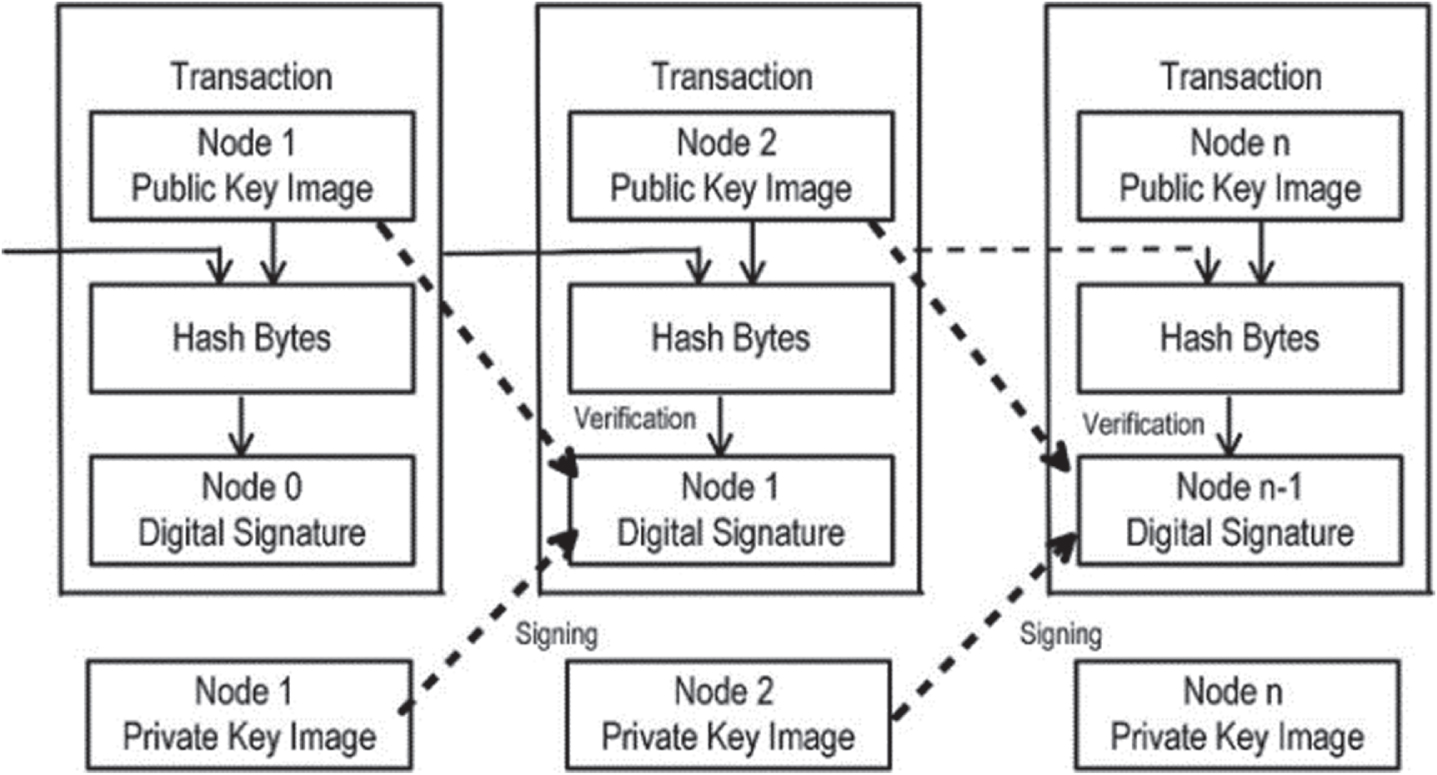
Architecture of multi signature scheme for secure hash algorithms.
Security features of Hash functions
The following steps are followed to secure hash algorithms based multi signature schemes. It can be divided into 3 phases. Image key generation phase Image signature generation Image signature verification
Group of images can be represented by K in (i≤l≤N)
Generate number of private key images such that 0≤P
rk
≤n Generate number of public key images such that 0≤P
bk
≤n Select number of message keys for images such that 0≤M
k
≤n Select number of address keys for images such that 0≤A
k
≤n Select brute force attack keys for images such that 0≤B
fs
≤n Select sybil attack keys for images such that 0≤S
yb
≤n
Generation of images with multisignature which is in the group of S
im
(l≤i≤N). Convert the array of data bytes into the public key images. Convert the array of data bytes into the private key images. Convert the message into the length of bytes value. Computation of array of bytes encryption from public key images with information bytes
here Pbk
i
–Number of public keys and Mj –Number of message information keys Computation of encoded array bytes using private key images with message information bytes
Where Prk
i
–Number of private keys and Mj –Number of message keys Compute different hash algorithm of private key image array of bytes with message bytes.
Measurement of accuracy for various hash algorithm with “private key images” [for M in f1]
Where Zacc–Private key image accuracy and Sa –Sum of hash values denoted by sum(f1) Measurement of time for various hash algorithm with private key images [for i in f1]
“Brute force attack” and “sybil attack” keys are combined with private key image and message bytes.
Where Bfn1 –“brute force attack” byte length and Bf1 –Difference of hash value bytes. Sybak –Length of bytes in sybil attack and Syn–Difference of hash value bytes. Measurement of accuracy for various hash algorithm with private key images
Where Z1acc –Private key image accuracy after brute force attack and S2 –Sum of hash values with attack bytes denoted by sum(P9) Measurement of latency of signature generation for hash algorithms interms of private key images
Computation of recovering the signature from attacks
Where Rbf –Recovered the key from brute force attack and Rsy –Recovered the key from sybil attack.
Compute the bytes of array from public key images with message bytes.
Where Vh obtained by
Vhd –encoded bytes of private key image for different hash value. Computation of public key images array of bytes with private encoded bytes.
Where Vhs–encoded bytes of public key images and Vsd –encrypted bytes of hash algorithm for “private key image” and message bytes. Measuring the accuracy for various hash algorithm with public key image data
Where Z2acc–public key image accuracy and S3 –sum of hash algorithm values [sum(f12)] Measuring the latency of signature verification for various hash algorithm with public key images
Compute the different address of encoded values of image data with address of bytes.
Where Vhad1 –encrypted public key images of bytes with message and Vhak –encrypted address data bytes. Compute different hash algorithm values of image with address data
Measurement of accuracy for public key image with address bytes of data
Where M –different address bytes with public key image data and S4–sum of address bytes [sum(fad)] Measurement of time complexity with address bytes data
Verified the decoded address and public key with message.
In this work, “revised elliptic curve cryptography multi signature scheme” can be proposed to boost the safety using medical images. Medical images or patient photos can be used as private keys and public keys in this work. Particularly, this work can be proposed for storing and transmitting the brain tumor patients from one hospital to other hospital. It can be performed as decentralized network. Every patient information can be stored in each block in this technology. Block contains the information about patient name, address, and their medical history. If any node or hospital or lab needs information about any patient that can be include in network, that node use the public key image to authenticate the data.
General form of ECDSA stretches a curve within the finite range of valid points on its N. a, b, P, N and G are elliptic curve functions. It can be written in Equation (1).
Where P- Prime modulo function, N- Number of points in elliptic curve, G- Reference points.
In this work, the reference point can be calculated by modular multiplication of keys instead of modular addition. It is P-P (Peer to Peer) network to record and store the patient’s information, transaction details. It has the advantages of decentralized network, secure transaction, tamper proof and data secure. This work makes the smart healthcare system in case of population. The information can be transacted to nodes including hospitals, research labs, insurance and bank. Figure 4 shows the flow chart of revised elliptic curve cryptography to store health records. The proposed algorithm enhances the security by generating keys up to 512 bytes of hash values compare to other cryptography hash algorithms like “SHA224”, “SHA256”, “SHA384”, “SHA512”, “SHA3-224”, “SHA3-256”, “SHA3-384”, “SHA3-512”, and “MD5”. Multi signature can be signed by number of authorities including patient, hospital, research Centre to give permission to exchange the patient information. This work generates the fixed hash values as keys and address bytes. If anyone tries to hack the key, it can be identified easily in this work. Because it increases the hash bytes. From this sudden increasing of hash bytes, the authorities can know the present attacks.
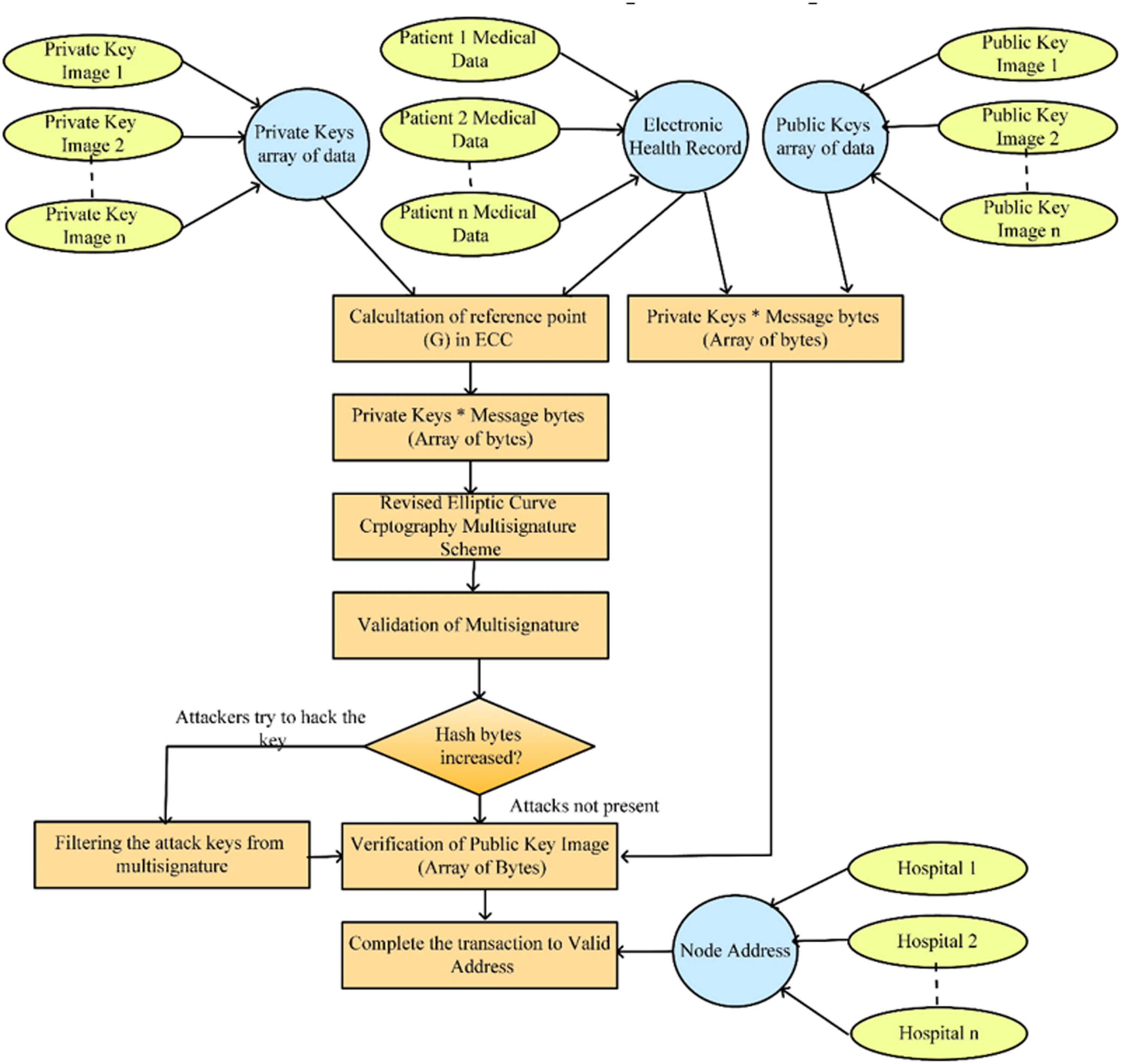
Flow chart of “Revised Elliptic Curve Cryptography” (RECC-MSS) for healthcare applications in Blockchain technology.
This work can be implemented by three phases. These are image key generation, image multi signature generation, and multi digital signature verification. The medical images or patient photos can be used for private key, public key generation. If any node needs information about the patient, that node verifies the public key image as array of bytes with multiple authorities.
The public key image is validated by multiple nodes, then the patient information is transacted in safe manner. Here, multiple services can access the encoded healthcare information without compromising privacy and security. Previous work uses the SHA256 function for multi signature algorithm for transmission. But this function access only 256 bytes of key size. Our proposed scheme uses “revised elliptic curve cryptography” to extend the key size of 512 bytes of key size using modular multiplication of keys instead of modular addition.
The three phases of multi signature algorithm for RECC-MS Scheme can be explained below:
Generate the number of image keys as follows Generate number of private key images such that 0≤P
rk
≤n Generate number of public key images such that 0≤P
bk
≤n Select number of message keys for images such that 0≤M
k
≤n Select number of address keys for images such that 0≤A
k
≤n Select brute force attack keys for images such that 0≤B
fs
≤n Select sybil attack keys for images such that 0≤S
yb
≤n
Convert the public key images into array of data bytes. Convert the private key images into array of data bytes. Convert the message into the length of byte values. Calculation of EC valid points in public key images with message values
Where P
bk
–Number of public key images and M
k
–Number of message keys Calculate the EC reference point in public key images with information byte
The individual public key images sent to nodes which are in the network point Gimg
i
to the equation.
Computation of the hash function of EC using public key image array with message bytes.
Where Pi–Public key images, Qj- Message values, and Gi –Individual node within the network Measurement of accuracy with private key images
Where Ac –Accuracy of private key image, S3 = sum (F1) Measurement of latency of signature generation with private key images
Where F1 –hash values of revised elliptic curve cryptography.
If brute force attack and sybil attack is present in private key image with message bytes
Where Bf1 –Length of bytes in brute force attack and Ba–Difference of hash value bytes. Sy1 –Length of bytes in sybil attack and Sa–Difference of hash value bytes. Measurement of accuracy for various hash algorithm with private key images
Where Ae –Error accuracy of private key image after brute force attack and S2 –Sum of hash values with attack bytes denoted by sum(P9) Measurement of latency of signature verification
Recovering of keys from attacks
Where Rebf –Recovered the key from brute force attack and Resy –Recovered the key from sybil attack.
Compute the address of RECC with public keys
Computing the EC refernce point in public key image with message
Where VHa –public keys with message encrypted data, VHp –private keys with message encrypted data and G –reference point Measurement of accuracy in public key image and message
Where M
i
–EC values, S4 = sum (F2). Measurement of time measurement in public key image with address
RECC-MS scheme results
“Revised ECC with multi signature” can be implemented to improve the security. It can be proposed in three phases. These are generation of keys, signature creation, and authentication of address. The private key image can be taken as patient picture. The medical image can be converted into array of data, then it can be modularly multiplied with message bytes. The message key contains the information about patient name, date of birth, medical history by medical provider.
Figure 5 represents the example of patient image as private key and conversion of key images into array of bytes. Figure 5 (a and c) denotes the examples of patient image and Figure 5 (b and d) denotes the array of bytes for the respected images. In this work, key images have been taken from google for references.
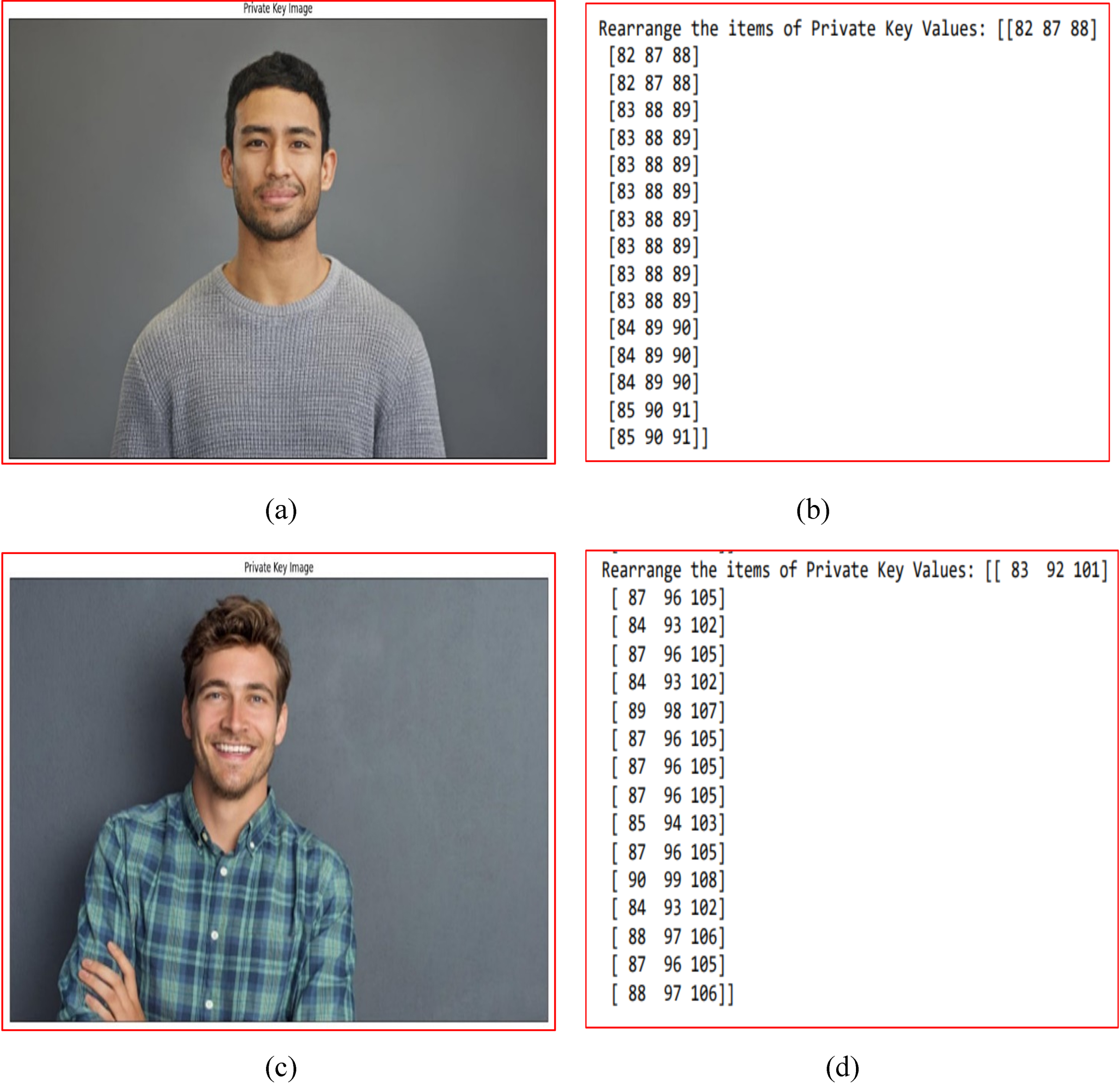
Conversion of key images into array of bytes.
Table 2 shows the example of hash bytes for private key 1. Here the private key can be given as image like patient face photo or biometric or medical image. These key images can be converted into array of data. This array of data can be performed in the operation of modular multiplication with data bytes. Finally, it generates hash bytes for private key with message. Figure 6 shows the example of decoded image with messages after transaction. It contains the patient’s name, age, and medical history.
Generation of Hash Bytes for key image 1
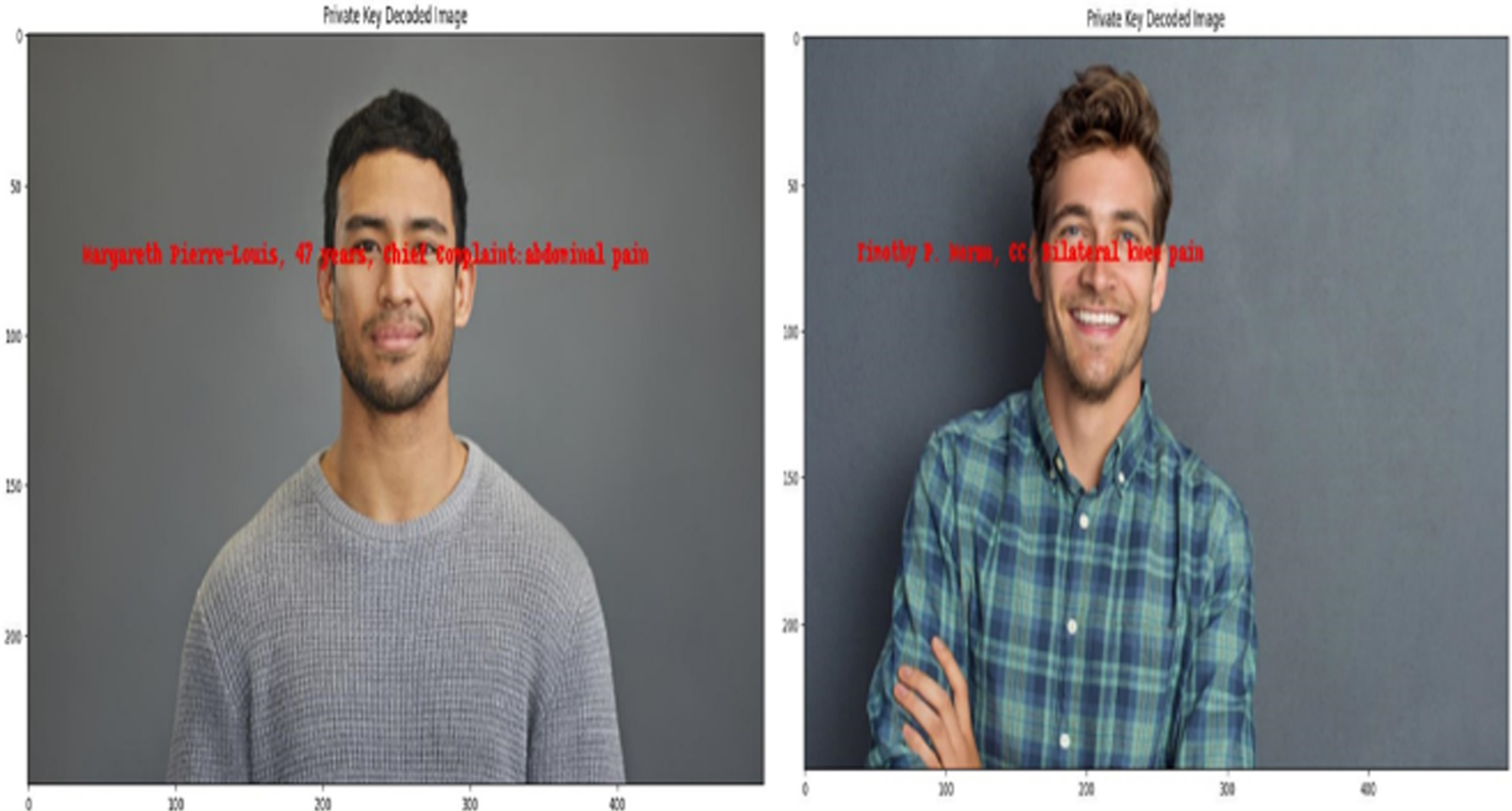
Decoded image with messages after transaction.
Table 3 represents the generation of “private key”, “public key”, “message bytes”, “address bytes” and “attack keys” including “brute force attack” and “sybil attack”. This table denotes the generated hash bytes after modular multiplication of private key and message bytes, public key and message bytes. If someone tries to hack the key as vulnerable attacks like sybil attack and brute force attack, it increases the generated hash bytes. The generated attack hash bytes also are shown in this table.
Conversion of Key images to array of bytes
Table 4 represents the example of changed hash bytes after security attacks on private key image1. Brute force attack denotes the cracking or hacking of password or encrypted private key. It is the unauthorized access in decentralized network. Similarly, sybil attack is a major issue in decentralized network. Sybil attack creates the multiple fake authorities to identify the password.
Altered Hash Bytes after security attacks in Private Key image 1
In our work, vulnerable attacks can be easily identified by the altered hash bytes. But our proposed work produced the constant signature in generation, and verification of keys.
Due to changes in hash bytes, the authority person easily identifies the presenting attacks. Then this work finds another shortest and vulnerable free path to transact the patient information.
Figure 7(a) shows the produced signature hash of “private key” in multi signature. Figure 7(b) shows the authentication of “public key” in multi signature. “SHA224” and “SHA256” cryptography hash function produces the 32 bytes of hash. But it leads to vulnerabilities due to its small key size. SHA384 and SHA512 generates the 56 bytes of hash, “MD5” and “SHA3-224” generates the 64 bytes. Similarly, “SHA3-256” and “SHA3-384” produces the 96 bytes and “SHA3-512” and “RECC-MS” produces the 128 bytes of hash. But “SHA3-512” access only 256 bytes of key size only. RECC-MSS can be proposed to extend the input key size up to 512 bytes.
Figure 8 represents the graphical form of generated hash bytes after verification of address like hospital name, research center, lab names. After successful verification of address, the message information is transacted along with key image. From this verification, it understood that the hash of “private key” are equal with hash bytes of public key.
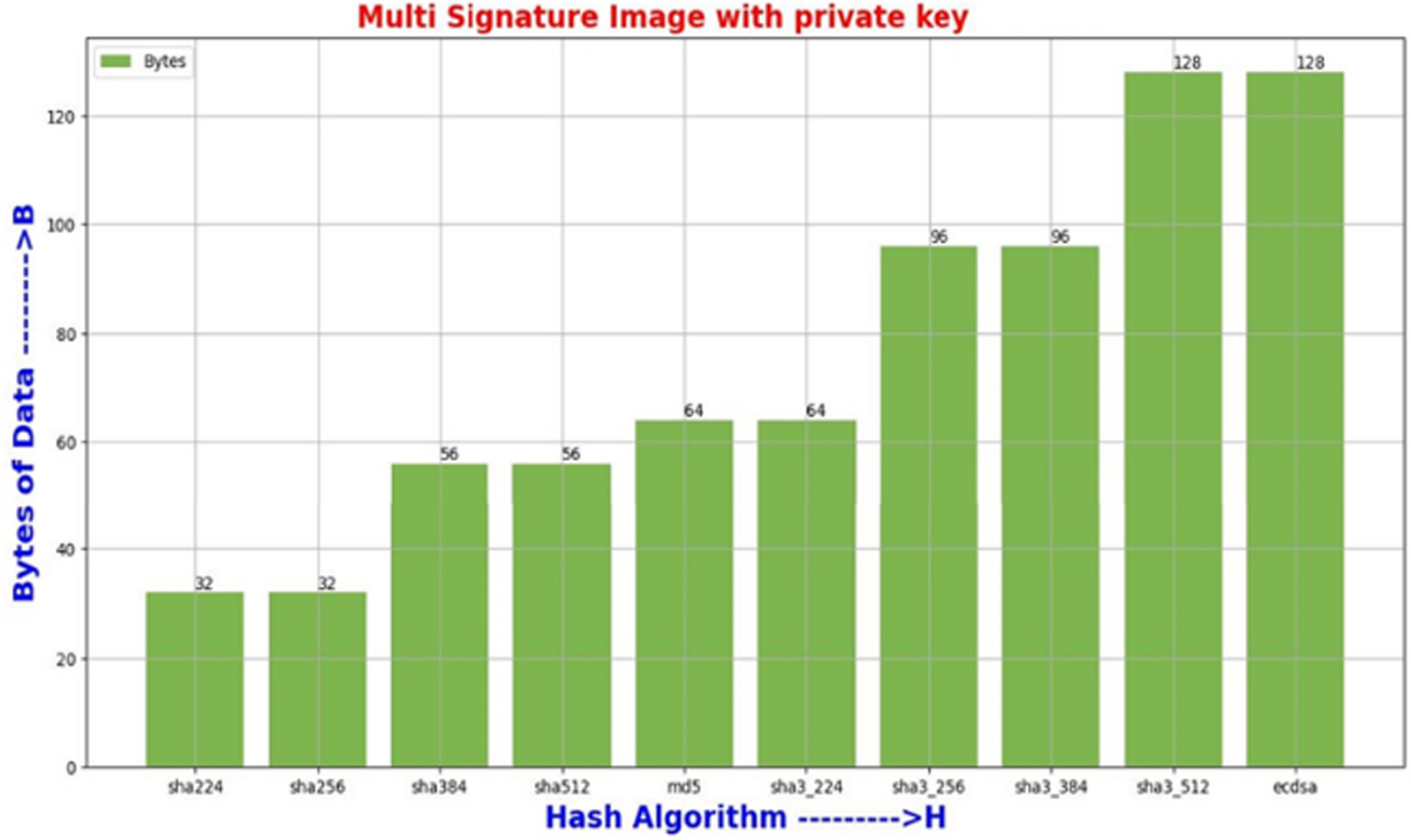
(a) Generated hash byte for private key image.
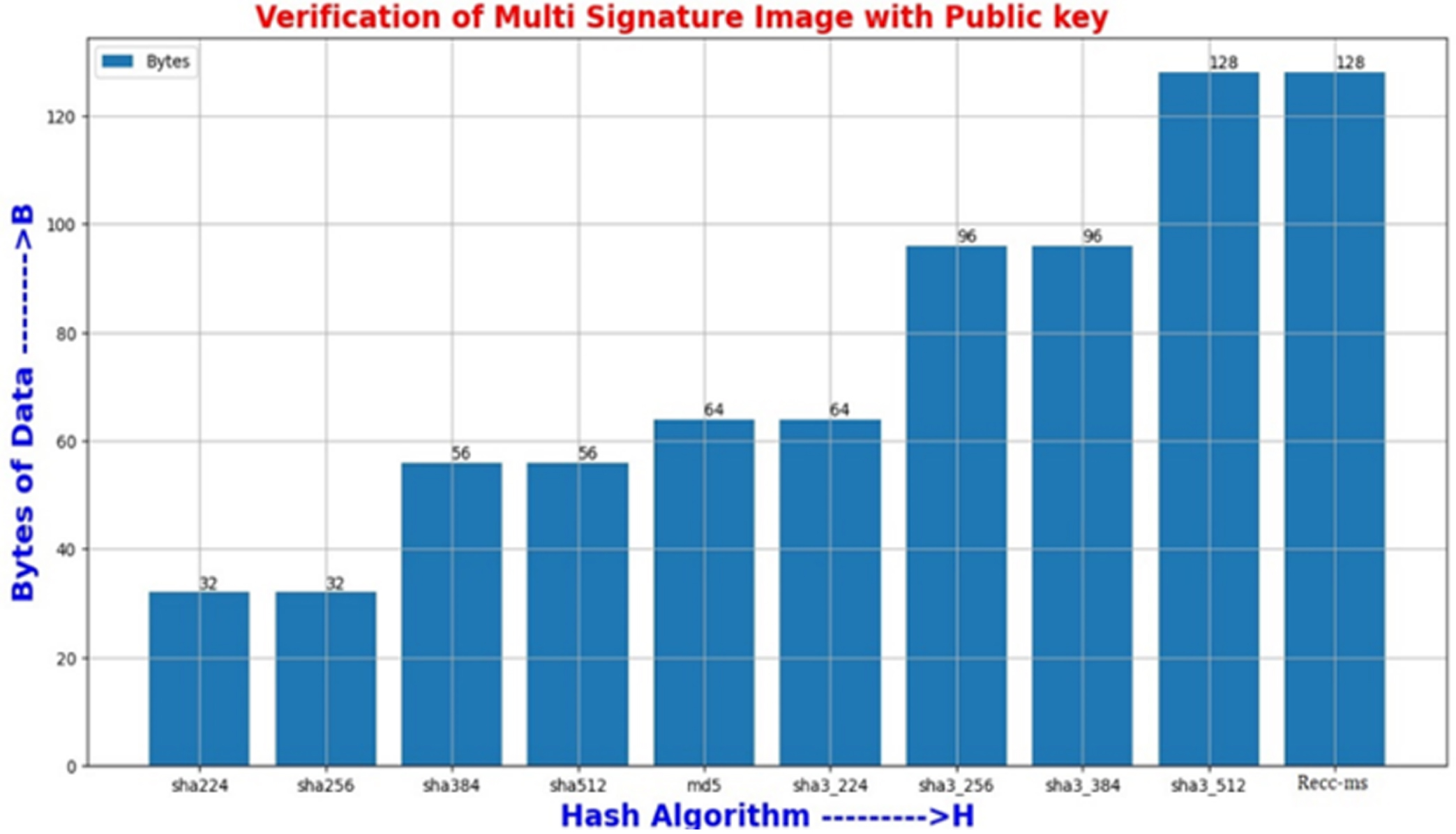
(b) Verified public key hash byte with multi signature.
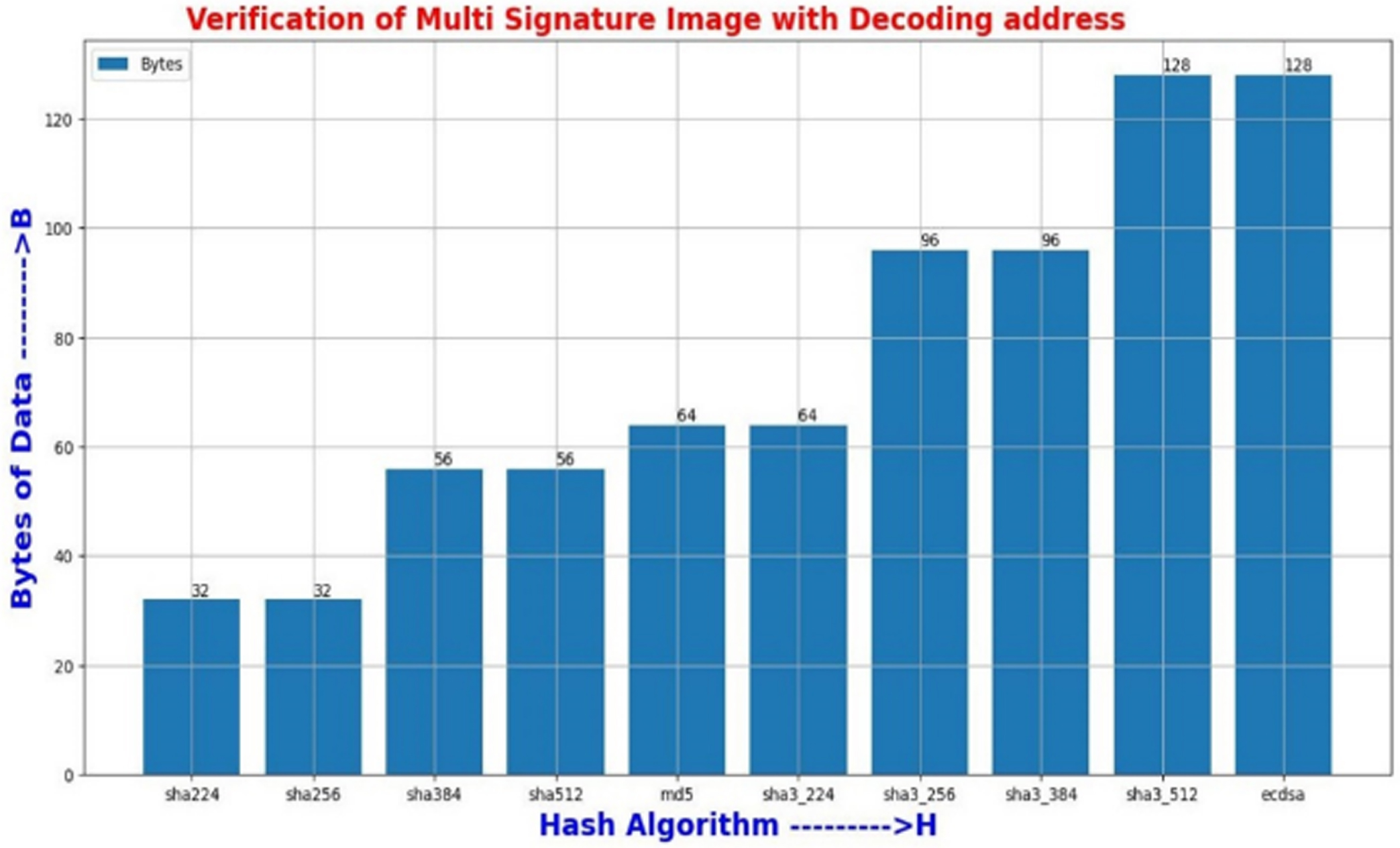
Verification of address with multi signature.
The generated constant signature and generated hash bytes after attack is shown in this figure. If attackers are hacking the key, the attack key bytes are added is constant signature to identify the attacks.
Table 5 represents the analysis of cryptography hash algorithms with multi signature in the concerns of accuracy, and time complexity. When attack is present, it increases the accuracy. The transaction has been cancelled, if sudden changes are there.
Performance Analysis of Cryptography hash algorithms
Performance Analysis of Cryptography hash algorithms
As well as the variations in hash output denotes the vulnerabilities. These attack bytes are added with original signature. Then it will produce large hash output. In authentication phase, the public key hash output can be verified by multiple authorities. If any attack presents, the security attack bytes can be filtered from key bytes. It can be shown in Fig. 9.

Generated hash bytes of constant signature and after attack presence.
Figure 10(a) 10(b) represents the noise level in signature size after security attack in constant signature. The generated signature has been changed suddenly due to the security attacks like brute force attack and sybil attack. After the security attacks, the attack key is modularly added with constant signature. So, it suddenly increases the signature size. Then the key can be recovered by byte filtering method.

(a) Noise level in signature size after brute force attack.

(b) Noise level in signature size after sybil attack.
In a successful transaction following address verification, Fig. 11 accurately measures various cryptography hash functions with multiple signature schemes. This finding demonstrates that updated elliptic curve encryption with multiple signatures accurately transmits information 93.25% of the accuracy.
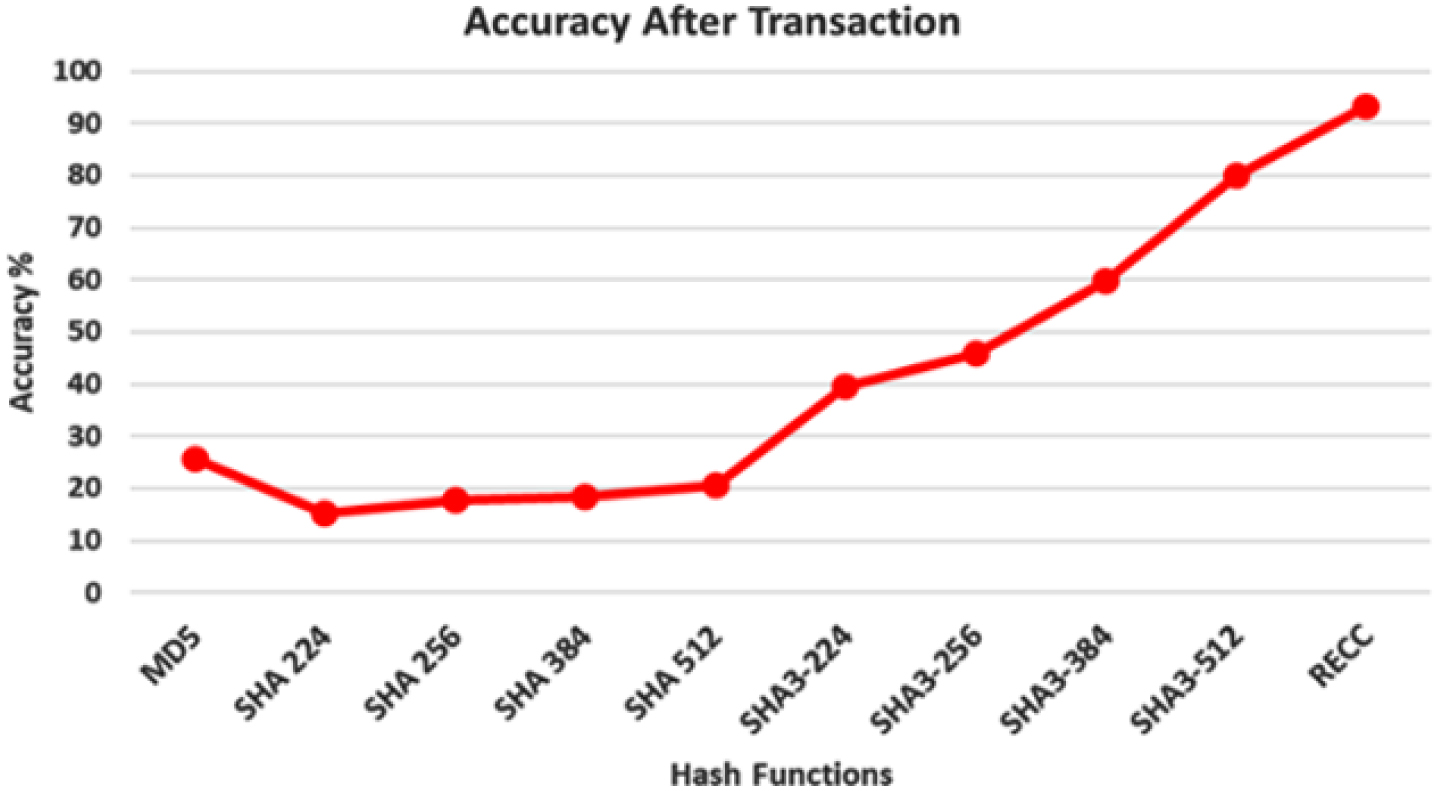
Accuracy measurement of cryptography hash functions with multi signature after address verification.
Accuracy is defined by calculating number of bytes transferred to receiver node from sender in accurate manner (Equation 2). It can be calculated by,
Time complexity is calculated by taking the logarithmic of accuracy. Otherwise, it can be by calculated by time taken to complete the transaction after signature verification. If attackers are trying to hack the password, it takes more time to complete the transaction.
Time complexity generally can be written as,
In this work, the time complexity denotes that time taken to transfer the medical information after signature verification. The latency for signature generation denotes that time taken to generate the signature based on the given key size. Similarly, the latency for signature verification is the time taken to verify the private key signature with public key signature.
The latency of signature generation for hash algorithms interms of private key images is given by,
In Secure hash functions,
In Elliptic curve cryptography,
The latency of signature verification for various hash algorithm with public key images in both hash functions and ECC is given by,
The measurement of time complexity with address bytes data is given by,
In Secure hash functions,
In Elliptic curve cryptography,
Throughput is defined by calculating the amount of data bytes transferred between locations during a specified period (Equation 8). It can be calculated in bytes per second.
The “time complexity” of several cryptography hash algorithms with multiple signatures after a transaction is similarly depicted in Fig. 12. Time complexity refers to the time it takes to complete a transaction, including the time it takes to generate keys, validate multiple signatures, and verify addresses.

“Time complexity” of cryptography hash functions.
Table 6 represents the throughput analysis of different cryptography hash functions for the time period of 20 ns, 50 ns, 100 ns, and 200 ns. From this analysis, the elliptic curve multi signature scheme achieved the throughput of 17.07 KB per 200 ns.
“Throughput” analysis of various cryptography hash functions is exposed in Fig. 13. It can be analyzed by different time period. From this analysis, ECDSA with proposed scheme achieved throughput of 1.71 kilobytes per 20 nano seconds, 17.07 kilobytes per 200 nano seconds.
Throughput Analysis of Cryptography hash algorithms

Throughput analysis of cryptography hash functions.
SPSS software can be chosen for statistical analysis for this work [22]. For analysis, totally 10 groups have been taken including “MD5”, “SHA224”, “SHA256”, “SHA384”, “SHA512”, “SHA3-224”, “SHA3-256”, “SHA3-384”, “SHA3-512” and “RECC-MSS”. For the one-way Anova test, five samples from each group were considered. This test is used to calculate the mean square, sum of squares, and significance can be done using this test. It can be examined using a G-power of 80% and an α-value of 0.05 with a 95% confidence level (CI). “One-way anova test” for comparing various cryptography hash algorithms with revised elliptic curve cryptography for the multi-signature method is shown in Table 7. Five samples for each group have been considered for “One-way Anova test. It can be analyzed by pretest power 80% and alpha value 0.05 with CI of 95%. It 7 gives the “One-way anova test” for analyzing different cryptography hash algorithms with “revised elliptic curve cryptography” of multisignature scheme. The obtained significance value for accuracy is 0.001 and for time complexity is 0.002 (p < 0.05). After security attacks, the accuracy values can be increased suddenly which can be denoted as accuracy1. After recovering keys from attacks, the keys can be verified and validated transaction is denoted as accuracy2. Similarly, time complexity values can be noted.
“One-way Anova test” and statistical analysis for “accuracy” and “time complexity”
“One-way Anova test” and statistical analysis for “accuracy” and “time complexity”
Figure 14(a) represents the statistical analysis of accuracy measurement with significance value of 0.001 and Fig. 14(b) represents the statistical analysis of time complexity with significance of 0.002. Revised elliptic curve cryptography with multi signature scheme attains an “accuracy” of 93.25% and “time complexity” of 1.5 ns after recovering keys from attacks. This analysis detected that our proposed algorithm “ECC” has significantly higher “accuracy” and lesser “time complexity” than other cryptographic hash functions.
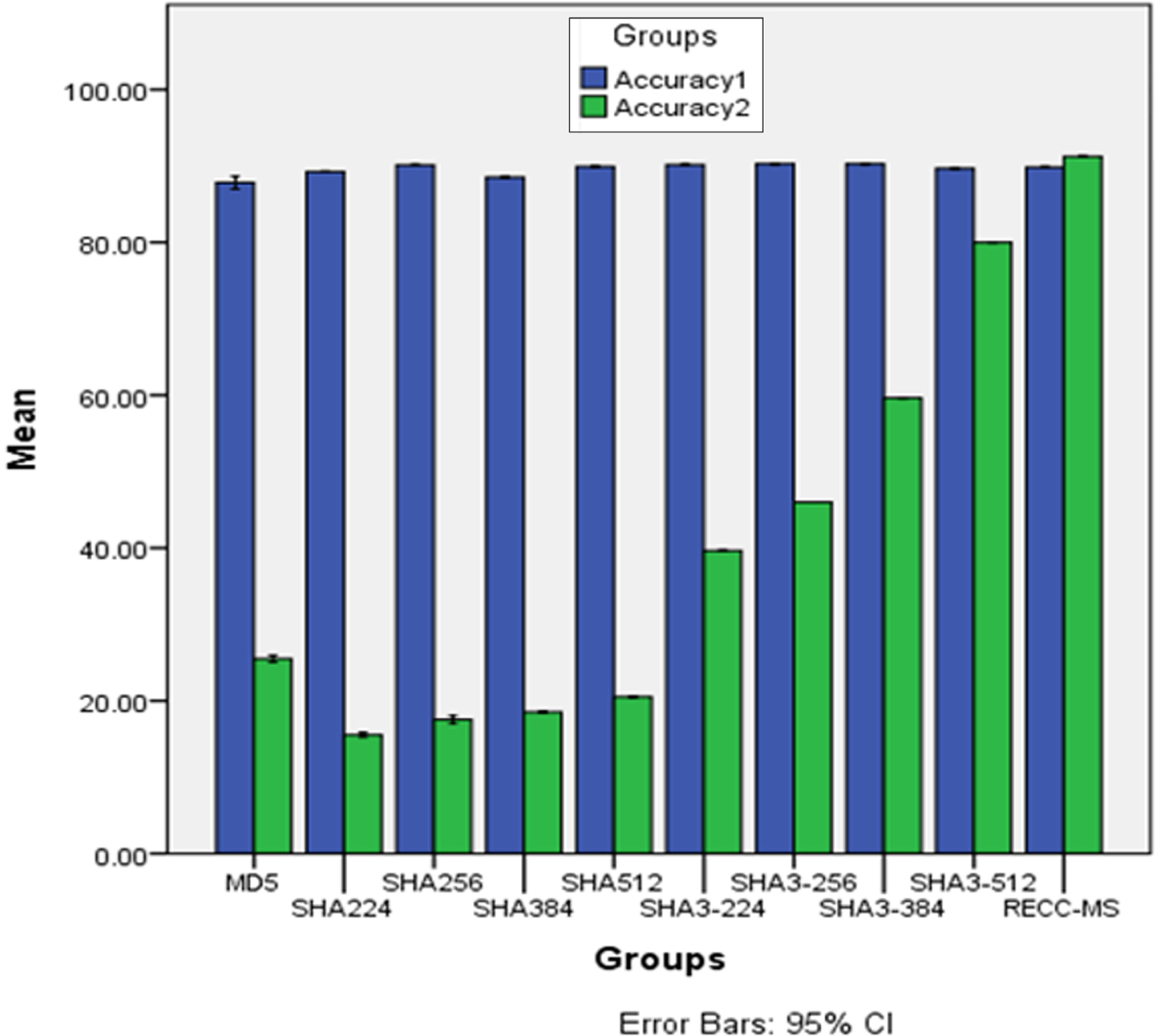
(a) Statistical analysis of different cryptography hash algorithm with proposed algorithm –Accuracy analysis.
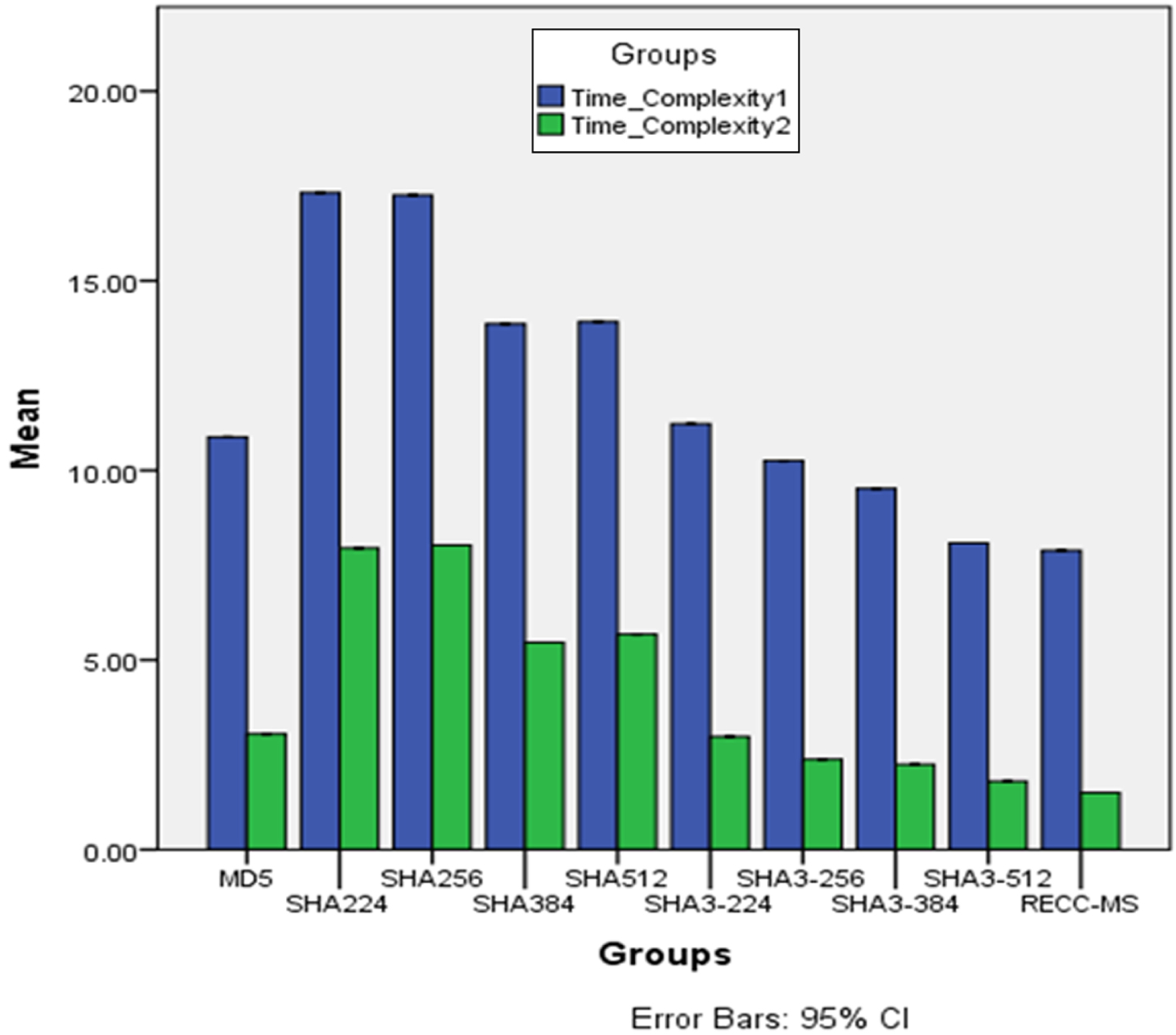
(b) Statistical analysis of different cryptography hash algorithm with proposed algorithm –Time complexity analysis.
Table 8 shows the comparison of existing scheme and RECC-MS scheme by different parameters. This work concentrated on to increase the security. Keys can be selected as different patient images. Existing signature schemes used arithmetic operations of modular addition with inversion operation. The proposed scheme used the modular multiplication of multiple node transaction at a time.
Comparison between existing scheme and RECC-MS Scheme
Comparison between existing scheme and RECC-MS Scheme
The multi signature with digital evidence framework was used strings of keys only up to 128 bytes accessible with 72% of accuracy, 70 ms of latency for signature generation, 73 ms of latency for signature verification, 52 ms of time complexity and throughput of 13.5 KB per ms. But this work is not suitable for image key and it is vulnerable to brute force and sybil attack.
The multi signature scheme with elliptic curve cryptography was developed with 512 key size accessible. This work achieved the greater accuracy 90% with usage of string keys. It is not suitable for image keys. As well as, it allows only 10 transactions at a time. Then another existing scheme of Identity based password signature scheme of multinode biometrics accessed the keys biometric images with modular addition with inversion. As well as, this scheme used the SHA-256 for signature generation. It achieved the accuracy of 70% with high digital signature forgery. But it allows the only four transactions at a time.
From this comparison, the revised elliptic curve cryptography transacted the decrypted message with accuracy of 93.25%, time complexity of 1.5 ns and throughput of 17.07 KB per 200 nano seconds. The time complexity denotes that time taken to complete the transaction. The key images are converted into array of bytes. Then it can be multiplied with message bytes for generating the signature. The proposed schemes took same timing for the latency of generating and verifying the signature and complete transaction. The latency denotes that the time required to complete the process. It allows multiple transactions at a time. Finally, the research was achieved to enhance the security for multiple node accessibility rather than limited node accessibility without random number keys generation. But this work is limited for less key patient images and it transfers the limited medical information. In future, it can be extended to transfer the increased medical data and developed for large scalability using more patient images.
Cryptography hash functions are the major part in blockchain technology for secure transaction. In medical field, Existing hash function with digital signature has single node accessibility and access the key size up to 256 bytes. It is difficult to safeguard the patient information in centralized network. So essential scheme is required to safeguard the patient information through encrypted patient images as keys. This work proposes the “revised ECC of multi signature scheme” (RECC-MSS) which can access the key size up to 512 bytes with usage of medical images for multiple node approachability to detect the nearest pathway for secure transactions. Then the performance of the proposed algorithm is analyzed with various cryptography hash functions like Secure Hashing Algorithms (SHAs) such as “SHA224”, “SHA256”, “SHA384”, “SHA512”, “SHA3-224”, “SHA3-256”, “SHA3-384”, “SHA3-512”, and “Message Digest5” (MD5) by “One-way ANOVA test” in the concerns of “accuracy” and “time complexity”. From statistical analysis, RECC-MSS achieves 93.25% accuracy with a significance of 0.001, time complexity of 1.5 nanoseconds with 0.002 for time complexity and throughput of 17.07 kilobytes per 200 nano seconds. The statistical performance shows that the “RECC-MSS” has significantly high “accuracy” and less “time complexity” than other cryptography hash algorithms. This suggested signature scheme is the best for securing the patient image with confidential medical data across a wireless medium and is effectively protectable from security vulnerabilities.
Data availability statement
The data used to support the findings of this study are included within the article.
Conflicts of interest
The authors declare that they have no conflicts of interest in this article.