



Abstract
Every decision-making process particularly those involving real-life issues is disproportionately plagued by uncertainty. It is also unavoidable and obvious. Since its conception are several ways for representing uncertainty have been proposed by numerous academics to cope with uncertainty. Fuzzy sets and hierarchical such as picture fuzzy sets stand out among them as excellent representation techniques for modeling uncertainty. However, there are several significant drawbacks to the current uncertainty modeling techniques. Due to its vast versatility and benefits we here embrace the idea of the spherical fuzzy set, an extension of the picture fuzzy set. On the other hand amid uncertainty in real life the multi-objective plays a critical role. In this research paper determining a Multi-Objective Linear Programming Problem of Spherical fuzzy sets serves to stimulate nous. The score function corresponding to the degree positive, negative and neutral is the foundation upon which the suggested approach is developed. Additionally we apply the suggested strategy to the solution of the multi-objective linear programming problem to demonstrate its superiority through certain numerical examples. Maximization or Minimizing of the cost is the primary goal of the multi-objective linear programming problem. Using an explicitly defined score function the suggested solution transformed the Spherical Fuzzy Multi-Objective Linear Programming Problem into a Crisp Multi-Objective Linear Programming Problem (CMOLPP). We establish some theorems to show that the efficient solution of CMOLPP is likewise an efficient solution of SFMOLPP. The CMOLPP is then further simplified into a single-objective Linear Programming Problem (LPP) thus we revamp the modified Zimmermann’s approach in the environment of a nonlinear membership function with the aid of the suggested technique. It is possible to simply solve this single-objective LPP using any software or standard LPP algorithm. The suggested approach achieves the fuzzy optimum result without altering the nature of the issue. An application of the suggested approach has been used to illustrate it and its results have been distinguished from those of other preexisting methods found in the literature. To determine the importance of the suggested technique which adjudicate thorough theorem and result analysis is conducted.
Keywords
ABBREVIATION
Multi-objective Linear programming Problem
Spherical Fuzzy numbers
Multi-objective spherical fuzzy linear programming problem
Multi-Objective Linear Programming
Linear programming problem
Introduction
Spherical fuzzy numbers (SFNs) are an extension of fuzzy numbers that have gained popularity in recent years in the field of fuzzy set theory. Fuzzy numbers are a mathematical tool used to handle uncertainty and vagueness in various fields such as decision-making, pattern recognition, image processing and expert systems. In standard SFns are defined as a fuzzy number where the membership function has a spherical shape. The center of the sphere represents the most representative value of the number and the radius of the sphere represents the degree of uncertainty or fuzziness associated with the number.
SFns are more flexible and expressive than classical fuzzy numbers because they can model a wider range of uncertainty and ambiguity. For example while classical fuzzy numbers can only model uncertainty in one dimension such as the degree of membership of a single number and SFns can model uncertainty in multiple dimensions such as the degree of membership of a number in multiple criteria SFn have many applications in various fields such as decision-making, finance, and engineering. They provide a more accurate and comprehensive method for handling uncertainty especially when dealing with complex and dynamic systems.
Various mathematical tools and techniques have been developed to analyze and apply SFns in different fields. For example aggregation operators can be used to combine multiple SFns to form a single SFN that represents the overall uncertainty or ambiguity of a system. Overall SFNs are a powerful and practical approach to dealing with uncertainty and vagueness in various contexts and they continue to be an active area of research in the field of fuzzy set theory.
The main aim of this study is where the spherical fuzzy numbers can be used to fit and approximate uncertain data more accurately than traditional fuzzy numbers which leading to better modeling and forecasting. Spherical fuzzy numbers offer a more comprehensive way to represent uncertainty in a system. In addition to the membership degree they also incorporate information about the dispersion or variability of the data, which provides a more accurate description of uncertainty. Spherical fuzzy numbers in Multi-objective LPP are useful in handling situations where there is imprecision and ambiguity in the data. They can model robustness and tolerance which is crucial in real-world decision-making processes where exact values may not be available or practical.
In multi-objective linear programming (MOLP) the purpose of using spherical fuzzy numbers is to model and handle uncertainty or imprecision in the objective functions, coefficients and constraints. Spherical fuzzy numbers are a type of fuzzy number that extend the concept of fuzzy numbers to two-dimensional space, typically represented as a center and a radius.
The are some reasons for using spherical fuzzy numbers in MOLP as follows,
In real-world decision-making scenarios there are often uncertainties associated with objective values and constraints. Spherical fuzzy numbers provide a convenient and intuitive way to represent such uncertainty in the problem data. Fuzzy multi-objective linear programming allows decision-makers to explore a range of possible solutions rather than just a single optimal solution. Spherical fuzzy numbers add an extra level of flexibility by considering a region of possible values defined by the center and radius instead of a single point estimate. By using spherical fuzzy numbers MOLP can perform robustness analysis to assess the stability and sensitivity of the optimal solutions under variations in the input data. This is particularly useful in situations where the exact values of the coefficients or objectives are not precisely known.
Spherical fuzzy numbers can capture ambiguous or vague information in the problem formulation. This is essential when dealing with subjective judgments or qualitative data as they provide a way to represent and incorporate such information into the optimization process. Spherical fuzzy numbers can be combined with different decision-making approaches such as fuzzy goal programming or fuzzy compromise programming to find solutions that balance multiple objectives under risk or uncertainty. It’s important to note that the use of spherical fuzzy numbers in MOLP may require specific algorithms and mathematical formulations to solve the optimization problem effectively. Researchers in the field of fuzzy optimization continuously work on developing efficient techniques to handle these types of problems.
Overall, the use of spherical fuzzy numbers in multi-objective linear programming allows for a more comprehensive and realistic approach to decision-making in situations where uncertainty and imprecision play a significant role.
The triangular fuzzy numbers (TFNs) are supposed to be the values of all the coefficients and variables in rubi [3] completely fuzzed MOLF optimization problem and three current classical numerical issues are turned into FFMOLF optimization problems using approximation TFNs to validate the proposed fuzzy intelligence algorithm. The strategy was put out to reduce the complexity of the computation used to solve the MOLF optimization problem. Dong [7] introduced a fuzzy multi-objective linear program with Trapezoidal fuzzy numbers (TrFNs) converted into an interval multi-objective linear programme using the order relationship of TrFNs. The interval multi-objective linear programme is further changed into a crisp multi-objective linear programme by combining the ranking order relation between intervals with the interval objective programme. The approach relies on α-cuts of the fuzzy solution to build its possibility distributions and then converts the crisp multi-objective linear programme into a mono-objective programme to be solved. Ahmad and Adhami [2] investigated a new algorithm based on the spherical fuzzy set (SF) named the spherical fuzzy multi-objective programming problem (SFMOLPP) under the spherical fuzzy environment. The SFMOLPP inevitably involves the degree of neutrality along with positive and negative membership degrees of the element into the feasible solution set. The attainment of the achievement function is determined by maximizing the positive membership function and minimization of the neutral and negative membership function of each objective function under the spherical fuzzy decision set.
Improved aggregation operators for T-spherical fuzzy sets were developed by Garg et al. [11] as an expansion of various existing sets including intuitionistic fuzzy sets, Pythagorean fuzzy sets, picture fuzzy sets and neutrosophic sets. Correlation co-efficient for T-spherical fuzzy sets were proposed by Ullah et al. in [18] and used in multi-attribute decision-making and clustering.
For intuitionistic fuzzy sets, Gonga et al. [33] suggested the spherical distance which was then used in decision analysis. Gündogdu and Kahraman [9] recently expanded intuitionistic fuzzy sets to spherical fuzzy sets where 02(x) + v2(x) + w2(x) = 1 defines the hesitancy level of element×in the universe independent from membership and non-membership degrees. Additionally spherical fuzzy distances, arithmetic, and geometric operations are defined for T-spherical fuzzy sets.
To solve the hospital placement selection problem, Gündodu and Kahraman [6] summarized the spherical fuzzy sets and implemented the spherical fuzzy CODAS approach. Due to its significant use during the production of the movie “The Lord of the Rings”, it has been included in 3D animation systems to create crowds.
Since it simulates how a person would make judgments, it is also widely used in contemporary control systems like expert systems and neural networks defined in [5].
In summary fuzzy set theory had been used in the fields of engineering, mathematics, computer sciences, medical sciences, business and economics, social sciences, and human behavioral to produce effective answers under ambiguity.
To model the variance shown by decision-makers in a medical decision-making environment through irregular fuzzy reasoning Garibaldi and Ozen [16] presented real-life research in which the inclusion of vagueness into the membership functions of a fuzzy system was studied. With the help of their aggregating operations the fuzzy goal programming (FGP) problem was first proposed by Zimmermann [12] in 1978 and is now widely used in practically all real-world contexts. The membership goals in the FGP model have a maximum accomplishment degree of unity 1. The FGP simultaneously optimizes the undesirable departure from each objective’s ideal solution. To solve the numerical examples are provided to demonstrate the applicability and validity of the suggested SFGP models. The University of Wisconsin’s Knitro 5.0 online facility is used to answer all of the numerical problems which are all written in the AMPL programming language described. The intuitionistic fuzzy set (IFS) which is based on greater intuition than the FS was studied by [19]. The IFS deals with how much an element fits into the collection of possible decisions as well as how little it does. Floudas [4] provided a brief overview of the genesis and progression of GP issues. Additionally a fresh fuzzy Multi-Objective Geometric Programming problem was researched and applied to transportation issues by Islam and roy [30].
Yang [32] proposed some of the constraints as having fuzzy numbers and suggested a solution for each of the fuzzy goals that were set for the fractional objectives. To deal with fuzzy numbers in constraints and attain the highest membership value SIMM is used. Then, a linear goal programming approach is used to address the issue of fractional objectives that are fuzzy goals. Fuzzy numbers and fuzzy stochastic variables are de-fuzzified and/or de-randomized such as via-cut levels as the traditional way of solving fuzzy linear programming. Currently SIMM has been used in a few fuzzy linear programming issues with uncertainty. A completely novel model known as the LR-type Pythagorean fuzzy linear programming issue was described by Akrama [15] et al. LR-type Pythagorean fuzzy number concepts included ranking for LR-type Pythagorean fuzzy numbers and arithmetic operations for unrestricted LR-type Pythagorean fuzzy numbers. They put forth a technique for resolving fully Pythagorean fuzzy linear programming problems of the LR type that have equality requirements and proposed approach with numerical illustrations including the diet issue.
Nikas et al. [1] presented a algorithm called the robust augmented ɛ-constraint method (AUGMECON-R) for solving multi-objective linear programming problems. It provides a comprehensive overview of the ɛ-constraint, AUGMECON, and AUGMECON 2 methods are highlights the key features that led to the development of AUGMECON-R.
The study compares AUGMECON-R with its predecessor (AUGMECON 2) and shows that the new algorithm outperforms its predecessor in terms of time and efficiency. Gulia [24] provided a comprehensive review of fuzzy-based multi-objective linear programming methodologies. It covers the fundamental concepts and prior research related to fuzzy set theory, triangular fuzzy numbers and their associated operations and the paper also discusses various methods for addressing the generic fuzzy multi-objective linear optimization issue and compares the resulting degrees of satisfaction. Additionally the limitations of using crisp conditions for multi-objective optimization and compares different fuzzy methods used to solve the problem of multi-objective optimization in an uncertain setting.
Riaz and Farid [20] present their research on enhancing green supply chain efficiency through Linear Diophantine Fuzzy Soft-Max Aggregation Operators. This study highlights the importance of sustainable practices in the entire supply chain from product design to transportation to minimize waste and reduce environmental impact while also improving business performance. Kausar [25] presented method for modeling water hammer in water distribution networks using switched differential-algebraic equations. The approach has the potential to prevent damage to network components and is supported by mathematical models for pipes, reservoirs, and valves. The paper includes a comprehensive analysis of a simple water network to demonstrate the occurrence of water hammer.
Farid [13] discussed the use of q-rung ortho-pair fuzzy Aczel–Alsina aggregation operators in multi-criteria decision-making. It provides a detailed analysis of the theory and properties of these operators and their advantages over other methods. The paper also includes practical examples of how these operators can be applied in real-world scenarios such as green supplier selection. Overall the article offers insights into the potential of q-rung ortho-pair fuzzy Aczel–Alsina aggregation operators for improving decision-making processes. Farid’s [14] research delved into the concept of q-rung orthopair sets (q-ROFSs) an extension of traditional orthopair fuzzy sets like intuitionistic fuzzy sets (IFSs) and Pythagorean fuzzy sets (PFSs). To enhance the applicability of q-ROFSs, the study introduces novel aggregation operators (AOs) with suggested operational laws. These AOs include the “q-rung ortho-pair fuzzy Einstein interactive weighted geometric operator,” the “q-rung ortho-pair fuzzy Einstein interactive ordered weighted geometric operator, the generalized q-rung ortho-pair fuzzy Einstein interactive weighted geometric operator,” the “generalized q-rung ortho-pair fuzzy Einstein interactive ordered weighted geometric operator,” and the “generalized q-rung ortho-pair fuzzy Einstein interactive hybrid geometric operator.
Teghem [17] presented an approach to address uncertainty in multi-objective linear programming (MOLP). The methodology involves sensitivity analysis, MOSLP problem formulation and introduces the STrANGE method, which integrates efficiency projection and interactive decision-making. Wang [26] introduced FMOLP (Fuzzy Multi-Objective Linear Programming) model for tackling Aggregate Production Planning (APP) problems. In this context, intricate trade-offs and inherent conflicts arise among the interdependent objective functions.
Zeng [31] addressed crop area planning in China’s Liang Zhou region. They proposed a novel fuzzy multi-objective linear programming model to optimize water resource allocation for various crops by considering uncertainties like fuzzy goals and uncertain parameters. Our study aims to maximize returns, minimize evapotranspiration and achieve target grain yields. Jiménez [23] presented a two-phase method for solving fuzzy multi-objective linear programming problems to find solutions that are both fuzzy-efficient and Pareto-optimal while accommodating imprecise aspiration levels and tolerance thresholds. Tavakkoli-Moghaddam [27] explained the use of the Lingo computer package to implement an FMOLP model and presented the results from 6-job and 7-job numerical examples including objective values and satisfaction degrees. The article discusses the model’s formulation as two-phase approach and the relevance of fuzzy goal programming in resolving scheduling conflicts.
Literature review
Literature review
Shamloo [22] discussed the development of a multi-objective framework for hydraulic fracturing wastewater management. The framework is based on goal and linear programming to optimize the management of wastewater generated during hydraulic fracturing operations. Ishak discussed [28] a linear optimization study on integrating various mitigation strategies in cement manufacturing. It presents a multi-objective MILP model that considers both environmental and economic aspects. A fuzzy multi-objective optimization model for sustainable closed-loop supply chains (CLSCs) in the dairy industry was presented by Alinezhad [21] and addressed economic, environmental and social impacts simultaneously and uses fuzzy linear programming and goal attainment method (GAM) techniques.
Keshteli [10] discussed the concept of multi-objective programming and proposed an algorithm to solve multi-objective fuzzy linear programming problems. It focuses on a model with flexible fuzzy constraints and suggested an approach using different cuts to reduce the problem to crisp multi-parametric multi-objective linear programming problems. The approach involves a one-phase method to achieve an optimal solution for each objective and then found the optimal Pareto solution using goal programming. Bharati [29] developed a computational algorithm for solving multi-objective linear programming problems using intuitionistic fuzzy optimization. It explains the basic principles of intuitionistic fuzzy sets and operations on them. The algorithm is based on the concept of optimal decision sets obtained by intersecting intuitionistic fuzzy decision sets corresponding to each objective function.
The paper is organized as follows. Section two explains the literature review, Section three is the discussion about basic definitions. Section four introduces the illustrated theorem for spherical fuzzy numbers in MOLPP. Section five explained about Multi-objective fully fuzzy spherical linear programming problem. Section six discusses benchmark description and analysis. Section seven describes the proposed Algorithm. Section eight describes a suitable numerical example for the proposed method. Section nine demonstrated the application in production planning. Section ten illustrates the limitations of the proposed strategy. Section eleven discussed the result analysis. Section twelve discussed comparative analysis. Section thirteen some conclusion is pointed out at the end of this paper.
Numerous studies have been conducted in the field of multi-objective linear programming. However most of the research has focused on exploring their simple numbers like triangular, trapezoidal, intuitionistic, and neutrosophic. Additionally attention has been given to specific applications of fuzzy sets in Multi-Objective Linear programming problems (MOLPP). In a literature review it was found that only have developed into the application of spherical fuzzy sets MCDM and linear programming using spherical fuzzy numbers.
Interestingly despite the extensive research on spherical fuzzy sets there has been a notable absence of studies related to spherical fuzzy sets. Therefore this paper takes a significant step forward by introducing a new concept called “spherical fuzzy sets in multi-objective LPP” and by developing operations to handle such sets. This pioneering effort marks the first-ever exploration of SFMOLPP presenting a novel contribution to the field of spherical fuzzy theory which obtains the fuzzy optimal solution.
By introducing and studying spherical fuzzy sets this research opens up promising avenues for further investigation and practical applications. The ability to represent and manipulate equations under uncertain or hesitant conditions holds potential implications for decision-making processes and other relevant domains. With this groundwork established, future researchers can build upon these findings to develop more advanced techniques and applications related to spherical fuzzy sets.
In summary the field of Spherical fuzzy sets had seen substantial research primarily focused on their properties, characteristics and specific applications in MOLPP. However the paper by Ahmad and Ahdami [2] introduced Spherical Fuzzy sets addresses in an LPP and initiates exploration into this previously unexplored aspect of spherical fuzzy set.
Preliminaries
Picture fuzzy set
Let (
Spherical fuzzy set
Let S be the domain of discourse the spherical fuzzy set is defined as ordered,
The diagrammatic representation of Sfns is in Fig. 1.

Diagrammatic representation of Spherical Fuzzy Number and Geometrical representation of Spherical Fuzzy Number.
Let the two spherical fuzzy numbers is defined as
Score function
Let
Ordering of score function
Let
Optimal solution [2]
A (Optimal Solution) solution x* is said to be an optimal solution to the multi-objective linear programming problem if and only if there exists x* ∈ X such that Zo(x*)≤ or ≥Zo(x) (for minimization or maximization case), for o = 1, 2,..., O and for all x ∈ X.
Example
The mathematical formulation of the problem:
The optimal solution is achieved at the point of intersection This means the point at which the equations X + 2Y≤100 and X + 3Y≤120 intersect gives us the optimal solution. The values for X and Y which give the optimal solution at (60, 20).
A solution x* is said to be a Pareto-optimal solution to the multi-objective linear programming problem if and only if there does not exist another x ∈ X such that Zo(x*)≤ or ≥Zo(x)
(for minimization or maximization case) for o = 1, 2,..., O and Zo(x*) = Zo(x) for at least one o, o∈ (1,2,..., O)
Example
Suppose U1(x,y) = y-0.5x and U2(x,y) = x–0.5y, where Ui is the pay-off function of player π. What are all the Pareto optimal solutions for x,y∈[0,1]?
For this particular case, (1, 0) and (0, 1) are the only solutions. In general, you would maximize one player’s payoff subject to the constraint that the other player’s payoff is constant. For example, maximize y–0.5×–0.5 subject to x–0.5 y = c, where x and y are non-negative. Different values of the parameter (c, and others if relevant) would give you different Pareto optimal allocations. The set of all solutions corresponding to permissible values of the parameter would give you all the solutions. In every Pareto optimum, one has x = 1 or y = 1. Otherwise, one can increase both values by the same amount and that will make both agents better off. The condition x = 1 or y = 1 is also sufficient for a Pareto optimum. For example, you can take the case x = 1 and calculate that every allocation that makes 1 better off must make 2 worse off and vice versa. Similarly, for x = 2.
Theorem
The efficient solution of (16) is the efficient solution of crisp MOLPP
Proof
Let
Since g is linear, we get
Therefore
and
Multi-objective linear programming model
The standard formulation of multi-objective lpp
l = 1, 2, 3,..,L
l = L1 + 1, L2 + 2, ... .L
Subject to constraints,
Since ZL be the Lth objective function fi(xj), ai are the real valued function and numbers respectively.
where D is the decision set ZL is the goal and C is the constraint
The decision set is established as
Spherical fuzzy sets and numbers had been used in various optimization problems including multi-objective linear programming (MOLP) problems. In MOLP the goal is to optimize multiple objective functions subject to a set of constraints. The traditional approach to MOLP involves optimizing each objective function separately and finding a compromise solution that satisfies all objectives. However the use of SFNs in MOLP provides a more flexible and comprehensive approach to handling uncertainty and vagueness. Here are some potential applications of SFNs in MOLP: Modelling of fuzzy coefficients: In MOLP problems the coefficients of the objective functions and constraints are often imprecise or uncertain. SFNs can be used to model these fuzzy coefficients where the center point of the SFN represents the most representative value of the coefficient and the radius represents the degree of uncertainty or fuzziness associated with the coefficient.
Incorporating preferences and priorities in MOLP problems decision-makers may have different preferences and priorities for the objective functions. SFNs can be used to represent these preferences and priorities where the center point of the SFN represents the most preferred value of the objective function and the radius represents the degree of flexibility or tolerance around the preferred value.
Finding Pareto-optimal solutions: In MOLP problems the goal is to find the Pareto-optimal solutions which solutions that are not dominated by any other feasible solution in terms of all objective functions. SFNs can be used to represent the Pareto-optimal solutions where the center point of the SFN represents the solution and the radius represents the degree of flexibility or tolerance around the solution. Overall the use of SFNs in MOLP problems can provide a more comprehensive and accurate approach to handling uncertainty and vagueness and can lead to more robust and effective solutions. Therefore,
The standard formulation of Spherical fuzzy Multi-Objective LPP follows as,
Let
The standard formulation of spherical fuzzy multi objective lpp
Maximize
Minimize
Subject to constraints, (16)
Since ZL be the Lth objective function fi(xj), ai are the real valued function and numbers respectively.
The spherical fuzzy decision set is established as
Let the positive, neutral and negative membership is defined as,
For all ∀x ∈ X
The evaluation of the previously described methods involved solving selected benchmark problems that represent different possible Pareto fronts including linear ones. Particular emphasis was placed on assessing the effectiveness of these methods based on the number of evaluations required. To tackle these benchmarks of multi-objective optimization problems a modified Zimmermann technique was employed and the solutions were obtained using the program LINGO.
The modified Zimmermann technique offers a versatile and adaptable interface between any simulation and a range of iterative methods and strategies. It incorporates several techniques to solve multi-objective optimization problems including the following:
De-fuzzification using score function (refer to Section 3.4).
Formulation of a pay-off table.
Construction of membership functions.
Application of the modified Zimmermann technique.
By leveraging this approach the study aimed to effectively address the benchmark of multi-objective optimization problems and making use of the various techniques and strategies provided by the modified Zimmermann technique. The evaluation and comparison of these methods provide valuable insights into their suitability and performance in solving case study multi-objective optimization challenges.
Proposed algorithm
Step 1
Construct the MOFSLPP as follows (16)
Step 2
While the scoring function is utilized to the MOFSLP problem (16) the problem is transformed into a crisp MOLPP.
Step 3
Consider only one objective at a time while neglecting the others to solve the CMOLPP then recur with the process L times with various objectives. Let X = xl: l = 1, 2,....,L let the solution be x1, x2, x3, etc.
Step 4
Determining the values of the objective function at each of the points acquired in step 3’s Zl = L1, L2,...
Step 5
Employing the pay-off matrix determine each objective function’s minimum and maximum values.
Let Ll = min Zl;L = 1,2, ... ,L and Ul = max Zl;L = 1,2, ... ,L. Step 6:
Utilizing Zimmerman’s method the pay off matrix of the problem is converted the CMOLPP to single objective NLPP or LPP.
Zimmerman’s method
Let λ = min{ μ U l F l (x) ; l = 1, 2, . . , L } Therefore the MOLPP can be defined as the process of creating an adequate strategy that the DM is more content with in terms of both constraints and objectives i.e., there’s ought to be the highest level of balance possible between the two.
The model is framed out as
Maxλ
Subject to constraints,
The modified Zimmermann technique is framed out and implemented as NLPP or LPP.
Subject to constraints
Step 7
Using LINGO 20.0 or any other software solve the problem. The overview of the proposed method is presented in Fig. 2.
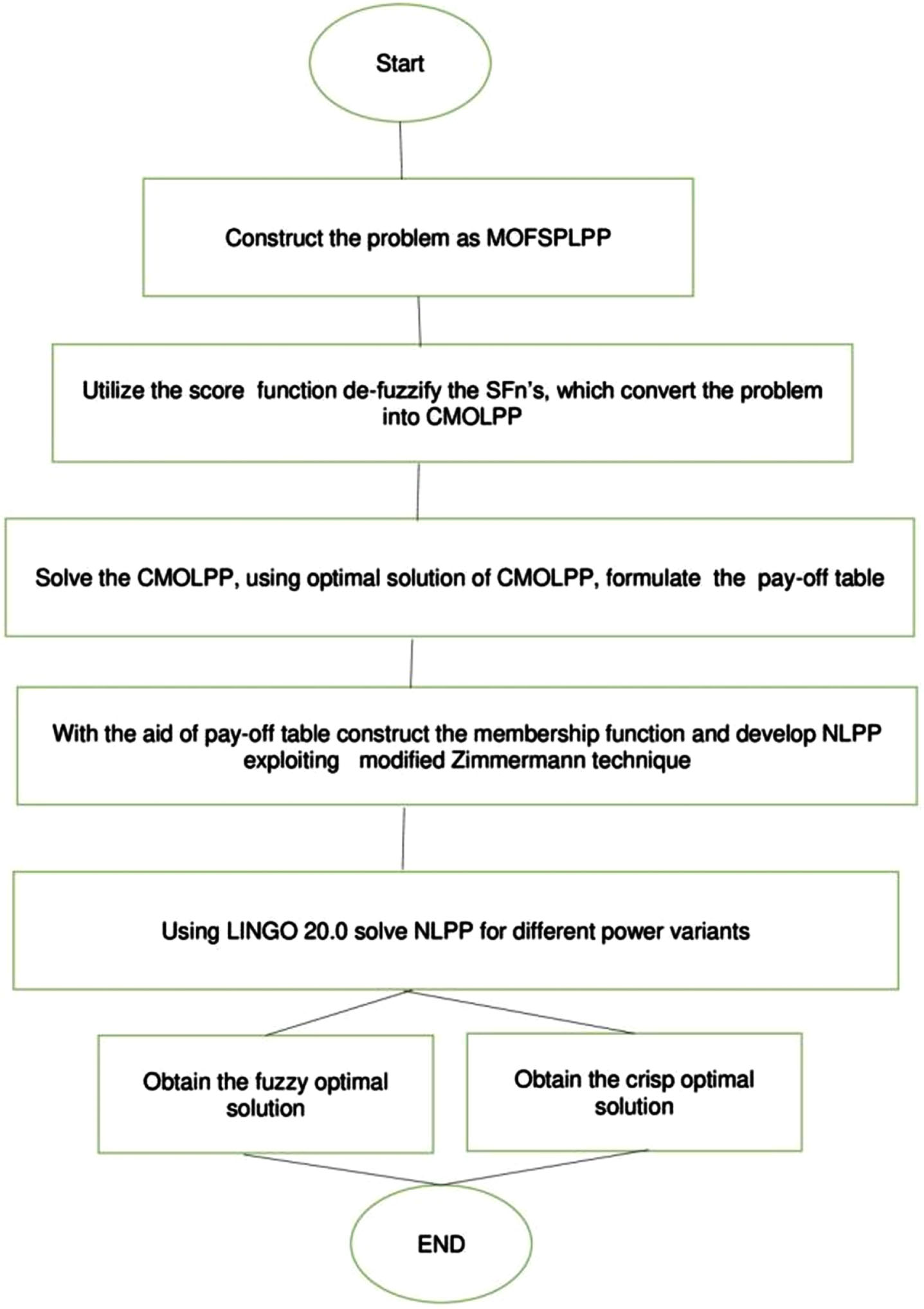
Pictorial representation of proposed method.
The numerical example shows the validity and applicability of the proposed method
The data sources have been gathered from the article referenced as [2] at the following UrL.
Example [2]
Step 1
Subject to constraints,
Step 2
Maximize
subject to constraints,
11.7367x1 + 13.4187x2≤1566.645
9.2870x1+ 11.48096 x2 + 10.96871x3 ≤1995.307
1.4142x1 + 10.7121x2≤1474.788
x1, x2, x3 ≥0
Solving the each objective function with respect to all constraints
constraints,
The values are (x1, x2, x3) = (0, 116.7508, 55.92530) and F1 (x) = 13355.8
The values are (x1, x2, x3) = (133.4723,0,68.90051) and F2 (x) = 18156
The values are (x1, x2, x3) = (0, 116.7508, 55.92530) and F3 (x) = 17294.3
Steps 4 and 5
The pay-off matrix is constructed with the aid of Table 2
Pay off Table
The membership function is represented as
Step 6
The modified Zimmermann technique of single objective NLPP
Subject to constraints,
0.70711x1 + 6.58122x2 + 6.83797x3 ≤1150.75,
9.2870x1+ 11.48096x2 + 10.96871x3≤1995.30,
1.4142x1 + 10.7121x2≤1474.788,
x1, x2, x3 ≥0.
Step 7
Case 1: The optimal solution to problem (30) & (31) is found as x1 = 4.709676, x2 = 112.5790, and x3 = 59.44263 with satisfaction level λ= 0.0756318 using the LINGO 20.0 software and s = 0.25.
Case 2: The optimal solution to problem (30) & (31) is found as x1 = 10.48084, x2 = 107.5837, and x3 = 60.4270 with satisfaction level λ= 0.123289 using the LINGO 20.0 software and s = 0.5.
Case 3: The optimal solution to problem (30) & (31)is found as x1 = 20.89250, x2 = 98.47716, and x3 = 61.1439 with satisfaction level λ= 0.0756318 using the LINGO 20.0 software and s = 1.
Case 4: The optimal solution to problem (30) & (31) is found as x1 = 47.16715, x2 = 75.49598, and x3 = 62.95136 with satisfaction level λ= 0.358069 using the LINGO 20.0 software and s = 1.5.
Case 5: The optimal solution to problem(30) & (31) is found as x1 = 47.29702, x2 = 75.38239, and x3 = 62.96049 with satisfaction level λ= 0.339139 using the LINGO 20.0 software and s = 2.
The graphical representation of feasible region and fuzzy optimal solution is deputize in Fig. 3 and 5.
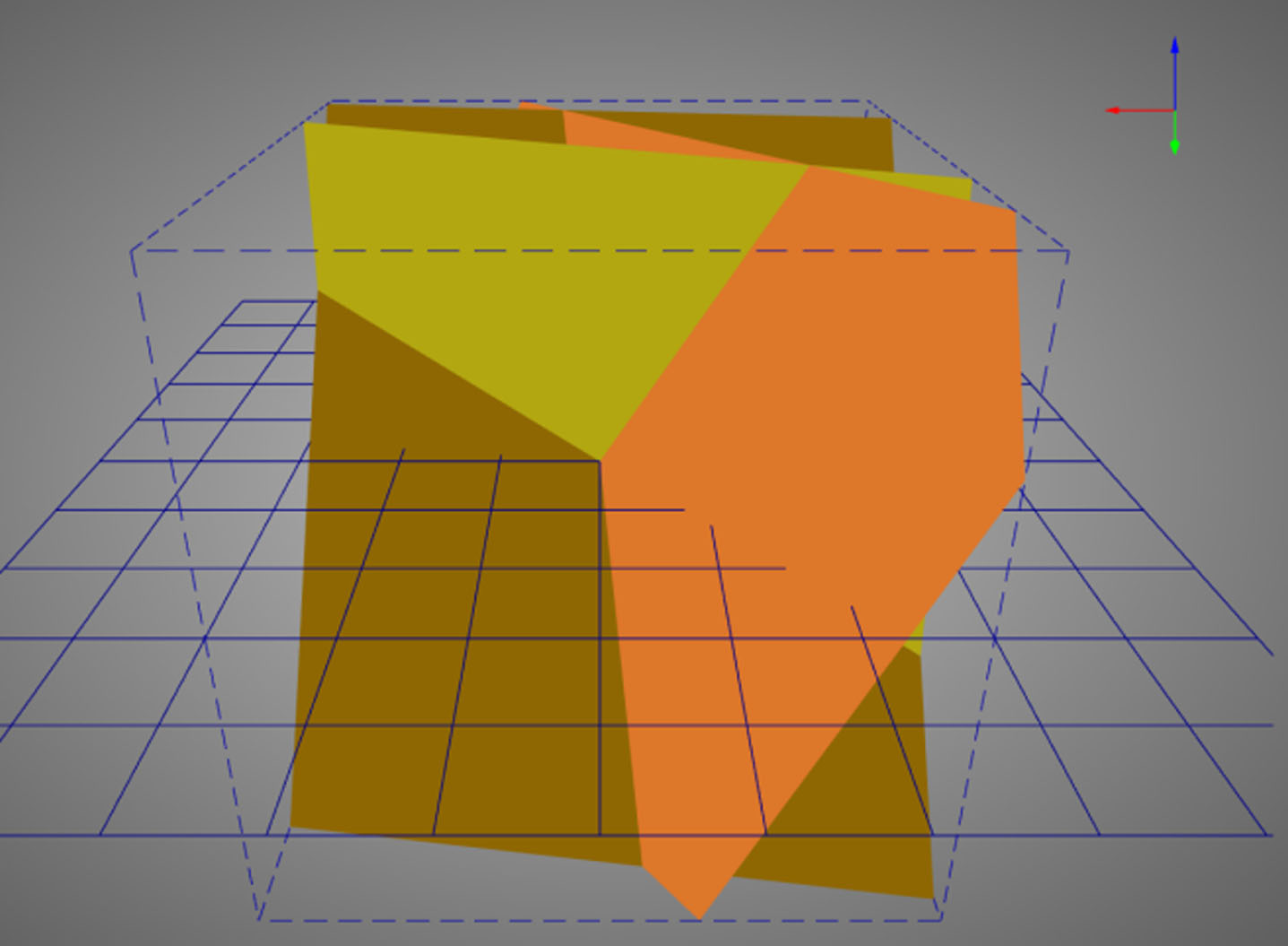
Graphical representation of the feasible region of SFMOLPP of example 1.
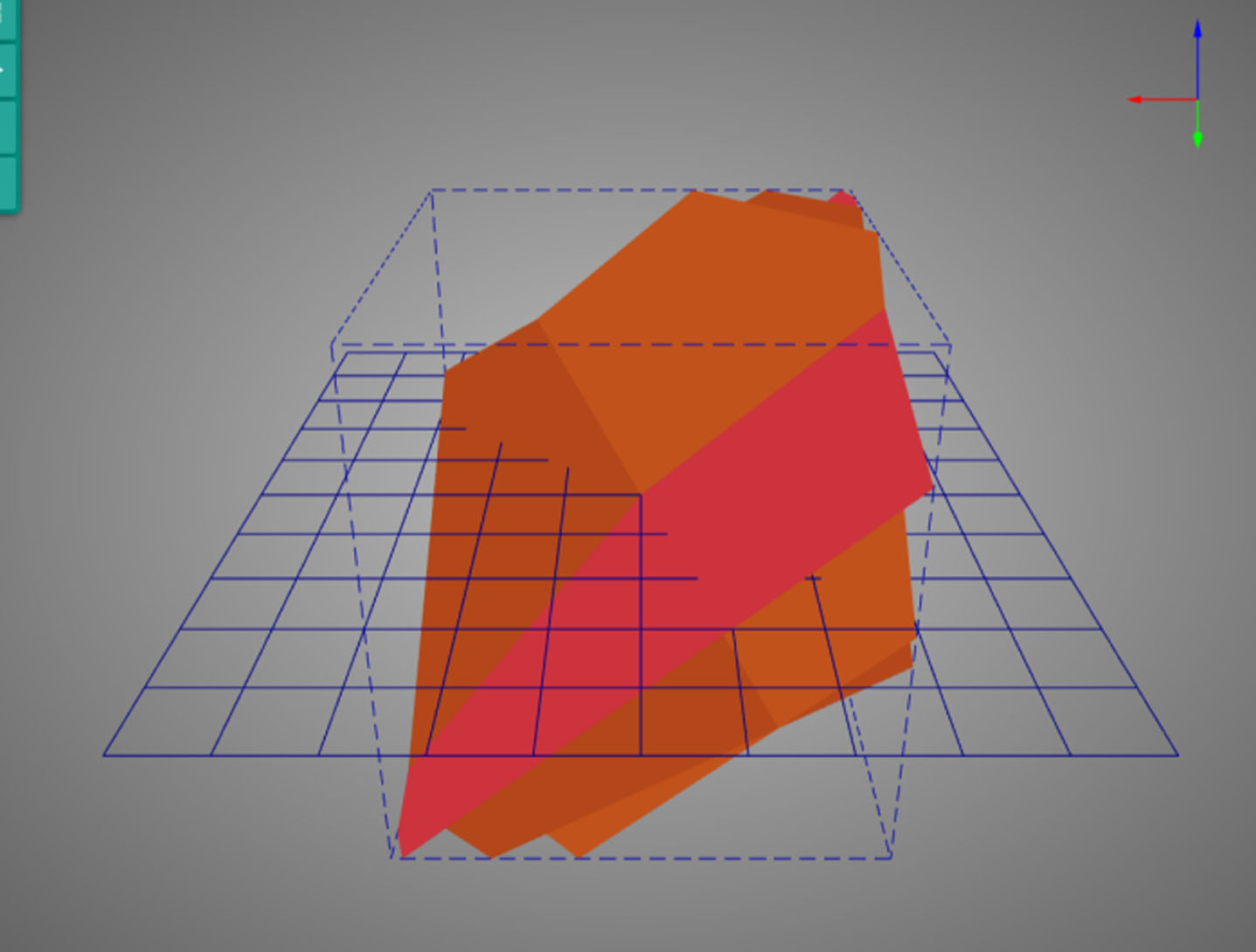
Graphical representation of the feasible region of SFMOLPP of Application in the production on planning problem.
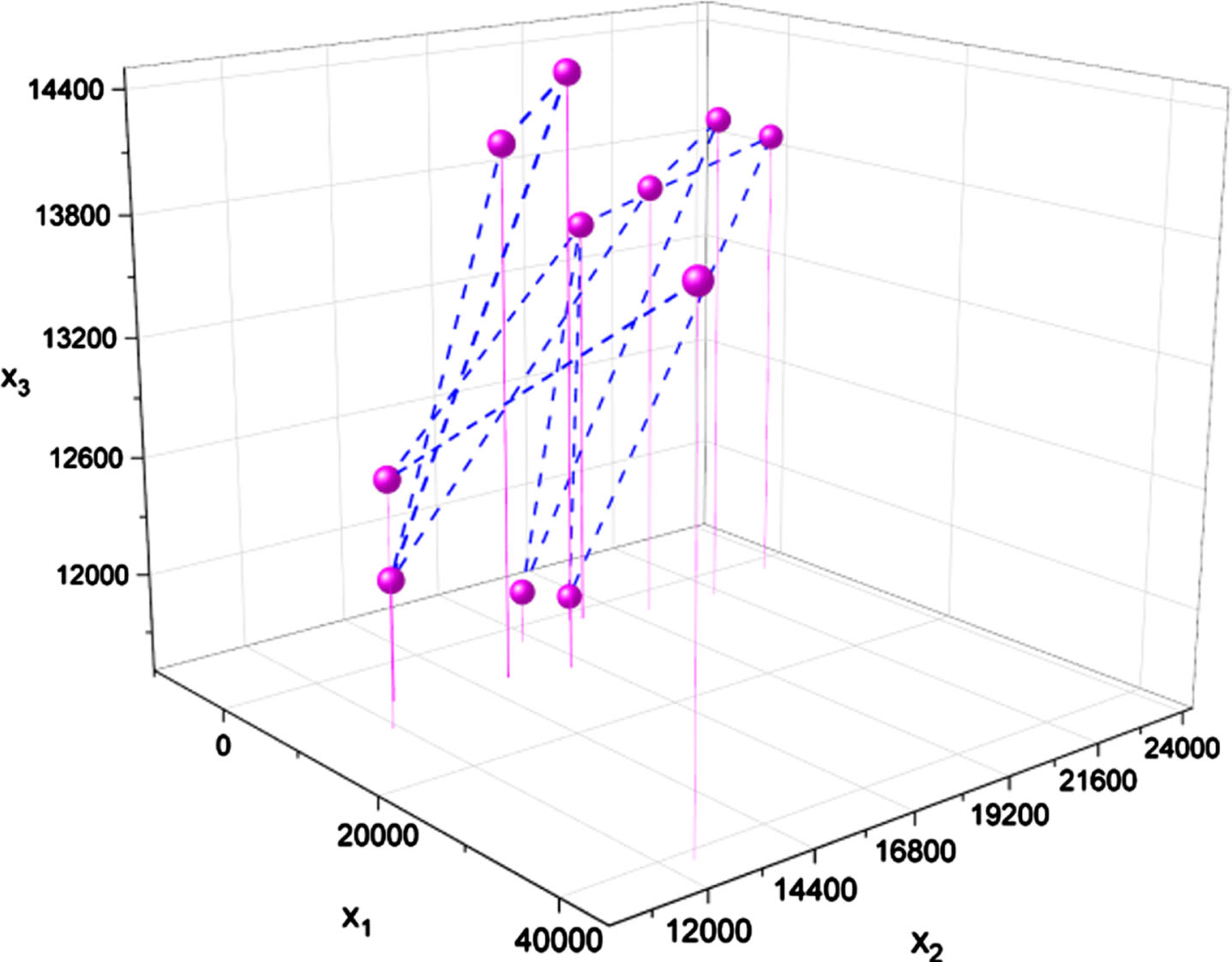
Visual representation of data for the fuzzy optimal solution of SFMOLPP for example 1.
The fuzzy optimal and crisp optimal solutions for each objective function is represented in Tables 3–7.
Fuzzy Optimal table
Fuzzy Optimal table
Fuzzy Optimal table
Fuzzy Optimal table
Fuzzy Optimal table
Changes in the right hand-side vector
In this example 1 for variation s = 0.25, 0.5, 1, 1.5, 2 examines in Table 15 shows how variations in the right-hand-side vector impact the optimal solution. The feasibility remains unaffected but the feasibility may be compromised. If the same basis remains optimal we update the values of the basic variables and the objective value accordingly. Otherwise we utilize the optimization software or simplex algorithm to obtain a new optimal solution while ensuring feasibility.
Changes in the right hand-side vector
In this example1 for variation s = 0.25, 0.5, 1, 1.5, 2 examines in Table 15 how variations in the right-hand-side vector impact the optimal solution. The feasibility remains unaffected but the feasibility may be compromised. If the same basis remains optimal we update the values of the basic variables and the objective value accordingly. Otherwise we utilize the
optimization software or simplex algorithm to obtain a new optimal solution while ensuring feasibility
Changes in the constraint matrix
The focuses for variation s = 0.25, 0.5, 1, 1.5, 2on how changes in the activity vector for non-basic columns of the constraint matrix affect optimality and feasibility. If a non-basic column is replaced with a new one the optimal value is evaluated. In the case of a maximization problem if the old solution remains optimal it is retained otherwise the optimization software simplex algorithm proceeds by introducing the non-basic variable.
Adding a new constraint
considers the addition of a new constraint to the original LPP in example1 for variation s = 0.25, 0.5, 1, 1.5, 2. If the optimal solution of the original problem satisfies the new constraint, it remains optimal for the new problem making the new constraint redundant. In
Adding a new activity
When introducing a new activity with cost coefficient and consumption column for possible production, we evaluate objective function, cost vector, <0 in a maximization problem the current solution remains optimal and otherwise×variable is introduced into the basis, and we employ the optimization software or simplex algorithm to obtain the new solution.
Changes in the cost vector
This investigates the impact of changing the cost coefficient of a variable on optimality and feasibility. We differentiate between cases where is a basic or non-basic variable.
Changing the cost coefficient of a non-basic variable
Changing the cost does not alter and thus remains unchanged. Consequently, in this a maximization
problem the solution remains optimal concerning the new LP problem. Otherwise the co-efficient must be introduced into the basis and the optimization software or simplex algorithm is continued as usual.
Changing the cost coefficient of a basic variable
In this case, changing the cost of coefficient of basic variable alters. Consequently we calculate for the non-basic variables. If these values satisfy the optimality condition then the old solution remains optimal concerning the new LP problem. Otherwise the optimization software or simplex algorithm continues as usual.
Application in production planning problem
Application (production planning problem) [2]
The data source had been gathered from the article
referred as [2].
A well-known leather company manufactures three different leather products (such as a belt, wallet, etc.). The various departments provide the manufacturing services to the raw materials that result in the finished goods. The data relating to the total time availability and the time devoted to offering various services to different products are summarized in Table 8. Furthermore, the customer satisfaction parameter over the different products are 36Sfn, 43Sfn, and 67Sfn, along with the expected profit of $57Sfn, $62Sfn, and $74Sfn, respectively. The quality assurance parameters are 52Sfn, 28Sfn, and 75Sfn for each product (Table 8). Suppose that x1, x2, and x3 represent the number of three different products. Then mathematical production planning model for the given data can be given as follows:
Values of different spherical fuzzy parameters
Values of different spherical fuzzy parameters
Departments Service time (in hrs.) Unit price Types of products.
Step 1
14 Sfn = (12, 14, 16) 14 Sfn = (10, 14, 18)
Step 2
subject to constraints,
13.93x1 + 10.51x2 + 9.63x3 ≤1811.59
4.84x1 + 5.61x2 + 19.49x3 ≤2176.02
14.19x1 + 11.22x2≤1700.61
0.97x1 + 9.54x2 ≤1700.61
9.54x1+ 4.84 x2 + 12.96x3 ≤1402.08
x1, x2, x3 ≥0
Step 3
Solving the each objective function w.r.t all constraints
The values are (x1, x2, x3) = (0, 79.963,78.3225) and F1 (x) = 8887.09
The values are (x1, x2, x3) = (23.86896, 87.72161, 57.85474) and F2 (x) = 12809.4
The values are (x1, x2, x3) = (82.074, 0, 47.76898) and F3 (x) = 8544.01
Steps 4 and 5
The pay-off matrix is constructed in Table 9
Pay-off table
The membership function is represented as
Step 6
The modified Zimmermann technique of single objective NLPP
Subject to constraints
11.7367x1 + 13.4187x2≤1566.645
0.70711x1 + 6.58122x2 + 6.83797x3 ≤1150.75
9.2870x1+ 11.48096 x2 + 10.96871x3 ≤1995.307
1.4142x1 + 10.7121x2≤1474.788
x1, x2, x3 ≥0
Step 7
Case 1: The optimal solution to problems (44) & (45) found as x1 = 39.03274, x2 = 37.65522, and x3 = 65.39016 with satisfaction level λ= 0.528432 using the LINGO 20.0 software and s = 0.2
Case 2: The optimal solution to the problem (44) & (45) found as x1 = 38.62243, x2 = 37.95427, and x3 = 65.55842 with satisfaction level λ= 0.520833 using the LINGO 20.0 software and s = 0.5.
Case 3: The optimal solution to the problem (44) & (47) found as x1 = 37.89670, x2 = 38.55077, and x3 = 66.21976 with satisfaction level λ= 0.50564 using the LINGO 20.0 software and s = 1.
Case 4: The optimal solution to the problem (44) & (45) found as x1 = 37.15033, x2 = 39.14416, and x3 = 62.95136 with satisfaction level λ= 0.490493 using the LINGO 20.0 software and s = 1.5.
Case 5: The optimal solution to problem (44) & (45) found as x1 = 36.41681, x2 = 39.73342, and x3 = 66.53965 with satisfaction level λ= 0.475432using the LINGO 20.0 software and s = 2.
The graphical representation of the feasible region and fuzzy optimal solution is deputized in Fig. 4 and 6. The fuzzy optimal and crisp optimal for each objective function are represented in Tables 10–14.
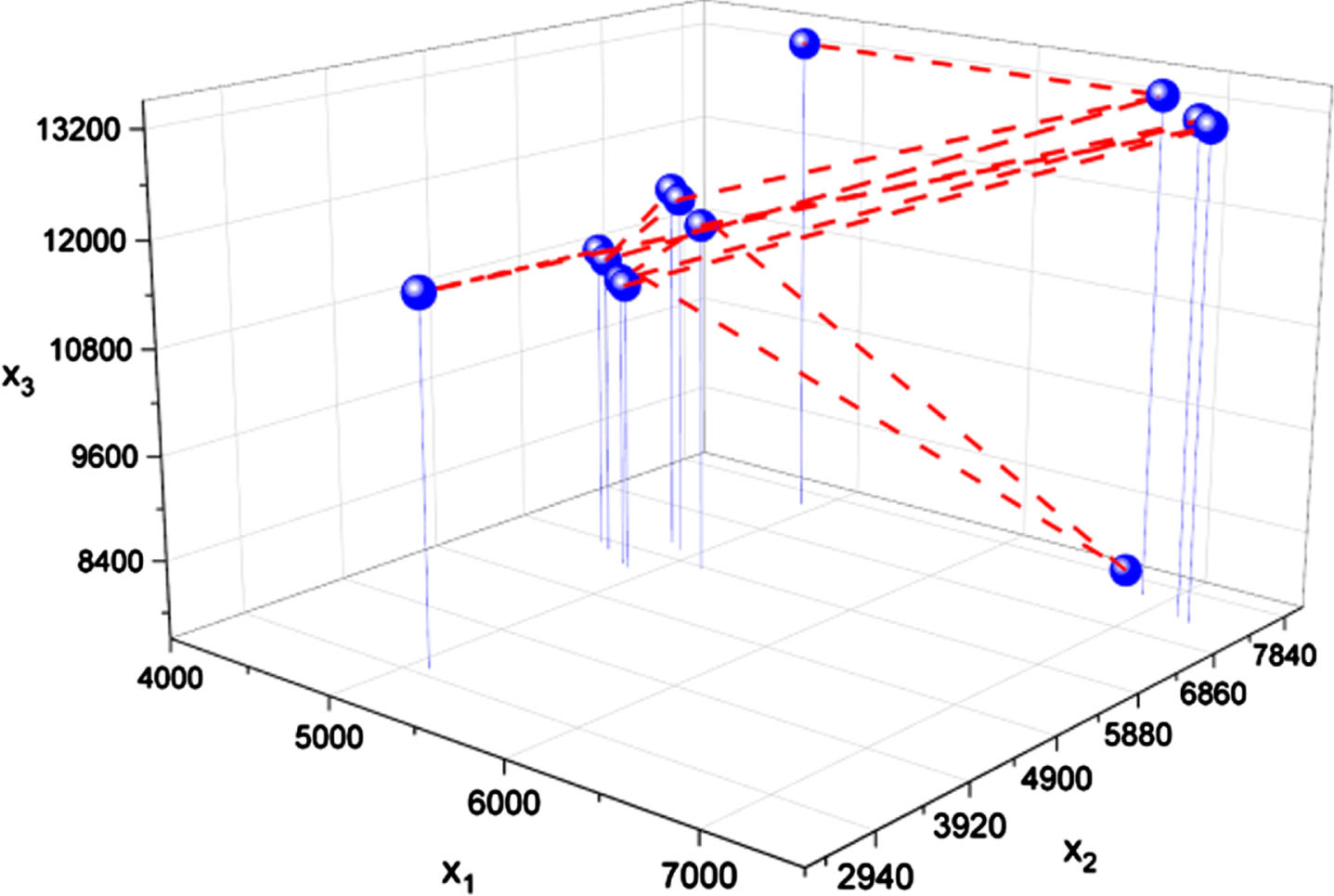
Visual representation of data for the fuzzy optimal solution of SFMOLPP for Application in the production planning problem.
Fuzzy Optimal table
Fuzzy Optimal table
Fuzzy Optimal table
Fuzzy Optimal table
Fuzzy Optimal table
Sensitivity analysis Range for basis and RHS for example 1
Examining the impact of cost coefficient changes in non-basic variables
In this example for variation s = 0.25, 0.5, 1, 2. An optimal basic feasible solution with the associated basis matrix derived from an LPP. By investigating the scenario in Table 16 where a component of the requirement vector b is denoted as changes. The optimal basis for the requirement vector to analyze the consequences of this change, specifically focusing on the interval within which must lie to maintain the feasibility of the new basic solution.
Sensitivity analysis range for basis and rHS for Application in production planning problem
Sensitivity analysis range for basis and rHS for Application in production planning problem
Given a change in the component the resulting has new basic solution corresponding to the basis can be mathematically expressed This translates to encompassing all elements of the basis. The value represents the element located in the inverse matrix.
We have undertaken discussions to ascertain the conditions under which the new basic solution remains feasible. Consequently we can assert that the optimality of the solution remains unaffected if the magnitude lies within a certain interval.
Where alterations arise in the constraint coefficients of a non-basic variable within the current optimal solution the feasibility of the solution remains unaltered. However the sole impact is on the optimality of the solution. Conversely if adjustments are made to the constraint coefficients of a basic variable where the situation becomes more intricate. This stems from the potential alteration of the feasibility of the current optimal solution which could result in a loss of optimality. Such modifications can influence the basis matrix and subsequently affect all the values within the present optimal table. Under such circumstances it may be prudent to reconsider and solve the problem anew.
Introduction of a new variable
The objective is to introduce an additional variable, characterized by a constraint matrix column and objective coefficients in Table 16. By evaluating the impact based on calculating the corresponding reduced entry. The entry proved to be positive indicating that the basis remains unaffected it continues to be optimal.
Removal of a variable
The elimination of a non-basic variable does not affect the feasibility or optimality of the existing optimal solution. However removing a basic variable can potentially impact optimality prompting the need to explore alternative optimal solutions.
Introduction of a new constraint
The situation where a fresh inequality constraint is introduced to the original problem. To accommodate this change a slack variable is introduced and the corresponding tableau is derived from the initial problem. Upon analyzing the resultant tableau using LINGO 20.0 it becomes evident that the bottom row remains unchanged. Given that the bottom row of the new tableau is characterized by non negative values it ensures feasibility. The value of could either be non negative thus leading to an optimal tableau.
In the latter case the simplex pivots can be employed iteratively until an optimal solution is reached or in-feasibility is determined. Such a scenario may necessitate a potential alteration in the existing basis.
Removal of a constraint
In the context of considering the removal of constraints where these constraints can be either binding or non-binding about the optimal solution. Eliminating a non-binding constraint merely extends the feasible region without exerting any influence on the optimal solution.
Result analysis
The proposed method is designed to apply to all variables and parameters without any restrictions and the obtained results satisfy all the constraints and non-negative restrictions. In comparison to existing models our approach efficiently represents reality by considering all aspects of the decision-making process including positive, neutral, and negative factors. This comprehensive consideration reduces the complexity of the problem by reducing the number of objectives. On the other hand existing models [2] are not time-consuming and also complex whereas our model is not.
Our proposed model not only provides fuzzy optimal solutions but also crisp optimal solutions unlike existing models that focus only on inequality constraints. This feature makes our model easily applicable to real-life situations offering convenience over existing methods. Although the abstract mentions the use of a case study and the comparison of results with other existing methods specific details regarding the case study and the comparison metrics are provided.
Limitations
The initial research was conducted on a small scale it is imperative to expand the study to encompass a larger data set within a spherical fuzzy environment in future endeavors.
The current research is focused on a spherical fuzzy environment and as an extension it will be extended to higher dimensions encompassing more intricate spherical fuzzy sets.
The research primarily addresses the maximization of objectives. However to achieve a comprehensive understanding future investigations should also encompass minimization, max-min, and min-max objectives.
Comparative analysis
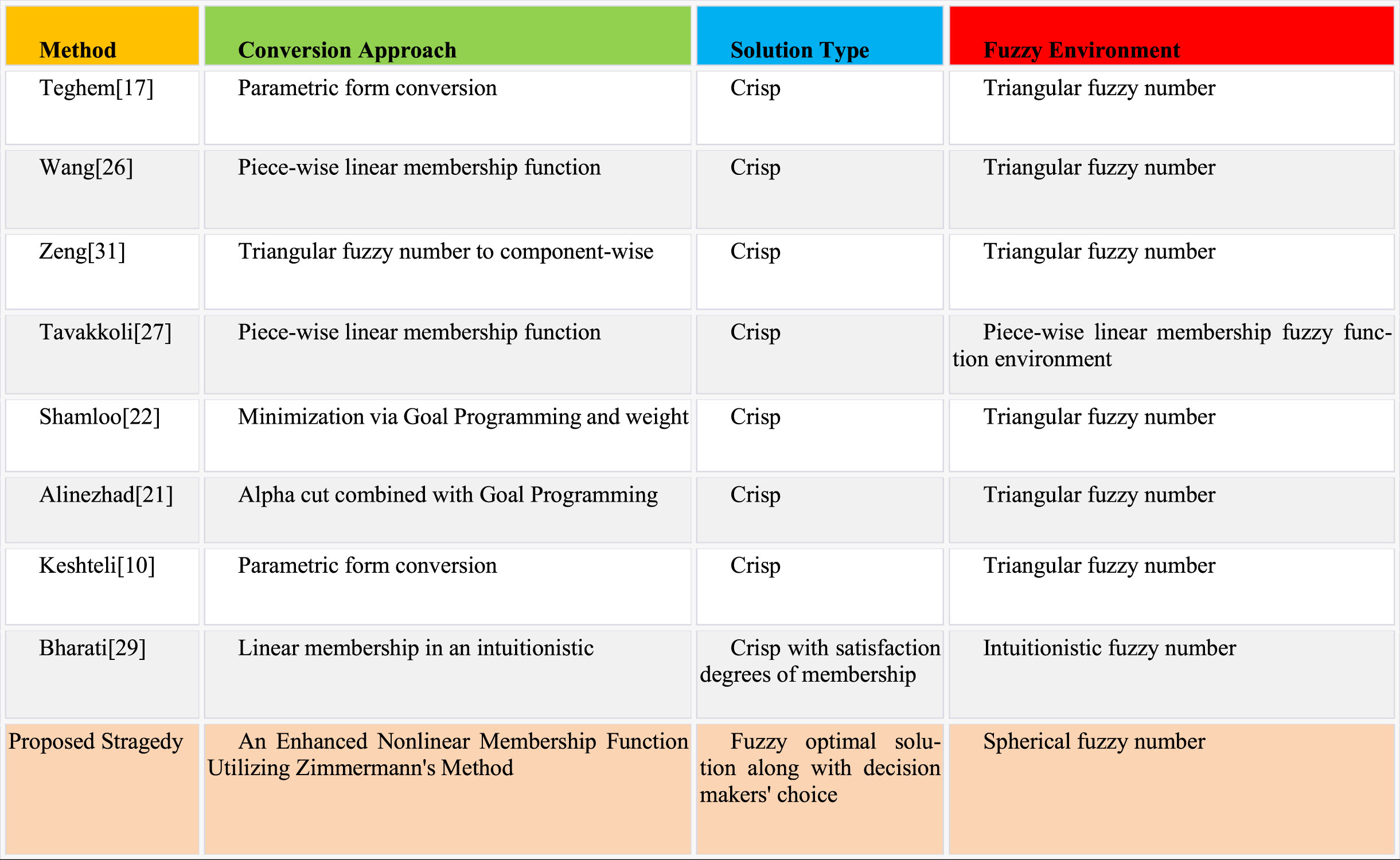
We examined the spherical fuzzy number-based MOLPP in evaluating an example and application related to production planning. Table 17 and Table 18 displays the comparative outcomes for various fuzzy environment MOLPP resulted in crisp is analyzed and where the total value of the objective function is computed with variations. Figure 7 is the solution quality as the function reaches its maximum value and the highest among the variations is chosen and compared against the existing method [2].
Comparison between proposed and existing method total value of objective values
Comparison between proposed and existing method total value of objective values
Comparison table for various fuzzy environment

Graphical representation of comparison between proposed and existing method total value of the objective function.
This comparison Table 18 provides an overview of various methods used to address MOLPP including the proposed spherical fuzzy approach. It highlights the diverse conversion approaches and solution types used by each method and enabling a comprehensive assessment of their respective capabilities in terms of solution quality and computational efficiency. We have developed a method that can be applied to various software programs as well as widely available software like Lingo. Our method is versatile and applicable across different software platforms making it accessible for various research and practical purposes.
This research paper proposes a new representation method for spherical fuzzy numbers which addresses the complexity of mathematical expressions, geometric interpretations, and fundamental operations associated with these sets. The method is developed by analyzing existing set definitions and by leveraging the characteristics of the domain of discourse to provide geometric
interpretations and mathematical expressions. To enable a more widespread application of spherical fuzzy information to MOLPP problems can be utilized in genetic and heuristic algorithms. This paper also introduces fundamental operations and de-fuzzification using a score function and present some related properties. To further enrich the research on spherical fuzzy MOLPP and its methods. This paper develops a modified Zimmermann method and de-fuzzification using the score function generated under Euclidean distance. Additionally, a spherical fuzzy MOLPP method is presented that obtains both fuzzy optimal solutions and crisp optimal solutions. Comparative analyses and validity tests are provided to demonstrate the rationality and effectiveness of the proposed mathematical expression and the developed spherical fuzzy MOLPP.
This paper offers a new perspective to enrich the research on spherical fuzzy MOLPP and its methods and presents a potential avenue for their future application. However certain limitations need to be addressed which also indicate directions for future research. For instance in practical online review problems there is a lack of connection between realistic online review information and spherical fuzzy information. This gap prevents the effective implementation of spherical fuzzy decision-making methods. To overcome this challenge it is essential to establish the relationship between spherical fuzzy linguistic terms or numbers and realistic online review information and construct the transformation between them. This will enable the application of spherical fuzzy MOLPP and its methods through online reviews. Moreover the developed decision-making method in this paper may involve a significant amount of calculations when dealing with large decision-making data. Thus it may not be suitable for such cases. Therefore it is a research topic to construct a spherical fuzzy model that can effectively handle decision-making problems with big data.
The primary objective of constructing the theory of spherical fuzzy sets is to facilitate their practical application to decision-making in linear programming problems. Thus building upon the work presented in this paper our future research will focus on two main aspects. Firstly, we aim to further enhance relevant decision-making theories including but not limited to solving spherical fuzzy MOLPP via dynamic programming and solving fuzzy goal programming problems. Secondly, we plan to explore the practical application of spherical fuzzy sets in decision-making problems. This includes investigating fuzzy decision-making methods to address spherical cubic fuzzy numbers which is an extension of spherical fuzzy sets as well as exploring their application to various decision-making problems such as supplier selection problems and location problems with the added complexity of consensus-reaching processes. These research areas will enable us to expand the scope and utility of spherical fuzzy sets for practical decision-making problems.
Footnotes
Acknowledgments

Funding
Not applicable.
Competing interests
The authors declare that they do not have any conflict of interest.
Ethical approval
This article does not contain any studies with human participants or animals performed by any of the authors.