



Abstract
Network security is one of the key concerns with wireless sensor networks. Because sensor nodes employ radio channel frequencies, which are riskier than traditional networks, the attacker may be able to force the node to compromise, disrupt data integrity, eavesdrop, or insert false data into the network, wasting network resources. Creating dependable sensor networks that offer the highest level of security while using the fewest resources is thus one of the problems. The designers of wireless sensor networks can take into account providing an efficient key management system that can enhance any efficiency features such as communication overhead, calculation rate, memory demand, and energy consumption rate. The energy level of nodes is determined in this article using a novel approach based on fuzzy systems and simple to implement in both hardware and software. In this study, the memory needed to carry out the plan was decreased, and the search performance was raised by integrating elliptic curve cryptography with an AVL search tree and a LEACH model. Also, the frequency range of radio channels in this study is 2.4 GHz. Based on the theoretical analysis as well as the outcomes of the experiments, the suggested key management strategy for wireless sensor networks improves security while also reducing computational overhead by 23%, energy consumption by 14%, and memory consumption parameters by 14%. 18% of people have used the network. Additionally, it was demonstrated that the suggested approach is scalable and extendable. Because of this, the suggested technique has a wide range of applications in massive wireless sensor networks.
Introduction
In today’s world where wireless technologies are expanding and developing rapidly, homogeneous mobile wireless sensor networks are one of the key factors in wireless communication. These networks are used for a variety of applications including environmental measurements, monitoring and control, and even in medical and industrial fields. With the increase in the use of these networks, the security of information transactions in these networks has also become an important challenge. Therefore, it is felt necessary to provide an effective key management scheme in order to increase the security of transactions in homogeneous mobile wireless sensor networks. Key management is one of the fundamental factors in the security of transactions in homogeneous mobile wireless sensor networks. An effective key management scheme not only helps us prevent malicious attacks such as espionage, unauthorized information injection, and unwanted data changes, but also ensures that our transactions in wireless sensor networks are confidential and secure. A sensor network is a network made up of lots of tiny nodes. Each node contains a number of sensors. The physical environment and the sensor network are intimately connected [1, 34]. It gathers data from the surroundings through sensors and uses triggers to act. Nodes communicate wirelessly with one another [2]. Each node is physically quite small, operates autonomously without human involvement, and has constraints on its processor speed, memory size, power supply, etc. [3]. These restrictions lead to issues that are the basis for numerous research questions in this area. This network adheres to the usual protocol stack. However, the protocols need to be rewritten owing to restrictions and variations depending on the application [4]. This chapter covers research concerns in the area of security in sensor networks in addition to introducing the sensor network and outlining its characteristics, constraints, applications, ideas, and difficulties [5]. The use of wireless networks is growing quickly as a result of the advancements made in this industry over the past ten years. In these networks, nodes often communicate over a shared channel [6]. This feature enables unauthorized access to the information of others and serves as the foundation for numerous assaults [7]. As a result, significant issues with information security in wireless networks need to be looked into and addressed to raise the bar for security in these networks [8]. One of the difficulties with wireless sensor networks is their lack of security [9]. Security in wireless sensor networks is similarly impacted by sensor node restrictions to other difficulties, while it differs somewhat from network security in several ways. In general, an encryption key needs to be set up and exchanged among two or more nodes for them to be able to interact securely [10]. One or more communication parties must produce, disseminate, and update this code, which is frequently referred to as key cryptographic knowledge [11]. Any security protocol’s key component is the administration of such encryption. On a more technical level, this expertise is referred to as key management. A collection of methods called “key management” is used to distribute keys and safeguard secure connections between authorized nodes [12]. The security of homogeneous mobile wireless sensor networks is a very critical issue in the modern wireless communication world. These networks are usually composed of small and distributed sensor devices that connect to the mobile network and send sensor information such as temperature, humidity, pressure, and other environmental data to central servers. These networks have security vulnerabilities that need to be managed and fixed. One of the main security challenges in homogeneous mobile wireless sensor networks is the protection of sensor data against intrusion and spoofing attacks. Information collected from sensors is usually sensitive and may be compromised if accessed by unknown persons or devices. Therefore, trusting network resources and components, using strong encryption and continuous monitoring of network traffic are some of the solutions implemented to strengthen security in these networks. Also, detection and prevention of intrusion attacks such as Denial of Service and social engineering are also of particular importance in order to protect homogeneous mobile wireless sensor networks from vulnerable points. Many important management plans have been proposed up to this point. With this addition, a new study demonstrates that asymmetric encryption (RSA) and elliptic curve encryption were not previously regarded as suitable methods for all applications of sensor nodes due to the high cost of calculations, high energy consumption, and high memory requirements [13]. Given the necessity for memory and the low transmission cost, sensor networks can use public key cryptography, such as the elliptic curve. Communication overhead is a fundamental concern in key management. One of the performance parameters for a key management method is communication overhead [14]. Increasing search efficiency is one approach to lower communication costs. Various search techniques have varying levels of effectiveness. One of the search techniques with the best relative performance is the self-balancing binary tree. When adding and removing nodes, certain kinds of trees perform better [15]. The AVL tree, which can only have two nodes as leaves, is one example of a self-balanced binary tree. This study presents a key management scheme based on the model proposed by LEACH [16] and the AVL tree and elliptic curve encryption [17]. Because elliptic curve encryption requires less memory than public key encryption and also uses the AVL tree’s optimal search, the efficiency is high.
Additionally, the given method will be effective for homogenous mobile networks by utilizing the proposed LEACH model. The use of elliptic curve encryption rather than RSA encryption and the AVL search tree appears to result in a significant decrease in search time and memory consumption. It will function for large-scale networks as well as energy [18]. The need for new key management techniques has always been taken into consideration since wireless sensor networks have constrained sensor resources. This problem is still unresolved. Due to the restricted resources in the sensors, many of the approaches that have been given need a lot of calculations, memory usage, or communication overhead. This makes it challenging to apply these methods. The creators of wireless sensor networks can take into account providing an efficient key management scheme that can enhance any efficiency criteria, including communication overhead, calculation rate, memory demand, and energy consumption rate. It is significant and vital to research since it is anticipated that by combining elliptic curve cryptography with an AVL search tree and the LEACH model, the memory needed to carry out the plan will decrease, and the search speed will be increased. In short, the scientific contribution of the authors is as follows. Improved search time using AVL search tree Improving energy consumption in wireless sensor networks Reducing the memory consumption of the wireless sensor network by using elliptic curve encryption Extending the lifetime of wireless sensor networks using AVL search tree and elliptic curve encryption Providing a key management plan for large-scale wireless sensor networks
The rest of the article is organized as follows. In the second part, there is an overview of previous works. The proposed method is discussed in detail in the third section. In the fourth section, the evaluation and efficiency of the proposed method are explained. Finally, the conclusion and future works are stated in the fifth section.
Research background
A crucial task in WSNs is key management. The robustness of the key management methods determines the security and integrity of messages sent across these networks as well as the legitimacy of the nodes, yet it can be difficult to build an effective key generation, distribution, and revocation strategy. While computationally intensive asymmetric key techniques shouldn’t be exposed to resource-constrained sensor nodes, the adoption of symmetric key-based systems makes the entire network susceptible to many attacks [30]. Widespread use cases, including those in the fields of health monitoring, environmental monitoring, and urban traffic management, have contributed to a recent surge in exploratory wireless sensor network research. Many fields, including wildlife conservation, border security, healthcare, and military intelligence, have found uses for sensor networks. The importance of these networks’ security in certain contexts necessitates robust backing. There must be mutual trust between network nodes, and any malicious nodes must be eliminated. Networks are typically protected using cryptographic methods. The key is crucial to the safety of the network. Keys are essential for ensuring not only data integrity but also authentication and privacy. Key distribution, generating a new session key depending on requirements, and renewing or canceling keys in case of attack are all challenging aspects of key management in a wireless sensor network. Semantic Analysis of Key Management Protocol for Wireless Sensor Networks was the title of a study published in [19], and it proposed a method for calculating and formulating key management protocols in wireless sensor networks. Presented is a sim of the actual world. The key management systems currently in use for wireless sensor networks, particularly wireless sensor networks, were examined in the study [20] titled Analysis of Key Management Scheme in Dynamic Wireless Sensor Networks. They made dynamic payments. A hierarchical algorithm for key management was provided in the study [21], which was given the title “Presenting a Key Management Protocol in Wireless Sensor Networks.” By establishing a proper structure, this approach would boost security in the key distribution stage and overhead. It enhances computing and communication, although this network design should have used a mesh structure. An article titled Dynamic Key Management in Wireless Sensor Networks was written by researchers in [22]. They analyzed the current dynamic key management systems and offered appropriate strategies for various applications in this article. A study titled Large-Scale Sensor Networks with Multi-Layer Key Management was published in [23]. In this article, he attempted to offer a multi-layer key management strategy for wireless sensor networks, employing meaningful and meaningless keys, which boosts security but has a high communication cost and requires memory.
An attempt has been made to create a more effective key management system [24], which is a way of key management in wireless sensor networks that is efficient and scalable. The proposed strategy increases the amount of memory needed by shrinking the key, but the search process is still time-consuming until it reaches the central station. A pre-distribution group key management technique with a hierarchical architecture was presented in [25] in an article titled Key Exchange in a wireless sensor network with energy management strategy. As a result, resolving this issue through the use of security schemes should ensure a moderate consumption of energy. To achieve this goal, a secure hybrid session key management scheme is proposed, in which the majority of operations depend on cryptography, the core of which are the keys that are used to guarantee both the security issue and the limited energy consumption. Benchmark schemes have been very useful in the analysis of the proposed scheme to reach the desired conclusion, guaranteeing its effectiveness in comparison to other benchmark schemes, its capacity to reduce energy consumption, and its ability to present quite an effective tool in network environments that is capable of securing management and key agreements [31]. They lowered the energy and communication overhead in this strategy, but the quantity of memory needed remained significant. [26] describes a method for rekeying in wireless sensor networks and discusses the benefits and drawbacks of distributed group keying techniques known as group rekeying schemes using deterministic sequence numbers. They listed the earlier techniques. While lowering communication overhead and enhancing security, the suggested system uses a lot of memory. A tree-based key management method was introduced by researchers in [27] in a paper titled A new tree-based key management scheme for heterogeneous wireless sensor networks. The strategy was effective for heterogeneous networks and unsuitable for homogeneous networks, yet it had an appropriate search time and reduced memory usage, communication overhead, and energy consumption. Zigbee PRO, WirelessHART, and ISA100.11a standards were examined, and their security analysis was presented in [18], a method named security analysis for wireless sensor mesh networks in critical systems. Finally, he offered a technique that included three standards and, while it ensured security, required a significant amount of memory and communication overhead. For wireless sensor networks, researchers presented a scalable and storage-efficient key management scheme (SSEKMS) in [28] that creates three different types of network keys: a network key shared by all network nodes, a shared cluster key for a cluster, and a pairwise key for each pair of nodes. They evaluated this scheme’s adaptability (i.e., the likelihood of key compromise versus node capture) and contrasted it with existing ones. A dynamic key management system called SSEKMS facilitates new node insertion and updates keys as needed.
The paper [29] explores dynamic key management systems in wireless sensor networks and presents some key management system evaluation criteria. On the basis of key types, key distribution mechanisms, key encryption techniques, and network models, they also divided dynamic key management schemes into different categories. Researchers can understand dynamic key management techniques in wireless sensor networks thanks to the classification suggested in this paper. The prospect of further research in this area is made possible by familiarity with novel procedures and alternative dynamic key management strategies.
Wireless sensor network model
Three different types of nodes make up the proposed wireless sensor network paradigm. These nodes, which are dispersed at random throughout the network, include sensor nodes, base station nodes, and cluster head nodes. The node inside the base station often receives the most energy consideration. Cluster head nodes will also possess a substantial amount of energy. Less energy is taken into account for the sensor nodes, which double as the network’s primary sensors. It should be noted that the base station node in the suggested model is stationary, whereas the sensor nodes and cluster head nodes are movable and can rotate up to. These three different node types are distributed randomly across a total area of m square meters. This area is regarded as having a square shape with a length of m2. The number of sensor nodes N
c
, the number of cluster head nodes N
s
, and just one base station are taken into consideration in the suggested model. Additionally, it is expected that the number of cluster head nodes equals the number of k sensor nodes. Equation (1) will be used to determine the total number of nodes in this network (N).
Each node in the network has an entity that sets it apart from the others, assuming that all of the nodes are sound. The primary ID for each node is this thing. All of this data will be sent to the base station during the wireless sensor network setup, where it will be stored so that the base station node has a complete list of the essential network data. If a new node wants to join the network during the stable operation phase, the first step is to check if its ID is on the list created during the initialization phase. Confirmation is the term for this work. The setup process in the suggested model entails the following five steps: a) the base station creates and sends the keys, b) the nodes generate and send the initial message, c) and the nodes determine the nodes’ energy level, d) compiling a list of the base station’s nodes, e) giving each node its unique ID.
Determining the energy level of the nodes
Six major levels—full energy level (F), very high energy level (VH), high energy level (H), medium energy level (M), low energy level (L), and very low energy level (VL)—represent the energy levels of all nodes. Base station energy is typically limitless. So it will be given its full energy level. On the other hand, Equation (2) is used to calculate the energy level for other nodes.

Fuzzy inference system to determine the energy level of the sensor node.
Using the ECC encryption algorithm, the base station creates a pair of public and private keys in this stage and distributes the public key to every node.
Sending the initial message by the nodes
Using the public key, each node encrypts a first message at this point and sends it to the base station. The “Hello message” or initial message contains the distinctive ID of each node. Each node already has this ID, which is the same ID.
Forming the list of nodes in the base station
The base station compiles a list of details about each node in the network configuration phase during this step. Additionally, a counter is created based on the time the sensors’ initial message was received. The base station list has a timestamp for this counter. This counter is then used to provide each node with a special ID in the following stage.
Assigning a unique ID to each node
Based on the “first request, first request” rule and the counter saved in the previous phase, each node is given a distinct ID in this stage. For each node, this identifier serves as the starting point for generating different keys. By doing this it is possible to “secure the transfer” because this ID is never copied.
Selection of cluster heads
After setting up the sensor network, it is necessary to select cluster heads and form clusters of nearby nodes based on them to increase the efficiency of the network. These cluster heads are responsible for the main communication with the base station. The cluster head is selected based on the updated energy level of the nodes and using the following random algorithm: Since a node with a higher energy level should have a greater chance of being selected as a cluster head, first, the energy levels of all nodes are updated, and the nodes with a higher energy level are selected as candidates. Then, using relation (3), the head of the cluster is randomly selected. As can be seen, the working process is described in the flowchart of Fig. 2. Flowchart of the proposed solution.

Each node can then use its ID to derive the key value of its immediate neighbor node. This implies that each node can be verified by the nodes to which it is logically connected. Only candidates whose key pair validation is judged by their immediate neighbors to be correct can be cluster heads after preselection of the state value and filtering by the aforementioned stochastic method.
The nodes must be grouped after choosing the cluster chiefs. In the suggested method, clustering is carried out as follows: Cluster headers carry preliminary communication. This initial message is encrypted with a symmetric key and contains the cluster heads’ initial serial numbers. By frequently receiving initial messages, nodes that are not cluster heads compile a list of the details of the cluster heads that are located nearby and automatically add those cluster heads to a list of backup cluster heads. The sensor node sends an initial message, including its original number, and is encrypted with the symmetric key if it does not already have a list of surrounding cluster heads. It then waits for the other nodes’ responses. Nodes that aren’t cluster chiefs join the cluster as members. A “membership request” message must be sent to the cluster head by a sensor node when it chooses to join a cluster. The cluster head node’s main number (CHMN), the sensor node that isn’t the cluster head but is encrypted with its symmetric key (NCHMN), and the authentication key (Kauth) are all contained in this message. The F function, given in connection (4), also yields the validation key. The cluster head compares the output with the NCHMN encrypted by the DES algorithm after first encrypting the message with the authentication key Kauth after receiving it. In the event of a successful match, the node gains legitimacy. In other words, the node has successfully undergone authentication. The reply attack and the replay attack are then stopped when the cluster head node sends the requesting node a “membership confirmation” message.
The full network is formed at this time and at the conclusion of this phase. The stability phase’s next step is a safe operation. Of course, it should be mentioned that there is a mutual validation operation between the cluster heads during the cluster heads’ formation phase.
Similar to how the communication key between a sensor node and the cluster head node is formed, so is the communication key between sensor nodes. It should be mentioned that ECC public and private keys, which are more secure than the first two, are primarily used for information exchange between the cluster head node and the base station. For this reason, updating over time is not necessary. Instead, it can be updated periodically. Equation (5) also displays the first two keys’ formula.
The production of communication keys occurs dynamically during the cluster-building stage. The ID of the node that joined the cluster is kept in the cluster header. A balanced binary search tree is then created by the cluster head using a list of cluster IDs that were generated and self-balanced using the AVL tree. This is demonstrated in Algorithm (2). Each node in this tree has a virtual ID, which will be delivered to the appropriate node after being encrypted with the cluster head’s symmetric key. The g function is employed in this case, which dynamically gets the ID1 and ID2 parameters and updates them. As a result, the communication key is dynamically updated whenever the cluster structure changes. The balanced tree is then connected to each node’s key. The key will dynamically update as a result. During the security period of stable operation, the dynamic key profile will protect the entire network.
Integrating a fresh node into the system. The base station first assesses and tests the new node’s primary number whenever a new node is introduced to the network. The original format of this number must match the original format used in the base station. If not, adding the new node to the network is not permitted. In order to thwart a Sybil assault, the base station will provide the node its ID number following a successful pattern match. A first message will be sent by the new node to learn the names of all of its cluster chiefs. The base station will analyze neighboring cluster heads’ validation messages, and if a match is made, the cluster head will send a response message. The mobile node will then choose a cluster head based on that head’s signal strength and join the related cluster. The balance is then checked by the cluster head, and if it has not been established, it will be through self-balancing. The step of establishing and upgrading the communication key will begin after the node has been accessed using the appropriate key. Additionally, as each mobile node across clusters uses energy constantly and while it is operating, the energy of the cluster heads should be higher than that of the other sensor nodes. As a result, a ceiling limit for the cluster heads’ energy level needs to be established. This threshold limit serves as the average energy level in the suggested strategy.
Defining the scenario to evaluate the proposed method
Different scenarios must be defined in order to be able to compare the proposed method to other methods and to determine the variables of memory usage, communication overhead, scalability, extensibility, and energy consumption during various stages. Table 1 offers explanations for the aforementioned variables.
Variables needed to evaluate the proposed method
Variables needed to evaluate the proposed method
To find the aforementioned variables, a network with the specifications shown in Table 2 is first simulated, a typical execution scenario is built without utilizing the key management plan, and four alternative scenarios are then carried out on it. The LEACH protocol elects a leader of the cluster (CH) to collect packets from sensor nodes and pass them to the sink node, whereas earlier protocols assumed that the WSN is flat. As seen in Fig. 3, every node, including Nodes 7 and 13, is one or two hops away from the sink node, Node 1.

Region Model produced by WSN when LEACH protocol is used.
Parameters used in the simulation of the proposed method
The purpose of this scenario is to assess the wireless sensor network’s effectiveness without utilizing a key management system. Although no network security mechanism is taken into account in this scenario, it will serve as a decent starting point for estimating the number of communication messages, memory requirements, and energy usage. In other words, this scenario defines and simulates an operating behavior for the wireless sensor network. This action is recorded for further scenarios’ execution and will be carried out exactly as new scenarios are added. In this case, each node has 1000 random movements defined for it and is dispersed over the network at random. Each move’s start time is chosen at random and is repeatable. As long as there is only one movement scenario for each node at each time, the number of moving nodes is likewise chosen arbitrarily and is repeatable. Finally, 50,000 potential communications between two randomly chosen nodes are also simulated, comparable to movement. By executing this scenario, all the relevant settings are recorded, making it possible to recreate them during subsequent iterations. The variables needed for comparison are calculated and stored at the same time.
The second scenario: evaluation of the proposed method
In this case, the proposed key management strategy will be used to carry out all the processes of the first scenario, and the message overhead, memory usage, and energy consumption will all be measured, recorded, and compared.
The third scenario: checking the expandability of the proposed method
This scenario involves adding a node to carry out each step from the second scenario. The message overhead, memory usage, and energy consumption are then measured, recorded, and compared.
The fourth scenario: checking the scalability of the proposed method
In this case, the network space dimensions and node count will be multiplied, the discussed variables will be assessed, and ultimately the scalability of the suggested method will be examined.
Evaluation and simulation
All wireless sensor nodes are homogeneous and assumed to be the same type in the proposed model; in the initial state, these nodes are randomly and uniformly dispersed throughout the network. According to Fig. 4, in the simulation, there is only one base node, and 100 nodes are dispersed around a square area with a side length of 100 meters. The central station is depicted as a larger red circle in this picture, while the sensor nodes are represented by smaller blue circles.
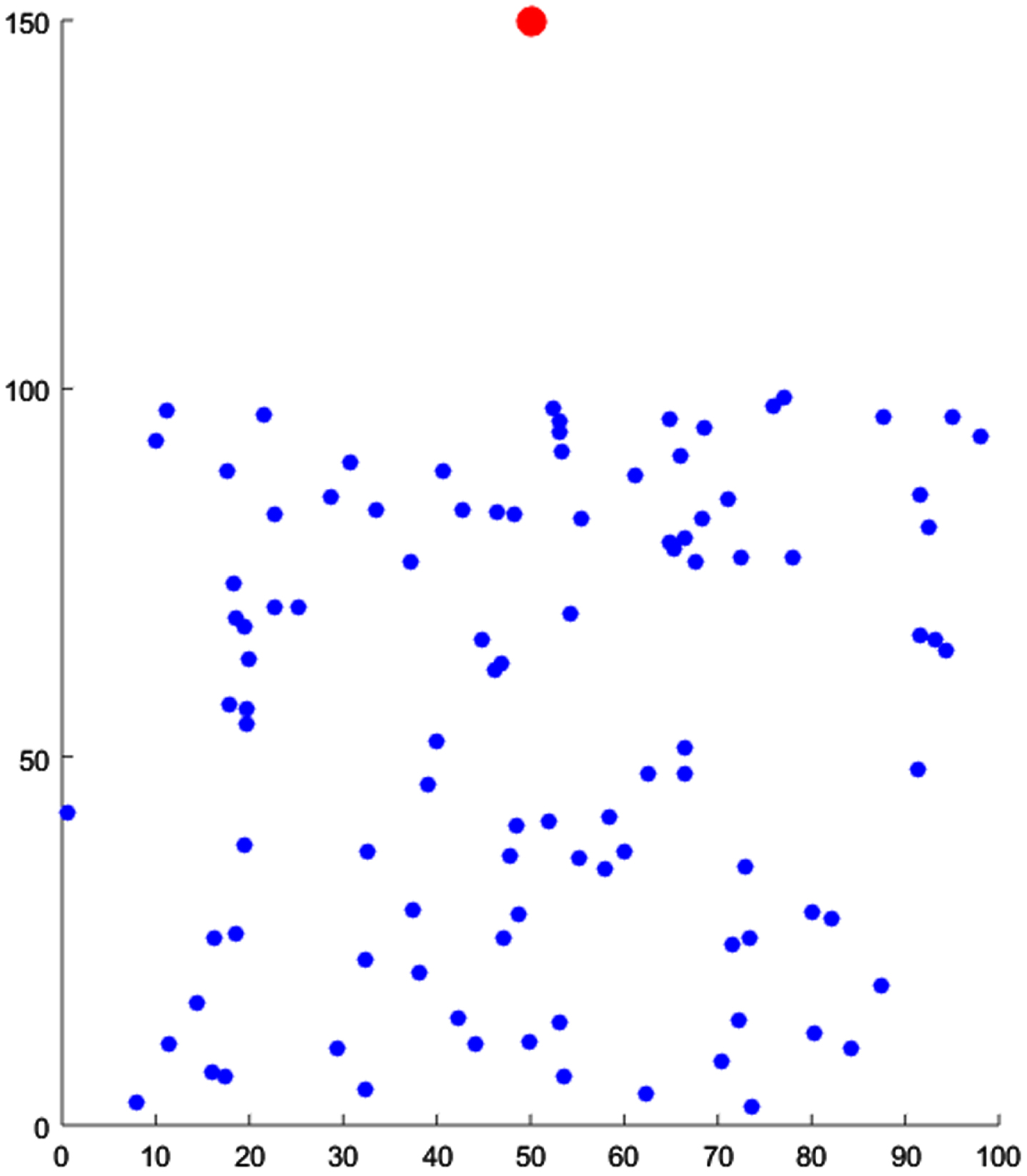
Wireless sensor network simulation.
Additionally, in this simulation, the scenarios covered in the previous chapter have been looked into, and a random movement is specified by default for a number of nodes. The settings utilized to simulate the movement of nodes in this network are shown in Table 3.
Variables needed to evaluate the proposed method
Figure 5 depicts the wireless sensor network’s performance prior to applying the key management scheme. Figure 6 depicts the wireless sensor network’s performance following the application of the suggested key management scheme. These results demonstrate that even after implementing the suggested key management strategy, the performance of the wireless sensor network is still adequate despite the increased computational overheads and energy consumption.
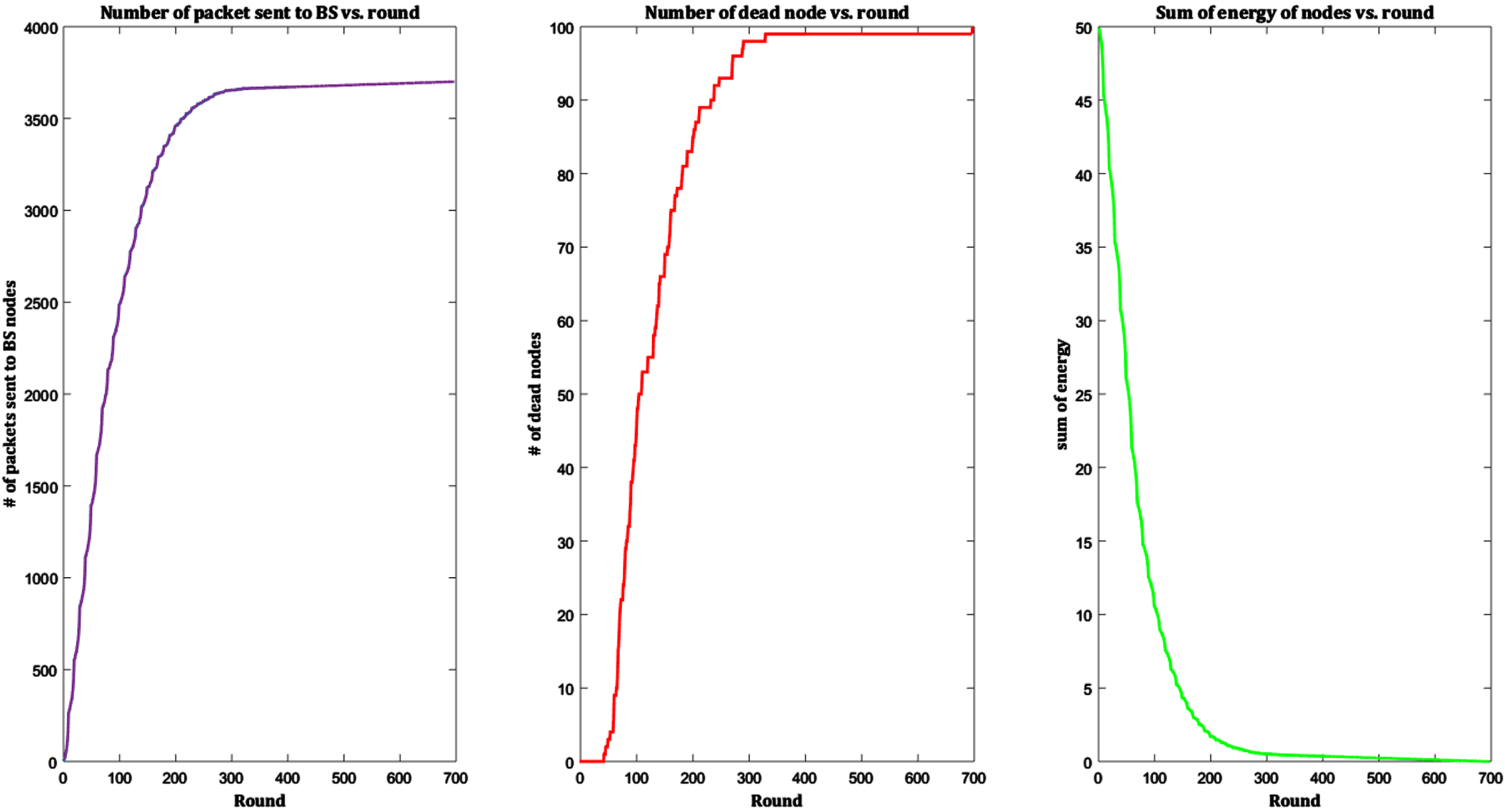
Wireless sensor network performance before implementing the proposed method.
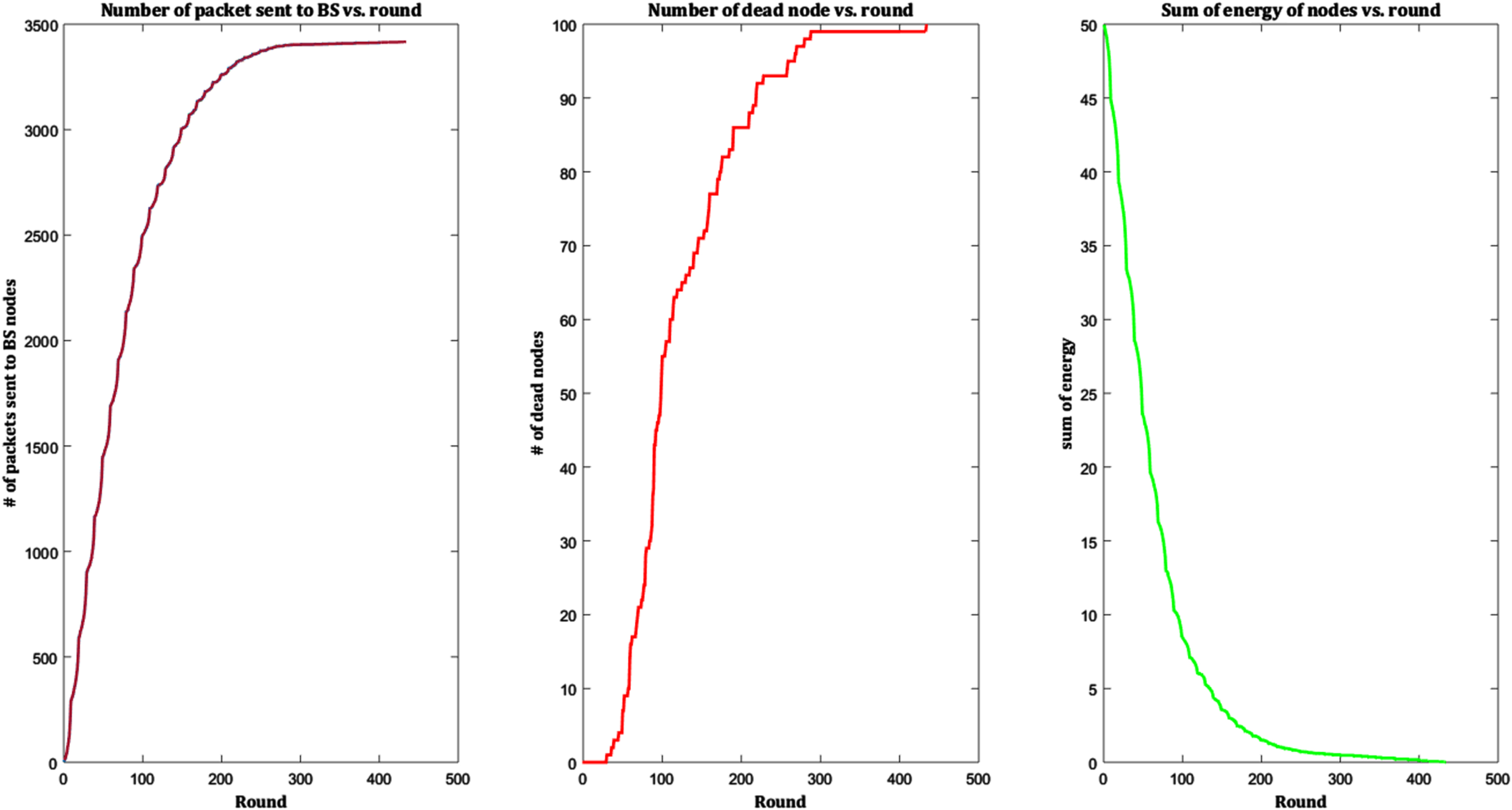
Wireless sensor network performance after implementing the proposed method.
Memory overhead is the extra memory required by the proposed key management strategy, which is placed on the wireless sensor network. Prior to calculating this variable, a simulation without the suggested plan is run to determine how much RAM was utilized. The proposed method is then utilized to run the identical simulation, and the amount of memory required is once more measured. The difference in memory usage between these two experiments demonstrates the suggested method’s memory overhead, which is shown in Table 4.
Parameters used in the simulation of the proposed method
Parameters used in the simulation of the proposed method
The results from the three approaches [4, 12], and [23] have been compared with those from the ones mentioned above in order to assess the memory overhead of the proposed method more accurately. Figures 7 and 8 demonstrate the outcomes of this comparison for memory overhead in cluster centers and memory overhead in sensor nodes, respectively.

Comparison of memory overhead for cluster centers in the studied methods.

Comparison of memory overhead for sensor nodes in the investigated methods.
Figure 7 illustrates how the suggested technique’s memory overhead for cluster centers is greater than method 3 and less than methods [4, 12]. Additionally, Fig. 8 shows that the proposed method has a lower memory overhead for sensor nodes than any other methods [4, 12], and [23]. This demonstrates that, overall, the proposed solution has less memory overhead than competing approaches.
The suggested key management approach imposes computational overhead on the wireless sensor network, and it is preferred that this overhead be as little as possible. Also, a technique similar to the method described in the memory overhead calculation is used to determine the computational overhead in the proposed method. The findings of this experiment are displayed in Table 5.
Parameters used to simulate the movement of nodes
Parameters used to simulate the movement of nodes
The computation overhead in the cluster centers will be 12-time units, while the computing overhead in the sensor nodes will be 6-time units, as shown in the above table. The results from the two approaches [4] and [12] have been compared with those from the ones mentioned above in order to assess the computational overhead of the suggested method more accurately. Figures 9 10, which represent the computational overhead in the cluster centers and the computational overhead in the sensor nodes, respectively, reveal the results of this comparison.

Computational overhead comparison for cluster centers in the studied methods.
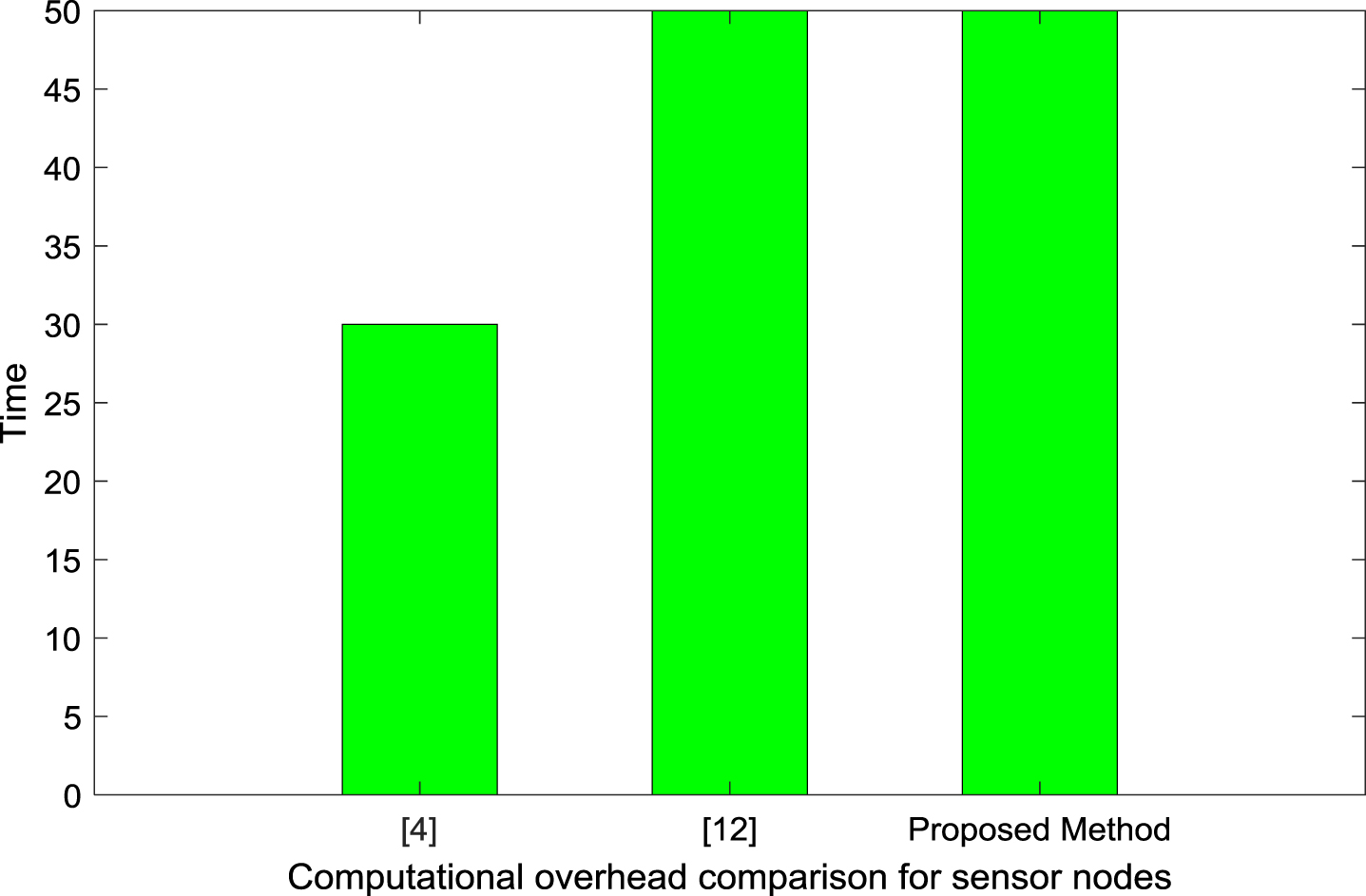
Computational overhead comparison for sensor nodes in the investigated methods.
The computational overhead for cluster centers in the suggested way is significantly lower than methods 1 and 2, as illustrated in Fig. 9. Additionally, Fig. 10 shows that the computational cost for the proposed method’s sensor nodes is greater than that of all other techniques [4] and equal to that of the method [12]. This demonstrates that generally speaking, the proposed method has less computational overhead than competing methods.
The proposed method’s energy consumption has been verified using an approach of a similar nature. The suggested technique will use less energy than existing methods because it uses an AVL search tree in addition to memory overhead and less computational overhead, which shortens the search time. Figure 11 compares the suggested method’s energy consumption to alternative approaches.
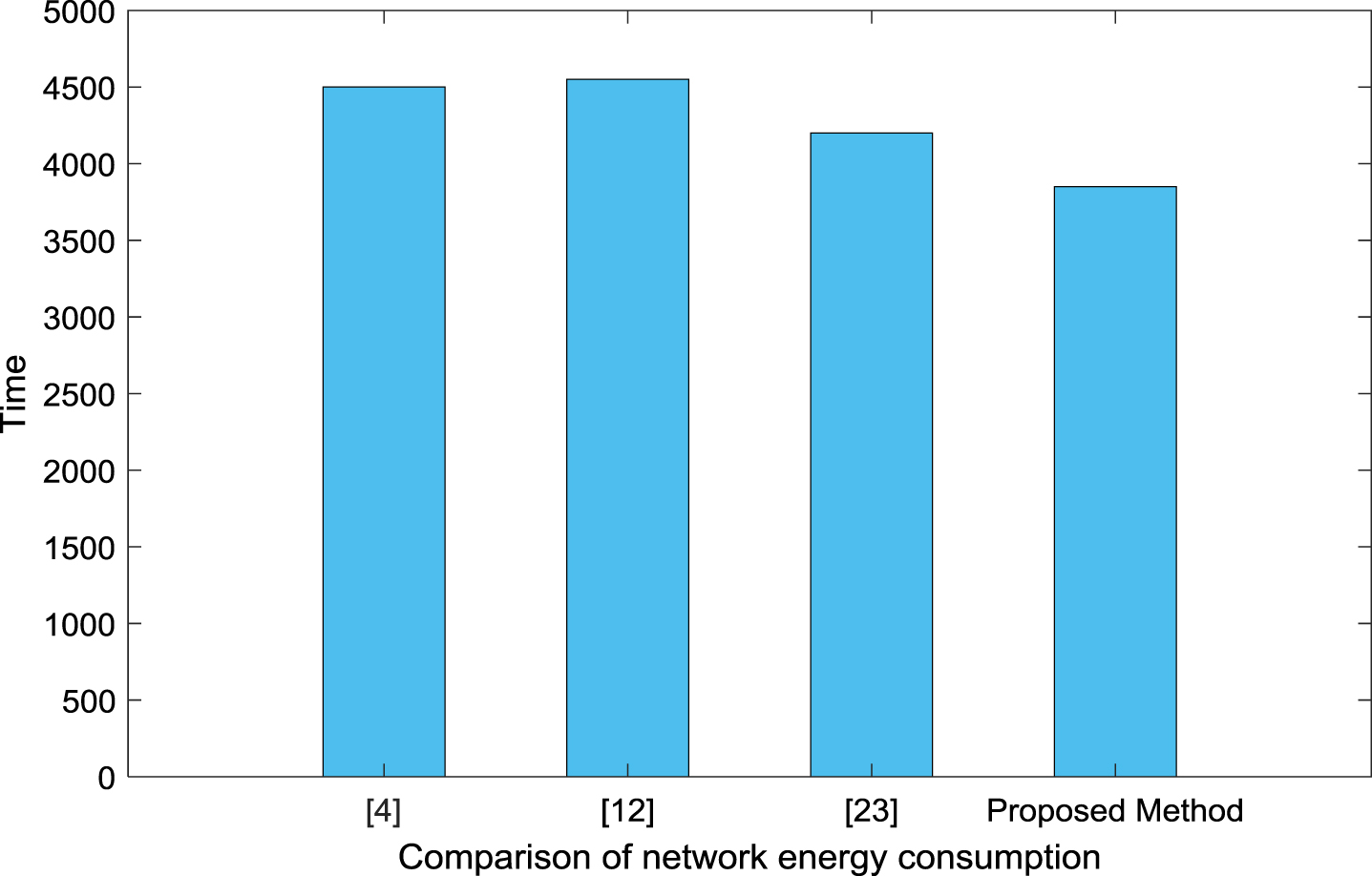
Comparison of network energy consumption for the investigated methods.
The proposed method uses a lot less energy than previous methods, as seen in the above figure. This problem is not entirely unexpected, given the advancements made by the suggested strategy.
This test measures the amount of computing overhead, memory overhead, and energy usage by adding a new node to the network. The findings of this experiment are displayed in Table 6.
Memory overhead of the proposed method
Memory overhead of the proposed method
The computational overhead of the proposed method
Investigating the scalability of the proposed method
It is important to clarify that this experiment was carried out 100 times, and the accompanying table displays the average results. The proposed approach is extendable, according to the aforementioned table.
The variables discussed in this experiment are measured by expanding the size of the network space and the number of nodes, then determining whether the proposed strategy is scalable or not. The results of this test are seen in Fig. 12. This exam is based on 10 distinct scenarios, numbered 1 through 10, and each test enlarges the network more than the test before it. Additionally, the researched variables’ values have been normalized between 0 and 1 to make comparisons easier. The proposed method is scalable, as determined by the outcomes of several tests.
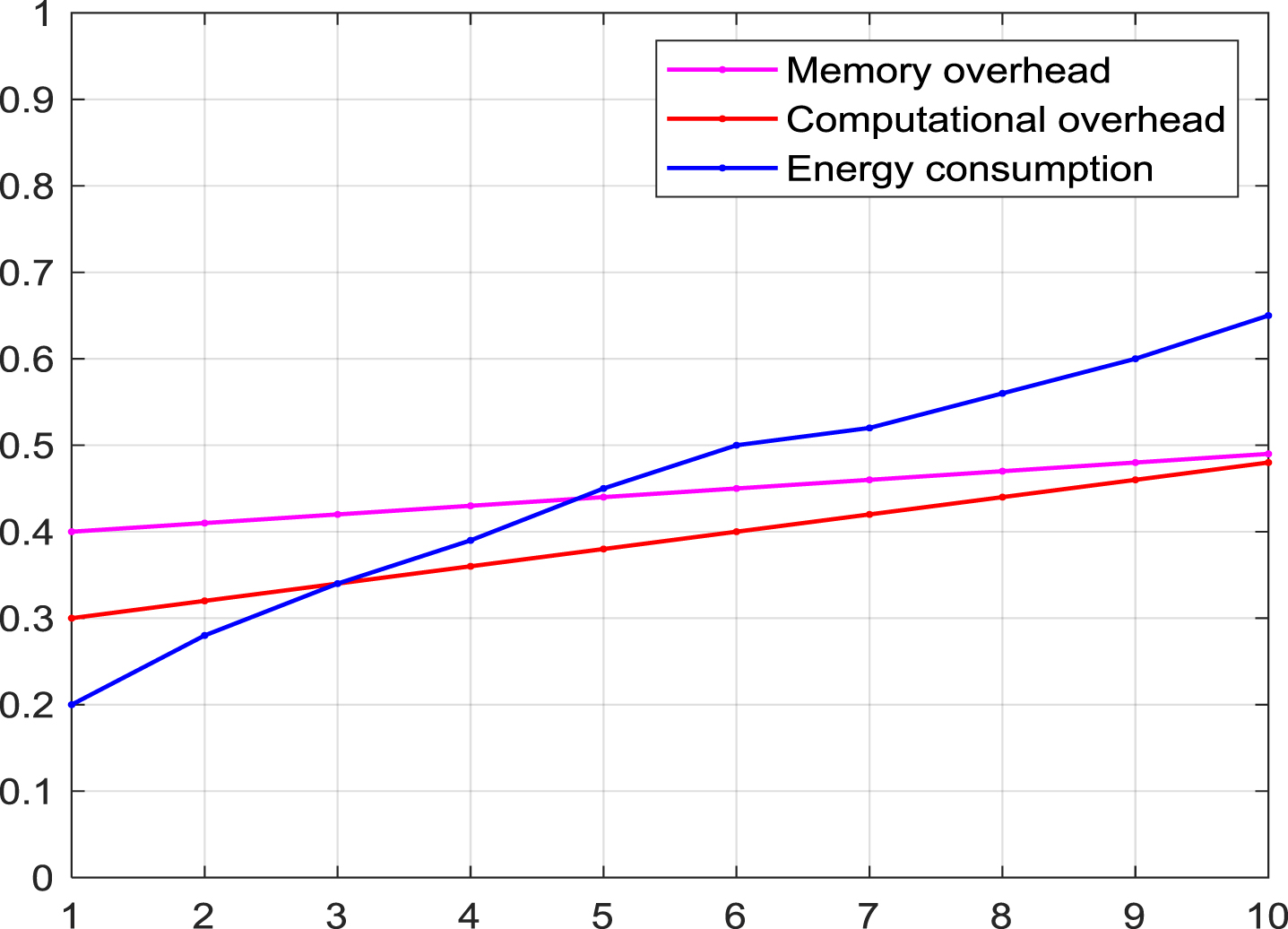
Check the scalability for parameters of memory overhead, computational overhead and energy consumption.
Information encryption has been looked at as a potential improvement in communication and information security in recent years. In this context, it is crucial to explain key management as a collection of algorithms for creating and exchanging keys. However, due to the inherent limitations of wireless sensor networks, solutions with lower communication overhead, computational cost, memory consumption, and energy consumption should be provided to increase the lifetime of wireless sensor networks. Various schemes have been proposed thus far for managing the communication key in wireless sensor networks. Using the AVL self-balanced binary tree and the LEACH algorithm, the proposed plan for communication key management in this study has been able to speed up node finding, insertion, and deletion, enhancing the effectiveness of the key management plan. The suggested solution employs elliptic curve encryption, which dramatically reduces the need for memory and communication overhead. As a result, there is significantly less energy consumption. As a result, the wireless sensor network’s lifespan has increased, and the proposed technology can be utilized to build large-scale networks with an acceptable level of efficiency.
A novel approach based on fuzzy systems and simple to implement in both hardware and software is also employed in the suggested strategy to gauge the nodes’ energy levels. As a result, the proposed key management scheme now has the appropriate flexibility thanks to the use of this fuzzy inference method.
In general, it is concluded that the proposed scheme for key management in wireless sensor networks leads to improvements in memory consumption, computational overhead and energy consumption of the network while improving its security. This conclusion is based on theoretical analysis and experimental results. Also, the scalability and extensibility of the method was also achieved. For this reason, the proposed technique has a wide range of applications in massive wireless sensor networks. Although the simulation of the suggested scheme in this research produced acceptably good results, the proposed scheme still has to be implemented and tested in a practical application. Real-world applications frequently experience unanticipated events that have varying effects on how the network functions. It is impossible to simulate these effects accurately in software. Therefore, to continue this research, it is imperative to assess how well the suggested design performs in a practical implementation. However, this task necessitates significant financial outlay and can only be carried out if the necessary hardware and expenses are covered. The fact that the simulation used for this research did not take into account the impact of side attacks and similar scenarios is maybe one of its flaws; however, this could be remedied with additional work for the ongoing study. Assaults like denial of service can jeopardize the wireless sensor network’s ability to function. Additionally, focusing on nodes with poor behavior can lead to new difficulties in the key management strategy.
Based on the text provided, here are some research gaps and areas that could be considered for further investigation or improvement:
Resource efficiency: While the proposed scheme aims to improve memory consumption, computational overhead, and energy consumption, there may still be room for further optimization. Research can explore ways to make the key management process even more resource efficient given the limitations of wireless sensor nodes.
Robustness in dynamic environments: The text discusses the effectiveness of the proposed design, but does not explicitly address its performance in dynamic or changing environments. Research can focus on how the key management strategy adapts to environmental changes, such as node mobility or network topology changes.
Footnotes
Acknowledgment
This work was supported by the project of Research on Campus Behavior Recognition and Early Warning System Based on AI under Epidemic Prevention and Control, Contract No.: KJQN202102403.
This work was supported by the project of Research and Manufacturing of Integrated Wearable Antenna Technology for Integrated Communication, Contract No.: KJZD-M202202401.