



Abstract
With the continuous changes and development of financial markets, it has brought many difficulties to investment decision-making. For the multi-objective investment decision-making problem, the improved Ant colony optimization algorithms was used to improve the effectiveness and efficiency of the multi-objective investment decision-making. Therefore, based on intelligent Fuzzy clustering algorithm and Ant colony optimization algorithms, this paper studied a new multi-objective investment decision model, and proved the advantages of this method through comparative analysis of experiments. The experimental results showed that the improved Ant colony optimization algorithms has significantly reduced the system’s construction costs, operating costs and financial costs, all of which were controlled below 41%. Compared with the traditional Ant colony optimization algorithms, this method had lower values in policy risk, technical risk and market risk, and can effectively control risks. Meanwhile, the environmental, economic, and social benefits of this method were all above 58%, and the average absolute return rate and success rate in this experiment were 21.5450% and 69.4083%, respectively. Therefore, from the above point of view, the multi-objective investment decision model based on intelligent Fuzzy clustering algorithm and the improved Ant colony optimization algorithms can effectively help decision-makers to find the best investment decision-making scheme, and can improve the accuracy and stability of decision-making. This research can provide reference significance for other matters in the field of investment decision-making.
Keywords
Introduction
With the rapid development of information technology and the continuous changes in financial markets, investment decisions for enterprises have become more difficult. Investors need to consider not only the return on investment, but also many factors such as risk, cost, and liquidity. Meanwhile, due to the inherent non-linear and uncertain characteristics of the market, investment decision-making becomes more difficult. Therefore, this paper improves the multi-objective investment decision model, and introduces intelligent Fuzzy clustering algorithm and Ant colony optimization algorithms, thus improving the accuracy and effect of investment decision-making.
Background
The research on multi-objective investment decision-making issues has important practical sig-nificance in dealing with complex situations, optimizing investment portfolios, conducting risk management, providing decision-making support, and promoting theoretical and methodological innovation. Various researchers have proposed different methods and algorithms to address these problems. For example, Liu Xi proposed a new improved SPEA2 algorithm with a local optimization strategy for multi-objective investment decision-making problems. This model provides investors with decision-making criteria that help them comprehensively consider various risks and returns, thus formulating optimal investment strategies [1]. Liu W studied the multi-objective decision model that can be used to achieve the optimal location of electric vehicle charging facilities. After considering multiple objectives, such as service scope, cost, and environmental impact, he found that this model is helpful for decision-makers to select the best charging station in the city. Moreover, he proved that the model can generate solutions with good equilibrium and can meet various requirements of investors [2]. A F K provided a new auxiliary decision-making method for solving the selection problem of multi standard suppliers. By combining Analytic Hierarchy Process (AHP) with TOPSIS (Technology for Order Preference by Similarity to Ideal Solution), he evaluated and ranked suppliers under multi-objective and multi constraint conditions, providing investors with high-quality supplier selection. Experiments have shown that the model proposed by this method can provide a basis for investment decisions of enterprises, thereby enabling them to achieve better performance and effectiveness [3]. Guliashki V G comprehensively considered and analyzed multiple objectives and applied multi-objective optimization methods to microgrid energy. The research results showed that this method can help microgrids achieve effective energy utilization, find the optimal solution suitable for various operating conditions of microgrids, and achieve balance between different objectives [4]. Therefore, after the above research, the role of multi-objective investment decision model in various fields can be clearly understood. However, there are still some problems in the traditional multi-objective investment decision model, and other algorithms need to be used to solve these problems and improve its application effect. Therefore, when facing the problem of traditional multi-objective investment decision model, many scholars have applied intelligent algorithms to multi-objective investment decision-making to solve this problem. Among them, Ant colony optimization algorithms is one of the optimization algorithms often used for such problems. Wei L proposed a new multi-objective iterative local optimization algorithm for the location selection of warehouse stackers. The results showed that Ant colony optimization algorithms has obvious advantages for multiple attribute decision-making in this method. Ant colony optimization algorithms can efficiently solve the path optimization problem of storage stacker, and find the optimal solution under multiple objectives [5]. Guoqing L’s research was based on a new multi-objective fuzzy optimization method for microgrid operation. The results showed that applying ant algorithm to microgrid systems can achieve multi-objective optimization and find the optimal solution under fuzzy conditions. The research of this algorithm fully leveraged the self-organization and collaborative effects of ant colonies, enabling efficient and stable operation of microgrids, and helping microgrid systems make optimization decisions under multiple objectives, improving the performance and reliability of microgrid systems [6]. Sawadogo M used the multi index decision-making method based on Ant colony optimization algorithms to plan joint transportation routes on a sustainable supply chain. The research results showed that Ant colony optimization algorithms can not only efficiently plan the supply chain transportation route, but also give full play to the information sharing and collaboration among ants, so as to improve the efficiency and sustainability of transportation routes [7]. Kparib D Y combined Ant colony optimization algorithms with multi index decision-making, and applied it to the discrete optimization problem of double objectives. It can be found that the improved Ant colony optimization algorithms can effectively solve the double objective optimization problem. In addition, in the application process, he simulated the self-organization behavior and information exchange of ants, thus improving the efficiency and accuracy of decision-making [8]. Zivkovic, M. successfully predicted COVID-19 cases by using hybrid machine learning and beetle antenna search methods [9]. In biomedical and biological cases, Nematzadeh, S. believed that meta-heuristic algorithms were used to adjust the hyperparameters of machine learning algorithms and deep neural networks [10]. Zivkovic M. used a simple convolutional neural network and XGBoost classifier to improve the accuracy of early diagnosis of COVID-19 [11]. According to the above research, Ant colony optimization algorithms has been further improved and applied to make it have better performance in multi-objective decision-making problems.
In general, although Ant colony optimization algorithms also has its own shortcomings, such as easy to fall into the local optimum, the ability to solve multi-objective problems is not strong. The problem studied in this paper is how to improve the accuracy and effectiveness of multi-objective investment decision by improving the application of ant colony optimization algorithm. Therefore, this paper used a multi-objective investment decision-making method based on Ant colony optimization algorithms. In the Ant colony optimization algorithms, the local optimization operation was introduced to improve the optimization ability of the ant algorithm, so as to avoid falling into the local extremum problem. At the same time, through the performance of other intelligent algorithms and multi-objective optimization methods, the multi-objective investment decision model can be effectively optimized. Therefore, applying the improved ant colony optimization algorithm to the traditional multi-objective investment decision-making problem can improve the accuracy and effectiveness of the problem.
The contribution of this paper is to analyze an improved multi-objective investment decision model by combining intelligent fuzzy clustering algorithm and ant colony optimization algorithm. This improvement aims to improve the accuracy and effectiveness of investment decisions by considering a variety of factors such as risk, cost, liquidity and return on investment.
In the introduction part, this paper introduced the background and explains the difficulties brought by the changes of financial markets to investment decisions. In the method part, it introduced the improved ant colony optimization algorithm to improve the effect and efficiency of multi-objective investment decision, and a new multi-objective investment decision model based on intelligent fuzzy clustering algorithm and ant colony optimization algorithm. The experimental design is described in the part of experimental design and result analysis, and the advantages of the proposed method are proved through comparative analysis of experimental results. It is pointed out that the improved ant colony optimization algorithm significantly reduces the construction cost, operating cost and financial cost of the system. Compared with the traditional ant colony optimization algorithm, this method has lower values in terms of policy risk, technical risk and market risk, which can effectively control the risk. The experimental results are discussed in the discussion section, and the feasibility and applicability of this method are discussed by comparison and analysis with existing studies. Finally, it is pointed out that the multi-objective investment decision model based on intelligent fuzzy clustering algorithm and improved ant colony optimization algorithm can effectively help decision makers find the best investment decision scheme and improve the accuracy and stability of decision making.
Multi-objective investment decision model based on intelligent fuzzy clustering algorithm
Construction of datasets
The dataset used in this article is a stock investment decision dataset that includes financial and market indicators of multiple companies. This dataset is sourced from the financial database Yahoo Finance, which contains investment decision datasets for 100 companies. The data of each company includes financial and market indicators, which are used to assist investors in making investment decisions. The dataset contains the following characteristics: Company Code: A unique identifier for each company. Stock Price: The stock price of each company, expressed in US dollars per share. P/E ratio: The P/E ratio of each company represents the market’s expectation of the company’s future earnings. Revenue growth rate: The annual revenue growth rate of each company represents the company’s performance growth. Market share: The market share of each company in a particular industry indicates the company’s position in the market. Policy risk assessment: It can assess the level of policy risk in the country or region where the company is located, which can be used to measure the impact of government policies on the company’s business. Technical risk assessment: It can assess the risk level of the company’s technological innovation and R&D capabilities, which can be used to measure the company’s technological competitiveness and continuous innovation capabilities. Market risk assessment: It can assess the risk level of the company’s market, including industry competition, market fluctuations, etc.
Intelligent Fuzzy Clustering Algorithm
Intelligent Fuzzy clustering algorithm is a new method that organically integrates Fuzzy clustering and intelligent algorithm. This method introduces multiple optimization algorithms such as genetic algorithm [12], Ant colony optimization algorithms, particle swarm optimization algorithm [13] into traditional Fuzzy clustering to make it have better clustering effect. Moreover, the core idea of the algorithm is Fuzzy clustering, which can be given a membership degree in the algorithm, equivalent to the clustering probability of each data point. At the same time, each cluster is represented by a weighted average of the membership degrees of each point within it, making the method more flexible and robust, and capable of handling fuzzy and uncertain data.
Therefore, the intelligent Fuzzy clustering algorithm usually includes the following steps:
(1) Initializing membership matrix: Each data point is randomly assigned membership values, and the total membership is 1.
Random initialization formula:
Among them, uij refers to the membership degree of data point i in cluster j, and rand (0,1) refers to the random number generated between 0 and 1.
(2) Calculating cluster centers: Based on the existing cluster membership matrix, the weighted average method or other methods are adopted to cluster the cluster centers.
The calculation formula for each cluster j and cluster center cj is:
Among them, uij represents a vector of length n, representing the membership of the I-th data point to the JTH fuzzy cluster, m refers to a hyperparameter whose value is generally greater than 1, and xi is the eigenvector of data point i.
(3) Updating membership matrix: Based on the current cluster center, the membership of each data point is updated to better match the similarity between the data and the cluster center.
The update formula for uij is:
Among them, dij refers to the distance between data point i and cluster center cj, and dik refers to the distance between data point i and cluster center ck.
(4) Repeating steps 2 and 3: The calculation of the cluster center and the update of the membership matrix are repeated until the maximum iteration number is reached, and the change in the membership matrix is below a certain threshold value.
In this article, it is assumed that there are four data points (A, B, C, D) and three clusters (cluster 1, cluster 2, cluster 3). The numbers in Table 1 represent the degree of membership to which each data point belongs. Therefore, by selecting values for the cluster center and updating them, a stable membership matrix and an optimal cluster center can be obtained. In this way, data points can be divided into different clusters, which can better process fuzzy and complex data, and give more detailed data analysis and mining results, so as to achieve the purpose of intelligent Fuzzy clustering. Therefore, the flowchart of the multi-objective investment decision model based on the intelligent fuzzy clustering algorithm is shown in Fig. 1.
Values of cluster center and membership matrix

Flow chart of the model.
Multi-objective investment decision model is to comprehensively consider multiple objectives in the investment process to obtain the optimal portfolio and optimal return. In the process of joint investment between the government and social capital, multiple objectives often need to be comprehensively considered, such as fund return rate, risk control, social benefits, etc. Therefore, it is very necessary to establish a multi index investment decision model.
Before building the model, the system variables of Public–private partnership projects should be determined first to understand the multi-objective investment decisions of Public–private partnership, as shown in Table 2.
System variables of Public–private partnership project
System variables of Public–private partnership project
From Table 2, it can be seen that in the government’s regulatory fees for PPP (Public-private Partnership) projects, Cgm represents daily regulatory expenses and Cge represents loss costs. Fgti represents economic penalties, while Pgtp represents compensation. Rgti represents reward income, while Iio represents production income. Iwi represents additional income, while Rgtp represents penalty income. Cpp represents the cost of reporting. By analyzing the system variables of Public–private partnership projects in Table 2, the balance and trade-offs between government and social capital in the process of multi-objective investment decision-making can be further understood. At the same time, the weights of each factor can be set according to different conditions to achieve the optimal investment strategy and decision-making plan.
Therefore, for the construction of multi-objective investment decision model, after finding the evaluation indicators, the model is established according to the indicators.
(1) Selection of indicators
1) Expected net present value: It reflects the absolute economic benefits of an investment project and is also one of the main objectives of investment. The formula is:
Among them, NPV represents the net present value, and Ct represents the cash flow at each time point t. r represents the discount rate or expected return rate; t represents the time point of the corresponding cash flow; I represents the initial investment amount.
2) Expected net present value index: This indicator reflects the relative economic benefits of investment projects, especially in cases that the net present value index should be adopted when the total investment amount is uncertain. Therefore, the formula is:
Among them, ENPV is the expected net present value index.
3) Investment failure rate: It reflects the degree of risk of an investment project, mainly measured by the likelihood that the net present value of a project is less than 0. The higher the index, the higher the risk.
4) Risk loss value: This indicator reflects the potential loss of an investment project. At lower loss values, the project becomes better.
5) Project investment payback period (static): This index reflects the time it takes to recover all investments from a project’s net income without considering the time value of capital. The shorter the payback period, the better it is.
6) Management difficulty level: This index reflects the operational difficulty of an investment project, and a mature business approach makes it easier to operate, thereby promoting the success of the investment. The difficulty of management is a qualitative indicator that is difficult to quantify. The use of fuzzy optimization method can effectively solve this problem.
(2) Establishing a model
A fuzzy optimization model method is proposed to address the above issues. In the multi-objective decision system, the scheme set is set as A={A, A1, A2,..., Am}, and the Index set is set as C={C1, C2,..., Cn}, so as to build the target eigenvalue matrix (xmn) of the system. Among them, xij is the index value of scheme Ai for index Cj, i = 1, 2,..., m; J = 1, 2,..., n. For different evaluation indicators, there are usually different dimensions and units, and at the same time, the quality of the plan depends on the relative degree of each choice, so it has relativity. In order to eliminate the incommensurability caused by different dimensions and units, and to facilitate calculation and optimization analysis, the absolute quantity of evaluation indicators is converted into relative quantity before making a decision, which is also known as relative superiority.
rij is set as the relative superiority of scheme i and evaluation index j. For cost type indicators: rxj = Xj*/rij; For benefit indicators: rij = rij/xj* (where xj*=max xij, i = 1, 2,..., m). Among them, quantitative evaluation indicators can be divided into 5 levels; The cost index from poor to good and the cost index from good to bad are taken as 9, 7, 5, 3, and 1. Through this method, the target eigenvalue matrix (xij) can be transformed into a relative superiority matrix (rij).
The weight vector of the above evaluation indicators is set to W=(w1,w2,...,wn)T. If ui represents the relative degree of membership between an alternative i and the best alternative, then a multi-objective fuzzy optimization theory model is established using the Fuzzy set [14, 15] theory:
Ui = 1/(1+varSigma[Wj(1-rij)]2/varSigma(Wjrij)2 (where j = 1, 2,..., n)
For all schemes, the calculation is carried out through the multi-objective fuzzy Optimality Theory model, and it is concluded that the option with the largest relative membership ui is the most satisfactory scheme, that is, to provide decision-making basis for multi-objective comprehensive evaluation and optimization according to the order of ui from large to small.
Through the construction of the completed model, when Public-private partnership cooperate in investment, the best one of the 1-5 options can be found for investment. The evaluation indicators for the five options are calculated based on information related to the enterprise, as shown in Table 3.
Calculation table of multi-objective decision indicator values for each project
After considering the indicators of return, risk, management, and other aspects of the investment project, five options are ranked and a result of 1 > 3>2 > 4>5 is obtained based on Table 3. At the same time, it also provides a basis for enterprises to make investment decisions in construction projects, thereby better solving some basic problems in investment decisions in construction projects.
In the multi-objective investment decision model, intelligent Fuzzy clustering algorithm can divide investment projects into several groups, and evaluate and rank each group, so as to achieve the optimal investment portfolio and optimal income. Meanwhile, this method has fast calculation speed and accurate decision-making, which can effectively improve the accuracy and effectiveness of project investment decisions. Therefore, in the investment of government and social capital cooperation projects, the application of multi-objective investment decision model based on intelligent Fuzzy clustering algorithm mainly includes: Project classification and evaluation: Intelligent Fuzzy clustering algorithm can group similar projects according to the characteristics of investment projects. Each group is evaluated and arranged in order to provide a reasonable classification and evaluation of the items. Investment plan design and optimization: Based on the clustering analysis results and combined with the decision index, the optimal investment plan is found, optimized, and evaluated to achieve maximum economic and social benefits. Risk control and early warning: Through an evaluation method based on Fuzzy clustering analysis, investment projects are cluster evaluated, so that decision-makers can find high-risk projects in time, and formulate corresponding countermeasures for decision makers to reduce possible risks and losses.
In a word, in the investment of public-private partnership projects, this model can realize the scientific classification, evaluation and optimization of government and social capital cooperation projects, so as to obtain the optimal investment portfolio and income.
Ant colony optimization algorithms and its application in multi-objective investment decision-making
Basic principles and steps of ant colony optimization algorithms
Ant colony optimization algorithms is an optimization algorithm based on Bionics thought according to ant foraging behavior [16]. This algorithm has the ability of multi-objective optimization. This method utilizes pheromones between ants for information exchange, establishes a global information sharing mechanism, and achieves the global optimal solution. This gives ant colony algorithm certain advantages in solving multi-objective optimization problems. The basic principle consists of the following steps: Initialization: The multi-objective function [17] and constraint conditions of the problem are determined, and the number of ants, pheromone matrix and heuristic information matrix are initialized. Constructing a solution space: The solution space is divided into several discrete domains according to the properties of the problem, with each domain having a solution. Encoding solution space: Each solution within the solution space is encoded and its fitness is recorded, that is, the value of the objective function. Searching for solution space: Heuristic search techniques are utilized to obtain adjacent solutions for each solution and determine its fitness. According to the concentration of Pheromone and the size of heuristic function, the best neighborhood is selected. Updating Pheromone: The mechanism of Pheromone attenuation and Pheromone update is used to continuously release Pheromone on one route, so as to optimize the whole route. Therefore, the update formulas of local Pheromone (6) and global Pheromone (7) are:
Among them, p1 and p2 represent local and global Pheromone evaporation rates respectively, and their value ranges are usually set to 0 < p1, p2≤1, and generally 0.5. T0 is the volatilization of Pheromone. Here, T0 = 1/dij, where dij is equal to the execution time of each path. T is the completion time for the ant to obtain the scheduling plan during this cycle. Judgment completion: According to the requirements of the problem and pre-set conditions, whether the search results have been completed is determined. If not, it is returned to step (4).
Therefore, it can be seen from the above that each ant determines the next behavior based on the current Pheromone concentration and the value of the heuristic function, and follows their route Pheromone concentration. The results show that when the Pheromone concentration is higher, the more ant colonies choose the path, the greater the probability of being selected, thus generating positive feedback.
In the Ant colony optimization algorithms, the main problem is the rapid update of Pheromone. Many scholars have proposed a new ant colony optimization method to address this issue. Therefore, for this issue, the following methods have been referenced to improve the algorithm. Introduction of local search mechanism [18, 19]: In the Ant colony optimization algorithms, local search mechanism is introduced to enable it to quickly find better optimization problems, in which the methods used include 2-opt, 3-opt, etc. This algorithm has made some modifications to the existing solution results to enable it to find shorter paths. Setting adaptive parameters: Specific adjustments are made based on the characteristics of the problem. For example, the release rate of Pheromone can vary with the size of the problem and the number of repetitions. Therefore, the known Pheromone and the existing experience are used to set the initial Pheromone reasonably. By adjusting the weight of the heuristic function, the trade-off between Pheromone and heuristic information is realized. Strengthening the Pheromone update mechanism: When updating the overall Pheromone, the attenuation coefficient of the Pheromone added can be considered, and the original Pheromone can be gradually reduced. In the update of local Pheromone, only Pheromone on the best path is updated, that is, only Pheromone between two cities is added on the best path. Through this method, the search focus can be on updating the optimal path, thereby accelerating the convergence of the algorithm. Table 4 shows the update process of Pheromone in Ant colony optimization algorithms. By updating the global Pheromone, it is ensured that the exploration experience of all ants can guide the overall search results; by updating the local Pheromone, the Pheromone on the optimal path is concentrated, so that the optimal solution is easier to be selected by ants. Therefore, in this Pheromone updating mechanism, Ant colony optimization algorithms can gradually converge to a better solution to improve the rate of convergence and search effect of the algorithm. Introducing multiple heuristic functions: Appropriate heuristic functions are selected to have strong adaptability and high computational efficiency. For example, in the TSP (Traveling Salesman Problem), in addition to considering the distance between cities, accessibility and similarity between cities can also be considered. Based on the characteristics of the problem, multiple heuristic functions can be selected or combined for ant colony search.
Relevant data on indicators and weights
Relevant data on indicators and weights
In general, the Ant colony optimization algorithms is applied to practical projects to better meet the requirements of collaborative decision-making between the government and social capital, and improve the efficiency and efficiency of the algorithm. Through the above improvements, government and social capital cooperation projects can be flexibly selected and adjusted under the specific circumstances of multi-objective investment decisions, so as to achieve better optimization results. The partial Python code of the meta heuristic algorithm studied in this article is shown in Fig. 2.
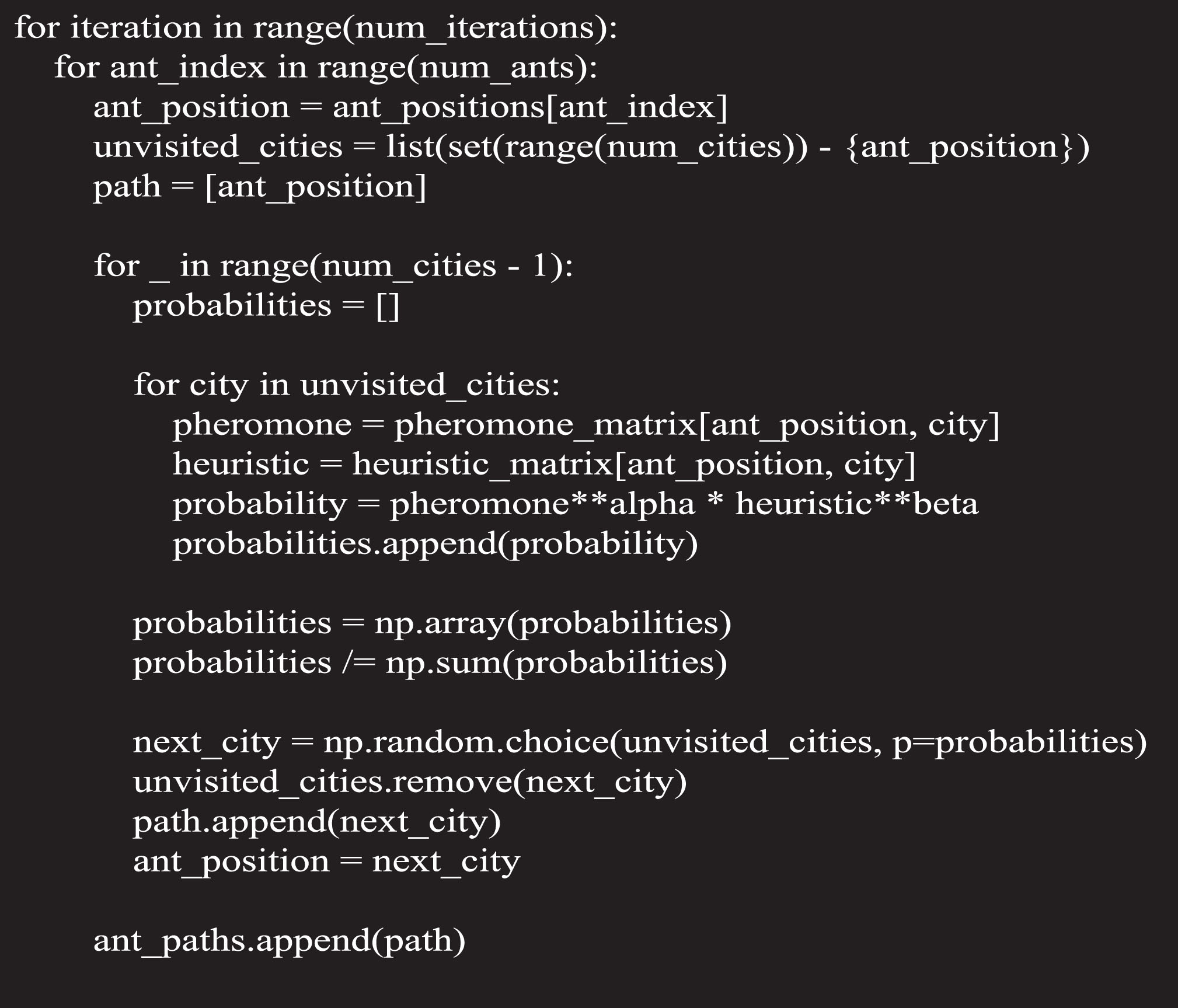
Partial Python code for meta heuristic algorithm.
The investment of Public-private partnership project is a multi-objective investment decision-making problem, in which the objectives include financial returns, social benefits and other aspects. In this case, Ant colony optimization algorithms can be applied to multi-objective decision-making to find the optimal investment scheme. The steps include the following: Target determination: According to the characteristics of government social capital cooperation projects, the objective function is defined as a multi-objective function, including economic benefits, social benefits, and environmental impacts. The objective function can be expressed as:
Among them, fn(x) represents the value of the nth objective, and x represents the solution of the investment decision. Specifically, the objective function is defined as economic benefits f1(x), social benefits f2(x), and environmental impacts f3(x). Other objective functions include risk assessment, sustainable development, etc. By using multiple indicator decision-making methods for each objective function, the optimal solution for investment decisions can be obtained. Encoding solution space: A solution space encoding method has been proposed for investment decision-making problems with multiple objectives, which can reflect the score level of each solution under different objectives. This article uses binary encoding scheme to solve multi-objective investment decision-making problems. In multi-objective investment decision-making problems, the selection of each investment project is represented as a binary vector, where each binary bit corresponds to an investment project. If a binary bit is 1, it indicates the selection of the investment project; If a binary bit is 0, it means that the investment project is not selected. In this way, the solution space of the problem can be represented by a binary matrix composed of 0 and 1. Setting weights: Based on the importance of each problem, corresponding weights are set to calculate the fitness of each problem. Search solution space: When Ant colony optimization algorithms is used to search solution space, Pheromone updating and path selection strategies are adopted to balance the global and local search results, so as to guide ants to search for possible good and bad solutions in the solution space. Selection results: Multiple indicator decision-making methods such as weighted summation and Pareto Principle optimality have been utilized. Based on the weights of each indicator and the fitness of the ant colony, the best solution is selected as the final investment decision.
Through the above research, the role of Ant colony optimization algorithms in the multi-objective investment decision-making of Public-private partnership projects is clarified. In multi-objective investment decision-making, the process of finding food can be seen as the process of finding the optimal investment strategy, while pheromone communication and path selection correspond to the communication between investors and the selection of investment strategies. Improving the ant colony optimization algorithm is a method to improve the traditional ant colony optimization algorithm. It is mainly to improve the performance of the algorithm by increasing the ability of local search and improving the pheromone update method. In multi-objective investment decision-making, this algorithm can achieve more effective information sharing among investors and gradually optimize investment strategies through multiple iterations, thereby obtaining a better investment portfolio. Due to the fact that the search process of ant colony optimization algorithm is based on swarm intelligence and has characteristics such as distributed, adaptive, and parallel, it has great potential in multi-objective investment decision-making. Compared with traditional methods, the use of ant colony optimization algorithm can more effectively solve multi-objective optimization problems in public-private partnership project investment, improving the efficiency and accuracy of project investment decision-making. Therefore, according to the optimal algorithm of Bionics thought - Ant colony optimization algorithms, it has shown a good effect when making investment decisions for multiple projects.
Experimental cases
It is assumed that the government and social capital of a certain region jointly invest in a new energy project, such as a solar power plant. In the region, local governments hope to promote the development of renewable energy through joint development with social capital, reduce dependence on conventional energy, and also play a positive role in the environment. Therefore, the data related to the project are collected and sorted out, including the investment cost of solar power station construction, expected power generation, power generation efficiency, operation and maintenance cost, project income, government subsidy policies, environmental impact assessment and other data. An investment decision model is jointly constructed, and then the investment cost, power generation efficiency, operating cost, income, environmental impact and other indicators are taken into consideration. According to the actual situation, each indicator is weighed to reflect the government’s preference for each goal. In the analysis of the above experimental cases, the investment decisions of government and social capital joint projects are evaluated and ranked to determine the priority of each investment plan. Table 4 lists the information related to the cooperation plan.
Table 4 shows the proportion and index of government and social capital in joint investment projects in the new energy field, which can help decision-makers better evaluate the advantages and disadvantages of various investment methods, thus making the optimal investment strategy. Therefore, this paper compares the performance of the improved Ant colony optimization algorithms and the traditional Ant colony optimization algorithms, and uses the same evaluation indicators and parameter settings. Among them, the number of solutions is set to 10, the number of iterations for algorithm operation is 100, the number of independent runs is 5, the initial pheromone is set to 6, the pheromone update rate is set to 0.5, and the parameter in the heuristic function is set to 1. The improved Ant colony optimization algorithms and the traditional Ant colony optimization algorithms are run separately, and their investment costs, risk control, benefits, investment decision accuracy, etc., are compared to select the scheme that can achieve the project goals and maximize social benefits.
Experimental results
(1) Investment cost
Investment cost refers to the expenses that need to be paid when making a certain investment, including construction costs, operating expenses, financial costs, etc. Through investment comparison with the traditional Ant colony optimization algorithms, this paper analyzes the impact of construction costs, operating costs and financial costs on the effectiveness and benefits of the two algorithms. Among them, the construction cost has a direct impact on the implementation and progress of the project. The higher the construction cost, the greater the investment, but the greater the income if it can improve the efficiency and competitiveness of the project; operating costs are directly related to the operational status and benefits of the project. Effectively controlling operating costs can enhance the profitability and competitive advantage of the enterprise; financial costs are directly related to the return and payback period of investment projects, and the higher the financial costs, the higher the return required to cover them. Therefore, when comparing, it is necessary to comprehensively consider the advantages and disadvantages of each indicator. After comprehensive analysis of all aspects, the optimal investment cost plan can be found. The comparison of investment costs between the two algorithms is shown in Fig. 3.
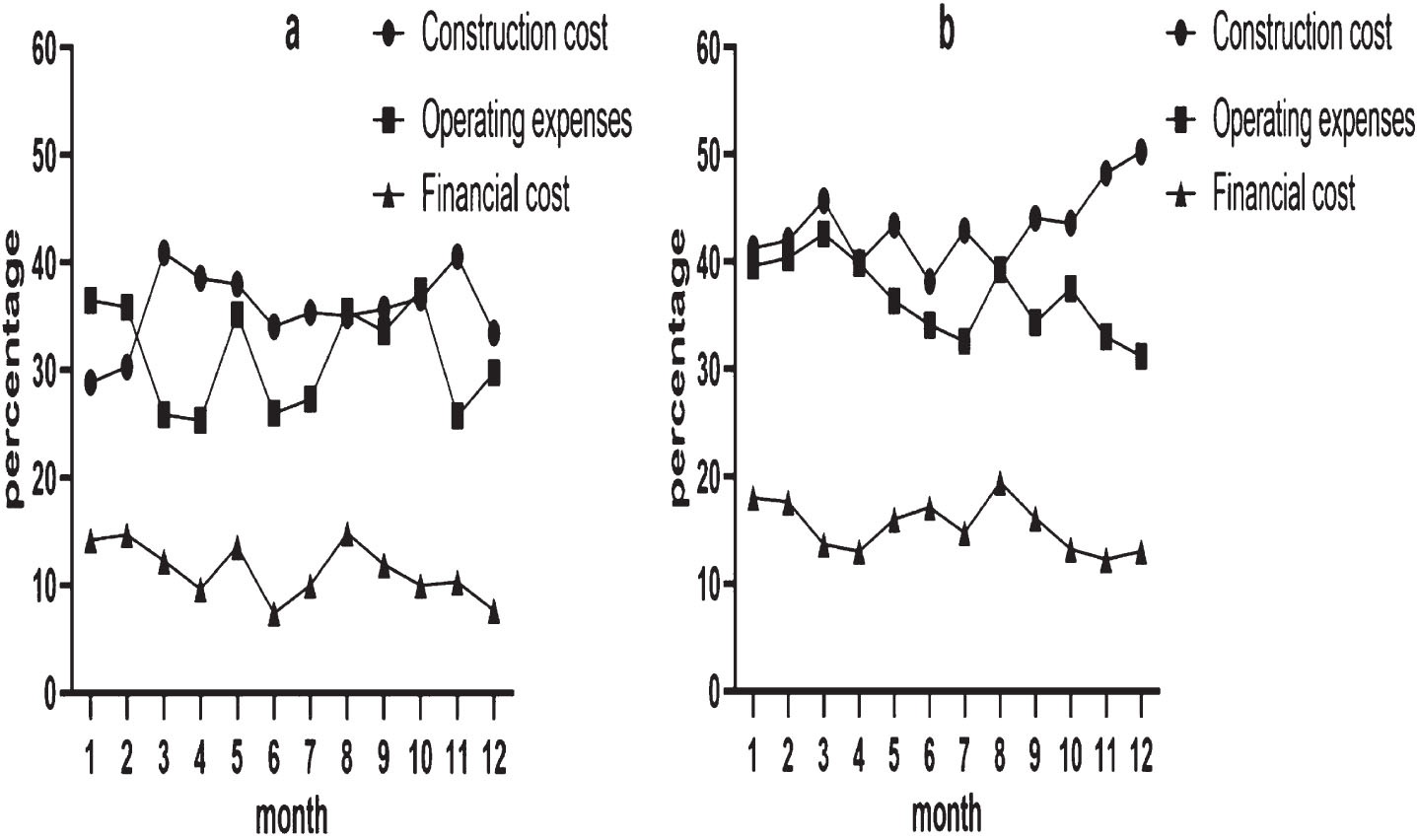
Investment cost comparison results of algorithms. (a): Improved Ant colony optimization algorithms; (b): Traditional Ant colony optimization algorithms.
From the data in Fig. 3, it can be seen that the improved Ant colony optimization algorithms was compared with the traditional Ant colony optimization algorithms in construction costs, operating costs and financial costs. In Figure (a), in the improved Ant colony optimization algorithms, the minimum value of construction cost was 28.88%, and the maximum value was 40.91%; In terms of operating expenses, the minimum value was 25.37% and the maximum value was 37.42%; In terms of financial costs, the minimum value was 7.42% and the maximum value was 14.88%. In Figure (b), in the traditional Ant colony optimization algorithms, the minimum value of construction cost was 38.17%, and the maximum value was 50.27%; In terms of operating expenses, the minimum value was 31.24% and the maximum value was 42.61%; In terms of financial costs, the minimum value was 12.27% and the maximum value was 19.46%. It can be seen from the two comparisons that the improved Ant colony optimization algorithms was less than 41% in terms of construction costs, operating costs and financial costs, which indicates that the improved Ant colony optimization algorithms can achieve better performance and income in investment projects. Therefore, applying the improved Ant colony optimization algorithms to multi-objective investment decision-making can reduce the required investment costs.
(2) Risk control effectiveness
Risk control is a series of measures taken by enterprises to prevent and control potential risks in the process of operation and investment in order to maintain their own interests. In order to ensure that enterprises have the ability to respond to potential negative situations, the purpose of risk management is to minimize the negative impact of risks on enterprises and investments. Among these risks, the most common are policy risk, technical risk, and market risk. Policy risk is determined by government policies, regulations, and political factors; Technical risks include technical failures, development changes, or implementation failures; Market risk is determined by market conditions, competitive environment, or supply and demand relationships. Therefore, under controllable risk, the probability of risk events can be reduced and their impact on the enterprise or project can be reduced, which can protect funds, resources, reputation, and reduce financial and economic losses. Moreover, by identifying, evaluating, and managing risks, the sustainability and stability of the enterprise can be improved. This can reduce the impact of risk events and fluctuations on enterprises or individuals, and maintain the normal operation of the enterprise to avoid accidents or crises, so as to promote the growth and partnership of the enterprise. Therefore, when comparing the risk control comparison results of the two algorithms, corresponding control methods and strategies can be brought, as shown in Fig. 4.
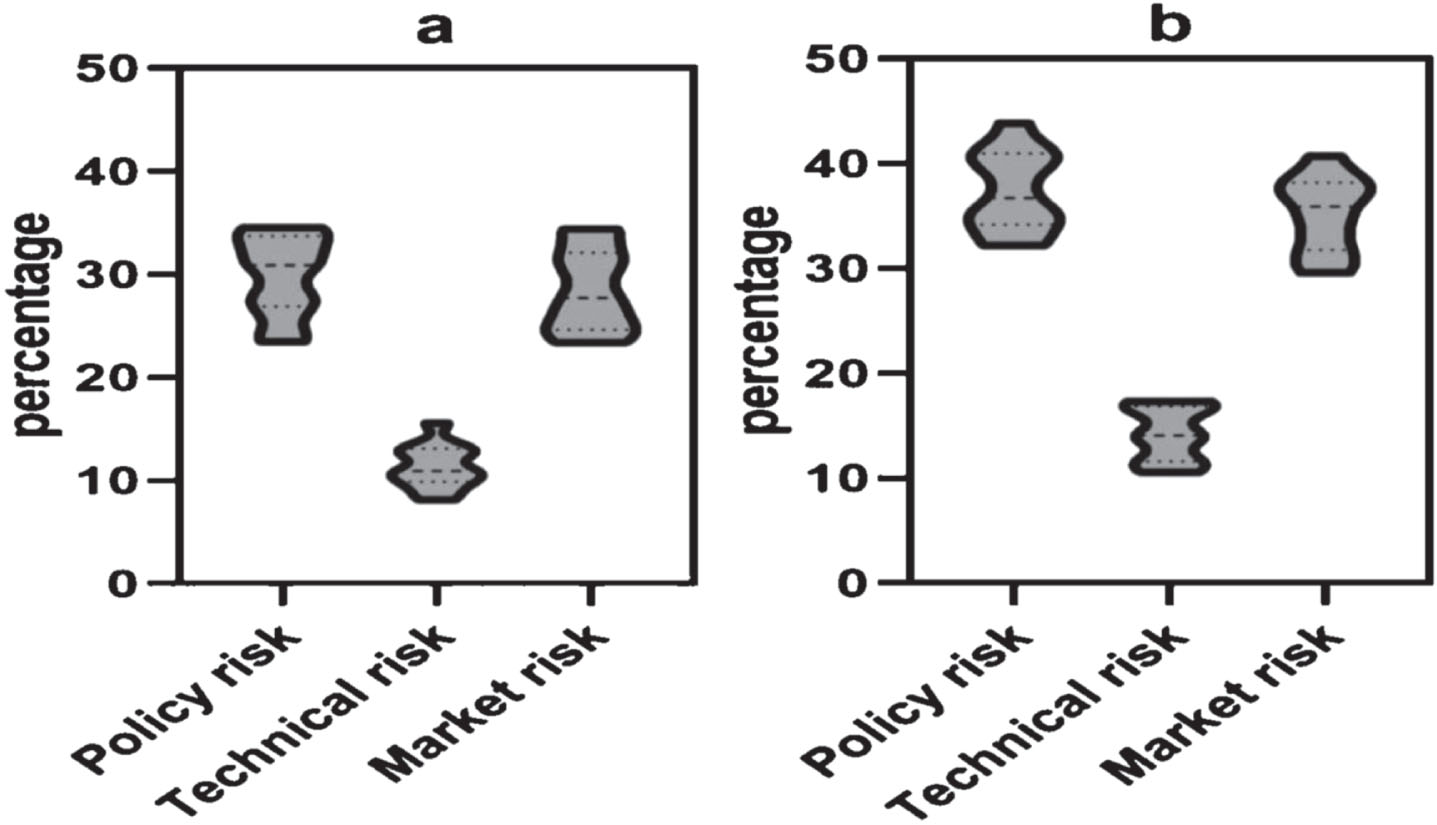
Comparison of risk control effects of algorithms. (a): Improved Ant colony optimization algorithms; (b): Traditional Ant colony optimization algorithms.
From the data shown in Fig. 4, it can be seen that the risk control effect of the improved Ant colony optimization algorithms was better than its traditional Ant colony optimization algorithms in policy risk, technical risk and market risk. In terms of policy risk, the improved Ant colony optimization algorithms in Figure (a) ranged from 23.46% to 34.56%; In Figure (b), the range of the traditional Ant colony optimization algorithms was 32.2% -43.9%. The results show that the scope of the improved Ant colony optimization algorithms is narrow, and it is more stable in policy risk control. In terms of technical risks, the range of improved Ant colony optimization algorithms in Figure (a) was 8.16% -15.62%; In Figure (b), the range of traditional Ant colony optimization algorithms was 10.58% -17.37%. This indicates that Figure (a) provides more effective control over the volatility of technical risks. In terms of market risk, the range of improved Ant colony optimization algorithms in Figure (a) was 23.38% -34.45%; In Figure (b), the range of traditional Ant colony optimization algorithms was 29.59% -40.79%. This indicates that Figure (a) shows better market risk control capabilities. Through the comparison and analysis of the algorithms in these three aspects, it is found that the improved Ant colony optimization algorithms has stronger risk control ability than the traditional ant colony clustering algorithm.
(3) Benefits
Benefit refers to the benefits that people receive from a behavior or decision under certain circumstances, which can be economic benefits, social benefits, and environmental benefits. These three aspects are interrelated, forming a complete social benefit evaluation system. The comparison of environmental, economic, and social benefits helps to comprehensively evaluate the implementation effectiveness of a certain activity, project, or policy, making it more scientific and sustainable. Effective management and balance can coordinate the economy, society, and environment, and achieve sustainable social development. Therefore, comparing benefits refers to evaluating and comparing the benefits of various options before making a decision, in order to determine which option has the greatest benefit. The comparison results of the benefits of the two algorithms are shown in Fig. 5.
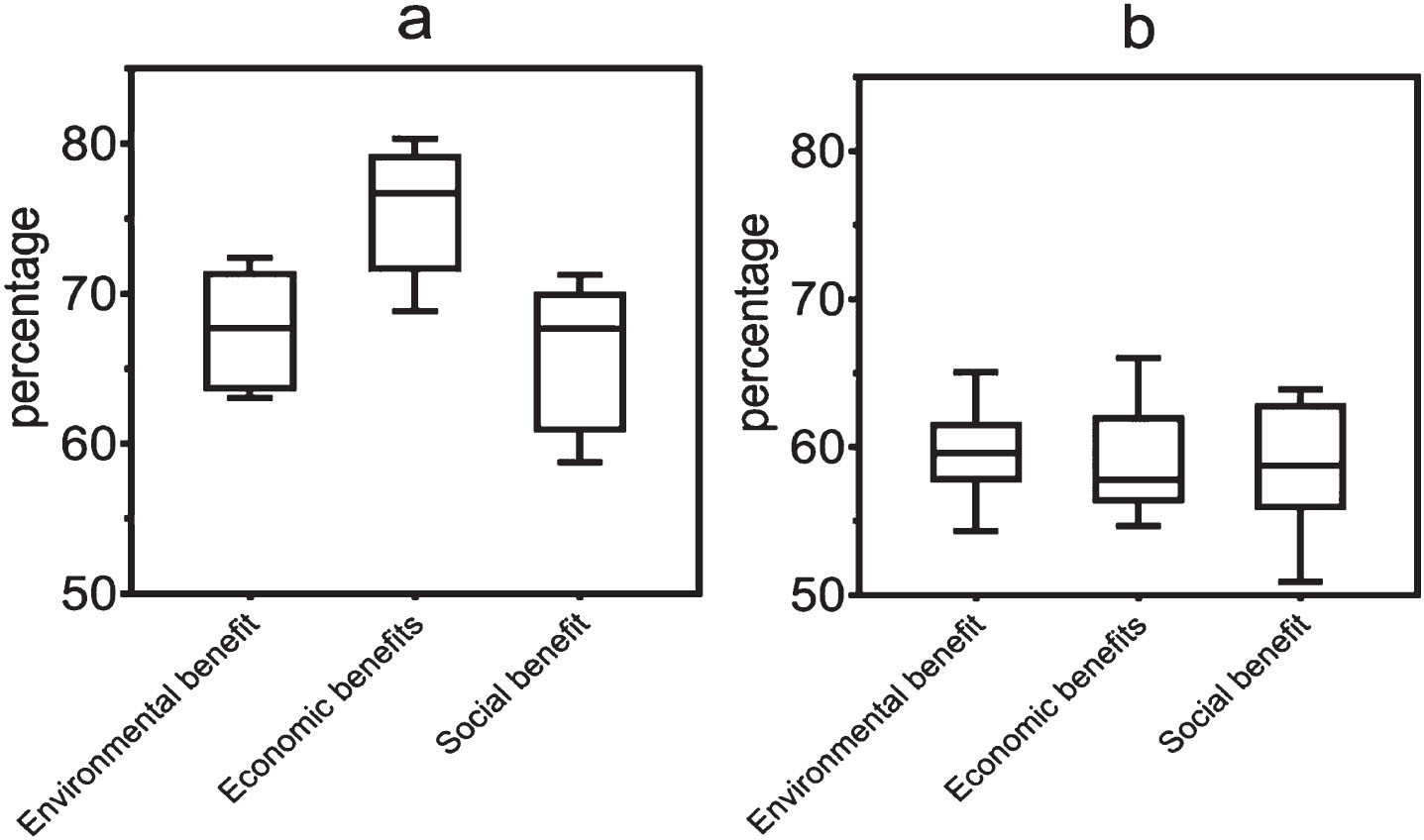
Comparison results of algorithm benefits. (a): Improved Ant colony optimization algorithms; (b): Traditional Ant colony optimization algorithms.
Figure 5 shows the comparison between the improved Ant colony optimization algorithms and the traditional Ant colony optimization algorithms when the benefits are divided into environmental benefits, economic benefits and social benefits. In Figure (a), the improved Ant colony optimization algorithms had the highest environmental benefit of 72.39%, the highest economic benefit of 80.31%, and the highest social benefit of 71.24%, which were generally more than 58%. In Figure (b), the traditional Ant colony optimization algorithms in the same experiment had the highest environmental benefit of 65.06%, the highest economic benefit of 66.03%, and the highest social benefit of 63.91%, all of which were generally below 67%. By comparing these benefit values, the overall performance of the algorithm can be evaluated. From various perspectives, the higher the benefit value, the better the benefits obtained. Therefore, the conclusion is that the improved Ant colony optimization algorithms has the greatest impact on environmental and economic benefits, while the impact on society is not very different. By evaluating the benefits of various choices, decision-makers can select those with greater benefits and achieve better results.
(4) Investment decision accuracy
Investment decision accuracy refers to the correctness and accuracy of investment decisions. It is a precision indicator for predicting, judging, and selecting investment behavior, and it is a precise judgment of investment behavior. Among them, the absolute rate of return refers to the returns and losses generated in an investment, while the success rate refers to the proportion of exchanges that obtain profits in an investment. When evaluating the accuracy and efficiency of an investment decision, these indicators are usually used. The two can complement each other and provide a basis for comprehensive evaluation of the accuracy of investment decisions. The absolute rate of return can intuitively reflect investment performance, while the success rate focuses more on controlling risk and ensuring the accuracy of investment decisions. By comparing the above indicators, investors can evaluate the quality and effectiveness of various investment decisions, and adjust their investment strategies accordingly to improve the accuracy and overall investment efficiency of investment decisions. The optimal investment plan is selected. In terms of accuracy in investment decisions, the results of these two algorithms are shown in Fig. 6.
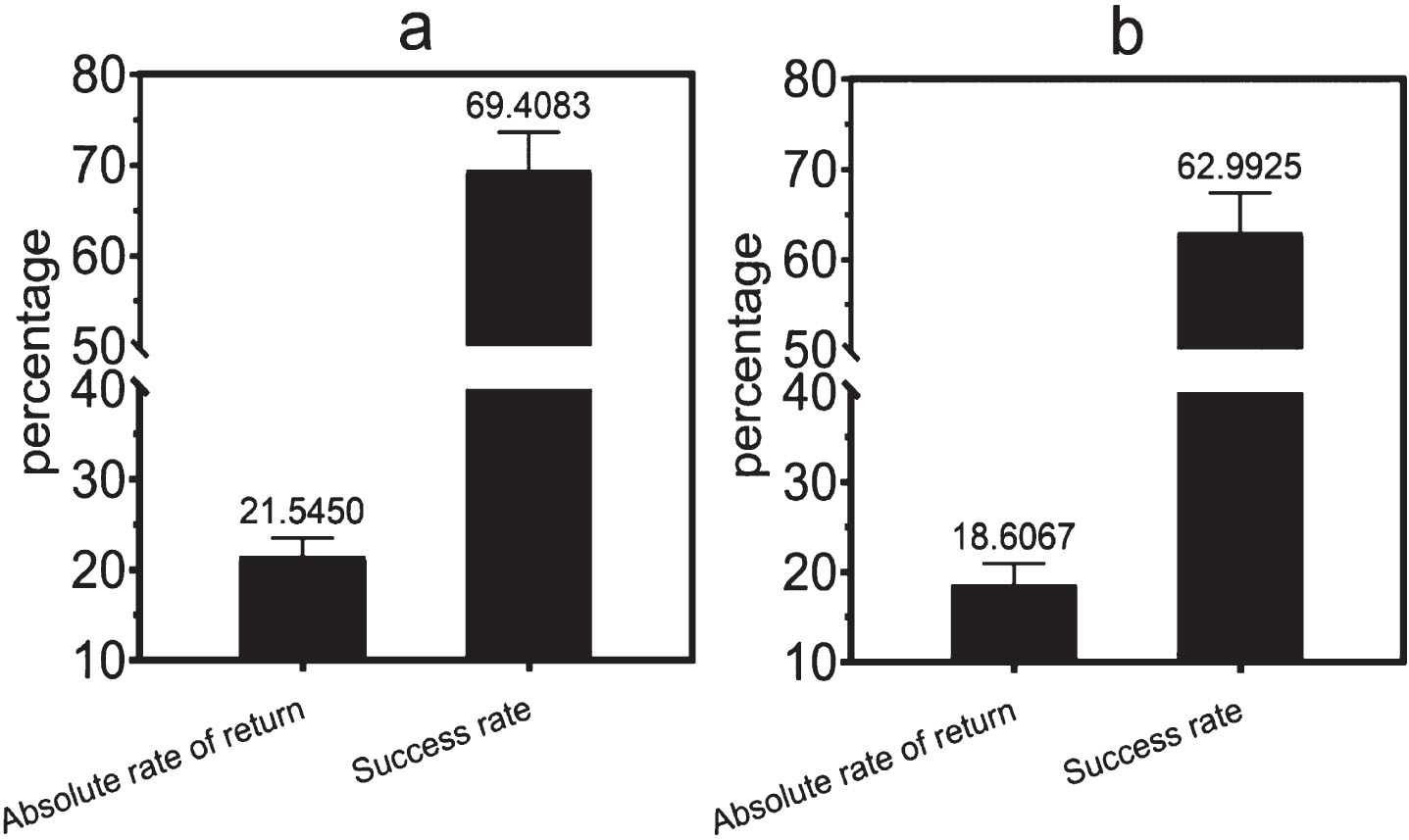
Comparison results of investment decision accuracy of algorithms. (a): Improved Ant colony optimization algorithms; (b): Traditional Ant colony optimization algorithms.
In Fig. 6, in terms of investment decision accuracy, the improved Ant colony optimization algorithms was compared with the traditional Ant colony optimization algorithms. The indicators for measurement include absolute return rate and success rate. For example, the average absolute return rate of the improved Ant colony optimization algorithms in Figure (a) in this experiment was 21.5450%, and the average success rate was 69.4083%. The average absolute return rate of the traditional Ant colony optimization algorithms in Figure (b) in the same experiment was 18.6067%, and the average success rate was 62.9925%. From the data of both, the improved Ant colony optimization algorithms has good performance in absolute return and success rate. A relatively high mean absolute recovery rate indicates that the company’s investment performance is good, while a relatively high mean success rate indicates that the company’s investment decisions are more accurate. Therefore, by comparing the indicators of the improved Ant colony optimization algorithms and the traditional Ant colony optimization algorithms in the accuracy of investment decisions, this paper selected an improved ant colony optimization algorithm to make it better able to make investment decisions and have a better comprehensive effect.
(5) Project income
Project income is an important index in investment decision, and its influence on improved ant colony optimization algorithm cannot be ignored. The increase in project income can improve the economic efficiency of the investment scheme, which makes the improved ant colony optimization algorithm more likely to find a better solution. When the project income increases, the algorithm can be more inclined to choose those investment schemes with higher income, thus maximizing the return on investment. In addition, the increase in project revenue can also increase the scope of trade-offs against other goals, so that the algorithm can better balance the relationship between different goals. Therefore, the impact of project income on the improved ant colony optimization algorithm is positive, which can improve the performance of the algorithm in multi-objective decision-making, improve the quality of the solution and the accuracy of the decision. This article records the project benefits of improving the ant colony optimization algorithm, as shown in Fig. 7, and compares it with the project benefits data of the neural network algorithm, as shown in Table 5.
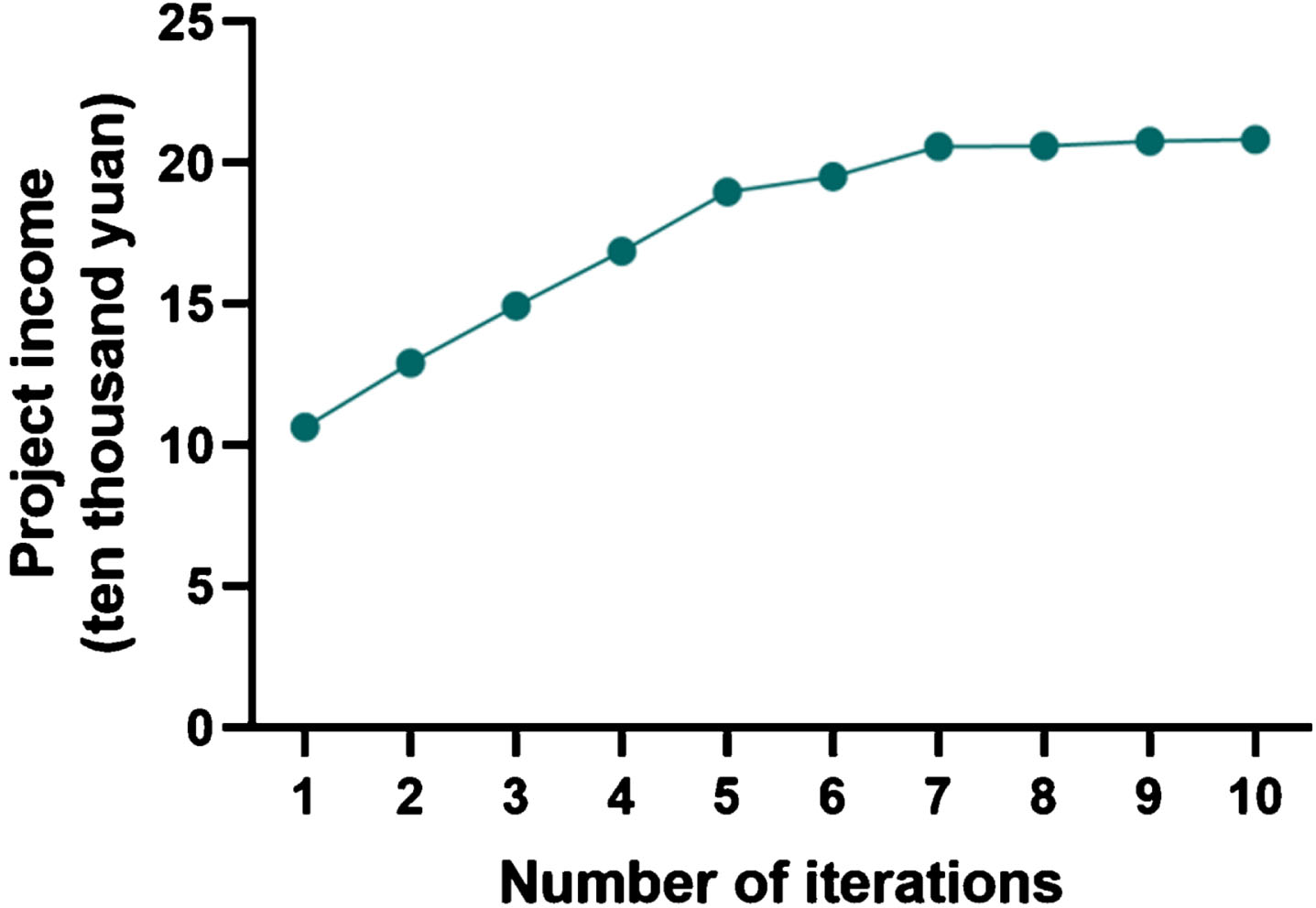
Project income of improved ant colony optimization algorithm.
Project income data of improved ant colony optimization algorithm and neural network algorithm (%)
As shown in Table 5, the optimal value of the improved ant colony optimization algorithm is 85.45%, and the optimal value of the neural network algorithm is 82.58%. It can be seen that the improved ant colony optimization algorithm analyzed in this paper can better improve project income.
This paper, taking the public-private partnership project investment as the research object, constructed a new multi-objective investment decision model, and compared it with the traditional Ant colony optimization algorithms. From the perspectives of investment cost, risk control effect, income, investment decision-making accuracy, etc., this paper gave full play to the advantages of the multi-objective investment decision model. The research conclusion of this article is that the comparison results of comprehensive consideration of investment cost, risk control effect, benefits, and investment decision accuracy indicate that in the multi-objective investment decision model, the improved ant colony optimization algorithm has lower construction cost, operating cost, and financial cost. It also has better risk control capabilities than traditional ant colony optimization algorithms, including policy risks, technical risks, and market risks. Moreover, the impact of the improved Ant colony optimization algorithms on the environment and economic benefits is better than that of the traditional methods, but the impact on the society is small. In addition, the improved Ant colony optimization algorithms has a greater improvement in the accuracy of investment decision-making, and has a higher investment decision-making ability. Therefore, using improved Ant colony algorithm can achieve better performance and effectiveness, improve the accuracy and efficiency of multi-objective investment decision-making, and enhance the overall effect. However, this study also has some limitations. The research in this paper relies on existing data and models, and some specific investment scenarios and factors may not be taken into account. The accuracy and efficiency of the multi-objective investment decision model should be further improved in the future. Other optimization algorithms or hybrid algorithms can be considered to improve model performance by further optimizing parameter selection and algorithm design. In addition, more decision-making factors and constraints can be explored to better reflect the actual investment decision-making environment.
Declaration of conflicting interests
The authors declare that there is no conflict of interest regarding the publication of this work.
Data availability statement
The data of this paper can be obtained through the email to the authors.
Funding
This work was supported by Zhejiang Province Jinhua City Federation of Social Sciences (No.YB2020060), Jinhua City Science and Technology Research Plan(No.2021-4-379), General scientific research project of Zhejiang Provincial Department of Education (No.Y202045644), Special project on the “Research and Interpretation of the Spirit of the 20th National Congress of the Communist Party of China and the Second Plenary Session of the 15th Provincial Committee of the Communist Party of China” of Philosophy and Social Science of Zhejiang Province (No.17) and Zhejiang Province Soft Science Key Project (2022C25012).