This research investigates the presence of unique solutions and quasi-uniform stability for a class of fractional-order uncertain BAM neural networks utilizing the Banach fixed point concept, the contraction mapping principle, and analysis techniques. In order to guarantee the equilibrium point of fractional-order BAM neural networks with undetermined parameters, some new adequate criteria are devised, and both time delays result in quasi-uniform stability. The acquired results, which are simple to verify in practice, enhance and extend several earlier research works in some ways. Finally, two illustrative examples are provided to show the value of the suggested outcomes.
The fractional order calculus was first introduced more than 300 years ago, but due to its complexity and paucity of practical applications, it didn’t gain much traction for a while. Researchers’ interest in it has recently grown, and it has emerged as a useful tool for simulating a wide range of events in the fields of engineering, physics, and control theory [7–43]. The fact that fractional derivatives offer an effective and exceptional instrument for the description of memory and hereditary properties of various materials and processes in comparison to integer-order derivatives is one of the key factors contributing to the extensive applications of fractional order calculus. As a result, fractional-order models have two advantages: increased degree of freedom and "memory". For instance, fractional-order models of joy [50] and love [14] have been created, and it is asserted that these models provide a better depiction than integer-order dynamical techniques.
We are aware that a system’s future state depends on both its historical data and its current state. The states of the neurons may be accurately described because a model created using fractional-order equations has memory. The advantage of the Caputo’s fractional order derivative is further demonstrated by the fact that the beginning conditions for fractional order differential equations with Caputo derivatives take on a shape akin to that of integer-order differentiation. Analysis of fractional-order neural networks (NNs) is so necessary and crucial in both theory and practice. Additionally, numerous intriguing findings have been reported [2–5]. A cellular neural network with fractional-order cells was described in Ref. [2], and it was hypothesized in [34], that fractional order derivatives give neurons a basic and universal computation ability that can help them process information efficiently and contribute to frequency-independent phase shifts of oscillatory neuronal firing. Additionally, fractional-order neural networks’ stability was examined in [16–46] and [19] using the stability theory of fractional-order systems. A fractional order network can exhibit chaotic behaviors, as was mentioned in [59]. Additionally, by utilizing the Laplace transformation theory and numerical simulations, [61, 62] presented the chaos management and synchronization of some straightforward fractional order networks. To control the Hopf bifurcation of the fractional-order gene regulatory network, a hybrid controller is presented [17]. In [5] and [54], a thorough discussion of the fractional-order neural networks’ synchronization issue was presented.
A key tool in the study of metric spaces in mathematics is the Banach fixed-point theorem, also known as the contraction mapping theorem, contractive mapping theorem, or Banach-Caccioppoli theorem. It provides a practical method for locating those fixed points and guarantees the existence and uniqueness of fixed points of particular self-maps of metric spaces. As an abstract formulation of Picard’s sequential approximation method, it makes sense. [4] Stefan Banach (1892-1945), who proposed the theorem in 1922, is credited as its creator and name-giver. A contraction mapping also only has one fixed point at most. A unique fixed point exists for any contraction mapping on a non-empty full metric space, according to the Banach fixed-point theorem. The existence of a solution to fractional order neural networks is therefore examined with the aid of the Banach fixed point theorem, and the uniqueness will be verified using the contraction mapping principle. Therefore, studying Banach fixed point theory and the fixed point theorem is crucial for fractional order neural networks.
Bidirectional associative memory (BAM) was first described by Kosko in 1988 [21, 22]. X and Y layers of neurons are organized in two layers in the BAM. These two layers are completely related to one another. Upon activation of the neurons, the network instantly evolves to a stable state of two-pattern reverberation. As a result, taking into account NNs of the BAM type is crucial and difficult, as seen in [26, 35]. There are always parameter variances, modeling flaws, and process uncertainties in real-world applications [27, 31]. [3, 37] looked into the stability of delayed BAM neural networks. The existence, uniqueness, and stability of the equilibrium point of delayed BAM neural networks were all guaranteed by a number of adequate requirements in the form of LMIs [41]. Additionally, using Lyapunov methods, Tu et al. looked at the global dissipativity of BAM neural networks [53]. Particularly in the case of neural network systems, the weight coefficients of neurons frequently exhibit modeling flaws (uncertainties) that are inescapable and typically time-varying. In [8], Cao and Wang conducted research on the global asymptotic and robust stability of uncertain systems. It is important to consider parameter uncertainties, often known as variations or fluctuations, when modeling neural networks [36, 52]. Additionally, the presence of time delays can cause complicated dynamic behaviors including oscillation, divergence, chaos, instability, or other subpart system performance [28, 58]. In light of this, stability analysis for neural networks with delays has become a popular area of study in recent years [25, 32]. Discrete and distributed delays are the two categories into which time delays fall. As a result of the excessively long axon diameters, we have here accounted for both delays while modeling our network architecture. Therefore, it is important to examine how temporal delays affect neuronal system dynamics; for examples, see [29, 63].
To the best of our knowledge, a great deal of research has been done on the stability of fractional-order neural networks, including work on exponential stability, Lyapunov stability, asymptotic stability, and other topics. The consistent stability of fractional-order neural networks has been proven in Ref. [12]. The theory of fractional order calculus and the generalized Gronwall-Bellman inequality approach were used by the authors to investigate the finite-time stability for Caputo fractional-order BAM type neural networks with distributed delay and establish a time delay-dependent stability criterion in [10]. Using a type of fractional-order neural networks with temporal delays, the authors of [49] examine the existence, uniqueness of the zero solution, as well as uniform stability. Integer-order BAM neural networks have been thoroughly researched in recent years [3, 42]. Recently, some scientists gave the uniform stability of time-delayed neural networks some thought; for instance, see [38, 39] and the references therein. But it’s important and difficult to investigate the quasi-uniform stability of fractional order BAM neural networks [40, 56]. Based on the aforementioned justifications, the purpose of this research is to describe the necessary conditions for the quasi-uniform stability of a class of fractional-order uncertain BAM neural networks with both discrete and distributed delays.
Motivation:
When compared to a ordinary differential equation, a fractional order differential equation typically explores the precise changes of state variables in neural networks. For instance, the straight line y leads the parabola y = x2 and its first order derivative . The abrupt transition of the parabolic curve into a straight line is shown here. It is essential to analyze this. Fractional order differential equations (FDE) are required to achieve the movements of the changes. We have accurately analyzed the precise motions of impulses moving through neurons using FDE. So that FDE consideration in neural networks is more significant and applicable to problems in everyday life.
This paper’s goal is to investigate the quasi-uniform stability for a class of fractional-order uncertain BAM neural networks utilizing the Banach fixed point concept, the contraction mapping principle, and analysis techniques, which is inspired by past debates. To the best of our knowledge, no research has been done on fractional-order uncertain BAM neural networks with mixed time delay factors that focuses on the quasi-uniform stability. This serves as the driving force behind the current study and highlights the significance and necessity of taking into account this class of neural networks. The following is a list of the work’s highlights:
The stability of planned fractional-order uncertain BAM neural networks takes into account mixed time-delays and uncertain parameters.
The existence and uniqueness of the solution for an uncertain BAM neural network is tested using the Banach fixed point theorems, contraction mapping principle, stability theory, and Lipschitz function criteria.
A brand-new set of stability requirements in the sense of the quasi-uniform description through the use of the LKF, matrix theory, and a few inequality techniques, NNs are achieved in terms of LMIs.
Theorem 3.3’s exposure of the usefulness of uncertain parameters and Corollary 3.6’s assertion that BAM neural networks are stable in the absence of uncertain parameters.
The upper bounds (UBs) of time-delay exist in our NNs, and their maximum UBs are reported in Table 1 to assess whether the method developed in this research is efficient and less conservative.
The results obtained for Theorem 3.1 and 3.3 are further checked for viability and as well as its simulations with the help in MATLAB LMI Control toolbox that are given in Examples 4.1 & 4.2, which ensures the superiority of the proposed work. Four special categories of main results are derived in Remark 3.2, 3.5 & 3.8.
Comparison table of discrete time-delay and distributed time-delay. (τ = τ1 = τ2 & σ = σ1 = σ2)
The remaining sections of the paper are organized as follows. Section 2 provides a few definitions of fractional-order calculus as well as a few essential lemmas. The existence, uniqueness of the zero solution, and quasi-uniform stability of the fractional-order BAM type neural networks 1 are all guaranteed by certain new and different necessary conditions that are found in section 3. An example is provided in section 4 to demonstrate the findings of this study. In Section 5, conclusions are drawn.
Notations Throughout this paper, we introduce the space Ω =(C ([0, T] , Rn) , ∥ . ∥) as a Banach space, where C ([0, T] , Rn) is the class of all continuous column n-vectors function. For ξ ∈ C ([0, T] , Rn) , the norm is defined by ∥ξ∥ = . We know that X is a Banach space with the norm ∥x∥ and Y is a Banach space with the norm ∥y∥. It is easy to see that X × Y is a Banach space with the norm ∥ (x, y) ∥ = ∥ x ∥ + ∥ y ∥ . Besides, for a matrix A =(aij (t)) n×n, we define the norm ∥A∥=
Model description and preliminaries
Consider the fractional-order BAM type neural networks with uncertain parameters and mixed time delays as follows:
where β ∈ (0, 1) , n corresponds to the numbers of units in a neural networks; x (t) = (x1 (t) , x2 (t) , . . . , xn (t)) T ∈ Rn, y (t) = (y1 (t) , y2 (t) , . . . , yn (t)) T ∈ Rn corresponds to the state vector at time t; f (y (t)) = (f1 (y (t)) , f2 (y (t)) , . . . , fn (y (t))) T, g (y (t)) = (g1 (y (t)) , g2 (y (t)) , . . . , gn (y (t))) T, and h (y (t)) = (h1 (y (t)) , h2 (y (t)) , . . . , hn (y (t))) T, = . . . , = . . . , and = . . . , denote the activation function of the neurons with f (0) = g (0) = h (0) = 0; C = diag (ci > 0) , K = diag (kj > 0) , A = (aij) , B = (bij) , M = (mij) , L = (lji) , N = (nji) and O = (oji) are constant matrices; ci, kj denotes the rate with which the ith unit and jth unit will reset its potential to the resting state in isolation when disconnected from the network and external inputs respectively. A = (aij) , B = (bij) , M = (mij) and L = (lji) , N = (nji) , O = (oji) are referred to the connection of the jth neuron to the ith neuron and ith neuron to the jth neuron at time t, t - τ1, t - σ1, t - τ2 and t - σ2 respectively, where τ1, τ2 and σ1, σ2 are the transmission delays and a non-negative constants, I* = . . . , J* = . . . , are an external bias vectors. ΔA (t) , ΔB (t) , ΔC (t) , ΔM (t) , ΔK (t) , ΔL (t) , ΔN (t) & ΔO (t) represents the structured uncertainties in the system (1) and which are diagonal matrices. Also they are represented by
where P, QA, QB, QC, QM, QK, QL, QN and QO are real constant matrices with appropriate dimension. The matrix Σ (t) is unknown real matrix with appropriate dimension and satisfies ΣT (t) Σ (t) ≤ I .
For the initial conditions associated with system (1), it is usually assumed that ψi (s) ∈ C ([- ν1, 0) ; Rn) , ζj (s) ∈ C ([- ν2, 0) ; Rn) , i,j ∈ N and the norm of C ([- ν1, 0) ; Rn) , C ([- ν2, 0) ; Rn) are denoted by ∥ψ∥ = ∥ψ∥ and ∥ζ∥ = ∥ζ∥ respectively.
Suppose that x (t) and y (t) are any two solutions of (1) with different initial functions ψ ∈ C and ζ ∈ C, ψ (0) = ζ (0) =0, let x (t) - y (t) = e (t) = (e1 (t) , e2 (t) , . . . , en (t)) T, and φ = ψ - ζ, δ = ζ - ψ, we have the following error system
where φ, δ ∈ C, φ (0) = δ (0) =0 is the initial solution of system (3), define the norms and
Remark 2.1. To the best of our knowledge, the uncertain parameters ΔA (t) , ΔB (t) , ΔC (t) , ΔM (t) , ΔK (t) , ΔL (t) , ΔN (t) & ΔO (t) satisfies equation (2) and reflect the elaborateness of dynamical process in neural networks. This must leads to the intricacy of systems and the difficulty of solving the neural networks is much increases.
Throughout this paper, the following assumptions are made:
Assumption 1. Denote ∥x∥ = ∥y∥ = and ∥A∥ = ∥K∥ = |kji|, ∥A+ ΔA (t) ∥ = |aij + Δaij (t) |, ∥K+ ΔK (t) ∥ = |kji + Δkji (t) |, which are the Euclidean vector norm and matrix norm, respectively; xi, yj and aij, kji, aij + Δaij (t) , aji + Δkji (t) are the elements of the vectors x, y and the matrices A, K, A + ΔA (t) , K + ΔK (t) respectively. Let = ∥ B ∥ , and = ∥C + ΔC (t) ∥ , = ∥A + ΔA (t) ∥ , = ∥B + ΔB (t) ∥ , = ∥M + ΔM (t) ∥ , = ∥K + ΔK (t) ∥ , = ∥L + ΔL (t) ∥ , = ∥O + ΔO (t) ∥ .
Assumption 2. The activation functions F (x) , G (x) , H (x) and are Lipschitz continuous in neurons, i.e., there exist positive constants F, G, H and such that
Remark 2.2. Typically, nonlinear sigmoid activation functions that are bounded, monotonic, and rising are continuously differentiable. For practical applications, yet electronic circuits [34] without monotonically rising or continuously differentiable input-output functions are frequently utilised. As a result, the activation functions—which are less conservative than typical activation functions—are merely assumed to satisfy the Lipschitz-continuous requirement.
Before ending this section, we introduce some definitions and lemmas, which will play a key role in proving the proofs of our main results below.
Definition 2.3. [43] The Riemann-Liouville fractional order integral of a function f (t) of order α ∈ R+ is defined by:
where Γ (.) is the gamma function defined as:
Definition 2.4. [43] Suppose that α > 0, t > t0, α, t0, t ∈ R . Then
is called the Riemann-Liouville fractional derivative (or) the Riemann-Liouville fractional differential operator of order α .
Definition 2.5. [43] The Caputo fractional derivative of order α of a function f(t) is given by:
where n = [α] +1, [α] denotes the integer part of the number α.
Definition 2.6. The system (ref3) is said to be quasi-uniformly stable, if for any ɛ > 0, there exists two scalars 0 < δ1, δ2 < ɛ and T > 0 such that
∀ t ∈ = [t0, t0 + T] , where t0 is the initial time of observation.
Lemma 2.7. [24] Suppose x (s) ∈ Cn [0, ∞) , and n - 1 < α, β < n ∈ Z+, then
Lemma 2.8. [39] (Holder inequality). Assume that p, q > 1, and if |f (.) |p, |h (.) |q ∈ L1 (E) then f (.) h (.) ∈ L1 (E) and
where L1 (E) is the Banach space of all Lebesgue measurable functions f : E → R with ∫E|f (x) |dx < ∞ . Let p, q = 2, it Converts to the Cauchy Schwartz inequality as follows:
Lemma 2.9. [20] If the Caputo fractional derivative (n - 1 ≤ α < n) is integrable, then:
Especially, for 0 < α < 1, one can obtain:
Lemma 2.10. [23] Let k ∈ N, and let x1, x2, . . . , xn be non-negative real numbers. Then for ϑ > 1 .
Lemma 2.11. [13](Gronwall inequality).If
where all the functions involved are continuous on [0, T) , T ≤ ∞ , and g (t) ≥0, then x (t) satisfies
If, in addition, f (t) is nondecreasing, then
Global Exponential stability for deterministic systems
Now we are ready to derive our main results of this paper in the following theorems.
Theorem 3.1. Suppose Assumptions 1 and 2 holds, then the system (ref3) has a unique solutions (e (t) , = (e1 (t) , e2 (t) , . . . , en (t) , . . . , ∈ C ([0, T] , Rn × Rn) satisfying the initial conditions of system (ref3) .
Proof. By the properties of the fractional calculus and Lemma 2.9, we obtain a solution of (3) in the form of the equivalent Volterra integral equation:
where t ∈ [0, T]. We transform the problem (4) into a fixed problem. Consider a mapping defined by F : Rn × Rn → Rn, where F (e (t) , = (F1 (e (t) , F2 (e (t) , . . . , Fn (e (t) , and Fi is defined by:
For any two different functions
From equations (6) and (7), we obtain
The equation (8) becomes,
e-Nt |Fi (e (t) , - Fi (v (t) , w (t)) |
Clearly, we get
Choose N be large such that
then we have
Therefore the mapping F becomes a contraction mapping. As a consequence of the Banach fixed point theorem, the problem (ref4) has a unique fixed point. Hence we conclude that system (ref3) has a unique solution, which completes the proof of this theorem.
Remark 3.2. The existence and uniform stability for the solution of fractional order neural networks are investigated by R. Rakkiyappan, J. Cao and G.Velmurug -an in [46]. Furthermore, Y. Cao et. al., discussed about the stability behavior of fractional order BAM type NNs (Neural Networks) with time delays by employing Gronwall inequality in [11] & [10]. The authors in [33], analyzed the performance of uncertain parameters in neural networks with fractional order. Motivated by the above research works, we initially treated the uncertain parameters and distributed time delays in a class of BAM type fractional order neural networks. In this paper, we obtain the unique equilibrium point of the fractional order BAM NNs with uncertain parameters and mixed time delays by using the contracting mapping and Gronwall inequality. And also, a new sufficient condition has been established for the quasi-uniform stability of the equilibrium point of system (3).
Theorem 3.3. Under the Assumptions 1 & 2, the Caputo-type uncertain BAM neural network system (1) is quasi-uniformly stable if, for 0 < β < 1 the following conditions holds
Proof. First fixed the initial time t0 = 0 and the initial conditions of system (3) are e0 = φ (0) , = δ (0). Depend on Lemma 2.7, the solution of the system (3) can be expressed in the following form:
Using the Assumptions 1 & 2 and the properties of norm ∥ .∥, it obtain
By Cauchy-Schwartz inequality, it follows from (12) that,
since,
Substituting (14) in (13), we get
From the Lemma 2.10, let k=5 and ϑ=2, Equation (ref15) becomes,
S =
T =
W =
X =
Since,
Which is equivalent to,
According to the Gronwall inequality (ref17) , we obtain
then,
So,
It follows that when ∥φ ∥ < η and ∥δ ∥ < ξ, if (ref10) & (ref11) are satisfied, then Therefore by Definition 2.4 and (18), the system (ref1) is reached quasi-uniformly stability.
Corollary 3.4. Suppose the time t=0, the sufficient conditions (10) & (11) can be simplified into the following:
where R, S, V & W are derived in Theorem 3.3. Then the neural networks (1) is quasi-uniformly stable.
Remark 3.5. Suppose the uncertain parameters are not appeared in neural networks (1), then we get the fractional order nominal BAM neural networks with discrete and distributed time-varying delays as follows:
Corollary 3.6. Under the Assumptions 1 & 2, the Caputo-type BAM neural networks (21) is quasi-uniformly stable if, for β ∈ (0, 1) the following conditions holds
where, t ∈ J, R = Y =
S =
T =
U = V =
W =
X =
M1 (t) = T + Ut2β (1 - e-2t) ,
M2 (t) = X + Yt2β (1 - e-2t)
Remark 3.7. Replace the fractional order β is 1 in neural networks (1) and (21), then we obtain the integer order BAM neural networks in nominal as well as uncertain types respectively.
Remark 3.8. The maximum admissible upper bounds of discrete time delays are provided in Table 1 together with some current findings in order to validate the benefits of this addressed neural networks (1). The maximum permitted time delays are determined based on observation. Thus, what actually occurs indicates that the little delays in our brains that cause the storage & passage of memories are not impacted because the neural networks that are built for this manner have enormous delays and are in stable state (quasi-uniform). In this manner, we implement this type of neural networks method in network communications of online, where we attain the information after a long time without any damage.
Illustrative examples
In this section, we give two examples to demonstrate the effectiveness of our main results.
Example 4.1. Consider the following two-state Caputo fractional-order BAM type uncertain neural networks model (1) with both delays:
with the initial condition
where the activation function is described by the functions fj (yj (t)) = gj (yj (t)) = hj (yj (t)) = tanh (yj)
and
= = = tanh (xi) (i, j = 1, 2) .
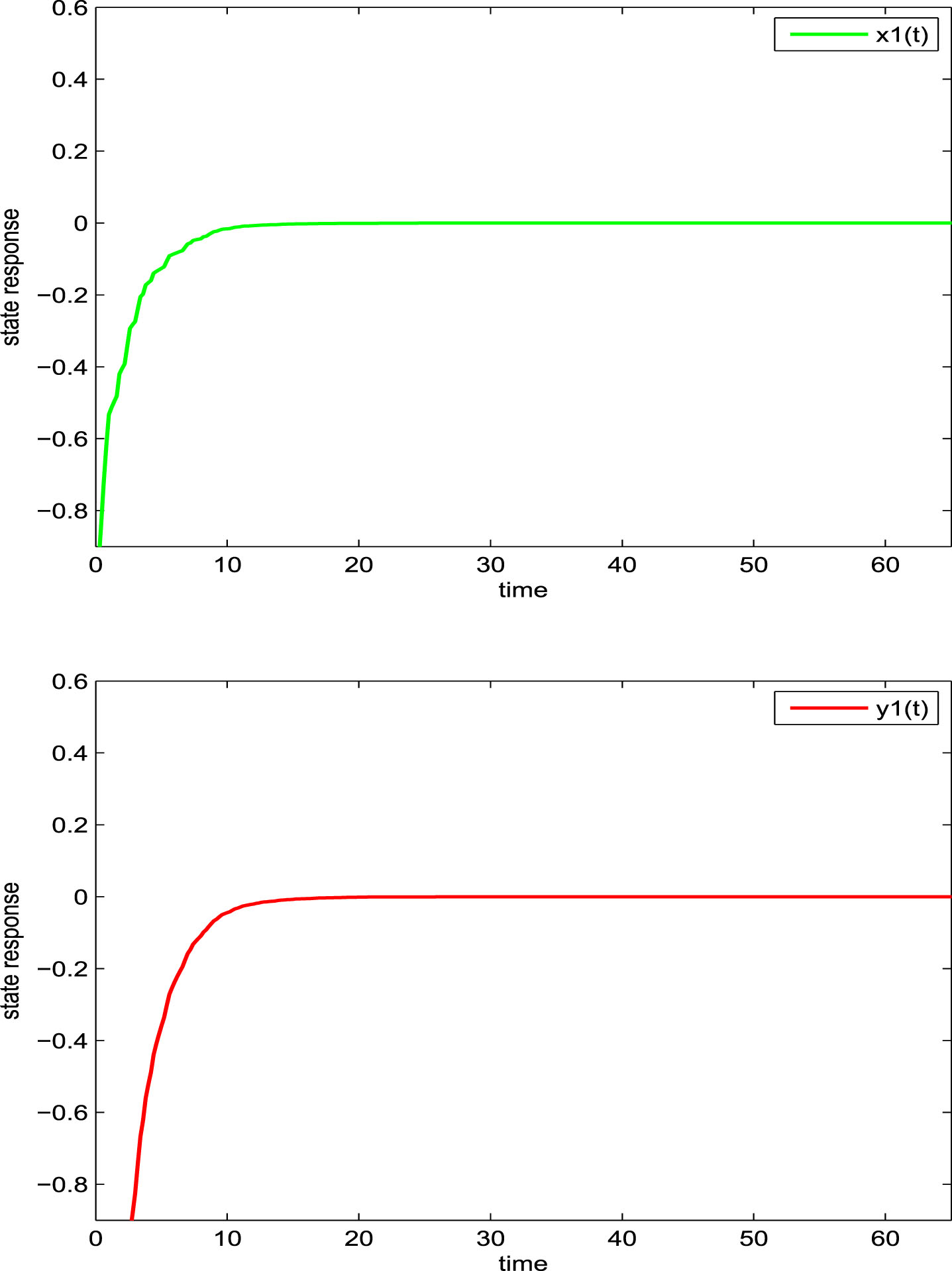
The state response x1 (t) , y1 (t) of neural networks (24)
So
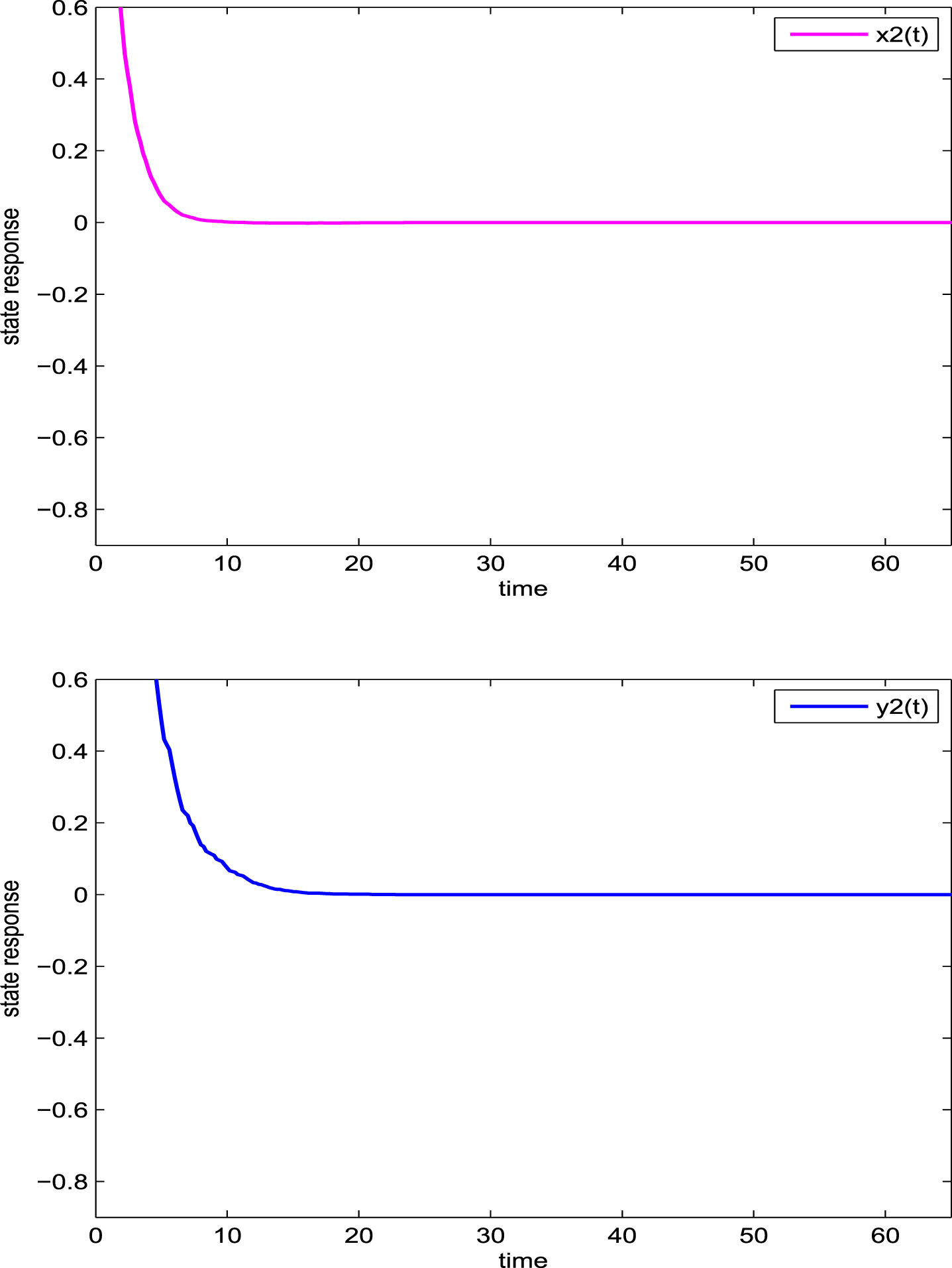
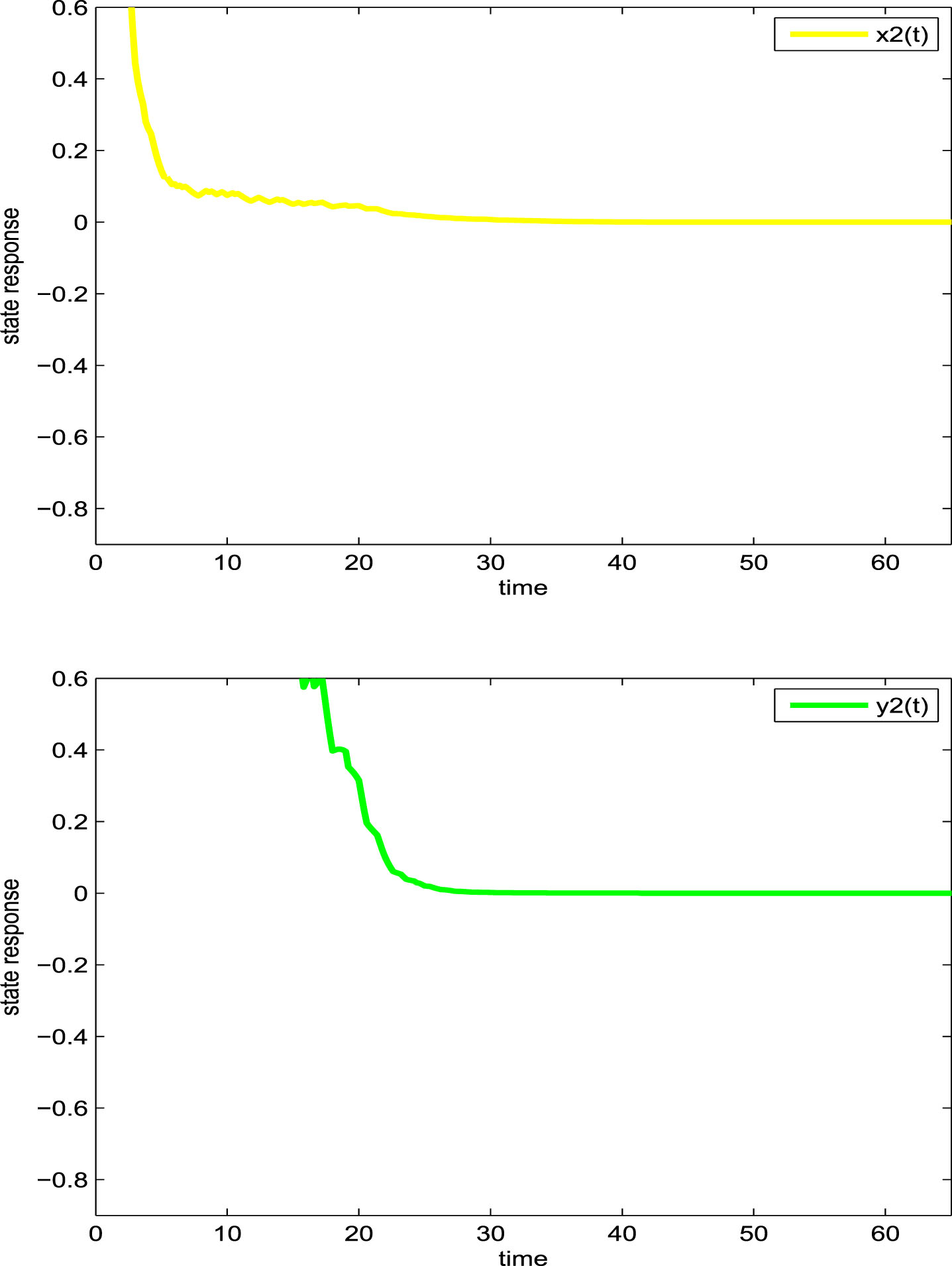
The state response x2 (t) , y2 (t) of neural networks (24)
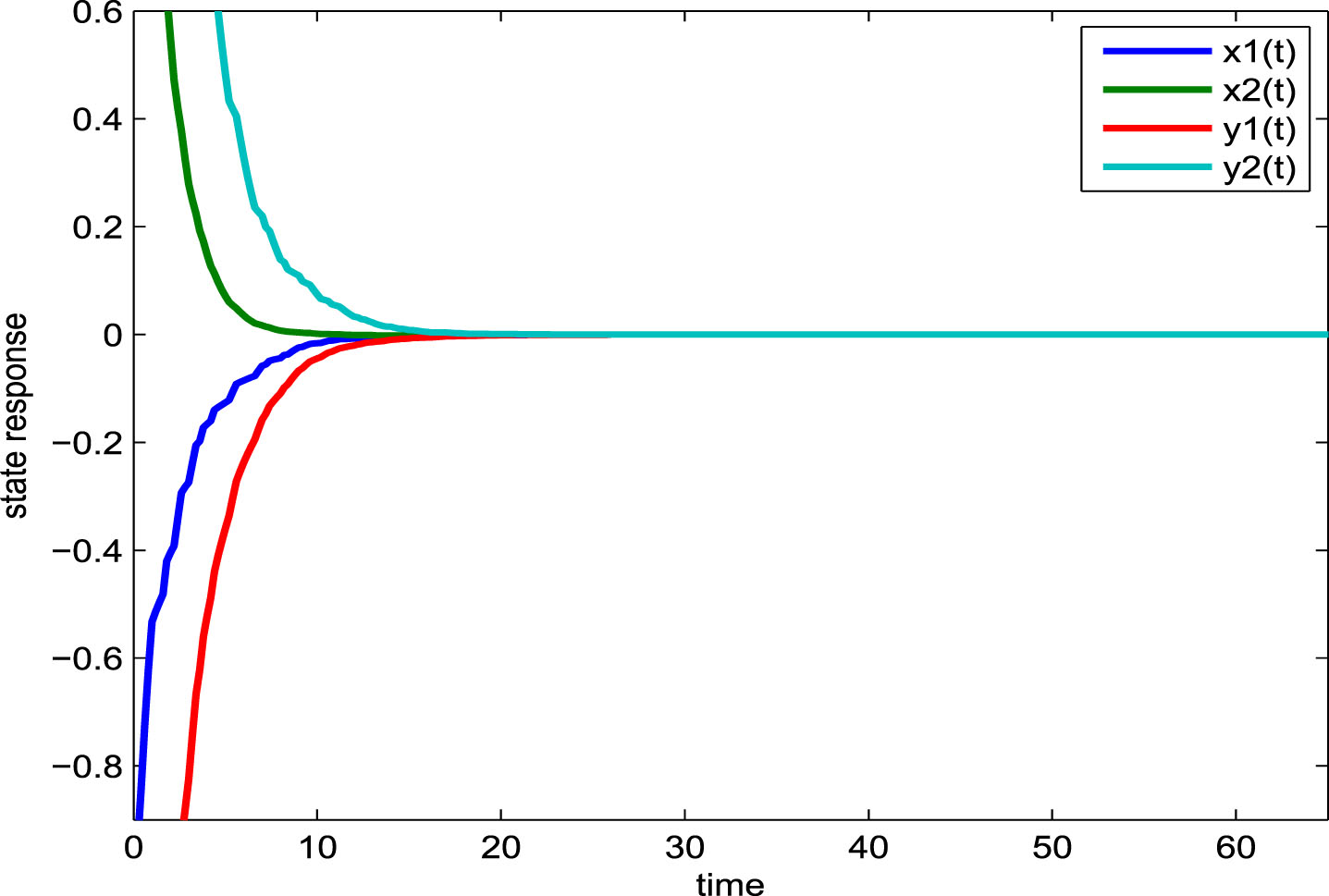
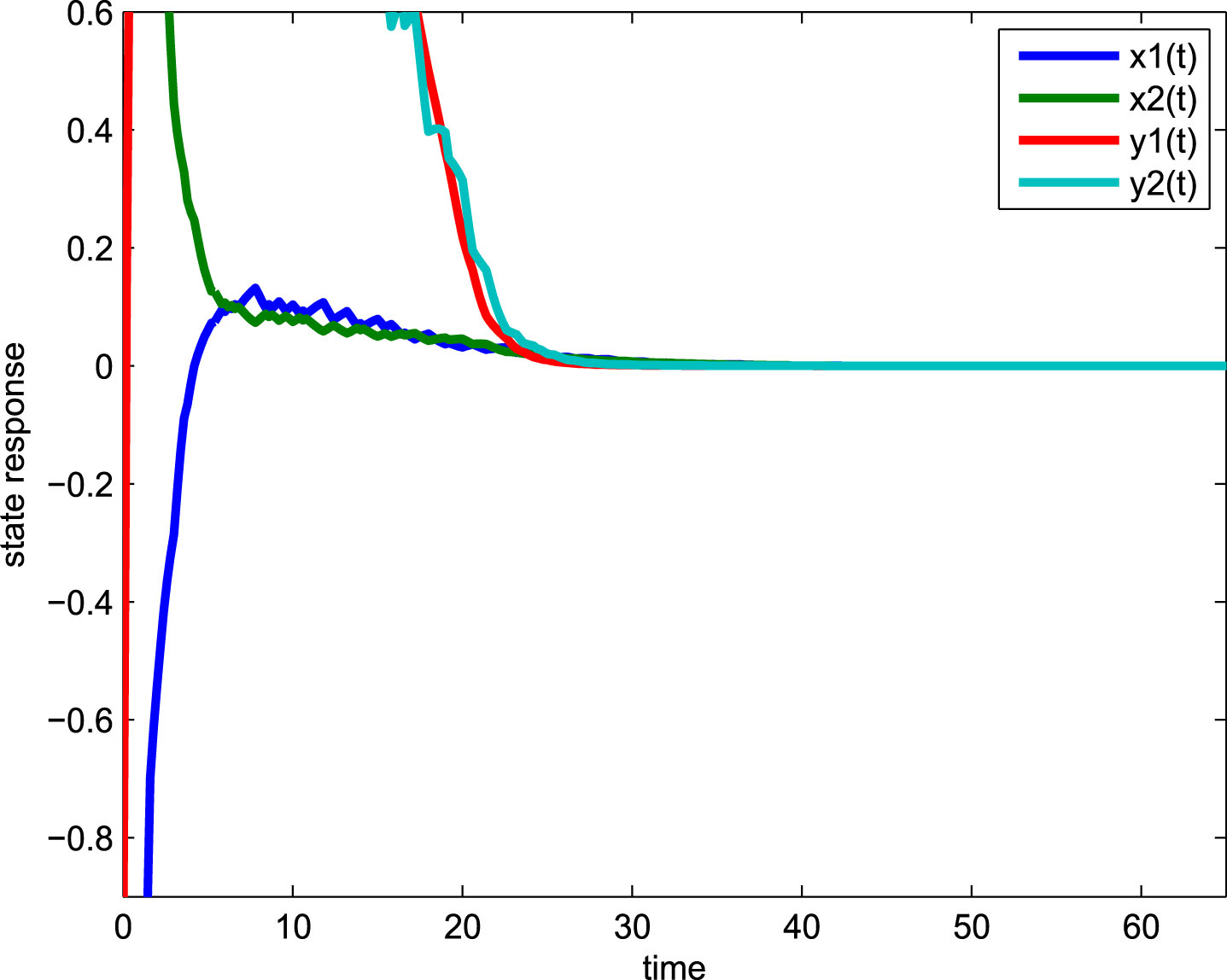
The state response x1 (t) , y1 (t) , x2 (t) , y2 (t) of neural networks (24)
From Assumption 1, we have Now, let t0 = 0, η = 0.6, ξ = 0.3, γ = 1, ɛ = 1.5, τ1 = τ2 = 0.3715, σ1 = σ2 = 0.283, t = 0.0517 .
Suppose β = 0.9, we get the variables R = 1.1242, S = 0.0026, T = 0.0731, U = 0.3924, V = 4.9964, W = 0.0023, X = 0.11426, Y = 0.1211, M1 (t) =0.0517, M2 (t) =0.1142 . From Theorem 3.3, we can get that (ref10) =1.0621 < 1.25 = and (ref11) =2.2384 < 2.5 = Therefore, in this paper, by solving the inequalities (ref10) & (ref11) in Theorem 3.3, we find that the Caputo fractional-order BAM type uncertain neural networks (ref1) is quasi-uniformly stable.
Example 4.2. Consider the following two-state Caputo fractional-order BAM type neural networks model (21) with both delays without uncertain parameters:
with the initial condition
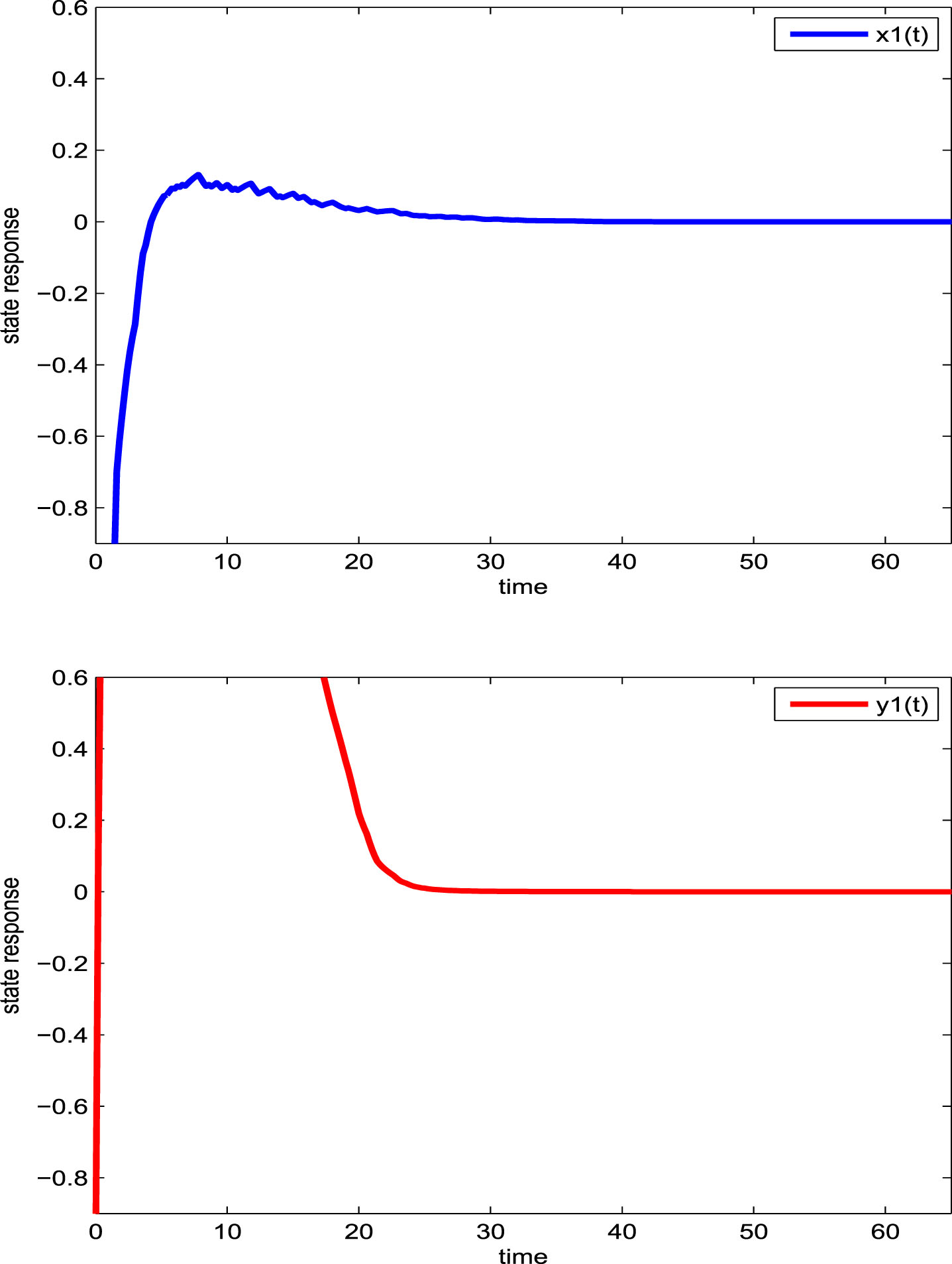
The state response x1 (t) , y1 (t) of neural networks (25)
where the activation function is described by the following functions fj (yj (t)) = gj (yj (t)) = hj (yj (t)) =
and
= = = (i, j = 1, 2) .
Therefore, we have F = G = H = = = = 1 .
The state response x2 (t) , y2 (t) of neural networks (25)
The state response x1 (t) , y1 (t) , x2 (t) , y2 (t) of neural networks (25)
From Assumption 1, we have Now, let t0 = 0, γ = 1, η = 0.8, ξ = 0.7, ɛ = 2.5, τ1 = τ2 = 0.047, σ1 = σ2 = 0.09, t = 0.0238 .
Suppose β = 0.7, we get the variables R = 1.2550, S = 0.0347, T = 0.06653, U = 0.0327, V = 1.2396, W = 0.0425, X = 0.0081, Y = 0.10811, M1 (t) =0.06653, M2 (t) =0.008106 .
From Corollary 3.6, we can get that (ref22) =1.1503 < 1.5625 = and (ref23) =1.1332 < 1.7857 = Therefore, in this paper, by solving the inequalities (ref22) & (ref23) in Corollary 3.6, we find that the Caputo fractional-order BAM type neural networks (ref21) is quasi-uniformly stable.
Conclusions
In this paper, quasi-uniform stability problems for a class of fractional-order uncertain BAM neural networks with discrete and distributed time delays is investigated. It is very difficult to construct Lyapunov functions for fractional-order neural networks compare with the integer-order delayed systems. So by utilizing the stability theory and inequality technique skills, sufficient conditions assuring quasi-uniform stability are derived in this paper. To show the effectiveness of proposed approach in this paper, two numerical examples with simulations are explored. By solving Theorem 3.3 and Corollary 3.6, we can conclude that the fractional-order uncertain BAM neural networks with mixed delays considered in this paper is quasi-uniform stable.
To the best of our knowledge, there are no results on the global exponential stability of the fractional-order BAM neural networks system with uncertainty by sampled-data controller, which might be our future research work.
Footnotes
Acknowledgments
This work is supported by National Natural Science Foundation of China (No.12261015, No.62062018), Project of High-level Innovative Talents of Guizhou Province ([2016]5651).
References
1.
AlofiA., CaoJ., ElaiwA., Al-MazrooeiA. Delaydependent stability criterion of Caputo fractional neural networks with distributed delay, Discrete Dynamics in Nature and Society (2014), Article ID 529358, pp. 6.
2.
ArenaP., CaponettoR., FortunaL. and PortoD., Bifurcation and chaos in non-integer order cellular neural networks, International Journal of Bifurcation and Chaos8 (1998), 1527–1539.
3.
ArikS. and TavsanogluV., Global asymptotic stability analysis of bidirectional associative memory neural networks with constant time delays, Neurocomputing68 (2005), 161–176.
4.
BanachS., Sur les opérations dans les ensembles abstraits et leur application aux équations intégrales, Fundamenta Mathematicae3 (1922), 133–181.
5.
BaoH. and CaoJ., Projective synchronization of fractional-order memristor-based neural networks, Neural Networks63 (2015), 1–9.
6.
BaoH., ParkJ. and CaoJ., Adaptive synchronization of fractional-order memristor-based neural networks with time delay, Nonlinear Dynamics82 (2015), 1343–1354.
7.
ButzerP.L., WestphalU. An introduction to fractional calculus in physics, World Scientific, Singapore (2000).
8.
CaoJ. and WangJ., Global asymptotic and robust stability of recurrent neural networks with time delays, IEEE Transactions on Circuits & Systems I Regular Papers52 (2005), 417–426.
9.
CaoJ. and WangL., Exponential Stability and periodic oscillatory solution in BAM networks with delays, IEEE Transaction on Neural Networks13 (2002), 457–463.
10.
CaoY., BaiC. Finite-time stability of fractionalorder BAM neural networks with distributed delay, Abstract and Applied Analysis (2014), Article ID 634803, pp. 8.
11.
CaoY. and BaiC., Existence and stability analysis of fractional order BAM neural networks with a time delay, Applied Mathematics6 (2015), 2057–2068.
12.
ChenL., ChaiY., WuR., MaT. and ZhaiH., Dynamic analysis of a class of fractional-order neural networks with delay, Neurocomputing111 (2013), 190–194.
13.
CorduneanuC. Principles of differential and integral equations, Allyn and Bacon, MA, USA 1971.
14.
GuR.C., XuY. Chaos in a fractional-order dynamical model of love and its control, Nonlinear Mathematics for Uncertainty & Its Applications, Nl-mua, Beijing, China, September. DBLP (2011), 349–356.
15.
HilferR. Applications of fractional calculus in physics world scientific, Hackensack, NJ 2001.
16.
HuM., CaoJ. and HuA., Exponential stability of discretetime recurrent neural networks with time-varying delays in the leakage terms and linear fractional uncertainties, IMA Journal of Mathematical Control and Information31 (2014), 345–362.
17.
HuangC., CaoJ. and XiaoM., Hybrid control on bifurcation for a delayed fractional gene regulatory network, Chaos, Solitons & Fractals87 (2016), 19–29.
18.
HuangH., HuangT.W. and ChenX.P., A mode-dependent approach to state estimation of recurrent neural networks with Markovian jumping parameters and mixed delays, Neural Networks46 (2013), 50–61.
19.
JmalA., Ben MakhloufA., NagyA.M. and NaifarO., Finite-time stability for Caputo-Katugampola fractional-order time-delayed neural networks, Neural Processing Letters50(1) (2019), 607–621.
20.
KilbasA., SrivastavaM.H. and TrujilloJ.J., Theory and application of Fractional differential equations, in: North Holland Mathematics Studies204 (2006).
KoskoB. Neural networks and fuzzy systems-a dynamical system approach to machine intelligence, Prentice Hall, Englewood Cliffs, NJ, USA 1992.
23.
KuczmaM. An introduction to the theory of fractional equations and inequalities: Cauchy ′s equation and Jensen ′s inequality, Birkhauser (2009).
24.
LiC.P. and DengW.H., Remarks on fractional derivatives, Applied Mathematics and Computation187 (2007), 777–784.
25.
LiR. and CaoJ., Stability analysis of reaction-diffusion uncertain memristive neural networks with time-varying delays and leakage term, Applied Mathematics and Computation278 (2016), 54–69.
26.
LiP.L., LuY.J., XuC.J., RenJ. Insight into Hopf bifurcation and control methods in fractional order BAM neural networks incorporating symmetric structure and delay, Cognitive Computation (2023) doi: https://doi.org/10.1007/s12559-023-10155-2.
27.
LiX. and RakkiyappanR., Stability results for Takagi-Sugeno fuzzy uncertain BAM neural networks with time delays in the leakage term, Neural Computing & Applications22 (2013), 203–219.
28.
LiX. and SongS., Stabilization of delay systems: delaydependent impulsive control, IEEE Transactions on Automatic Control62(1) (2017), 406–411.
29.
LiX. and SongS., Impulsive control for existence, uniqueness andglobal stability of periodic solutions of recurrent neural networks with discrete and continuously distributed delays, IEEE Transactions on Neural Networks and Learning Systems24 (2013), 868–877.
30.
LiX. and WuJ., Stability of nonlinear differential systems with state-dependent delayed impulses, Automatica64 (2016), 63–69.
31.
LiX., ZhuQ. and ReganD.O., pth moment exponential stability of impulsive stochastic functional differential equations andapplication to control problems of NNs, Journal of the Franklin Institute351 (2014), 4435–4456.
32.
LiuX., JiangN., CaoJ., WangS. and WangZ., Finite-time stochastic stabilization for BAM neural networks with uncertainties, Journal of the Franklin Institute350 (2013), 2109–2123.
33.
LiuH., LiS., WangH., HuoY. and LuoJ., Adaptive synchronization for a class of uncertain fractional-order neural networks, Entropy17 (2015), 185–200.
34.
LundstromB.N., HiggsM.H., SpainW.J. and FairhallA.L., Fractional differentiation by neocortical pyramidal neurons, Nature Neuroscience11 (2008), 1335–1342.
35.
MaharajanC., RajaR., CaoJ. and RajchakitG., Novel global robust exponential stability criterion for uncertain inertial-type BAMneural networks with discrete and distributed time-varying delays via Lagrange sense, Journal of the Franklin Institute355(11) (2018), 4727–4754.
36.
MaharajanC. and SowmiyaC., Exponential stability of delay dependent neutral-type descriptor neural networks with uncertain parameters, Franklin Open100042 (2023). https://doi.org/10.1016/j.fraope.2023.100042
37.
MaharajanC., RajaR., CaoJ., RaviG. and RajchakitG., Global exponential stability of Markovian jumping stochastic impulsive uncertain BAM neural networks with leakage, mixed time delays, and a-inverse Hölder activation functions, Advances in Difference Equations113 (2018).
38.
Meyer-BaseA., RobertsR. and ThummlerV., Local uniform stability of competitive neural networks with different timescales under vanishing perturbations, Neurocomputing73 (2010), 770–775.
39.
MitrinovicS. Analytic Inequalities, Springer-Verlag, New York 1970.
40.
NaifarO., JmalA., NagyA.M., BenA. Improved Quasi uniform stability for fractional order neural nets with mixed delay, Mathematical Problems in Engineering Article ID 8811226, (2020) pp. 7.
41.
OuW., XuC.J., CuiQ., LiuZ., PangY., FarmanM., AhmadS., ZebA. Mathematical study on bifurcation dynamics and control mechanism of tri-neuron BAM neural networks including delay, Mathematical Methods in the Applied Sciences (2023), https://doi.org/10.1002/mma.9347.
42.
ParkJ., A novel criterion for global asymptotic stability of BAM neural networks with time delays, Chaos, Solitons and Fractals29 (2006), 446–453.
43.
PodlubnyI. Fractional differential equations, Academic, New York 1999.
44.
RajaR., SakthivelR. and MarshalS., Anthoni, Linear matrix inequality approach to stochastic stability of uncertain delayed BAM neural networks, IMA Journal of Applied Mathematics78 (2012), 1156–1178.
45.
RajaR., ZhuQ., SenthilrajS. and SamiduraiR., Improved stability analysis of uncertain neutral type neural networks with leakage delays and impulsive effects, Applied Mathematics and Computation266 (2015), 1050–1069.
46.
RakkiyappanR., CaoJ. and VelmuruganG., Existence and uniform stability analysis of fractional-order complex-valued neural networks with time delays, IEEE Transaction on Neural Networks and Learning Systems26 (2014), 84–97.
47.
RakkiyappanR., SivaranjaniR., VelmuruganG. and CaoJ., Analysis of global O(t-α) stability and global asymptotical periodicity for a class of fractional-order complex-valued neural networks with time varying delays, Neural Networks77 (2016), 51–69.
48.
RenF., CaoF. and CaoJ., Mittag-Leffler stability and generalized Mittag-Leffler stability of fractional-order gene regulatory networks, Neurocomputing160 (2015), 185–190.
49.
SongC. and CaoJ., Dynamics in fractional-order neural net-works, Neurocomputing142 (2014), 494–498.
50.
SongL., XuS.Y. and YangJ.Y., Dynamical models of happiness with fractional order, Communications in Nonlinear Science and Numerical Simulation15(3) (2010), 616–628.
51.
SrivastavaH.M., AbbasS., TyagiS. and LassouedD., Global exponential stability of fractional-order impulsive neural network with time-varying and distributed delay, Mathematical Methods in Applied Sciences41 (2018), 2095–2104.
52.
TuZ., CaoJ. and HayatT., Matrix measure based dissipativity analysis for inertial delayed uncertain neural networks, Neural Networks75 (2016), 47–55.
53.
TuZ., WangL., ZhaZ. and JianJ., Global dissipativity of a class of BAM neural networks with time-varying and unbound delays, Communications in Nonlinear Science & Numerical Simulation18 (2013), 2562–2570.
54.
VelmuruganG., RakkiyappanR. and CaoJ., Finite-time synchronization of fractional-order memristor-based neural networks with time delays, Neural Networks73 (2016), 36–46.
55.
WanL., ZhanX., GaoH., YangQ., HanT. and YeM., Multiple asymptotical stability analysis for fractional-order neural networks with time delays, International Journal of Systems Science50(10) (2019), 2063–2076.
56.
WuH., ZhangX., XueS. and NiuP., Quasi-uniform stability of Caputo-type fractional-order neural networks with mixed delay, International Journal of Machine Learning and Cybernetics8(5) (2017), 1501–1511.
57.
XiaoM., ZhengW., JiangG. and CaoJ., Undamped oscillations generated by Hopf bifurcations in fractional order recurrent neural networks with Caputoderivative, IEEE Transactions on Neural Networks and Learning Systems26(12) (2015), 3201–3214.
58.
XuC.J., MuD., PanY., AouitiC. and YaoL., Exploring bifurcation in a fractional-order predator-prey system with mixed delays, Journal of Applied Analysis and Computation13(3) (2023), 1119–1136.
59.
ZhangR., QiD. and WangY., Dynamics analysis of fractional order three-dimensional Hopfield neural network, In International conference on natural computation (2010), 3037–3039.
60.
ZhangH., YeR., LiuS., CaoJ., AlsaediA. and LiX., LMI-based approach to stability analysis for fractional-order neural networks with discrete and distributed delays, International Journal of Systems Science49(3) (2018), 537–545.
61.
ZhouS., LiH. and ZhuZ., Chaos control and synchronization in a fractional neuron network system, Chaos, Solitons and Fractals36 (2008), 973–984.
62.
ZhouS., LinX., ZhangL., LiY. Chaotic synchronization of a fractional neurons network system with two neurons, In International conference on communications, circuits and systems (2010), 773–776.
63.
ZhuH., ZhouS., ZhangW. Chaos and synchronization of time-delayed fractional neuron network system, In The 9th international conference for Young computer scientists (2008), 2937–2941.