



Abstract
The concept of domination in graphs is very ancient. Several types of notions of domination in graphs have been discussed by many researchers. In this work, the concept of domination and some notions of domination sets, minimal dominating sets, independence sets, and maximal independence sets are introduced in bipolar fuzzy soft graphs. Additionally, several properties of dominating sets are discussed and some theorems in bipolar fuzzy soft graphs are proved.
Keywords
Introduction
The idea of graph theory was introduced by Euler while he solved Konigsberg bridge problem and graph theory has large variety of applications in various domains [1]. Lotfi A. Zadeh, familiar as father of fuzzy logic, introduced the notion of fuzzy set in 1965 which was defined as the set of distinct objects having membership values in [0, 1], later on many notions were introduced in fuzzy set [2]. The notion of fuzzy graphs was introduced by Rosenfeld in 1975 [3], then after some remarks on fuzzy graphs were given by Battacharya [4]. Some new ideas on fuzzy graph were initiated by Mordeson and Nair [5]. A lot of new terminologies on fuzzy graphs also introduced by akram et al. [6–9].
The concept of bipolar fuzzy sets was introduced by Zhang [10]. Bipolar fuzzy set is a generalization of fuzzy sets [11] and having membership values ranging in [– 1, 1]. An element having 0 membership value then this indicates that the corresponding property of an element is irrelevant, if an element having membership value ranging in (0, 1], then this element fulfil the corresponding property, in the same way if an element having membership value ranging in (– 1, 0), then this element fulfil the corresponding implicit counter property. Akram initiated the idea of bipolar fuzzy graphs and investigated basic properties of bipolar fuzzy graphs [6, 12– 14].
The fuzzy soft sets that are the combinations of fuzzy sets and soft sets, which was introduced by P.K. Maji, A.R. Roy and R Biswas in 2002 [15, 16]. The combination of fuzzy sets and rough sets, new models of soft rough set, rough soft set and fuzzy soft set were introduced by using soft fuzzy sets by Feng et al. [17–19]. Thereafter Naz and Sabir initiated the idea of the bipolar fuzzy soft sets that are combination of bipolar fuzzy sets and soft set [20] and Aslam et al. work on some basic properties and operations on bipolar fuzzy soft sets [21]. Later on Yildiray Celik introduced the concept of bipolar fuzzy soft graphs by applying the concept of bipolar fuzzy soft sets to graphs and introduced several operations and investigate the basic characteristics of bipolar fuzzy soft graphs [22]. Readers are referred to [23–26] for further applications.
The concept of domination in graph theory was first introduced in the game of chess. The issue began when all squares faced the involvement of a queen, by checking the number of at least the queen’s number of queens [27]. The domination in graph theory was introduced by Berge [28]. It was further explained by Cockayne and Hedetniemi [29, 30].
Aras et al. [34] introduced the structures of bipolar soft locally compact and bipolar soft paracompact spaces. Malik et al. [35] introduced the rough bipolar fuzzy left ideal, rough bipolar fuzzy right ideal, rough bipolar fuzzy two-sided ideal, rough bipolar fuzzy interior ideal, and rough bipolar fuzzy bi-ideal in SGs. Malik et al. [36] proposed that becoming the most prominent reason for the increased rate of disease in an area. Gul et al. [37] present (α, β)-optimistic multi-granulation bipolar fuzzified preference rough sets ((α, β) o-MG-BFPRSs). Al-Shami [38] introduced bipolar soft sets to build an optimal choice application. Several varieties of domination in fuzzy graphs have been well expressed in [31– 33, 39– 41].
Contribution
The key contribution of this writing is as follows. To make some notions of domination sets, minimal dominating sets To consider independence sets, and maximal independence sets are introduced in bipolar fuzzy soft graphs. To build a multi-attribute DM (MADM) approach under To categorize theorems in bipolar fuzzy soft graphs To define the Numerical application
Motivation
In this paper, we define the new idea of domination in bipolar fuzzy soft graph, based on different properties and theorems. bipolar fuzzy soft graphs is implemented to evaluate the claim seeing the DMs’ chance favorite done the submission of bipolar fuzzy soft graphs, which troubles the different things of additional, and to closely indenture the great provider. The bipolar fuzzy soft graphs is documented to dialectal MCDM difficulties and deliver an organized and reliable claim to philological claim assortment problems. To define through of all, there are regular reproduces in the writing on basis graphs. Mainly in superior a protracted period, vulnerability in selection-making minutes for as pleasantly many standards has lengthy. We current the bipolar fuzzy soft graphs within the form Domination, Minimal Domination, Maximal Independence set in Bipolar fuzzy soft graphs. We describe the application of bipolar fuzzy soft graphs. We describe the comparison method with existing method.
Novelty
Many investigators have worked on fuzzy graph mean and variances, but can study the domination of bipolar fuzzy soft graph. We aimed to develop a novel MCDM technique based on domination and apply them to real models. The following novel idea is developed in this study. The domination of bipolar fuzzy soft graph is introduced. A novel MCDM is developed based on bipolar fuzzy soft graph. We have considered unique numerical example with bipolar fuzzy soft graph to show the applicability of our mentioned method. We have discussed the comparison analysis.
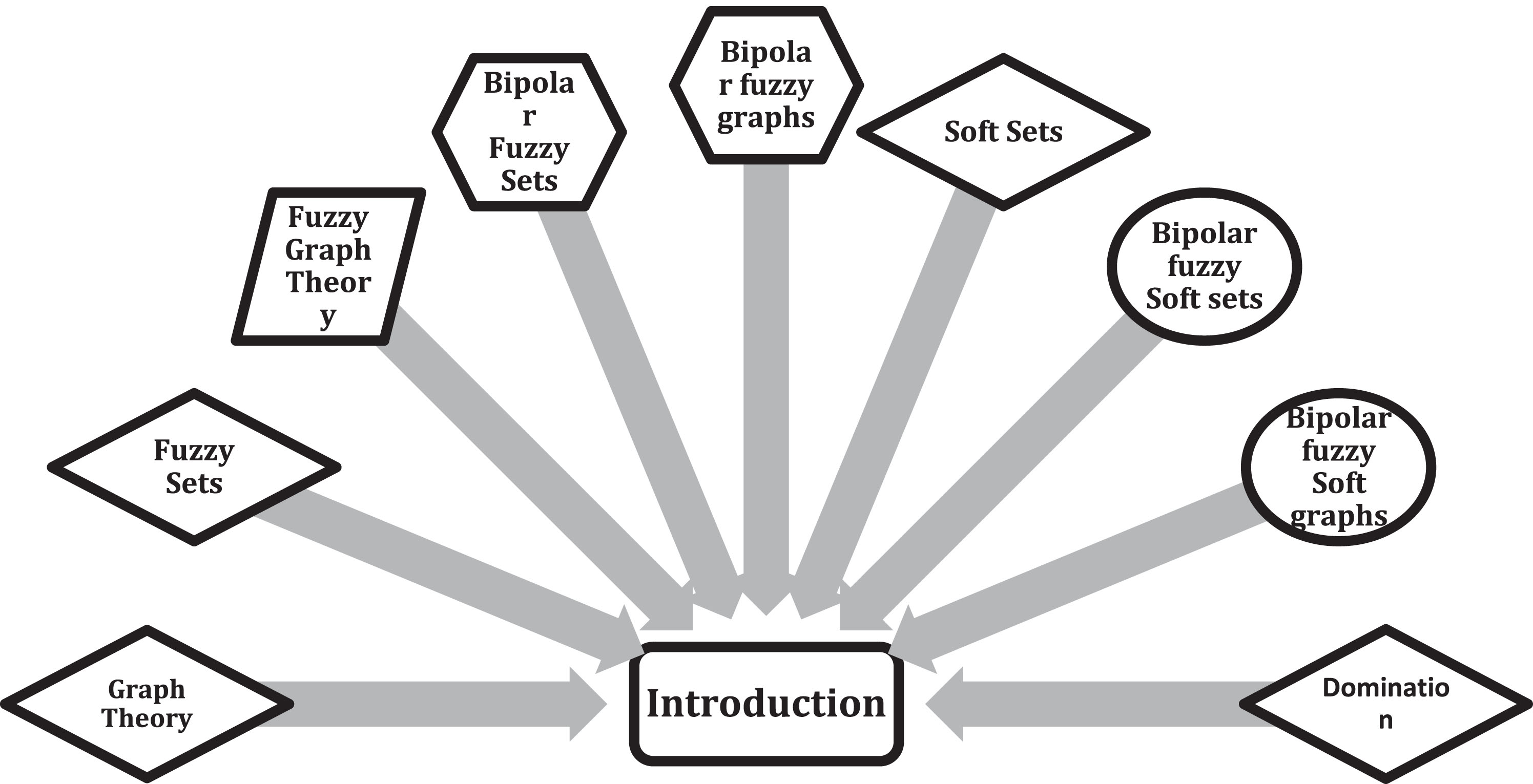
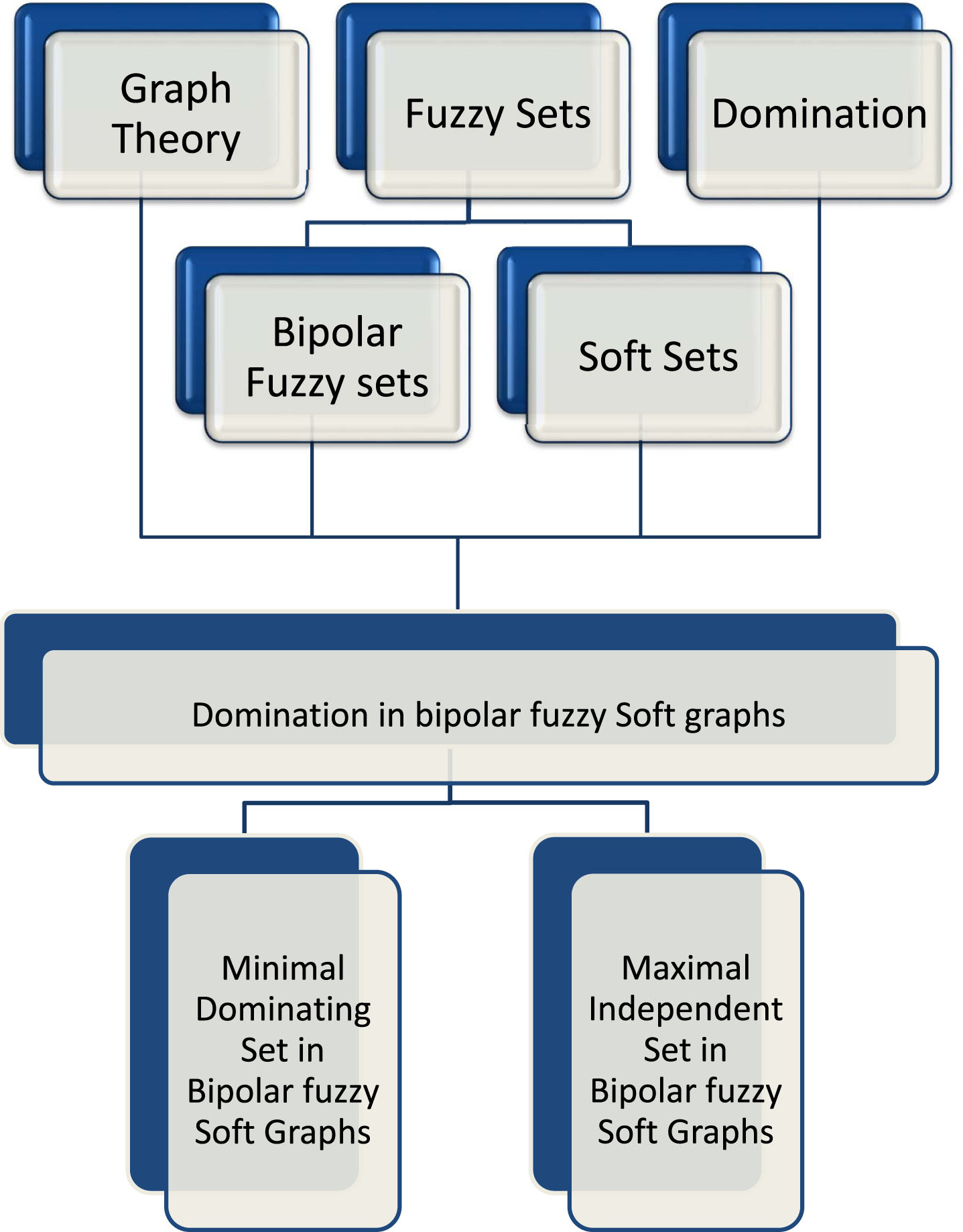
In this research work, the concepts of domination set, minimal dominating set, and maximal independence set in bipolar fuzzy soft graphs will be discussed. Figure 1.1 is given below.
History.
We use some abbreviations in this paper that are given in Table 1.
List of abbreviations
A
In
is a (Γ (ρ) , K (ρ)) is a
That is for all ⋎1, ⋎2∈ ∨ × ∨ and for all
Domination, minimal domination, maximal independence set in bipolar fuzzy soft graphs
In Example 3.4, Edges (⋎1, ⋎2) and (⋎1, ⋎4) are strong edges.
In Example 3.4, N d (⋎1) ={ ⋎2, ⋎4 }, N d (⋎2) ={ ⋎1 }, N d (⋎3) =∅, N d (⋎4) ={ ⋎1 }.
In Example 3.4, As N d (⋎3) =∅ so ⋎3 is an isolated vertex.
Figure 3.1. is given as below.
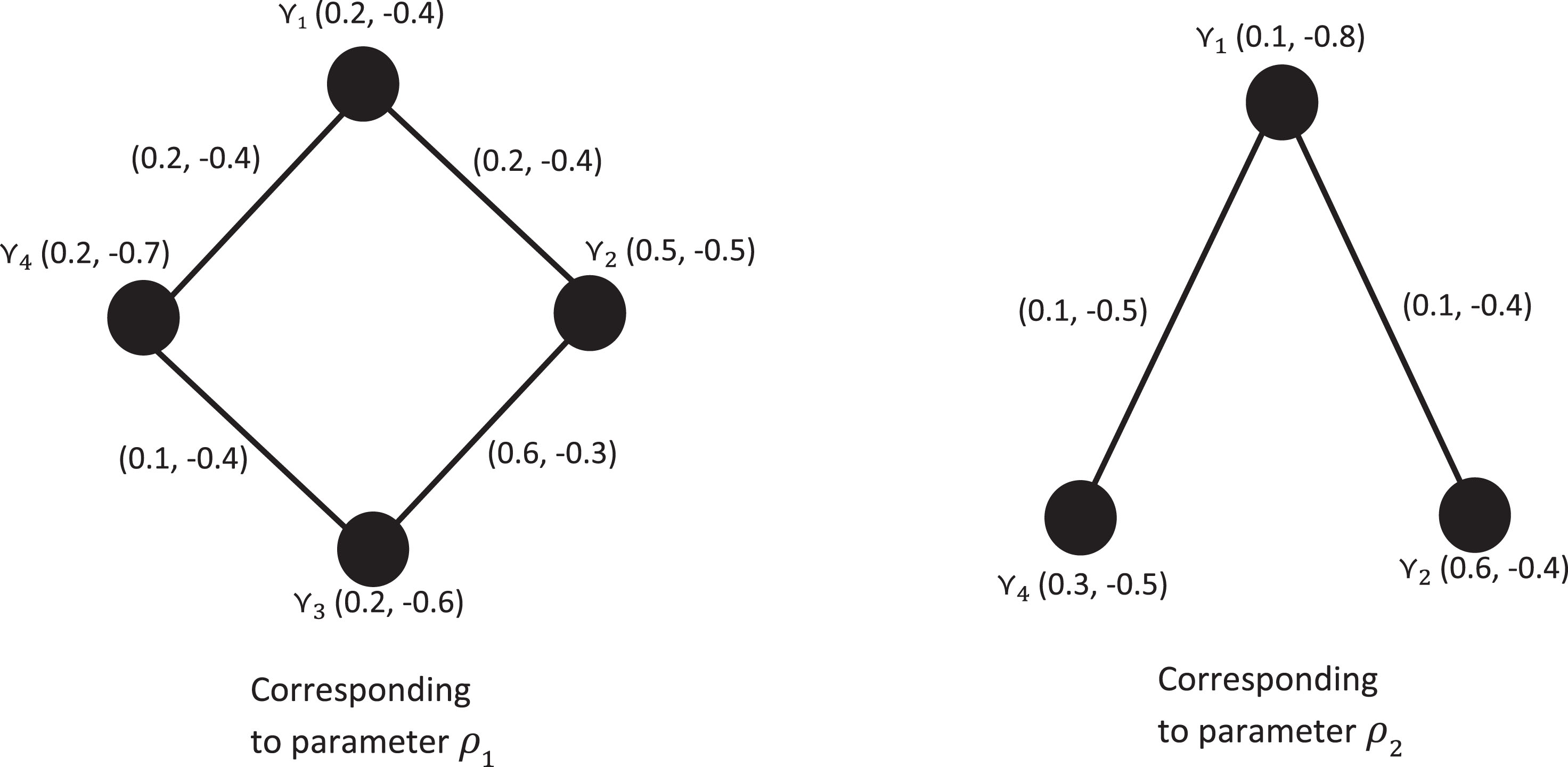
Bipolar fuzzy soft vertex and edge sets
Figure 3.4 is given as below.
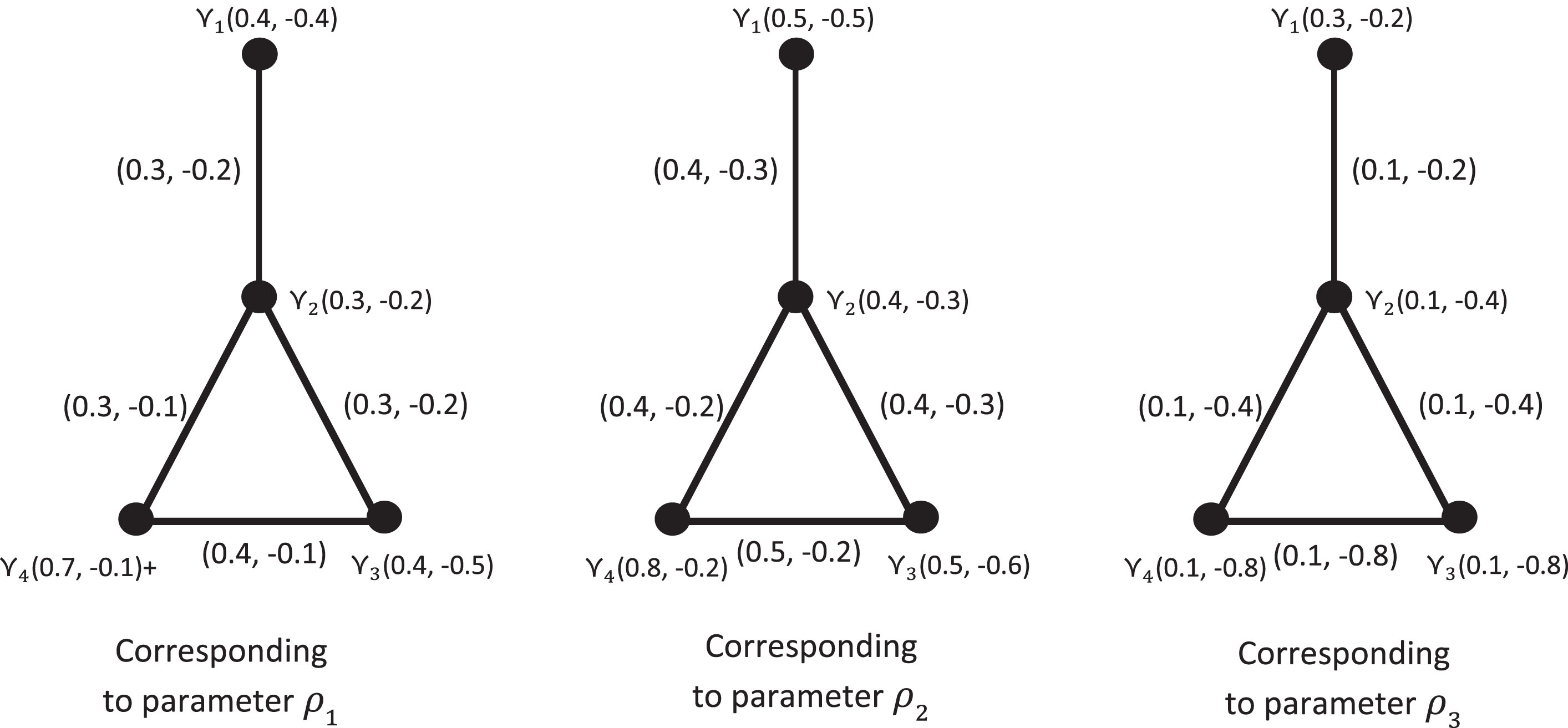
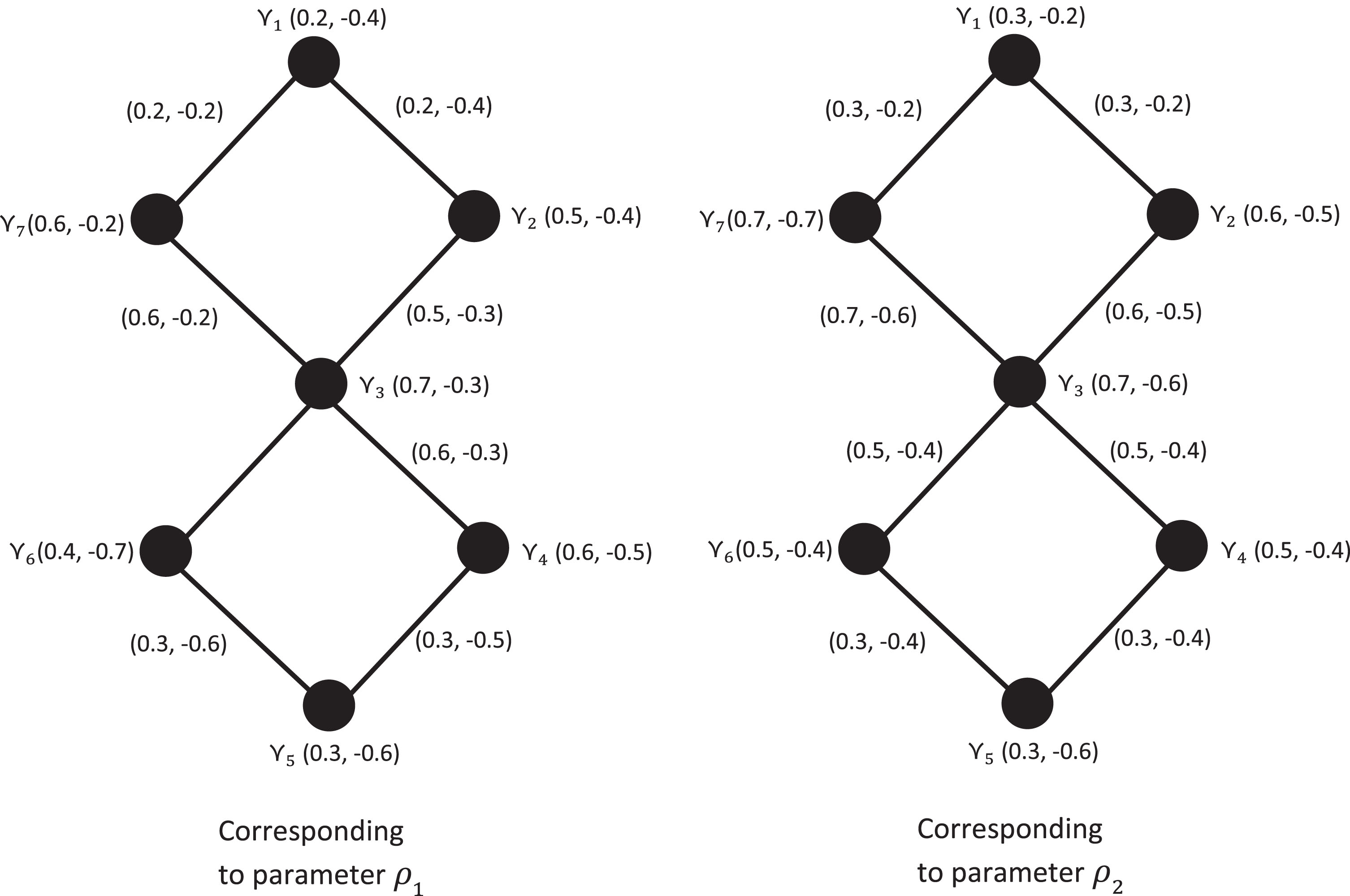
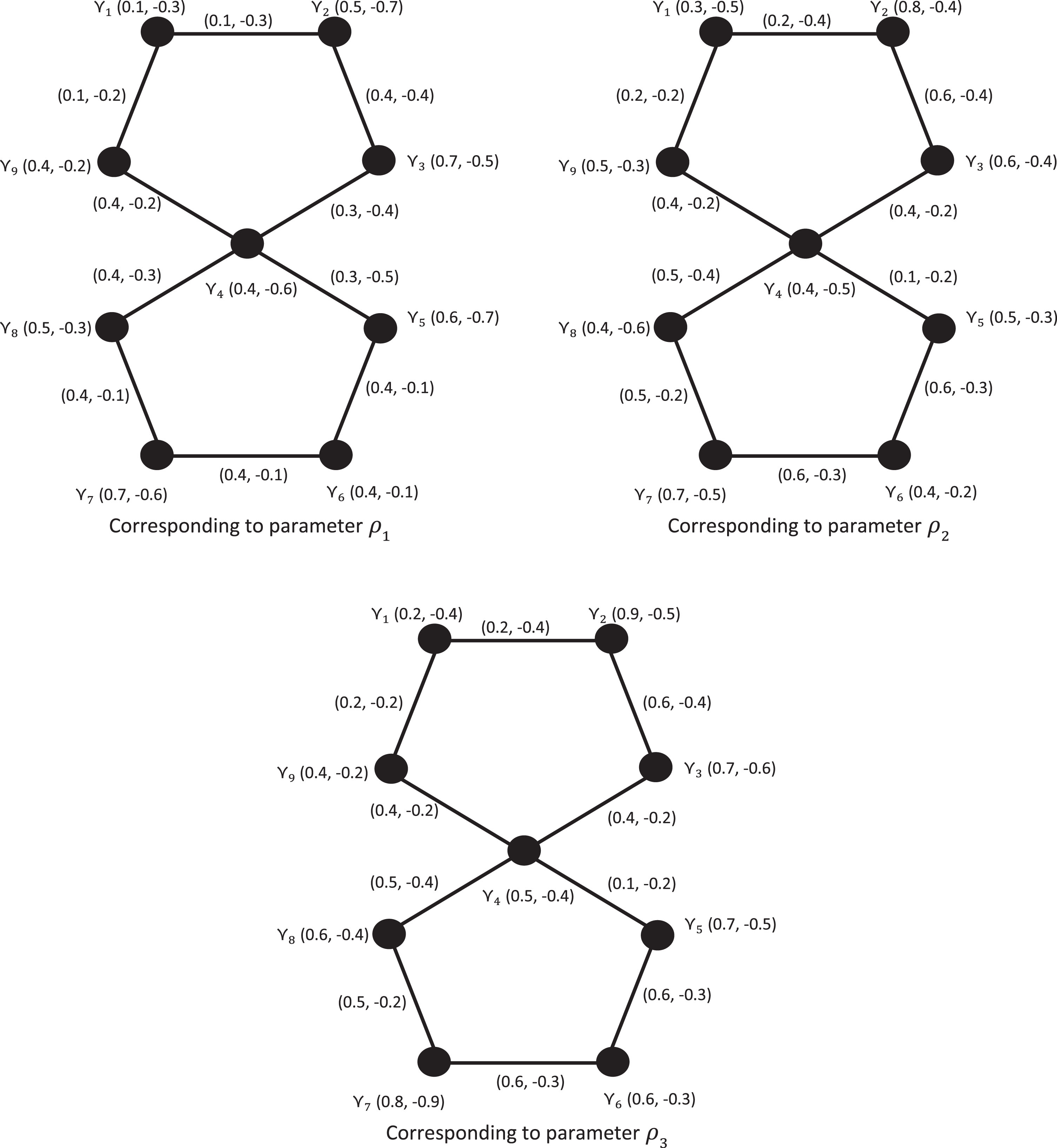
Figure 3.5 is given as below.
In Example 3.4, the vertex cardinality of
Domination is symmetric relation that is if ⋎1 dominates ⋎2 then also ⋎2 dominates ⋎1⋎1, ⋎2∈ ∨. {N
d
(⋎) : any⋎∈ ∨ } is a collection of all vertices of ∨ that are dominated by ⋎, If for all ⋎1, ⋎2∈ ∨ and for all
Figure 3.2 is given in below.
Bipolar fuzzy soft vertex and edge sets
In each parametrized graphs, the minimal
In the same way, cardinality of
For each
Conversely, Consider for given conditions (i), (ii), one of the condition holds for
In each parametrized graphs, obviously
Bipolar fuzzy soft vertex and edge sets
Figure 3.3. is given as below
(⋎5⋎6) , (⋎6⋎3) , (⋎3⋎7) , (⋎7⋎1)}, set of parameters
Bipolar fuzzy soft vertex and Edge sets
In each parametrized graphs, obviously there are many
Conversely, if we suppose
Figure 3.4 is given as below
Bipolar fuzzy soft vertex and Edge sets is written in Table 5.
In this section, we define the proposed method,
Calculate the bipolar fuzzy soft graphs
Calculate the different value in figure.
Application of domination in Bipolar fuzzy soft graphs
Domination have a major role to identify the sets with unique properties that are applicable in solving problems. It is also useful in transportation department. In this department, traffic spot lights are fixed on particular terminals/road intersections /crossings. These spot lights are very helpful to minimize the possibilities of road accidents. For this purpose, they have all the data of all terminals/road intersections /crossings with huge rush for a particular city. In this model, the idea of domination is useful to reduce the complications that are given below.
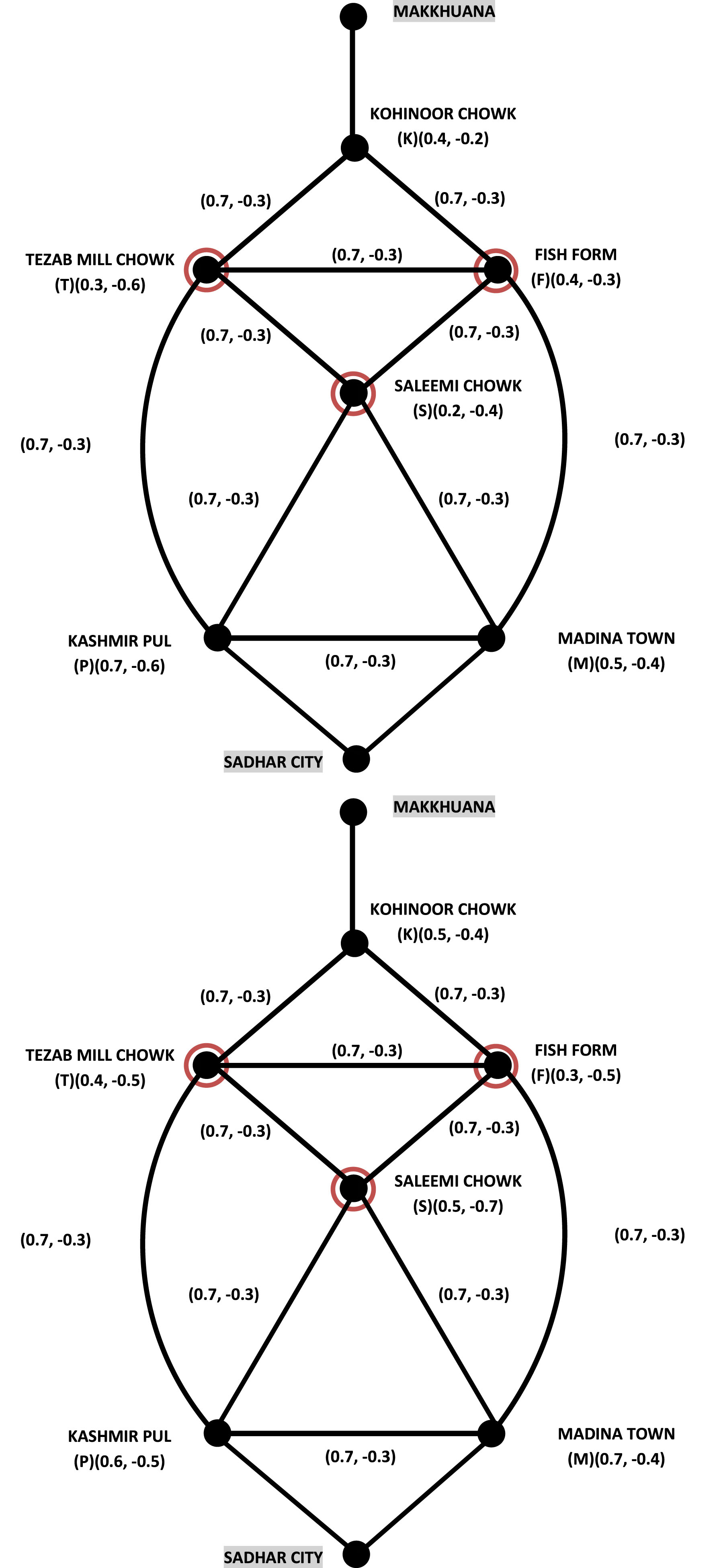
Consider Makkuana(Mk) and Sadhar city(Sc) as the entrance and exit from East to West of any city. People often travel from Mk and Sc by means of any available transport. There are many terminals/road intersections /crossings between Mk and Sc. To construct a model of domination of bipolar fuzzy soft graphs the terminals/road intersections/crossings are considered as vertices and the routes between them are considered as edges. For set of vertices
∨ = {Tezab mill chowk (T), Kohinoor Chowk (K), Madina Town (M), Saleemi Chowk (S), Fish Formlinebreak (F), Kashmir Pull (P)}
In bipolar fuzzy soft graphs, we will take positive membership values as possibility of accidents according to followed route to reach on desire terminal and negative membership values will depends on availability of traffic setup for that route. The values of traffic setup is taken negative due to good traffic setup will reduce the possibility of accidents on that route. Also we will discuss the possibilities of traffic accidents on our roads in two different parameters that is parameter ρ1 is in 09 : 00AM to 03 : 00PM and parameter ρ2 is in 03 : 00PM to 09 : 00PM.
For an instance, one have to cross six terminals/road intersections/crossings. While crossing these one faces a huge traffic rush. To settle this issue transportation department cannot fix traffic spot on all of these terminals/road intersections/crossings. As the flow of traffic is going on all these routes so all the edges have same positive and negative membership values in both parameters ρ1 and ρ2.
In the selection of terminals/road intersections/crossings which one is most suitable for the fixing of traffic spot lights, the idea of domination play a vital role. From Fig. 3.5, the encircled vertices having strong neighbors (strong edges) are with their adjacent vertices are those that facing a huge rush. So these terminals/road intersections/crossings are most suitable for the fixing of traffic spot lights. If the vertices have having same positive and negative membership values in both the parameters, because both have same possibilities of accidents and availability of traffic setup. If we select both then the dominating set is not minimal. The purpose is to fix minimum number of light with maximum benefits. So we choose only one of them. Hence {F, T, S} is dominating set.
The
Table 6 is given in Bipolar fuzzy soft vertex and Edge sets.
Bipolar fuzzy soft vertex and Edge sets
Bipolar fuzzy soft vertex and Edge sets
Figure 3.5 is given as below
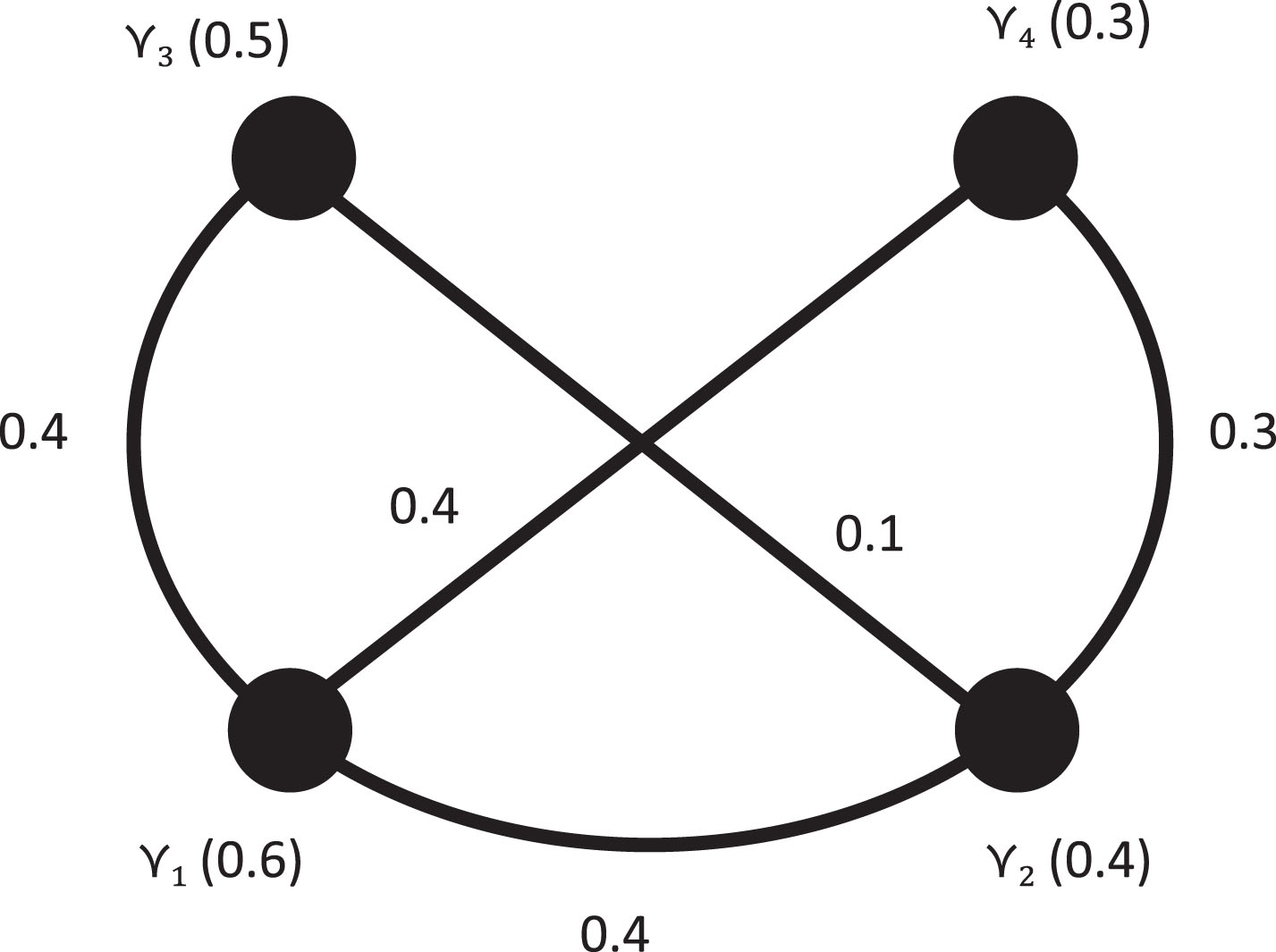
In this subsection, we define the Fig. 3.6 is given as below
Figure 3.6 is given below.
Comparsion technique.
For a
Flow charts.
In this figure, sets {⋎2}, {⋎1, ⋎2}, {⋎2, ⋎3}, {⋎1, ⋎3, ⋎4}, etc. are fuzzy dominating sets.
The theory of domination is highly intriguing and has a wide range of applications and properties in graphs. In this study, we have introduced the concepts of domination, independence, minimal domination, and maximal independence in BϝS’Gs, and have presented some results. For future research, we can define and discuss additional domination parameters.