



Abstract
A CNF formula with each clause of length k and each variable occurring 4s times, where positive occurrences are 3s and negative occurrences are s, is a regular (3s + s, k)-CNF formula (F 3s+s,k formula). The random regular exact (3s + s, k)-SAT problem is whether there exists a set of Boolean variable assignments such that exactly one literal is true for each clause in the F 3s+s,k formula. By introducing a random instance generation model, the satisfiability phase transition of the solution is analyzed by using the first moment method, the second moment method, and the small subgraph conditioning method, which gives the phase transition point s* of the random regular exact (3s + s, k)-SAT problem for k≥3. When s < s*, F 3s+s,k formula is satisfiable with high probability; when s > s*, F 3s+s,k formula is unsatisfiable with high probability. Finally, through the experimental verification, the results show that the theoretical proofs are consistent with the experimental results.
Introduction
The satisfiability (SAT) problem is NP-hard problem, and the SAT problem with each clause of length k is a k-SAT problem, and the k-SAT problem with randomly generated variables of size n is called a random k-SAT problem [13]. The random regular exact (3s + s, k)-SAT problem is whether there exists a set of variable assignments such that exactly one literal is true for each clause in the (3s + s, k)-CNF formula. Obviously, the random regular exact (3s + s, k)-SAT problem is still NP-hard [11] problem. For the random k-SAT problem, researchers found that the ratio α (constraint density) of the number of clauses m to the number of variables n is closely related to the satisfiability phase transition of the random k-SAT problem, and this ratio portrays the degree of intractability and the critical features of the solution for the random k-SAT problem instances. However, the constraint density α is constant for the regular exact SAT problem, and thus α cannot measure the degree of intractability and the phase transition for the regular exact SAT problem instances. Therefore, the study of satisfiability phase transition of random regular exact (3s + s, k)-SAT problem is instructive for analyzing the phase transition threshold of regular (d,k)-SAT problem.
The regular (d,k)-SAT problem is a k-SAT problem in which the variable occurs d times, and it is worth noting that any k-SAT instance can be converted to the regular (d,k)-SAT problem. In order to understand the difficulty of solving the SAT problem, it is necessary to study the distribution pattern of the solutions to the problem and analyze the degree of difficulty in solving it. At present, the satisfiability phase transition of the random regular exact (3s + s, k)-SAT problem is still unclear, and there is a need to find new parameters to measure the satisfiability phase transition of the problem. For the similar problem of this problem, researchers have obtained some important research results on the satisfiability phase transition, which are important references for analyzing the satisfiability phase transition of the random regular exact (3s + s, k)-SAT problem. Achlioptas et al. [1] gave the satisfiability phase transition for the 3-NAE-SAT problem by the differential equation method and proved the existence of a nonuniform threshold. Further, Achlioptas et al. [2] applied the second moment method to give the satisfiability phase transition for the k-NAE-SAT problem and the random hypergraph 2-colourability problem. Subsequently, Coja-Oglan et al. [3] proposed a survey propagation based the second moment method for proving the random k-NAE-SAT problem [18]. Ding et al. [4] gave the satisfiability phase transition for the random regular (d,k)-NAE-SAT problem with phase transition control parameters. The satisfiability problem of making exactly one literal true in each clause under a set of variable assignments is called the exact satisfiability problem. For the 1-in-k-SAT problem, assuming that each clause does not contain negative literal, the problem is the exact cover problem of the set (positive 1-in-k-SAT). Knysh et al. [5] and Kalapala et al. [6] applied the differential equation method to give the satisfiability phase transition for the Positive 1-in-3-SAT problem. Moore [7] gave the satisfiability phase transition for the Positive 1-in-k-SAT problem and proved a lower bound on the satisfiability threshold by the small subgraph conditioning method. Panagiotou et al. [8] applied the second moment method and the small subgraph conditioning method to give the satisfiability phase transition for the 2-in-4-SAT problem. Wang et al. [9] gave the satisfiability phase transition for the balance regular exact (2 s,k)-SAT problem. Nie et al. [19] applied the first moment method and the second moment method to give the satisfiability phase transition for the random regular exact 2-(d,k)-SAT problem.
The main techniques for analyzing phase transition used in the above research results are the differential equation method, the first moment method and the second moment method. However, when the second moment method is applied to analyze the phase transition, it is very difficult to characterize the solution space structure of the problem. In analyzing the satisfiability phase transition of the random regular exact (3s + s, k)-SAT problem, a random instance generation model for the problem is introduced. The instance generation model adopts a perfect matching mechanism, in which the positive literal of each variable is replicated 3s times and the negative literal is replicated s times to form 4sn variable nodes; each clause is replicated k times to form mk clause nodes. A random perfect matching of variable nodes and clause nodes corresponds to a random regular (3s + s, k)-SAT instance.
In this paper, by introducing a generative model for random regular exact (3s + s, k)-SAT instances, we apply the first moment method, the second moment method, and the small subgraph conditioning method to analyze the satisfiability phase transition of the random regular exact (3s + s, k)-SAT problem and to give the phase transition point with respect to parameter s. Numerical experiments on two sets of random regular exact (3s + s, k)-SAT instances with k = 4 and k = 6 are carried out by taking the variable size n = 10, and the theoretical proofs are verified to be consistent with the experimental results.
Random regular exact (3s + s, k)-SAT instance generation model
Let the set of Boolean variables V = {x1, x2, . . . , x n }. A Boolean variable x i (1 ≤ i ≤ n) or the negation of Boolean variable ¬x i is called a literal L. The disjunction of several literals represents a clause, denoted as C = L1 ∨ L2 ∨ L3 ∨ . . . ∨ L n , and the conjunction of several clauses composes a Conjunctive Normal Form (CNF), denoted as F = C1 ∧ C2 ∧ … ∧ C m [20].
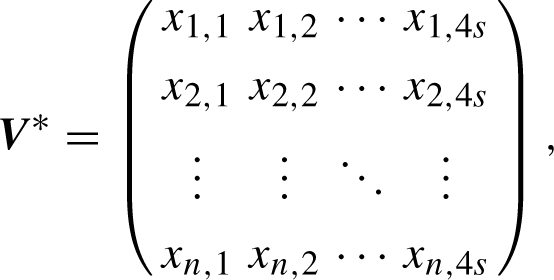
Let the set of Boolean variables V = {x1, x2, . . . , x
n
}, and copy each variable 4s times to obtain the following variable matrix
Let the CNF formula F = (C1 ∧ C2 . . . ∧ C
m
), and copy each clause k times to obtain the following position matrix
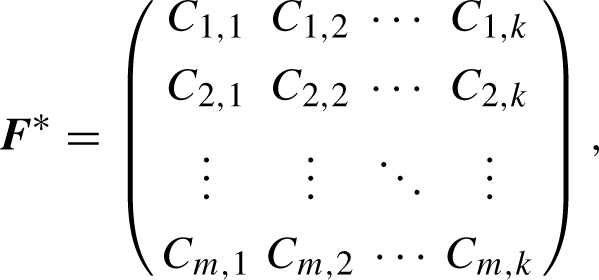
Note: For a regular (3s + s, k)-CNF formula, there is 4sn = mk.
Generate a random regular exact (3s + s, k)-SAT instance by following the steps below: Generate an unsigned formula: On the set S = {1, 2, ⋯ , mk}, the sample space is formed by all possible permutations, and there are (mk)! different permutations in the sample space. A permutation π is chosen at random to generate an unsigned formula. Realization of the symbol matrix Generate random regular exact (3s + s, k)-SAT instance: Randomly take a permutation π and symbol matrix
For the study of satisfiability phase transitions of random regular SAT problems, the first moment method [17, 19] and the second moment method [14, 15] are mainly used. However, the use of the small subgraph conditioning method [10, 16] to study this problem provides new possibilities and accuracy. We write f (n) ∼ g (n) if
First moment method
Let Z(n) be a random variable, and Z(n)≥0, then for any real number ξ > 0,we have

The theoretical basis of the first moment method is Markov inequality. By proving that
Let Z(n) be a random variable, E[Z(n)] and D[Z(n)] denote the expectation and variance of the random variable Z(n), respectively, and we have

The theoretical basis of the second moment method is Chebyshev inequality. By proving that
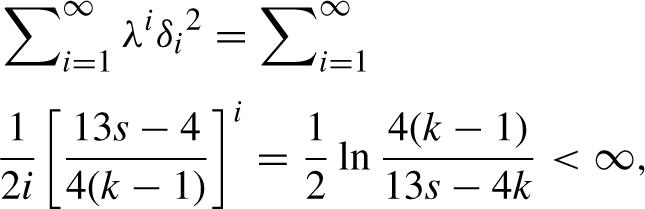
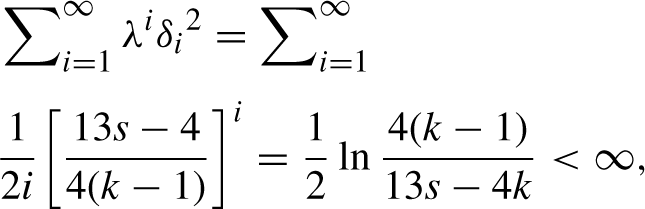
Let Z, X1, X2, ⋯ X n , ⋯ be random variables with non-negative integer values. Suppose E [Z] >0, and for ∀i ≥ 1, ∃ λ i > 0, δ i > -1 (λ i and δ i are constants), such that the following conditions are satisfied.
–For ∀j, X1, X2, ⋯ X j obey approximately independent Poisson distribution, and E [X i ] ∼ λ i .
–For ∀j, a non-negative integer series m1, m2, ⋯ , m
j
, there is


Then Pr [Z ≥ 1] =1 - o (1).
The principle of the small subgraph conditioning method is that by using the cycle counts to follow a Poisson distribution approximately, multiple cycles follow an approximately independent Poisson distribution. Then, the weighted probability space is constructed by solution counting, and the Poisson distribution is analyzed in the weighted space, so the random regular SAT instance is satisfiable with high probability.

For any k≥3 and any integer s,

Theorem 1 shows that when k≥3, for an F3s+s,k instance, if s > s*, then F3s+s,k is unsatisfiable with high probability; if s < s*, then F3s+s,k is satisfiable with high probability. First, by using the first moment method and the second moment method, it is given that F3s+s,k is not satisfiable with high probability when s > s* and is satisfiable with high probability when s < s*, respectively. Then, the latter is proved to be satisfiable with high probability by the small subgraph conditioning method. Proof of the following two lemmas to prove Theorem 1.
Lemma 1 Proof
Let F3s+s,k = {C1, C2, ⋯ , C
m
} be a random regular (3s + s, k)-SAT instance. Let there be a truth assignment δ = {δ1, δ2, ⋯ , δ
n
} on the set V = {x1, x2, . . . , x
n
} of Boolean variables, where δ
i
∈ {0, 1}. Let Z be the number of satisfiable assignments T (the number of solutions to a random F3s+s,k instance), where |T| = n. The satisfiable assignments T = {l1, l2, ⋯ , l
n
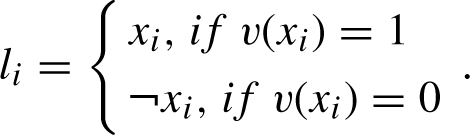
} are the set of literals corresponding to V that take on true values, with
The random regular exact (3s + s, k)-SAT problem is whether there exists an assignment T such that exactly one literal in each clause C
j
is true, i.e., |T ∩ C
j
|=1. Construct an realization
The k-1 empty positions in each row after the permutation are filled by eliminating the elements in T from
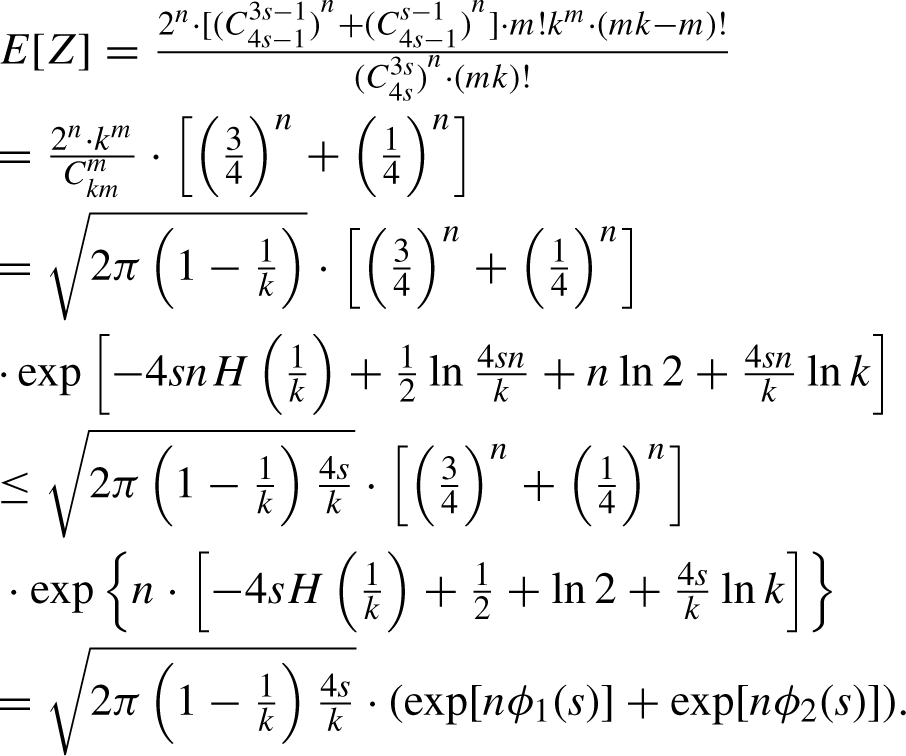
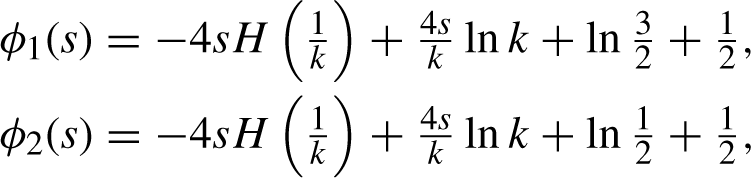

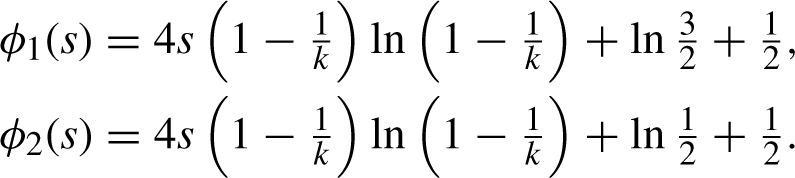
When k ≥ 3 can be verified, the function φ1 (s) and function φ2 (s) are monotonically decreasing functions with regard to s respectively (see Fig. 1) and there are unique zeros s1 and s2, and s1 > s2. Therefore, we have Image of function φ(s) (k=4).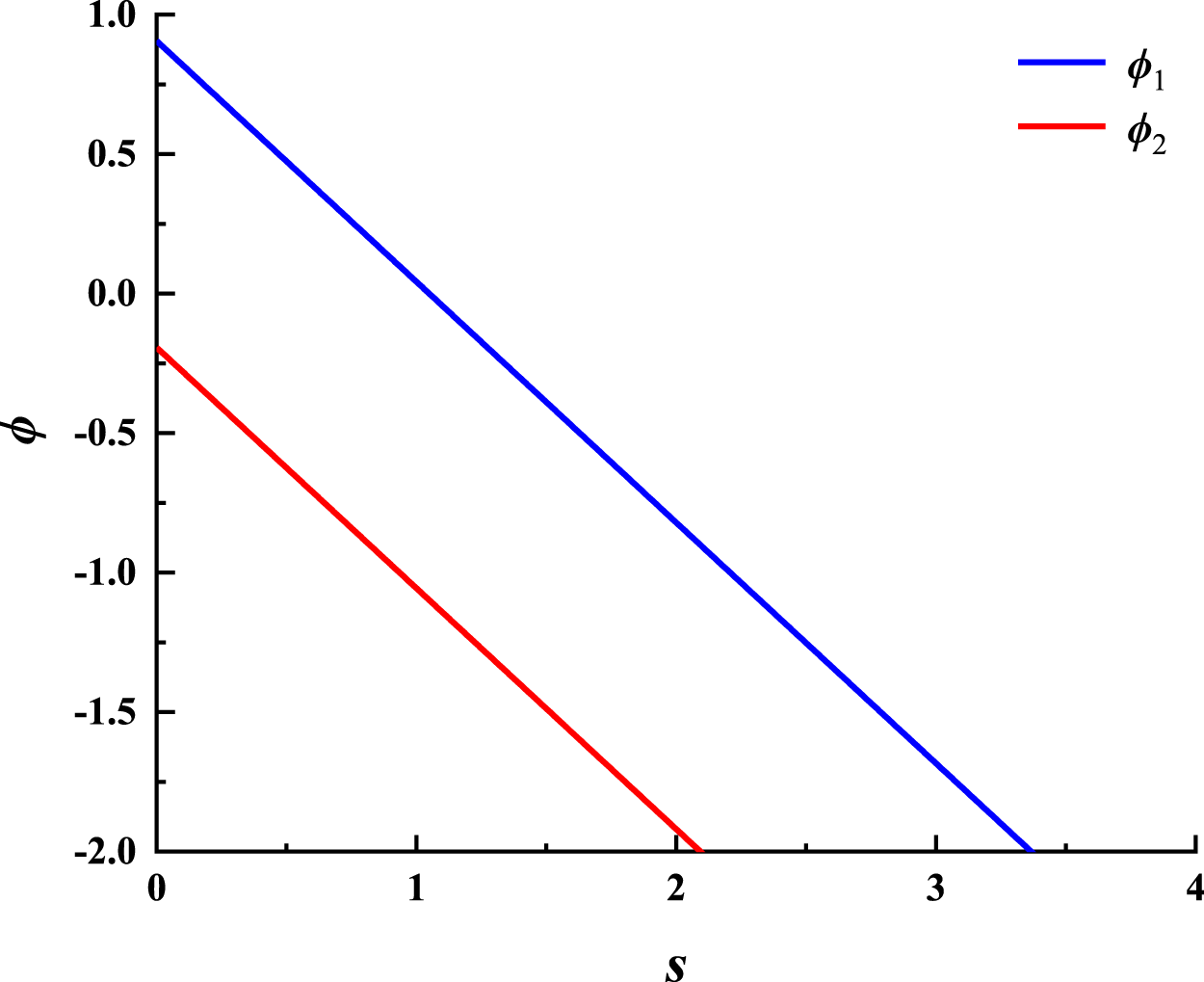

Proof and analysis by second moment method
The second moment method focuses on proving E [Z2]/E [Z] 2 ∼ c, where c is a constant. Let F3s+s,k = {C1, C2, ⋯ , C
m
} be a random regular (3s + s, k)-SAT instance. Assuming that the formula for F3s+s,k is satisfiable, there are a satisfiable assignments {T1, T2, ⋯ , T
a
}. An assignment pair (T
i
, T
j
) is said to satisfies the F3s+s,k formula if both assignments T
i
and T
j
satisfy the F3s+s,k formula. Take variable Z to denote the number of assignments that satisfy the F3s+s,k formula and variable Y to denote the number of assignment pairs that satisfy F3s+s,k formula, we have Z = a ⇔ Y = a2. Consider the set of assignment pairs {(T
i
, T
j
) :1 ≤ i, j ≤ a} consisting of a2 assignment pairs and divide it into n + 1 classes. When |T
i
- T
j
| = |Ti′ - Tj′| = a, the assignment pair (T
i
, T
j
) and the assignment pair (Ti′, Tj′) are said to be in the same class, denoted as P
a
= {(T
i
, T
j
) : |T
i
- T
j
| = a}. Obviously, P0, P1, ⋯ , P
n
forms a partition of the set of assigned pairs with |P0| + |P1| + ⋯ + |P
n
| = a2. In order to express the summation in integral form, a normalization parameter ω, (0 ≤ ω ≤ 1) is introduced. Noting that Qω = P
ωn
= {(T
i
, T
j
) : |T
i
- T
j
| = ωn}, the following conditions are satisfied in the Qω block: Image of function φ3 (ω).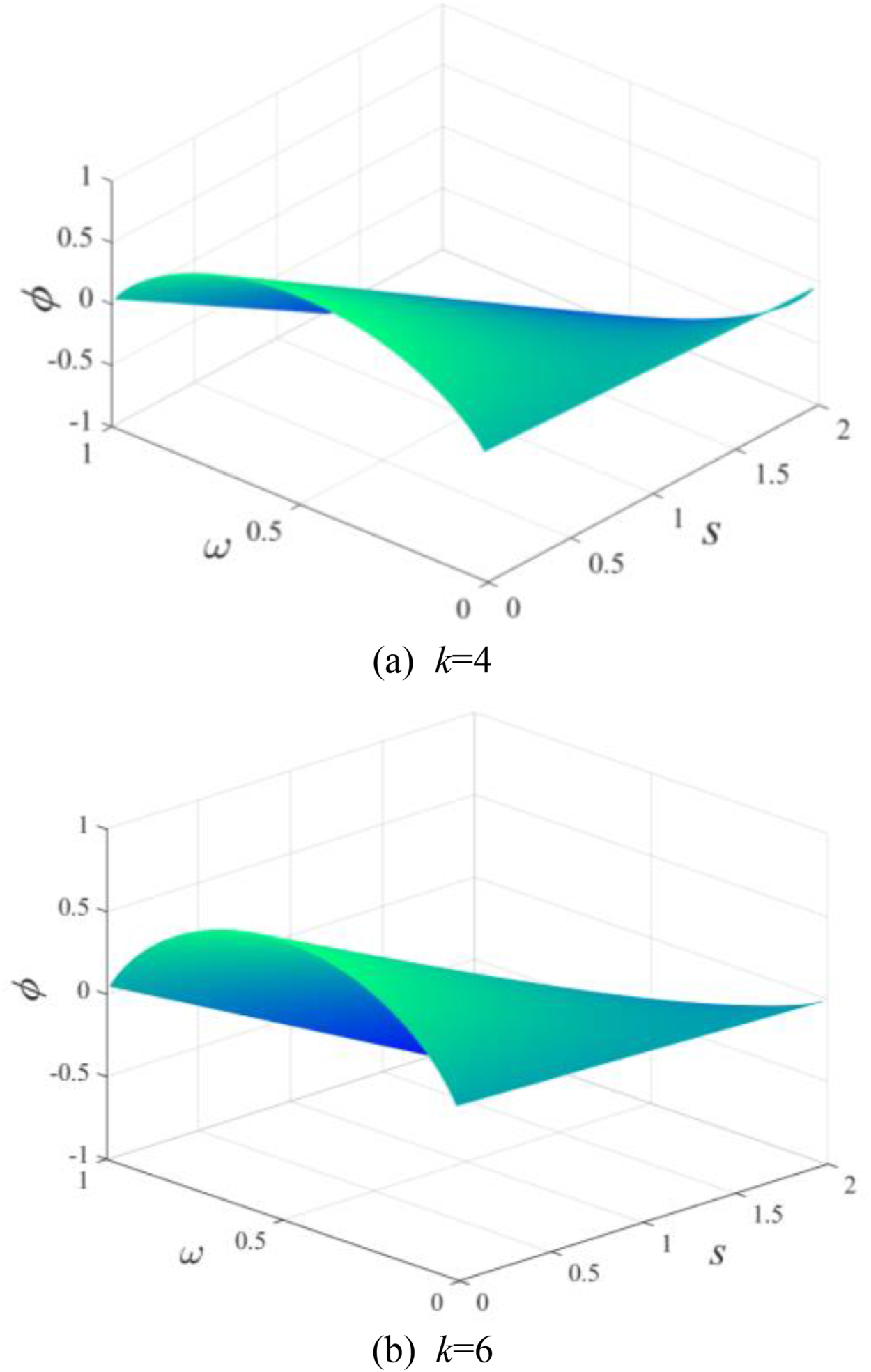


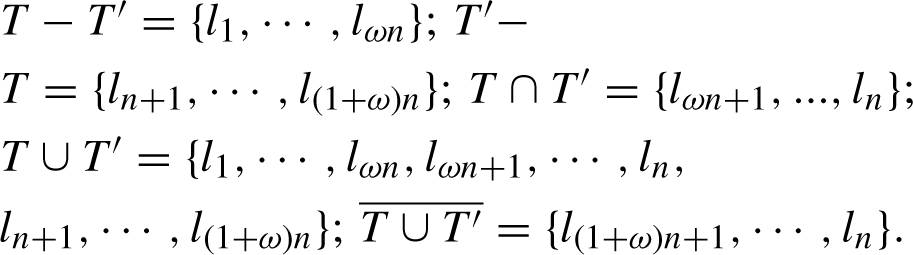
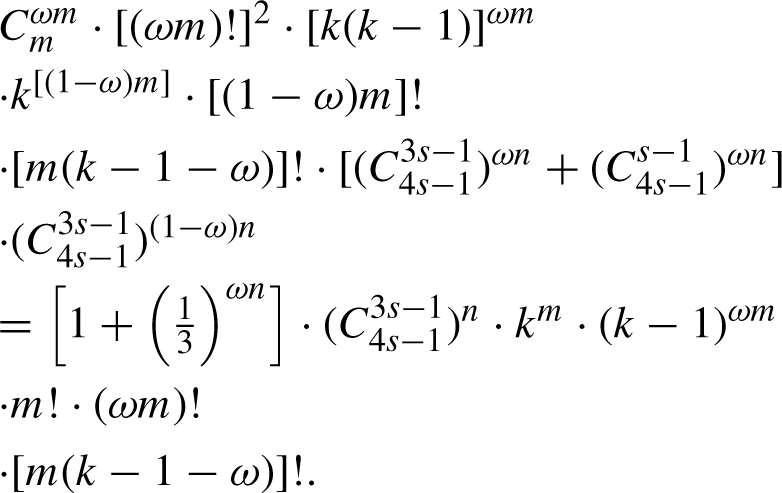

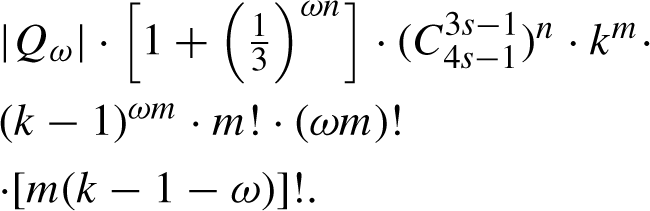
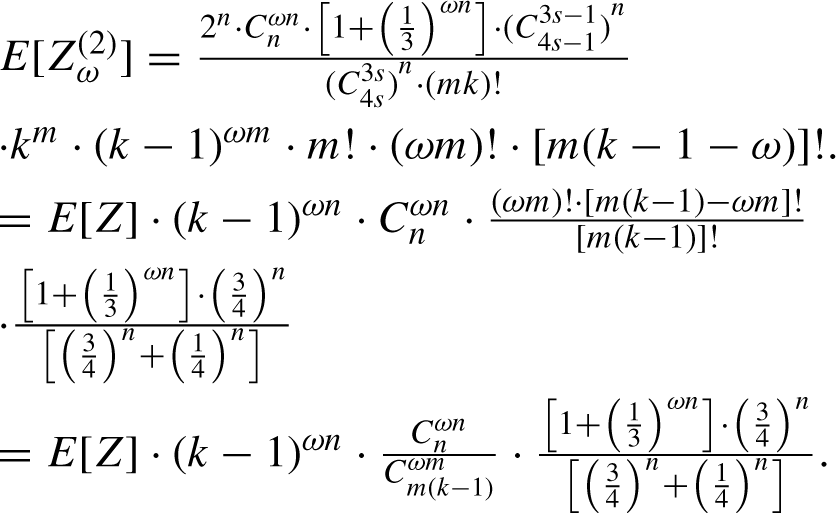
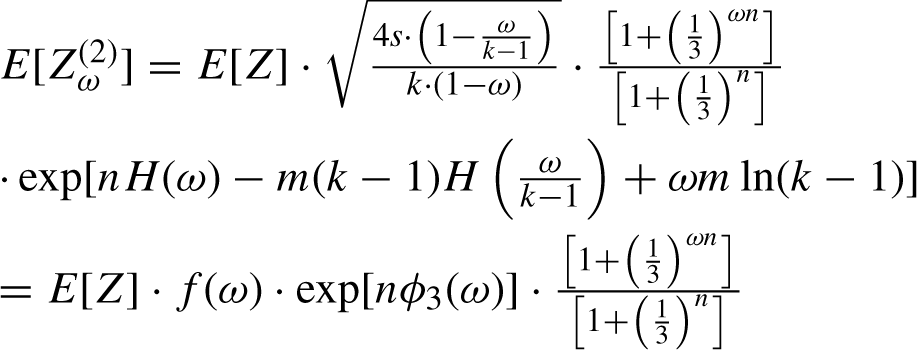
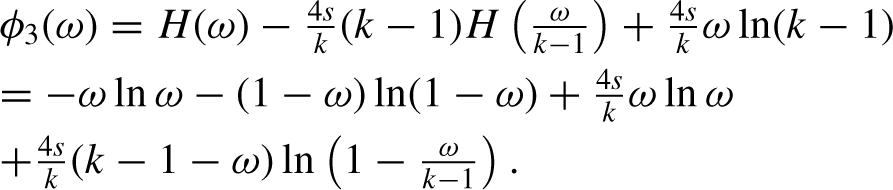
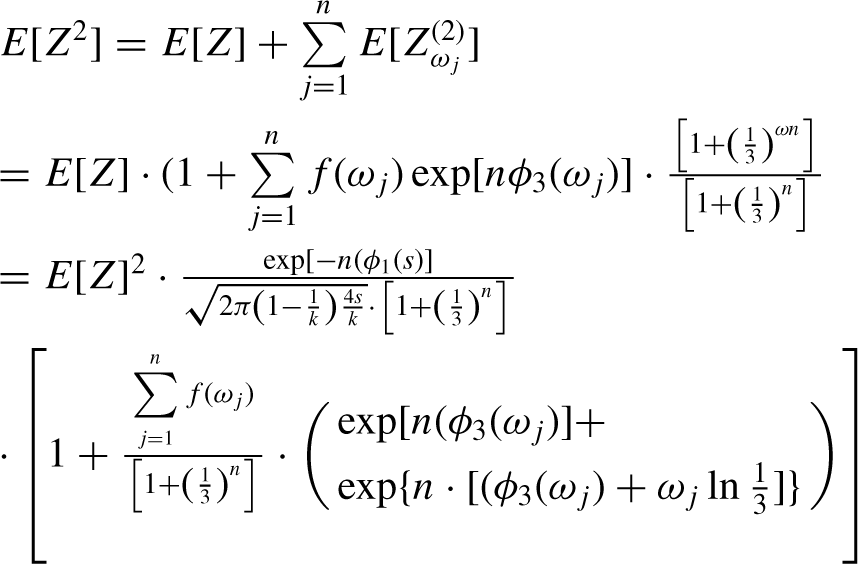
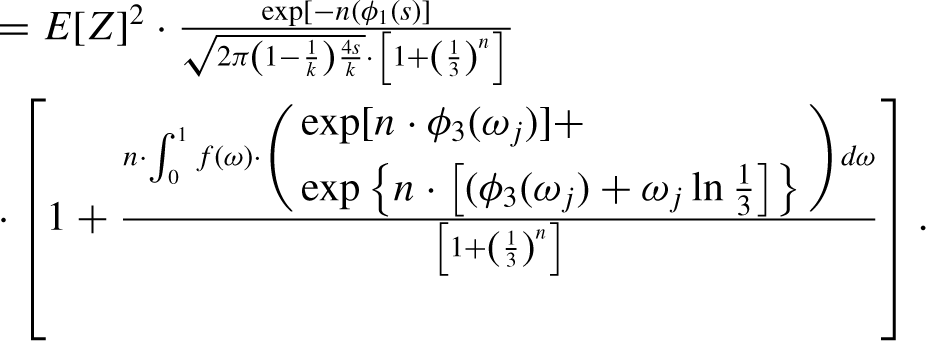

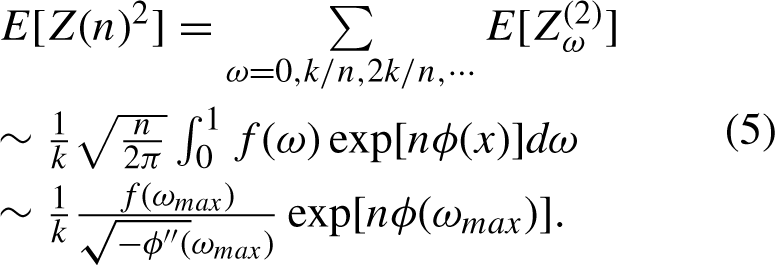
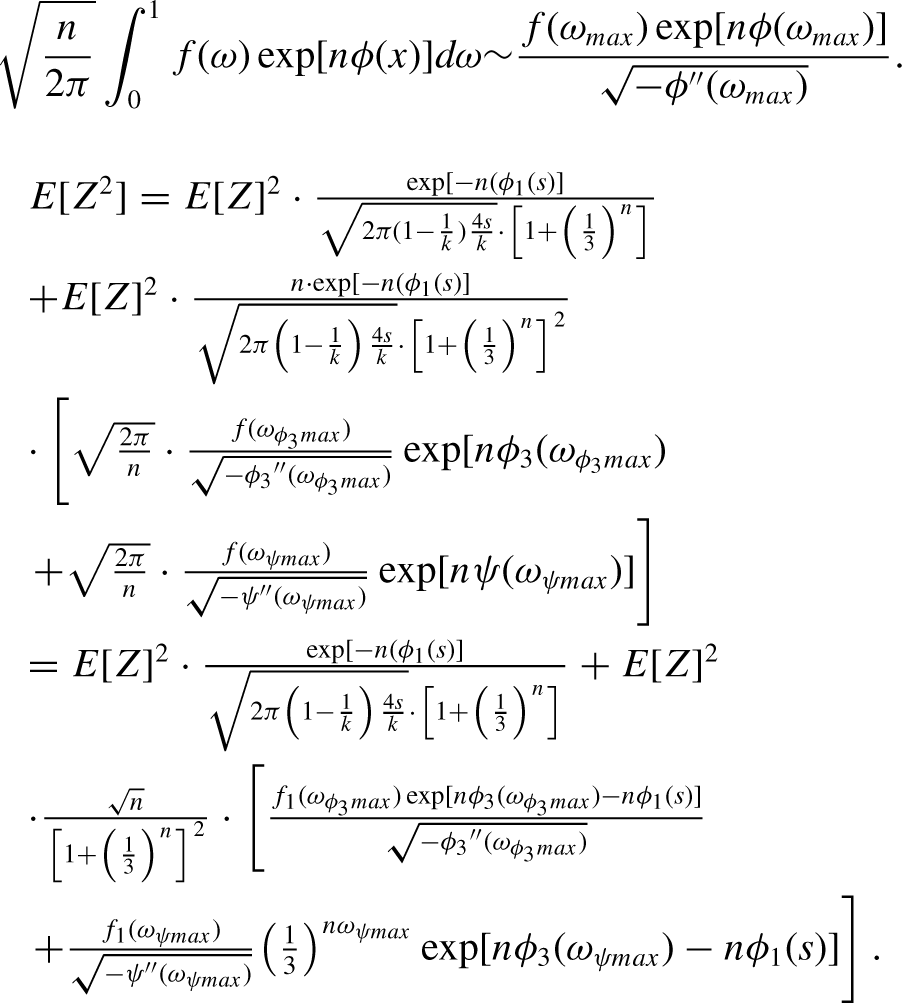
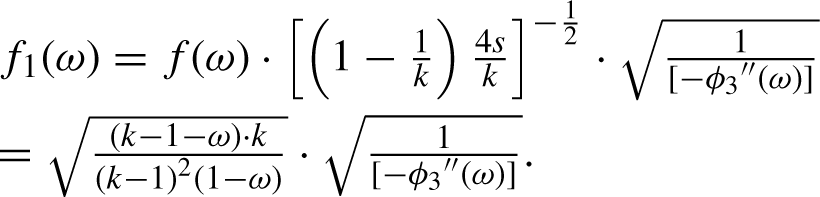

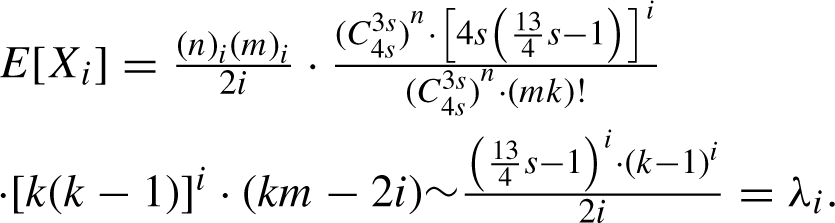
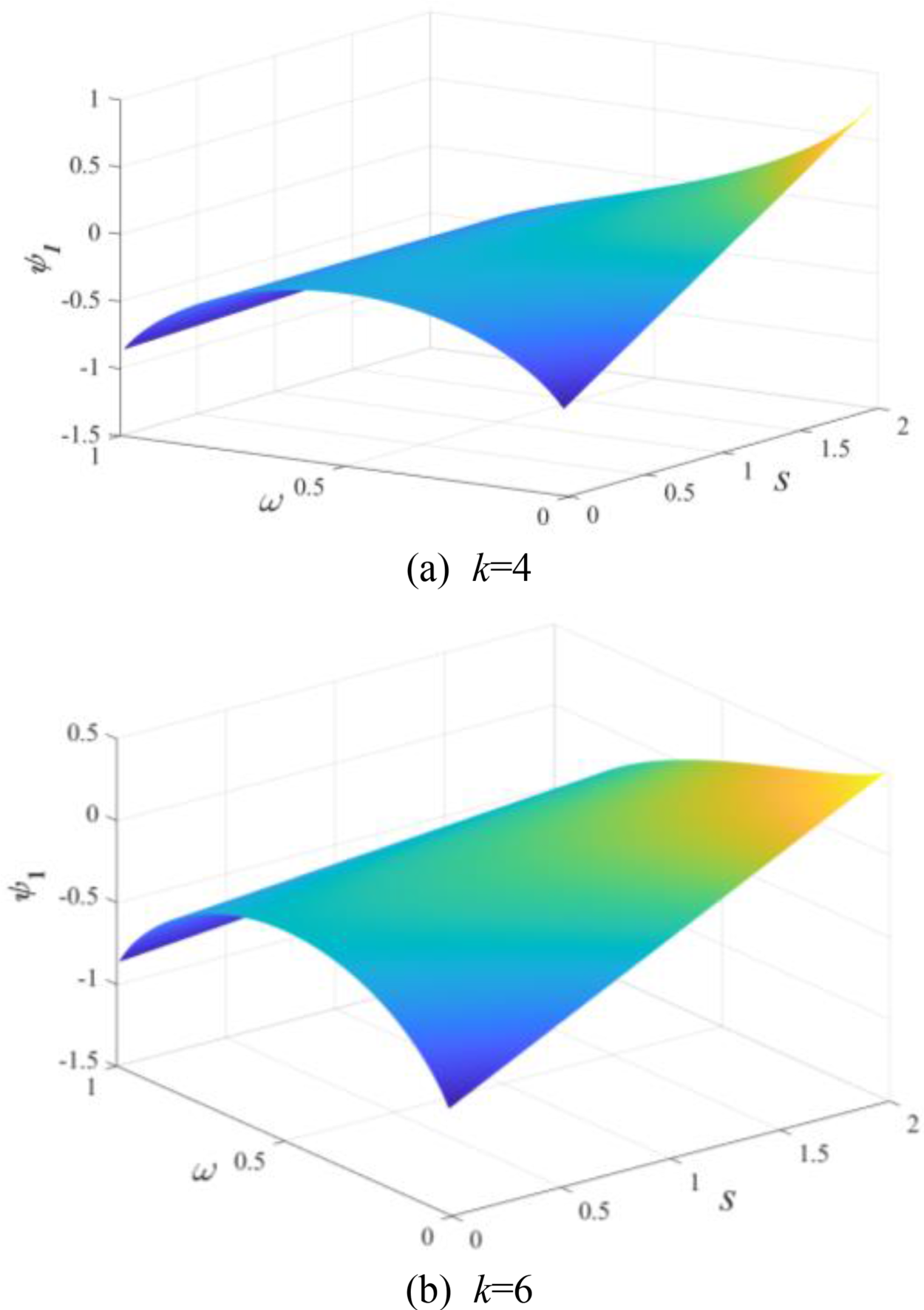
Image of function ψ1 (s).
When there is strong correlation between events that are satisfied by a pair of assignments, this results in variance D[Z] that is constant multiple of the expectation E2[Z]. However, in special case, the variance is shown to be much smaller by small subgraph conditioning method, counting the number of small cycles of fixed length in the formula. Therefore, when s < s*, using the small subgraph conditioning method to proof that the random regular exact (3s + s, k)-SAT instance can be satisfied with high probability is more precise than proof by the second moment method. Let X
i
denote the number of perfect matches corresponding to factor graphs with cycle length 2i, and the small subgraph conditioning method mainly calculates the correlation between X
i
and Z and their high moment. Denote by (x)
r
the descending factor, and (x)
r
= x (x - 1) ⋯ (x - r + 1).According to Wormald [10], the random variable X
i
obeys the Poisson distribution with parameter λ
i
approximately independently. By the nature of the Poisson distribution, E [X
i
] = λ
i
, and the approximate expected value λ
i
is calculated by estimating E [X
i
]. Under the condition that the nodes are not repeated, an ordered sequence of nodes is formed by alternately selecting from the set of variable nodes and the set of clause nodes in the factor graph, respectively. Each sequence of nodes forms a cycle, and there are (n)
i
(m)
i
such sequences of nodes. Since such selection is related to the starting point and direction, there are 2i kinds of node sequences corresponding to the same cycle, so that the total number of node sequences of different cycles formed by alternating variables and clauses is (n)
i
(m)
i
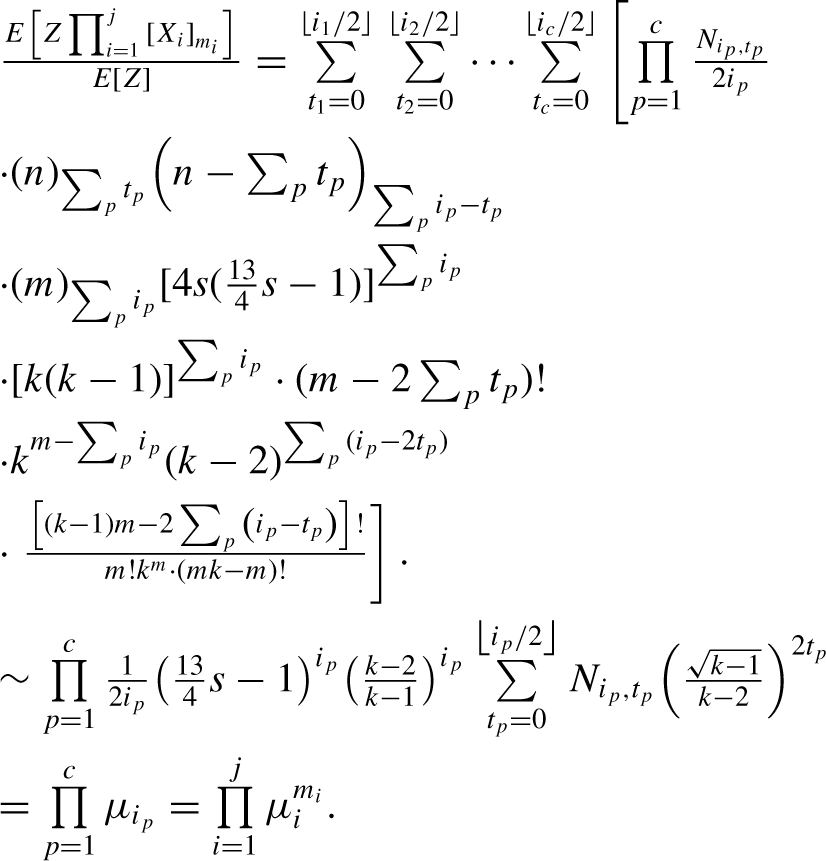
/2i. Each variable is selected twice, so there are 3s (3s - 1)+3s · s+s (s - 1) choices from each row of the matrix
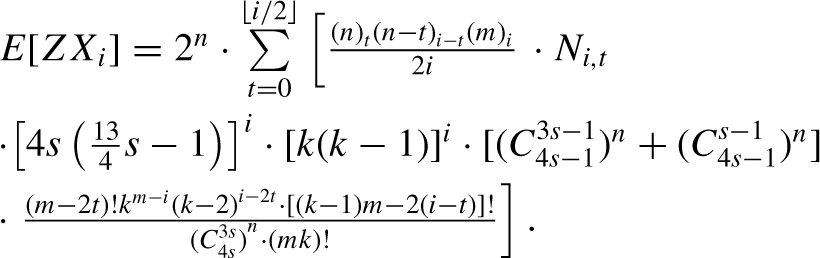
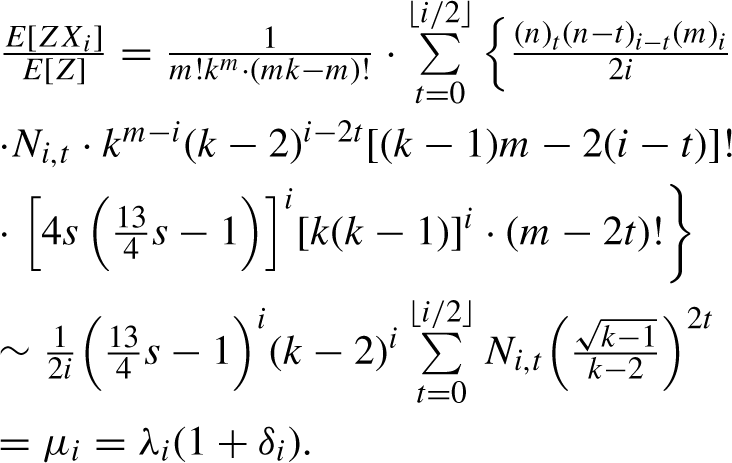
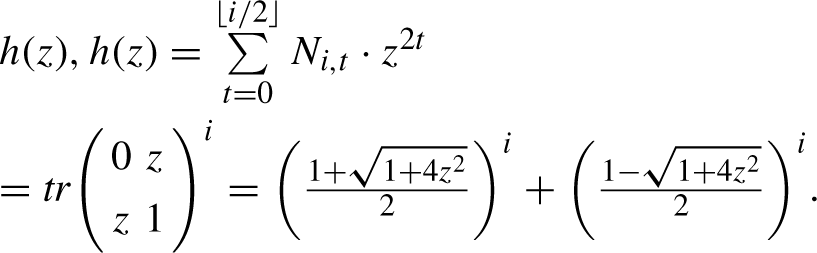
Numerical experiments and analysis
In order to verify the theoretical results, take n = 10, two data sets with k = 4 and k = 6 are selected for the experiments. According to Theorem 1, when k = 4, s*=1.048, when k = 6, s*=1.490. The experimental environment is configured as computer with Intel(R) Core (TM) i5-8265U CPU and 8GB RAM. The phase transition of the random regular exact (3s + s, k)-SAT problem is shown in Fig. 4, and each data point consists of the statistics of 100 random F3s+s,k formulas generated by the random regular exact (3s + s, k)-SAT instance model. Among them, the horizontal coordinate is the phase transition control parameter s and the vertical coordinate is the statistical probability Pr that the random F3s+s,k formula can be satisfied.
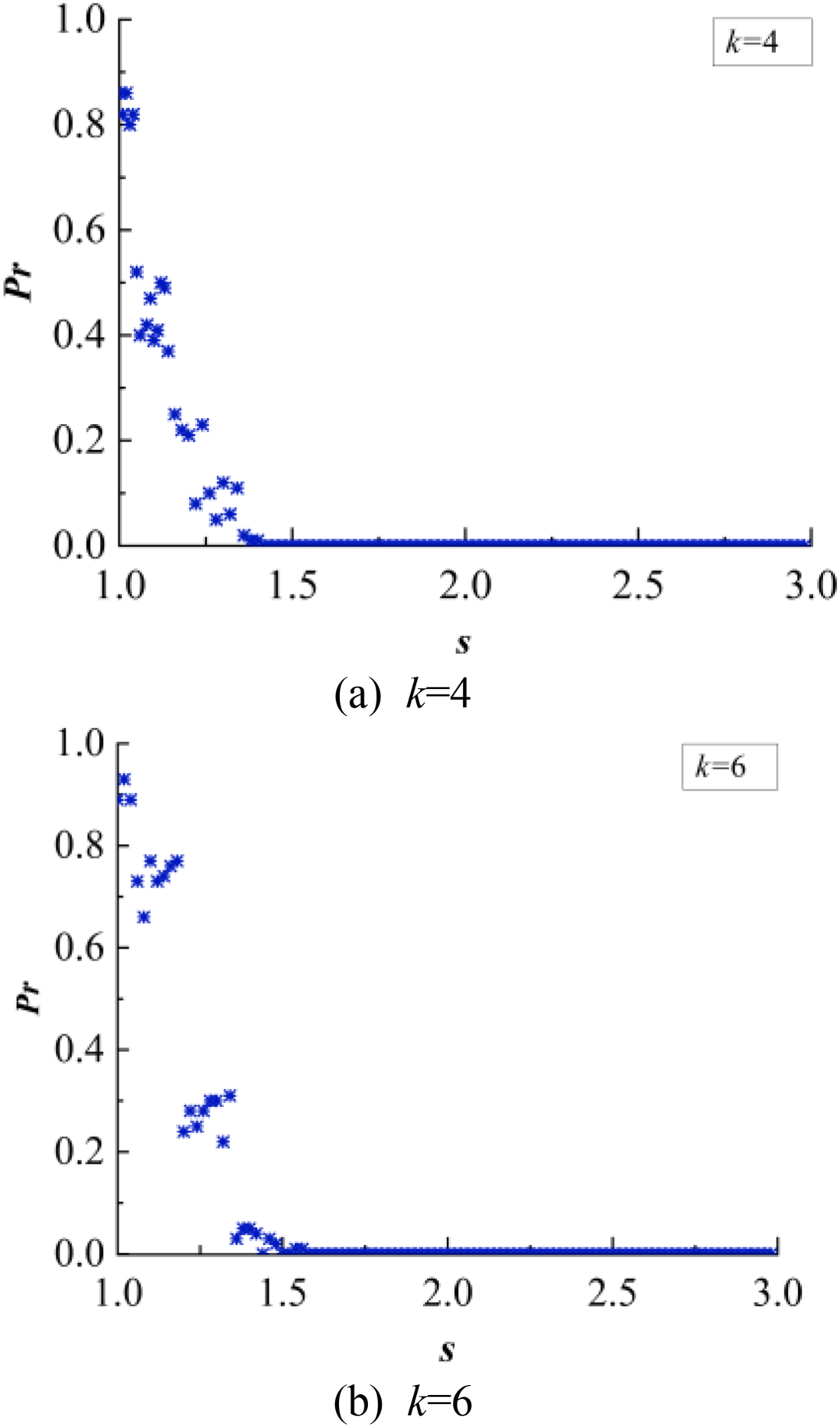
Phase transition of the random regular exact (3s + s, k)-SAT problem (k = 4 or k = 6, n = 10).
The results of the experiment are shown in Fig. 4, where the value of k is 4 in Fig. 4(a) and 6 in Fig. 4(b). Observing the phase transition phenomenon in Fig. 4, we can see from Fig. 4(a) that the phase transition phenomenon occurs about 1.05< s<1.3, and Fig. 4(b) that the phase transition phenomenon occurs about 1.2< s<1.5, the experimental results are almost in accordance with the theoretical proofs. Due to the approximation of the assigned values of m and s in the experiment and the small problem scale, the obtained experimental results have some errors with the theoretical results. However, as the problem scale increases, the experimental errors caused by this approximation will be reduced, and the experimental results will gradually become more accurate. At the same time, since the experiment uses the exhaustive assignment method (2 n assignments in total) to determine whether the random F3s+s,k formula is exact and satisfiable, the solution time increases exponentially as the problem scale becomes larger.
In this paper, we analyze the phase transition phenomenon of the random regular exact (3s + s, k)-SAT problem, and give the phase transition point s* of the random regular exact (3s + s, k)-SAT problem in which each variable occurs 4s times, of which the positive occurrences are 3s times and the negative occurrences are s times. The upper and lower bounds of the satisfiability phase transition threshold are proved by using the first moment method, the second moment method, and the small subgraph conditioning method, in which the small subgraph conditioning method provides a new feasibility of proving the lower bound of the phase transition threshold. Subsequently, numerical experiments are carried out to verify the experimental results, and the results show that the experimental results are consistent with the theoretical ones. Since the phase transition threshold for the regular (d,k)-SAT problem is not available at present, and the random regular exact (3s + s, k)-SAT problem is a special case of this problem, it provides reference value for the study of satisfiable phase transitions of the regular (d,k)-SAT problem. Future work is to further use these phase transition analysis methods to give the phase transition for the random regular exact (s + d,k)-SAT problem with positive variable occurrences s times and negative variable occurrences d times, as well as other similarly intractable problems.
Footnotes
Acknowledgments
This work was supported by the National Natural Science Foundation of China (62062001) and the Ningxia Youth Top Talent Project (2021).