



Abstract

Serge Pujol passed away on May 1st, 2018, at the age of 74. He was the father of the Orange cryostat and an uncontested expert in cryogenics at the Institut Laue-Langevin (ILL). For many colleagues, friends and users worldwide, Serge was a legend. He started working at the age of 14 with a diploma of locksmith. He also learnt the skills of metalworker because he wanted to know how to draw objects in three-dimensional space using projective geometry. However, he did not pass the final exam because he wanted to assist to the birth of his first daughter.
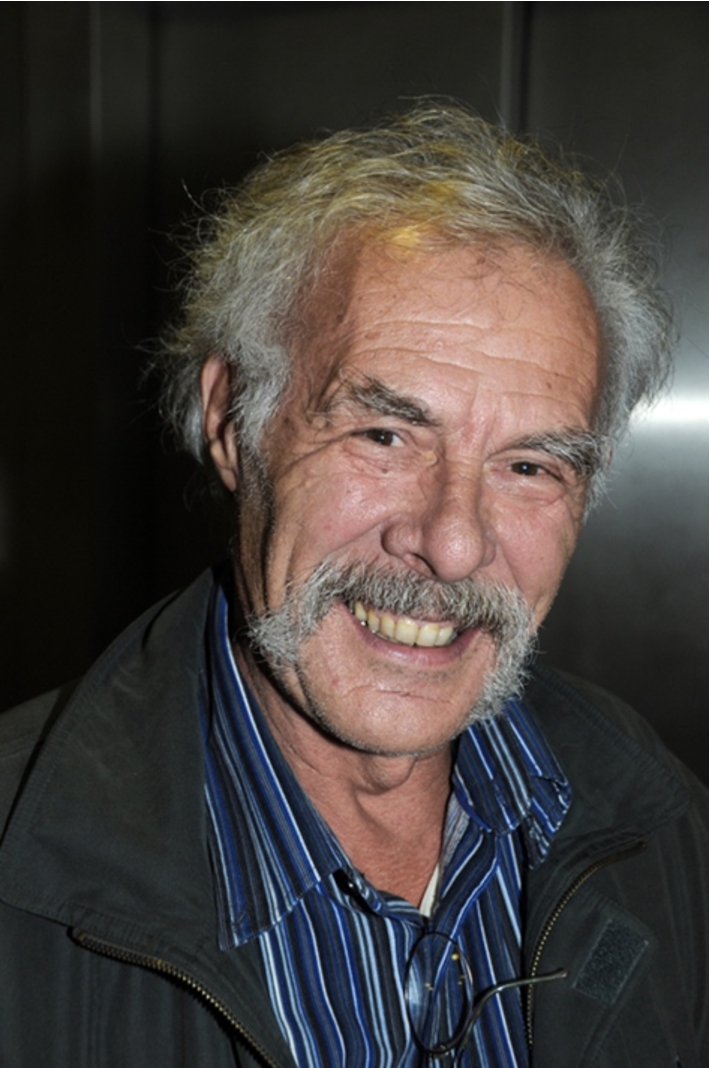
Serge Pujol in 2008 (© ILL – Serge Claisse).
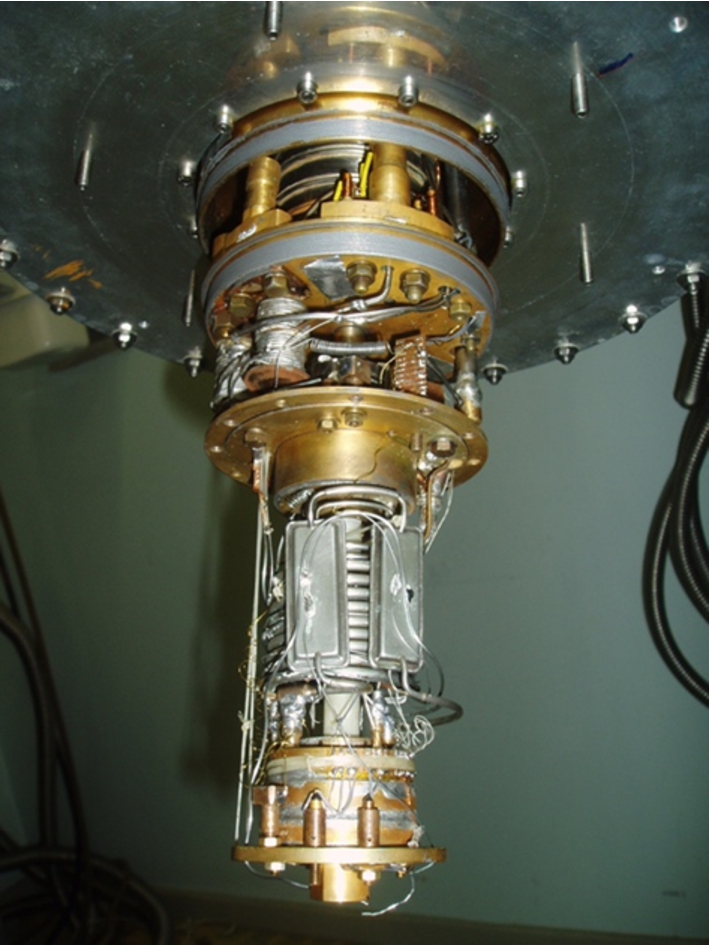
15 mK dilution fridge cryostat built by Serge in 1985 (© ILL).

Serge operating the 100 mK 4-circle dilution fridge cryostat insensitive to gravity in 1991 (© ILL).
After several fixed-term jobs, he began working for Air Liquide in a hydrogen plant. He used to laugh of this time where he used to set fire to evaporation outlets of the hydrogen tanks every morning. The safety engineers wanted to forbid him and his chief to smoke in the plant but they always refused claiming that the safest way to protect the tanks and themselves was to burn hydrogen at the outlets. They did it for several years and a few months after their leave an explosion destroyed most of the production line. As Serge used to say: instead of trusting safety engineers, try to understand things!
In the late 60s, he was working for Air Liquide in Sassenage, near Grenoble, when he met the first ILL cryogenics technician Gabriel Prati. Impressed by Serge’s manual skills, Gabriel pushed him to come and participate in the construction of the ILL. Serge accepted and almost lost an eye when he was soldering pipes of the cooling circuit of the reactor, lying on his back. A few years later, in the early 70s, he then started working in the ILL cryogenics team lead by Dominique Brochier [1].
At the time, the ILL was starting the user programme and physicists needed cryostats for cooling their samples. In a few years, Dominique acquired 35 cryostats from different companies but had to face many complaints from users: the helium and nitrogen did not last long enough, and the sample temperature could not be reliably stabilised.
Therefore, in 1975, Serge and Dominique decided to design and build a new type of cryostat which will later be called the Orange Cryostat. This name comes from the colour of the only paint that was available at the lab, and was used to protect the body of this first cryostat. Dominique did the calculations to determine the volumes and Serge built entirely the cryostat. They had invented the Variable Temperature Insert (VTI), thermally decoupled from the liquid cryogens and driven with a heat exchanger and a cold-valve.
They were so successful that they started building Orange cryostats in series with the help of the British company, AS Scientific Products Ltd, which then allowed any facility to acquire them. In 1983, they invented the Cryofurnace for answering the demand of chemists who wanted to work below and above room temperature. Physicists then required temperatures lower than 1.5 K and Serge built 3He–4He dilution inserts with Charlie Neumaier and Jean-Louis Ragazzoni, and then a dilution cryostat with Alain Benoît of the CNRS (Fig. 2). These systems were much more practical because it was not necessary to remove cryogens for changing samples.

Serge Pujol surrounded by the ILL Sample Environment team in April 2017 (active and retired). From left to right, top to bottom: F. Marchal, Y. Memphis, P. Martin, J.-L. Ragazzoni, X. Tonon, J.-P. Gonzales, S. Pujol, S. Turc, C. Payre, P. Andant, E. Bourgeat-Lami, E. Delangre, A. Dugit-Gros, N. Belkhier, S. Baudoin, O. Losserand-Madoux and E. Lelièvre-Berna (© ILL – Serge Claisse).
In order to access the full reciprocal space, Serge then built a 4-circle helium-flow cryostat in 1987 followed by a dilution cryostat insensitive to gravity [2] with Alain Benoît in 1991 (Fig. 3). Today, this world-unique cryostat is still very demanded on the single-crystal diffractometer D10. In parallel, he also designed and built the Cryoflipper and the first Cryopad [5], helping Francis Tasset to develop the Spherical Neutron Polarimetry technique.
The following years, during the long shutdown of the ILL, Serge worked at the CNRS and contributed to the successful development of dilution refrigerators for space applications. In 1994, just before the restart of the high flux reactor, he came back to the ILL as Leader of the Sample Environment team. Among the many projects he participated in, he developed compact dry cryostats, a superconducting cavity called Cryopol for hosting 3He spin filter cells in large stray fields [3], two new generations of Cryopad [4,6] and, to improve their performance, he re-built the VTIs of a few cryomagnets and the superconducting arms of the triple-axis spin-echo spectrometer IN20.
Serge was passionate and an uncontested expert in cryogenics. He also had an unsurpassed sense of service. Every evening, he used to visit the instruments and check whether cryostats, magnets and dilution refrigerators were operating smoothly. Many times, he stopped and spent hours helping users late in the evening while his wife was waiting for him.
Always humble, Serge used to share his know-how with his colleagues and friends Jean-Paul Gonzales and Maurice de Palma and all others he was meeting on the instruments. Before his retirement in 2006, he took the time to teach a new generation (Fig. 4) who now supports users with great success. He then used to visit us (Fig. 1) to discuss about projects, staff and future plans. Several times, he told us that he was glad, sometimes proud, to see the evolution of the team. Serge will be greatly missed by his colleagues and friends.
Eddy Lelièvre-Berna
Editor-in-Chief