



Abstract
The replacement of the H16-IN5 guide has been decided in the frame of the ILL Endurance program. This guide is made of heteroclite sections and the upgrade aims at improving the performances with a modern homogeneous ballistic guide. Several constraints applied to the project: (i) the instrument will remain at the same location, (ii) considering (i), in terms of gain relative to cost, it was judged more reasonable to keep the same chopper system, (iii) many technical elements under control of the nuclear safety authorities cannot be changed within the lifetime of the project. We present the results of the McStas optimization of the replacing guide performed under these constraints.
Keywords
Introduction
The IN5 instrument has been the subject of several improvements over the years [2–4]. However, the neutron guide, one of its major components, had not been completely renewed during any of these upgrades because the different projects kept focused downstream the instrument. A refurbishment of the last straight 15 m guide was, however, undertaken in 2000 in the frame of the UFI project (Upgrade of Five Instruments) together with a new chopper system for monochromatizing the beam [2,4]. Since then, only the beginning of the guide near the reactor core and in the light water pool have been replaced during the decennial refurbishment in 2006. The guide cross-sections was kept identical in order to feed the installed curved guide. The weakness of this beamline is that the middle of the guide between its two extremities, i.e., after the light water pool and before the tapered instrument guide, has remained unchanged since the early days of the ILL.
For the instrument guide refurbishment, it had been decided to use the full upstream guide cross-section: 30 × 200 mm2 but to focus on smaller sample sizes with a beam of the order of 15 × 50 mm2 at the sample position. With the best technology available at that time, the tapered guide was made of super-mirrors sections with coatings up to
Several constraints come from the heritage of the design of the early days of the ILL, e.g., the narrow and tall H16 guide that was shared between several instruments in the past. The modifications of some essential components close to the reactor and at the reactor building crossing face many hurdles for getting authorisations from the French nuclear safety authorities. This kind of modifications, such as the enlargement of the in-pile section, are not worth doing with regard to the tight schedule and to the expected moderate gain in flux despite a substantial cost increase and tedious paperworks. Indeed, the coming planned long reactor shutdown scheduled in 2020 does not provide enough time for engaging into such large modifications, and the next one, beyond 2023 is too far whereas some reasonable gains are still possible with a simpler upgrade of the guide.
Guide optimization
Several constraints have been taken into account in the simulations. First, there will be no change of the different guide cross-sections near essential components. Second, the guide beamline will be kept at the same position because the spectrometer itself [1] must remain not affected by the guide change. This imposes to keep the same angle between the reactor guide exit axis and the choppers-sample axis which restricts, in particular, the possibilities in changing the guide curvature to enlarge the ballistic guide while keeping away from the reactor line-of-sight. The choice of keeping the chopper system, for which an upgrade of the control electronics has recently been made, imposes further limitations on the guide width and height at the chopper disks positions.
In the continuation of adapting the cross-section of the beam so as to match the evolution of the sample size demand, it has been decided that the beam focalisation at sample position will deliver a beam height of less than 30 mm. As for the guide width, already matching the last chopper slot width, it will be left unchanged.
The final chosen geometry is made of a curved guide with constant cross-section up to the reactor exit followed by an elliptic focusing part over the 15 m straight section before the sample position. It has been found that there is little gain in working with
Within the constraints, it results that the majority of the flux gain at the sample position comes from the improved coating of recent supermirror guides (see, e.g., Ref. [5]) whatever the geometry. Further gains come from the ballistic geometry. However, these gains of the order of a few tens percent appear marginals compared to the coating gains. More complex geometries come also with a higher cost because of a larger complexity in design, fabrication, installation and alignment at the final position. Such a ballistic guide has however been retained for the straight instrument focusing section. An advantage of this geometry in comparison to a tapered section guide is to homogenise better the beam in phase space. Another benefice is that it reduces the lengths of guide sections with high m-coating.
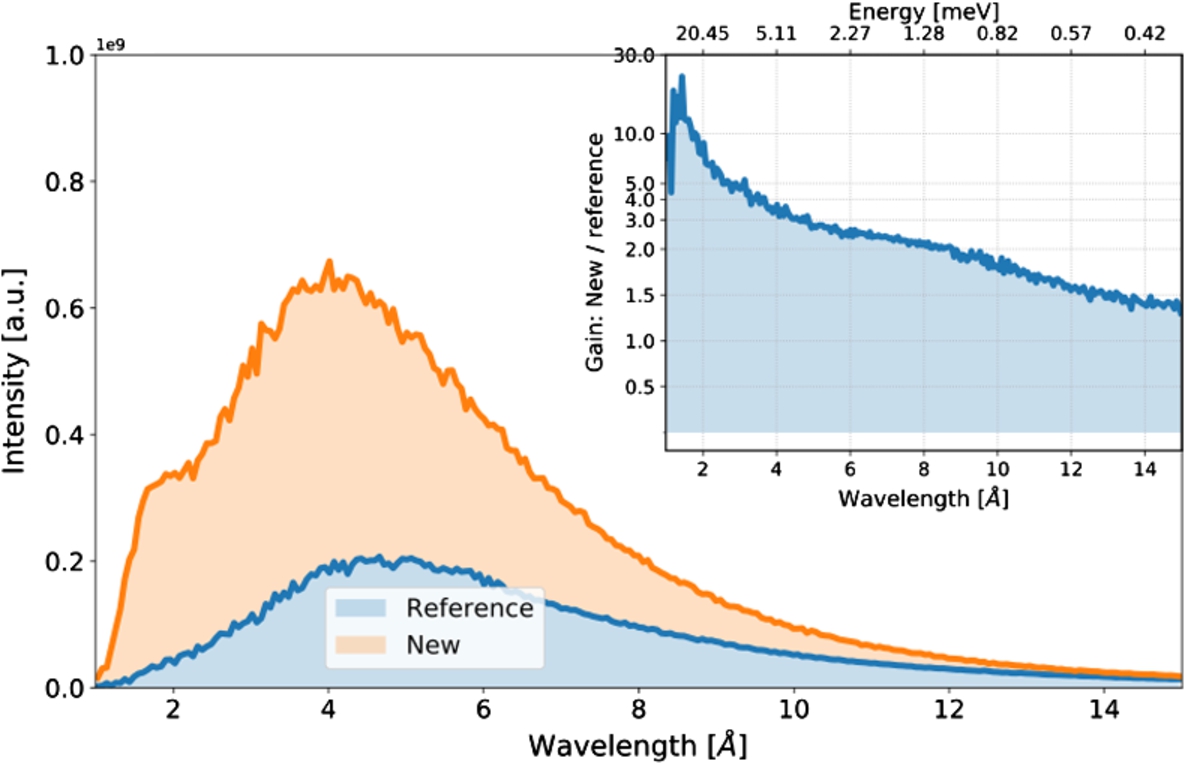
Expected gains vs. the reference guide with the wavelength or energy for a sample of 10 × 10 mm2.
Figure 1 gives the expected gain on a simulated sample size of 10 × 10 mm2. The average gain is around 3 varying with the wavelength: above 2 below λ = 8 Å, above 3 below 4 Å and even higher at shorter wavelengths. This gain seems limited but it is not a surprise because the comparison is made with an already optimally focusing (tapered) guide and not versus a simple straight guide. The extension toward shorter wavelengths was a first expected improvement while changing the guide (at constant radius of curvature) for higher supermirror coatings. Whereas this increase of accessible incident energies is appreciable to overlap with thermal instruments, it has to be mentioned that the IN5 chopper spectrometer is optimal for cold neutrons when dealing with the energy resolution. It is not meant to be a high resolution “warm” neutron spectrometer. The gain in flux is also to the detriment of the beam divergence. While neutrons of shorter wavelengths are now transported, neutrons from already transported wavelengths see their gain coming from more divergent neutrons. In the final geometry, a compromise had to been found to limit the divergence increase to less than twice the present values that were considered as rather good so far, in particular in the vertical direction where the focusing is maximised (Fig. 2).

Average gain ratio for different sample sizes (left) and average horizontal and vertical divergences (right) compared to the reference guide versus the guide end height (the width is kept constant).
The replacement H16 guide has been simulated within the set of various limits of the project. The gains found by the simulation over the existing guide are substantial and will boost the scientific output of IN5. While these gains are not orders of magnitudes, they should help the IN5 instrument in keeping the lead in spectroscopic studies with cold-neutron time-of-flight instruments in Europe, at least before the arrival of more powerful neutron sources and instruments such as planned at the ESS. The chosen final design appears to be the best compromise to achieve the H16 project before some more substantial and resources-consuming works from the next steps of the Endurance programme are taking place while reducing to the minimum the unavailability of the instrument.