



Abstract
BACKGROUND:
Although prior studies have explored the demographic and health factors that influence the relationship between disability and employment for working-age adults, relatively little is known about how living arrangements and gender affect this relationship.
OBJECTIVE:
This study addresses that gap in knowledge by examining how employment status varies by gender and living arrangements for working-age adults with disabilities.
METHODS:
Using 2014 American Community Survey (ACS) data, we used logistic regression analysis to estimate the likelihood of employment by gender and living arrangement in a nationally representative sample of 195,236 adults (18–64 years old) with disabilities.
RESULTS:
More than one-third of working-age adults with disabilities were employed (37.7% of men and 31.7% of women, p < 0.001). Both men and women who lived alone had higher odds of employment, compared with living with a spouse only, but the difference was more pronounced among women (OR for men: 1.5, p < 0.001; OR for women: 3.3, p < 0.001).
CONCLUSIONS:
The amount of support that working-age adults with disabilities need to successfully participate in employment may vary by both gender and living arrangement, and both factors should be taken into account in designing programs and targeting outreach efforts to support individuals with disabilities.
Introduction
In 2014, approximately one-third (34.4 percent) of working-age adults with disabilities (18–64 years old) reported that they were participating in the labor force (Kruse, 2015). However, the employment rate was more than double that for people of the same age without disabilities (75.4 percent). As an alternative to private health insurance through an employer, many working-age adults with disabilities rely on federal benefits, including the Social Security Disability Insurance (SSDI) program, which offers Medicare eligibility and coverage after a two-year waiting period (Houtenville & Brucker, 2014). Also, a majority of SSDI beneficiaries rely on other safety net programs, including food stamps, unemployment insurance, and worker’s compensation (Brucker & Houtenville, 2014).
Employment is an important activity that supports participation in the community, fosters independence, and provides a source of earned income. However, once a person receives federal disability benefits, he or she is less likely to return to work (Maestas, Mullen, & Strand, 2013). Using Social Security Administration (SSA) beneficiary records over a ten-year period, the authors of one study found that only 3.7 percent of SSDI beneficiaries exited the disability rolls in order to return to work (Liu & Stapleton, 2011). Furthermore, other studies have shown that beneficiaries’ concerns about losing Medicare coverage have a major influence on their decision not to seek employment (Delin, Hartman, & Sell, 2012). Yet, working-age adults with disabilities who receive SSDI benefits are more likely than their counterparts without disabilities to live in poverty and to have restricted access to health care (Livermore, Stapleton, & Claypool, 2010; Stapleton, O’Day, Livermore, & Imparto, 2006; Livermore & Bardos, 2014). Public assistance programs like SSDI also come with restrictions on income and asset accumulation, making it difficult for individuals to break out of a cycle of poverty once they are in it (Ball, Morris, Hartnette, & Blanck, 2006).
Despite these prior studies on the prevalence of adults with disabilities who rely on public assistance programs, less attention has focused on the extent to which living arrangements and socio-demographic factors may be associated with employment decisions among working-age adults with disabilities. Illuminating these factors would contribute useful insights on which working-age adults with disabilities are more likely to be employed, and help policymakers to better target program outreach efforts that support employment opportunities for adults with disabilities. Given the relatively low employment rate of working-age adults with disabilities (Kruse, 2015) and their greater reliance on public assistance, a better understanding of the personal characteristics and living arrangements of employed adults with disabilities is needed.
Over the past three decades, federal and state policymakers have developed a number of program interventions to promote employment and reduce applications for federal disability benefits for working-age adults with disabilities (Wittenberg et al., 2013). However, well-designed evaluation studies have shown mixed effects from such interventions, with some evidence from one randomized control trial study that early interventions can reduce SSDI applications and receipt of benefits for working-age adults with mental health conditions (Gimm et al., 2014; Gimm et al., 2011). These findings provide motivation for developing a better understanding of who is more likely to be employed, in order to target early intervention programs before individuals with disabilities apply for SSDI benefits.
The 2001 International Classification of Functioning, Disability, and Health (ICF) provides a widely accepted conceptual framework for defining disability (WHO, 2002). Under the ICF framework, a disability is viewed as a functional limitation that results from the dynamic interaction between a person’s health conditions, demographic characteristics, and environment (Jette, 2009). This environment includes one’s immediate living arrangement (Lawrence & Jette, 1996).
An emerging body of literature has explored the relationships between living arrangements and disability status, and found empirical evidence of differences in the prevalence and risk of disability by household composition (Waite & Hughes, 2005; Henning-Smith, 2016a; Henning-Smith, Shippee, & Capistrant, 2017). Research has also demonstrated differences in the relationship between living arrangements and health status by gender (Henning-Smith, 2016b; Hughes & Waite, 2006). However, much of this research is focused on adults in middle and older ages, without a focus on employment. It is likely, however, that one’s living arrangement influences a person’s likelihood of being employed, as the decision to work may depend on instrumental support received at home and the potential for pooling financial resources with others within the same household. Furthermore, a long history of documented differences in employment by gender (Wootton, 1997) may also impact the relationship between living arrangements and employment for working-age adults with disabilities. Although prior studies have examined the relationship between disability and employment, no studies have explored how living arrangements and gender influence employment for adults with disabilities.
Living arrangements not only can affect one’s financial status and support system, but also one’s quality of life and mental health status (Greenfield & Russell, 2011). Living alone may be a positive experience that is associated with greater independence and employment; however, it may also be a risk factor for social isolation (Henning-Smith, 2016b). Although nearly one-quarter of working-age adults with disabilities in the U.S. live alone (Altman & Blackwell, 2014) and working-age adults with disabilities are less likely than their counterparts without disabilities to be married or have children (Clark & Hirst, 2007), little is known about how this arrangement influences employment. This study seeks to address this gap in knowledge by examining how employment status varies by gender and living arrangements for working-age adults with disabilities. The results of this study can help to inform policies and target programs to support the employment of working-age adults with disabilities.
Methods
Data and sample
The analytic sample was drawn from the 2014 American Community Survey and included 195,236 non-institutionalized adult respondents with disabilities, ages 18–64. The data were obtained from the Integrated Public Use Microdata Series (IPUMS), a publicly-available, harmonized version of the ACS produced by the Minnesota Population Center (Ruggles, Genadek, Goeken, Grover, & Sobek, 2015). The 2014 ACS includes a randomly-selected one-percent sample of the U.S. population, including individuals living in group quarters. We included anyone age 18–64 who had complete data on living arrangements, socio-demographic characteristics, employment participation, and who reported having one or more of five types of functional limitations. The data are weighted to provide nationally-representative estimates of the entire population.
Measures
Rather than rely on a single measure of living arrangements, this study investigates the role of both social and physical environment. Living arrangements were defined by household composition (with spouse only; alone; with spouse and others, including children; with parents, but no spouse or children; with minor children, but no spouse; and with others, not including spouse or minor children); housing type (single-family detached home; mobile home, van, tent, or boat; and small, mid-sized, or large apartment building); home-ownership; housing cost burden (<30% of household income; 30–50% of household income; >50% of household income); and crowded housing (>1 person/room). Disability was defined as answering “yes” to having a limitation in at least one of five areas: cognitive, ambulatory, independent living (“difficulty doing errands alone”), self-care (“difficulty dressing or bathing”), and vision/hearing.
We also included several socio-demographic measures that are associated with differences in disability status, employment, and living arrangements: gender; age; race and ethnicity (non-Hispanic White; Hispanic; non-Hispanic Black; non-Hispanic Asian/Pacific Islander; and non-Hispanic other, including multiple races); educational attainment (less than high school, high school degree, some college, and college degree and higher); insurance status (private insurance, Medicaid, Medicare, Medicaid and Medicare, other public insurance, and uninsured); poverty status; and receipt of SSDI or Supplemental Security Income (SSI).
Statistical analysis
We investigated bivariate differences in employment and living arrangements by gender for working-age adults with disabilities. We then used logistic regression analysis to determine the odds of employment (full or part-time) by gender, and accounted for education, race and ethnicity, health insurance, poverty status, and receipt of SSDI or SSI. All results from the logistic regression models are presented as odds ratio estimates. In all of the analyses, survey weights were applied to yield nationally-representative estimates. We also included a state fixed effect in the logistic regression models in order to account for state-level differences in employment patterns.
Results
Descriptive characteristics of working-age adults with disabilities
In the analytic sample, we found statistically significant differences by gender in the socio-demographic characteristics of working-age adults with disabilities (see Table 1). For example, women with disabilities were significantly older (more likely to be 35 years or older) than men with disabilities (more likely to be 18–34 years). Women with disabilities were less likely to be non-Hispanic White and more likely than men to be non-Hispanic Black. Women were more likely than men to have attended some college or to have a college degree, and were less likely than men to have not completed high school. Women were more likely to have Medicaid coverage than men, and less likely to be on other public insurance (including TRICARE) or to be uninsured. Women were more likely to be in poverty than men (28.8% vs. 22.9% , p < 0.01) and more likely to receive SSI benefits.
Sample characteristics by gender
Sample characteristics by gender
Notes: *Black, Asian/Pacific Islander, and Other Race did not include respondents who self-identified as Hispanic. **The 2014 federal poverty level (FPL) was $11,670 for an individual.
Figure 1 shows the prevalence rates for the five disability types (i.e., functional limitation) by gender. For both men and women, the most common type of disability was ambulatory (55.3% of women vs. 45.1% of men with any disability had an ambulatory disability, p < 0.001). The next most common type was cognitive (40.9% of women vs. 42.1% of men, p < 0.001). For both men and women, sensory and self-care disabilities were the least common (18% for women for each vs. 17% for men for each, p < 0.001).

Prevalence of Disability Types by Gender. Notes: N = 195,236 adults ages 18–64 with at least one disability type. Data are from the 2014 American Community Survey. Differences in disability type by gender are statistically significant (p < 0.001) for each of the five disability types.
Approximately one-quarter (25.1% ) of working-age adults with disabilities were employed full-time (35 or more hours per week) and just under one in ten (9.6% ) were employed part-time (<35 hours per week); in total, nearly 35% of all working-age adults with disabilities were employed. Women with disabilities were significantly more likely to not be in the labor force, compared with men with disabilities (62.8% vs. 55.3% , p < 0.001; see Fig. 2). Women were less likely to be unemployed than men (5.5% vs. 7.1% , p < 0.001) and to work full-time (20.9% vs. 29.3% , p < 0.001). However, women were more likely than men to work part-time (10.8% vs. 8.4% , p < 0.001).
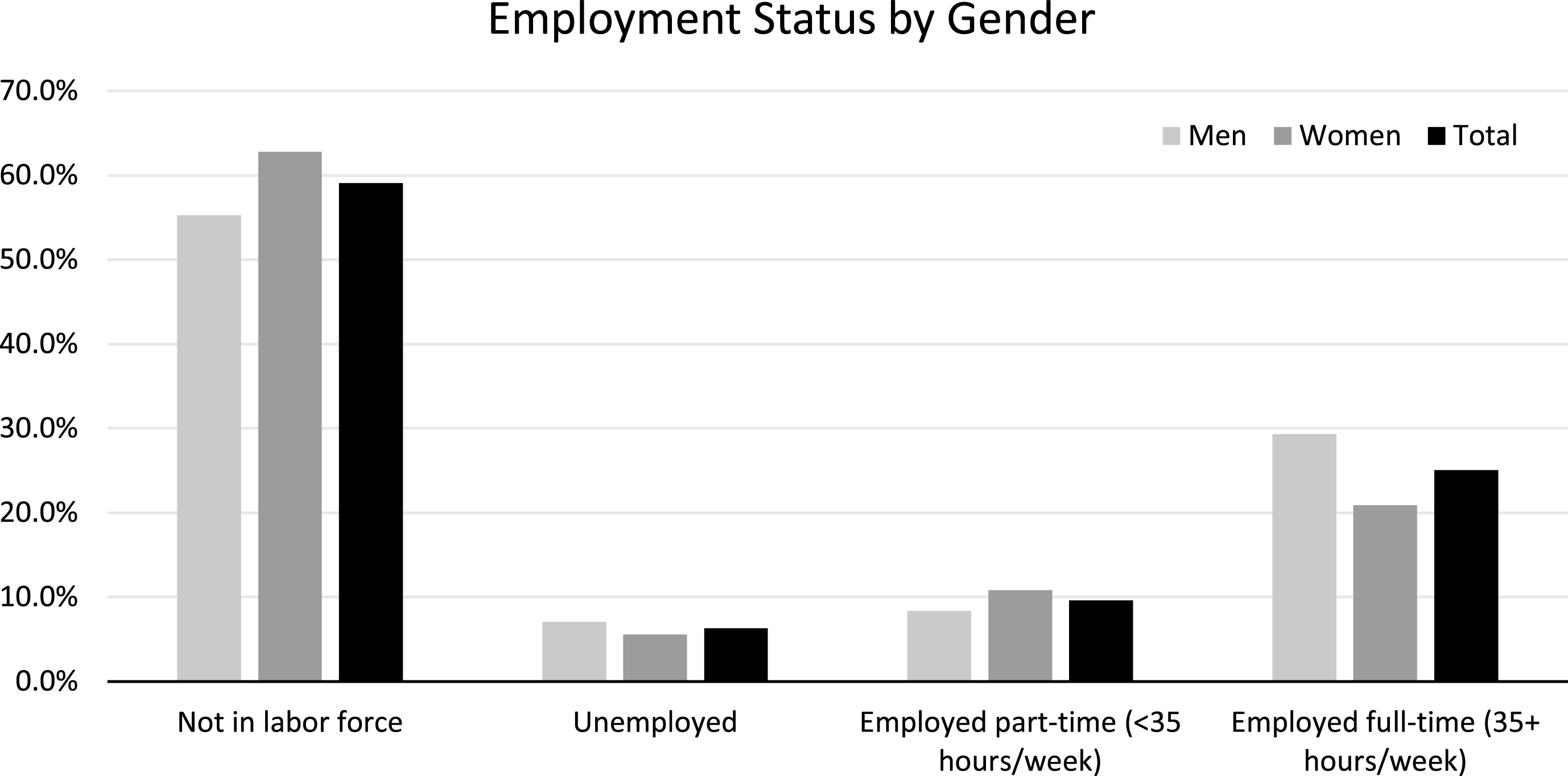
Employment Status by Gender. Notes: N = 195,236 adults ages 18–64 with at least one disability type. Data are from the 2014 American Community Survey. Differences in employment status by gender are statistically significant at p < 0.001.
Table 2 shows the characteristics of living arrangements for working-age adults with disabilities by gender. In the full analytic sample, the most common household composition was living with a spouse and others (including minor children) and the most common housing type was a single-family, detached home. Women were less likely to live with a spouse and others, compared with men (19.7% vs. 21.2% , p < 0.001) and much less likely to live with parents without a spouse or child (11.7% vs. 19.9% , p < 0.001). In contrast, women were more likely than men to live with minor children only (10.5% vs. 3.4% , p < 0.001) and to live with others, without a spouse or minor children (24.6% vs. 21.0% , p < 0.001). Among housing types, women with disabilities were less likely than men to live in single-family detached homes and mobile homes or other temporary structures, but more likely to live in all types of apartment buildings. Women were significantly more likely than men to rent, rather than own, their home (44.6% vs. 39.3% , p < 0.001). And, women had higher rates of housing cost burden and crowded housing than men.
Living arrangements by gender
In logistic regression models looking at the likelihood of employment, we accounted for observable socio-demographic characteristics, type of disability, and state of residence. Our analysis found that women with disabilities who live alone, compared to living with a spouse only, had much higher odds of being employed (full or part-time) than men (OR: 3.32, p < 0.001 vs. OR: 1.54, p < 0.001; see Table 3). Also, men living with their parents (without a spouse or children) had lower odds of being employed (OR: 0.40, p < 0.001), whereas there was no significant association for women.
Odds of employment by gender and living arrangements
Odds of employment by gender and living arrangements
Notes: Odds ratios generated from logistic regression models estimating employment; survey weights were used to yield national estimates. Fully-adjusted regression models include control variables for socio-demographic characteristics, type of disability, and state of residence.
Women had considerably higher odds of being employed if they lived with minor children or others, compared with living with a spouse only (OR: 2.94, p < 0.001 and OR: 2.19, p < 0.001). Both men and women who owned their homes had lower odds of being employed, compared with adults who rented. And, for both men and women, having a housing cost burden above 30% was associated with lower odds of being employed.
This study found that nearly 35% of all working-age adults with a disability are employed, either full or part-time, consistent with previous research on this topic (Kruse, 2015). However, for working-age adults with disabilities, the relationship between living arrangements and employment varied by living arrangement and gender. Women were more likely to be out of the labor force altogether and to work part-time if they were in the labor force, compared with men. For both men and women, the odds of being employed were higher if they lived alone or with minor children only (without a spouse), compared with living with a spouse only. However, women living alone had nearly twice the odds of being employed (relative to living with a spouse only), compared to men.
These findings suggest a need for working-age adults who live on their own or as single parents to work as a means of supporting themselves (and their minor children); however, the relationship is stronger for women, indicating that the employment decisions of men may be less closely tied to their living arrangements than for women. We also found evidence that working-age women with disabilities were more likely than their male counterparts to live in poverty, to experience a housing cost burden of >50% of their income, to receive SSI, and to rent (vs. own) their home. These differences occurred despite the fact that women were more likely than men to have received a college degree or attended some college. This finding raises an important concern that, despite having greater educational attainment, women with disabilities may not necessarily have the same employment opportunities that men do.
Furthermore, women in this sample were more likely than men to be single parents (living with minor children only) and less likely to be non-Hispanic White. Both of these personal characteristics are associated with greater risk of economic hardship and women in this sample may face intersecting disadvantages of being female, non-White, poor, single parents, and living with a disability (Ontario Human Rights Commission, 2001; Erevelles & Minear, 2010). The finding that women living alone and with minor children only are much more likely to be employed than their male counterparts in the same situation, relative to individuals living with a spouse only, may be indicative of the resourcefulness of these women. However, it may also reflect the economic reality that they need to work to make ends meet. Policies and programs should pay careful attention to supporting working-age women with disabilities who live alone or with minor children. This research shows that it is possible for these women to be employed, but they remain especially vulnerable to living in poverty and face a high burden with respect to housing costs.
It is also important to note several factors that were associated with lower odds of being employed. For working-age men with disabilities, the lowest odds of being employed were for those who lived with their parents or with others (e.g., roommates). Some of these men may still be completing their schooling; however, some of these men with disabilities may be living with parents or in group situations because their disability requires additional support, which makes independent living difficult. Some individuals may be living in these situations by choice, while others may lack access to the resources to help them live independently (Hendey & Pascall, 2001) or gain access to appropriate and worthwhile employment opportunities.
For working-age women with disabilities, the odds of employment were lowest if they lived with a spouse only or with a spouse and others (including minor children). This latter finding is consistent with the general population: married mothers are less likely than unmarried counterparts or women without children to be employed (Bureau of Labor Statistics, 2016). Still, given the high poverty rates of women in this sample (nearly 29% ), some of these women may be financially better off if they were able to be gainfully employed. Programs and policies should find ways to support parents living with disabilities in working if they choose to.
This study had some data limitations. First, the ACS dataset is cross-sectional, which provides a snapshot in time of the U.S. population, but does not allow for causal inferences. For example, we could not determine whether employment status influenced living arrangements or the other way around. Second, the ACS data excluded measures of chronic conditions and health status, which may influence employment. However, the fact that we found significant differences in labor force participation by gender and living arrangements within the U.S. population of working-age adults with disabilities suggests that not all living arrangements are equally supportive in finding and maintaining employment. Furthermore, the evidence suggests that women may continue to face unequal opportunities for employment, relative to men.
Conclusions
For both men and women with disabilities, living alone was associated with the highest odds of being employed, with the odds being especially high for women. This may be indicative of a selection effect – those who are able to work are also better able to live alone. It may also highlight particular successes of a sub-set of the population with disabilities who are successfully able to live alone and maintain employment, on par with their peers without disabilities. The amount of support that working-age adults with disabilities need to successfully participate in employment and other community activities may vary by both gender and living arrangement, and both should be taken into account in designing policies and programs to support individuals with disabilities.
Conflict of interest
The authors have no funding sources or conflicts of interest to report.