




Abstract
BACKGROUND:
College students with intellectual disability (ID) face many challenges while maintaining employment. These challenges encompass both social and behavioral tribulations. Increasing social skills at work is a significant goal for practitioners and educators of adults with ID. Coaching strategies such as Covert Audio Coaching (CAC) and Remote Audio Coaching (RAC) have proven effective in teaching students with ID various employment related skills.
OBJECTIVE:
The purpose of this study was to determine if RAC would increase on-topic workplace communication skills for college students with ID.
METHODS:
This study used a multiple probe design to test the effects of RAC on teaching communication skills in the workplace. In this study, college students logged onto a Zoom call to speak with a co-worker about an employment topic while the interventionist used RAC to coach the student through the conversation.
RESULTS:
The results of this study demonstrated that the RAC intervention was effective in increasing on-topic exchanges between college students with ID and their co-workers.
CONCLUSION:
The COVID-19 pandemic has shifted the workplace to virtual settings for training and work tasks. RAC can be used as an employment support for adults with ID while minimizing in person contact. Limitations and implications of this study were further described at the end of the article.
Keywords
Introduction
Adults with intellectual disability (ID) have historically low employment rates and have traditionally been employed in sheltered workshops or positions that are deemed non-competitive due to their wages and hours being substantially below a typical co-worker (Hiersteiner et al., 2016). Due to poor employment outcomes, adults with ID are more likely to rely on their government benefits (Sannicandro et al., 2018) and experience unemployment rates at 10 times greater than their nondisabled peers (Butterworth et al., 2011). Although this population has traditionally been woefully un- or under-employed, recent legislation has resulted in more accessible programs for individuals with ID to attend after they have graduated from secondary education (Grigal et al., 2018).
In recent years the development of Inclusive Post-Secondary Education (IPSE) programs have improved work conditions for adults with ID through activities and curricula such as high-quality employment skills instruction (Gilson et al., 2017). For example, IPSE programs help adults with ID gain competitive employment resulting in increased work opportunities and competitive wages as an outcome of a college-based employment curriculum (Grigal et al., 2018). These curricula vary but overall share common objectives specifically for employment preparedness including interview skills, resume writing, and social skills on the job (Kelley & Westling, 2019). Typically, workers with ID face challenges with retaining their jobs, not because of their productivity levels, but because they lack job experience and training in a community context (Bennett et al., 2010). Workers with ID are stigmatized within their community and are therefore less likely to be hired and experience job training (Gormley, 2015). Without the appropriate job training in an inclusive setting, workers with ID will struggle to learn social skills on the job. Community-based social skills can help workers with ID to become independent in the workplace and help retain jobs (Joseph et al., 2020).
To increase community-based employment, reciprocal communication in the workplace is an essential part of social competency (Joseph et al., 2020). Workplace conversations that involve customer service, teamwork, retail, and employee-to-supervisor interactions must be directly taught to many individuals who have not previously had positive community work experiences (Kaye et al., 2011). Holmes and Fillary (2000) found that when adults with ID in the workplace engaged in conversations with employees without ID, they often shared inappropriate topics (e.g., intimacy, family issues), had difficulty staying on-topic, and only interacted with the same familiar employees. Other studies had similar findings of social deficits when conversing with employers and other employees (Gilson & Carter, 2016; Kearney et al., 2020; Mason et al., 2020; Oswald et al., 2018). These studies suggest that on-topic conversational skills, and the instruction of these skills, are a critical part of employment training programs designed for adults with ID.
Audio coaching
Some interventions that have been used thus far to teach social employment skills are video modeling, literary-based behavioral interventions, and covert audio coaching (CAC). One intervention specifically, CAC, has a long history of success in teaching employment skills. CAC involves a coach (job coach, teacher, other professional, etc.) delivering immediate feedback to a person completing a skill through a two-way radio system and earbud (Bennett, 2013). The success of CAC interventions has led a group of researchers to explore teaching social skills with Remote Audio Coaching (RAC) is the remote application of covert audio coaching (Joseph et al., 2020) via a videoconferencing platform. CAC has long been used amongst many populations and in multiple settings, while RAC has evolved due to recent environmental need (i.e., social distancing) during the COVID-19 pandemic.
Purpose of the study
Full-time competitive employment requires that employees with ID overcome the social skill deficits that put job promotion and retention at risk. One strategy for teaching these social skills is remote audio coaching (RAC) as demonstrated in the study by Joseph et al. (2020). The research proposed here is an extension of a prior study from Joseph et al. which examined the effectiveness of RAC in increasing on-topic conversations for college students with ID. However, the purpose of this research is to extend the application of RAC to employability –specifically to on-topic workplace and employment related communication. This is a critical need for college students with ID. The research questions for this study were: What are the effects of Remote Audio Coaching on increasing the on-topic workplace communication of college students with ID? Will on-topic workplace communication be maintained once the RAC intervention is removed? Will on-topic workplace communication generalize to novel professionals?
Method
Participants
The participants in this study were three college students enrolled in an IPSE program at a university in the southeastern United States. All students were required to have a documented intellectual disability and have little to no prior work experience. The students were administered the Job Observation and Behavior Scale: Opportunities for Self Determination (JOBS:OSD) to obtain employment profile norms. To be selected for the study, students were not actively engaged in employment internships and students showed employment profiles below average for entry level employees. All students had prior experience using Zoom, a free online videoconferencing application, for online coursework, meetings with faculty, and campus clubs and activities. Students who were selected demonstrated regular attendance, availability, and a willingness to participate. Students with the most pronounced need for workplace communication skills were prioritized for selection for the study. Prior to baseline, the study was approved by the Institutional Review Board. Verbal and written assent was obtained from the students, and written consent was obtained from their parents or legal guardians.
Jenna
Jenna was a 24-year old White female diagnosed with ID. Her full-scale IQ score was 53 on the Weschler Adult Intelligence Scale (WAIS). On the JOBS:OSD assessment, Jenna scored a Work Related Daily Living score of 37 with a level of support score of 37, a Work Required Behavior score of 22 with a level of support score of 20, and a Work Required Job Duty score of 25 with a level of support score of 23. These scores indicate that Jenna perceived she can sometimes achieve job tasks but required support for work-related daily living skills. Jenna had job shadowing experience in an on-campus entity at the University but had no employment experiences since the start of the COVID-19 pandemic. She had never worked a paid job before.
Cameron
Cameron was a 22-year-old White male diagnosed with autism spectrum disorder (ASD). His WAIS full-scale IQ score was 70. On the JOBS: OSD assessment, Cameron scored a Work Related Daily Living score of 34 with a level of support score of 24, a Work Required Behavior score of 18 with a level of support score of 17, and a Work Required Job Duty score of 19 with a level of support score of 18. These scores indicated that Cameron perceived he can sometimes achieve job tasks and that he required support sometimes. He had job shadowing experience in an on-campus entity at the University but had no employment experiences since the start of the COVID-19 pandemic. Cameron had never been employed in a paid position.
Aaron
Aaron was a 21-year-old White male diagnosed with ASD. His WAIS full-scale IQ score is 71. On the JOBS: OSD assessment, Aaron scored a Work Related Daily Living score of 30 with a level of support score of 34, a Work Required Behavior score of 24 with a level of support score of 22, and a Work Required Job Duty score of 24 with a level of support score of 25. These scores indicated that Aaron perceived he can achieve job tasks and that he can do most of them independently. He had job shadowing experience in a department of the University, but had no employment opportunities since the start of the COVID-19 pandemic. Aaron had never worked a paid job before.
Setting
The study took place remotely on Zoom. Students and researchers used their personal laptops, home computers, or cell phones, to login to the meeting. The researcher emailed the students a Zoom link and access code each morning before the meeting. Students were advised to find a quiet and distraction-free environment to be able to properly hear the conversation and participate in the meeting. All sessions, baseline, intervention, follow-up, and generalization, consisted of four or five people: the confederate, the student, the coach, and one or two data collectors.
At the beginning of each session, the data collectors muted their audio, discontinued their video, and erased their name. This resulted in a blank screen. This protocol was developed to minimize measurement reactivity. The confederate also muted their audio and discontinued their video but did not erase their name as the coach would instruct the student to speak with the confederate after a prompt was given. The coach was the only individual in the meeting that began with their video and audio on. Once the coach gave the prompt, the coach would then turn their video off and only use their audio to be in true remote audio coaching format.
Aaron used his home laptop to access the Zoom meeting. He was stationed at a home desk either in his bedroom or living room and typically wore headphones to minimize distractions and other background noises. Cameron used his home laptop to access the Zoom meeting. He was stationed at a table in his dining room but there were no distractions or other individuals nearby. Jenna used her cell phone to access the Zoom meeting. She was typically not at home while she was attending the Zoom call but at an organization that she attends. She was able to find a distraction free environment from her activities at the organization by stepping outside or using headphones. All students had approximately 1.5 years of experience using Zoom.
Measures
Dependent variable
The dependent variable for this study was on-topic employment conversation exchanges with a confederate (research assistant) serving as a co-worker. There were two dependent variables: on-topic exchanges and off-topic, or inappropriate exchanges, with the confederate. An example of an on-topic employment exchange in this study was talking about taking care of animals at the animal shelter for work; an example of an off-topic or inappropriate exchange was discussing a recent intimate interaction with a significant other. As in the study by Joseph et al. (2020), a control code for a confederate-initiated exchange was used to determine if student increases in on-topic exchanges were in fact due to the intervention rather than in response to the confederate’s initiation. The following are codes listed on the data collection sheets: on-topic (OT), off-topic (OffT), participant talk (PT), confederate talk (CT), coaching prompt (Coach), and confederate initiated (ConI). Participant talk was listed above the on-topic and off-topic codes and data collectors were given an option beneath this code to determine if the exchange was on or off topic.
Data collection, interobserver agreement, and treatment fidelity
Two staff members from the IPSE program served as data collectors. Data were collected during a 5-minute observation, using a partial interval system with 10-second intervals. During all observations, data collectors observed with their screens darkened and audio functions muted so they were considered “hidden” to the students. During sessions that included the IOA data collector, both data collectors would use their cell phones to participate in a phone call with each other. A pre-recorded 5-minute audio to prompt for the 10-second intervals would be played via one data collector into their cell phone. The prompt consisting of cues such as “Look” and “End”. This method was adapted from the study by Joseph et al. (2020).
To establish procedural and treatment fidelity, the researchers developed a checklist that summarized the experiment and intervention protocol. The list analyzed the coach’s behavior throughout all conditions. The treatment fidelity data sheet also collected data on the types of prompts the coach provided and why the prompt was provided (i.e. latency, inappropriate exchange, etc.).
Procedures
Experimental design and procedures
The researchers used a multiple baseline design across participants in this study. This single-subject design staggers the implementation of the intervention across participants to assure that improvements in the outcome behavior occur when, and only when, the intervention is applied. The researchers implemented a follow-up condition to address the second research question of whether the skills are maintained once the intervention is removed.
Pre-baseline
Prior to the study, the investigator developed a list of 30 topics related to employment that would be appropriate for the student to have a conversation with a co-worker about while at work (e.g., asking a co-worker for a quality control check; helping a customer). 30 topics were generated in order to avoid a topic being used more than once by each student throughout the study. Before each daily session, the investigator selected randomly the daily employment conversation topic and shared it with the data collectors and confederate. To develop this list of topics, the investigator surveyed job coaches, parents, and current employers of individuals with ID to determine necessary and challenging topics. The survey was emailed to each individual and asked three open ended questions about their experience with workers with ID, perceptions of social work challenges for workers with ID, and improvement of social interactions for workers with ID.
Baseline
Each baseline session began with the confederate (research assistant in the role of a co-worker), the data collectors, and the coach (interventionist) in the Zoom meeting. The data collectors were hidden, and the confederate was muted. The student was admitted to the session from the waiting room by the coach. The coach greeted the student and checked microphones and connectivity. The coach shared a visual, such as a video of a person making photocopies, that matched the conversation topic with the student. Then, the coach provided an organizing statement—but no actual instruction—with the conversation topic to the student (e.g., “John, one of the job tasks that you might do in the future is making photocopies. While you think about this, I am going to observe your conversation with a co-worker, [confederate name]”). Next, the coach turned off her video and microphone; the confederate turned on her video to join the conversation. Baseline sessions were held until sessions showed a stable or descending trend in the un-prompted employment communication exchange data.
Intervention
The independent variable in this study was the remote audio coaching (RAC). Like baseline, intervention sessions began with the confederate, the data collectors, and the coach in the Zoom meeting. The coach turned on her screen and microphone to admit and inform the student about the topic. Then, the coach hid her screen but kept her microphone on to provide instruction. The confederate turned on her audio and video to join the conversation once the coach turned her video off. Identical to the baseline condition, the coach provided a conversation topic with a visual, and an organizing statement.
The confederate did not initiate a conversation but always engaged with the student after every exchange initiated by the student. The coach provided a coaching prompt if 10-seconds elapsed without any exchange from the student, or if the student engaged in an off-topic comment or repeated statement during the conversation. Coaching prompts were delivered using the Kearney et al. (2020) 2-step hierarchy of indirect and direct prompts. If a coaching prompt was needed to cue the student to initiate a communication exchange, the first prompt was indirect (e.g., “John, remember we’re talking about work schedules”). If a second prompt is needed, it was direct (e.g., “John, ask [confederate name] what her work schedule is this week”). At the end of the observation, the coach provided a closing statement (e.g., “Great job talking to your co-worker, John”) and prompted the student to sign off for the day. Intervention sessions were held until three consecutive sessions showed that the un-prompted employment conversation exchange data stabilized at a higher rate than the un-prompted employment conversation exchange data from baseline sessions.
Generalization
The researchers conducted a generalization probe in each condition for each student. The probe included an employment conversation with a novel confederate acting as a co-worker. The generalization probes followed the same procedures of the baseline condition, but the confederate was unfamiliar to the student. The confederate for the baseline condition was a researcher from the same department. The generalization confederate was trained in the same manner as the main confederate, using practice sessions to ensure she did not initiate any exchanges with the student.
Follow-up
The researchers collected follow-up probes after the last intervention session for each student. This was done to determine if the student maintained the skill. During the follow-up sessions, the procedures were identical to baseline, with no intervention occurring at all.
Data analysis
Data were analyzed using traditional visual analysis procedures. This included comparing the primary dependent variable across each condition using the following metrics: (a) measures of central tendency and range across participants as well as (b) direction, (c) trend, and (d) level of data (Kratochwill et al., 2013). A post-hoc analysis using the Tau-U coefficient determined omnibus and individual effect sizes across conditions (Vannest et al., 2016).
Social validity
The researchers assessed perceptions of professionals in the field to evaluate the social validity of the RAC intervention on workplace communication. A survey tool was developed and emailed to professionals at the end of the study. These professionals were recruited to participate in the social validity survey based on prior collaborative partnerships that already existed between the university and the field professionals. The survey consisted of six questions with a Likert scale for responses. The scale responses were Strongly Agree, Agree, Disagree, and Strongly Disagree. The survey was returned via email to the researchers and the results were recorded with no identifying characteristics. Additionally, the students participating in the study completed a separate social validity survey that was developed by the researchers. This survey assessed the students’ perceptions of learning workplace communication skills. The survey also had visuals that followed the Likert scale. The researchers emailed the survey to students after they completed their final follow-up session.
Results
The effects of RAC intervention, as well as the generalization and maintenance of the skills, are shown in Fig. 1. Overall, the RAC intervention was effective in increasing unprompted on-topic exchanges.
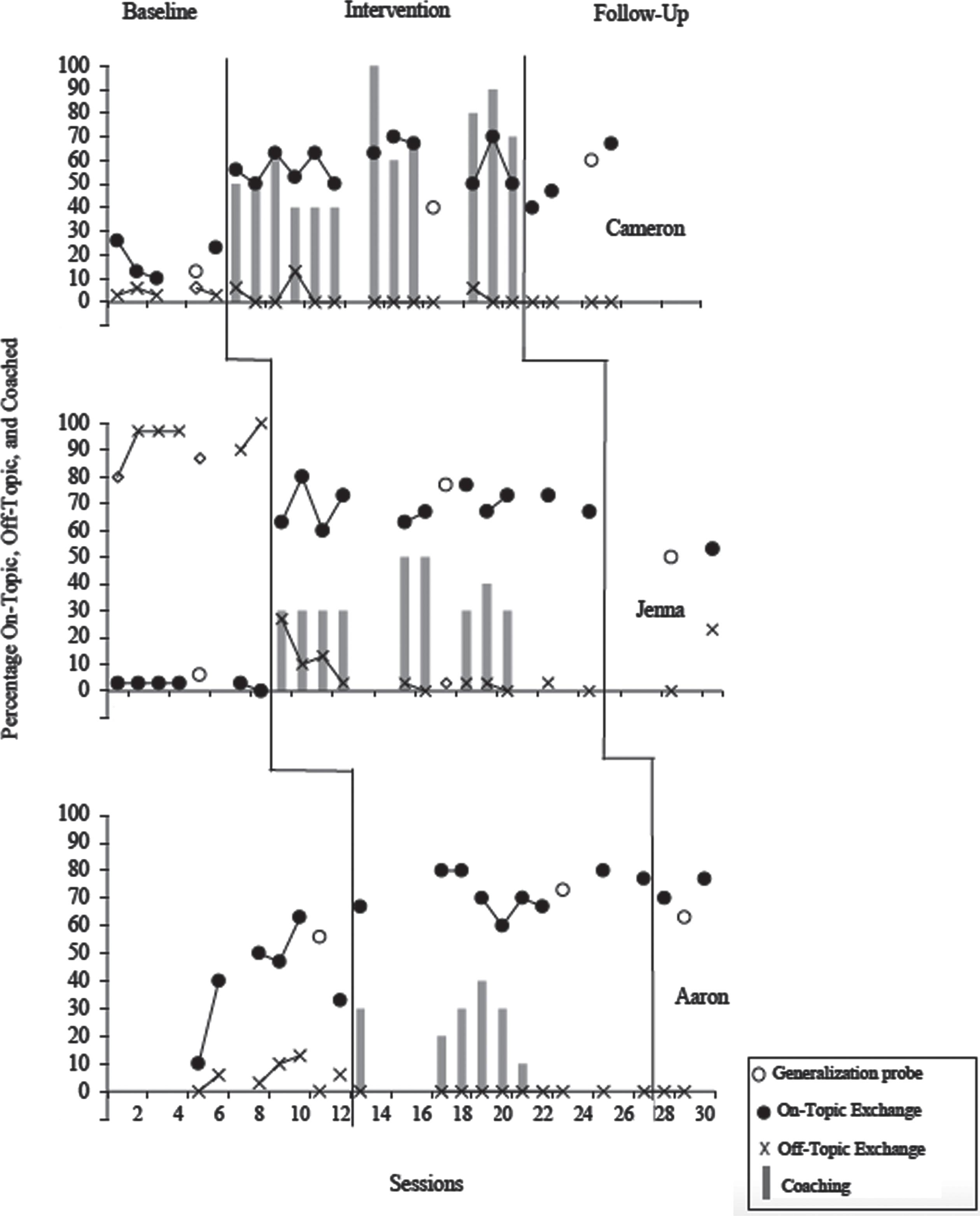
Percentage of workplace exchanges on-topic, off-topic, and coached.
During baseline, Cameron’s on-topic exchanges averaged 18% of the intervals (range = 10–26%) and his off-topic exchanges averaged 3.8% of the intervals (range = 3–6%). For the baseline sessions, he only spoke for about the first minute of the 5-minute session and remained quiet for the rest of the session. After four days of baseline sessions, Cameron received the RAC intervention. On the first day of intervention, Cameron received five coaching prompts, resulting in an increase of his on-topic exchanges to 56% of the intervals. For the remainder of the intervention session, Cameron’s on-topic exchanges averaged 58.8% of the intervals (range = 50–70%), and his off-topic exchanges averaged 2.1% of the intervals (range = 0–13%). The reader can observe, through Fig. 1, that when the coach delivered more prompts, Cameron’s on-topic exchange averages increased. The average amount of coaching prompts delivered to Cameron during the intervention sessions was 6.25 (range = 4–10) prompts per session. After 12 days of intervention sessions, the RAC intervention was removed. Cameron’s on-topic exchange averaged 47% of the intervals (range = 40–67%) and his off-topic exchanges averaged 0%. This occurred over three follow-up sessions, across 8 days.
Jenna
During baseline, Jenna’s on-topic exchanges averaged 2.5% (range = 0–3%) of the intervals and her off-topic exchanges average 93.5% (range = 80–100%). After six days of baseline, Jenna began the RAC intervention. On the first day of intervention, Jenna received three coaching prompts. This resulted in an increase of her on-topic exchanges to 63% and a decrease in her off-topic exchanges to 27%. For the following intervention sessions, Jenna’s on-topic exchanges averaged 69.2% of the intervals (range = 63–80%) and her off-topic exchanges averaged 7.2% of the intervals (range = 0–27%). The average amount of coaching prompts delivered to Jenna during the intervention sessions was 3.5 prompts per session (ranging from 3 to 5). Jenna’s on-topic exchanges stabilized, and the RAC intervention was removed after nine days of intervention. During three follow-up sessions, across 19 days, Jenna’s on-topic exchanges averaged 64.3% of the intervals (range = 53–73%) and her off-topic exchanges averaged 8.7% of the intervals (range = 0–23%).
Aaron
During Aaron’s first baseline session, he only had on-topic exchanges for 10% of the intervals and zero off-topic exchanges. The following baseline session, Aaron had on-topic exchanges for 40% of the intervals and 6% of the intervals had off-topic exchanges. For all baseline sessions, Aaron’s on-topic exchanges averaged 40.5% (range = 10–63%) of the intervals and his off-topic exchanges averaged 6.3% (range = 0–13%). Aaron began the RAC intervention after six days of baseline sessions. On the first day of intervention, Aaron received three coaching prompts. He had on-topic exchanges for 67% of the intervals and zero off-topic exchanges. For the rest of the intervention sessions, Aaron’s on-topic exchanges averaged 71.8% of the intervals (range = 60–80%) and his off-topic exchanges averaged 0% of the intervals (range = 0%). The average amount of coaching prompts delivered to Aaron during the intervention sessions was 2.5 (range = 0–4) prompts per session. After eight days of intervention sessions, the RAC intervention was removed. Three follow-up sessions occurred across 10 days. During the follow-up sessions, Aaron’s on-topic exchanges averaged 74.7% of the intervals (range = 70–77%) and his off-topic exchanges averaged 0% of the intervals (range = 0).
Post-hoc analysis and effect size
The researchers used the Tau-U web-based calculator (Vannest et al., 2016) to calculate post-hoc analysis of the on-topic exchanges at the overall level. The Tau-U post-hoc analysis showed an overall effect size of .986, suggesting a robust effect size across students (Parker et al., 2011). Jenna’s overall effect size between baseline and intervention was 1.0; Cameron’s overall effect size between baseline and intervention was 1.0; and Aaron’s overall effect size was 0.958. The overall Tau-U effect size for all three students between the baseline and intervention conditions indicate that the intervention was in fact, effective.
Interobserver agreement and treatment fidelity results
One data collector attended every session and the second data collector attended 41% of all sessions to collect interobserver agreement (IOA) and treatment fidelity data. Jenna’s IOA percentage for all codes totaled 88%; Cameron’s IOA percentage for all codes totaled 92.5%; and Aaron’s IOA percentage for all codes totaled 94.7%. All three students’ combined IOA percentage for all codes totaled 91.9%. Treatment fidelity data was collected at 41% of all sessions. During each observation, the interventionist implemented the design procedures with 100% fidelity.
Social validity results
Students and professionals in the field provided answers to questions related to the significance of the goal of the intervention, acceptability of the intervention, and the impact of the outcomes of the intervention. Across all items and respondents, there was an indication of a high level of social validity for learning workplace communication skills. Students provided highest ratings for items related to the significance of the intervention and the acceptability of the RAC intervention (3.7 and 3.7 out of 4.0), with the impact of the intervention outcomes still strong (3.5). Professionals’ ratings were similarly strong for the significance of the intervention and the acceptability of the intervention (3.7 and 3.7 out of 4.0). Their thoughts on the impact of using the RAC intervention were adequate (3.3).
Discussion
The purpose of this study was to determine if RAC would increase on-topic workplace communication skills for college students with ID. The researchers determined this by examining on-topic conversational exchanges versus off-topic conversational exchanges. The researchers also calculated effect sizes for each student at the individual level. The Tau-U effect sizes for all three students indicated that the intervention was effective. All three students in this study received the RAC intervention and increased their on-topic exchanges during the intervention and follow-up phases. This is significant because all three students were able to maintain the learned skills once the intervention was removed. Additionally, all three students were able to use the learned skills when speaking with novel co-workers, proving that RAC was an effective intervention for generalization purposes.
A researcher provided coaching prompts as part of the intervention protocol. These coaching prompts decreased for Jenna and Aaron after the first few intervention sessions. This shows that the communication skills learned through the intervention phase were acquired quickly and did not require the RAC intervention as frequently. For Cameron, the coaching prompts remained at a higher frequency throughout the intervention phase. During Cameron’s follow-up sessions, the coach did not provide prompts and Cameron was still able to provide more on-topic exchanges than during his baseline sessions. This is significant because although he required a higher frequency of prompts throughout the intervention sessions, he maintained the communication skills learned once the RAC intervention was removed, further proving that the RAC intervention was effective. Through the follow-up sessions, when coaching was not provided, we can get a better sense of what this intervention may look like when used in applied settings. Although all students decreased the amount of time they engaged in on-topic conversation between intervention and follow-up, they all engaged in higher levels of on-topic conversation during follow-up (once the coaching was removed) than they did during baseline. This demonstrates the possibility of RAC being used temporarily to bolster newly learned skills and the likelihood of these new skills maintaining at higher levels once the intervention is removed.
The RAC intervention used in this study was like the one used in the study by Joseph et al. (2020). Although this was not a true replication study, the intervention was used in the same manner as the Joseph et al. study. Therefore, between the two studies, the methods were similar with some minor exceptions, specifically the topics discussed and the visual prompts to begin each session. The researchers used the suggestion for future research from the Joseph et al. discussion to guide the purpose of this study. Employment conversations and workplace communication were suggested areas to explore with the RAC intervention. The research completed in this study added to a series of CAC and RAC studies that will hopefully continue to be researched in different contexts and across other populations.
Social validity outcomes
Social validity outcomes
On-topic discussions at work between co-workers, supervisors, and customers or clients, help adults with ID retain their employment. However, engaging in small talk, even if deemed ‘appropriate’ too frequently or sharing personal details that are too intimate with coworkers may be detrimental to an individual’s employment status (Joseph et al., 2020). Off-topic discussions at work may hinder the employment success of adults with ID, especially if these conversations are inappropriate or if the behaviors need to be addressed in multiple instances by employers. Providers and professionals in the field can ensure better employment outcomes for adults with ID by teaching more social employment behaviors.
This study had several limitations. First, for Aaron, there was a slight ascending trend in baseline, prior to a decrease. The researchers determined it was appropriate to progress to intervention to avoid extended periods of Aaron not speaking at all to the confederate. Second, the students in the study were familiar with the interventionist and the confederate, which could have had an impact on willingness to communicate or expectations to converse more with the confederate. Third, while RAC was effective in increasing workplace communication amongst all students, it is possible if this study occurred in real world settings, we could see different levels and effects due to more distraction in the environment. Two of the students were stationed at their desks in their homes, with little distraction. Many jobs that students with ID or entry level workers obtain are not situated at quiet desks, hidden from customers or passersby. Since this was a single-subject design, there were only three participants. Further research is needed to extrapolate these findings and determine the true effect of this intervention in applied settings.
Implications
Students in this study learned to participate in a conversation about various workplace topics. In prior audio coaching studies, students learned to participate in a small-talk conversation or complete various work tasks. This study was meaningful because students learned social skills that were essential to maintaining a job. College students with ID face challenges maintaining jobs and many of these challenges are related to social skills (Grigal et al., 2018). Attending IPSE programs and learning essential job skills can decrease the employment challenges that college students with ID encounter in their careers. IPSE programs, vocational agencies, and job coaches can use interventions such as RAC while teaching students these essential job skills.
Interventions such as RAC can be used by the practitioners and job coaches to improve skills and to ultimately reduce reliance on financial assistance. The limitations of this study imply that future researchers could examine the effects of RAC in real-world employment settings. This could be achieved at the student’s place of work or in simulated areas of work. Additionally, remote services are increasing in practitioner environments. Remote services provide more flexibility in scheduling and travel. Practitioners could use RAC interventions as a way increase their productivity levels with clients and students.
Conclusion
This study examined the effects of RAC on teaching social employment skills to college students with ID. The study proved that RAC is an effective intervention for practitioners and job coaches to use with clients and students. Due to the COVID-19 pandemic, many places of business are distancing and decreasing foot traffic. Some places of work may not be willing to allow in-person job coaches. RAC interventions could allow students with ID to have reasonable accommodations through job coaching supports while they are on the job but still maintaining social distance.
Footnotes
Acknowledgments
The corresponding author offers sincere gratitude to her advisors, Michael Brady and Kelly Kearney, for all their guidance and support in writing this manuscript. She is grateful to the Florida Atlantic University Academy for Community Inclusion for providing the setting and participants to conduct the study. Finally, she wishes to thank her research mates, Lauren Berlingo, Kaley Adams, and Stefanie Kenney, for all their support.
Conflict of interest
None to report.
Ethics statement
This research project was approved by the institutional review board of Florida Atlantic University on July 22, 2021 (protocol number: 1789116-1).
Funding
The project was funded by Policy Research, Inc. This funding group provided a small student grant program called: Analyzing Relationships between Disability, Rehabilitation, and Work. The research reported herein was performed pursuant to a grant from Policy Research, Inc. as part of the U.S. Social Security Administration’s (SSA’s) Analyzing Relationships Between Disability, Rehabilitation and Work. The opinions and conclusions expressed are solely those of the authors and do not represent the opinions or policies of Policy Research, Inc., SSA or any other agency of the Federal Government.
Informed consent
Prior to baseline, consent was obtained by the parents of the participants in this study. The students in this study then signed assent forms via email in addition to providing verbal assent. The consent and assent forms were approved by the university’s institutional review board.