



Abstract
BACKGROUND:
Job seekers must know how to determine whether the jobs identified during a search are a good fit. Employment decision making requires problem-solving and choice-making skills. There is limited research on employment decision making skills.
OBJECTIVE:
The purpose of this study was to teach three young adults with dually diagnosed visual impairment and intellectual/developmental disability to determine appropriate job fit. The mnemonic “ELSE” was paired with remote audio coaching to teach the participants how to determine if the education level, likes, skills, and earnings of each presented job were an appropriate fit for them.
METHODS:
This study used a single subject design to determine the effectiveness of the multicomponent intervention. The design was a multiple baseline across participant design.
RESULTS:
The results demonstrated all three participants were able to reach a pre-determined mastery criterion of the skill. Maintenance and generalization were variable across participants.
CONCLUSIONS:
All participants who received the intervention increased their ability to determine appropriate job fit. The results from this study are promising and demonstrate the potential and flexibility of the mnemonic ELSE on determining appropriate job fit by young adults with VI and IDD.
Keywords
Introduction
Young adults with disabilities have lower employment rates than their peers without disabilities. In 2017, 36.9% of young adults with disabilities aged 20–24 years were employed compared to 67.3% of their peers without disabilities (Bureau of Labor Statistics, 2018). This discrepancy in the employment rate is even higher for working-age adults with visual impairments; the full-time, full-year employment rate of this population is 29.5% (Erickson et al., 2019). Compared to the general U.S. population, individuals with visual impairments also have lower annual earnings, lower annual household income, and higher poverty rates (Erickson et al., 2019; Lund & Cmar, 2019). The broad category of visual impairment includes various degrees of vision loss and variations in visual functioning. Visual impairment refers to loss of vision that cannot be corrected with glasses or contacts and creates functional limitations. Some individuals with visual impairments may also be considered legally blind. Legal blindness refers to best corrected visual acuity of 20/200 or worse in the better eye or a visual field of less than 20 degrees (Social Security Administration, 2018).
Visual impairment affects about 1% of youth in the United States (Lund & Cmar, 2020). Youth with visual impairments have unique developmental and educational needs that warrant specialized attention (Sapp & Hatlen, 2010). Many concepts and skills that sighted children learn casually and incidentally must be taught to children with visual impairments systematically and sequentially (Cmar & Markoski, 2019). Students with visual impairments may not learn through natural visual observation, therefore qualified professionals must deliver carefully developed instructions and interventions to teach many skills like employability and self-determination to students with visual impairments (Cmar & Markoski, 2019). Previously conducted systematic literature reviews provide critical appraisal of all relevant research on employment in individuals with visual impairments (Cavenaugh & Giesen, 2012; Goertz et al., 2010; Lund & Cmar, 2020; Nagle, 2001). The results across reviews show consistency and suggest that both postsecondary education and early paid work experience are key to the short- and long-term employment prospects of individuals with visual impairments. They highlight the lack of intervention studies targeting employment outcomes and the need to teach vocational skills, particularly job search skills to youth with visual impairments.
Dual diagnosis: Visual impairment and intellectual/developmental disabilities
Just like individuals with visual impairments, the individuals with intellectual/developmental disabilities (IDD) historically have been woefully un- or under-employed (Domin et al., 2020). Only 10% of people with IDD are paid members of the integrated work force (Wehman et al., 2018). A dearth of pre-employment training, lack of career preparation, and limited work experiences are major reasons for poor employment outcomes for adults with IDD (Carter et al., 2012; Clark et al., 2019; Kearney & Torres, 2022; Southward & Kyzar, 2017). Individuals with multiple impairments have more complex developmental problems than individuals with a single impairment. For example, there is a high prevalence of visual impairments in individuals with severe or profound intellectual disability (Dijkhuizen, 2019). However, there is limited research in the special education or vocational rehabilitation literature addresses the unique needs and challenges of individuals with both visual impairments and IDD. In particular, given the high unemployment rates of young adults with visual impairments and IDD, there is an urgent need to identify services, interventions, teaching tools, and resources that improve their employment outcomes.
Employment decision making
Job searching is a pre-employment skill that involves intentional, dynamic, and self-regulated goal-directed processes (Cmar & Steverson, 2021). It is a direct method of countering unemployment (Kearney & Torres, 2022). To master job searching skills, job seekers must know how to determine whether the jobs they identified during their search are a good fit for them (Torres et al., 2021). Employment decision making is a selection process for one of several potential employment options and requires problem-solving and choice-making skills (Wehmeyer & Field, 2007). To become fluent in identifying options, evaluating jobs, and decision making, adults with disabilities need to practice these skills in option-rich environments (Bambara, 2004).
Interventions to teach employment decision-making also have the potential to address many common barriers for young adults with disabilities; these barriers include unclear goals, unrealistic expectations, lack of vocational information, and lack of self-awareness (Agran & Krupp, 2011; Germeijs & DeBoeck, 2003; Kaur & Kaur, 2017; Ochs & Roessler, 2001). The following methods have been used to teach choice-making and decision-making to young adults with disabilities: task analysis (Belfiore et al., 1994; Cooper & Browder, 1998; Lattimore et al., 2003), picture books (Faw et al., 1996), forced-choice preferences (Browder et al., 1998), computer assisted instruction (Mazotti et al., 2010), multimedia stories (Richter & Test, 2011), and Self-Determined Learning Model of Instruction (SDLMI; Burke et al., 2019; Shogren et al., 2019). These methods were found to be effective, however, literature highlights the lack of intervention research (Raley et al., 2018).
What ELSE about this job?
“What ELSE about this job?” is a multicomponent intervention to teach students employment decision-making skills. The intervention utilizes a four-step mnemonic device ‘ELSE’ with each letter representing a different category to evaluate the job fit: E: What is the EDUCATION level required for this job? L: Do I LIKE the job responsibilities? S: What SKILLS are required for this job? E: What are the monetary EARNINGS from this job?
This four-step process helps students discriminate between appropriate and inappropriate jobs based on their personal circumstances. Torres and colleagues (2021) developed this intervention to be implemented through remote audio coaching with college students with IDD. Their research indicated that all students who received the intervention substantially increased their ability to determine appropriate job fit. The effect size suggested that the intervention was highly effective for all students. In another study, investigators evaluated this intervention using the range-bound changing criterion design to assess students’ stepwise progression through skill acquisition (Brady et al., 2022). Investigators used the intervention to teach students with IDD to assess whether preferred jobs were a good fit for them, and to provide reasons for their decisions. This study also found that “What ELSE about this job?” substantially increased students’ employment decision-making skills. In addition, students generalized those skills to a novel job coach who was not part of the intervention, and maintained the skills after the intervention was removed.
Purpose of the study
The purpose of this study was threefold: First, we sought to replicate the Torres et al. (2021) study that combined a mnemonic strategy with remote audio coaching (RAC) to teach employment decision-making skills virtually. The effectiveness of using a mnemonic teaching strategy has been well establish in special education literature. However, there is limited information available on the remote delivery of this method. Second, we investigated the effectiveness of the intervention with a unique population, young adults with both visual impairment and IDD. We made adaptations to the implementation process so that the intervention does not rely on the visual methods in teaching. This is one of the first intervention studies addressing employability skills of young adults with dual diagnoses of visual impairment and IDD. Finally, the interventionist in this study was a field practitioner who worked for a community-based agency providing vocational rehabilitation services to adults with vision loss. The interventionist did not have experience with the intervention. This study also evaluated the practicality and feasibility of the utilization of the intervention by field practitioners. We asked the following research questions: What are the effects of the ELSE mnemonic on the acquisition of employment decision-making skills for young adults with visual impairment and IDD? Will the skills learned through the ELSE mnemonic maintain once the intervention is removed? Will the participants generalize the employment decision-making skills learned from the job coach they interacted with throughout the study to a new job coach they have not met before?
Method
Participants
Three young adults participated in this study. Hugo, Edward, and Paul were all active clients of an agency servicing adults with blindness or other visual impairment in the southeastern region of the United States at the time of this study. Each participant had a primary diagnosis of visual impairment and a secondary intellectual and/or developmental disability (IDD) based on educational and medical records. Each participant had an employability assessment completed with the Job Observation Behavior Scale: Opportunity for Self Determination (JOBS:OSD; Brady et al., 2006). JOBS:OSD assesses individuals’ perception of their work performance (WP), and the degree to which they can work with varying types of support (TS). The JOBS:OSD assessment had a series of analyses done that found the assessment to be both reliabile and valid (Brady et al., 2008), and is useful in determining the level of support needed at a job compared to individual’s actual job performance (Brady et al., 2008).
Each participant had been selected to participate in a job development program through the agency. Each participant received employment services with the agency through a work experience program, which is how they met the interventionist, who served as their job coach at the agency. Neither the agency nor the job coach had previously been involved with the participants’ educational programming while they attended high school. Services related to their visual impairment were provided through the county’s department of education by a public school teacher of students with visual impairments (TVI), independent of the agency.
These three participants were chosen for this study due to their lack of employment history, as well as their limited experiences in job searching. The information regarding each participants’ transition services received while in their secondary education program was retrieved from personal records available to the job coach at the time of the study. Clarification and further details concerning medical diagnosis for developmental disability were provided by legal guardians for Edward and Hugo. Each participant self-reported on the type of career-related experience they had participated in as part of the agency’s work experience placement process. All three participants had some previous work-related volunteer experience in integrated community-based settings, but only Paul had any competitive work experience prior to participating in this study. Participation in the study required consistent attendance, consistent access to an electronic device, and independent use of an electronic device (e.g., phone and/or laptop). Hugo and Edward provided written and verbal consent prior to participation. Paul provided written and verbal assent and his guardian provided written consent prior to participation. The study received approval from the University’s institutional review board before the researchers contacted the participants.
Hugo
Hugo was a 19-year-old White, Hispanic man. Hugo spoke both English and Spanish at home. According to his guardian, he was a premature twin with spastic cerebral palsy who had a femoral derotation osteotomy surgery around the age of 5 years to enhance his mobility. Hugo’s IEP records for his 12th grade year indicated he received special education services primarily for his visual impairment. The employment transition section of the IEP record listed him as a full-time student with general household chores as employment responsibilities. In addition, the community experience section stated Hugo did not participate in any club or organization inside or outside of the school setting. He had a visual diagnostic of retinal detachment with severe neovascular glaucoma in his right eye leading to total blindness in that eye. His left eye acuity was 20/200. He was able to navigate his environment, indoors and outdoors, without the use of a cane.
Hugo had recently graduated from a local public high school and was planning to enroll in a community college. Hugo had never worked prior to the agency’s work experience program apart from his participation in the college-based summer camp facilitated by the agency. He attended a life-skills focused camp hosted by the agency at a local university and had limited and sporadic participation in the agency’s summer camp pre-ETS work based learning experiences in the current year. It took place in a group setting for a period of one to two hours about two days a week. Hugo received a less than minimum wage stipend issued by DBS.
On the On the JOBS:OSD assessment, Hugo’s WP scores and TS scores were 37 and 36 for the Work Related Daily Living subscale, 24 and 24 for the Work Required Behavior subscale, and 25 and 22 for the Work Required Job Duty subscale. His scores were also close to other employees with developmental disabilities self-reported work performance and perceived employment support for entry-level employees. Hugo was actively engaged in a work experience with the assistance of the interventionist serving as his job coach at the time the study was conducted.
Edward
Edward was a 19-year-old Black man. According to his guardian, he was diagnosed with Attention Deficit Hyperactive Disorder (ADHD) and autism spectrum disorder (ASD) around the age of five. Individualized Education Program (IEP) records provided by his guardian from elementary school reported Edward received services under a disability classification of autism; his most recent 12th grade IEP record from a public school for the deaf and blind listed him as receiving special education primarily for his visual impairment. Both records highlighted reading and language deficits for Edward. Specifically, the most recent IEP record stated that his Lexile score and his continued decline placed him far below the 12th grade (senior) norm for career and college readiness. No further information was provided concerning transition to adult living (e.g., employment). Edward had a visual diagnostic of Retinopathy of Prematurity (20/400 to 20/100 functional vision). He wore prescribed correctable glasses to enhance his vision and made use of a cane when navigating unknown and/or outdoor environments. The IEP record portrayed Edward as having good cardinal direction skills, strong use of technology to locate desired settings, and good advocacy skills in the community to request assistance when needed.
Edward had recently graduated high school from a state school for the deaf and blind with a standard diploma and was currently enrolled in his 1st semester of freshman year seeking a degree in Computer Information from a local community college. Edward reported having worked as a recycling intern at his high school for two separate semesters. In this role, he assisted with loading recycling items in bins to recycling plants, exchanging full recycling bins for empty ones, and completing any other tasks assigned by the manager. In addition to this employment experience, Edward had also participated in Pre-Employment Training Service (Pre-ETS) work-based learning experiences as part of the agency’s transition program. These Pre-ETS experiences consisted of performing voluntary work at local business (i.e., wiping tables at a bowling alley, displaying items for sale at a thrift shop) in a group setting for a period of one to two hours, two days a week, for which he received a less than minimum wage stipend issued by the district’s Division of Blind Services (DBS). Further, Edward had also been involved in a college-based summer camp facilitated by the agency which provided Pre-ETS career and college readiness training. These camps consisted of a one-week college immersion experience aiming at learning how to navigate a college campus, following a schedule of classes, and practicing independent living skills in a real-life setting. A second week of camp provided an opportunity to participate in job training at a pre-selected work site. Edward also received compensation from DBS for this type of work experience.
On the JOBS:OSD Work Related Daily Living subscale, Edward scored 32 on work Performance (WP), with a type of support (TS) score of 35, which is near the mean for a comparison group of entry-level employees. On the Work Required Behavior subscale, Edward scored 19 with a support score of 19, below but near the mean for the entry-level employees. On the Work Required Job Duty subscale, Edward scored 21 with a support score of 17, also below but near the mean for the entry-level employees. These scores indicated that Edward perceived that he could perform most entry-level job tasks with intermittent support. Edward had not yet begun a work experience with the current agency at the time of this study.
Paul
Paul was a 20-year-old Black man. He was diagnosed with intellectual disability and language impairment as a child. Paul’s IEP records for his 12th grade year listed Paul as receiving special education services under three primary eligibilities of intellectual disability, language impairment, and visual impairment. At the time, he was receiving instruction in a specialized varying exceptionalities (SVE) program setting working on increasing his academic skills, his social skills, and his employability skills. He had two classes outside of the SVE setting. Paul’s academic education program was based on the state’s alternative assessment standards. He struggled when asked to read independently and answer questions where he had to interpret the answers. He was also noted to struggle with making inferences from the text. For math, he was working on skills related to adult independence, such as banking and shopping. Paul was described as able to add, subtract and multiply using a calculator. The employment transition section of this IEP listed Paul as working on employability skills in the classroom setting and in the community. He had worked on a recycling team where he collected paper from various locations on campus and deposits them into the recycle bin. He also had worked as a volunteer at a food bank and a shoe bank. He participated in community-based instruction (CBI) where he demonstrated an ability to order meals, pay, and make change independently. He understood the cost of items and knew how much money he had and what he could purchase. Paul had a visual diagnostic of Congenital Nystagmus (20/70 to 20/200 functional vision). He was able to navigate his environment, indoors and outdoors, without the use of a cane. Additionally, he rode a bike and/or the bus to get to local places in his neighborhood and had an interest in purchasing a car and getting a driver’s license.
Paul had graduated high school with a special diploma through Access Points/State Standards Alternative Assessments criteria a couple of years prior to being selected to participate in the agency’s work experience program. He had attended a Heating, Ventilation, and Air Conditioning Technician (HVAC) Training Program at a vocational college and received a certification in HVAC repair. However, Paul stated he did not like this role. He was also a recipient of multiple pre-ETS training through the visual disabilities servicing agency and participated in two life-skills summer camp hosted by the agency at a local university.
On the JOBS:OSD assessment, Paul’s WP scores and TS scores were 37 and 37, respectively, for the Work Related Daily Living subscale, 24 and 24 for the Work Required Behavior subscale, and 24 and 24 for the Work Required Job Duty subscale. His scores were close to other employees with developmental disabilities self-reported work performance and perceived employment support for entry-level employees. Paul was actively engaged in a work experience with the assistance of a separate job coach (not the interventionist) at the time the study was conducted.
Setting
This study took place completely virtually. All sessions were conducted through Zoom, a popular videoconferencing application freely available to download online. The research team used a paid, professional Zoom account in order to prevent any privacy issues. All participants had previously downloaded Zoom to their smartphones or laptops for other purposes prior to this study and were experienced Zoom users. Participant caregivers were asked not to assist during the sessions; there were no known instances of caregiver interference during any session.
Each session consisted of the participant and interventionist logged onto Zoom and was recorded for primary and secondary data collectors to review later that day. A job coach attended the generalization sessions live. When the job coach attended, she kept her camera and microphone off, unless she was speaking directly to the participant, in order to minimize any distractions.
Materials
Two of the participants used their personal smartphones during the study for all the sessions. Hugo used a desktop computer primarily and his personal smartphone for a couple sessions. The Career One Stop website was used by the research team to share career videos with the participants. A script to describe the ELSE mnemonic was created to teach participants to determine appropriate job fit.
Career one stop
Career One Stop (https://www.careeronestop.org/) is a website developed and funded by the U.S. Department of Labor. This website was developed as a cohesive platform for people to search different careers, trainings, and discover local job opportunities. The research team utilized the career video section of the website. This section houses numerous career videos that provide information about different jobs and the relevant tasks and responsibilities of each job, as well as the skills and education level needed and estimated earnings. Each video is between one and two minutes long. Researchers reviewed videos and created two pools, appropriate and inappropriate, of selected career videos based on the education level and known skills of each participant prior to beginning the study. The interventionist randomly selected a video from either the appropriate or inappropriate pool before each session to present to the participants that day.
ELSE mnemonic script
A script for the mnemonic, “What ELSE about this job?” was created based on the Torres et al. (2021) study. The script described each letter of the ELSE mnemonic:
ELSE mnemonic
ELSE mnemonic
The independent variable was remote audio coaching (RAC), coupled with the ELSE mnemonic script. The interventionist was a field practitioner currently working for the agency as a job coach. She had interacted with all of the participants previously for their work experience placement, job coaching and/or through the agency’s transition summer camp program. She had a graduate degree in special education and was trained by the lead researcher on RAC, the ELSE mnemonic, and the accompanying script twice for a total of 30 minutes prior to implementing the intervention.
When implementing the independent variable, the interventionist shared her screen and used RAC to coach each participant through the ELSE mnemonic script. She then played a pre-selected video from Career One Stop, once the video finished playing, she said, “What ELSE about this job?” As the participant worked his way through the mnemonic, the interventionist provided no verbal feedback unless an error was made. If the participant made an error, the interventionist used RAC to correct the step. For example, if the participant forgot to state the education level required the interventionist used her microphone to say, “E stands for education –what is the education level required for this job?”
The goal was to teach students the decision making model using the ELSE mnemonic and to teach each ELSE concept (education / likes / skills / earnings) and their relation to employment decisions. Other than Education level, for items Likes, Skills, and Earnings, students reflect on their preferences (based on their personal likes / perception of the skill / thought of earning).
Dependent variable and data collection
The research team developed a task analysis to teach how to determine appropriate job fit using the ELSE mnemonic. The task analysis involved 12 total steps, two of which could be omitted during a session depending upon the participant’s response to the job presented that session. Participants responded verbally. See Table 2 for task analysis. The dependent variable was the percentage of steps the participant independently provided a verbal response to in the task analysis. The data collector marked each item in the 12-step-task analysis “independent and correct” or “incorrect” if the student covers (+) or misses (–) each step (without any prompts).
Task analysis of determining appropriate job fit using ELSE mnemonic
Task analysis of determining appropriate job fit using ELSE mnemonic
Note. *This step may not be necessary depending upon prior answer.
Each session, regardless of condition, started with a data collection probe. This data collection probe involved the data collector taking data on each participant’s ability to complete the steps in the task analysis independently, prior to teaching the lesson that day. During intervention sessions the intervention took place immediately following the data collection probe, ensuring a minimum of 24 hours between the application of the intervention and the corresponding data collection probe. This eliminated the threat of artificially exaggerated scores from immediate practice effects. Data were translated to percentages by dividing the number of steps completed accurately by the entire number of steps and multiplying the total by 100. Accuracy or correctness of the step completion was determined by whether students remembered, covered, and followed the steps as outlined in the task analysis.
The lead researcher served as the primary data collector during all sessions. She had a graduate degree in special education and had extensive experience working with adults with developmental disabilities. A second researcher, who had a graduate degree in vocational rehabilitation counseling and was experienced in working with people with visual impairment and blindness, collected data for interobserver agreement (IOA) and treatment fidelity purposes. The interventionist recorded all sessions and sent to the data collectors for review later that same day.
The secondary data collector watched 41% of the recorded sessions to determine IOA, observing sessions in baseline, intervention, and follow-up, as well as being present live during generalization probes. Generalization probes involved the data collector gathering data on each participant’s ability to complete the steps in the task analysis independently with a job coach the participant had never met before, prior to teaching the lesson that day. Agreement was calculated by counting the number of steps in the task analysis both observers agreed on, dividing the agreements by the total number of possibilities for agreement, then multiplying by 100. Agreement on Hugo’s observations averaged 96%, agreement on Edward’s observations averaged 97%, and agreement for Paul’s observations averaged 97%. Protocol required the primary data collector and secondary data collector to meet and discuss IOA discrepancies if IOA was scored as less than 80% in any given session. However, no session had IOA that low, so discrepancies were not discussed between the data collectors.
The research team also collected data on treatment fidelity. A 4-step fidelity checklist was used during baseline, follow-up, and generalization conditions to determine that the experimental procedures were followed appropriately by the interventionist, and ensuring that the intervention was not implemented during these conditions. A 5-step fidelity checklist was used during intervention to determine if the interventionist used the ELSE mnemonic script and RAC as intended. The secondary data collector gathered treatment fidelity data for all participants during 41% of all baseline, intervention, follow-up, and generalization sessions. While following the 5-step checklist, the secondary data collector determined the interventionist implemented the experimental protocol with 100% fidelity across all conditions.
Experimental design and procedures
A multiple probe across participants design was used to determine the effect of the intervention on participants’ ability to determine appropriate job fit. The probe design limits extended, inaccurate practice of a new skill (Kennedy, 2005). By introducing the intervention in a systematic and staggered way, researchers demonstrate that the increase in the skill is due to the introduction of the intervention instead of by chance or unanticipated elements.
Baseline
All baseline sessions began with the interventionist and the participant logged onto Zoom. As soon as the participant was admitted from the waiting room, the interventionist informed him that they would watch a video about a possible future job and she would record the session to share with the data collector. The interventionist shared her screen, displaying a pre-selected video from the Career One Stop website. The interventionist played the video, and once the video finished said, “tell me what ELSE about this job”. No other direction was given. Participant behavior was observed for multiple days. The interventionist began the intervention after at least three data points of a stable and low rate of skill performance. The baseline session ended if the participant did not complete any steps in the task analysis after 10 seconds, or if the participant verbally indicated that he did not know what to do.
Intervention
All intervention sessions began with the interventionist and the participant logged onto Zoom. As soon as the participant was admitted, the interventionist informed him that they would watch a video about a possible future job and she would record the session to share with the data collector. The intervention for this study was comprised of the script for the mnemonic ELSE delivered on Zoom via RAC by the interventionist. The intervention was implemented individually to each participant during a 10-minute session. As discussed previously, each session started with a data collection probe and was then followed by the intervention in order to avoid immediate practice effects. The data collection probe followed the same procedure as the baseline sessions. After the data collection probe, the interventionist shared her screen to display the visual ELSE mnemonic while reading the accompanying script for the participant to listen to. She verbally practiced the mnemonic with the participants, then played the same career video for the participant. Once the video was over, she said, “tell me what ELSE about this job.” The participant then completed the steps in the task analysis using the ELSE mnemonic. If the participant made an error, the interventionist used RAC to provide a verbal prompt for the participant based on the mnemonic. For example, if the participant stated the education level for the job but did not state if he had that level of education, the interventionist would ask, “E stands for education - do you have that education level?” This was for practice and data were not collected during this part of session. Once the participant reached the mastery criteria of at least three consecutive sessions at 80% correct and independent, based on the data collected in the probes that occurred at the beginning of each session, intervention ended and the follow-up condition was implemented.
Follow-Up
Procedures during follow-up were identical to those during baseline. All follow-up sessions began with the interventionist and the participant logged onto Zoom. As soon as the participant was admitted, the interventionist informed him that they would watch a video about a possible future job and she would record the session to share with the data collector. The interventionist shared her screen, displaying a pre-selected video from the Career One Stop website. The interventionist played the video, then said, “tell me what ELSE about this job”. No other instruction was given. Follow-up began after the participant achieved mastery criteria to determine if the skill would maintain after removal of the intervention. Each participant’s follow-up probe occurred at least one week after intervention ended.
Generalization
The generalization sessions followed the same procedure as baseline sessions, but a job coach communicated a potential job opportunity rather than the Career One Stop videos. We wanted to determine if the participants would generalize the skills needed to determine appropriate job fit from the interventionist to the job coach. The second author served as the job coach, and none of the participants had met her prior to this study. All generalization sessions began with the interventionist, participant, and job coach logged onto Zoom. The interventionist began the session by informing the participants of the recording and introduced the job coach. No other instruction was provided. The job coach joined the Zoom room prior to the interventionist admitting the participant from the waiting room. Her camera remained off until she was introduced by the interventionist. Each generalization session began with the interventionist telling the participant, “A job coach will be joining us to talk about a potential job opportunity.” The job coach then turned on her camera and microphone and said, “Hi, I know about a job as an XXX. What do you think of that?”. She did not provide any additional information about the job opportunity unless the participant asked specific questions about it (e.g., what are the earnings for this job?). A generalization probe occurred during each condition for all participants.
Data analysis
Data were first analyzed through established visual inspection procedures. We determined measures of central tendency and ranges for each participant during each of the conditions of baseline, intervention, and follow-up. We calculated level, trend, and variability of the data across conditions to determine condition changes (Kratochwill et al., 2013). Following the visual inspection, we calculated Tau-U to establish an omnibus effect size based on the weighted average of each participant’s baseline and intervention changes (Parker et al., 2011). According to Rakap (2015), an effect of 65% or less would be a weak effect, an effect between 66% and 92% would be considered a medium effect, and an effect of 93% or higher would be classified as a strong effect. We used the Tau-U web-based calculator as a post-hoc analysis to determine the true effect size (Vannest et al., 2016).
Results
The percentage of correct and independent responses is displayed in Fig. 1.
Hugo
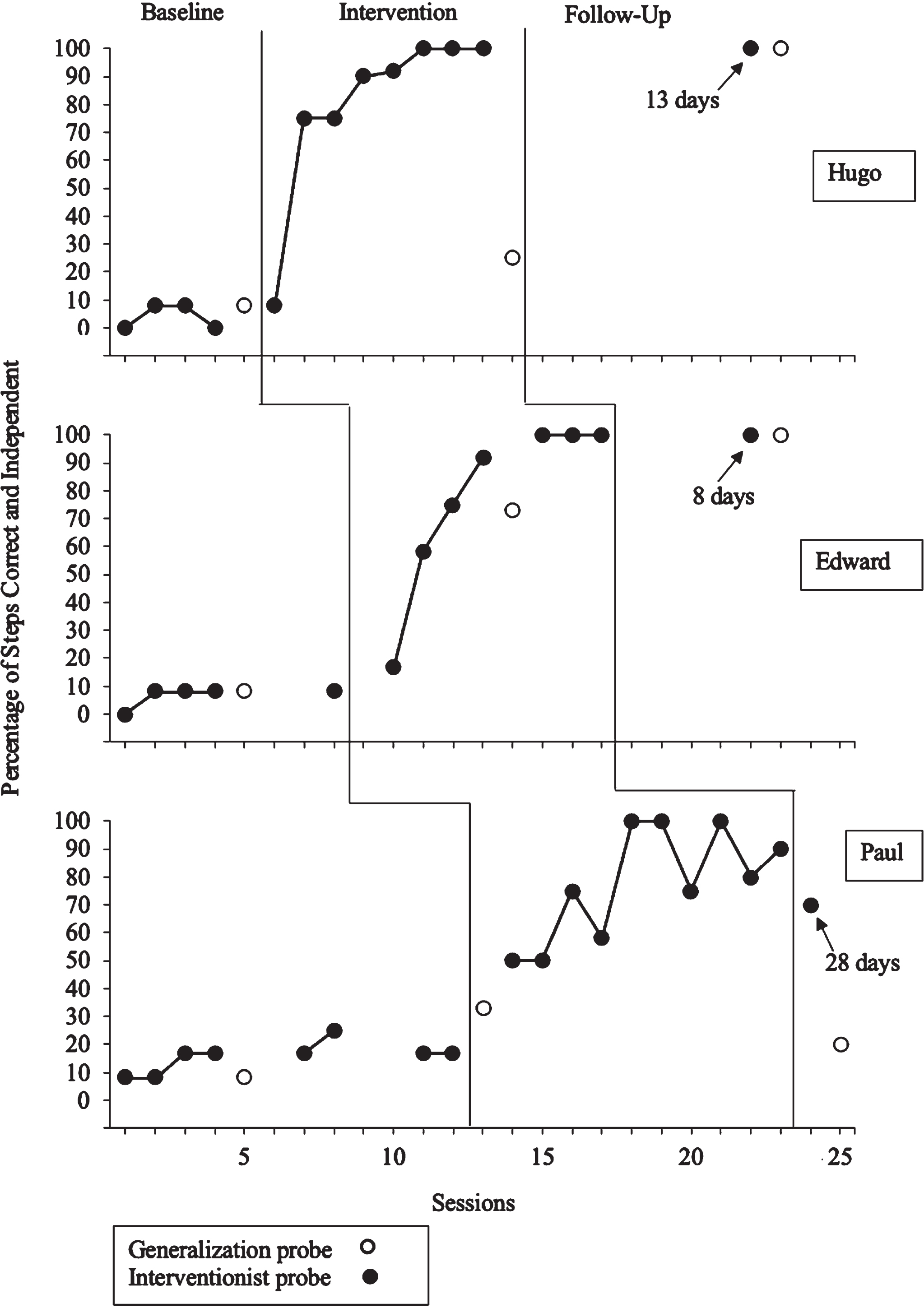
Percentage of correct and independent responses.
During Hugo’s first baseline session he completed none of the steps in the task analysis accurately. During sessions two and three he correctly completed one step in the task analysis, but during session four he dropped back down to no steps correct. In the generalization probe conducted during baseline he completed one step correctly in the task analysis. Intervention was implemented in session six, but his skill level did not increase after the first intervention session. However, after the second session his skill level increased substantially, jumping from 8% correct to 75% correct. Hugo had a steady, accelerating trend and reached 100% skill acquisition by session 11. Hugo reached mastery criteria after a total of eight intervention sessions. However, his generalization probe during intervention was only at 25%. Hugo’s follow-up probe occurred 13 days after intervention. Both his follow-up probe and generalization probe demonstrated skill maintenance of 100%.
During Edward’s first baseline session he completed none of the steps in the task analysis correctly. During the following session, Edward increased to 8% skill accuracy and stabilized at 8% throughout the rest of the baseline sessions. The generalization probe during baseline was also 8% accurate. Intervention was implemented in session ten, and he had a slight increase in skill accuracy after the first intervention session, from 8% in baseline to 17%. He continued to have a steady, increasing trend throughout intervention, reaching 100% skill accuracy on session 15 and reaching mastery criteria after only seven intervention sessions. His generalization probe during baseline was 73% accurate. Edward’s follow-up probe occurred eight days after intervention. Both the follow-up probe and generalization probe demonstrated skill maintenance of 100%.
Paul
During Paul’s first and second baseline sessions he completed 8% of the steps in the task analysis accurately. He then increased to 17% skill accuracy and eventually his baseline levels stabilized there. Paul’s data during intervention demonstrated some variability, but had an overall increasing trend. Paul reached 100% skill accuracy on session 18, but did not hit mastery criteria until session 23. The generalization probe that occurred during baseline had 33% skill accuracy, which was relatively low, yet still higher than his baseline sessions. Paul’s follow-up probe occurred 28 days after intervention due to the end of the semester and participant availability. The follow-up data had some variability, with a dip to 70% skill accuracy and 20% skill accuracy during the generalization probe.
Post hoc analysis and effect size
Tau-U results showed a weighted effect of 98% for the baseline and intervention contrast. This is classified as a strong effect size (Parker et al., 2011).
Discussion
The purpose of this study was to determine the impact of a script for the mnemonic device ELSE delivered through RAC by a field practitioner on participant abilities to determine appropriate job fit. Additionally, we sought to determine if any skills learned during intervention would maintain once the intervention was removed and if participants would generalize any skills acquired to a novel job coach they had not met before. After the intervention, all participants increased their ability to determine appropriate job fit based on the ELSE mnemonic.
Generalization proved to be difficult for participants in this study. Participants did not readily display an increase in the skill accuracy during generalization probes during intervention sessions. Paul did not generalize the skills he gained during intervention or follow-up. Hugo and Edward had an increase in skill accuracy during the intervention condition, although not commensurate with the skill levels during a standard intervention session. Both Hugo and Edward did however demonstrate high levels of skill generalization during follow-up. Unsurprisingly, this study demonstrates the importance of programming for generalization rather than just ‘training and hoping’ for generalization to occur (Stokes & Baer, 1977).
This study demonstrated that a field practitioner is able to easily implement the ELSE mnemonic device through RAC without extensive training. The dissemination of a simple intervention that is easily implemented by practitioners through user-friendly technology, such as Zoom, is needed to bridge the research-to-practice gap. Job decision making skills are one of many sets of skills needed by young adults with disabilities to combat un- and under-employment. Being able to identify appropriate job fit based on education, likes, skills, and earnings can help young adults with disabilities determine if jobs available in their community are worth pursuing.
Explicit instruction is often needed to successfully teach young adults with disabilities problem-solving and decision-making skills (Burke et al., 2019). In this study, the ELSE mnemonic device explicitly teaches young adults with VI and IDD how to determine appropriate job fit by using the mnemonic to make decisions about four key areas to consider regarding employment fit. The ELSE mnemonic can be simply integrated into transition curriculum and implemented by teachers, job coaches, vocational rehabilitation specialists, and other direct service providers. This intervention allows students to explore their strengths, preferences, and needs while determining appropriate job fit (Torres et al., 2021).
One of the silent findings from this study was the lack of attention to needs of individuals with dually diagnosed VI and IDD in job readiness skills. To the best of our knowledge, there is no intervention research in rehabilitation or special education focusing on this unique population’s challenges in obtaining and maintaining employment. Access and outcome disparities of individuals with VI and IDD in employment is a clear indicator of the lack of response to the barriers this population faces. Disparities in employment for individuals with unique needs arise from inaccessible education, lack of training, and limited social awareness of needs and support of this population. Equipping vocational rehabilitation professionals and special educators with effective interventions and increasing their knowledge to effectively serve this population is imperative. Researchers’ responsibility in this matter is not only to address these gaps, but also to develop and adapt accessible interventions. This study serves this purpose.
Conclusion
This study, like all studies, had some limitations that should be addressed. First, the participants in this study were all familiar with the practitioner. Perhaps their familiarity and comfort with her from previous experiences shaped their interactions with her during this study. Future researchers may want to use an interventionist who is unknown to the participants or do additional generalization probes with additional service providers. Second, the participants were all already fluent in their use of Zoom. This familiarity with the platform prevented any issues that may have occurred if a student was not already well-versed in the Zoom platform. The participants in this study also were able to visually process the information on the screen in front of them to some degree, so this intervention may not be appropriate for individuals with more significant vision impairment. Also, delivering an intervention remotely with a video conferencing application can result in technical difficulties. Although we did not experience any technical difficulties in this study, others who attempt to replicate this intervention could experience technical difficulties. In addition, a lack of reliable Internet service may limit whom this intervention would be effective for. Future research should look into delivering the ELSE mnemonic device in-person, reducing participant dependence on the Internet.
The results from this study are promising and demonstrate the impact and flexibility of the mnemonic ELSE on determining appropriate job fit for young adults with VI and IDD. Additional studies are needed in order to determine how effective this intervention truly is. Future studies may replicate this intervention with a different population of students (different disabilities, different employment experience levels, etc.) and through different modes of delivery (other web-based applications or in-person). Replication is required to determine the true effect of “What ELSE about this job?”
Footnotes
Acknowledgments
The authors have no acknowledgements.
Conflict of interest
The authors declare that they have no conflict of interest.
Funding
The authors report no funding.
Ethics statement
The study was approved by the Instiutional Review Board of Florida Atlantic University (# 1823559-1).
Informed consent
Hugo and Edward provided written and verbal consent prior to participation. Paul provided written and verbal assent and his guardian provided written consent prior to participation.