



Abstract
Environment protection and basic health improvement of all social communities is now considered as one of the key parameters for the development. It has become a responsibility for both industry and academia to optimize the usage of finite natural resources and preserve them. Efficient promotion and strategic marketing of Eco Friendly products can contribute to this development. It is important to consider any market as a heterogeneous mix, which requires well-organized and intelligent split or segmentation. A survey was conducted in Kolkata, metropolitan city in India, through a structured questionnaire to measure Perceived Environmental Knowledge, Perceived Environmental Attitude and Green Purchase Behavior associated to 18 product categories identified by Central Pollution Control Board for Eco Mark Scheme, 2002. Two hundred and twenty three data inputs from the respondents were analysed for this study. Here in this study a fuzzy rule based clustering technique was performed to segregate customers into two sections considering three parameters like Perceived Environmental Knowledge, Perceived Environmental Attitude and Green Purchase Behavior associated to Eco friendly product, which acts as an input variable. The rule base has linguistic variables like Significantly High, Little High, Medium, Little Low and Significantly Low and output as “Eco friendly” or “Non-ecofriendly” consumers. A set of
Introduction
Environmental concerns have become one of the primary discussion among practitioners and researchers for more than 30 years since the threat of global warming looming high and resulting in climate change, oxygen depletion, rise of sea level, food crisis etc. [31]. The natural resources of this planet are limited therefore it has become extremely important to develop mechanisms for optimum utilization of those resources and protect and preserve them for our future generations. At the same, time massive growth in population, exploitation of environment to a great extent, unequal distribution of essential resources can lead to major imbalance in the ecosystem [15]. Different organizations have adopted different strategies to protect their environmental sensitivity. It has become the priority for the marketers for bigger companies or as the company grows to develop consumer knowledge about environment friendly product along with effective green marketing strategies to reduce greenhouse gas emission and promote eco friendly products [1]. The marketers play an important role in generating awareness through different communication strategies and develop purchase behaviour of environment friendly product. So it is important to segment consumers into groups like “eco friendly” and “non eco friendly” in order to develop their communication strategy and optimize their communication expense.
Market is extremely heterogeneous and therefore it is extremely important for the marketers to divide it into multiple homogeneous segments based on consumer behaviour and develop product differentiation strategy to increase competitiveness [2]. One of the most frequently used techniques to do this is Cluster analysis to classify customers and develop targeting strategies through multiple clustering methods [2]. Here in this study a fuzzy rule based cluster analysis will be performed to segment customers into two groups as mentioned before based on three parameters like Perceived Environmental Knowledge (PEK), Perceived Environmental Attitude (PEA) and Green Purchase Behaviour (GPB) pertaining to Eco friendly product, which acts as an input variable.
Literature review
The study provides a comprehensive literature review on three attributes connected to this exploration: Knowledge, Attitude, and Purchase Behaviour related to eco friendly product. These parameters act as input variables. The review will also include literature related to Market segmentation.
Knowledge
Knowledge about environment is the intellectual basis that enables someone to lead a more ecologically sustainable life [24]. Environmental Knowledge among consumers has evolved through understanding the impact of any product or its production process on environment in general [7]. The awareness about environment of a person plays an important role at multiple layers to influence his or her behavior to make rational choices while purchasing environment friendly items [17]. It is necessary for a consumer to have enough knowledge and sensitivity towards various environmental issues and challenges. This Knowledge shows some positive correlation with attitudes [5].
Attitude
Attitude is mental propensities that can be expressed through evaluation of a specific object integrated with a level of opinion to a certain extend [8]. Environmental consciousness and sensitivity plays a significant role for shaping ones Attitude towards environment [29]. Study shows that Attitude of consumers towards environment can influence eco friendly Purchase Behaviour [16].
Purchase behaviour
Purchase of eco friendly product can be observed in those consumers who are environmentally conscious enough to buy products which are environmentally safe and produced through an environment friendly process [16]. Consumers should be made aware of the fact of purchasing green as an important criterion in order to minimize attitude-behaviour gap [9] and make the consumers attentive towards the messages related to green [25]. Cognizance about green products generates positive attitude, which plays a key role in eco friendly purchasing [12].
Market segmentation
Market segmentation is a tool which is quiet valuable for marketers in the era of customization and personalization [2]. Exploration and research related to segmentation, targeting and positioning received significant coverage in both academia and industry [6]. An extensive diversity of culture, demographic, socio-economic and behavioural attributes have been applied for classifying green consumers [6]. Study shows that customers or users knowledge, attitude and purchase behaviour associated to eco friendly items varies mainly due to demographic and socio-psychographic factors [23]. The study conducted by Chan in 2000, segregated consumers between heavy and light green based on demographic information and other variables related to environment and green consumerism. Study also supports that eco friendly consumer or users can be grouped into different eco friendly or green categories and variety of strategies related to marketing communication and promotion can be ideated for each of the groups or categories [14]. Eco friendly product or Green Product has been referred as a generic term for any product category in the literature related to segmentation of market. However there are rarely any studies related to market segmentation considering various eco friendly products. This study is directed towards consumer segmentation based on the Knowledge, Attitude and Purchase Behaviour associated to 18 product categories identified by Central Pollution Control Board for Eco Mark Scheme. The segmentation studies related to eco friendly product have considered hard clustering process. However, in many of the cases it is difficult to draw a well-defined demarcation among the groups based on their Knowledge, Attitude and Purchase Behaviour related to eco friendly products. So this study has considered fuzzy rule based cluster analysis to extract the unknown pattern in the data set. The clustering of target consumers will facilitate marketing team to create group profile and address them accordingly through effective communication.
Therefore the study attempts to develop fuzzy rule based system to facilitate decision making, where PEK, PEA and GPB among consumers related to eco friendly products act as a fuzzy input variable with a group of linguistic variable as mentioned (Significantly Low, Little Low, Medium, Little High, and Significantly High) and output as “Eco friendly” or “Non-ecofriendly” consumers.
Methodology
Design of survey tool and collection of data
The exploration with the survey tool was executed among 230 respondents from Kolkata through a structured questionnaire, out of which 7 incomplete survey forms were discarded due to incompleteness. Random sample was drawn from 5 Housing Societies of Kolkata. The sample comprised of 121 female and 102 male. 43 responses belong to age bracket of 20–30 years, 157 of them belonged to age bracket of 30–40 years, and 23 of them belonged to age of 40–50 years. The family income per annum for 172 respondents was lower than Rs.6 lakhs and that of 51 respondents had family incomes ranging between 6 to 10 lakhs. The totals of 172 respondents were from the lower income families, while 51 respondents had family incomes in the higher range for that society.
The questionnaire was organized and structured into two portions. Section A comprised of the information related to demographic variables of the respondents. And Section B comprised of the questions used to measure Perceived Environmental Knowledge, Perceived Environmental Attitude, and Green Purchase Behavior associated to 18 product categories identified by Central Pollution Control Board for Eco Mark Scheme, 2002. The questions related to the product categories used to test consumers’ PEK, PEA, and GPB, which were measured on 5 points scale anchored between Strongly Agree (5) and Strongly Disagree (1). This is known as Likert scale. The products used in this study were soap, detergent, paper, cooking oil, lubricants, packaging material, paint, batteries, electronic, food flavours, wood alternatives, cosmetics, aerosol propellants, plastic containers, and textile, fire extinguisher, leather and coir items. As the exploration was executed in the capital city of an Indian state, Kolkata, the respondents of this region are more comfortable with their vernacular medium. Therefore, the bi lingual-questionnaire was developed using Bengali and English language. It was experienced that the quality of response was quiet satisfactory with bilingual questions.
Fuzzy rule-based systems (FRBS)
Fuzzy logic is generally used when the environment having impression, ambiguity, lack of complete information, contradicting information, partial truth and possibility of occurrence, in other words an environment of uncertain and flawed evidence [19]. Fuzzy rule based system comprises of two major portions they are Knowledge Base (KB) and Inference Engine (IE). Knowledge can be expressed in multiple forms. Human knowledge can be best represented through expression evolving from normal communication. The Knowledge Base usually symbolizes the acquaintance with the problem that can be cracked through fuzzy linguistic rules like IF-THEN, and effective utilization of fuzzy inference system through Inference Engine. This will help in generating output from FRBS, with specific input. The illustration of FRBS is shown in Fig. 1.
The diagram of an FRBS.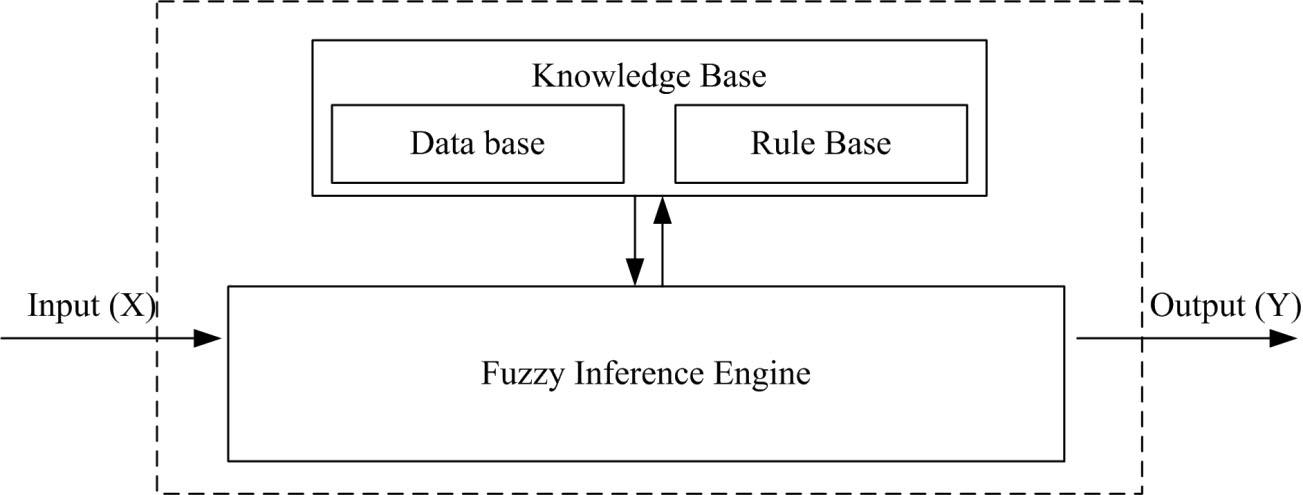
There are three components in FRBS – the first step is fuzzification followed by inference and ends with defuzzification. Fuzzification is the procedure by which appropriate fuzzy sets are formed after the input parameters are being fed into the system. These fuzzy sets are formed to express the measurement of uncertainty. Then the inference engine use these fuzzified measurements to assess the rules which are controlled and kept in the fuzzy rule base and then the result or output is obtained in form of fuzzy logic. Then this fuzzy output is further transformed through a process called defuzzification into a single crisp value. This are quantifiable result and easy to use for analysis. Defuzzification is the method of mapping a fuzzy set to a crisp set [26].
Fuzzy Set Theory (FST) is applied in this exploration for quantification of the linguistic variable in terms of vague evidence and facilitates consumer’s or respondent’s decision in an uncertain and ambiguous situation. The method contains the following elements(a) fuzzy input variables like PEK, PEA, and GPB and (b) linguistic terms like Significantly Low (SL), Little Low (LL), Medium (M), Little High (LH), and Significantly High (SH). Fuzzy logic controller (FLC) is significantly easy to formulate and apply. The output achieved is significantly robust [26]. A systematic development of FLC can determine the knowledge base with allocation of membership function of the input variables which is the actual data base for the analysis and rule base. Approaches like Mamdani, Takagi and Sugeno’s had suggested for formulating fuzzy reasoning tool [19, 28]. A method named as Gradient descent was also applied for fuzzy rule generation [22].
Good rule base can be identified through reinforcement learning mechanism [10]. Likewise, many researchers took an initiative to produce the basis of the rule associated to fuzzy reasoning instrument through neural networks [21, 27]. In this research, standard fuzzy reasoning tool had been adopted to construct a predictable plotting between the perception of Environment Knowledge, Attitude, and the consumer decision.
Fuzzy linguistic technique is to make linguistic decisions and methodically presenting linguistic variables through natural assessment [20, 31]. A fuzzy set is used to represent fuzzy linguistic label. Fuzzy sets are generally used for modelling imprecision and uncertainty by approximation methods [3].
Three input and one output Fuzzy inferences system using Mamdani Approach.
A fuzzy set
Input and output variables were expended for Triangular membership functions to achieve simplified framework of the Fuzzy Logic Controller. A gradation of coinciding of two was utilized, as shown in Fig. 2. Moreover, creation of dissertation which was normalized to the span of [0.0, 1.0] which were utilized. This value or level of membership (as given below), enumerates the membership grade of the element in X to the fuzzy set A [26].
Here,
The Variables PEK, PEA and GPB Already Defined
The variables which were considered as input
Linguistic terms and their ranges for the variables
{PEK},
{PEA} and
{GPB}
Linguistic terms and their ranges for the variables
Membership function distributions for the variables: 
Eco-friendly and non-ecofriendly were two linguistic terms used to express the output variable:
Determining FRBS from input and output variables
Rules are the fundamentals of the FRBS, and associations between its inputs and output variables were represented by these rules. Three input variables were reflected in this problem and each of them was expressed through five linguistic terms. Three input variable and five linguistic terms leads to maximum of
The 1
If
And
If
Fuzzy rule encoding
In this study there are 3 input variables. Each of the variable is having 5 linguistic terms. These variables and terms are used to define 125 rules. The linguistic terms are explained through index values, as displayed in Table 2.
Description of fuzzy linguistic term
Description of fuzzy linguistic term
Membership function distributions for output fuzzy variable: 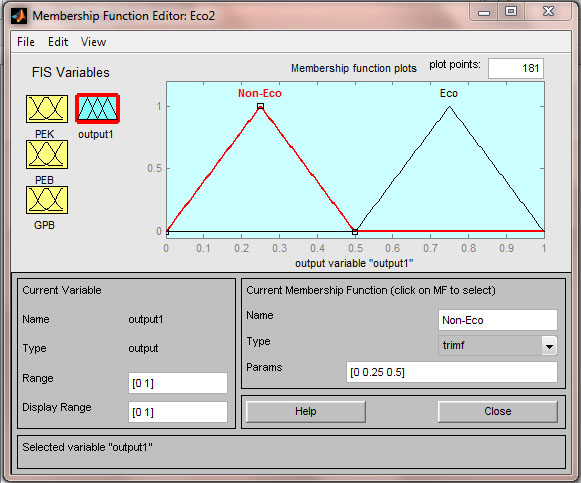
A schematic view of IF-THEN else rules formulation using three input and one output in fuzzy inferences system based on Mamdani approach.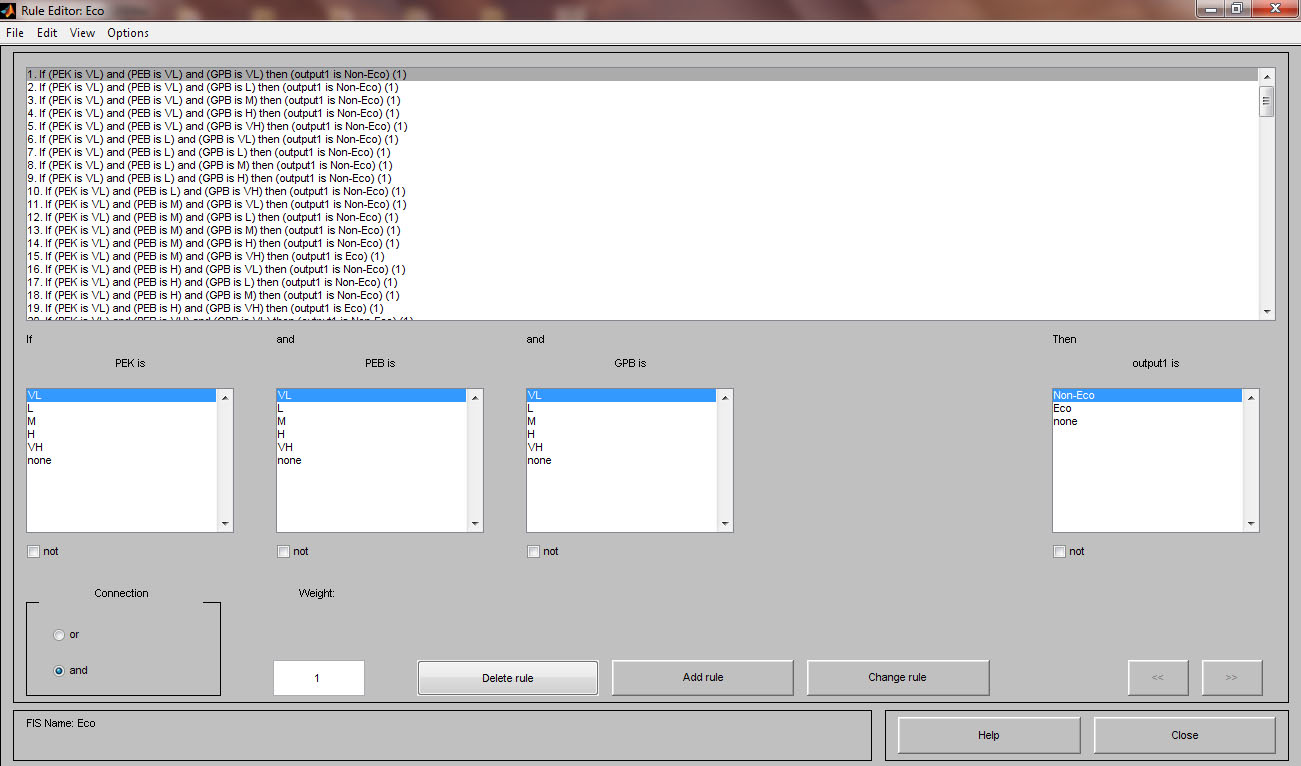
Fuzzy Logic Controller is developed through a set of rules which are portrayed through IF (signifies a set of conditions that can be satisfied) and THEN (signifies a set of consequences that can be prepared). The precursor is a condition in an applied domain and resulting in a regulated action for the system. Some linguistic terms are used to represent the precursors and its results of IF-THEN rules. The inputs of FRBS must be provided through fuzzy sets, and then the discrete inputs need to be fuzzified. Furthermore, the output which is obtained from Fuzzy Logic Controller is in form of fuzzy set. Then the crisp value which should be consistent, a defuzzification method needs to be applied. All the input variables are measured through fuzzification followed by a scale where the range of values of input variables is transferred into respective universes of discussion. Then fuzzification method was performed to convert input data to appropriate linguistic values and can be examines through fuzzy set labels.
The knowledge of the application domain based on evidences from the data set is the fundamental building block of rule-based system. All the required data is being provided by this database to design the control rules through an effective engagement of the linguistic terms. Domain experts’ policy and the goals that need to be controlled are being described by rule base through a set of linguistic control rules.
As mentioned earlier Fuzzy Logic Controller has an Inference Engine which has got the capability to develop a human decision-making simulation. This simulation process is based on fuzzy perceptions. The process infers fuzzy control events through fuzzy implications and rules. The crisp denomination related to the fuzzified output is achieved through the method of defuzzification. In this study, defuzzification was conducted through adoption of COS method. The formula is mentioned below,
where
Fuzzy fired rules based on Mamdani approach.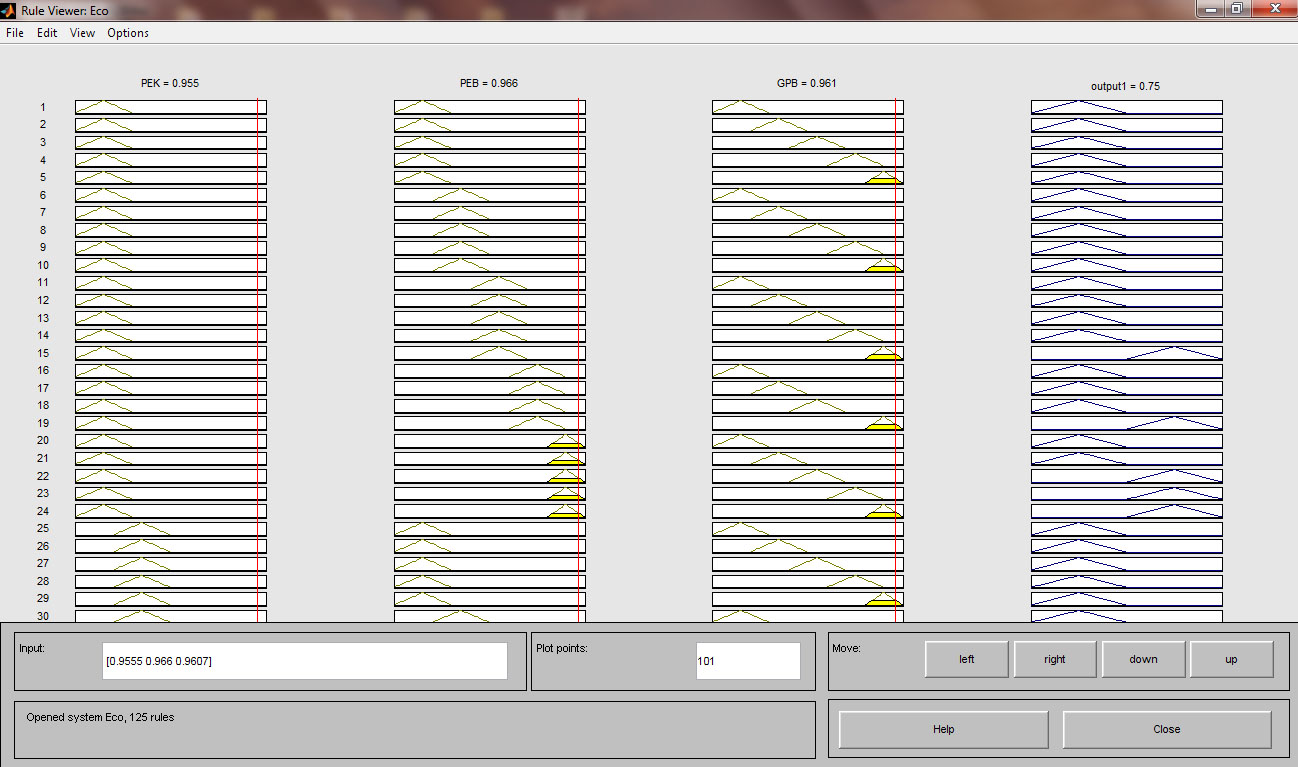
Traditional fuzzy reasoning tool was composed using three inputs, namely Perceived Environmental Knowledge, Perceived Environmental Attitude, and Green Purchase behavior and each having five linguistic responses (that is, significantly low, little low, medium, little high, and significantly high). A set of
For example rule number 25, which reveals that even if Perceived Environmental Knowledge is “Significantly Low” but their Perceived Environmental Attitude is “Significantly High” and they exhibit “Significantly High” Green Purchase Behaviour, then they can be considered as “Eco Friendly Consumers”. Similarly 13 such fired rules were identified through Fuzzy Reasoning Tool, which can lead to better Decision Making and facilitate the marketers to develop strategy and take up effective marketing decisions.
Conclusion
The study attempted to create a fuzzy rule based system for decision-making based on Perceived Environmental Knowledge, Perceived Environmental Attitude, and Green Purchase Behavior among consumers related to Eco friendly products. In the presented project,conventional Fuzzy reasoning tool was used. Perceived Environmental Knowledge (PEK), Perceived Environmental Attitude (PEA), and Green Purchase Behavior (GPB) were selected as a fuzzy input variable, each one with set of five linguistic variable (significantly low, little low, medium, little high, and significantly high). Output had two sets defined as “Eco friendly” or “Non-ecofriendly” consumers.
Fuzzy reasoning tool is popularly applied to deal with complex processes and are not well defined. The tool can be effectively used for the systems which are controlled through skilled human operator with lack of knowledge. However multiple researchers are applying theories and tools related to Fuzzy logic in behavioral science domain as Decision Making tool. The study on decision making has been explored from a multi disciplinary approach comprising of philosophy, psychology, biology, mathematics, and computer science. Market researchers always aim towards finding the right ways of interacting with the clients and consumers. They mine appropriate information related to consumer behavior. Then analyse them effectively and head towards impactful decision making. In this study we have tried to identify a set of effective rules, which can guide the Market researchers. The rules can predict the behavioral pattern of consumers to exhibit Eco Friendly Behaviour based on their Perceived Environmental Knowledge, Perceived Environmental Attitude, and Green Purchase Behaviour pertaining to 18 product categories. Therefore this fuzzy rule based clustering technique will facilitate
Efficient Data clustering technique is extremely important tool for market segmentation. A comparative study between Fuzzy Clustering Algorithm and Hard Clustering Algorithm to understand and explore consumers’ behavioural pattern pertaining to eco friendly product purchase can be an important area of study to develop a better decision making tool for market penetration.
Footnotes
Acknowledgments
The researcher would like to thank the respondents who had shown sincere cooperation and provided their valuable time to fill the questionnaire.