



Abstract
The objective of this study is to evaluate areas of applicability of Industry 4.0 or the Fourth Industrial Revolution (4IR) to the Agriculture sector in India and how significant benefits can be delivered to the farmers by focusing on selected use cases. Agriculture has been the backbone of Indian economy for centuries, however, its contribution to the India’s economy, measured as a per cent of Gross Domestic Product (GDP), has declined over the last decade. Farm productivity has only marginally improved during this timeframe. At the same time, a surge in expected demand for food grains is expected, posing a significant challenge to the demand-supply parity. To solve this conundrum, 4IR Technologies as the umbrella framework comprising of cognitive internet of things (IoT), big data analytics, drones/spatial technologies and digital user experience, were evaluated in this research study. A baseline assessment of the digital use cases of 4IR Technologies that have already been leveraged in India was conducted. The list of these digital use cases was then enhanced and prioritized using Delphi technique, considering economic value of the use cases to the Indian farmers as well as ease of their implementation.
Keywords
Introduction
Agriculture, a core sector for the primarily agrarian economy of India, has witnessed de-growth in its contribution to the National Income over the last few decades. As per the recent Economic Survey by the Ministry of Finance, Government of India (GoI), it stood at a meagre 16.5% in 2019–20 (compared with over 18.2% in 2014–15). However, it is also a fact that over 70 per cent of the rural households still depend on Agriculture for their livelihood (The Economic Survey of India, 2019–20). More than 65% of the country’s population under poverty lives in rural areas. Hence, their chance of getting out of the same depends a lot on the performance of the Agriculture sector. The productivity of the sector has also come under tremendous volatility. Over the last decade, for example, the average growth rate of production of wheat, rice and food grains has shown declining growth patterns. Low productivity, declining water and land availability, rising labour costs, and declining international commodity prices, as well as late-onset of and erratic periodicity of monsoon, are some of the reasons for the current challenges.
In this backdrop, the GoI, both at the Central and State levels, has launched various welfare and support programs with the objective to double farmers’ income. These programs have included promotion of greater farming mechanization methods and use of latest technologies in Agriculture. From a technology evolution perspective, there have been rapid advances in 4IR and its related technologies (e.g., communication infrastructure, sensors, analytics) opening up avenues for new applications/use cases to help solve the challenges that have been constraining the sector’s growth for a long time.
This study therefore contextualizes/reviews the related research and proposes a solution to the key issue of how could 4IR Technologies address the current challenges of Agriculture, particularly in the Indian context. The paper has been organized as follows: Section 2 discusses related work/literature review, Section 3 presents the research methodology, Section 4 shows the scope and limitations of the study, Section 5 articulates the key findings and discussion and finally, Section 6 presents the conclusion.
Literature review
In this section prior research about three aspects is included. The first involves the concept of 4IR Technologies itself. Thereafter, in the second section, information requirements of Indian farmers have been summarized. Finally, for the third section, 4IR Technology solutions that could help meet these information requirements have been discussed.
The Industry 4.0
The Industry 4.0 (4IR), a term coined by Prof. Klaus Schwab, founder and executive chairman of the World Economic Forum (WEF), describes a fundamental transformation as regards how we live, work and relate to each other. It is a world where human development is enabled by technology that is a progression from the First (1IR), Second (2IR) and Third (3IR) Industrial Revolutions.
The 1IR started in the 18
The 4IR is characterized by ‘fusing technologies’ [23] that stretch across physical, digital, and biological spheres. Individuals move between digital domains and offline reality with the use of connected technology to enable and manage their lives [17]. These fusing technologies include internet of things (IoT) and artificial intelligence (AI), which are regarded as a General Purpose Technologies (on the same lines as the domestication of plants and animals, smelting of ore, the invention of the wheel, the steam engine, electricity, etc.) that have the potential to significantly impact our society, including its economic and social structures.
Besides fusing technologies, some of the other facets of the 4IR include managing ethics and identity, governance of agile technologies, managing business disruption, fostering innovation/productivity as well as managing security and conflict.
For this study the technological aspects of the 4IR have been considered. These include advances in big data, AI, machine learning (ML)/robotics, IoT, digital user experience, drones/ spatial technologies and conversational commerce. These have been elaborated in the context of Agriculture in the subsequent sections.
Information requirements of Indian farmers
Several research studies have been conducted that highlight as to what the Indian farmers really struggle with when it comes to timely and accurate information requirements. In a socio-economic study of the five major states (Punjab, Haryana, Uttar Pradesh, Bihar and West Bengal) of the Indo-Gangetic Plains, it was found that areas where farmers required most information support included farm preparation, planting seeds and farming support activities [16].
In a survey of farmers in the Indian State of Haryana in the Jind district, the information on modern cultivation techniques was found to be highly required. This was apart from information on new crop production materials and government schemes on Agriculture, fertilizer management and disease/pest management. Post-harvesting techniques, agricultural loan, subsidized products/seeds and plant materials, soil and water management, weather information and storage of crops were ranked lower in order of priority [7].
The fourth industrial revolution framework, WEF, 2016.
Summary of literature research on the intensity (high to low) of information requirements of Indian farmers
In another survey of tribal farmers conducted in the State of Kerala, a majority of farmers mentioned about their information requirements about the availability of seeds, followed by new crop production, insecticide availability, and pesticide application, government schemes and fertilizer availability/application methods. This was followed by information about new agricultural equipment, loan facility, harvesting methods, soil preparation, irrigation, storage methods, agriculture insurance policy, weather information, market information on agricultural information, farm labour availability and transport facility [9].
Interestingly, for neither of the two surveys (i.e. conducted in Haryana or Kerala), was internet mentioned as a source of information. This points to perhaps lack of availability of farmer relevant use cases in existing solutions, which again highlights the value of this study. Most of the information needs for farming were sourced from the Key Opinion Leaders (KOL) or fellow farmers, apart from the inputs from the Government’s Krishi Vikas Kendras. However, it is also noted that the relevance of internet as an information source was mentioned for use cases like remote education and healthcare for farmers.
For the State of Maharashtra, most of the requirements of farmers were for help in new crop cultivation as well as for the availability of seeds, insecticides and fertilizers [4], another analysis, [8, 1] also indicated that male and female farmers required information on crop production, seeds and fertilizers availability. Other areas of information support included water requirement/management for crops, weather information monitoring/forecasting and agricultural equipment availability/procurement and maintenance.
In another study of farmers in the State of Tamil Nadu, it was determined that there are two types of information requirements of farmers for rice crops. These included both the crop related (rice cultivation) and non-crop specific information needs. The most significant crop related requirements included disease/pest management and use of fertilizers. On the other hand, the crucial non-crop related information needs included Government subsidies, crop insurance, farmer loans/credit systems, crop diversification, farmer education and training [3].
As illustrated in Table 1, these information requirements can be broadly categorized into farm preparation, planting seeds, nourishing plants and farming support activities.
As mentioned earlier, for this study, selected 4IR Fusion technologies that have been considered include internet of things (IoT), big data-enabled precision farming/AI and ML, drones/spatial technologies and digital user experience.
Internet of things (IoT)
IoT is a system of interrelated computing devices, mechanical and digital machines provided with unique identifiers (UIDs) and the ability to transfer data over a network without requiring human-to-human or human-to-computer interaction. IoT in Agriculture is gaining momentum in global agricultural practices leveraging data right from weather information, water availability and soil quality at the farms. The IoT sensors measure factors like temperature, humidity, light, air pressure, soil pH, precipitation, groundwater and wind [13].
Big-data analytics enabled precision farming (BDT)
IoT Devices such as crop sensors, sensors fitted to farm equipment, satellite or drone imagery, etc. generate a large amount of data. The data collected by these devices, powered with Big data Analytics enable farmers to predict when to harvest, where to sell the produce, how much to sell it for, what to sow next, which inputs (seeds, fertilizers, etc.) are needed.
Similarly, this analysis can help the manufacturers of seeds, fertilizers, pesticides, agricultural machinery to develop new products or ensure optimum performance as well as uptime of their products [12, 19].
With advances in Artificial Intelligence and Machine Learning, Agricultural Robots or AgBots are getting deployed that help in automating the manual and repetitive activities in farming and helps in improving productivity and efficiency. The most common applications are in:
Soil quality management. Irrigation management. Field mapping. Harvesting management. Weather tracking and forecasting. Dairy farm management.
Big-data enabled precision farming.
Spatial technologies, including Geographic Information Systems (GIS), multispectral imagery collected by satellites or small aircraft or Unmanned Aerial Vehicles (UAVs) or drones determine the following parameters [24, 10]:
Soil and field analysis, at the start of the crop cycle, by producing 3D maps of aerial surveys. Planting systems that shoot seeds and plant nutrients into the soil. Crop monitoring, by assessing colour, size of leaves, to show time-series animations.
With most of the global tractor and farm equipment manufacturers, making investments in launching autonomous farming vehicles, farming is expected to be revolutionized by use of self-driving tractors and robots that can perform time-consuming tasks with increased precision. Besides fuel-saving, the advantages for farmers include
Self-driving tractors’ automatic planting systems have better accuracy, resulting in seed conservation and an improved return on investment (ROI) for growers. Conventional tasks such as tilling, sowing, harvesting of grains, can be performed using autonomous robots with the accuracy provided by the vehicle itself (currently about The tractors’ sensors can also collect information on soil conditions, offering improved maintenance of already-planted crops and generating increased data both before and after harvest time. Self-driving tractors can reduce the dependency on the workforce, providing assistance for driving and managing a wide range of tasks on the farm. Farm equipment of autonomous tractors or AgBots are designed for use in fields. Hence the design poses less risk than self-driving vehicles on road. This also opens up opportunities for offering a fleet of small robots as a service by farm equipment dealers.
Digital user experience platform is an integrated and cohesive piece of technology designed to enable the composition, management, delivery and optimization of contextualized digital experiences across multiple experience customer journeys.
While there are various ways of improving digital user experience, like augmented reality/virtual reality, best practices sharing, conversational AI including chatbots and voice bots have emerged as a key capability. Chatbots are conversational virtual assistants which automate interactions with end-users. AI-powered chatbots, using machine learning techniques, understand natural language and interact with users in a personalized way [26].
Industry 5.0
If fusion technologies are enabling the 4IR, it is pertinent to analyse where the future advances could be. It is anticipated that the next Industrial Revolution, the Industry 5.0, would be about greater personalization. It would be focused on co-operation between man and machine or between cyber, physical and cognitive systems [20]. By putting humans alongside robots, humans could be upskilled for value added tasks, leading to mass customizations and personalization for customers.
Considering that these concepts are still in early stages of development, these have not been included in detail as part of this study. However, they have a potential to further impact the digital experience of the farmers by deep personalization across their lifecycle.
Research gaps and motivation for study
This study is distinctive as it maps the information requirements of farmers with the technologies and rank orders them in terms of value to the farmers themselves. There have been several studies (cited in this paper) that have considered information requirements for specific regions as well as sources for the same. This study brings unique perspective on which technologies could enable a specific information requirement/use case.
Further, the study prioritizes the use cases, making it easier for an information aggregator (e.g., a technology service provider) to focus on the high priority ones, thereby enhancing its relevance to the farmers. Also, while there are several point technology solutions that exist today, it is yet unclear as to how they may interplay/integrate. This paper provides a conceptual technical architecture view that brings out the relevance of various layers to enable the use cases.
Methodology
For this research study, the Delphi technique has been used to achieve consensus expert inputs to address the key question of which 4IR applications (digital use cases) are most valuable for Indian farmers.

Delphi technique – an introduction
The Delphi technique was invented by Olaf Helmer and Norman Dalkey of the Rand Corporation in the 1950s. The method relies on the key assumption that forecasts from a group are generally more accurate than those from individuals. The aim of the Delphi method is to construct consensus forecasts from a group of experts in a structured iterative manner. Delphi is a judgmental forecasting technique and is the only option in situations when there is a complete lack of historical data, or when a new product is being conceptualized or launched, when a new competitor enters the market, or during completely new and unique market conditions [22].
The Delphi technique is a structured process that uses a series of questionnaires or ‘rounds’ to gather information which continues until ‘group’ consensus is reached [5, 11, 14]. Its popularity has centred on the fact that it allows the anonymous inclusion of a large number of individuals across diverse locations and expertise and avoids the situation where an expert might dominate the consensus process [18].
The technique involves the presentation of a questionnaire to a panel of informed individuals in a specific field of application to seek their opinion or judgement on a particular issue [15]. After the questionnaires are returned, the data is summarized and a new questionnaire is designed based on the responses from the first round. This second-round questionnaire is then returned to each participant showing the overall group response and the participant’s response from round one. Participants are asked to reconsider their initial response in the light of the first round’s overall results. Repeat rounds of this process are carried out until consensus has been reached [5, 11, 27].
Rationale for using Delphi technique
There are broadly two types of forecasting techniques judgmental or statistical. Delphi is a type of judgmental technique. Judgmental technique is used (vs. quantitative) in three general possibilities: (i) there is no available data, so that statistical methods are not applicable and judgmental forecasting is the only feasible approach; (ii) data is available, statistical forecasts are generated, and these are then adjusted using judgement; and (iii) data is available and statistical and judgmental forecasts are generated independently and then combined [21, 2]. For this study, judgmental technique has been used considering that available data is not available, so the statistical approaches are not possible.
While considering statistical techniques, there are two possibilities – Delphi or Analogy. Forecasting by Analogy is used in situations where forecasts are developed based on comparison with pre-existing products of similar properties. Hence, this forecasting method is also not applicable considering unique information requirements of Agriculture sector and lack of analogues. Therefore, Delphi is best suited to this study since it leverages inputs from relevant experts.
Research methodology and implementation approach
For this study, a seven step process was adopted.
Step 1, a literature review was conducted (as mentioned in Section 2). The information requirements were identified and mapped to the 4IR technology solutions (mentioned in Section 2.3). This mapping was crucial as it served as the basis for a questionnaire that was developed. Step 2 involved identifying and setting-up a panel of experts (30) was set-up. The panel constituted included not only the technology experts, but also Agricultural Scientists as well as Key Opinion Leaders (KOLs) from villages in the States of Maharashtra and Delhi National Capital Region. Step 3 (Round 1 of Delphi technique) involved conducting interviews with the panel. The objective of these interviews was to enhance the list of digital use cases that was developed from the literature review (in Step 1). Step 4 involved analysis of data, whereby an enhanced list of use cases were synthesized and appended to the list of pre-existing use cases. Step 5 (Round 2) involved administering a survey questionnaire to rank order the list of digital use cases based on perceived value to the Indian farmers (in terms of decision support to farmers for yield improvement, cost reduction and crop risk management) and perceived ease of implementation of these use cases. For Step 6, rank ordering of the digital use cases was achieved with over 70% consensus. Finally for step 7, result was compiled and has been incorporated in this paper.
Enhanced list of use cases of 4ir in Indian agriculture
Legend: IOT: Internet of things, BDT: Big data/precision agriculture, DRN: Drones and spatial, DUX: Digital experience.
The scope of this research study is limited to the applications/digital use cases for the 4IR as defined in this study. A broader definition of 4IR was considered as compared to narrowly focusing on the IoT only.
Further, the enhancement of the initial list of digital use cases in Round 1 and subsequent rank ordering of these digital use cases was done based on interviews and survey of a panel of 30 experts. While these experts were spread across both technology and Agricultural Science background as well as KOLs in selected villages, the results may not be applicable to all the regions. Also, there could be variation in preferences of the experts and KOLs based on the types of crops they grow (cash crops v/s food crops), the type of soil, availability of support mechanisms and incentives, etc.
Key findings and discussion
Prognosis of information requirements of Indian farmers
As a result of literature research (Step 1), 24 digital use cases were identified. This list was further enhanced to 42, based on Delphi interviews in Step 3 (Table 2). The list of 4IR digital use cases in Agriculture was prioritized/rank ordered as part of the Delphi round 2.
As shown in Fig. 3, the priority 1 digital use cases like precision planting (BDT), yield maps per crop (BDT), yield predictors (BDT), cropping calendar planning (BDT), seeding prescriptions (BDT), inventory quality (IoT), and predictive maintenance (IoT) deliver high value to the Indian farmers despite the fact that many of these require significant incremental effort to implement.
Demand prognosis of 4IR digital use cases in agriculture in India.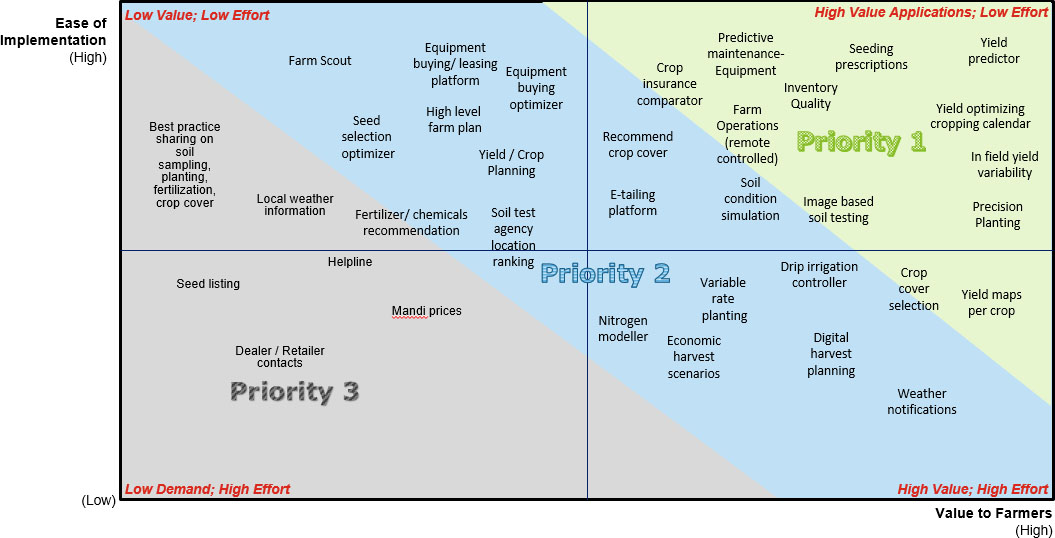
Proposed conceptual technology architecture for 4IR use cases in agriculture.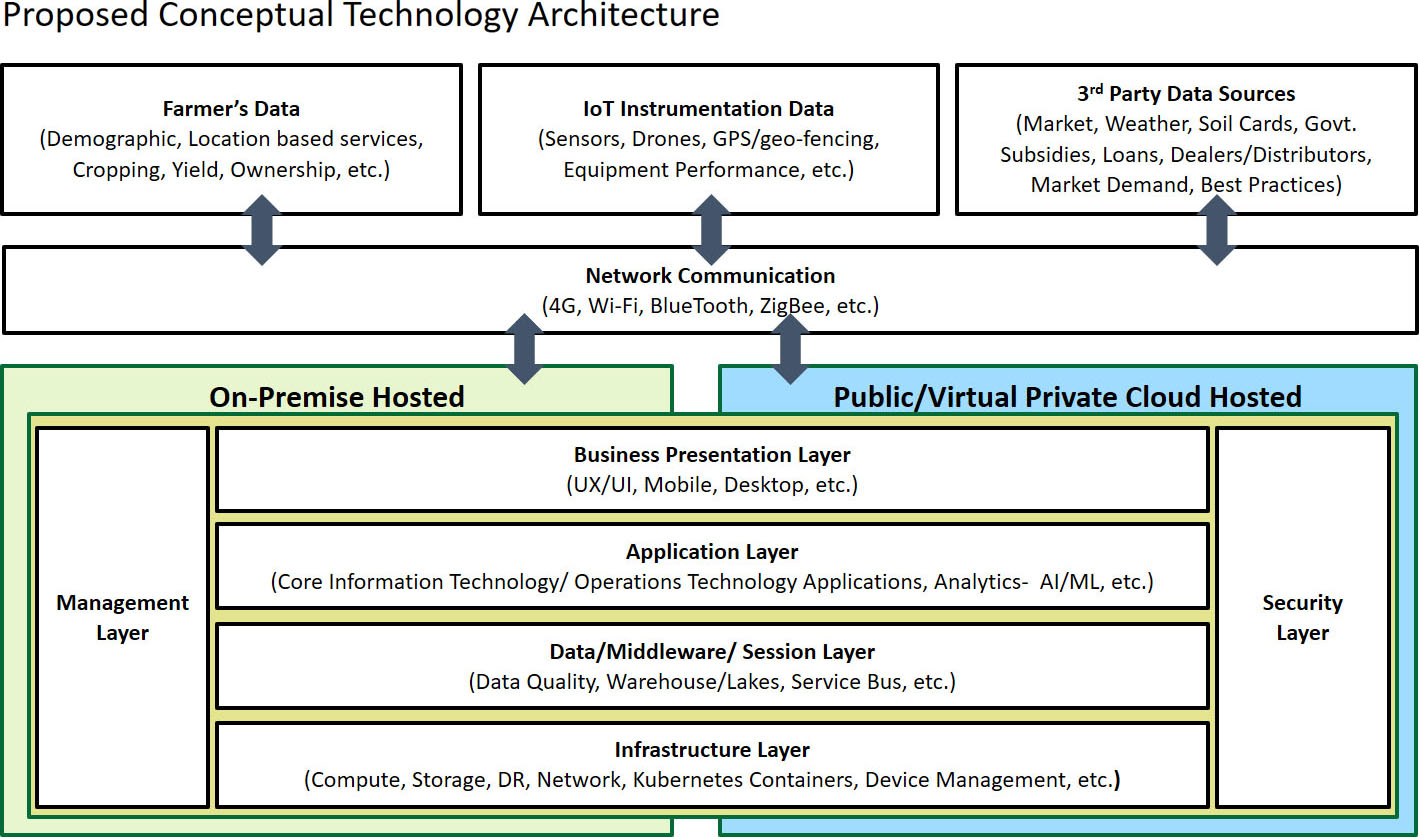
On the other hand, Priority 3 digital use cases like best practice sharing (DUX), local weather information (DUX), seed listing (DUX) were perceived to be low value considering the other pre-existing options or due to lack of personalization to individual farmers.
To implement these technologies would require a robust multi-layered technology architecture as demonstrated in attached Fig. 4. Data would be sourced from three different types of data sources: farmer’s data (that includes demographic data, cropping data, past yields, farm ownership details, etc.), IoT instrumentation data (including sensors, drones, GPS/geo-fencing, equipment performance, etc.) that collect information about humidity, location, Air quality Index, temperature, soil pH, luminosity and 3
The network communication layer comprises the long-range or the short-range wireless networks like 4G, Wi-Fi, Bluetooth, ZigBee, etc. The technology is rapidly evolving with upcoming 5G networks set to transmit 10 Gbps
The business presentation layer interfaces and collects data generated by the three sources based on specific workflows and logic. The data gathered is then analysed by the Application Layer (IT/OT core applications as well as AI/ML apps, etc.) and then passed to the data/middleware layer. This layer is responsible for the session service management and consists of functionality for setting up and taking down of the association between the IoT connection points, data collection in data warehouses and data lakes or integration via Service Bus. The entire infrastructure is hosted in the infrastructure layer. The Security layer and Management Layer are overlays that enable local network topology management, traffic and congestion management, etc. This entire stack can be hosted in an on premise data center or on a public or private cloud platform.
Discussion of the results
This research study provides specific applications/ digital use cases that have been determined to be of significant value to the Indian farmers, while being relatively easy to implement. This research, therefore, should be relevant to not only the farmers, but also to various Technology Solution providers, to Agricultural Sciences firms as well as to Government entities for their farmer enablement programs.
It was also found that most of the existing technology solutions in India offer Priority 3 applications (and to a limited extent Priority 2). This is quite in variance to the actual demand prognosis of the farmers (that value Priority 1 digital use cases higher). It also points to the wide gap between demand (from farmers) and supply (from technology solution providers) side of the applications. This gap could be the likely reason for the low adoption of the existing use cases by the farmer community.
As illustration, 4IR solutions from IFFCO Kisan, RML, iAGri, Agrimall, e-Chaupal, Krishidoot, focus on Priority 2 or 3 digital use cases like registration, market rates, weather, best practice sharing, helpline, etc. Most of these solutions had low downloads of less than 1 million users with only 10–20% active users and over 75% churn within two months of app download. A possible next step for solutions like these could be to consider enhancing to Priority 1 Use Cases.
Conclusion
There have been significant challenges to the Agriculture sector growth and productivity over the last decade. The 4IR, with its Fusing Technologies, has brought about innovation in the IoT, big data analytics enabled precision farming, drones and spatial technologies as well as digital user experience, unleashing new applications that were not possible even half a decade back. While these technologies have been implemented as point solutions on pilot basis, this study has aimed to address the gap in determining which applications are more value adding to the farmers that could be implemented with relatively manageable efforts. The 4IR digital use cases that could deliver greater value to farmers are the ones that could simplify the day-in-their-life and address some of their major challenges (e.g., enhance yield productivity, improve soil testing, seeding and fertilizer prescriptions, cropping calendars and crop inventory management).
This study does not claim to be definitive, more so considering how rapidly the 4IR Technologies are evolving. It aims to act as guide for those researchers who wish to undertake further research on the possible use cases by providing a methodology based on Delphi Technique and providing recommendations about prioritization of these use cases.