



Abstract
Accurate prediction of water table depth over long-term in arid agricultural areas are very much important for maintaining environmental sustainability. Because of intricate and diverse hydrogeological features, boundary conditions, and human activities researchers face enormous difficulties for predicting water table depth. A virtual study on forecast of water table depth using various neural networks is employed in this paper. Hybrid neural network approach like Adaptive Neuro Fuzzy Inference System (ANFIS), Recurrent Neural Network (RNN), Radial Basis Function Neural Network (RBFN) is employed here to appraisal water levels as a function of average temperature, precipitation, humidity, evapotranspiration and infiltration loss data. Coefficient of determination (R
Introduction
Amongst the supply resources for industries, household and farming purpose groundwater is one of the most important. Excessive utilization is the basis for change in groundwater stream pattern and its bad quality in coastal regions make it unhealthy to drink and for different reasons. Hence, groundwater level (GL) supervision is enormously significant, particularly in semi-arid watershed. Network designing and its supervision in spatial and temporal form is dependent on hydro-environmental circumstances and obtainable logistical resources.
Yan and Ma [1] predicted monthly GL using a model combined of autoregressive integrated moving average and RBFN for multiple inspection wells in Xi’an, China. Soleymani et al. [2] designed a novel technique, a combination of RBF and firefly algorithm (FFA) for predicting water level of Selangor River and using FFA to interpolate RBF for finding preeminent result. Amutha and Porchelvan [3] employed ANFIS and RBF to predict GL on basis of preceding precipitation and GL at Malattar catchment, Tamilnadu. Yin et al. [4] presented usability of chronological learning RBFN for to predict precise real-time stage of tidal. Samantaray et al. [5] used various neural networks to scrutinize the groundwater potential of Bolangir watershed, India. Daliakopoulos [6] examined working of various ANNs to forecast GL which helps simulating declining tendency of GL and providing satisfactory forecast to 18 months in advance. Affandi and Watanabe [7] used ANFIS, Levenberg Marquardt and RBF to forecast daily variation in GL to monitor the variation pattern. Coulibaly et al. [8] used a comparatively small span of GL report and associated hydro meteorological data to calibrate diverse types of ANN models for simulating variation in stage of water in Gondo aquifer, Burkina Faso. Krishna et al. [9] projected an ANN methodology for predicting one month ahead GL in particular wells at a coastal aquifer in Andhra Pradesh, India. Emamgholizadeh et al. [10] investigated prospective of ANFIS and ANN about forecast of GL of Bastam Plain, Iran. Suryanarayana [11] used integrated wavelet and SVM model for predicting monthly variation of GL. Moosavi et al. [12] evaluated capability of Wavelet-ANN, ANFIS, Wavelet ANFIS, and ANN to forecast GL. Jalalkamali and Jalalkamali [13] investigated potential of an integrated model of ANN and genetic algorithm (GA) to forecast GL in a particular well. Güldal and Tongal [14] constructed recurrent neural network (RNN) and ANFIS for predicting stage of Lake Egirdir at time of hydro meteorological alterations and anthropogenic actions in Turkey. Yarar et al. [15] used moving average, ANN, ANFIS to estimate change in stage of Lake Beysehir. Chang and Chang [16] employed ANFIS for building a model which helped in predicting to manage reservoir and illustrated potential and ability of the projected model at Shihmen reservoir, Taiwan. Coppola Jr. et al. [17] developed ANNs to predict rise in water stage of a well precisely in semi confined hostile sand and gravel aquifer. Sun et al. [18] applied ANN for predicting groundwater table in a freshwater inundate forest region of Singapore. Firat and Gungor [19] used ANFIS for constructing a structure to forecast course of Great Menderes River. Samantaray et al. [20] employed BPNN, Layer RNN and RBFN to predict runoff in Loisingha, and Saintala watersheds, Odisha. Ch and Mathur [21] developed a methodology on basis of a combined ANFIS and Particle Swarm Optimization approach to quantify ambiguity in groundwater surge. Karaboga and Kaya [22] examined the heuristic and hybrid approaches utilized in ANFIS training. Sahoo et al. [23] studied applicability of RNN and RBFN to forecast daily streamflow at a gauge site in River Mahanadi. Nguyen et al. [24] explored application of confined learning approach in dynamic evolving neural-fuzzy inference system for forecasting stage of water of Mekong River. Seo et al. [25] developed and applied wavelet-based ANN and wavelet-based ANFIS to forecast stage of water on daily basis and investigate their accuracy. Gong et al. [26] validated ANN, SVM and ANFIS to predict GL while considering interface amid surface and groundwater. The objective of this research is to predict water table depth using various soft computing algorithms.
Case study
Nuapada is a district of Odisha. This is situated in western Odisha. It falls amid 20
Proposed study area.
RBFN
In past decades, ANN is being vastly linked for developing, optimizing, estimating, predicting and monitoring complex arrangements. RBFN is a novel and efficient feed forward neural network (FFNN) consisting of three layers, having good uniqueness of estimation performance and universal finest [27]. In general, RBFN comprises of input, hidden and output layer. For transferring recorded signal to hidden layer every neuron is accountable in input layer. RBF is frequently used as transfer function for hidden layer, while an easy linear function is usually adopted for output layer. Major motivation to choose RBFN is because it is fine in computation, simple, reliable, better adjustment to optimizing problems and different adopting techniques and in addition its flexibility to handle constraints that are much complex [28]. ANN implements nominal calculation for offering a yield. Calculation includes one-pass mathematics step.
Architecture of RBFN.
In recent time, NNs have turned out to be extremely popular to predict in a lot of areas of science and engineering. NN is a pragmatic technology for modeling, which has a capability for identifying fundamental vastly multifaceted relation of input and output values. NN maneuver using learning connection amid input constraints and proscribed and unrestrained variable learning from previous noted values [29]. RNNs have lately achieved reputation as a promising and computational tool amid various kinds of NN which are alike FFNNs. However these networks contain extra feedback loop in state-space demonstration of vibrant structure. RNNs help in providing forecasting on basis of preceding time series value based on quantity of memory constituents by amount of feedback circles. RNNs otherwise is said to contain extra feedback loop either from output or hidden to input which setback and stock up facts from preceding time step which is not there in FFNNs structure. Existence of feedback loop puts intense influence on ability to learn and presentation of NN. A distinctive RNN structure comprising of M external input, N hidden neuron and K output is shown in Fig. 3. RNNs are appropriate for procedures which involve dynamic change with respect to time and appropriate for time series for precedent data provisionally for predicting data of succeeding prospect time steps.
Performance of constraints using RBFN
Performance of constraints using RBFN
Architecture of RNN.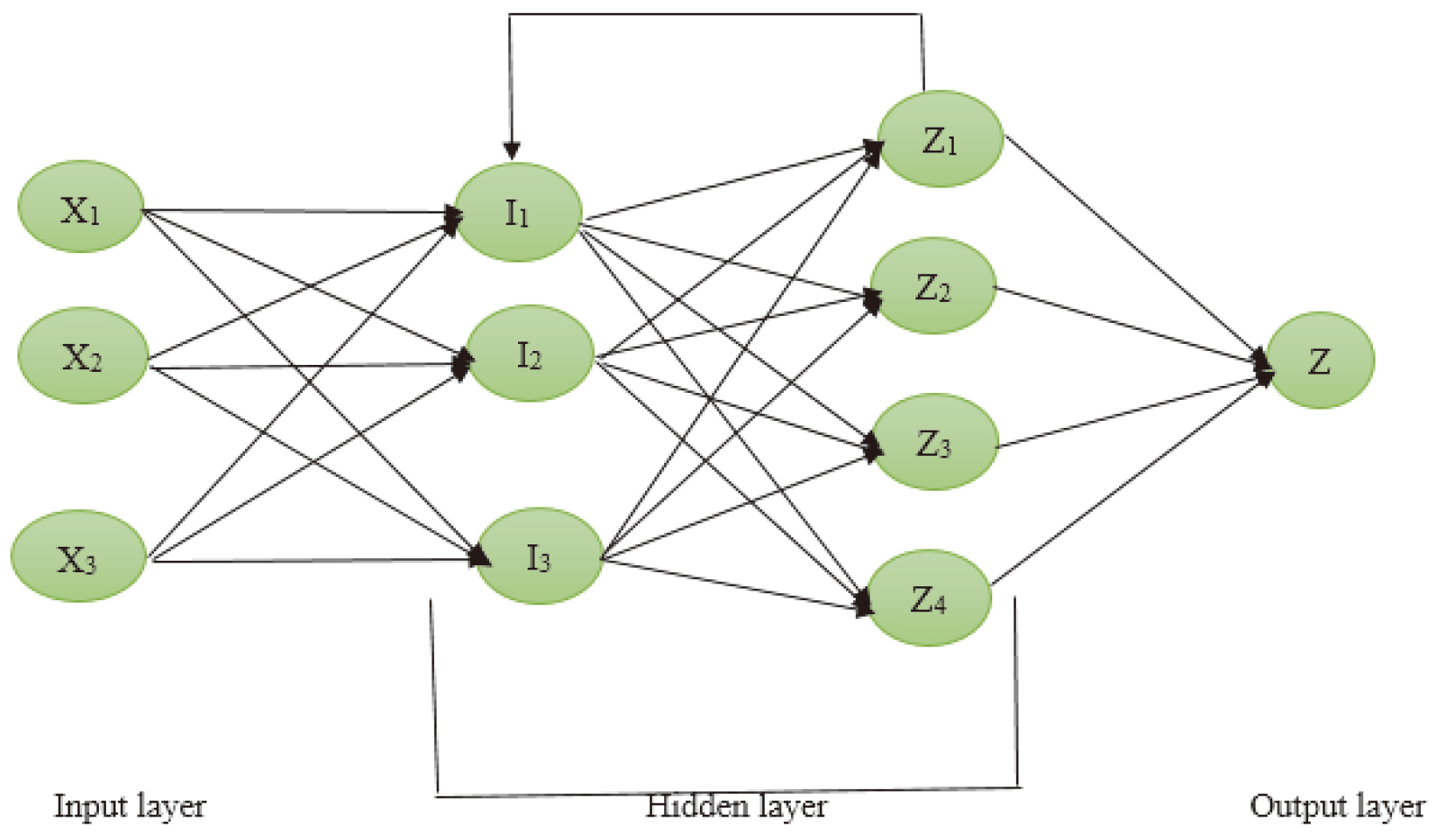
ANFIS is a worldwide estimator which helps in approximating whichever genuine incessant function having a solid set of accurateness level to any extent. Fundamental arrangement of FIS category is observed to be a model which helps mapping input characteristic to input membership functions (MFs). Subsequently it communicates this MF to rules and rules to a series of output characteristic. At last mapping of output characteristic to output MFs, and output MF into a solitary output or a conclusion linked with output [30, 31]. All FIS consists of three major components, defuzzifier, fuzzy database, and fuzzifier. Fuzzy rule base and deduction locomotive are two vital components of fuzzy database. Structure of an emblematic ANFIS is represented in Fig. 4. First layer comprises of nodes where each is an adapted one having a function namely generalized bell MF or a Gaussian MF. In second layer, each node is permanent on behalf of firing power of every regulation, and is evaluated using fuzzy and connective of ‘multiple’ of inward indicators. Each node in third layer is rigid on behalf of standardization firing power of every regulation. The
Performance of constraints using RNN
Performance of constraints using RNN
Performance of constraints using ANFIS
Performance of constraints using RBFN
Architecture of ANFIS.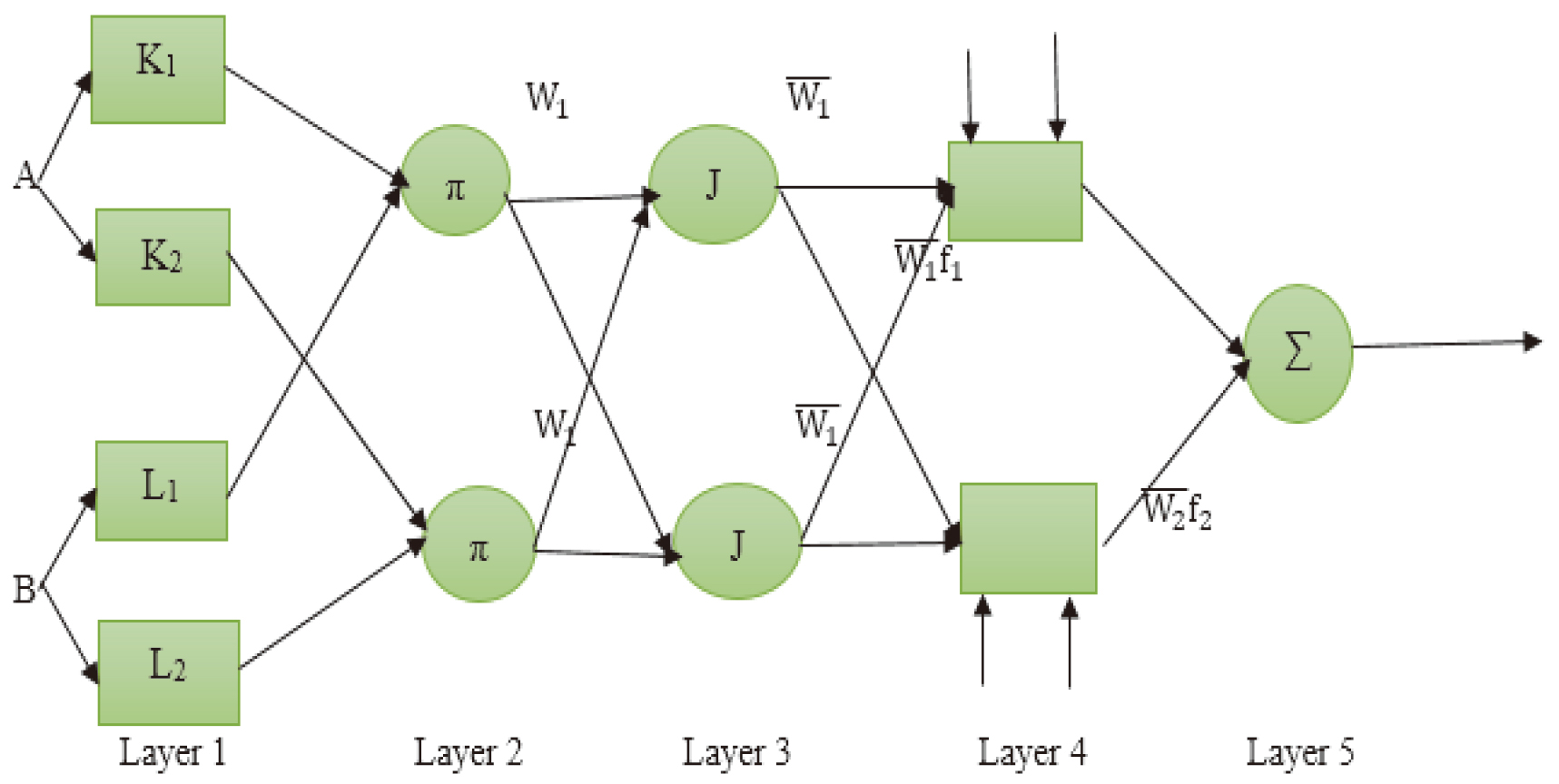
Here two scenarios are considered to evaluate the performance of model. Monthly Precipitation, Avg. temperature, evapotranspiration, humidity are recommended as input parameter for scenario 1. Addition of infiltration loss with the parameters of scenario 1 is considered as input constraints for scenario 2. Data from 1994–2013 and 2014–2018 are used for training and testing network.
where,
Performance of constraints using RNN
Performance of constraints using ANFIS
Scenario 1
For RBFN results are conferred below for Nuapada station. For performance evaluation, 4-0.3-1, 4-0.2-1, 4-0.5-1, 4-0.9-1, and 4-0.7-1 architectures are deliberated. Preeminent model architecture is institute to be 4-0.5-1 which possesses MSE testing, training value 0.05894, 0.00509, RMSE testing, training value 0.07006, 0.06338 and R
Similarly, here to evaluate model altered transfer functions like logarithmic and tangential sigmoidal are engaged to illustrate model performance. R
Six different membership functions are used to evaluate the efficacy of model in case of ANFIS algorithms. Among them Gbell function gives prominent value of performance which possess MSE and R
Actual verses predicted water table depth using ANFIS, RNN, and RBFN for (a) training and (b) testing phase.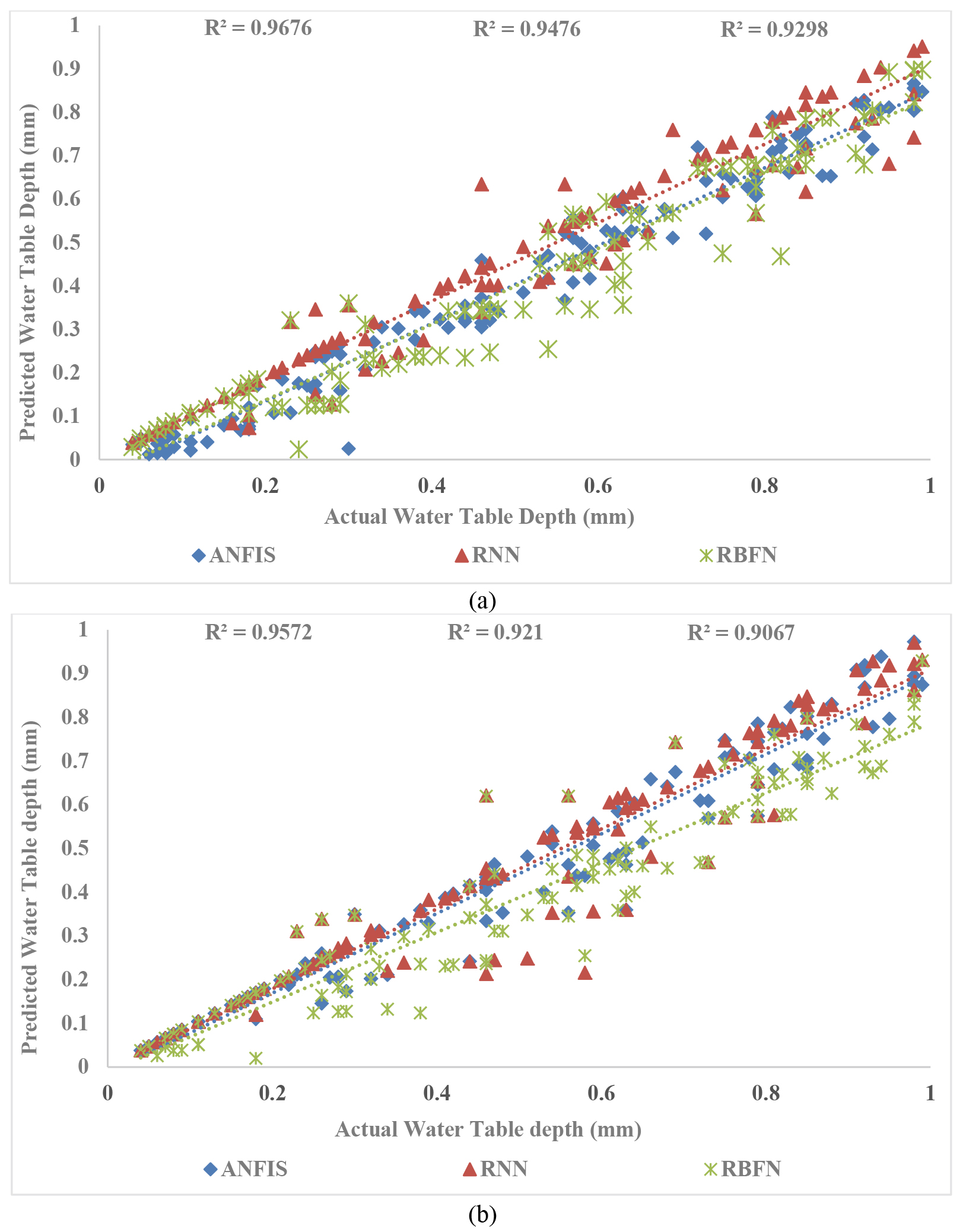
Similarly for RBFN superlative model architecture is established to be 5-0.9-1 which retains MSE training, testing value 0.00601, 0.00418, RMSE training, testing value 0.04984, 0.03116 and R
Actual verses predicted water table depth using RBFN, RNN, and ANFIS for Scenario 2 are presented in Fig. 5.
Conclusion
Present study focuses on working application of three developments in ANN technique, i.e. ANFIS, RNN and RBFN model for comparing GL prediction in Nuapada watershed. Two scenarios are considered for evaluating efficacy of model. Inclusion of infiltration loss as input in context to scenario 1, model gives prominent performance. Model performance is done on basis of RMSE, MSE and R