



Abstract
The magnitude of the utility of a good depends on the subjective psychological evaluation of the good by the consumer, and the difference in the obtained utility will affect consumer behavior, taking into account that consumers are not completely rational in the actual decision-making process, and that under uncertain conditions, consumers’ perception of loss is much greater than gain. This paper investigates an improved scoring function based on consumer utility and loss aversion, which takes into account the effects of different decision makers’ preferences and loss aversion on the decision outcome. First, the existing score function of intuitionistic fuzzy sets is analyzed in depth, an improved score function is defined, and its properties and special cases are studied in detail. Then, a Multi-Attribute Decision-Making (MADM) method is proposed based on the improved scoring function combined with the intuitionistic fuzzy hybrid average (IFHA) operator. Finally, a real case of new energy-used car transaction decision-making is given, and the proposed method is validated by Spearman’s correlation coefficient, WS ranking similarity coefficient, and RW coefficient to prove its practicality and effectiveness.
Keywords
Introduction
With the wide application of the energy industry in the automotive field, new energy vehicles have been developing rapidly, especially under the support of our government’s new energy vehicle policy, the development of new energy vehicles is particularly rapid. The increase in the number of new energy vehicles promotes the vigorous development of the new energy used car market. Currently, the transaction decision of used cars is usually a multi-attribute fuzzy decision, but because the current transaction evaluation methods tend to ignore the psychological factors that the decision maker is affected by in the actual decision-making environment. Considering that consumers tend to make decisions in the hope of maximizing the utility obtained, and at the same time, under uncertain conditions, consumers cannot be completely rational, it is also necessary to consider some behavioral anomalies of the decision maker, such as the decision maker tends to have a strong perception of loss, which can be attributed to the consumer’s psychological factors in economic activities. Therefore, ignoring the economic impact of consumers’ psychological behavior in actual decision-making can lead to often inaccurate decision-making results in the past, which also affects and restricts the development of the used car market and limits the improvement of the efficiency of used car distribution. Multi-attribute decision making as a common decision making method. Atanassov [1]introduced hesitancy into Zadeh [2] fuzzy set theory and proposed an intuitionistic fuzzy set theory that takes into account three aspects of information. Compared with traditional fuzzy sets, intuitionistic fuzzy sets are more practical in dealing with vagueness and uncertainty problems by considering three aspects of information, and are therefore widely used. The Intuitionistic Fuzzy Hybrid Averaging (IFHA) operator not only weights the intuitionistic fuzzy numbers to prevent information loss but also takes into account the importance of data location, making it more suitable for intuitionistic fuzzy multi-attribute decision making. Sensible knowledge is developed in more and more decision-making fields [3]. Yager [4] proposed ordered weighted averaging (OWA) operators for many applications, adding the effect of evaluator optimism to the setting of weights. Liang, Qi, Ding and Leng [5] proposed a hybrid multi-attribute decision making method based on TOPSIS. By incorporating preferences from the standpoint of scheme preferences, He and Liu [6] developed the intuitionistic fuzzy multi-attribute decision-making technique. Chao and Jing [7] synthesized fuzzy hesitation sets and intuitionistic fuzzy sets and proposed hesitation intuitionistic fuzzy sets. Wu, Liu and Wan [8] improved the score function and proposed a new intuitionistic fuzzy ensemble operator. Li and Chen [9] introduced the concept of D-intuitionistic fuzzy hesitation set. Meng, Wang, Zhang and Liu [10]proposed a new intuitionistic fuzzy ensemble operator to improve the score function from the angle that the number of pros and cons is equal. However it doesn’t reflect the reality of the issue, their improvements to the decision-making process are based on the same population of positive and negative views. Rahimi, Kumar, Moomivand and Yari [11] proposed an intuitionistic fuzzy entropy measure for supplier attribute selection and ranking. Thao [12] established the entropy measure and knowledge measure of intuitionistic fuzzy sets based on the divergence test of intuitionistic fuzzy sets. AI-shami, Ibrahim, Azzam and Elmaghrabi [13] proposed SR-fuzzy sets based on intuitionistic fuzzy sets and defined a new score function to rank schemes. Furthermore, there are still limitations in the research on the modified score function for intuitionistic fuzzy theory and fuzzy multi-attribute decision making. Xu [14] proposed a scoring function based on pro and con attitudes for the ranking of schemes. the scoring function proposed by Lin, Yuan and Xia [15] and Wang, Zhang and Liu [16] divided the abstention population into n groups and obtained the expression of the scoring function with parameters after taking the limit. The idea of grouping the abstention population is instructive. Wu, Liu and Wan [8] improved the scoring function by assuming an equal number of yes and no votes and corrected the abstention population for the no population. The score function proposed by Meng, Wang, Zhang and Liu [10] divides the population into three parts, with equal levels of approval and disapproval by default. This improvement motivates us to further subdivide the abstentions on the basis of the three-part division. Ashraf, Ullah, Hussain and Bari [17] classified likelihood into four categories of affiliation, non-affiliation, abstinence, and rejection, further refining the classification of likelihood to interpret information in the form of intervals. Biswas and Joshi [18] used a multi-criteria decision making approach and investigated the impact of prospect theory on investment decisions in a comparative performance evaluation of IPOs with heterogeneous business operations proposition. My research has been greatly influenced by the idea of exploring the influence of psychological expectations on decision making from a behavioral perspective.
Nevertheless, the scoring functions proposed by the aforementioned scholars ignore the issue of heterogeneous consumers in the transaction decision process and does not take into account the behavioral anomalies of consumers, as well as having the drawbacks of being unable to rank the special fuzzy numbers encountered in the application and the difficulty of determining the parameters with objectivity [19, 20, 21, 22, 23, 24, 25]. For the purposes to effectively use many attributes in decision-making, it is essential to incorporate customer price sensitivity and perceived expectations. It is also necessary to incorporate loss aversion in order to better describe real decision-making situations, taking into account the bounded rationality of decision makers in the actual decision-making process. The goal of this research is to create a new scoring function that is more effective in dealing with the problem of psychological choice differences arising from consumers’ cognitive biases about goods in multi-attribute decision-making and consumers’ loss aversion, which has an impact on transactional decisions. The focus of these activities is therefore discussed below. First, each attribute’s weight was determined using data from the study of Xu [26], which facilitated the method’s generalization. An empirical application of this new approach is then presented and a comparative analysis of similar schemes using Spearman’s correlation coefficient, RW coefficient and WS coefficient is presented to illustrate some of its advantages.
The remainder of this paper is organized as follows. Section 2 presents some necessary knowledge of consumer utility, loss aversion and intuitionistic fuzzy set formation operators. The computational steps for improving the score function and proving the proposition of the improved score function are given in Section 3. Section 4 provides a comparative analysis of the Chinese new energy used car trading decision calculus with other score functions. Finally, we conclude this work in Section 5.
Preliminaries
In this section, we introduce the concepts of consumer utility [42], Spearman correlation analysis [18], WS ranking similarity coefficient [27], rw coefficient [27], intuitionistic fuzzy sets [28] and the IFHA operator [8].
In this paper, we focus on the heterogeneous decision behaviour of consumers when faced with different products in a transaction decision, and therefore assume that there is only one distributor in the market, without considering the problem of competition in the distribution channel. There are two types of products in the market: the higher-rated product is marked by the H and its price is marked by
The ordered (
if if
Where
The larger
Spearman’s rank correlation analysis, also known as the rank difference method, is based on the analysis of the basis of correlation between variables in rank information, which is calculated as the difference in the number of ranks. In contrast to the product-difference correlation coefficient, this method does not impose stricter data conditions. It only requires that the ranks of the two observed variables are paired. are paired, and the specific equation is as follows:
The
In Eq. (4),
We further validate the issue of ranking similarity through the rw coefficient and the WS coefficient. The ranking similarity analysis is related to the location where the difference occurs. The formula for the rw coefficient is as follows.
Where Rx is a reference and Ry is a test ranking. Test rankings are created by changing the correct rankings of two neighbouring options. Note that the rankings are based on the best decision option and are ordered in order from best to worst. The top ranked errors should have a greater impact on the results. And our hypothesis is verified by observing the values of the coefficients. We hypothesize that the new metric should be closely related to the difference between two rankings for a given position. We introduce the WS coefficient, denoted as.
where WS is a value of similarity coefficient, N is a length of ranking,
Existing scoring functions
An intuitionistic fuzzy number (
The score function
Where
From Eq. (7), we can see that the value of the score function is related to the degree of membership and the degree of non-membership, and the larger the difference between them, the larger the score value of
From the line of Eq. (7),
The traditional score function does not take into account the influence of abstainers on decision outcomes, which has limitations in practical application to scheme decision-making. Wang, Zhang and Liu introduced the influence of abstainers on decision outcomes into the score function and modified the score function as follows [16]:
Equation (8) considers the influence of three groups of people who agree, disagree, and abstain on the decision outcomes; the degree of membership, non-membership and hesitation degree are
Based on the inadequacy of the traditional scoring function, Liu and Wang proposed a scoring function that divides the abstainers into n groups and takes the limit of the improved scoring function to obtain:
mpared to Eqs (8) and (9), the influence of abstainers on the decision outcomes is also taken into account. However, the weights a and b of
Meng [10] divided the abstaining population into three categories of inclined to favor, inclined to oppose and still inclined to abstain on this basis, assigning
A review of the existing research on the score function shows that the setting of the weights of the abstention group does not take into account the bounded rationality of the decision maker in the uncertain environment, and often ignores the loss aversion of the decision maker in the actual decision-making environment, which affects the accuracy of the scoring function; moreover, from the point of view of the preference, the current scoring function does not take into account the impact of the decision maker’s preference on the consumption decision. To address these shortcomings, our study introduces two parameters, the decision maker’s price sensitivity and the loss aversion coefficient, to provide an improvement to the existing score function from two perspectives: consumer utility and consumer’s loss aversion. Due to the different perceived expectations caused by cognitive bias, the influence of mental choices on decision making will be greater, and the overall consideration of the differences before decision options based on the utility derived from different options. At the same time, considering the decision maker’s loss aversion under uncertainty can further improve the accuracy of decision making and provide decision making reference for consumers. The improved scoring function is as follows:
Compared with the scoring function in Eq. (7), based on the consumer utility model,
Comparison of calculation results of several score functions
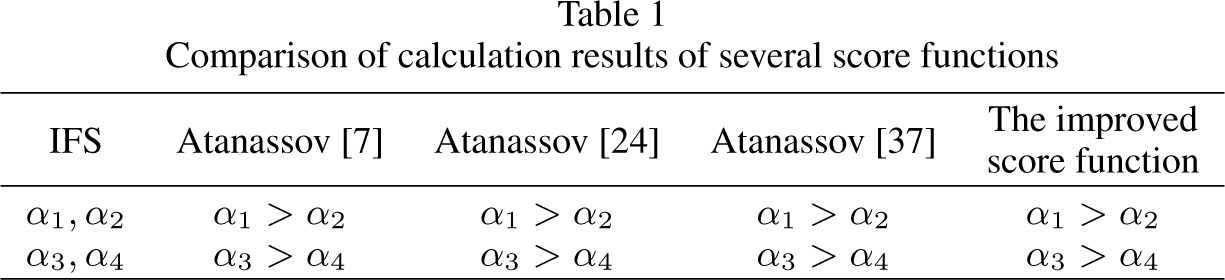
It can be seen from Table 1 that, compared to other scoring functions, the calculated results of the improved scoring function do not contradict the actual situation, and the calculated results are consistent with objective facts.
Here we will demonstrate that the improved scoring function still satisfies the proposition of the scoring function, thus justifying and validating the improved scoring function.
Therefore,
Therefore,
In the same way,
Thus
The same reasoning gives.
Therefore
So
Therefore
The properties and corollaries related to the new improved score function are given above. Among them, Property 1 shows the monotonicity of
For multiple attribute decision making problems, let
The characteristic of scheme
Where
Therefore, the characteristic information of all schemes
Intuitionistic fuzzy matrix D

The process of decision-making based on a herding psychology improved score function for trading decisions.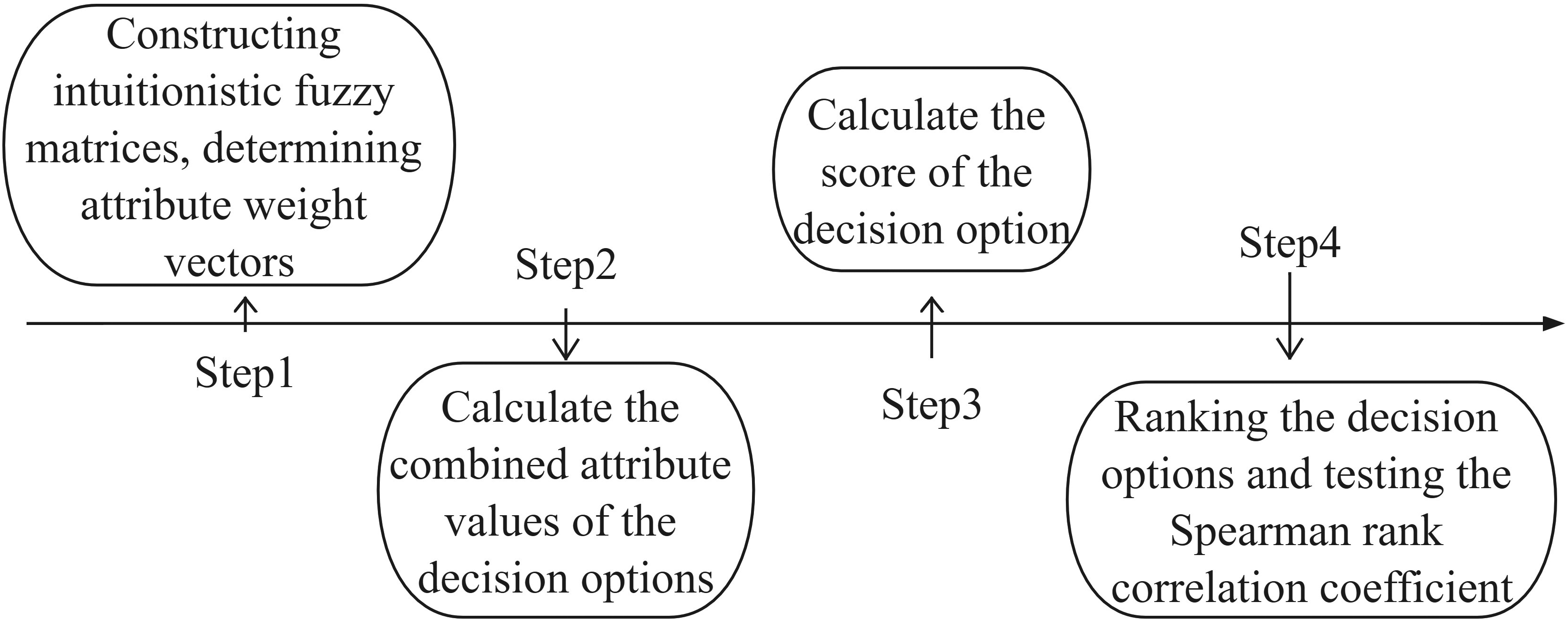
The steps of the Intuitionistic Fuzzy Hybrid Averaging operator multi-attribute decision making method based on the improved score function are as follows:
Step 1: Give the intuitionistic fuzzy matrix
Numerical example
With the development of the modern economy and the improvement of living standards, new energy vehicles have developed rapidly, especially in China, supported by the policies of the Chinese government. The increase in the number of new energy vehicles has promoted the vigorous development of the used new energy car market compared with traditional fuel vehicles. There is no reasonable transaction evaluation method for the trade decision of used new energy cars. The trade decision of used new energy cars affects and restricts the development of the used car market and limits the circulation efficiency of used cars. To improve the efficiency of used car trade decisions, make different trade decision making schemes for different groups of people, improve the problem of undervalued prices of new energy second-hand cars, and provide appropriate solutions for used car trade decisions. Then, make an effective trading scheme to solve the second-hand car trading decision. In this section, the Intuitionistic Fuzzy Hybrid Averaging operator based on an improved score function can be applied to the decision making of used new energy car trading schemes. As different traders want to choose a used new energy car that best suits their trading preferences, six indicators are selected through a questionnaire survey: total engine power (G1), manufacturer’s guide price (G2), battery capacity (G3), brand (G4), driving range (G5) and service life (G6) as reference indicators for traders when purchasing new energy used cars. The degree of preference of decision makers for the above six indicators is determined by a questionnaire survey, and five schemes
Based on the results of the questionnaire trader voting hypothesis
Intuitionistic fuzzy matrix D
Intuitionistic fuzzy matrix D
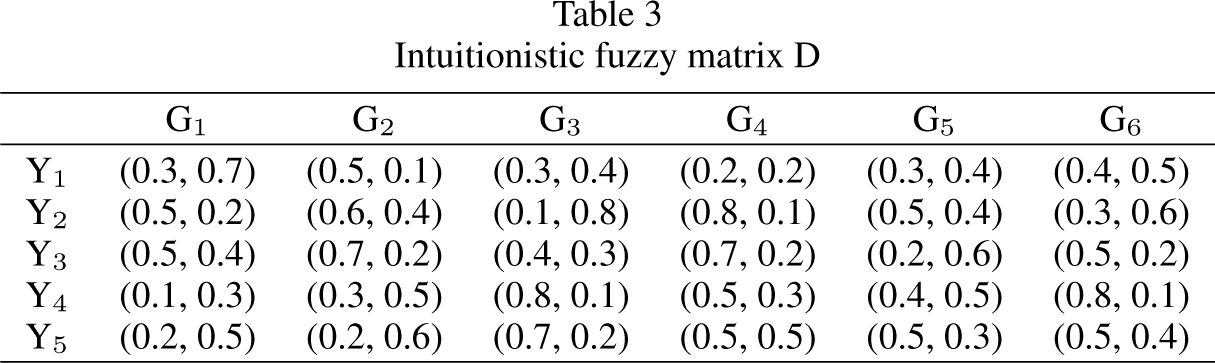
Since G2 and G4 are cost indicators, and G1, G3, G5, and G1 are benefit indicators, to make the indicators of different dimensions comparable, the cost indicators are transformed into benefit indicators by Eq. (21). Thus, the intuitionistic fuzzy decision matrix
Normalized intuitionistic fuzzy decision matrix D’
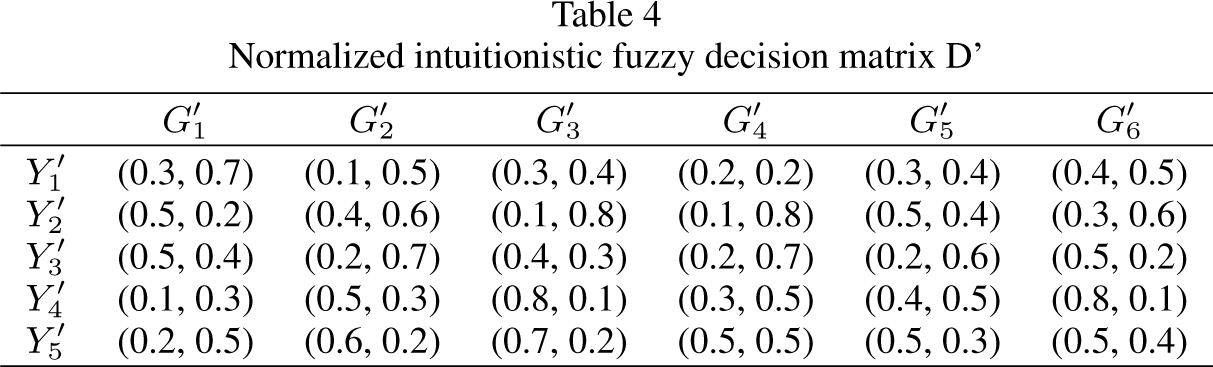
The attribute values of the decision scheme
Weighted intuitionistic fuzzy decision matrix
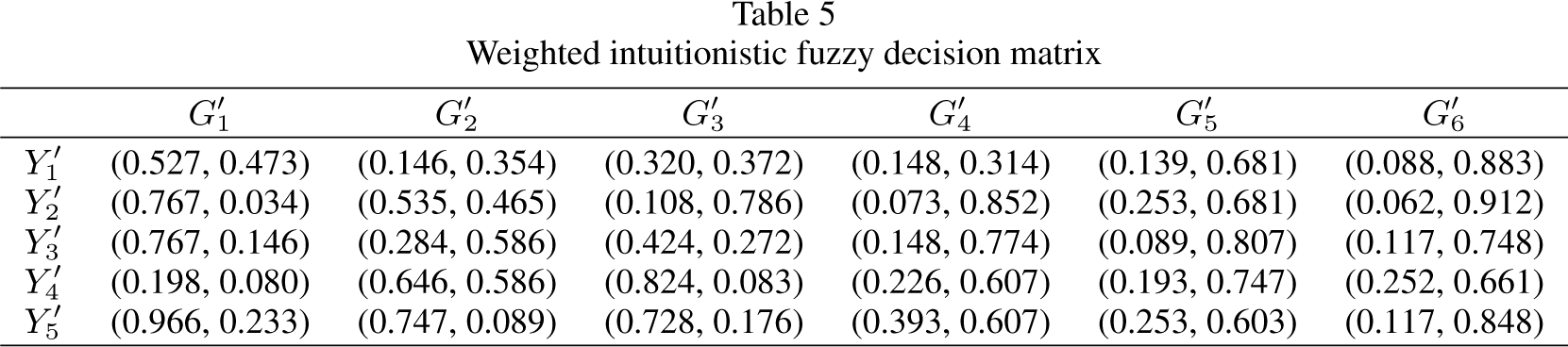
According to Xu’s [14] research on the weighted attribute values of schemes, the attribute values are sorted according to their size, and then the position vector of the IFHA operator is determined as
Comprehensive attribute values of schemes
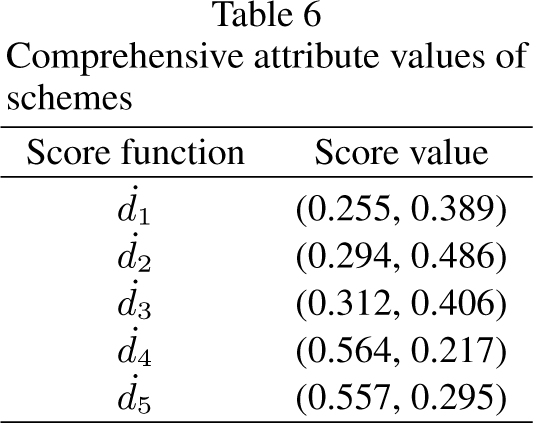
The score value of
The score value of the score function
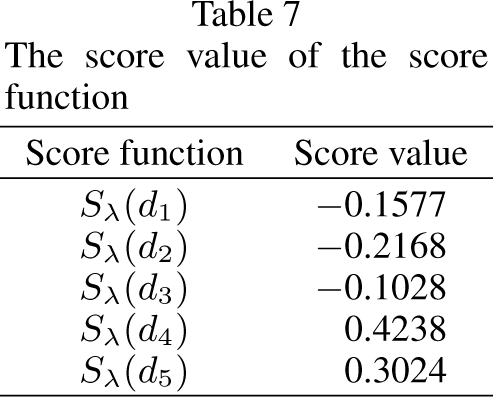
According to the score value of the score function in Table 7, the ranking result of the selection scheme is
In this section, we compare the decision results obtained by the improved score function with those obtained by the transmission score function to illustrate its superiority.
First of all, we compare the improved score function with the method in Atanassov [7]. For Atanassov [7], the calculated results are
Finally, the final ranking results of the three scoring function schemes are shown in Table 8.
The score value of the score function
The score value of the score function

Based on the data in Table 8, Spearman’s rank correlation was calculated between the score values and the score function, and the decision scheme, and the correlation was found to be statistically significant, as shown in Table 9.
Correlation between score values, score functions and decision options
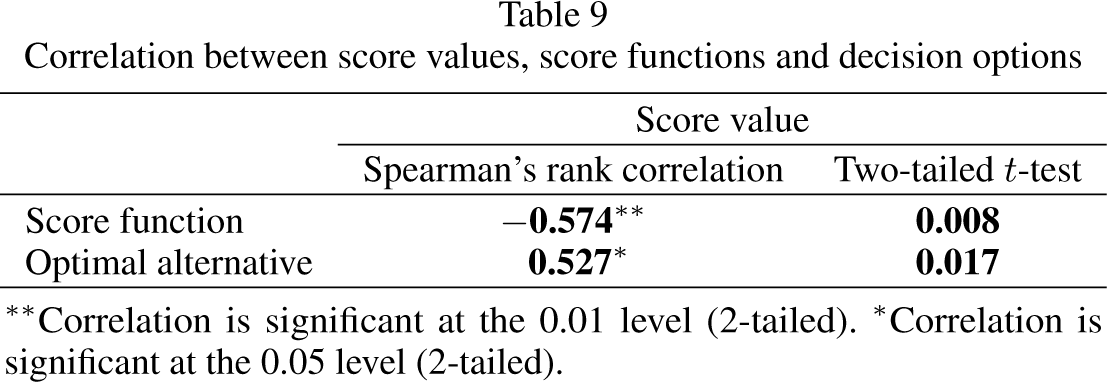
**Correlation is significant at the 0.01 level (2-tailed). *Correlation is significant at the 0.05 level (2-tailed).
Table 9 shows that the score function and decision option variables pass a two-tailed
There is a relatively significant negative correlation between the score value and the score function. The negative correlation is due to the inclusion of the effects of consumer utility and loss aversion coefficients in the score function, which increases the volatility of the score. Based on the volatility, it is possible to select the worse decision solution and negative factors from similar solutions, thus increasing the accuracy of the decision. The selection of the optimal solution is based on the condition that the decision maker is perfect rationality, but the actual decision-making situation may be more complex, and it is also necessary to consider that the decision maker is bounded rationality. Therefore, in addition to providing the consumer with the best option, negative information affecting the decision option must be analysed to make the results more realistic. There is a more significant positive correlation between the score value and the decision options. The positive correlation is due to the fact that the improved score function is more applicable to multi-option choices, which can effectively solve the distress caused by multi-attribute choices. Although more decision options can provide consumers with more choices and satisfy different consumer needs. However, in the case of cognitive bias, the large number of similar decision options increases the influence of consumers’ mental choices on the decision. This is at odds with rational judgement. Therefore, our analytical results are reasonable, analyzing decision options from the overall perspective of consumers’ utility acquisition, combining with consumers’ loss aversion for comprehensive consideration, and simulating decision maker’s bounded rationality, which can better describe the real decision-making situation, enhance the explanatory ability of the score function model, and improve the accuracy of decision-making.
Based on the data in Table 8, we further analyze the similarity of the rankings. The results of this analyze are shown in Table 10.
Ranking relevance test

We observe the variability between the scenarios by changing the position of the best option (scenario 4).
The first two options are the most relevant. There is a wide variety of goods, and the utility received by consumers varies from person to person, while the psychological feeling of loss aversion is not the same for everyone. but quality goods will always be preferred by consumers, so the first and second choices are the most relevant. The middle option has the lowest correlation with the best option. Located in the middle of the program, it has no characteristics of its own and is less attractive to consumers. Therefore, the correlation test result is the lowest.
We numbered Atanassov [7, 24, 37] and the improved score function sequentially 1, 2, 3, 4 and compared them to analyse the fluctuation of the score values. From Fig. 2 and Table 8, it can be concluded that the improved score function is more sensitive to different decision options.
Sensitivity analysis.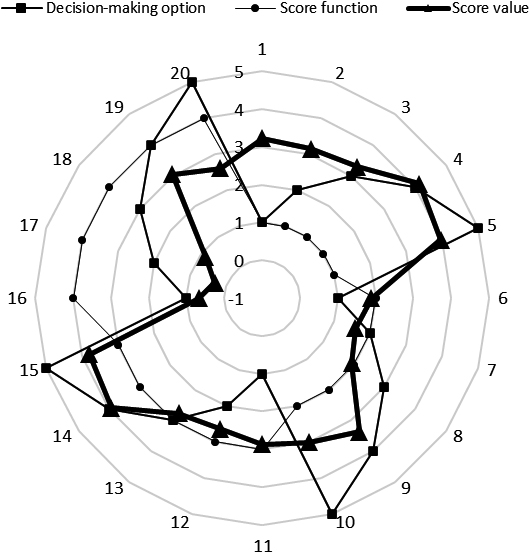
Several useful observations can be made from this paper. First, when comparing the scores, it can be seen that although the best and worst options are the same, the ranking for the intermediate options is not the same. It can be seen that the Atanassov [7] and Atanassov [37] scores for the decision options are generally stable and do not differ significantly from one decision option to another. On the other hand, the scores of Atanassov [24] and The improved score function fluctuate significantly, and the ranking of the decision options in the middle is not the same. It is difficult to extend their use in practical applications. Our improved score function can better reflect the difference in utility obtained by decision makers for homogeneous goods in the presence of cognitive biases, and takes into account the influence of loss aversion that decision makers may have in decision-making environments of practical uncertainty, and can more accurately select the better option and negative factors to provide input to consumer decisions.
The multi-attribute decision-making problem is a difficult task due to the complexity and uncertainty of the objective situation as well as different psychological expectations and loss aversion due to the decision maker’s own cognitive biases. This study explores the effects of consumer utility and loss aversion on trading decisions under the assumption of bounded rationality from the perspective of behavioral economics. Consumers’ decision-making behavior is mainly driven by different perceived expectations due to cognitive biases and aversion to loss. The scoring function for the comparison group does not consider the effect of utility, and decisions made in the presence of cognitive bias are susceptible to psychological choices, and it also does not consider that the decision maker is bounded rationality, and is therefore more susceptible to losses than gains. We design a method to rank the transaction options from the perspective of the utility obtained by consumers in the transaction decision, taking into account the cognitive differences between decision makers, thus introducing the parameter of price sensitivity, and at the same time, taking into account that decision makers are not completely rational in the uncertain decision-making environment, so we also introduce the parameter of loss aversion coefficient to indicate that decision makers are stronger in the perception of loss than gain, thus compensating for the shortcomings of the other scoring functions in the setting of the weights and avoiding the loss of decision-making information, and minimizing the decision maker’s subjective arbitrariness. A new intuitionistic fuzzy multi-attribute decision-making method based on utility theory and loss aversion is proposed by introducing the average of the utilities obtained by heterogeneous consumers from homogeneous goods and the decision maker’s aversion to loss modified score function and using the improved score function to make a comprehensive evaluation of the transaction options; in combination with the IFHA operator. To verify the effectiveness of the improved score function, the correlation between the score value and the score function as well as the Spearman rank correlation coefficients of the decision options are verified by analysing the correlation between the score value and the score function. A comparison was also made with the ranking of the scenarios in the comparison group. The results show that the improved scoring function is more comprehensive and realistic for the decision population, ensuring the reasonableness and validity of the decision results. Decision-making is not only about choosing the best solution but also about finding the influencing factors that affect the decision. It is also about finding the influencing factors that affect the decision, providing a more informed view when faced with a complex choice. The improved score function is more sensitive to different decision options and provides consumers with more information about their decisions. However, our work has some shortcomings. In this paper, we use the given attribute values to rank the decision alternatives, and although we introduce the consumer acquisition utility and loss aversion coefficient to correct the decision, this may still have some impact on the precision of the decision.
In future work, the determination of attribute weights can be further investigated and the use of Pythagorean Hesitant Fuzzy Number (PHFN) to represent attribute values can be explored [32]. This paper used given objective attribute weights based on the number of attributes, which may affect the scope of application in the future. Future research can consider Pythagorean Hesitant Fuzzy Number (PHFN) to represent attribute values, which can reflect the decision-making information in a more detailed and comprehensive way; and establish an optimisation model to determine the attribute weights through the dispersion rate of the original decision-making information to avoid information bias. In addition, future research could investigate the effect of the retailer’s sales probability on the decision outcome and further improve the accuracy of the decision method through a combined analysis of the two. In addition, the design method has been applied to many other uncertain environments [33, 34, 35, 36, 37] and can be used to solve multi-attribute decision problems such as project selection [38, 39, 40, 41, 42, 43, 44, 45, 46, 47].
Footnotes
Acknowledgments
This paper is supported by the National Natural Science Foundation of China (No. 12261007), Guangxi Natural Science Foundation of China (No. 2020GXNSFAA297225) and the project of Doctoral Fund of Guangxi University of Science and Technology (No. 19Z43).