



Abstract
Resource allocation strategy selection in 5G networks is a MADM (Multi-Attribute Decision-Making) problem, which all the methods defined so far or those used to solve it have neglected the negative aspects of attributes. This can result in the occurrence of information loss and it would be difficult to come to the right decision. Thus, in this paper, we present a MADM technique that can be used to take the negative aspects of attributes into account. This goal will be achieved by the method based on bipolar fuzzy sets (BFS) and tangent trigonometric aggregation operators (AOs). For this, in this article, firstly, we devise the concept of tangent trigonometric bipolar fuzzy number (TT-BFN) and linked algebraic operators. Then, we deduce tangent trigonometric bipolar fuzzy weighted averaging (TT-BFWA), tangent trigonometric bipolar fuzzy ordered weighted averaging (TT-BFOWA), tangent trigonometric bipolar fuzzy weighted geometric (TT-BFWG), and tangent trigonometric bipolar fuzzy ordered weighted geometric (TT-BFOWG) operators. We also devised the related results of these operators that is idempotency, monotonicity, and boundedness. Further in this manuscript, we investigate a case study “Selection of resource allocation strategy for 5G network” by considering artificial data and employing the invented MADM approach in the environment of BFS and get that “Max-Min Fairness Allocation” is the finest resource allocation strategy in 5G network. Finally, we compare our deduced theory with a few current ones to reveal supremacy and dominance.
Keywords
Introduction
Resource allocation strategies are highly significant in 5G wireless networks for effective operation and performance. The use of Intelligent and dynamic allocation of scarce network resources is a must to meet the various Quality of Service (QoS) requirements of users and applications. The appropriate resource allocation strategies will result in the high use of available bandwidths, power, and computing resources, and thereby, the network will be able to support a wide range of services from ultra-reliable low-latency communications to enhanced mobile broadband. The fifth-generation (5G) wireless communication networks are being created to help countless gadgets and a different scope of utilizations with fluctuating Nature of Service (QoS) prerequisites. Productive resource allocation is a basic test in 5G organizations, as it assumes a fundamental part in guaranteeing ideal organization execution, expanding resource usage, and fulfilling the different QoS needs of clients. Resource allocation strategies decide how restricted network resources, like transmission capacity, power, and computational resources, are apportioned among clients and applications.
Resource allocation strategy determination in 5G organizations is a very complicated Multi-Trait Navigation (MADM) issue, where numerous clashing targets and rules should be thought about at the same time. The objectives may be, for example, to increase the throughput, lower the latency, provide an equal opportunity to all users, decrease the energy consumption, and limit the interference. The resource allocation strategy is a major factor that should be considered since it directly affects the whole network’s performance, user experience, and operational efficiency. Usually, the conventional resource allocation methods are about the optimization of certain objectives such as the maximization of throughput or the minimization of latency without considering the negative aspects of the attributes. Nevertheless, considering the complicated and ever-changing characteristics of 5G networks, an all-inclusive method that covers both the pros and cons of multi-attribute selection is a must for the proper and efficient resource allocation strategy choices.
A MADM is employed to manage complicated DM dilemmas that contain many criteria or objects. It is utilized in various areas such as environmental management, engineering business public policy, etc. MADM takes into account many attributes at a time, thus, it assists the decision-makers or experts in the assessment and the selection of the best alternative from a set of alternatives. These attributes can be either qualitative or quantitative, and their relative weights can also vary. MADM approaches enable the decision-makers or experts to rank and compare the alternatives based on various attributes. MADM dilemmas are mostly complex and uncertain and fuzzy set (FS) [1] is a great mathematical tool for solving and modeling these problems. FS is a bridge that connects the fragile details of life and the strict limits of the conventional set theory. These sets are a good way to shake the usual black-and-white thinking that is usually connected with traditional mathematics by the admission that not everything can be neatly divided into binary categories. FS theory is the most essential tool for the explanation of human cognition, artificial intelligence, and DM in the uncertain universe because of the concept of partial belonging, which is a complex mathematical model of the complex and ambiguous world that we have to understand.
A notion of bipolar FS (BFS), an amendment of FS that allots to each element or object a positive grade of belonging placed in
Literature review
The emergence of 5G and beyond wireless communication technologies has been the focus of much attention on network resource allocation strategies aimed at optimizing network utilization and quality of service (QoS). It is necessary to have a deep comprehension of resource allocation approaches for meeting the diversified needs of new applications and services in modern wireless networks. In their study, Degambur et al. [3] did an extensive review of resource allocation in both 4G and 5G networks stressing the role of efficient resource management in achieving optimal network performance and user experience. Song et al. [4] suggested a dynamic virtual resource allocation for network slicing in 5G and beyond where adaptive resource allocation mechanisms are vital to cater to different service needs. Rehman et al. [5] addressed the issue of resource allocation improvement in 5G MTC networks, emphasizing that the key to the efficient support of massive machine connectivity lies in the improvement of resource utilization. Nguyen [6] highlighted the issue of resource allocation for energy efficiency in 5G networks which is a key aspect of green communication technologies that can be used to reduce energy consumption and the environmental impact. In their systematic review, Kamal et al. [7] consider a wide range of resource allocation schemes for 5G networks, showing different approaches and their ability to maximize resource use. Jayaraman et al. [8] put forward a resource allocation technique that is efficient in improving QoS in 5G wireless networks, pointing out the importance of QoS-aware resource allocation methods to improve user satisfaction. Guo et al. [9] conducted a review of cooperative communication resource allocation schemes for 5G and beyond networks, where they discussed the architectural aspects, challenges, and opportunities for the efficient utilization of cooperative communication. The slicing and user-priority-based admission control strategy for 5G networks was analyzed by Ajibare and Falowo [10]. They highlighted the need for dynamic resource allocation mechanisms that can accommodate different service requirements and user priorities. In their work, Akhila et al. [11] looked into different authentication and resource allocation strategies during handoff for 5G Internet vehicles (IoVs) using deep learning methods to emphasize the necessity of intelligent handoff management for efficient connectivity and resource utilization in vehicular areas.
The area of MADM has been the object of extensive research, especially the integration of fuzzy logic to handle uncertainties and vague information. Chen and Klein [12], investigated the method of solving fuzzy MADM problems. Perego and Rangone [13] proposed a reference framework for the application of MADM fuzzy techniques, particularly in technology selection for AMTS. Dunn et al. [14] demonstrated the importance of the fuzzy MADM tool in the agricultural and resource economics contexts and showed its wide applicability. Fuzzy MADM was shown to be effective by Wang et al. [15] in machine choice within flexible manufacturing cells. Chiadamrong [16] extended the integrated fuzzy MCDM method for the selection of manufacturing strategy, to deal with complex decision contexts. Liang and Wang [17] suggested a fuzzy MADM method for the facility site selection, which is applicable in spatial decision-making. The development of BFSs got a boost with Zhang’s work [18] which proposed a mathematical model for cognitive modeling and multi-agent decision-making (DM). Later studies by Wei et al. [19] and Jana et al. [20] went on to develop BFS theory and came up with new AOs as well as examining their applications in DM processes. The latest studies have revealed the progress of the methodologies and applications of BFS in MADM. Riaz et al. [21] came up with the novel bipolar fuzzy (BF) AOs for medical tourism supply chain management, while Jana et al. [22] designed an MABAC framework for supplier selection under logarithmic BF information. Garg et al. [23] went ahead to implement the use of Aczel-Alsina power AOs under the BF setting by developing a MADM approach with a specific focus on quantum computing. Besides, the literature is also full of methodological improvements such as the extended BF MABAC approach proposed by Jana [22] and the adaptation of DM methods like ELECTRE II to handle the BF model that is seen in Shumaiza et al. [24]. In addition, the application of VIKOR for MCDM under BFS by Alsolame and Alshehri [25] is another example of the ongoing transformation of DM procedures to meet the increasing complexity of decision situations. Secondly, the fundamental principles of BFSs have been widely explored. Akram [26, 27] developed the theory of BF graphs and their applications.
Motivation and contribution
One kind of AO that may be used to combine data from several sources even in the face of ambiguity and inconsistency is the tangent trigonometric AO. The tangent trigonometric function, on which tangent trigonometric AOs are built, has several advantageous characteristics, including periodicity, symmetry, and monotonicity. Because of this, tangent trigonometric AOs are very suitable for a wide range of DM issues, including MADM. The capacity of tangent trigonometric AOs to manage ambiguity and inconsistent DM is among its most significant benefits. This is so that tangent trigonometric AOs consider more than just the magnitudes of the input values; they also consider their directions. This makes it possible for tangent trigonometric AOs to compile data from many sources in a more thorough and instructive manner. Further, the attributes of resource allocation strategies have both positive and negative aspects and thus, for accurate selection of resource allocation strategy, the MADM technique is necessary in the setting of BFS. So, by keeping in mind, the advantages of the tangent trigonometric operators and the need for MADM technique which copes with positive and negative aspects, in this manuscript, we devise tangent trigonometric AOs in the setting of BFS that is TT-BFWA, TT-BFOWA, TT-BFWG, and TT-BFOWG operators. After that, we deduce a technique of MADM within BFS by employing the invented tangent trigonometric AOs.
Construction of article
The rest of the article is demonstrated as: In Section 2, we devise some current concepts such as BFS and linked results. In Section 2, we demonstrate the notion of TT-BFN and linked algebraic operators. In Section 4, we deduce tangent trigonometric AOs in the setting of BFS along with properties. In Section 5, we interpret a technique of MADM within BFS with the assistance of invented operators and discuss a case study. Section 6, contains the comparative study, and Section 7 has theoretical and managerial implications of the proposed work. Section 8 contains the conclusion.
Preliminaries
This section contains the definition of BFS and related results.

Observed


From above we have
If If If
If If If
In this part of the article we develop the notion of TT-BFN and its fundamental algebraic operations

where,
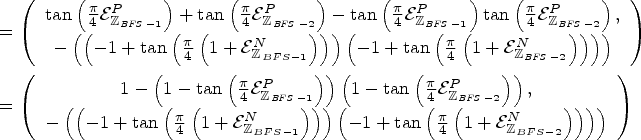

In this part, we will devise various AOs in the setting of BFS that is TT-BFWA, TT-BFOWA, TT-BFWG, and TT-BFOWG operators, and their corresponding results.

Noticed that


Now we have that


Then




now consider Eq. (4) is hold for


Next, take





Equation (4) is valid for









Similarly, as





This implies that



Noticed that





Noticed that



Now we have that


Then




now consider Eq. (4) is hold for


Next, take





Equation (4) is valid for




Noted that





The devised MADM technique is a new method that overcomes the drawbacks of the conventional MADM methods by taking into account both the positive and negative aspects of attributes at the same time. This MADM technique employs the idea of the BFS to express the decision information. Each attribute is indicated by a BFN, which is composed of a positive and a negative membership function, thus, it is possible to represent both the positive and negative aspects at the same time. One of the most important features of the proposed MADM technique is the tools for aggregating information, thus in this MADM technique tangent trigonometric AOs in the setting of BFS are utilized, which are devised in this script.
Assume a situation where an assembly of
Attributes can be categorized into two sorts: benefit sorts and cost sorts. For benefit sorts of attributes, the normalization is not required but if any of the attributes are cost sort then the normalization is required which would be done by the underneath formula
After the normalization of the BF decision matrix, the decision matrix would be aggregated by employing any of the diagnosed AOs that are TT-BFWA, TT-BFOWA, TT-BFWG, and TT-BFOWG operators. Get the score or accuracy values by employing Eqs (1) and (2) respectively of the aggregated outcomes. Utilize the obtained score and accuracy values to rank the alternative and achieve the optimal alternative. Finish.

In order to guarantee the best network performance and customer satisfaction for their 5G network, Company
Proportional Fairness Allocation (PFA): In network frameworks and remote correspondence, PFA is a resource allocation strategy that is frequently utilized. It looks to dispense accessible resources, for example, transmission spaces or transfer speed, among a few clients or gadgets in a way that finds some kind of harmony among effectiveness and reasonableness. PFA expects to circulate resources such that considers every client’s interest or nature of service, focusing on the people who have greater levels of popularity while guaranteeing that every client gets a decent amount. It is a helpful strategy for improving resource allocation in correspondence networks since it accomplishes a split the difference between ensuring that no client is at any point left with lacking resources and boosting in general framework throughput. Max-Min Fairness Allocation (MMFA): A well-known resource allocation strategy in PC organizations and dispersed frameworks, MMFA isolates resources, including data transfer capacity or handling power, among a few clients or exercises. Indeed, even in instances of framework clog or weighty burden, MMFA means to guarantee that no undertaking or client is kept a sensible part from getting the accessible resources. It accomplishes this by designating resources in a manner that expands the littlest sum distributed to every client or undertaking, hence forestalling resource starvation for any person. MMFA is intended to give powerful and fair resource allocation. Throughput Maximization Allocation (TMA): A strategy or approach called TMA is applied in a few businesses, including fabricating, PC organizations, and telecommunications, to expand the effectiveness of cycles and resources. Inside a given framework or climate, TMA looks to enhance the rate at which undertakings, information, or products can be handled, communicated, or finished. This includes designating resources and going with choices that focus on greatest throughput while considering variables like resource imperatives, network limit, and undertaking booking. In a given system or environment, TMA tries to maximize the speed at which jobs, data, or goods are processed, transmitted, or finished. To enhance the whole system’s performance, this means that the resources have to be distributed and the decisions that will be made have to be based on the maximum throughput while considering variables like resource restrictions, network capacity, and job scheduling. TMA is primarily needed when the main aim is to increase the flow of commodities or information since this guarantees the best possible use of the available resources. QoS-Aware Allocation: The process of distributing and managing resources – such as network bandwidth, processing power, or storage capacity – in a way that ensures and guarantees the necessary quality of service for some users or applications is called QoS (Quality of Service)-Aware Allocation. The objective of this allocation approach is to achieve the desired performance measures, such as latency, throughput, dependability, or reaction time, taking into consideration the specific needs and limitations of different services or applications. The QoS is set as the top priority which will lead to resource optimization and a reliable and enjoyable user experience, especially when there are several services or apps that are competing for the limited resources.
The decision-maker of Company
Minimum user data rate: The minimum user data rate is the rate that is needed to achieve high network efficiency and capacity utilization. Network throughput: The assurance of a minimum data rate for each user will stop any user from suffering from poor network performance. QoS compliance: Complying with the unique Quality of Service demands of various applications, such as mission-critical services’ high dependability and real-time applications’ low latency, is known as QoS compliance. User fairness: Ensuring that network resources are distributed equally across users to avoid any group from receiving subpar service.
These attributes have different levels of importance, so the decision-maker will give weights (0.26, 0.24, 0.35, 0.16) to each attribute respectively. Nevertheless, the conventional MADM methods may not be able to deal with the difficulties of this problem, as they usually do not take into account the negative side (aspects) of the attributes. To solve this problem, Company X intends to use a bipolar fuzzy MADM method, which is based on the idea of BFS and tangent trigonometric AOs. This method is the one that enables the efficient representation and the aggregation of both the positive and the negative aspects of the attributes, thus, it represents the vagueness and the uncertainty in the DM process. In addition, the creation of tangent trigonometric bipolar fuzzy AOs for example, TT-BFWA, TT-BFOWA, TT-BFWG, and TT-BFOWG, gives Company X’s decision maker a set of tools to aggregate and synthesize the assessment information of the alternatives. The assessment values of the decision-maker in the shape of BFN are portrayed in Table 1.
The assessment values of the decision-maker.

The steps of the MADM approach in the setting of BFS are below.
The category of every attribute is the same that is benefit sort so we are skipping this step. After step 1, the decision matrix is aggregated by employing the diagnosed AOs that is TT-BFWA, TT-BFOWA, TT-BFWG, and TT-BFOWG operators and the aggregated results are part of Table 2. The aggregated result.

Got the score or accuracy values by employing Eq. (1) the aggregated outcomes and placed them in Table 3.
The score values of each resource allocation strategy.

The ranking of resource allocation strategies.

Utilized the obtained score, the alternative ranked in Table 4.
As per ranking in Table 4, by employing any of the developed operators in MADM under BFS, interpret that
Finish.
It is necessary to compare the newly developed work with a few established ideas in order to demonstrate its importance and supremacy. To show the dominance and importance of the suggested theory, we compare the diagnosed theory with a few other prominent theories in this section.
For this purpose, we consider the underneath prevailing theories.
The approach of MADM is based on tangent trigonometric operators in the setting of single-valued neutrosophic number (SvNN) invented by Ye [28]. The approach of WASPAS relying on tangent trigonometric operators within the framework of a CFS, devised by Farhan et al. [29] The technique of MADM is based on Hamacher AOs in the setting of BF information deduced by Wei et al [18]. The approach of MADM based on Dombi AOs under the environment of BF information originated by Jana et al. [19]. The SIR approach is based on sin trigonometric operators within BFS devised by Riaz et al. [20].
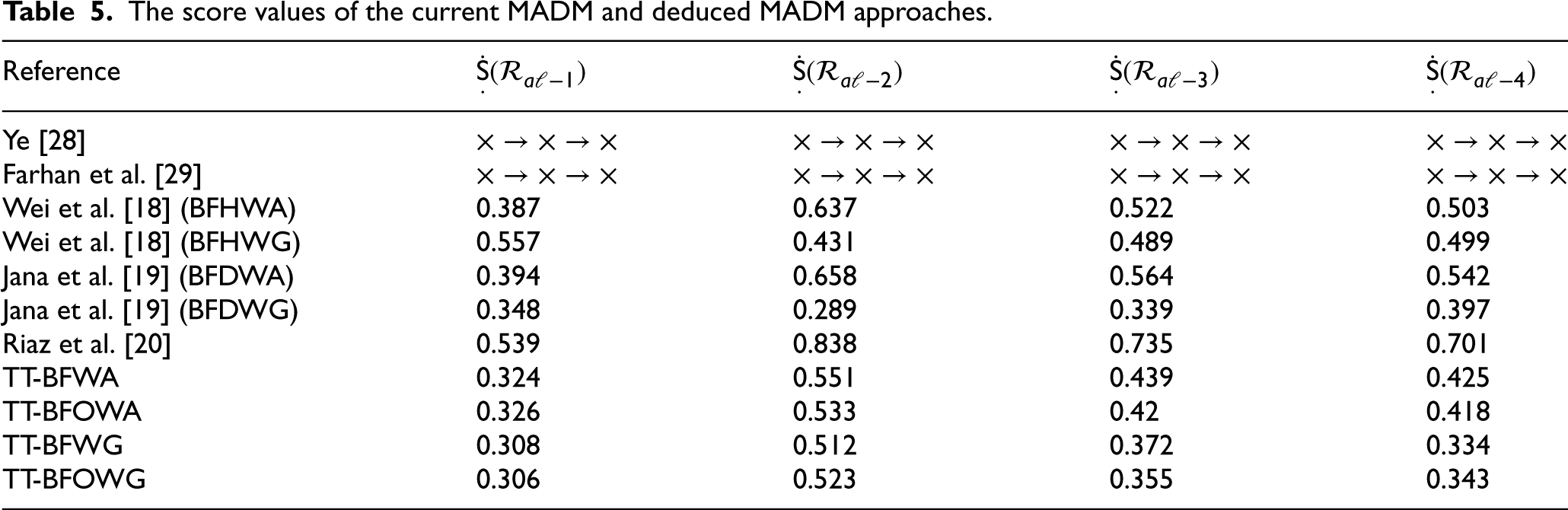
Now go back to the case study that was covered in Section 5.1 and attempt to solve that MADM issue by using the theories that have been developed and taken into consideration. Tables 5 and 6 illustrate the outcome.
The score values of the current MADM and deduced MADM approaches.
The score values of the current MADM and deduced MADM approaches.
The score values of the current MADM and deduced MADM approaches.
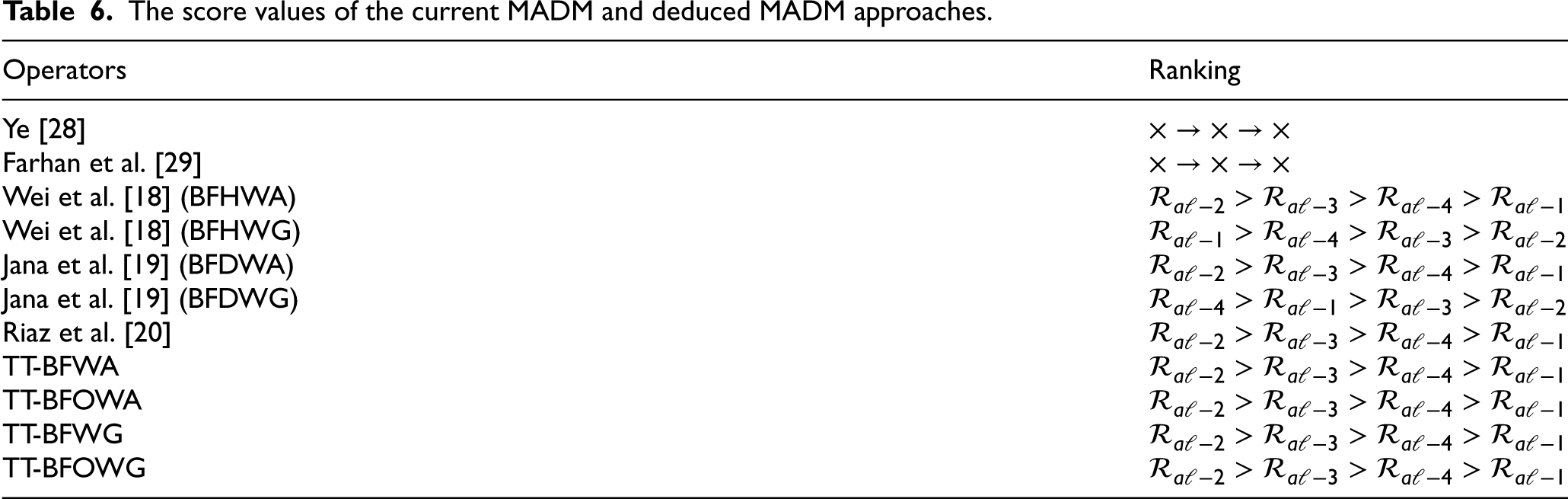
Tables 5 and 6, indicate that the theory deduced by Ye [28] and Farhan et al. [29] are not suitable for tackling the information displayed in Table 1. Because that information is in the model of BFNs the theory of Ye [28] and Farhan et al. [29] can’t handle the negative aspects of the elements. Thus, the theory of Ye [28] and Farhan et al. [29] do not apply to the structure of BFNs. Along with that keep in mind that there is no other MADM technique based on the tangent trigonometric operator for coping BF information.
Tables 5 and 6 also indicate that the prevailing MADM approaches for coping with BF information, invented by Wei et al. [18], Jana et al. [19] Riaz et al. [20], and the proposed technique of MADM for BFNs apply to the information displayed in Table 1. These current theories and the diagnosis theory give us the ranking which is revealed in Table 6. By employing the BFHWG operator in the technique of MADM, the ranking is
The specific criteria used for comparison and how each theory addresses them are as follows:
Ability to handle positive and negative aspects of attributes simultaneously: The way of BFS and tangent trigonometric AOs is proposed to be able to deal with both the positive and negative aspects of attributes, which is the main advantage of this method over the others. The theory by Ye [28] and Farhan et al. [29] is not a good fit for the negative aspects of attributes. Capability to model vagueness and uncertainty: The utilization of BFS in the suggested approach enables the depiction of the ambiguity and uncertainty that are present in decision-making problems that involve many conflicting attributes. The theories by Wei et al. [18], Jana et al. [19], and Riaz et al. [20] also use BFS to describe vagueness and uncertainty. AOs and their properties: we compare the developed operators (TT-BFWA, TT-BFOWA, TT-BFWG, TT-BFOWG) and their properties (idempotency, monotonicity, and boundedness) with the operators and their properties used in the theories by Wei et al. [18] (Hamacher AOs), Jana et al. [19] (Dombi AOs), and Riaz et al. [20] (sine trigonometric AOs). Applicability to resource allocation in 5G networks: The appropriateness and the efficiency of the proposed approach in solving the problem of resource allocation strategy selection in 5G networks, by considering both positive and negative aspects of the attributes are analyzed and compared with the other theories. Further, none of the existing theories discussed this application by considering both positive and negative aspects.
If the MADM technique is defined in the mathematical framework of FSs, then the MADM technique will only handle the positive aspects of the attributes and will not consider any other information besides that. Likewise, if the MADM technique is used in the single-valued neutrosophic set, it will also be limited to the positive aspects of attributes and will not be able to deal with the negative aspects. If the MADM is made into a CFS, then that MADM technique will deal with the positive aspects along with the extra fuzzy information, but again it will not be able to deal with the negative aspects. The negative aspects of the attributes will be disregarded when making a decision, which will result in a 100% inaccurate decision, as we know that attributes have both positive and negative aspects. Through the above discussion and the comparison with the case study, it is evident that the developed MADM approach is more suitable for MADM dilemmas, and since the selection of a resource allocation strategy is a MADM problem, this MADM approach is also suitable for this problem.
Here, we discuss the theoretical and managerial implications of this article.
Theoretical implications
The following are the theoretical implications of this article.
The use of tangent trigonometric (TT) AOs in BFSs is a new mathematical framework for modeling and aggregating bipolar information, combining the advantages of trigonometric functions and BFS theory. The suggested methodology will not only expand the existing aggregation theory but also introduce a new class of AOs that are capable of dealing with BF data effectively. These operators will be able to better depict the nuances and subtleties of DM processes that are both positive and negative. The inclusion of TT functions in the assembly process will give rise to new horizons, which in turn will allow the study to be based on the peculiar properties and features, which are used to model and analyze DM problems. The theoretical creation of TT-AOs in BFSs is a crucial milestone in the growth of decision science and FS theory, which will lead to more research and exploration in the field of MADM.
Managerial implications
Underneath are the managerial theoretical consequences of this article.
The expected MADM approach based on TT-AOs in BFSs is a strong tool that network operators and service providers can use to deal with the complexities of the resource allocation strategy selection in 5G networks. By the procedure of combining and synthesizing the information from the positive and negative sides, the method can make the decision more in-depth and balanced, considering the both positive and negative aspects of the different attributes of the resource allocation strategies. The practical implementation of the TT-AOs on BFSs can be considered a novel approach to the development of better and more reliable 5G networks, which support the wide range of applications and services that are envisioned for next-generation wireless communications. The managerial implications go beyond the 5G area, as the proposed approach can be adapted and applied to other complex DM situations involving multiple attributes, both positive and negative aspects of the attributes, in various industries and sectors.
Conclusion
This article interpreted a new MADM technique approach for resource allocation strategy selection in 5G networks, knowing that a significant absent part in the prevailing approaches is the negative aspects of the attributes. The invention of TT-BFNs was accompanied by the development of associated algebraic operators which provide a powerful tool for information aggregation and modeling BF information. Also, the development of TT-BFWA, TT-BFOWA, TT-BFWG, and TT-BFOWG operators, with their idempotency, monotonicity, and boundedness properties, forms a strong toolkit for decision. The proposed MADM approach was validated through a case study consisting of artificial data, which simulated the “Max-Min Fairness Allocation” strategy to be the best option for resource allocation in 5G networks. This discovery further highlights the importance of examining both positive and negative aspects of the attributes in the decision process which is aimed at achieving efficient resource utilization, faster network performance, and better user experience. Additionally, the comparison with the existing methods showed that the developed method is better and more dominant than the others, which proves that it can overcome the shortcomings of the traditional methods that cannot fully take into account the negative aspects of the attributes. The obtained outcomes are not limited only to 5G networks as the presented approach can be used further in many other DM problems including those with two aspects of attribute (positive and negative) in different industries and sectors.
Limitations and future direction
The invented operators and MADM approach can’t cope with information in the framework of bipolar complex FS (BCFS) [30], bipolar complex fuzzy soft set [31, 32], bipolar complex spherical FS [33], complex hesitant FS [34], and other generalizations of BFS. The TT AOs would be beneficial within these structures for example, if we develop these operators in the BCFS, then these operators would be able to handle the information containing both aspects along with extra fuzzy information, which the current operator can’t handle. Thus, in the future, we would aim to develop such theories in other frameworks and handle some other MADM dilemmas. Further, we would also like to expand this work in the framework of probabilistic theory [35], three-way decision support systems [36] and Schweizer-Sklar aggregation operators [37, 38].
Footnotes
Ethics declaration statement
The authors state that this is their original work and it is neither submitted nor under consideration in any other journal simultaneously.
Human and animal participants
This article does not contain any studies with human participants or animals performed by any of the authors.
Funding
No external funding is received for this submission.
Conflict of interest
About the publication of this manuscript, the authors declare that they have no conflict of interest.
Data availability
The data will be available on reasonable request to corresponding author.