




Abstract
This study contains analysis of the influence of changes in the real exchange rate on the results of the monetary policies conducted by the central banks of emerging market economies targeting inflation. The analysis is based on the Taylor rule modified with the Ball rule and the Orphanides rule. The methods used included evaluating variables, such as the GDP, the inflation rate, the real interest rate, and the real exchange rate index, with the Hodrick-Prescott filter (HP-filter) and the two-step cointegration approach of Engle and Granger with structural breaks. Empiric estimates for two countries, Brazil and South Africa, based on quarterly data during inflation targeting for 1999–2015, have been obtained. The influence of the exchange rate on the monetary policy results before targeting in the case of South Africa has been analyzed. For the latter economy, our analysis covered the period of 1960–2015. The period under consideration included the 2008 financial crisis, which accounted for the choice of the dates of breaks in the level and regime of the countries’ monetary policies. Our research showed that, although the approach undertaken by the central banks of both countries to using the interest rates for the purpose of inflation targeting was classical, both banks took the fluctuations in the exchange rates into account. A long-term relationship between the interest rate, the GDP gap, the real exchange rate, and the inflation deviation from its equilibrium value has been demonstrated for both Brazil and South Africa. The level shift took place in South Africa in the second quarter of 2008; and the shift in the level and regime in Brazil occurred in the fourth quarter of the same year. The model estimation proves that the significance of the exchange rate fluctuations has become more important since the crisis of 2008. For South Africa, we have empirically proved that after the country’s turn to inflation targeting and dismissal of the official exchange rate, the exchange rate fluctuations have still influenced the results of the national central bank’s policy. We have found the Taylor rule to be acceptable for South Africa and Brazil for a short-term period; in terms of inflation targeting, the interest rate has been positively influenced by the GDP gap and the inflation gap; the impact by the real effective exchange rate has been found to be negative.
Keywords
Introduction
One of topical issues reflecting the role of a central bank in a national economy is the choice of the monetary policy, which shapes the situation on the commodity market, in real economy, on the credit market, and the domestic foreign exchange market. Traditionally, the monetary policy conducted by central banks consisted in exploiting the targeting regime of the exchange rate; however, for almost three recent decades they have preferred the monetary policy of inflation targeting (IT). Steadiness of prices is assumed to be a necessary condition for achieving stable economic growth and full employment, while high inflation is considered destructive in the long run. Conducting the IT regime, central banks aim at controlling prices by establishing inflation targets. In such circumstances, the main instrument of the monetary policy is the interest rate,1 which a central bank announces based on the factors it considers significant for the economy.
Since the beginning of the 1990s, economists have proposed a number of rules for defining the monetary policy in terms of IT. The most famous one is the Taylor rule, which defines the change in the short-term interest rate by a central bank (Taylor, 1993). It relates the inflation target, the equilibrium interest rate and the rate of inflation as measured by the GDP deflator. Later, Ball (1999) proposed to take the real exchange rate and its changes into account, and Orphanides (1997) introduced GDP gaps as the difference between the actual GDP and the trend line.
We based our analysis on the theories mentioned above and developed them by modifying the Taylor rule, taking into account the influence of the real effective exchange rate, GDP gaps and the inflation deviation from target, which were estimated by means of the Hodrick-Prescott filter (HP-filter). The resulting equation, which includes the modified Taylor rule, the GDP dynamics, inflation rate, the real effective exchange rate, and the interest rate, will be referred to as the equation of the central banks’ response.
Having analyzed the available sources, we found out a lack of detailed analysis of the factors influencing the way the central banks of the emerging market economies (EME) in question implement their monetary policy. In our research, we estimate the central banks’ response equation in the short and long run.
The objective of our research has been to evaluate the influence of the real effective exchange rate on the interest rate in the equation of the response of the central banks by two BRICS countries, Brazil and South Africa, which have been implementing the IT regime for over 25 years.2
To achieve our objective, we used the method of the error correction model (ECM) with structural breaks. This method has certain novelty aspects, as it allows nonlinear estimators of regression parameters with structural breaks to be obtained. It is suitable for our purposes, as the time series considered in the equation are non-stationary, and the method used allows long-term relations between the parameters to be determined. In order to consider possible shifts in the cointegration vectors, the Engle and Granger two-step approach (Engle & Granger, 1987) has been implemented.
Literature review
According to economists, some common issues faced by the central banks of emerging economies include economic feasibility of introducing the monetary policy and exchange rate regimes. Some authors point out that while adapting the IT regime, EMEs have to loosen control of the currency market, which may run counter to the current economic objectives (Peters, 2014; Ebeke & Azangue, 2015).
The long-term relation between the interest rate and the inflation rate for EMEs is explained by the fact that EMEs have to focus on financial stability and define IT as the priority. Having weak institutions, EMEs have to demonstrate stable intentions in the long run and stick to their monetary policy priorities. A slightest digression from the targets announced can form unrealistic expectations in economic operators and cause a decrease in the credit rating, increase in the exchange rate volatility, and uncertainty in capital flows (Mishkin, 2004; Fraga et al., 2003).
The same reasons account for the long-term relation between the interest rate and the inflation deviation from the target, which was revealed and analyzed in (Ghosh et al., 2016).
Analyzing the strengths and threats of the floating exchange rates in Brazil, India, China, and South Africa, scholars emphasize that it is the macroeconomic conditions contributing to the efficiency and suitability of the regime that should back the introduction of such a regime (Kabir et al., 2015).
Industrially developed countries do not tend to take into account the exchange rate as a parameter in their reaction equation (Garcia et al., 2011). However, emerging market economies are more vulnerable to changes on their exchange markets, and their central banks can identify certain factors if they introduce this parameter into the reaction equation. Several studies (Mohanty & Klau, 2005; Aizenman et al., 2011) modified the Taylor rule with the exchange rate parameter. The authors (Domaç & Mendoza, 2004) focused on the relations between exchange interventions and the volatility of the national currency. They used GARCH modeling to consider countries with IT target trying to identify the impact of the exchange rate volatility on the policies conducted by their central banks.
In their work, Siklos and Wohar (2005) evaluated the Taylor rule for Brazil without considering the exchange rate. The authors showed the necessity to analyze cointegration vectors to prove stable correlations between the parameters, but they did not describe long-term dependences. Estimation in the equation with nonstationary time series should be adjusted by means of cointegration vectors, according to Mankiw and Shapiro (1986). Siklos and Wohar (2005) also mentioned the significance of cointegration vectors in relation to the issue of nonstationarity. They claim that nonstationary time series that characterize factors in the Taylor rule can have a stationary linear combination, which should be taken into account while estimating the parameters. They also show that the interest rate and inflation rate are most likely to have a cointegration relation.
Cortes and Paiva (2017) analyzed the monetary policy in Brazil. Using different instruments, the authors studied whether the IT policy declared corresponded to its real characteristics and whether the inflation-target behavior was in action. The authors did not include the exchange rate into the reaction equation, though they noticed that before 2011 the interest policy often deteriorated the national currency volatility, while after 2011 the central bank started to take the exchange rate fluctuations into account while implementing its monetary policy. The authors diagnosed changes in the Brazil’s central bank’s policy after the new government came to office.
Taking into account the results obtained, we emphasize the influence of not only the inflation component and the GDP fluctuations, but also of the national currency exchange rate on the reaction of EMEs central banks.
The issue of structural breaks is essential considering the period of our investigation. We followed the authors who paid attention to this issue regarding some other areas of economics, such as the oil price volatility (Ewing & Malik, 2017), the carbon dioxide emission problem (Charfeddine & Kheridi, 2016), and the real exchange rate determinants in Australia (Chowdhury, 2012).
Table 1 shows our summary of the other authors’ results concerning implementation of the Taylor rule for different countries, as well as the methods used to evaluate short-term and long-term relations between its components.
Selected empirical research on inflation targeting countries
Selected empirical research on inflation targeting countries
Inflation targeting as a monetary policy framework is accepted by the central banks of more and more economies, both developed and developing. The results of inflation targeting analyses differ from country to country, which can be explained by differences in the duration of the study periods, relatively short periods of the monetary policy applied, differences in the methods of investigation, and unique country aspects. The economic benefits or losses from inflation targeting depend on many factors, such as macroeconomic and institutional conditions, the way of accepting the inflation targeting by the national governments, and the rate of transparency, consistency and stability of the central bank’s monetary policy. Nowadays there is no general opinion, which monetary policy framework is the best for developing economies, what factors are crucial for choosing the target, and what results of economic stability and growth can be expected. New empirical data will provide an opportunity for new investigation in this field.
We have proposed and empirically tested a model which reflects the current situation with the monetary policy in the EMEs considered. The base model is the Taylor equation, which relates the inflation target of the monetary policy, the equilibrium interest rate and GDP gaps. Extending the description of the monetary policy, Taylor (2000) pointed out that the change of the nominal exchange rate should be introduced into the equation of central banks’ reaction. He claimed that changes in the exchange rate influence a country economy through two channels – the export component and the prices for imported commodities. In addition, the exchange rate influences the national capital market.
According to the rules of the monetary policy, central banks are supposed to try to influence the real interest rate by establishing a certain target. They use such instruments as the base interest rate and the price target, whose change influences the real interest rate target with a minimum lag of one period due to a quick reaction. We also believe this parameter to be affected by the exchange rate policy related to the nominal exchange rate of the national currency and other parameters of foreign trade, such as the structure of trade partners and the inflation rates in partner countries.
We have used modified the Taylor equation based on the Ball rule (Ball, 1999), which takes the real exchange rate and its changes into account. According to the Ball rule, the nominal short-term interest rate is related to the inflation deviation from target, the GDP gap and the real exchange rate.
Finally, to calculate GDP gaps and inflation rate, we used a modification known as the Orphanides rule. We replaced the GDP deviation from the baseline by the difference between the real GDP growth and its trend. In addition, we included the inflation deviation from the baseline. In using this model, we followed the authors (Ghosh et al., 2016), who analyzed the monetary policy of EMEs.
Unlike the other authors, we evaluated the inflation deviation from the baseline using the HP-filter. Ghosh and others (2016) based their empirical calculations on the expected inflation rate, while Bevilaqua et al. (2008), who analyzed the situation in Brazil, used the real inflation value of the previous period as the expected inflation rate. The latter authors considered it correct, as due to the stable economic situation with IT lasting during a long-term period, the economic operators had formed reasonable price level expectations.
We used the following base model:
where:
REER – real effective exchange rate index;
The empirical methodology used for analysis of the significance of exchange rate movement in the central banks’ reaction equation (or the modified Taylor rule) can be summarized as follows:
Firstly, we used the HP-filter (Hodrick & Prescott, 1997) to estimate the GDP gaps and the inflation gaps. Secondly, we tested whether the time series were non-stationary, implying they were characterized by the presence of unit roots. For this purpose, the standard ADF test was used. At this step, we determined whether or not all the series should be differenced with order 1, I (1). The first and second steps are pre-conditions for testing for the existence of a long-term relationship. Thirdly, we applied the Gregory and Hansen testing procedure (Gregory & Hansen, 1996) to identify the existence of a cointegration relationship with the level and regime shifts. We used three modified ADF, Then we determined the optimal lags using information criteria: AIC (Akaike, 1974) and the HQIC (Hannan & Quinn, 1979). Finally, we estimated short-term and long-term relationships taking into consideration the level and regime shifts in the cointegration vectors. For this purpose, the two-step Engle-Granger cointegration approach was used (Engle & Granger, 1987).
Since in the case of South Africa we considered the period of the official exchange rate as well, we used the nonlinear method to estimate the parameters of the regression. We included a dummy variable equal to 0 for the period from Q1 2000 till Q1 2015 and equal to 1 from Q1 1960 till Q4 1999 (Dum_1999). In order to estimate the change in the parameters of the equation before and after the period of IT regime, we also used Dum_1999*
Instead of absolute values for inflation rate and GDP, we calculated their deviation from the trend according to the theory of business cycles. The central bank tries to mitigate violent fluctuations of economic variables by ensuring steady long-term development, which makes evaluation of deviations more relevant. In order to calculate the GDP gaps and inflation rate gaps, we used the HP-filter (Hodrick & Prescott, 1997), a highpass filter, which passes only the high (treble) frequencies. An advantage of this instrument is the fact that the filter is applicable to nonstationary series.
Essentially, it works as follows. Assume that an economic variable has the form
where
We find such
where
In order to check whether the time series are stationary, the ADF (Augmented Dickey-Fuller) test was implemented. The Dickey-Fuller test involves estimating the model
where
The goal of the ADF test is to test the hypothesis of
In order to determine structural shifts, the procedure by Gregory and Hansen (1996) was used. The authors proposed using the ADF,
The null hypothesis is rejected if the obtained values of the ADF,
Based on Eqs (6)–(8), the statistics are calculated for all the possible regime shifts (T),
We used a model of cointegration with structural breaks:
where:
(
A dummy variable
In the C model
Our investigation was based on implementing the level shift model (C model) and the regime shift model (CS model). We did not use the level shift with a trend model (CT model), as we agree with the researchers that for a time-series analysis the C model and the CS model provide reliable results (Perron, 1988; Lee & Strazicich, 2003).
We used two criteria, namely, Akaike and Hannan-Quinn information criteria, to determine the optimal lags. These tests are based on estimating the regression with different numbers of lagged variables by means of the log-likelihood method. As a result, the lag depth was chosen according to the minimum AIC and HQIC values. Having n observations, k is the number of parameters to be estimated that depends on the lags tested. The criteria are the following:
where
In order to analyze the short and long-term relationships between all variables in the model with the structural breaks, the two-step Engle-Granger technique was used. The model is described by Eq. (13):
At the first step
At the second step, the first difference of
where
The data used in our study were obtained from the International Monetary Fund database, the Federal Reserve Bank of St. Louis statistics, the OECD database, the official documents and the statistics provided by the South African Reserve Bank (the South Africa) and by the Banco Central (Brazil). The statistics used in the proposed model includes the indices of the real effective exchange rate, the consumer price index, interest rates, the GDP and the target inflation rate. The data covers the period from Q1 1999 to Q1 2015 for Brazil (65 periods) and Q1 1960 to Q1 2015 for South Africa (224 periods), quarterly. In the case of South Africa, we estimated the influence of the exchange rate on the monetary policy before and after introducing the IT regime. In the case of Brazil, it was impossible to do so due to insufficient long-term data. The period under consideration includes the 2008 world financial crisis that is believed to have influenced the central banks’ objectives and the priorities of the instruments of the monetary policies implemented. Table 2 reports descriptive statistics of our analysis.
Descriptive statistics
Descriptive statistics
GDP and inflation gaps
In order to estimate the GDP gaps and inflation gaps for the countries analyzed, we used the HP-filter. We constructed periodograms for GDP and inflation deviations from the target. As for the GDP, we used its log-differences rather than the absolute values; inflation was estimated for absolute values. The estimates obtained were further used in the basic model and for further analysis.
Sample spectral density function for GDP gap. Brazil (a) and South Africa (b).
Figure 1 demonstrates periodograms for the GDP deviation from the target for Brazil (a) and South Africa (b), which were chosen for our analysis, and Fig. 2a and b – those for the inflation deviation.
The graphs show that the deviation of GDP for both Brazil and South Africa is characterized by more or less positive trends, with some growth at the end of the period. The deviation of inflation in the case of Brazil is decreasing, while in the case of South Africa it is not uniform.
The standard ADF test was implemented to investigate the stationary property. The unit root test with the intercept and one with the time trend were used, with four lags included. Based on t-statistics (Table 3), the null hypothesis of unit root could not be rejected for each variable level. The ADF test results prove that each time series is integrated with the first order.
ADF unit root test (with intercept and trend)*
ADF unit root test (with intercept and trend)*
*– MacKinnon appropriate
Gregory and Hansen results with one structural break for Brazil and South Africa
*, **, *** – the null hypothesis of no cointegration is rejected at 10, 5, 1%.
Sample spectral density function for inflation gap. Brazil (a) and South Africa (b).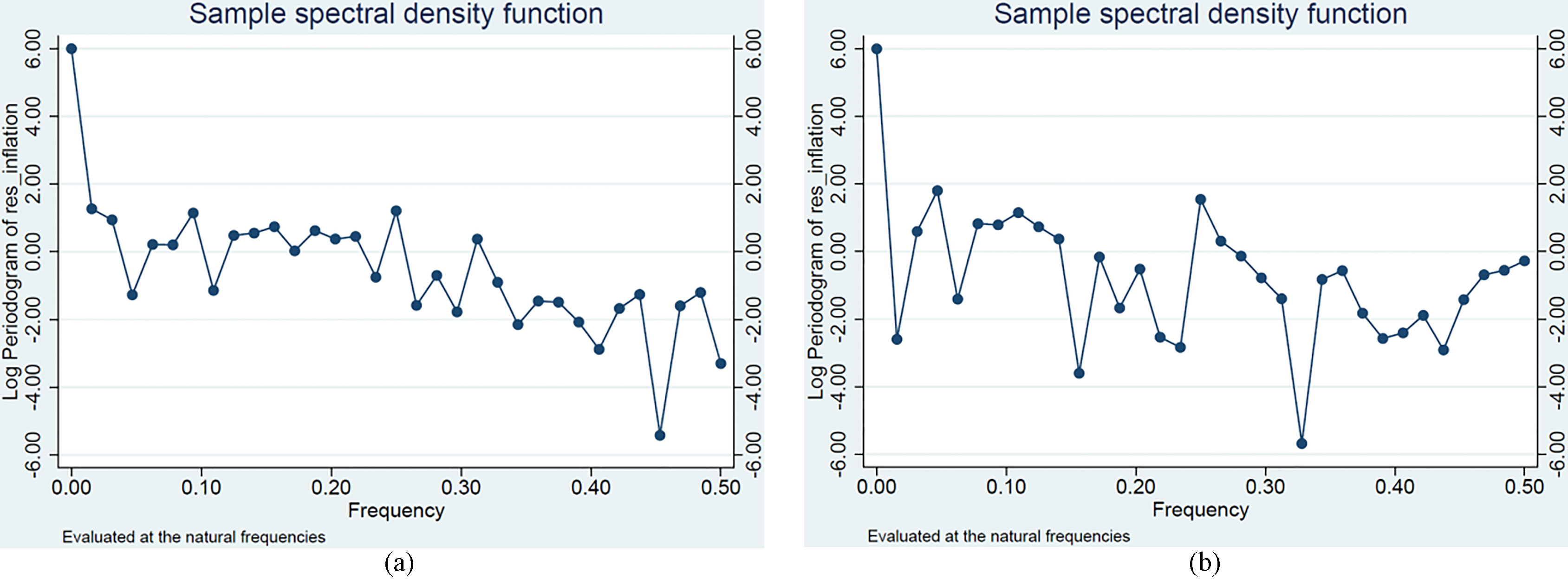
VAR Lag order selection
VAR Lag order selection
AIC: Akaike information criterion. HQIC: Hannan-Quinn information criterion. *– Indicates lag order selected to be the criterion.
Estimate of long-term dynamics
*, **, *** – indicate significance at the 10, 5 and 1% levels respectively.
Table 4 shows the results of the ADF,
In order to determine the optimal lag length, the AIC (Akaike, 1974) and the HQIC (Hannan & Quinn, 1979) criteria were used. Based on both criteria, the optimum lag of three quarters was determined for South Africa, and a lag of two quarters – for Brazil. The results are shown in Table 5.
The two-step Engle-Granger cointegration approach
The results for long-term dynamics for Brazil and South Africa are shown in Table 6.
Estimate of short term dynamics
Estimate of short term dynamics
Based on the estimates, we can conclude that in the long run the interest rate in South Africa and Brazil, which reflects the central banks’ long-term policy, depends on the real exchange rate, GDP, and inflation deviation. When the real effective exchange rate is growing (e.g., due to national currency evaluation), the interest rate in South Africa should be decreased in order to ease the pressure on the national currency, which conforms to the economic theories. When the cyclical component of GDP is growing (e.g., under conditions of economic overheating), the interest rates grow over a long-term period in order to make the GDP turn back to the stable level. Such a long-term dependence between the interest rate and the real effective exchange rate confirms the fact that the interest rate is significant for the central bank’s policy. Besides, according to the empirical results of the C model, the targeting real interest rate decreased after the structural breaks implemented both in Brazil and South Africa. This fact can be explained by the governments’ goal of ensuring liquidity for their economies with liquidity. In the long run, South Africa did not demonstrate any difference in the influence of the changing exchange rate, inflation rate or GDP before and after introducing the IT regime.
The Taylor equation for Brazil is confirmed by both C and CS models illustrating the level and regime shifts after Q4 2008. Significance of the variable Dum4_2008* y (GAP)
The REER variable is significant in the short run for Brazil in both models, but for South Africa it is significant in the CS model only. It proves the hypothesis that, despite the IT regime in the short run, central banks take into account the exchange rate movements whose significance increased after the world financial crisis of 2008. According to the CS model, South Africa had a higher value of the exchange rate in the equation of the central bank’s reaction before introducing the IT regime in the short-term equilibrium. The coefficient responsible for changing the exchange rate from Q1 1960 till Q4 1999 was equal to
Based on the CS model estimates, we can conclude that the REER variable in the Brazil central bank’s reaction equation becomes more significant with a negative coefficient. Based on the C and CS model estimates for South Africa, we report that structural shifts for 2008 do not influence the equation parameters in the short run. The coefficient of the ECM variable for Brazil and South Africa in the C model is negative and significant, but close to zero. Its negative sign shows adjustment toward long-term equilibrium.
The distinguishing feature of our study consists in an attempt to verify whether the modified Taylor equation is true for EMEs, with IT as well as to identify both short-term and long-term relations. As we consider the period of 1999–2015 including the 2008 financial crisis, when the central banks could change their monetary policy, the two-step method of Engle and Granger (1987) with structural breaks that reflect the shift and regime levels has been used.
The central bank’s reaction equation proposed in the paper and based on the modified Taylor rule was estimated for two counties, South Africa and Brazil. All the factors appeared to be significant. The equation includes the factor of the exchange rate, which is typical of EMEs conducting IT. The research shows that the IT regime and control of the national currency exchange rate fluctuations are interrelated. Achieving the inflation target and smoothing the exchange rate changes for both South Africa and Brazil are complementary processes.
Our analysis for the period of 1960–2015 for South Africa showed that in the short run the influence of the exchange rate fluctuations on the results of the monetary policy before IT in this country was higher than afterwards. After the change in the monetary policy in 2000, the exchange rate stayed significant but the empirical analysis showed that this parameter should be included into the South Africa’s central bank’s reaction equation.
The dependence between the interest rate, the GDP gap, the real exchange rate, and inflation deviation from its equilibrium value was estimated in the long run for both Brazil and South Africa. The level shift for South Africa took place in Q2 2008, whereas the level and regime shift for Brazil was determined in Q4 2008. These model estimates prove that the exchange rate fluctuations have become more significant since the crisis.
Based on the results of our research, we can make a conclusion that the two central banks of the countries under investigation, the South Africa and Brazil, combined the inflation targeting and the exchange rate management in practice, i.e. they used the monetary policy framework of flexible inflation targeting. It is necessary to mention that in modern economic conditions of declining rates of economic growth in developing countries, these economies are likely to face new challenges in their monetary policy and use their experience in inflation targeting. It can be useful for some other economies, developed and developing ones, as well.
Footnotes
Central banks can use other monetary instruments as well, but this is beyond the scope of our investigation.
Other BRICS countries introduced the monetary regime of inflation targeting much later. India did it in 2011, Russia in 2014, China is targeting monetary aggregates.
In the present paper, this parameter is equal to 1600, according to the recommendations in (Hodrick and Prescott, 1997) for quarterly data.
We analyzed the first differences for stationarity as well, first differences of the variable are I(0). Results can be presented on request.
Acknowledgments
We express our gratitude to the anonymous referee for many useful comments which have led to substantial improvements in our original manuscript.