



Abstract
Analytic Hierarchy Process (AHP) is a unique tool which can help in improvising the usage of machine learning in attaining organizational effectiveness. True, machine learning has emerged as one of the most important tools in enhancing organizational effectiveness through improved strategic decision-making vis-à-vis key performance indicators. It has redefined the way companies can create, and measure value added, and experiences generated for the end users of their products, services, and other offerings. Machine learning algorithms are being leveraged for making more predictive and prescriptive key performance indicators which ultimately contribute towards optimizations of business processes and overall improvement in the competitiveness of the organizations. It also helps the organizations in attaining excellence in execution of strategic decisions through almost accurate predictive insights on various management functions related to HR, marketing, finance, and operations which in turn boost stakeholder satisfaction. In this study, the authors have developed an analytic hierarchy process framework based on review of 166 peer-reviewed research papers to determine how the organizations can priorities management functions and their attributes coupled with machine learning applications for higher levels of efficiencies. Insights from this article may help the practicing managers in prioritizing use of machine learning in management functions for optimizing results and improving overall organizational effectiveness.
Keywords
Introduction
Machine learning has enabled the companies across sectors to enhance their competitiveness by transforming management practices and strategic as well as functional decision-making. All aspects of businesses have been positively impacted by advances in machine learning. Hence, most of the companies, especially in the developed world, today are keen to adopt machine learning as part of their corporate strategies. Over the years, machine learning has demonstrated its exceptional capability for pattern recognition and predicting outcomes for diverse datasets (Nieto et al., 2019). Digital disruptions induced by machine learning is the ‘new normal’ and companies operating across countries are proactive in terms of building right capabilities and creating appropriate ecosystem commensurate with the emerging needs of the industry and expectations of the end users.
Machine learning has evolved rapidly in recent years due to the cost-effective computing resources, massive publicly available data and, above all, the accessibility of enormously powerful, free, and open-source tools and authoritative libraries that abstract away the composite underlying math. Thus, it is now practically possible to use machine learning with minimal technical expertise. Hence it is imperative that companies in developing world with lessor resources can also make concerted efforts towards leveraging machine learning to augment their competitiveness by enhancing organizational effectiveness in terms of doing more with less resources or constantly innovating and improvising the products/services beyond the expectations of the end users.
Organizational effectiveness has often been linked to productivity, innovation, quality assurance, and overall performance of the companies. On the other hand, machine learning has tremendous potential to help the companies enhance their productivity, trigger innovations, keep an eye on quality assurance and, push their overall performance by providing incisive inputs, as well as simplifying processes and systems. Effective organizations can attain their goals consistently with the help of strong internal processes and systems, optimum utilization of resources, and strategic congruence with both internal and external business environments. Machine learning can boost the prospects of companies by enabling them to be effective in a true sense. It has been observed that the machine learning applications invariably improve employees’ experience and thereby contribute towards higher organizational performance (Garg et al., 2022). At the same time, machine learning applications can be leveraged for reducing uncertainty-induced fallouts by carefully using predictions generated by various algorithms with greater accuracy and objectivity. There are use cases indicating application of machine learning in augmenting overall performance of the organizations (Pap et al., 2022).
Literature review
The concept regarding the ability of machines to think emerged as early as 1950 (Turing, 1950). It can be explained thus: “A computer program is said to learn from experience E with respect to some class of tasks T and performance measure P, if its performance at tasks in T, as measured by P, improves with experience E” (Mitchell, 1997). It is considered a sub-field of artificial intelligence (Goodfellow et al., 2016). True, machine learning is an advancing branch of computational algorithms which are designed to simulate human intelligence by learning from the surrounding environment (Naqa & Murphy, 2015). It is a kind of artificial intelligence which makes predictions based on statistical models. Machine learning can be viewed as computerized modelling of learning processes in their multiple manifestations (Carbonell et al., 1983). Machine learning algorithms are capable of processing large-scale and unstructured data with flexible model structures which yield effective predictive results (Ma & Sun, 2020).
Scholars have linked the machine learning applications with improved quality of managerial decision-making thereby enhancing the organization’s abilities to handle crises, cope with uncertainties and reduce unwarranted costs due to inadvertent human errors (Ewertowski et al., 2023). Machine learning has the unique capability of producing models which can be integrated with decision-making processes (Lounis & Fares, 2011). Knowledge management is another function that significantly contributes to organizational effectiveness. It has been found that machine learning techniques such as neural networks, support vector machines, decision trees and logistic regression are quite efficient in organizational knowledge management (Delen et al., 2013). Furthermore, machine learning also helps in augmenting organizational learning which implies “a change in the organization’s knowledge that occurs as a function of experience” (Argote, 2011).
It is said that the inductive nature of machine learning enables the organizations to build unique learning capabilities which was not possible through traditional information technology techniques or artificial intelligence rule-based expert systems. Moreover, machine learning ensures diminished experience volatility and knowledge exhaustion within an organization. For example, AI Recruiter is trained under supervised system through a sizable set of curriculum vitae labelled as suitable and unsuitable in the past by the recruitment agent to evaluate appropriateness of the candidates based on earlier trends/patterns as well as non-obvious rules. It has also been observed that machine learning can discover patterns and relations in data about which the employees may not be aware at all. At the same time, machine learning is also capable of overcoming inherent deficiencies in manual knowledge acquisition through automated learning process.
It appears that machine learning considers the tacit knowledge of employees who had performed the experience recorded in training data both under supervised as well as unsupervised scenarios and makes it available to the decision-makers in an organization (Afiouni, 2019). Thus, the predictions made by machine learning are based on captured as well as discovered tacit knowledge, increasing their accuracy and validity. Further, advanced machine learning techniques are also capable of providing explanations and interpretations of the automated recommendations. For instance, machine learning recommender suggests new items based on preferences and records the feedback of the consumers through repeated interaction with them and maintaining a repository of knowledge for use in future to manage inventory. Besides, machine learning applications are also helpful in segmenting customers for new products. Various scholars have provided evidence regarding effective application of machine learning algorithms in various functional domains of management such as HR, marketing, finance, operations etc.
It has also been suggested that machine learning applications can be more effective in tandem with human collaboration. Further, organizations are likely to accomplish optimum improvements in performance when humans and machines work together (Wilson & Daugherty, 2018). People need to train machines, interpret their predictions, and warrant responsible use of the insights gained from such predictions. Machine learning can help organizations in improving flexibility quite significantly. For example, assembly robots work safely alongside humans to customize cars in real time in Mercedese-Benz. Likewise, decision-making can be improvised with the help of machine learning applications. In Morgan Stanely, Robo advisers offer clients a range of investment options based on real-time market intelligence. Personalization is yet another area in which machine learning applications are quite useful. Carnival Corporation uses wearable AI devices to streamline the logistics of cruise ship activities like guest preferences and tailored staff support.
Most of the HR functions today are driven by machine learning (Jha & Khera, 2017; Kumar et al., 2017; Verma & Jha, 2020; Jha, 2021). For example, recruiters use machine learning in a big way, especially in resume analysis based on natural language processing (Zimmermann, 2016). It is practically possible to predict the successful placement of a candidate in a specific position at a pre-hire stage and utilize predictions to devise a global optimization model. Further, in comparison to actual recruitment decisions, the devised framework can provide a balanced recruitment plan while improving both diversity and recruitment success rates, despite the inherent trade-off between the two. Companies have leveraged machine learning for improving quality of hire and employee selection (Shet & Nair, 2023). Machine learning applications have been used in predicting performance of new hires by analyzing their social media footprints. Besides, there are a few studies which indicate use of machine learning algorithms in performance management (Ramachandran et al., 2022). Experts have successfully used machine learning to develop wage forecasting model which uses gradient descent algorithms and backpropagation (BP) neural network to improve the accuracy of the predictions. Machine learning applications have been quite useful in predicting job involvement through generalized linear model (GLM) including linear regression and binomial classification. Moreover, machine learning applications have been quite effective in predicting employee retention.
Machine learning algorithms are quite useful in predicting employee attrition. Further, it has been observed that machine learning Classification and Regression Tree (CART) analyses are used to predict turnover intention. Also, extreme gradient boosting (XGBoost) has demonstrated the ability to predict turnover intentions of employees with better accuracy as compared to other traditional machine learning tools due to its regularization formulation. Some of the other machine learning algorithms used to predict employee turnover intentions include linear support vector machine, C 5.0 Decision Tree classifier, Random Forest, k-nearest neighbor and Naïve Bayes classifier. Further, machine learning applications can be leveraged in planning and implementing strategies to mitigate the turnover intentions by addressing issues such as competencies, commitment, trust, and cultural values through big data tools to develop a granular, case-dependent measure of turnover. While machine learning applications are useful in improvising HR processes and functions, it is equally important to take care of the concomitant vulnerability regarding privacy and data protection (Jha, 2022; Jha & Kumar, 2022).
Machine learning has been used significantly in market research. For example, support-vector machines, topic models, ensemble trees, deep neural networks, and network embedding have been used in market research for predicting consumer behaviour and generating insights on future trends. Marketing practices such as digital search and advertising, social media interaction, mobile tracking and engagement, online purchase, and in-store shopping experience, are increasingly powered by scalable and intelligent algorithms, with the help of both technology powerhouses such as Google and Amazon and many smaller MarTech (Marketing Technology) companies. Further, machine learning has proved to be a game-changing technique in digital marketing which records, analyses, and reuses the clicks and the comments about brands, thereby learning the emotions relating to the brand and helping the marketers in personalizing the sales as well as customizing their sales calls to each potential customer. Moreover, machine learning applications have also been useful in marketing strategies, direct marketing social media marketing. social network marketing, customer relationship management, predicting consumer behaviour, customer clustering, customer retention, search personalization and personalized marketing.
Machine learning algorithms are widely used in the financial sector to detect fraud, automate trading, and provide financial advice to investors (Lei et al., 2022). Besides, machine learning applications are also used in prediction of bankruptcy, money laundering detection, equity research, and detection of financial statement frauds (Lei et al., 2022). Yet, companies are hesitant to leverage machine learning applications, especially in mission-critical and privacy-sensitive data due to lack of trust. Furthermore, machine learning applications have been useful in financial statement analysis, option pricing, derivative pricing, hedging, behavioural finance, financial forecasting, prediction of stock returns, risk analysis, prediction of credit risk, bankruptcy prediction.
Machine learning is quite an efficient solution while implementing it in the supply chain which allows the industries to target the new goals of an optimum quality product with a low cost by the optimum utilization of resources. Machine learning algorithms can be extremely useful in capacity planning, resource utilization, storage management, anomaly detection, and threat detection and analysis for effective management of supply chain and logistics. Some of the machine learning applications in improving operations management efficiency include demand forecasting supplier selection, supplier segmentation, supply chain risk prediction, demand/sales estimation, inventory management, transportation, and distribution efficiency (Nagar et al., 2021)
Methodology
Application of Machine Learning in augmenting organization effectiveness can be leveraged with the help of Analytic Hierarchy Process (AHP), developed by Thomas L. Saatey in 1970s. In the present study, AHP has been used to determine how the organizations can priorities management functions and their attributes coupled with machine learning applications for higher levels of efficiencies both in manufacturing as well as service sectors. Forming hierarchies of criteria/attributes, determining priorities and logical consistency are the characteristic features of AHP which make it a desirable decision-making tool (Badri & Abdulla, 2004). According to Lipovetsky (2023), AHP helps in identifying critical factors/attributes and prioritizing them in an objective manner for decision-making.
For this study, a repository of 166 research papers published in peer-reviewed journals during the last 25 years were compiled by the authors. A thorough search on Google Scholar using keywords such as Machine Learning and Human Resource Management/Marketing/Finance/Operations was made to elicit relevant peer-reviewed literature. Based on the available literature, 8 attributes under each management function i.e., HR, Marketing, Finance, and Operations having impact on improving organizational efficiency were identified. Further, Analytic Hierarchy Process was applied to determine the importance of each attribute in terms of its contribution towards augmenting organizational effectiveness.
AHP framework for leveraging machine learning in management functions for organizational effectiveness.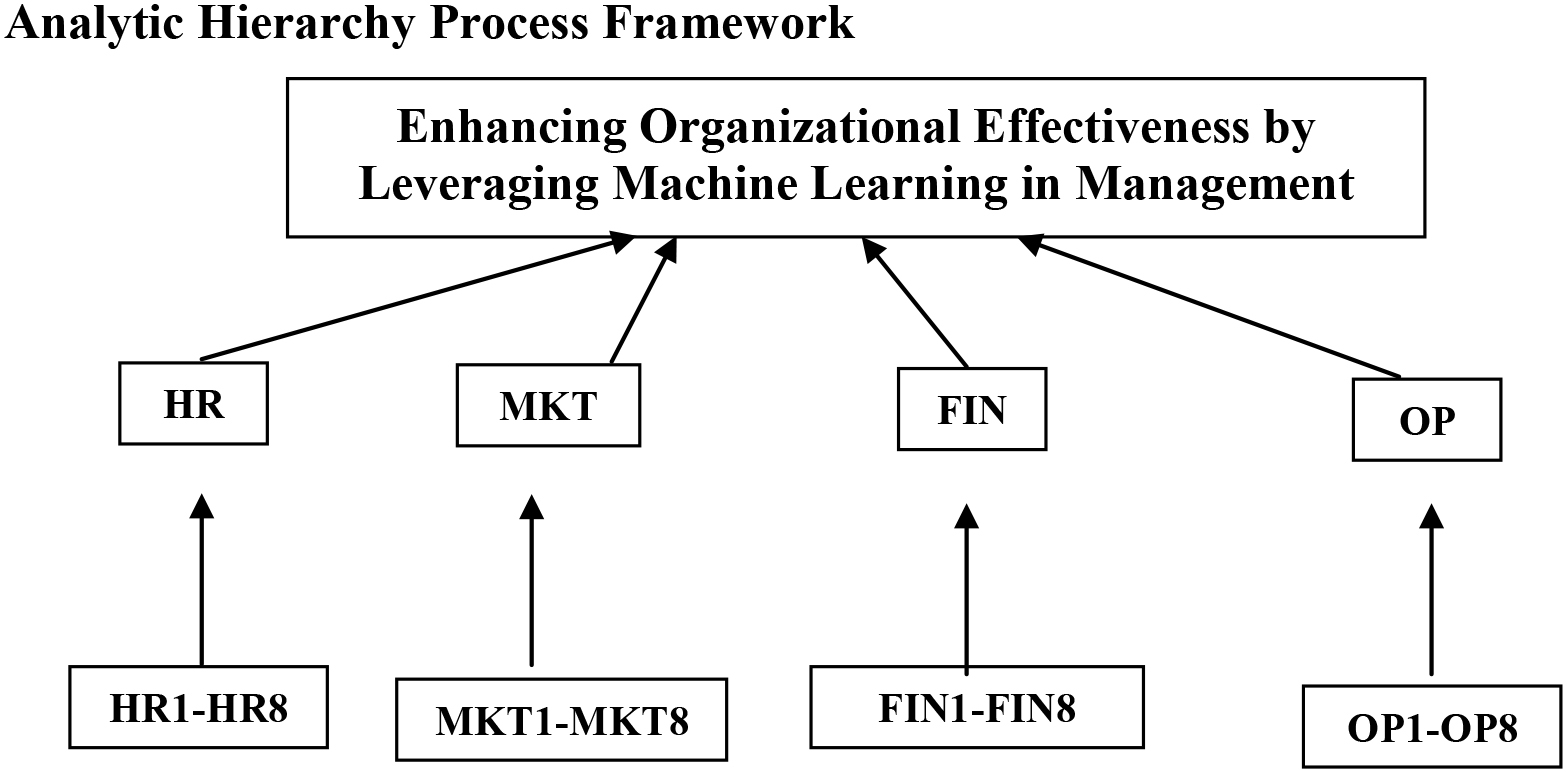
Description of attributes under four majors functions of management
Source: Based on authors’ compilation of peer-reviewed literature on application of machine learning in four management functions viz. HR, Marketing, Finance, and Operation.
The extant literature provides definitive relationship between application of machine learning in various management functions such as HR, marketing, finance, and operations and organizational effectiveness. However, the contribution of each function differs in terms of their ability to augment organizational effectiveness. The proposed AHP framework indicates higher weights attributed to HR (4.11) followed by operations (4.06), finance (4.00), and marketing (3.93) functions as reflected in Table 2. Consistency ratio (CR) of 0.012 is less than the acceptable norm of 0.10.
Relative weights attributed to HR, Operations, Finance, and Marketing
Relative weights attributed to HR, Operations, Finance, and Marketing
In the HR function, all the attributes from HR1 to HR8 have been assigned relative weights based on supporting peer-reviewed literature. Table 3provides how application of machine learning in various HR functions contribute towards organizational effectiveness. It appears from Table 3 that HR5 (Prediction of Job Involvement) is most important in terms of relative weights followed by HR1 (Recruitment and Selection), HR6 (Prediction of Employee Retention), HR2 (Performance Management), HR7 (Prediction of Employee Attrition), HR3 (Career Development), HR8 (Prediction of Employee Turnover/Turnover intentions) and HR4 (Compensation and Rewards Management) as indicated in Table 3. Consistency ratio (CR) of 0.039 is less than the acceptable norm of 0.10.
Relative weights attributed to HR functions from HR1 to HR8
In the Operations function, all the attributes from OP1 to OP8 have been assigned relative weights based on supporting peer-reviewed literature. Table 4 provides how application of machine learning in various functions of Operations contribute towards organizational effectiveness. According to Table 4, OP4 (Supply Chain Risk Prediction) is most important in terms relative weights followed by OP7 (Managing Projects), OP8 (Quality Control), OP3 (Supplier Segmentation), OP2 (Supplier Selection), OP5 (Inventory Management), OP6 (Transportation and Distribution Efficiency) and OP1 (Demand Forecasting). The consistency ratio (CR) of 0.08 is less than the acceptable norm of 0.10.
Relative weights attributed to operations functions from OP1 to OP8
In the Finance function, all the attributes from FIN1 to FIN8 have been assigned relative weights based on supporting peer-reviewed literature. Table 5 shows how the application of machine learning in various functions of Finance contribute towards organizational effectiveness. According to Table 5, FIN5 (Financial Forecasting) is most important in terms of relative weights followed by FIN1 (Option Pricing), FIN6 (Risk Analysis), FIN2 (Derivative Pricing), FIN7 (Prediction of Credit Risk), FIN8 (Bankruptcy Prediction), FIN4 (Behavioural Finance), and FIN3 (Hedging). The consistency ratio (CR) of 0.052 is less than the acceptable norm of 0.10.
Relative weights attributed to finance functions from FIN1 to FIN8
Relative weights attributed to marketing functions from MKT1 to MKT8
Rank of attributes contributing to organizational effectiveness when coupled with machine learning applications based on their global weights
In Marketing function, all the attributes from MKT1 to MKT8 have been assigned relative weights based on supporting peer-reviewed literature. Table 6 shows how the application of machine learning in various functions of Marketing contributes towards organizational effectiveness. As reflected in Table 6, MKT3 (Marketing Strategies) is most important in terms of relative weights followed by MKT1 (Market Research), MKT2 (New Product Development), MKT6 (Customer Segmentation), MKT4 (Direct Marketing), MKT7 (Customer Retention), MKT5 (Social Media Marketing) and MKT8 (Personalized Marketing). The consistency ratio (CR) of 0.09 is less than the acceptable norm of 0.10.
Table 7 provides an overall ranking of each of the attributes in all the four functional areas of management viz. HR, Marketing, Finance and Operations. Based on global weights, OP4 (Supply Chain Risk Prediction) is at the top of the hierarchy in terms of importance while OP1 (Demand Forecasting) is at the bottom. Managers can use the priority ranking of all the 32 attributes drawn from four management functions i.e., HR, marketing, finance, and operations while planning machine learning applications in the organization for improving functional efficiency.
Analytic Hierarchy Process (AHP) framework for enhancing organizational effectiveness by judicious application of machine learning in various management functions can help the companies gain competitive advantage in both domestic and international markets. AHP framework enables the managers to prioritize application of machine learning in various functions based on their ranking derived through an objective method. Disorderly use of machine learning in management functions may not yield desired organizational outcomes. So far, the companies have been applying machine learning sporadically. A systematic adoption of AHP framework on enhancing organizational effectiveness by leveraging machine learning in management as envisaged in this paper is an imperative which the corporate cannot ignore for long.
It goes without saying that machine learning applications have emerged as the greatest source of strategic differentiation in the highly competitive world today. However, the companies need to adopt an integrated view toward machine learning to optimize organizational effectiveness. Piecemeal use of machine learning applications in one or two management functions of the organizations may not yield desired results. Hence, it is imperative the organizations should have a holistic vision of implementing machine learning applications in all functional areas of management viz. HR, marketing, finance, operations, etc. Extant literature has demonstrated varied use of machine learning applications in each of the domain of management functions. Based on analytic hierarchy process framework, relative importance of application of machine learning in HR is higher than operations, finance, and marketing in terms of contributing to optimizing organizational effectiveness. Even within HR function, various elements have different levels of importance or priority. Likewise, different attributes of finance, marketing, and operations have different levels of significance based on their relative weights. Besides, all the attributes of HR, finance, marketing, and operations can be prioritized as per the ranks based on global weights. Managers need to prioritize application of machine learning in management functions based on their relative importance to ensure most cost-effective optimization of resources and augmentation of organizational effectiveness.
Companies which fail to adopt machine learning applications are likely to lose their competitive advantage in the long run. On the other hand, start-ups as well as small and medium enterprises also can leverage machine learning applications and upscale themselves in a relatively shorter span of time by taking advantage of companies offering machine learning applications as services. Organization-wide adoption of machine learning application however depends on change in mindset of people from boardroom to shop-floor. Generally, employees see machine learning as a threat. Such perceptions are an impediment to successful implementation of machine learning applications in organizations. It is the responsibility of top management to ward off such threat perception with greater assurance that machine learning applications are complementary to human intelligence, and both can co-exist in the best interest of the organizations. Organizations which have adopted machine learning applications to reduce manpower have not been successful in the long run. Human oversight has tremendous potential to reduce inadvertent errors in predictions made by machine learning algorithms. At the same time, human oversight can also help in mitigating the risks related to privacy issues of individuals within and outside the organizations as well as security of big data.