



Abstract
A novel transition metal chelate Cd(SCZ)2Cl2 (SCZ = semicarbazide) was synthesized from a known 1D metal-organic framework (MOF) Cd(SCZ)Cl2 and fully characterized by elemental analysis and FTIR spectroscopy. Then the 1D MOF Cd(SCZ)Cl2 was regained by adding CdCl2 to the chelate Cd(SCZ)2Cl2. Single-crystal X-ray diffraction analysis revealed that Cd(SCZ)2Cl2 crystallizes in orthorhombic Pbcn space group. Differential scanning calorimetry (DSC) was applied to assess the thermal decomposition behavior of Cd(SCZ)2Cl2. The non-isothermal kinetics parameters of Cd(SCZ)2Cl2 were calculated by the methods of Kissinger and Ozawa-Doyle, respectively.
Introduction
Metal-organic frameworks (MOFs) have attracted great attention because of their stable and controllable architectures, unique properties and potential applications in gas storage, chemical separation, catalysis, molecular sensing, conductivity, nonlinear optical materials, drug delivery, and so forth [1–7]. The ongoing search has confirmed many times that nitrogen-rich MOFs could also be high explosives [8–11]. In 2014, Zhang highlighted MOFs as high explosives will provide a great opportunity for developing new-generation green primary explosives [9]. In 2016, an inductive overview of the application prospects and development potentials in the field of high-energy-density-materials (HEDMs) on MOFs was presented [10]. During the past four years, energetic MOFs have demonstrated high density, low sensitivity, suitable thermostability, remarkable high energy output due to their strong structural reinforcements and extensive supramolecular structures [12–20].
On the other hand, chelating energetic material, which we noted as CEM, is also becoming more and more popular for its high density, excellent energetic properties and favorable thermal stability [21–28]. Among the reported ligands, derivatives of hydrazine have drawn our attention. Carbohydrazide can be one of the most capable ligands, which has been studied by many researchers worldwide [29–33]. Particularly, cadmium tri(carbohydrazide) perchlorate and zinc tri(carbohydrazide) perchlorate both turn out to be lead-free primary explosives in industrial detonators. Among them the perchlorate salts are shown to be potential primary explosives. 3-Amino-1-nitroguanidine is also an excellent bidentate ligand, and some perchlorate containing transition metal chelates are found out to be laser ignitable [24]. Another brilliant polydentate ligand is 5-(1-methylhydrazinyl)-1H-tetrazole (HMHT) [25]. Various photosensitive copper(II) compounds with HMHT as ligand have been synthesized and characterized.
Suffice it to say, MOFs and CEMs could be promising HEDMs. By contrast, MOFs possess higher detonation performance, whereas CEMs present lower sensitivities. Based on the consideration above, transformation between MOFs and CEMs could be a good alternative to harmonize the inherent confliction between energy and sensitivity, which makes the energy and sensitivity adjustable.
Consequently, it is important to carry out research on transformation between MOFs and chelates. Herein we report the preparation, crystal structure and thermal decomposition of a novel transition metal chelate Cd(SCZ)2Cl2, which was synthesized from the reported MOF Cd(SCZ)Cl2 [34]. And the MOF Cd(SCZ)Cl2 was further regained by the chelate Cd(SCZ)2Cl2 simply and straightly. Mutual transformation between MOF and chelate was first studied by this work.
Experimental
Materials and physical techniques
All reagents (analytic grade) were purchased commercially and used without further purification. Elemental analyses were performed with a Flash EA 1112 full automatic trace element analyzer. The FT-IR spectra were recorded with a Bruker Equinox 55 infrared spectrometer (KBr pellets) in the range of 4000–400 cm-1with a resolution of 4 cm-1. DSC measurement was performed with a Pyris-1 differential scanning calorimeter in a dry nitrogen atmosphere with flowing rate of 20 mL·min-1. The condition for the thermal analysis was as follow: the sample was powdered and sealed in the aluminum pans with a linear heating rate of 10C·min-1from 50C to 500C.
Syntheses
Synthesis of Cd(SCZ)2Cl2
Semicarbazide hydrochloride (1.11 g, 10 mmol) was dissolved in distilled water (10 ml) and the pH value was adjusted to 6-7 using 10% NaOH solution. A solution containing Cd(SCZ)Cl2 [36] (2.58 g, 10 mmol) in distilled water (25 ml) was stirred with a mechanical agitator and heated to 65C for using. And then mixture of the above solutions and kept at 65 C for another 20 min. Afterwards, the solution was cooled to the room temperature naturally. The precipitate was collected by filtration, washed with ethanol, and the product was dried in an explosion-proof dryer. Single crystals suitable for X-ray measurement were obtained by evaporation of the mother liquor at room temperature for 7 days. Elemental analysis calcd. for Cd(SCZ)2Cl2 (molar mass 333.46 g/mol) (%):C 7.20, H 3.02, N 25.20; Found (%): C 7.25, H 3.00, N 25.15. IR (cm-1, KBr pellets): 3484(s), 3377(s), 3280(s), 3142(s), 1667(vs).
Synthesis of Cd(SCZ)Cl2
Cd(SCZ)2Cl2 (3.33 g, 10 mmol) was dissolved in distilled water (35 ml) and stirred with a mechanical agitator at 65C for using. And then a solution containing CdCl2 (1.83 g, 10 mmol) was added into the above solution and kept at 65C for another 20 min. Afterwards, the solution was cooled to the room temperature naturally. The precipitate was collected by filtration, washed with ethanol, and the product was dried in an explosion-proof dryer. Elemental analysis calcd. for Cd(SCZ)2Cl2 (molar mass 258.38 g/mol) (%): C 4.64, H 1.94, N 16.26; Found (%): C 4.66, H 1.89, N 16.35. IR (cm-1, KBr pellets): 3480(s), 3392(s), 3276(s), 3150(s), 1655(vs).
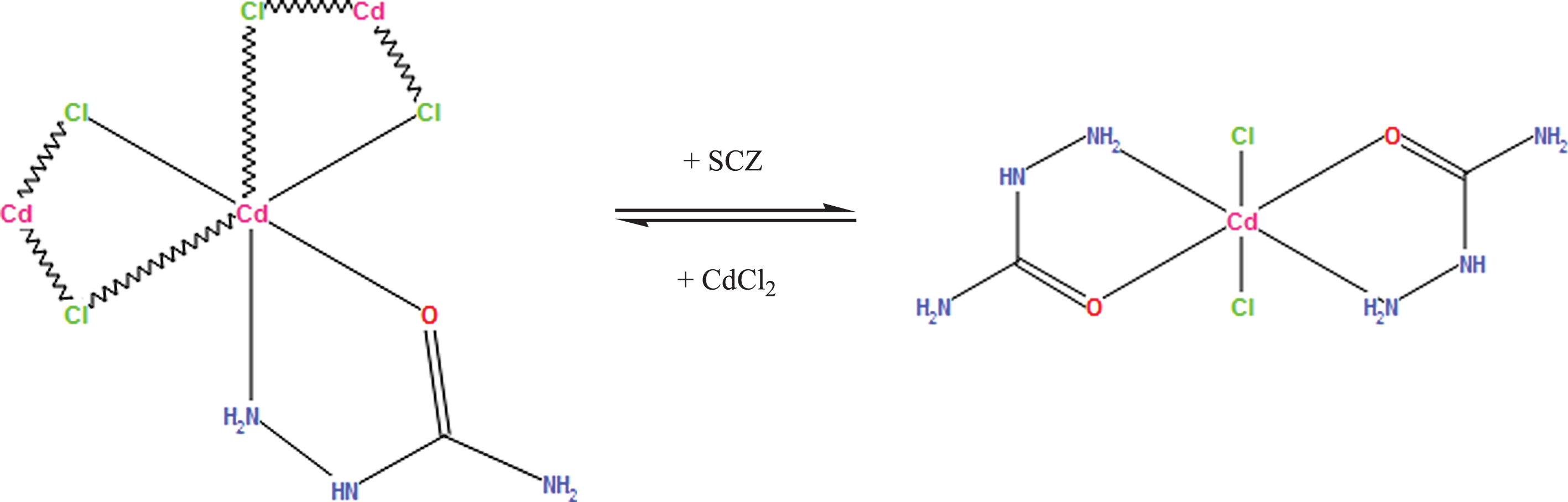
Transformation between Cd(SCZ)2Cl2 and Cd(SCZ)Cl2.
The X-ray diffraction data collection was performed with a Rigaku AFC-10/Saturn724+CCD detector diffractometer with graphite monochromated Mo-Kα radiation (λ= 0.71073) with φ and ω modes at 153(2)K. The structure was solved by direct methods using SHELXS-97 and refined with SHELXL-97 [35, 36]. All non-hydrogen atoms were obtained from the difference Fourier map and subjected to anisotropic refinement by full-matrix least squares on F2. Detailed information concerning crystallographic data collection and structure refinement are summarized in Table 1.
Crystallographic data and structure determination details
Crystallographic data and structure determination details
[a] w = 1/[s2(Fo2) + (0.1000p)2 + 0.0000p], P = (Fo2 + 2Fc2)/3.
Structure description
As shown in Table 1, Cd(SCZ)2Cl2 crystallizes with a orthorhombic unit cell in the space group Pbcn, different with Cd(SCZ)Cl2 (Pna21). The coordination environment of the cadmium cation and the molecular unit of Cd(SCZ)2Cl2, with atom labeling are demonstrated in Fig. 1. Selected bond lengths and angles for Cd(SCZ)2Cl2 are given in Table 2.
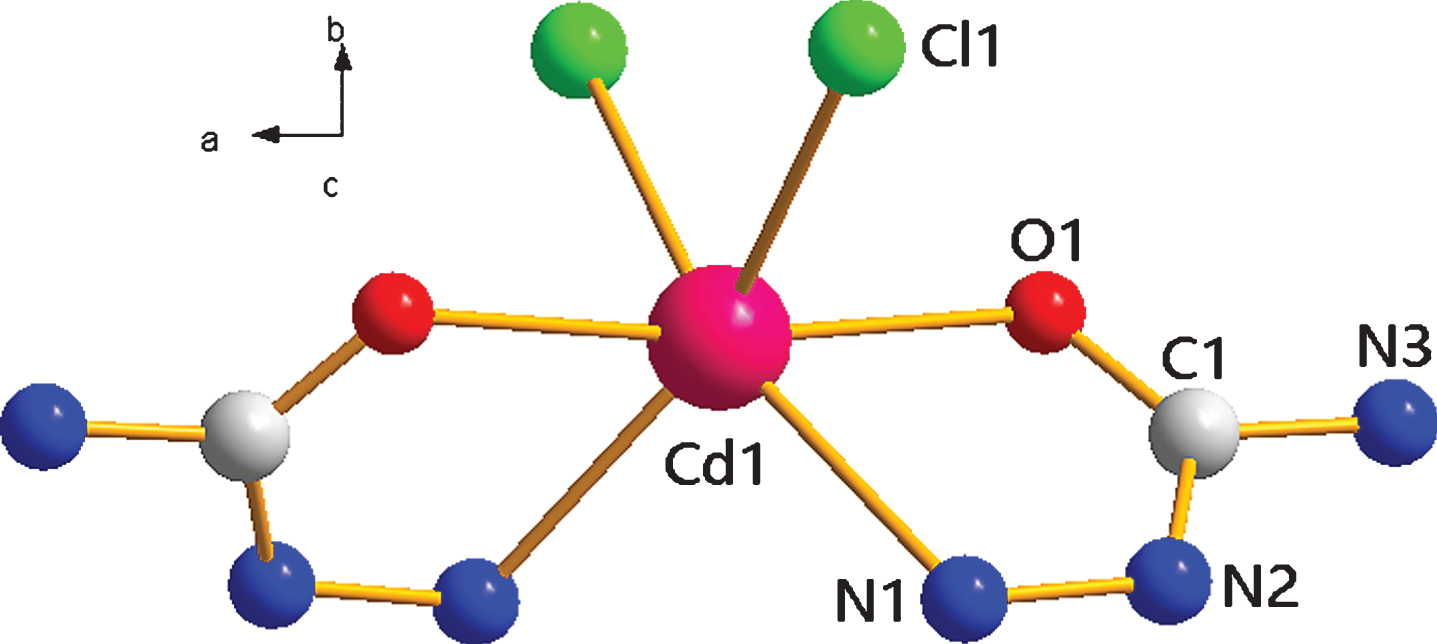
Molecular structure of Cd(SCZ)2Cl2.
Selected bond lengths and angles for Cd(SCZ)2Cl2
Symmetry code: #1 – x+1, y, – z+3/2.
The Cd(II) ion has sp3d2 hybridization, contributing six empty orbits to accommodate the lone pair electrons from ligands. Molecular unit of Cd(SCZ)2Cl2 contain one cadmium cation, two neutral SCZ molecules and two chloride ions. The central cadmium cation coordinates with six ligand atoms, two chlorides, two nitrogen atoms and two oxygen atoms from two SCZ ligands. SCZ shows typical bidentate coordination mode. The bond lengths of the central cadmium(II) atom to coordinated atoms range from 2.32 Å to 2.58 Å, which demonstrate that the cadmium(II) cation is coordinated to form a distorted octahedral configuration. These selected bond angles O1-Cd1-O1#1 and N1-Cd1-Cl1 obviously deviate from the ideal angle of 180°, which illustrated that the octahedral configuration is severely distorted. Two SCZ molecules coordinated to the central Cd atom to form two planes. Two chloride ions are in separate planes and these two planes are almost vertical to each other, ensuring the minimum of the space steric hindrance, benefiting to the structural stability.
Semicarbazide coordinates to cadmium(II) center to form a five-membered ring and there is one uncoordinated amino group connecting to the five-membered ring. The uncoordinated amino group is in a semi-dissociated state. This semi-dissociated structure leads to good molecule flexibility to the title complex. Besides, weak N–H⋯O and N–H⋯Cl hydrogen bonds were observed in Cd(SCZ)Cl2 (Table 3). The electrostatic forces, all intermolecular and intramolecular hydrogen bonds extend the structure into a 3D supramolecular structure and make an important contribution to enhance the thermal stability of the complex (Fig. 2).
Hydrogen bonds for Cd(SCZ)2Cl2
Symmetry codes: #2 – x+1, – y+1, – z+1; #3 x–1/2, y–1/2, – z+3/2; #4 – x+3/2, – y+3/2, z–1/2; #5 x + 1/2, y–1/2, – z+3/2; #6 – x+3/2, y–1/2, z.
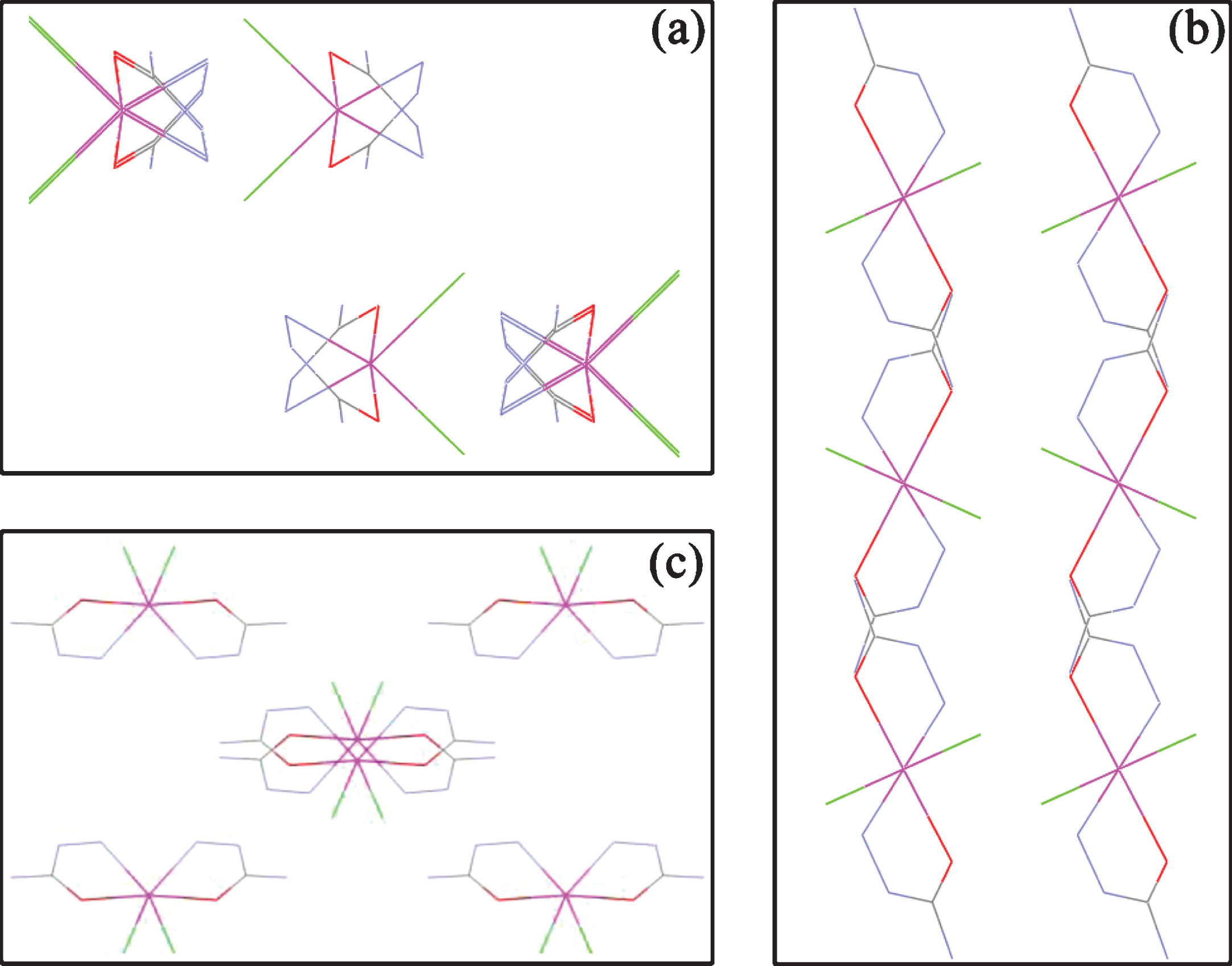
Packing diagram of Cd(SCZ)2Cl2 viewed along different axes.
In order to investigate the thermal behavior of Cd(SCZ)2Cl2, DSC curve with a linear heating rate of 10C·min-1 was recorded (Fig. 3). In the DSC curve, there is one endothermic peak and one exothermic peak. The endothermic stage occurs in the range of 269C∼311C with a peak temperature of 295C, while the exothermic process starts at 319C and ends at 415C with a peak temperature of 344C. The DSC curve of Cd(SCZ)2Cl2 shows its potential as heat-resisting material with its onset thermal decomposition temperature above 300C, and both its endothermic peak temperature and exothermic peak temperature are higher than Cd(SCZ)Cl2 (287C/335C) [36].
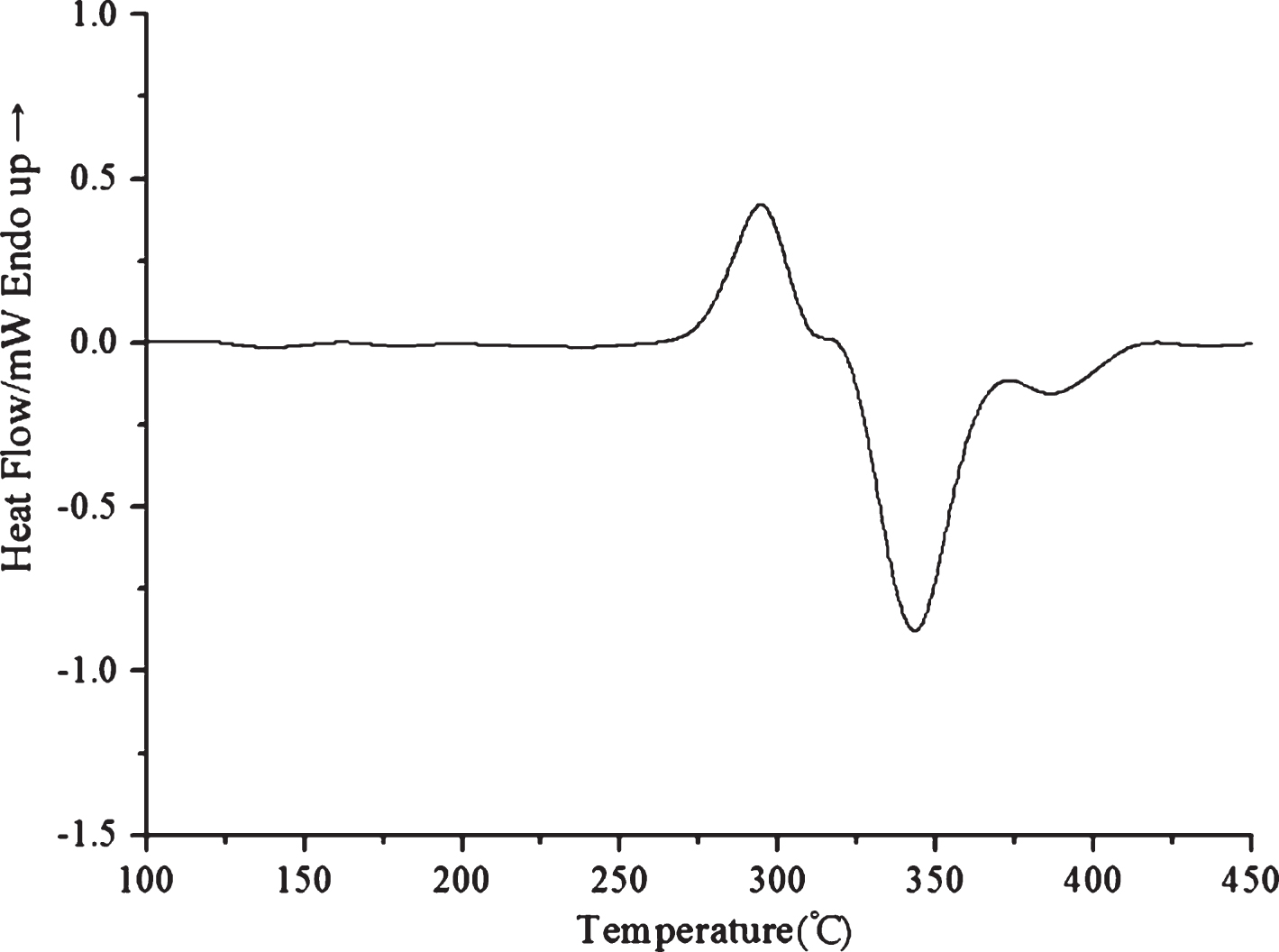
DSC curve for Cd(SCZ)2Cl2 with β= 10C·min-1 in a nitrogen atmosphere.
In the present works, Kissinger’s method and Ozawa-Doyle’s method are widely used to determine the apparent activation energy (E) and the pre-exponential factor (A). The Kissinger and Ozawa-Doyle equations are as follows, respectively.
Where Tp is the peak temperature [C], A is the pre-exponential factor [s-1], E is the apparent activation energy [kJ mol-1], R is the gas constant (8.314 J K-1 mol-1), β is the linear heating rate [C min-1], and G(α) is the reaction mechanism function.
Based on the first exothermic peak temperatures measured at four different heating rates of 5, 10, 15 and 20C/min, Kissinger’s method and Ozawa-Doyle’s method were applied to study the kinetics parameters of Cd(SCZ)2Cl2. From the original data, the apparent activation energy E, pre-exponential factor A, linear coefficient R and standard deviations S were determined and shown in Table 4.
Peak temperatures of the first exotherm and the chemical kinetics parameters
So, the Arrhenius equation of 1 can be expressed as follow: (E is the average of EK and EO):
The equation can be used to estimate the rate constants of the initial thermal decomposition process of the title compound.
A novel chelate Cd(SCZ)2Cl2 (SCZ = semicarbazide) was synthesized from a known MOF Cd(SCZ)Cl2 and fully characterized by elemental analysis, X-ray diffraction and FTIR spectroscopy. Then the MOF Cd(SCZ)Cl2 was further regained by adding CdCl2 to the chelate Cd(SCZ)2Cl2. Thermal analysis indicates that chelate Cd(SCZ)2Cl2 has potential as heat-resisting material with its exothermic peak temperature above 300C and higher than that of MOF Cd(SCZ)Cl2. Non-isothermal kinetics analysis reveals that the Arrhenius equation of Cd(SCZ)2Cl2 can be expressed as follow: lnk = 80.60–427.5×10³/(RT). The work here provide a starting point for investigating mutual transformation between MOF and chelate, a hitherto overlooked aspect of coordination chemistry, which is bubbling with full opportunities for developing new chelates and MOFs.
Footnotes
Acknowledgments
We gratefully acknowledge financial support from the State Key Laboratory of Explosion Science and Technology (No. YBKT16-17), Science and Technology on Applied Physical Chemistry Laboratory (No. 9140C370101150C37170), the National Natural Science Foundation of China (No. 11672040).