



Abstract
A novel nitrogen and oxygen rich chelating energetic material (CEM) Zn(SCZ)2(H2O)2·2HTNR (1, SCZ = semicarbazide, TNR = styphnic acid) was prepared and characterized by elemental analysis, IR spectra and differential scanning calorimetry (DSC). Its crystal structure was determined through X-ray single crystal diffraction at 153(2) K. The crystal belongs to triclinic. Space group is P-1 with crystal parameters of the unit cell dimensions: a = 0.8284(2) nm, b = 1.1848(4) nm, c = 1.3411(4) nm, α = 99.617(4)°, β = 92.593(4)°, γ = 97.148(4)°, V = 1.2642(6) nm3, Z = 2 and D c =1.943 g·cm–3. The kinetic parameters of the first exothermic process of 1 were studied by the Kissinger’s method and Ozawa-Doyle’s method. Sensitivity tests revealed that 1 is insensitive to mechanical stimuli. Energy of combustion and enthalpy of formation of 1 were calculated.
Introduction
For the time being, insensitive high-energy-density materials (HEDMs) is a topic of interest that is receiving significant attention in the field of energetic materials [1–6]. The development of insensitive HEDMs continues to focus on coordination energetic materials [7–12]. On one hand, nitrogen heterocyclic rings have obtained much attention as ligands to construct energetic coordination complexes, such as 3-azido-1,2,4-triazole, 5-nitrotetrazole and 1,5-diaminotetrazole, due to the positive heat of formation and thermal stability. On the other hand, a new class of transition metal complexes containing chelating groups with chain ligands, we noted as chelating energetic materials (CEMs), has also attracted researcher’s interests.
Carbohydrazide based CEMs have been studied by many researchers worldwide [13–17]. Among them the perchlorate CEMs are shown to be potential primary explosives. Particularly, cadmium tri(carbohydrazide) perchlorate and zinc tri(carbohydrazide) perchlorate both turn out to be lead-free primary explosives in industrial detonators. 3-Amino-1-nitroguanidine is also an excellent bidentate ligand, and some perchlorate containing CEMs are found out to be laser ignitable [18]. SCZ based coordination CEMs were reported extensively [19–24], but its energetic characteristics didn’t arouse attention until recently [25, 26].
Researchers have also paid intense attention to the green zinc coordination compounds. In 2013, a new energetic zinc-FOX-7 (FOX-7 = 1,1-diamino-2,2-dinitroethylene) complex, Zn(NH3)2(FOX-7)2 was synthesized and structurally characterized by Zhe et al. [27]. In the same year, We prepared and characterized a green nitrogen-rich coordination compound Zn3(ATZ)6(N3)6 (ATZ = 4-amino-1,2,4-triazole, N% = 61.7%), which has the highest nitrogen content reported for a coordination compound based on 4-amino-1,2,4-triazole being reported [28]. In 2014, we have reported the structure of [Zn(SCZ)3](NO3)2 and its potential to be energetic material [26].
In order to deepen the study on SCZ based compounds, herein we report a novel zinc coordination CEM Zn(SCZ)2(H2O)2·2HTNR (
Experimental
Materials and physical techniques
All reagents (analytic grade) and chemicals (chemically pure) were purchased commercially and used without further purification. Elemental analyses were performed with a Flash EA 1112 full automatic trace element analyzer. The FT-IR spectra were recorded with a Bruker Equinox 55 infrared spectrometer (KBr pellets) in the range of 4000-400 cm–1with a resolution of 4 cm–1. DSC measurement was performed with a Pyris-1 differential scanning calorimeter in a dry nitrogen atmosphere with flowing rate of 20 mL·min–1. The condition for the thermal analysis was as follow: the sample was powdered and sealed in the aluminum pans with a linear heating rate of 10°C·min–1 from 50°C to 500°C.
Synthesis
Semicarbazide hydrochloride (3.33 g, 30 mmol) was dissolved in distilled water (30 mL) and the pH value was adjusted to 6-7 using 10% NaOH solution. Zinc carbonate (10 mmol, 1.14 g) was added to a solution of 2,4,6-trinitroresorcinol (20 mmol, 4.90 g) in deionized water (40 mL), and the mixture was stirred at 60–65°C until a clear solution resulted. The solution containing SCZ was added and the mixture was kept at 60–65°C for 15 min. Then the solution was cooled to room temperature. The precipitate was collected by filtration, washed with ethanol, and dried under vacuum in an explosion-proof water-bath dryer. Yield: 42% (3.11 g). Yellow prism single crystals suitable for X-ray measurements were obtained by recrystallization of the products from deionized water at room temperature over half month. Anal. Calcd (%) for C14H18N12O20Zn: C, 22.73; H, 2.45; N, 22.72. Found (%): C, 22.85; H, 2.39; N,22.86. IR (KBr): 3453, 3321, 3235, 2371, 1634, 1537, 1437, 1382, 1305, 1269, 1170, 1087, 928, 788, 746, 689, 560, 474 cm–1.
X-ray data collection and structure refinement
The X-ray diffraction data collection was performed with a Rigaku AFC-10/Saturn724+CCD detector diffractometer with graphite monochromated Mo-Kα radiation (λ = 0.71073) with φ and ω modes at 153(2) K. The structure was solved by direct methods using SHELXS-97 and refined with SHELXL-97 [29, 30]. All non-hydrogen atoms were obtained from the difference Fourier map and subjected to anisotropic refinement by full-matrix least squares on F2. Detailed information concerning crystallographic data collection and structure refinement are summarized in Table 1.
Crystallographic data and structure determination details.
Crystallographic data and structure determination details.
Structure description
The coordination environment of the zinc cation, the molecular structure and the packing plot of
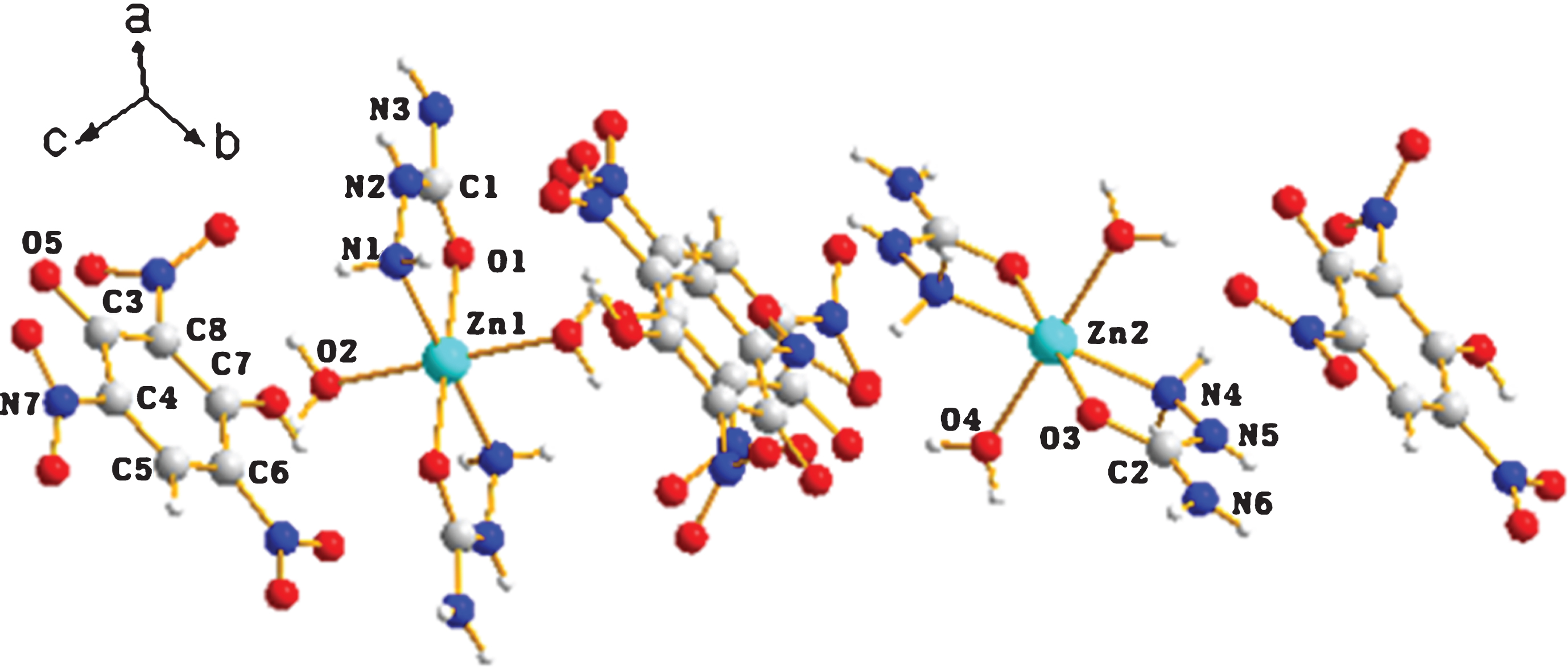
Molecular structure of 1.

Packing diagram of 1.
Selected bond lengths and angles for
Symmetry code: #1 -x, 1-y, 1-z; #2 -x, -y, -z.
The central Zn(II) ion has sp3d2 hybridization, contributing six empty orbits to accommodate the lone pair electrons from ligands. Molecular unit of CEM
The chelate effect, electrostatic attractions, and intermolecular and intramolecular hydrogen bonds (Table 3) extend the structure into a 3D supramolecular structure and make an important contribution to enhance the thermal stability of the complex.
Hydrogen bonds for
Symmetry codes: (i) -x, 1-y, 1-z; (ii) -1+x, -1+y, z; (iii) x, -1+y, z; (iv) 1+x, y, z.
In order to investigate the thermal behavior of

DSC curve for 1 with β = 10°C·min–1 in a nitrogen atmosphere.
In the present works, Kissinger’s method and Ozawa-Doyle’s method are widely used to determine the apparent activation energy (E) and the pre-exponential factor (A) [31, 32]. The Kissinger and Ozawa-Doyle equations are as follows, respectively.
Where Tp is the peak temperature [°C], A is the pre-exponential factor [s–1], E is the apparent activation energy [kJ mol–1], R is the gas constant (8.314 J K–1 mol–1), β is the linear heating rate [°C min–1], and G(α) is the reaction mechanism function.
Based on the first exothermic peak temperatures measured at four different heating rates of 5, 10, 15 and 20°C/min, Kissinger’s method and Ozawa-Doyle’s method were applied to study the kinetics parameters of
Peak temperatures of the first exotherm and the chemical kinetics parameters
So, the Arrhenius equation of
The equation can be used to estimate the rate constants of the initial thermal decomposition process of the title compound.
Impact sensitivity was determined by a fall hammer apparatus. The compound (20 mg) was placed between two steel poles and was hit by a 5.0 kg drop hammer. The test showed that the 50% firing height (h50) was 50 cm (= 22.5 J).
Friction sensitivity was determined using 20 mg sample.
According to the method of flame sensitivity test, 20 mg of
To sum up, both CEM
Energy of combustion and enthalpy of formation
In order to study the energy of combustion (ΔH) and the enthalpy of formation (ΔfH°298), constant-volume energy of combustion (Qv) was measured by oxygen bomb calorimetry and was –8.54 MJ·kg–1.
The bomb equation is as follow:
And the energy of combustion is as follow (T = 298.15 K):
So the energies of combustion of
The metal coordination compound should have relatively thermodynamically stable structure. The standard enthalpy of formation was back calculated from the heat of combustion on the basis of Equation (4), and Hess’s Law as applied in thermochemical Equation (5). With the known enthalpies of formation of zinc oxide [ΔfH°298(ZnO, s) = –348.28 kJ·mol–1], carbon dioxide [ΔfH°298(CO2, g) = –393.5 kJ·mol–1] and water [ΔfH°298(H2O, l) = –285.8 kJ·mol–1], the enthalpy of formation of
A novel CEM Zn(SCZ)2(H2O)2·2HTNR (
Footnotes
Acknowledgments
We gratefully acknowledge financial support from the State Key Laboratory of Explosion Science and Technology (No. YBKT16-17), Science and Technology on Applied Physical Chemistry Laboratory (No. 9140C370101150C37170).