



Abstract
In this work, chitosan-g-itaconic acid copolymer nanocomposites containing nanoclay (1–5%, weight ratio) were synthesized using cerium (IV) ammonium nitrate as initiator. The optimum reaction conditions were identified as chitosan/itaconic acid monomer weight ratio of 3/9 and initiator concentration of 0.003 mol/L. These reaction conditions were used as preparation of chitosan-g-itaconic acid copolymer nanocomposites. XRD analysis and grafting percentage determination were used for characterization of nanocomposites. XRD patterns of nanocomposites indicate that clay sheets are exfoliated. Grafting percentages of chitosan-g-itaconic acid copolymers were determined as about 30%. Chitosan-g-itaconic acid nanocomposites were used for the removal of heavy metal ions from aqueous solutions. The results showed that the second-order kinetic model was suitable for the adsorption of Cu(II) and Pb(II) onto chitosan-g-itaconic acid nanocomposites. The equilibrium adsorption data have been evaluated using Langmuir, Freundlich, Temkin, Dubinin-Raduskevich and Redlich–Peterson models. Langmuir isotherm model (Type 1) and Redlich–Peterson isotherms are the best-fit models forthe adsorption process in this study.
Keywords
Introduction
Industrial materials are usually made from metals, ceramics or polymers. Polymers have more advantageous properties than other material groups and these materials can be produced from two base sources that are called “renewable sources” and “non-renewable sources”. Nowadays, non-renewable sources for producing polymers are not preferred because of environmental pollution. However, most of industrial polymers are non-renewable sources. That means a lot of un-degradable waste and environmental pollution. In the recent years, biodegradable polymers (biopolymers) which are decomposed spontaneously in nature and so called green-polymers are have become more important. Terms of biopolymer or natural polymer are commonly used to refer to polymers biologically synthesized by nature [1, 2]. Biopolymers are used in different areas such as drug delivery, water treatment, agriculture, food [3].
The term biomaterials has alternately been used to describe materials derived from biological sources.
Polysaccharides are the best-known class of biopolymers. Among the polysaccharides, cellulose and chitin are the most commonly used biopolymers. The structure of chitin is a linear polysaccharide [β-(1–4)-2-acetamido-2-deoxy-D-glucopyranose] [2]. The most abundant source of chitin is the shell of crab and shrimp [4]. Chitin is important source for cleaning surface pollution on the coasts [5]. Chitosan, N-acetylation derivative of chitin, is important biodegradable polymer and it is second most abundant biopolymer after cellulose in the world [5, 6]. The structure of chitosan is a linear polymer [β-(l-4)-2-amino-2-deoxy- D – glucopyranose]. Chitosan has methylol and amine end groups and that’s the reason why chitosan is a reactive polymer. Chitin, chitosan, cellulose and their derivatives have superior properties more than synthetic polymers in terms of biodegradability and biocompatibility. However, reactivity and processability properties of the mentioned polymers are weak [5]. Reactiveness of the chitosan allows for chemical reaction with other materials and so it is obtained structures that more advantageous properties according to pure polymer. There are a lot of research published about chitosan modifications and applications [7–10]. Reactive –NH2 and –OH groups of chitosan structure are convenient for graft copolymerization of hydrophilic vinyl monomers such as acrylic acid [6], methacrylic acid [11], methyl acrylate [12], acrylamide [13], dimethylamino ethyl metacrylate [14], N-isopropylacrylamide [15]. Chitosan graft copolymers were evaluated as flocculant, paper strengthener, adsorbent, drug delivery material [12]. In recent years, synthesis, characterization and applications of polymer/clay nanocomposites has become a very important research area [16]. Many layered clays such as montmorillonite [17], sepiolite [18], organophilic rectorite [19], vermiculite [6], organophilic montmorillonite [20] have been used in the preparation of chitosan based nanocomposite materials.
Agricultural and industrial activities have caused different types of toxic pollutants such as heavy metals, cationic and anionic dyes in water resources [21, 22]. Heavy metals are highly toxic and non-degradable pollutants and they cause serious environmental problems [23, 24]. Different methods to remove heavy metal ions from industrial and natural water have been developed such as flocculation, ion-exchange, evaporation, membrane filtration, electrodialysis, chemical precipitation, adsorption and reverse osmosis techniques [25–28]. Adsorption is one of the most widely used methods for removal of heavy metals from waters because it is simple, nontoxic and inexpensive. In addition adsorbents are also easily separated from the treated water [22, 30]. Biopolymers like vinyl grafted cellulose [31], starch [25, 32–34] and chitosan [11, 36] copolymers are used in the removal of metal ions from waste waters. Chitosan based nanocomposite materials are also used as absorbent for the removal of heavy metals from water. Fan and his co-workers reported the synthesis of chitosan coated montmorillonite for the removal of Cr(VI) [37]. However, there are no studies in the literature on synthesis of chitosan graft copolymers/clay nanocomposites for removal of heavy metals ions from waters.
In this study, we reported the preparation and characterization of a new nanocomposite adsorbent based chitosan-g-itaconic acid copolymer/hydrophilic nanoclay (Ch-g-IA/H-NC) and these nanocomposite adsorbents were used for the removal of heavy metal ions from aqueous solutions.
Experimental
Materials
The monomers, itaconic acid (IA) and chitosan (Ch) were obtained from Fluka (USA) and Sigma-Aldrich (USA), respectively. Cerium (IV) ammonium nitrate (CAN) (initiator) was purchased from Merck (Germany). Nanoclay, hydrophilic bentonite (Nanomer PGV) (>98% montmorillonite) was purchased from Sigma-Aldrich (USA). All solutions and standards were prepared using distilled water.
Preparation of Ch-g-IA/H-NC Nanocomposites
Ch-g-IA copolymers were synthesized using cerium ammonium nitrate (CAN) initiator at different reaction conditions. For this purpose, polymerization reactions were carried out in different initiator concentrations (0.003–0.007 mol/L), different monomer ratios [Ch/IA 3/9-3/20 (w/w)] and different H-NC concentrations (1–5% wt based on monomer). The reaction mixture was made to 130 mL with 1% acetic acid solution and graft copolymerization reactions were maintained at 40C and 180 min. under nitrogen atmosphere. After 180 min., reaction mixture was neutralized by addition of NaOH solution (10% weight ratio). These products were precipitated in excess of cold methanol. Grafting percentage (GP %) of these precipitated products was determined.
Grafting percentage (GP1% and GP2%) was determined by titration method. Copolymer samples were contacted with 2N HCl solution at 2 h. Then, these samples were separated with filtration from acid solution and washed with ethanol solution. Dried samples were titrated with 0.1N KOH solution in the presence of phenolphthalein indicator and GP1% and GP2% were calculated by the following equations.
m1 = amount of grafted IA (g) (calculated from result of titration),
m2 = amount of graft copolymer (g).
m1 = amount of grafted IA (g) (calculated from result of titration),
m2 = amount of chitosan (g).
Synthesis conditions and GP1% and GP2% values of Ch-g-IA copolymers were given in Table 1. Symbols and synthesis conditions of Ch-g-IA/H-NC nanocomposites were also given in Table 2.
Synthesis conditions and grafting percentage values of Ch-g-IA copolymers
Reaction conditions for Ch-g-IA/H-NC nanocomposites
Cu(II) and Pb(II) adsorption capacities of all samples were tested and kinetic studies were performed. For this purpose. stock solutions containing Cu (II) ion and Pb (II) ion were separately prepared by dissolving Cu (II) acetate salt and Pb (II) acetate salt in distilled water. Ch-g-IA copolymers (0.5 g) were added in 50 mL of stock solutions (4 mmol metal ion/L) and the mixtures were stirred with a magnetic stirrer. The amount of residual metal ions in the solutions was determined by atomic absorption spectrometer (AAS) (Varian SpectrAA FS-220) after desired treatment period (0.5 h. 1 h. 2 h. 3 h. 5 h. 7 h. 9 h. 24 h. 48 h and 72 h) was applied.
The adsorption capacities (mmol metal ion g-1 sample) of copolymer samples were calculated using the following expression;
Adsorption isotherms of samples in the solutions of metal ions with various initial concentrations were obtained. The range of the initial metal ion concentration was 100–500 mgL-1 residual concentration of metal ion determined.
Stock solution containing Cu(II), Pb(II), Zn(II) and Cd(II) ions all together with equal concentration, 4 mmol/L was prepared by dissolving metal acetate salts in distilled water for competitive metal ion removal experiments.
Powder X-ray diffraction (XRD) patterns of the samples were obtained using a Rigaku D/Max-2200/PC X-Ray Powder Diffractometer (Japan) using CuKα radiation (λ= 1.5406 nm) at 2 kW. 60 kV.
Results and discussion
XRD studies
Figure 1 shows the XRD patterns of nanoclay and Ch-g-IA/H-NC nanocomposites at different weight percentages of nanoclay. The used clay in this work is hydrophilic bentonite containing >98% montmorillonite (Nanomer PGV). The XRD pattern of PGV nanoclay shows a strong peak at 2θ= 7.2. This peak is attributed to the formation of the interlayer space by a regular stacking of the silicate sheets along the [001] direction [38]. The absence of this peak in the XRD patterns of Ch-g-IA/H-NC nanocomposites indicates that clay sheets are exfoliated and uniformly dispersed in organic network.
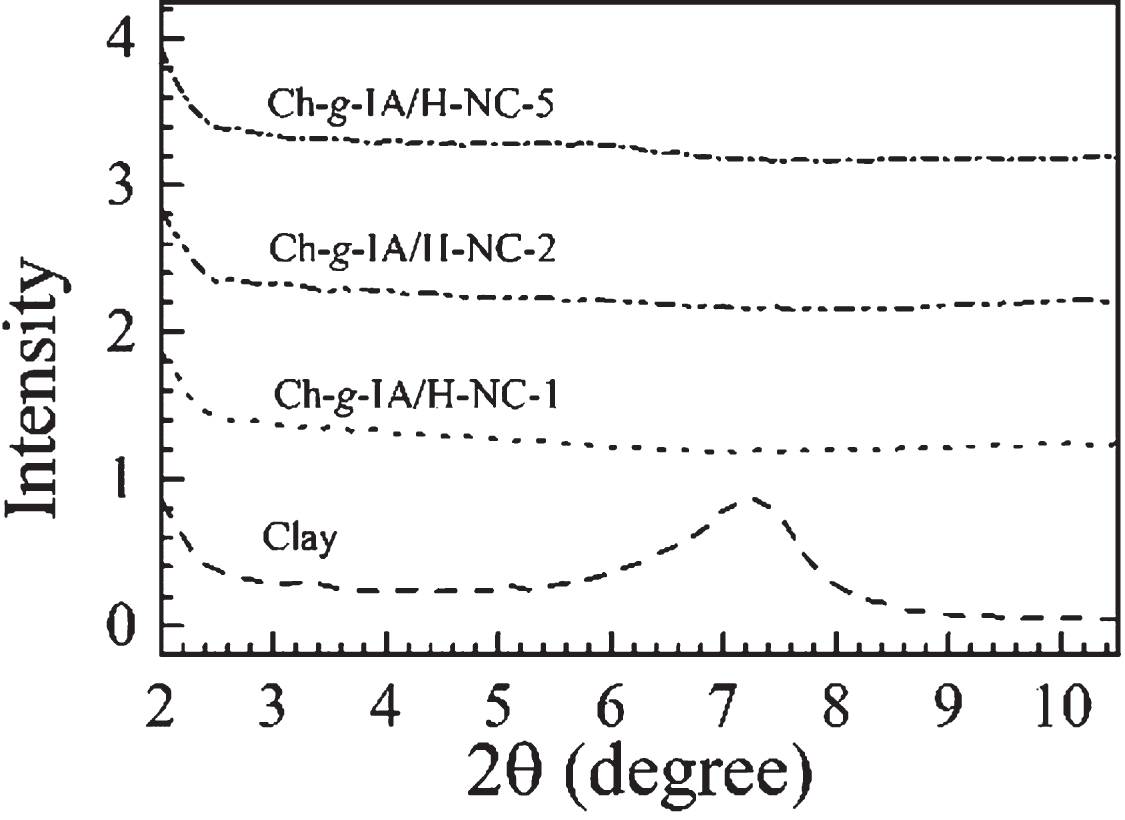
XRD patterns of hydrophilic nanoclay and Ch-g-IA/H-NC nanocomposites.
Ch-g-IA copolymers were prepared at different monomer ratios and different initiator concentrations for determination of optimum reaction conditions. GP1% and GP2% values of graft copolymers were determined and these values were summarized in Table 1. A significant difference was not observed in grafting percentages of copolymers with the change of initiator concentration and monomer ratio. As a result, the optimum reaction conditions were identified as Ch/IA monomer weight ratio of 3/9 and initiator concentration of 0.003 mol/L. These reaction conditions were used as preparation of Ch-g-IA/H-NC nanocomposites in this study.
Effect of nanoclay content on metal ion removal capacities of Ch-g-IA/H-NC nanocomposites
Figures 2 and 3 illustrate the effect of adsorption time on the adsorption efficiency for pure copolymer (Ch-g-IA/H-NC-0) and nanocomposites containing different amounts of H-NC (Ch-g-IA/H-NC-1, Ch-g-IA/H-NC-2, Ch-g-IA/H-NC-5). The adsorption capacities of these samples for Cu(II) and Pb(II) ions increase with the increase of the adsorption time until they reach the equilibrium value. Cu (II) ion adsorption capacities of copolymer samples increased with the increase of amount of H-NC. The adsorption capacities of Ch-g-IA/H-NC-2 and Ch-g-IA/H-NC-5 samples were almost same amounts for Cu(II) ions. In the case of Pb(II) adsorption, adsorption capacities of Ch-g-IA/H-NC-0 and Ch-g-IA/H-NC-1 were very close to each other as shown in Fig. 3.
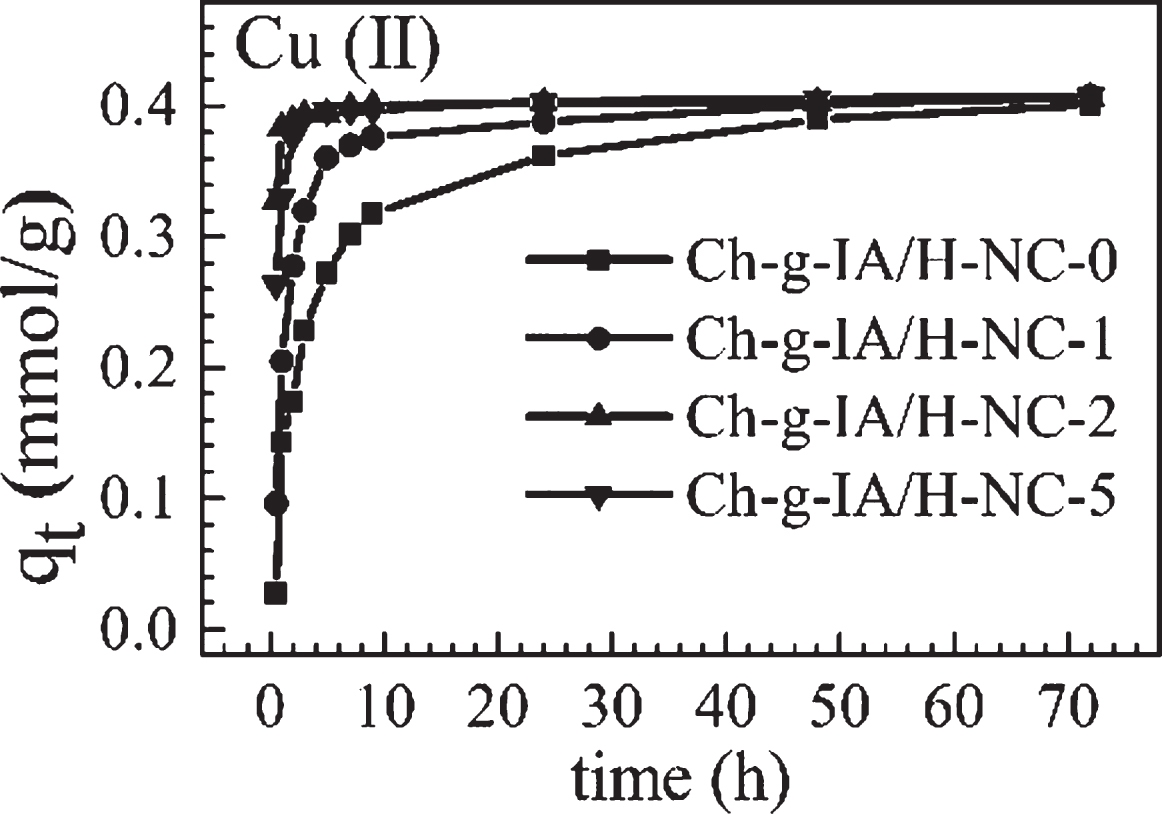
The effect of the treatment time on the adsorption of Cu(II) on Ch-g-IA/H-NC nanocomposites.
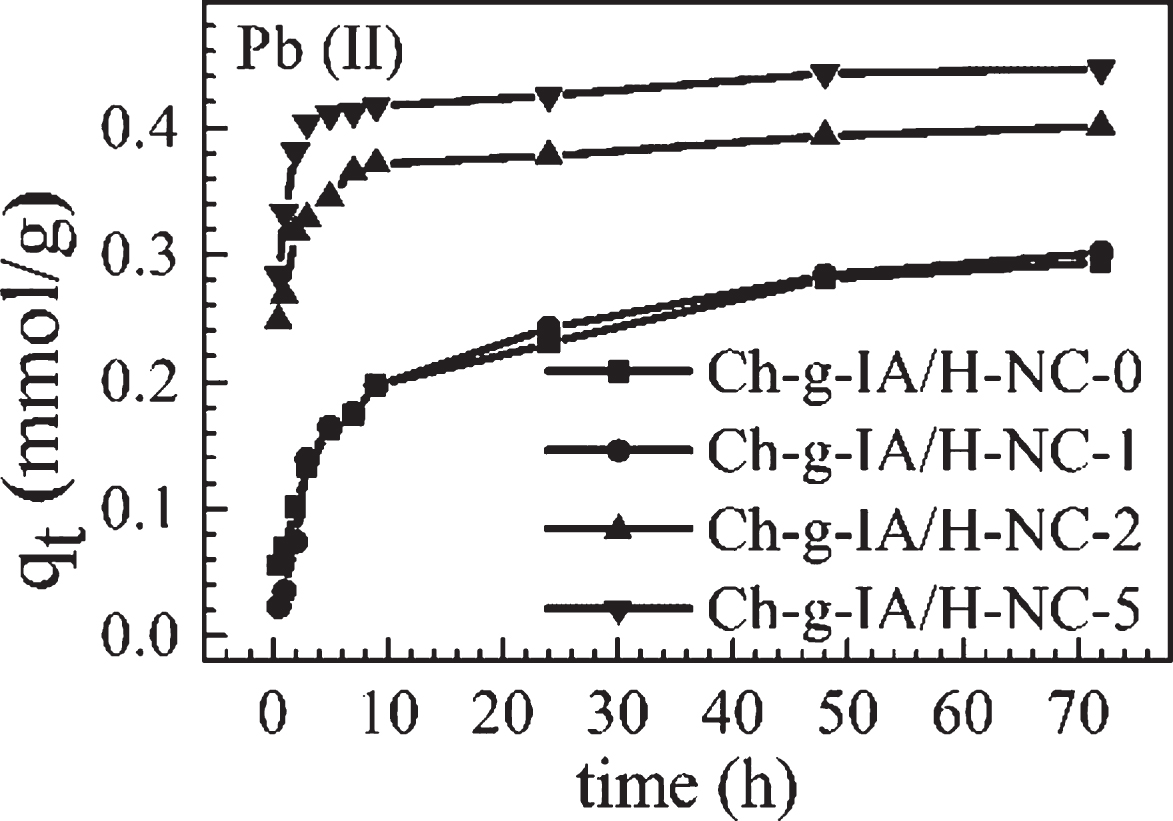
The effect of the treatment time on the adsorption of Pb(II) on Ch-g-IA/H-NC nanocomposites.
Increasing the amount of H-NC up to 2% caused an increment in Pb(II) adsorption capacity. However, adsorption capacity of nanocomposite sample only increased 10% with increasing the amount of clay from 2% to 5%. There was no significant difference in metal ion adsorption capacities of nanocomposites at higher clay concentrations than 2% due to the increase of the crosslinking points of the copolymer chains according to high H-NC content [16, 39]. In conclusion, optimum H-NC ratio has been considered as 2% for heavy metal ion removal studies.
Pseudo-first order model and pseudo-second order model were used to investigate the adsorption kinetics of heavy metal ions on Ch-g-IA/H-NC nanocomposites. The equations of non-linear and linear regression methods for pseudo-first order and pseudo-second order models [40, 41] were shown in Table 3.
The equations of non-linear and linear kinetic model equations for pseudo-first order and pseudo-second order models
The equations of non-linear and linear kinetic model equations for pseudo-first order and pseudo-second order models
The non-linear form of pseudo-first order equation is given as follows [40, 41]:
where qe and qt show the amounts of metal ions adsorbed on Ch-g-IA/H-NC nanocomposites (mmol g–1) at equilibrium and at time t (hour), respectively; k1 is the rate constant of first-order adsorption (h–1). Plots of qt against t were plotted for Cu(II) and Pb(II) adsorptions and the parameters of this kinetic model for non-linear method were presented in Table 4.
Kinetic constants for metal ions onto Ch-g-IA/H-NC nanocomposites by non-linear regression analysis method
qe,exp = adsorption value obtained from experimental data (mmol/g). qe,teo = adsorption value calculated from the equations (mmol/g). k1 = rate constant of first order adsorption (1/h). k2 = rate constant of second order adsorption (g/mmol.h).
Linearized form pseudo-first order equation is given as follows [42]:
Kinetic constants for metal ions onto Ch-g-IA/H-NC nanocomposites by linear regression analysis method
qe,exp = adsorption value obtained from experimental data (mmol/g). qe,teo = adsorption value calculated from the equations (mmol/g). k1 = rate constant of first order adsorption (1/h). k2 = rate constant of second order adsorption (g/mmol.h).
The non-lineer form of pseudo-second order equation is given as follows [43]:
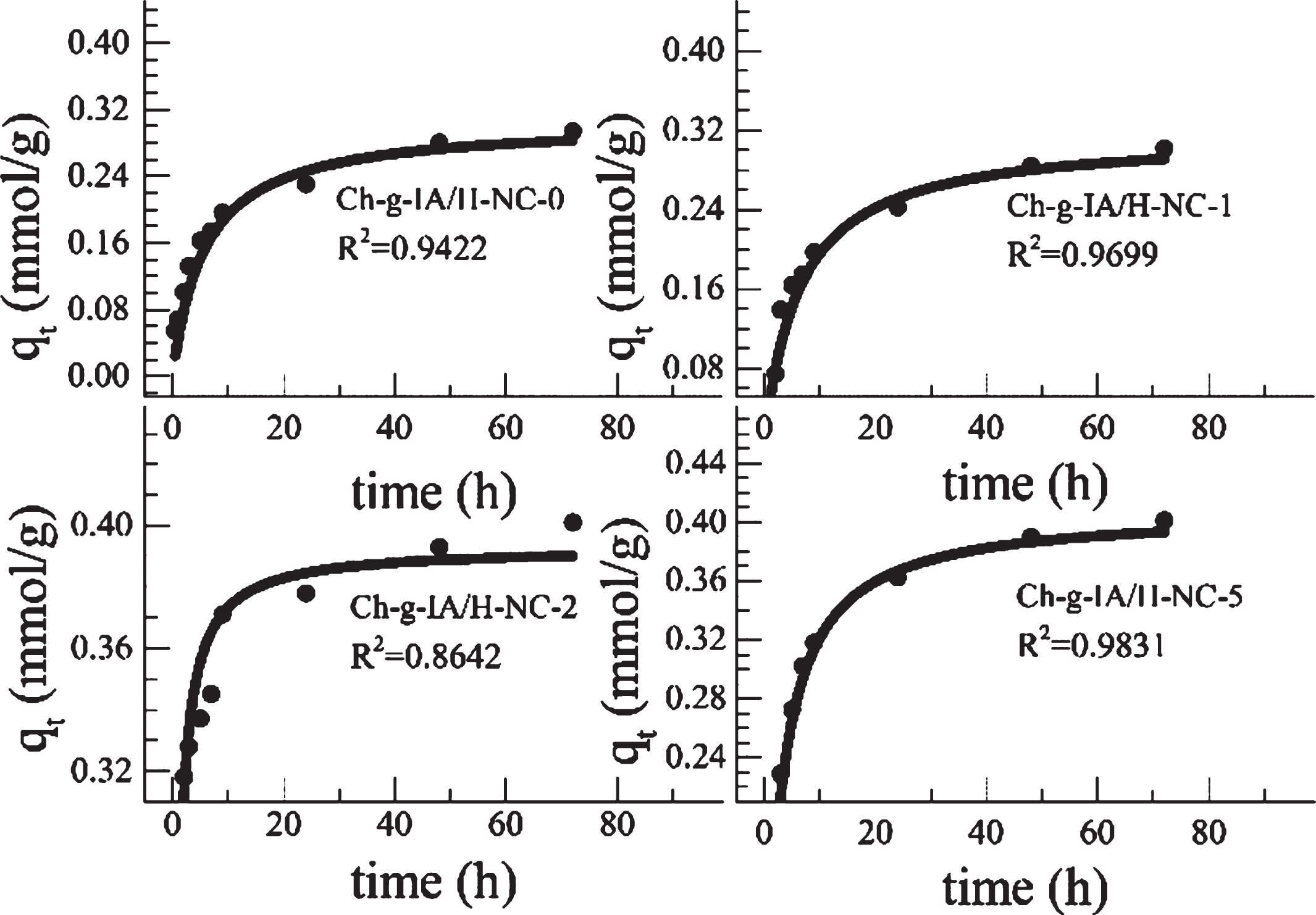
where k2 is the rate constant of second-order adsorption (g mmol–1 h–1). Plots of q t against t were plotted for Cu(II) and Pb(II) adsorptions (Figs. 4 and 5) and the parameters of this kinetic model for non-linear method were presented in Table 4.
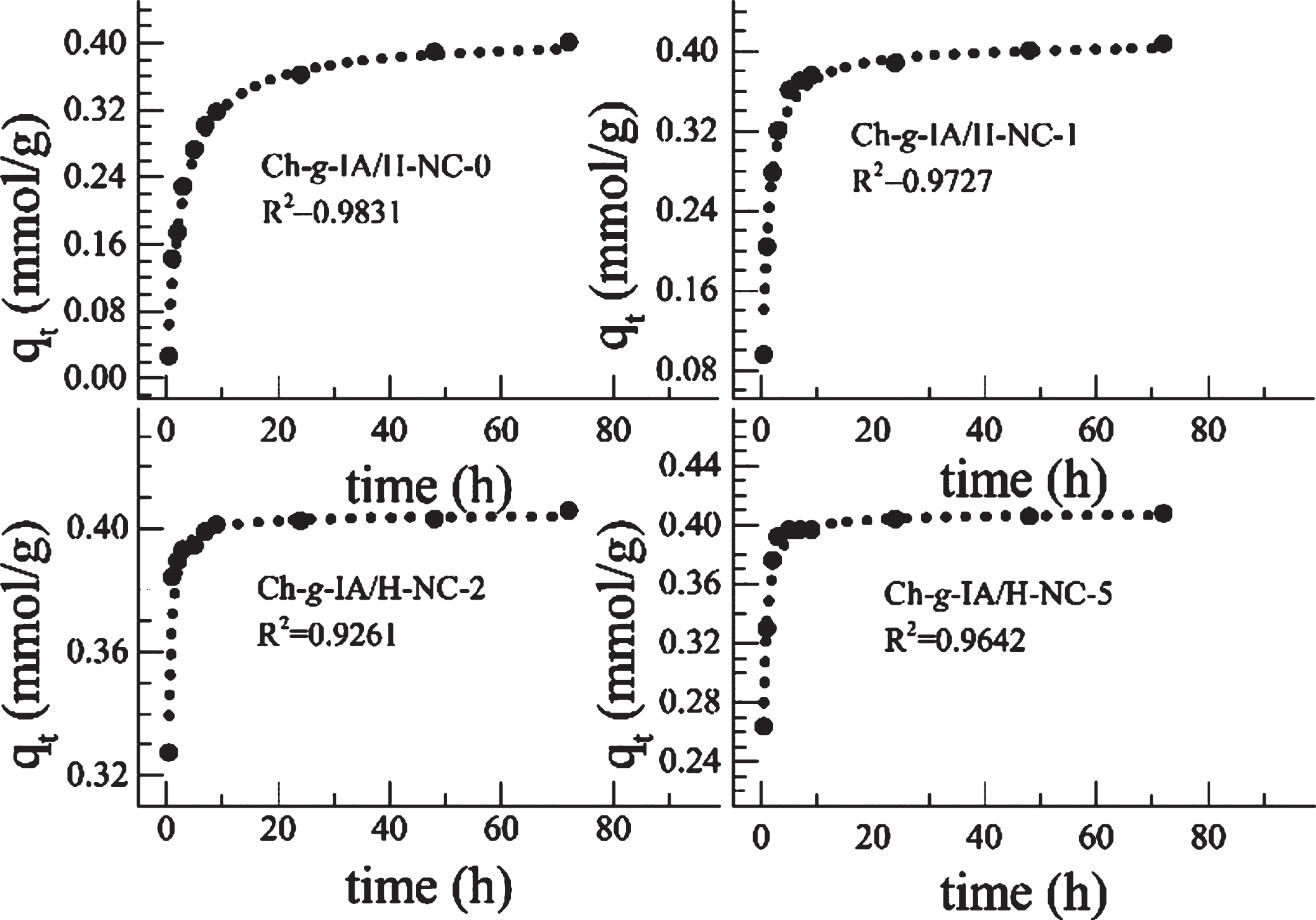
Pseudo-second order non-linear method for Cu(II) ion adsorption.
Pseudo-second order non-linear method for Pb(II) ion adsorption.
Pseudo-second order kinetic model can be linearized as four different types and these equations were given in Table 3. The parameters of these kinetic models for linear method were presented in Table 5. The best fit was obtained by using the Type 1 expression of pseudo-second order kinetic model. The slopes and intercepts of plots of t/q t versus t (Figs. 6 and 7) were used to determine the second-order rate constant k2 and equilibrium adsorption value qe for pseudo-second order Type 1 kinetic model. The results indicated that this kinetic model fitted better than the data obtained from other kinetic models. When second order Type 1 kinetic model was used in the analysis of kinetic data, high correlation coefficients (0.99<) were obtained. The calculated qe values almost agree with the experimental data for this kinetic model. These results showed that the second-order kinetic model was suitable for the adsorption of Cu(II) and Pb(II) onto the Ch-g-IA/H-NC nanocomposites. This kinetic model is more likely to predict the behavior over the whole range of adsorption and is in agreement with chemical sorption being the rate controlling step [42].
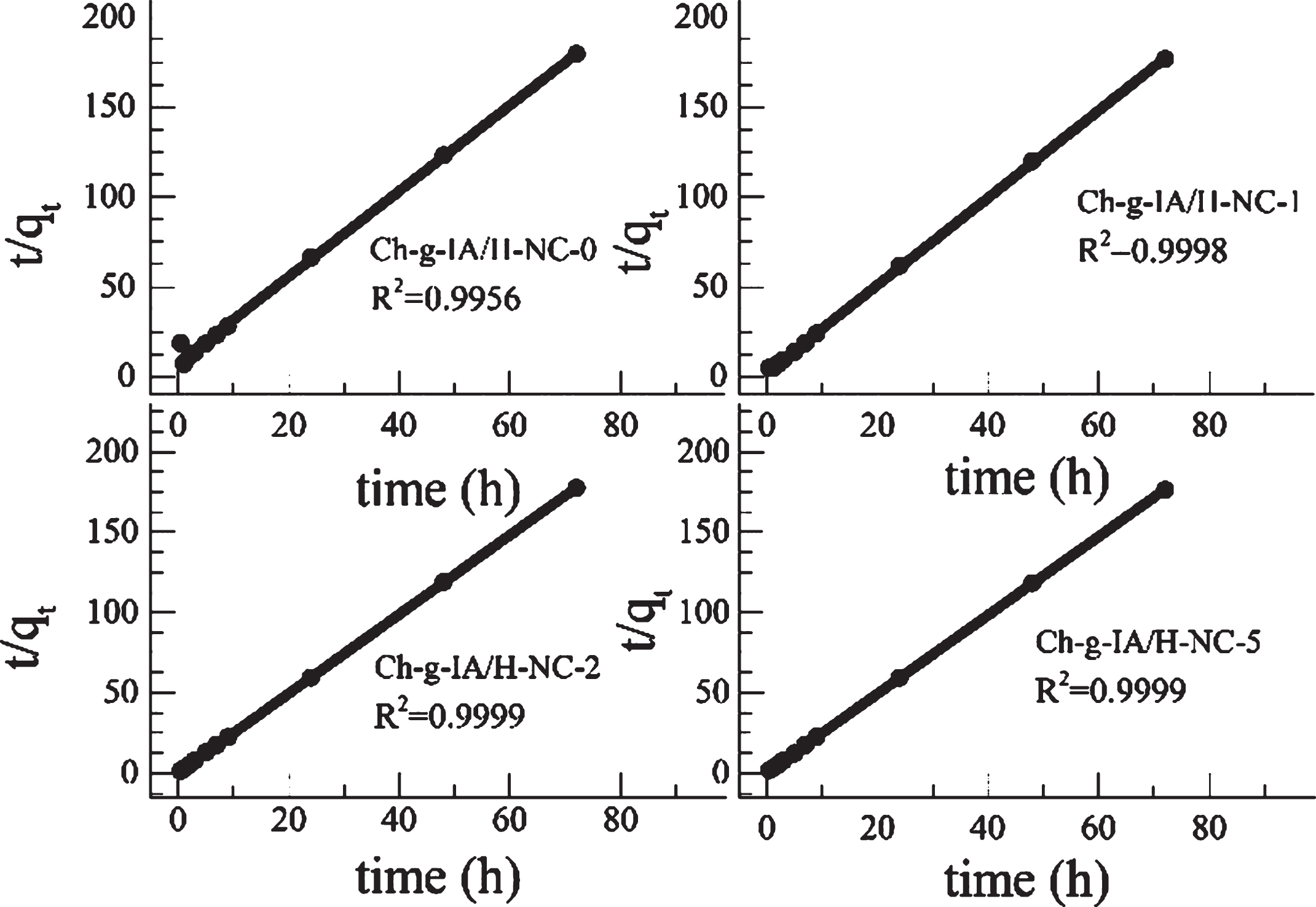
Pseudo-second order linear method (Type 1) for Cu(II) ion adsorption.
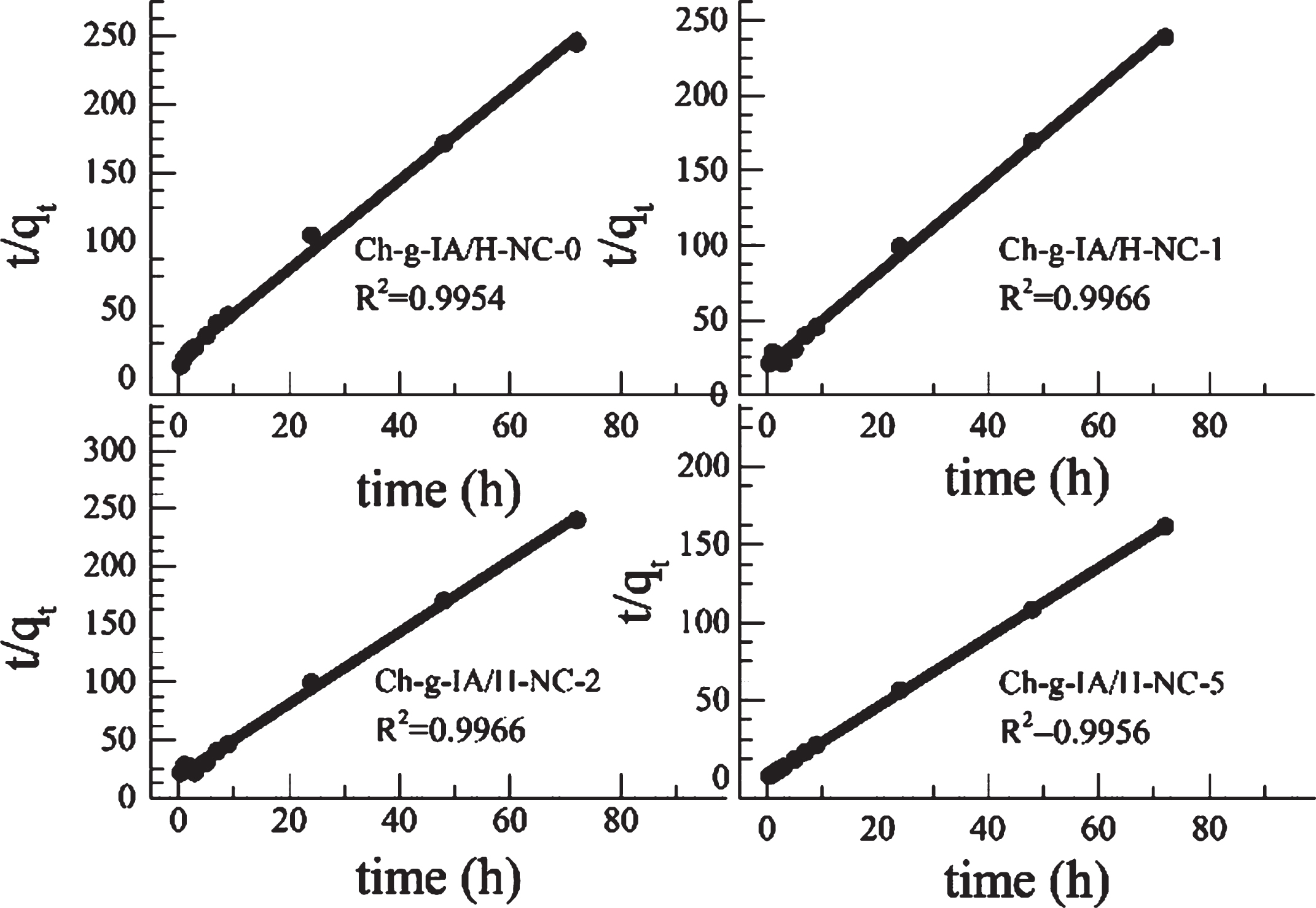
Pseudo-second order linear method (Type 1) for Pb(II) ion adsorption.
The equilibrium adsorption isotherms are described the relationship between the adsorbent and adsorbate. The equilibrium isotherm plays an important role in modeling of adsorption systems. The results obtained adsorption isotherm experiments are extremely important data to understand the mechanism of the adsorption process [39, 44]. Different isotherm models have been published that the describe adsorption process. There are many theories relating to adsorption equilibrium in the literature such as Langmuir, Freundlich, Temkin, Dubinin-Raduskevich (D-R) and Redlich–Peterson (R-P) models [45, 46]. Equations of these models [47, 48] were given in Table 6. Adsorption isotherm parameters of these isotherm models were presented in Table 7. The correlation coefficient R2 values of the Langmuir isotherm model (Type 1) and R-P model are higher than the R2 values of other isotherm models.
Isotherms and their equations
Isotherms and their equations
Isotherm parameters for Cu(II) and Pb (II) onto Ch-g-IA/H-NC nanocomposites
Figures 8 and 9 show the equilibrium adsorption of Cu(II) and Pb(II) when using Ch-g-IA/H-NC nanocomposites for Langmuir isotherm model (Type 1) and R-P isotherm model, respectively. According to the Langmuir adsorption model adsorption occurs at specific homogeneous sites within the adsorbent. This model is suitable for use with homogeneous surfaces [39, 49]. The R-P isotherm model is a special case of Langmuir and Freundlich isotherm models. KR and αR are the Redlich–Peterson constants and β is basically in the range of zero to one. If β is equal to 1, reduces to the Langmuir isotherm equation [47, 50]. β values were found between 0.85- 1 for adsorption of Cu(II) and Pb(II) ions onto Ch-g-IA/H-NC nanocomposites. In conclusion, Langmuir isotherm model (Type 1) and R-P isotherms are the best-fit models for the adsorption process in this study.
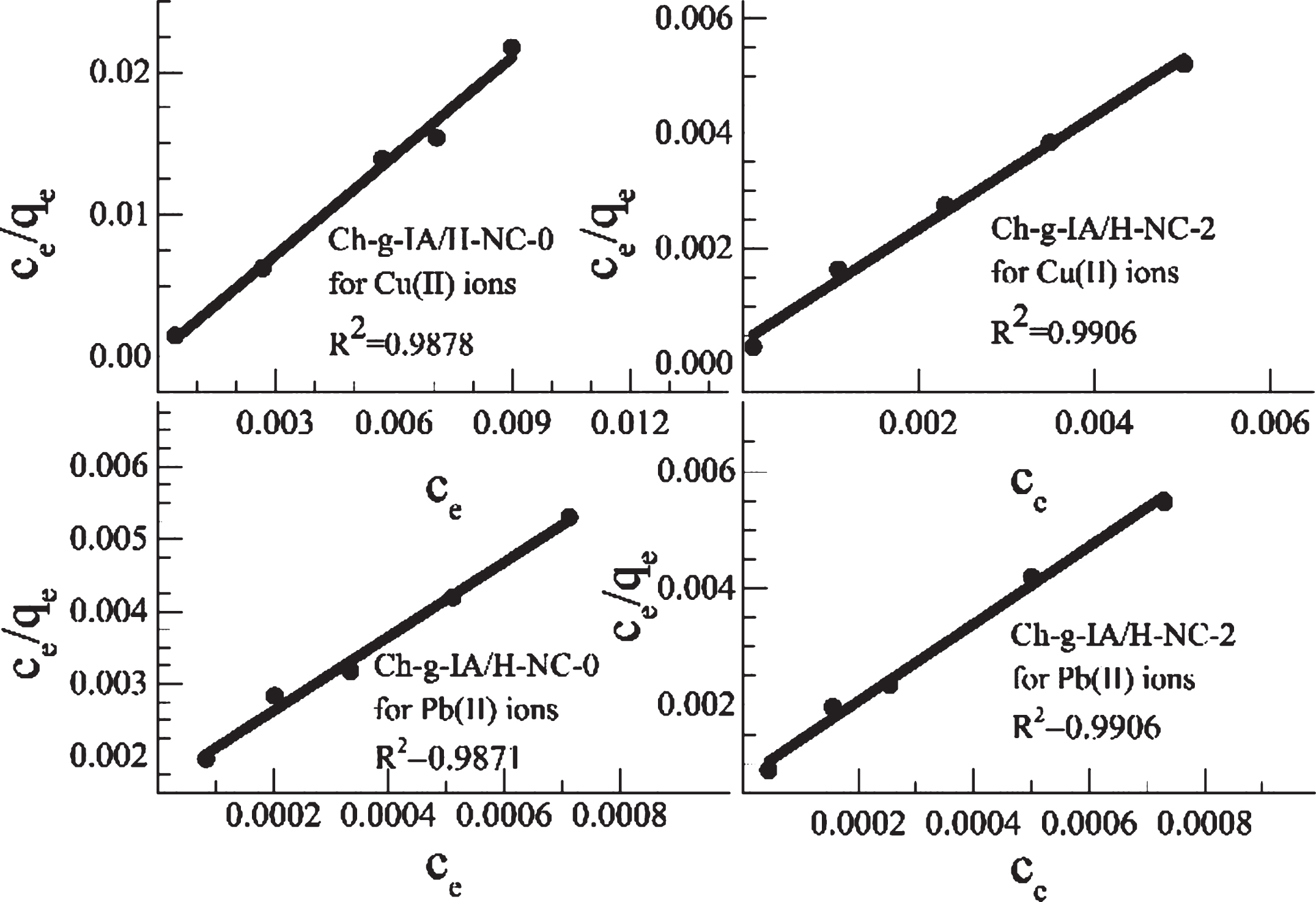
Langmuir isotherm model (Type 1) for Cu(II) ion and Pb(II) ion adsorption.
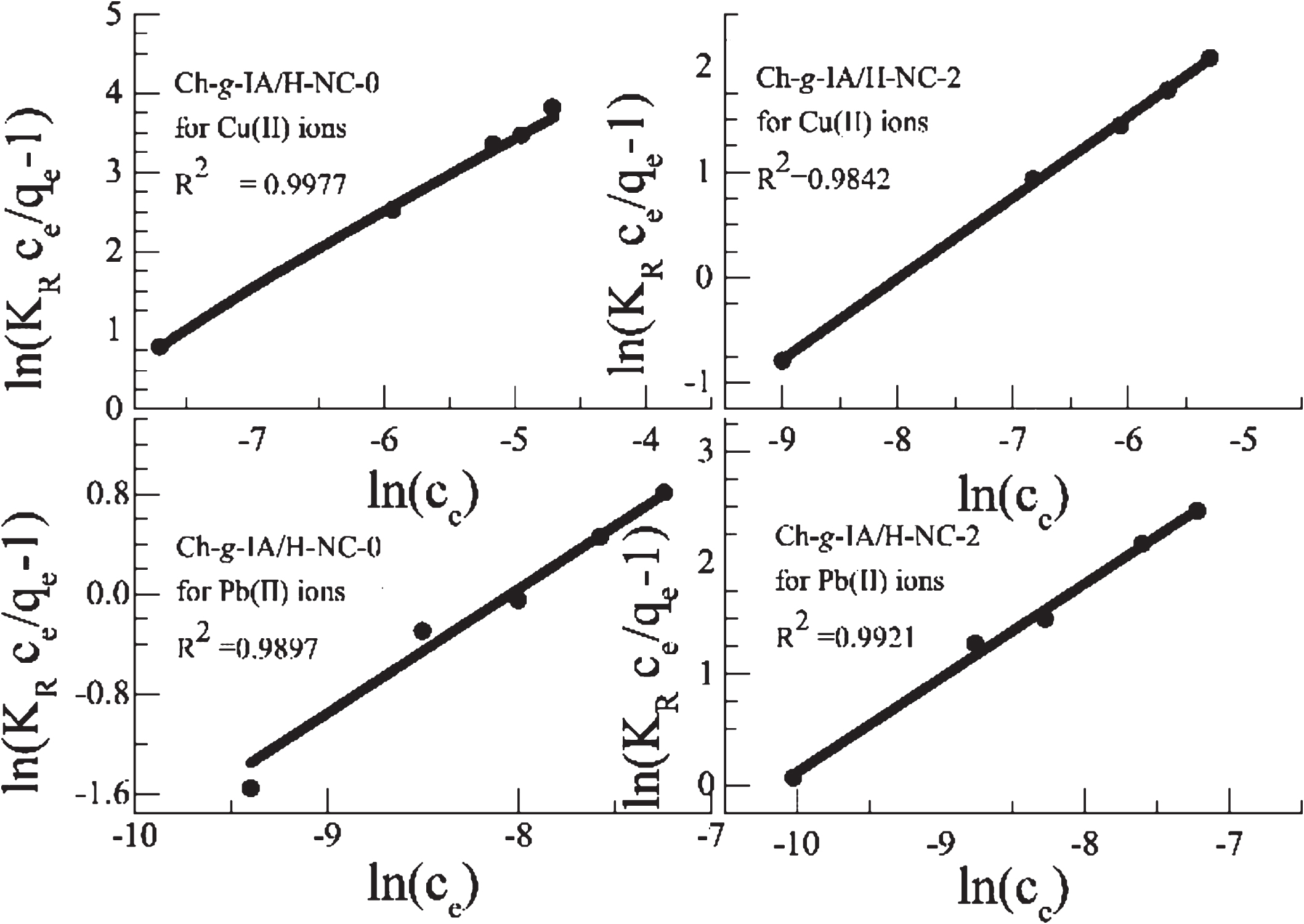
R-P isotherm model for Cu(II) ion and Pb(II) ion adsorption.
The competitive removal of Cu(II), Pb(II), Zn(II), Cd(II) ions from aqueous solutions was investigated in this section. Concentration of each ion in aqueous solution was fixed 4 mmol/L in competitive metal ion removal experiments. Adsorption capacities of Ch-g-IA/H-NC nanocomposites for Cu(II), Pb(II), Zn(II) and Cd(II) ions were found between 0.8-0.9 mmol/g, 0.5-0.6 mmol/g, 0.06–0.15 mmol/g, 0.05–0.09 mmol/g, respectively. In conclusion, the order of the selectivity of the removal of metal ions is Cu(II) >Pb(II)>Zn(II) >Cd(II).
Conclusion
The graft copolymerization of IA onto Ch was carried out with Ch/IA monomer weight ratio of 3/9 using 0.003 mol/L cerium (IV) ammonium nitrate as initiator. H-NC was used as nanoparticules. XRD analysis and grafting percentage determination were used for characterization of nanocomposites. Ch-g-IA/H-NC nanocomposites were used for the removal of heavy metal ions from aqueous solutions. The following conclusions can be drawn: The XRD pattern of nanoclay shows a strong peak at 2θ= 7.2. The absence of this peak in the XRD patterns of Ch-g-IA/H-NC nanocomposites indicates that clay sheets are exfoliated. GP1% and GP2% values of chitosan-g-itaconic acid copolymers were determined as about 25% and 30%, respectively. Metal ion adsorption capacities of nanocomposites increase with the increase of the adsorption time and all nanocomposite samples show a similar adsorption behavior. Metal ion adsorption capacities of copolymer samples increased with the addition of H-NC. There was no significant difference in metal ion adsorption capacities of nanocomposites at higher H-NC concentrations than 2% due to the increase of the crosslinking points of the copolymer chains according to high H-NC content. Adsorption processes of Cu(II) and Pb(II) ions onto Ch-g-IA/H-NC nanocomposites follow pseudo second- order Type 1 adsorption kinetic. The straight lines in plots of t/qt versus t indicated good agreement of experimental data with this kinetic model. High correlation coefficients (R2 = 0.9999) were obtained when second-order kinetic model was used. The equilibrium adsorption data have been evaluated using Langmuir, Freundlich, Temkin, Dubinin-Raduskevich and Redlich–Peterson isotherm models. Langmuir isotherm model (Type 1) and Redlich–Peterson isotherms are the best-fit models for the adsorption process.
Finally, we can say that Ch-g-IA/H-NC nanocomposites can be used as alternative adsorbents of Cu(II) and Pb(II) ions.