



Abstract
We perform density functional calculations on the ground state geometries of VOn (n = 1–5) complexes and analyze their stability against dissociation to O atom and O2 molecule in neutral as well as anionic forms. It is shown that a V binds with four O atoms stably such that the maximum possible oxidation state of V can be as high as +7. The electron affinity of VOn suggests that these species behave as superhalogen for n≥3, which become as large as 4.52 eV for n = 5. The interaction of VOn superhalogen with appropriate alkali metal is stronger than traditional alkali halides. This is exemplified by formation of stable NaVO3 complex compound by interacting alkali Na atom with VO3 superhalogen. This finding demonstrates that VOn superhalogens form a new class of salt,which is relatively more stable than NaCl molecule.
Introduction
Seventh group elements in the periodic table have the highest electron affinity (EA) than the rest of elements. The term “superhalogen” refers to molecular species having higher EA than halogens (3.40 eV for F, 3.61 eV for Cl, 3.36 eV for Br etc [1, 2]. Superhalogen consists of a metal which may be surrounded peripherally by halogen, oxygen, pseudohalogen or halogenoid etc. such that the last electron is delocalized over peripherally attached atoms, hence, EA increases [3–7]. The concept of superhalogen was introduced in 1981 by Gutsev and Boldyrev [8] by using sp elements. First superhalogen came in light was LiF2 with EA 5.45 eV 9]. Due to the fixed valence of s block element, they were able to bind with fixed number of atoms. To overcome this difficulty, transition metal element came to play the central role. The transition metal elements possess variable coordination number and hence, their binding property is enhanced. The study of superhalogen has been continuously expanding due to their interesting applications [10–16]. For instance, gold (Au) having electronic configuration 5d106s1 should be monovalent but its oxidation state varies from 5 to 7 [17, 18]. The oxidation state of any metal element is number of electron removed from its outer orbit to participate in chemical bonding. Another example might be Mn with electronic configuration 3d54s2, which interacts with oxygen and makes MnO4 having EA 5 eV [19]. Likewise, FeO4 and CrO4 complex show super halogen properties with EA 3.8 and 4.96 eV, respectively [20–22]. There are a number of studies on transition metal oxide clusters [23–27] including 3d elements such as Sc [25], Ni [26], Co [27] etc.
Vanadium is 3d transition metal element having outer shell electronic configuration of 3d34s2, its oxidation state may be as high as +5. This is exemplified by V2O5, an important compound of industrial use. Vanadium oxides are widely known as cathode materials in lithium batteries [28], ferromagnetic nanotubes [29], in bolometric detectors [30], and their use as supported catalysts [31]. Vanadium catalysts are widely used in production of sulphuric acid; the reduction of nitrogen oxides with ammonia and the selective oxidation of hydrocarbons utilize industrially important bulk and fine chemicals [32]. In this paper, we have studied VOn species for n = 1–5. We discuss the structures of neutral and anionic state of these species in different spin states and their stability against decomposition in O and O2. The evolution of superhalogen properties of VOn species have been analyzed with high oxygen content.
Computational methodology
The geometry and total energy were calculated by hybrid exchange correlation functional B3LYP [33, 34] method and aug-cc-pVTZ basis set [35] using Gaussian 09 [36]. The geometry optimization was followed by frequency calculations to ensure that optimized structures correspond to at least some local minima in the potential energy surface. All calculations were repeated for higher spin states to obtain preferred spin state of neutral as well as anionic species. B3LYP functional has been employed to study the superhalogen properties of a variety of transition metal oxides [26, 37]. Furthermore, B3LYP calculated values match well with experimental data. For instance, the bond length, binding energy of Cl2 1.98 A°, 2.34 eV, respectively and EA of (Cl) 3.70 eV agree well with corresponding experimental values [38].
Results and discussions
Structures and stability
We have considered structures of VOn clusters in which O atoms bind associatively as well as dissociatively to V core. The possible initial geometries of VOn clusters are shown in Supplementary Figure S1. The optimized structures of neutral VOn (n = 1–5) clusters and their anions for various spin states are shown in Figs. 1 and 2, respectively. Table 1 lists the relative energies of VOn and

Equilibrium geometries of VOn (n = 1–5) neutral. Central gray sphere represent (V) atoms and peripheral red spheres represent oxygen (O) atoms. Bond lengths (in A°) are also shown.
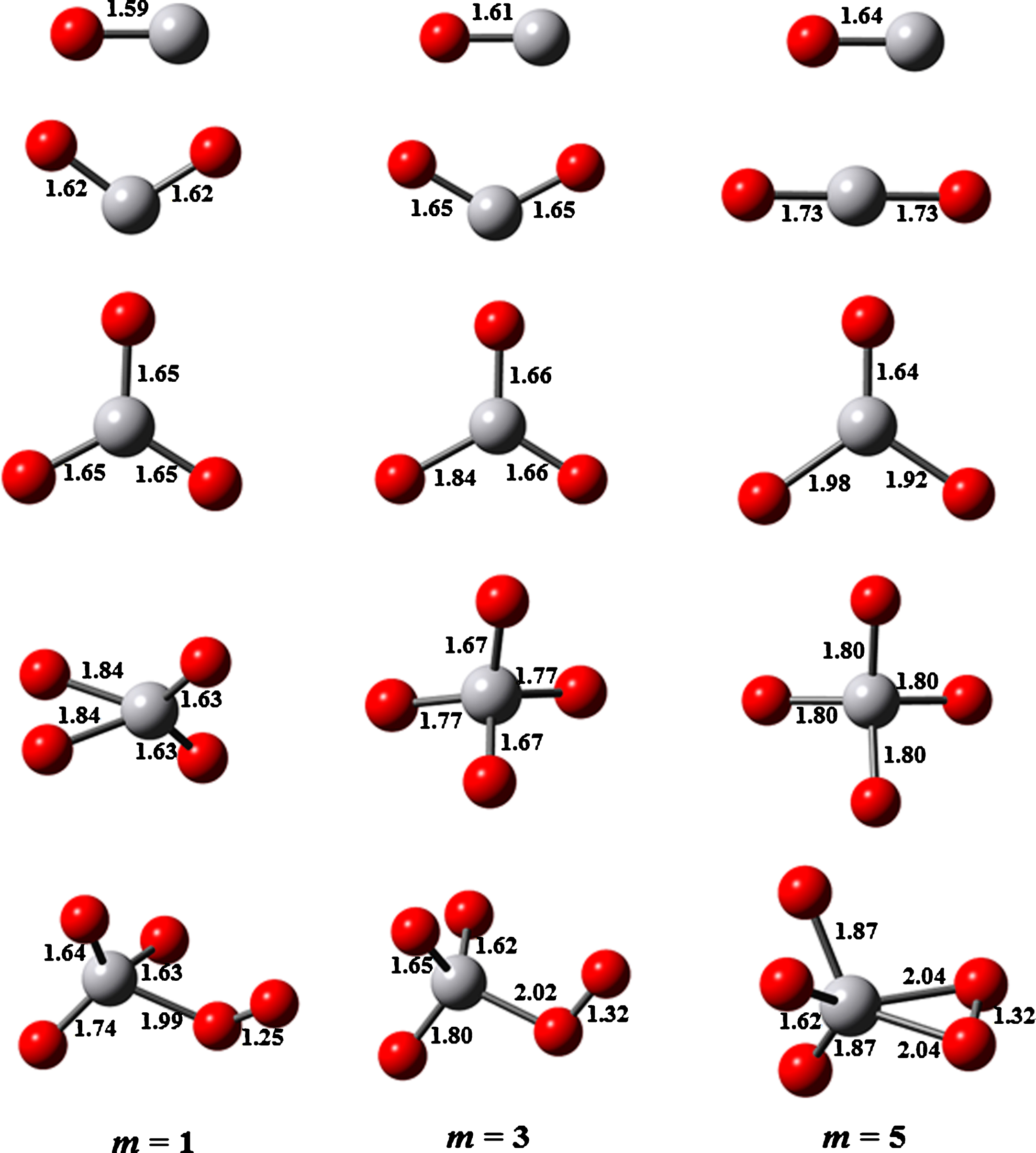
Equilibrium geometries of VOn (n = 1–5) anion. Central gray sphere represent (V) atoms and peripheral red spheres represent oxygen (O) atoms. Bond lengths (in A°) are also shown.
Relative energies are (in kcal/mol) for different spin multiplicities (2S+1) of neutral and anionic VOn species. The expectation values <S2>are given in parenthesis
The calculated dissociation energies (De) for neutral and anionic VOn species are listed in Tables 2 and 3, respectively. All VOn species are found to be stable as all dissociation energy values are positive. The dissociation energy decreases as the successive O atoms are attached to V. The dissociation energy of VOn against O removal is higher than O2 in neutral and anionic forms. VOn anions are more stable than their neutral form due to high energy values for dissociation to O2.
Preferred spin multiplicity (m), symmetry (s) and partial NPA charge on V atom (q), HOMO-LUMO energy gaps (Egap, in eV) and dissociation energy (De, in eV) of neutral VOn clusters for n = 1–5
Preferred spin multiplicity (m), symmetry (s) and partial NPA charge on V atom (q), HOMO-LUMO energy gaps (Egap, in eV) and dissociation energy (De, in eV) of anion
The highest occupied molecular orbital (HOMO) represents the ability to donate an electron and while lowest unoccupied molecular orbital (LUMO) shows ability to accept it. The HOMO-LUMO gap (Egap) is also a parameter to explain relative stability of VOn species. Pearson [39] gave the principle of maximum hardness, which states that the species with higher Egap values are chemically hard, i.e., possess higher chemical hardness value (η). This value correlates with electronic stability as hard species with larger Egap are less polarized in comparison to soft molecule having smaller Egap. In order to compare their chemical reactivity of VOn species, we have given Egap values in Tables 2 and 3. The higher Egap (3.55 eV) for VO4 suggests that it is relatively more stable while smaller gap for VO5 (2.27 eV) indicate that it is chemically more reactive that means it can interact easily with other species. In anionic form, Egap value is higher for
The stability of VOn species clearly suggest that the oxidation state of V can easily reach to +5. From Table 2, one can note that
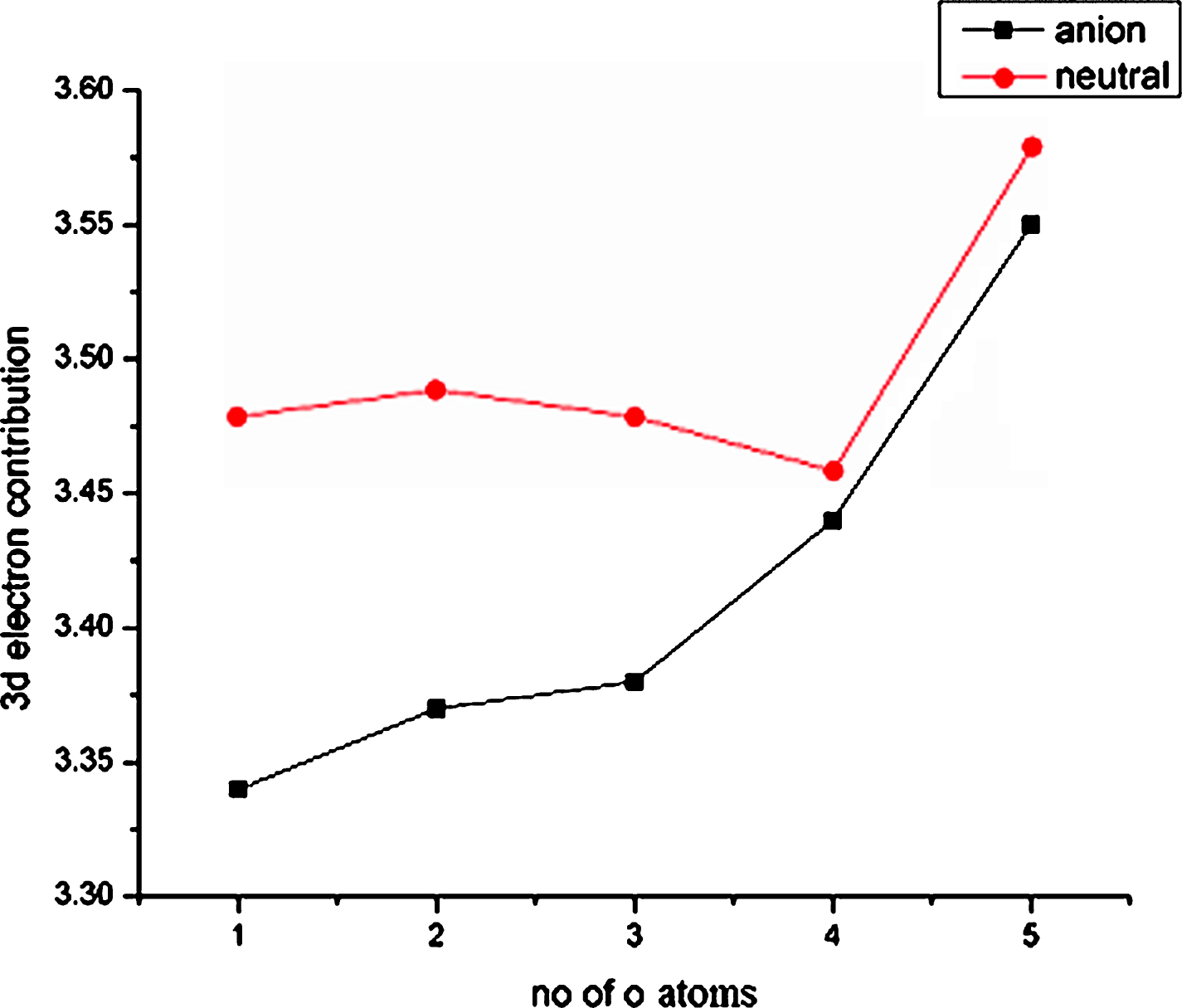
Contribution of 3d electrons in bonding of neutral and anion of VOn for n = 1–5.
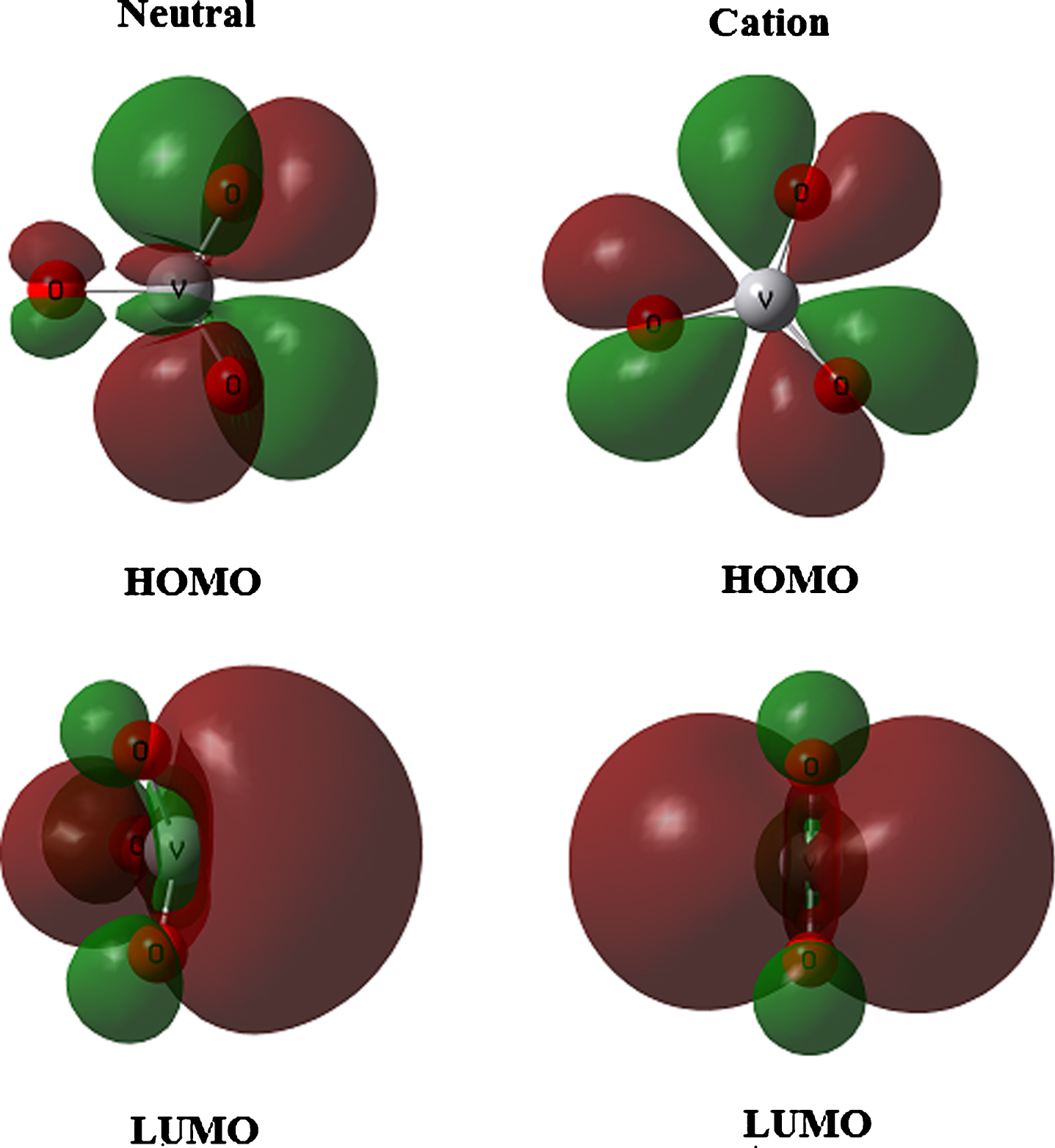
HOMO (upper) and LUMO (lower) surfaces of neutral and anionic VO3 clusters with an isovalue of 0.01 a.u.
The adiabatic electron affinity (EA) of VOn species are calculated by the difference of energies between neutral species and corresponding anions both in their ground state configurations. The calculated EA of VOn species are collected in Table 4. We can see that the EA increases as the successive O atoms are attached to V up to n = 5. The EA of VO2, 2.04 eV is larger than that of O atom. Furthermore, the EA for VO3 attains the value of 4.35 eV, which exactly reproduces the experimental value 4.36 eV [40]. Although EA of VO4 is smaller than that of VO3, it is still higher than that of F atom. Therefore, EA values clearly show that VOn (for n≥3) clusters behave as superhalogen. The large EA values of VOn superhalogens can be explained on the basis of natural bonding orbital (NBO) charge analysis [41]. In Table 4, we have also listed the NBO charge difference on V (ΔQ) in VOn and
Electron affinity (EA, in eV) and NBO charge difference on V (ΔQ, in e) for VOn species
Having established VOn as super halogens for n≥3, we expect it to mimic some characteristics of halogen atoms. For instance, halogen atoms have tendency to form dimer such as Cl2 and ionic salt such as NaCl. Therefore, it is desirable that VO3 should exhibit similar properties. We choose two different configurations for the study of possible dimeric structure of VO3. In first configuration, both VO3 units are placed parallel to each other. In second configuration, both units are placed perpendicular to each other. In both cases, V of one unit is close to O atom of another to promote the interaction. The optimized structure of VO3 dimer along with their HOMO and LUMO surfaces are shown in Fig. 5. Binding energy of above dimer VO3 (3.35 eV) is greater than the binding energy of Cl2 (2.34 eV).

Equilibrium geometry of dimer VO3 structure and all bond-lengths (in A°) and HOMO – LUMO surfaces with an isovalue of 0.01 a.u. are also given.
Now we discuss the formation of complex salt with Na. Initially we have substituted Na atom just above to the V atom. After full optimization, the Na atom binds with two O atom forming a planner structure as shown in Fig. 6 along with their HOMO-LUMO surfaces. Binding energy of above complex salt is equal to 4.52 eV. This binding energy is greater than that of calculated binding energy of NaCl (3.99 eV). In NaCl, the HOMO surface does not contain Na site but LUMO is covered whole molecule. In NaVO3, however, both HOMO and LUMO do not contain Na site. This clearly indicates that binding nature of Na with VO3 is covalent rather than electrovalent as in case of NaCl salt.
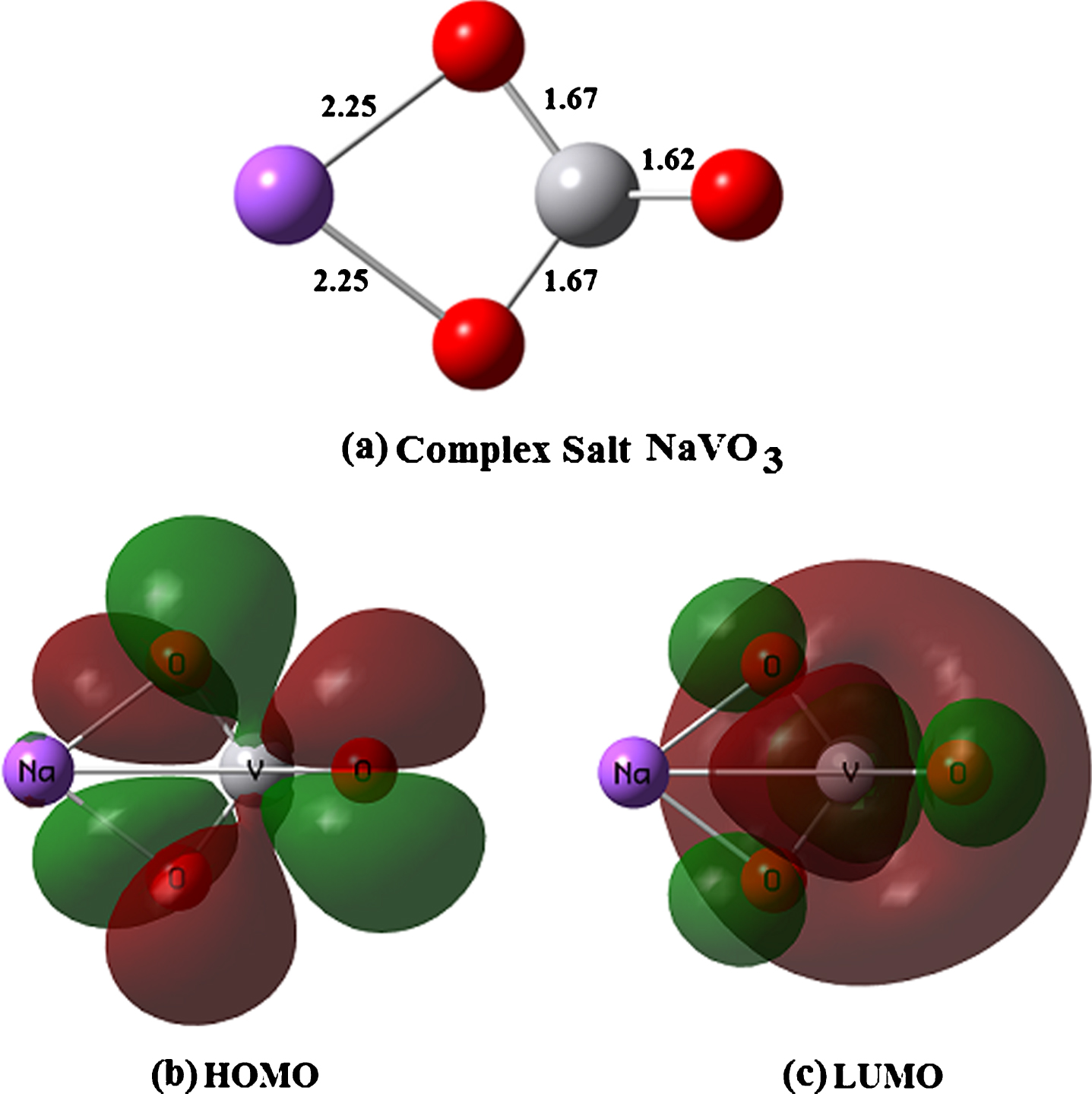
Equilibrium geometry of NaVO3 complex and all bond-lengths (in A°) and HOMO – LUMO surfaces with an isovalue of 0.01 a.u. are also given.
The results of B3LYP calculations on VOn clusters have been discussed. We have shown that V atom can bind with a maximum of five O atoms, expanding its oxidation state to +7. VOn species are stable in the neutral as well as anionic states against dissociations to O atom and O2 molecule. The superhalogen behaviour of VOn cluster has been established due to their larger electron affinities as compared to halogen for n≥3. The interaction of VO3 superhalogen with alkali metal Na is found to be covalent form and leads to the formation of a stable NaVO3 complex. This opens up an opportunity for the researcher a new class of compounds by the interaction of VO3 superhalogen with appropriate alkali atoms.
Supplementary information
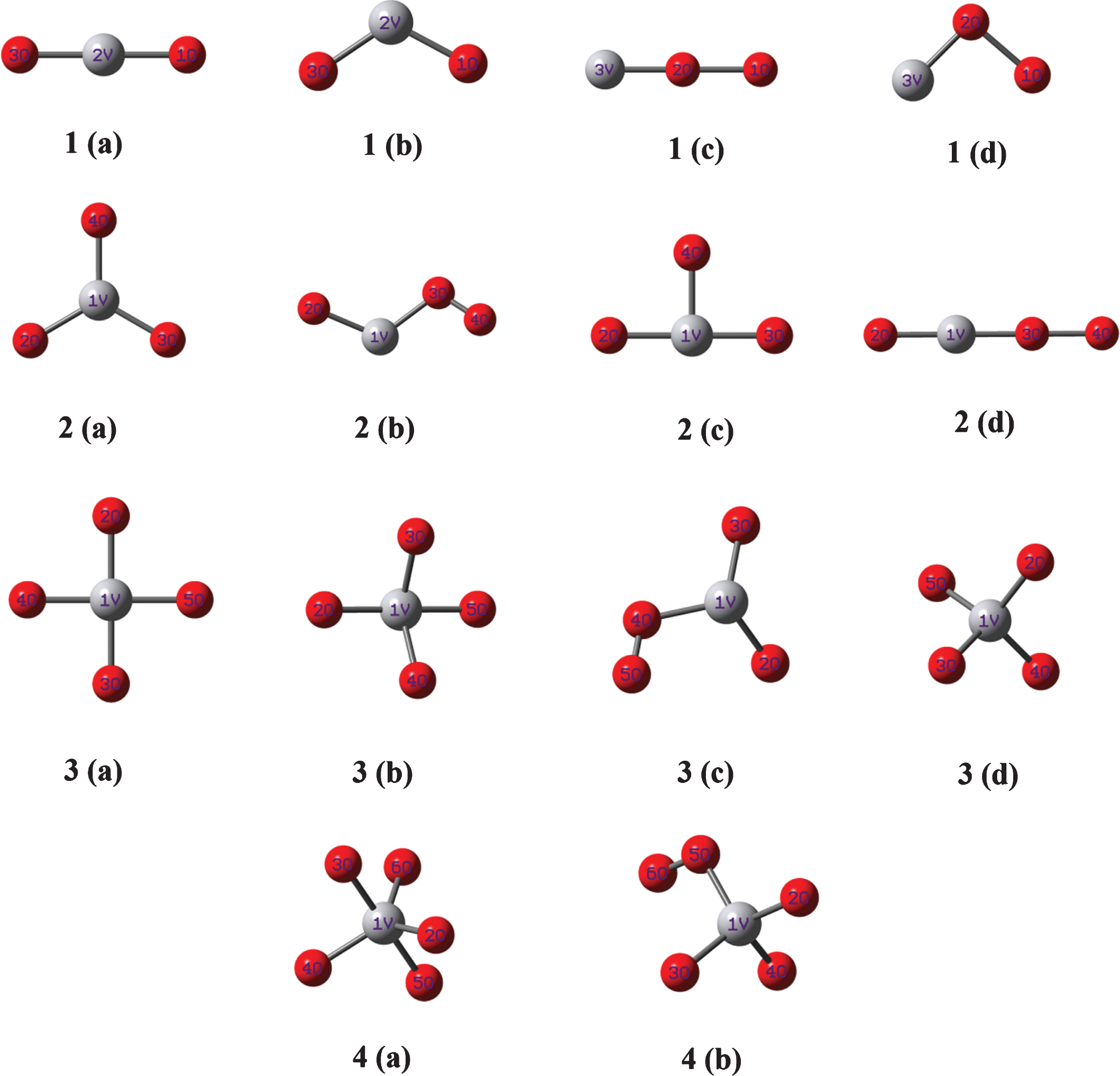
Initial geometries of VOn (n = 1–5) clusters considered in this study.